Are you an executive with a small or medium sized identity/biometrics firm?
If so, you want to share the story of your identity firm. But what are you going to say?
How will you figure out what makes your firm better than all the inferior identity firms that compete with you?
How will you get the word out about why your identity firm beats all the others?
Are you getting tired of my repeated questions?
Are you ready for the answers?
Your identity firm differs from all others
Over the last 29 years, I (John E. Bredehoft of Bredemarket) have worked for and with over a dozen identity firms, either as an employee or as a consultant.
You’d think that since I have worked for so many different identity firms, it’s an easy thing to start working with a new firm by simply slapping down the messaging that I’ve created for all the other identity firms.
The messaging that I created in my various roles at IDEMIA and its corporate predecessors was dramatically different than the messaging I created as a Senior Product Marketing Manager at Incode Technologies, which was also very different from the messaging that I created for my previous Bredemarket clients.
IDEMIA benefits such as “servicing your needs anywhere in the world” and “applying our decades of identity experience to solve your problems” are not going to help with a U.S.-only firm that’s only a decade old.
Similarly, messaging for a company that develops its own facial recognition algorithms will necessarily differ from messaging for a company that chooses the best third-party facial recognition algorithms on the market.
So which messaging is right?
It depends on who is paying me.
How your differences affect your firm’s messaging
When creating messaging for your identity firm, one size does not fit all, for the reasons listed above.
The content of your messaging will differ, based upon your differentiators.
For example, if you were the U.S.-only firm established less than ten years ago, your messaging would emphasize the newness of your solution and approach, as opposed to the stodgy legacy companies that never updated their ideas.
And if your firm has certain types of end users, such as law enforcement users, your messaging would probably feature an abundance of U.S. flags.
In addition, the channels that you use for your messaging will differ.
Identity firms will not want to market on every single social media channel. They will only market on the channels where their most motivated buyers are present.
That may be your own website.
Or LinkedIn.
Or Facebook.
Or Twitter.
Or Instagram.
Or YouTube.
Or TikTok.
Or a private system only accessible to people with a Top Secret Clearance.
It may be more than one of these channels, but it probably won’t be all of them.
But before you work on your content or channels, you need to know what to say, and how to communicate it.
How to know and communicate your differentiators
As we’ve noted, your firm is different than all others.
How do you know the differences?
How do you know what you want to talk about?
How do you know what you DON’T want to talk about?
Here are three methods to get you started on knowing and communicating your differentiators in your content.
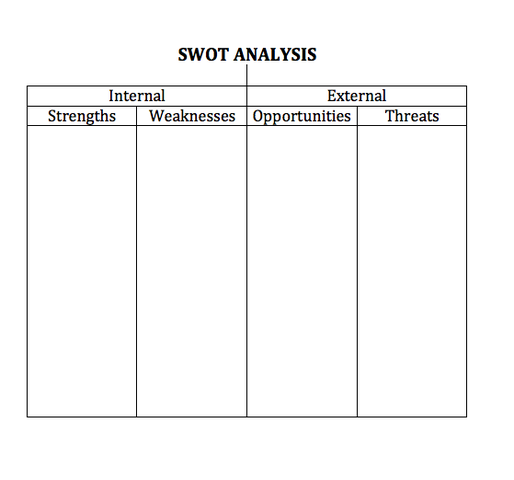
Method One: The time-tested SWOT analysis
If you talk to a marketer for more than two seconds about positioning a company, the marketer will probably throw the acronym “SWOT” back at you. I’ve mentioned the SWOT acronym before.
For those who don’t know the acronym, SWOT stands for
Strengths. These are internal attributes that benefit your firm. For example, your firm is winning a lot of business and growing in customer count and market share.
Weaknesses. These are also internal attributes, but in this case the attributes that detract from your firm. For example, you have very few customers.
Opportunities. These are external factors that enhance your firm. One example is a COVID or similar event that creates a surge in demand for contactless solutions.
Threats. The flip side is external factors that can harm your firm. One example is increasing privacy regulations that can slow or halt adoption of your product or service.
If you’re interested in more detail on the topic, there are a number of online sources that discuss SWOT analyses. Here’s TechTarget’s discussion of SWOT.
The common way to create the output from a SWOT analysis is to create four boxes and list each element (S, W, O, and T) within a box.
Once this is done, you’ll know that your messaging should emphasize the strengths and opportunities, and downplay or avoid the weaknesses and threats.
Or alternatively argue that the weaknesses and threats are really strengths and opportunities. (I’ve done this before.)
Method Two: Think before you create
Personally, I believe that a SWOT analysis is not enough. Before you use the SWOT findings to create content, there’s a little more work you have to do.
I recommend that before you create content, you should hold a kickoff of the content creation process and figure out what you want to do before you do it.
During that kickoff meeting, you should ask some questions to make sure you understand what needs to be done.
I’ve written about kickoffs and questions before, and I’m not going to repeat what I already said. If you want to know more:
Now that you’ve locked down the messaging, it’s time to actually create the content that differentiates your identity firm from all the inferior identity firms in the market. While some companies can proceed right to content creation, others may run into one of two problems.
The identity firm doesn’t have any knowledgeable writers on staff. To create the content, you need people who understand the identity industry, and who know how to write. Some firms lack people with this knowledge and capability.
The identity firm has knowledgeable writers on staff, but they’re busy. Some companies have too many things to do at once, and any knowledgeable writers that are on staff may be unavailable due to other priorities.
This is where you supplement you identity firm’s existing staff with one or more knowledgeable writers who can work with you to create the content that leaves your inferior competitors in the dust.
What is next?
So do you need a knowledgeable biometric content marketing expert to create your content?
One who has been in the biometric industry for 29 years?
One who has been writing short and long form content for more than 29 years?
Are you getting tired of my repeated questions again?
Well then I’ll just tell you that Bredemarket is the answer to your identity/biometric content marketing needs.
Are you ready to take your identity firm to the next level with a compelling message that increases awareness, consideration, conversion, and long-term revenue? Let’s talk today!
My compulsion to share stuff about identity and biometrics, which you can see if you visit my Bredemarket Identity Firm Services LinkedIn page and Facebook group.
Unfortunately for us, 90% of the song deals with the negative aspects of a person obsessing over another person. If you pick through the lyrics of the Animotion song “Obsession” and forget about what (or who) the singer is obsessing about, you can find isolated phrases that describe how an obsession can motivate you.
“I cannot sleep”
“Be still”
“I will not accept defeat”
But thankfully, there are more positive ways to embrace an obsession.
Justin Welsh on embracing an obsession
While Justin Welsh’s July 2022 post “TSS #028: Don’t Pick a Niche. Embrace an Obsession” is targeted for solopreneurs, it could just as easily apply to those who work for others. Regardless of your compensation structure, why do you choose to work where you do?
For Welsh, the practice of picking a niche risks commoditization.
They end up looking like, sounding like, and acting like all of their competition. The internet is full of copycats and duplicates.
(For example, I’d bet that all of the people who are picking a niche know better than to cite the Animotion song “Obsession” in a blog post promoting their business.)
Perhaps it’s semantics, but in Welsh’s way of thinking, embracing an obsession differs from picking a niche. To describe the power of embracing an obsession, Welsh references a tweet from Daniel Vassalo:
Find something you want to do really badly, and you won’t need any goals, habits, systems, discipline, rewards, or any other mental hacks. When the motivation is intrinsic, those things happen on their own.
Find something you want to do really badly, and you won’t need any goals, habits, systems, discipline, rewards, or any other mental hacks. When the motivation is intrinsic, those things happen on their own.
I trust you can see the difference between picking something you HAVE to do, versus obsessing over something you WANT to do.
What’s in it for you?
Welsh was addressing this post to me and people like me, and his message resonates with me.
But frankly, YOU don’t care about me and about whether I’m motivated. All that you care about is that YOU get YOUR content that you need from me.
So why should you care what Justin Welsh and Daniel Vassllo told me?
The obvious answer is that if you contract with Bredemarket for your marketing and writing services, you’ll get a “pry my keyboard out of my cold dead hands” person who WANTS to write your stuff, and doesn’t want to turn the writing process over to some two-year-old bot (except for very small little bits).
I’m still working on my TikTok generative AI dance. (Don’t hold your breath.)
“Pry my keyboard,” indeed.
Do you need someone to obsess over YOUR content?
Of course, if you need someone to write YOUR stuff, then I won’t have time to work on a TikTok dance. This is a good thing for me, you, and the world.
As I’ve stated elsewhere, before I write a thing for a Bredemarket client, I make sure that I understand WHY you do what you do, and understand everything else that is relevant to the content that we create.
As I work on the content, you have opportunities to review it and provide your feedback. This ensures that both of us are happy with the final copy.
And that your end users become obsessed with YOU.
So if you need me to create content for you, please contact me.
Companies often have a lot of things they want to do, but don’t have the people to do them. It takes a long time to hire someone, and it even takes time to find a consultant that knows your industry and can do the work.
This affects identity/biometric companies just like it affects other companies. When an identity/biometric company needs a specific type of expertise and needs it NOW, it’s often hard to find the person they need.
If your company needs a biometric content marketing expert (or an identity content marketing expert) NOW, you’ve come to the right place—Bredemarket. Bredemarket has no identity learning curve, no content learning curve, and offers proven results.
Identity/biometric consulting in the 1990s
I remember when I first started working as an identity/biometric consultant, long before Bredemarket was a thing.
OK, not quite THAT long ago. I started working in biometrics in the 1990s—NOT the 1940s.
In 1994, the proposals department at Printrak International needed additional writers due to the manager’s maternity leave, and she was so valuable that Printrak needed to bring in TWO consultants to take her place.
At least initially, the other consultant and I couldn’t fill the manager’s shoes.
Both of us could spell “RAID.” Not the bug spray, but the storage mechanism that stored all those “huge” fingerprint images.
But on that first night that I was cranking out proposal letters for something called a “Latent Station 2000,” I didn’t really know WHAT I was writing about.
As time went on, the other consultant and I learned much more—so much that the company brought both of us on as full-time employees.
After we were hired full-time, we spent a combined 45+ years at Printrak and its corporate successors in proposals, marketing, and product management positions, contributing to industry knowledge.
But neither of us knew biometrics before we started consuting at Printrak.
And I had never written a proposal before I started consulting at Printrak. (I had written an RFP. Sort of.)
But frankly, there weren’t a lot of identity/biometric consultants out in the field in the 1990s. There were the 20th century equivalents of Applied Forensic Services LLC, but at the time I don’t think there were any 20th century equivalents of Tandem Technical Writing LLC.
Unlike the 1990s, identity/biometric firms that need consulting help have many options. In addition to Applied Forensic Services and Tandem Technical Writing you have…me.
Mike and Laurel can tell you what they can do, and I heartily endorse both of them.
Let me share with you why I call myself a biometric content marketing expert who can help your identity/biometric company get marketing content out now:
No identity learning curve
No content learning curve
Proven results
No identity learning curve
I have worked with finger, face, iris, DNA, and other biometrics, as well as government-issued identity documents and geolocation. If you are interested, you can read my Bredemarket blog posts that mention the following topics:
Because I’ve produced both external and internal content on identity/biometric topics, I offer the experience to produce your content in a number of formats.
External content: account-based marketing content, articles, blog posts (I am the identity/biometric blog expert), case studies, data sheets, partner comarketing content, presentations, proposals, sales literature sheets, scientific book chapters, smartphone application content (events), social media posts, web page content, and white papers.
Does your identity business provide biometric or non-biometric products and services that use finger, face, iris, DNA, voice, government documents, geolocation, or other factors or modalities?
Does your identity business need written content, such as blog posts (from the identity/biometric blog expert), case studies, data sheets, proposal text, social media posts, or white papers?
How can your identity business (with the help of an identity content marketing expert) create the right written content?
When keeping your websites updated, I advise you to do as I say, not as I do. Two of my websites were significantly out of date and needed hurried corrections.
I realized this morning that the “My Experience” page on my jebredcal website was roughly a year out of date, so I hurriedly added content to it. Now the page will turn up in searches for the acronym “ABM” (OK, maybe not on the first page of the search results).
Let’s look at why I declared myself the biometric proposal writing expert (BPWE) and biometric content marketing expert (BCME) in mid-2021, what happened over the last few months, why it happened, and who benefits.
Why am I the BPWE and BCME?
At the time that I launched this marketing effort, I wanted to establish Bredemarket’s biometric credentials. I was primarily providing my expertise to identity/biometric firms, so it made sense to emphasize my 25+ years of identity/biometric expertise, coupled with my proposal, marketing, and product experience. Some of my customers already knew this, but others did not.
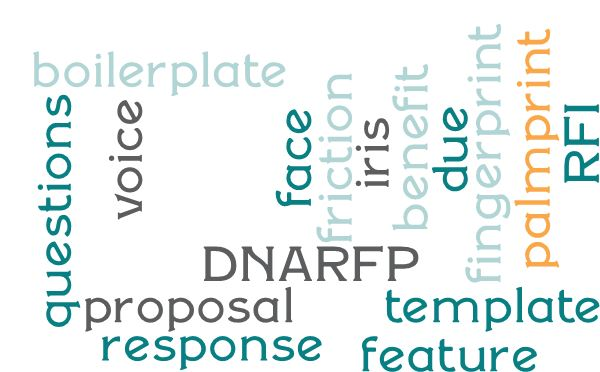
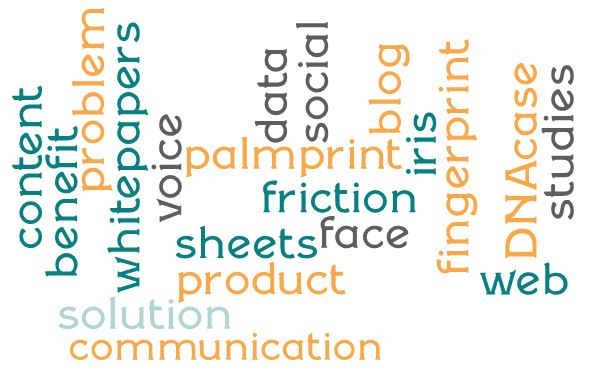
My word clouds for “biometric proposal writing expert” and “biometric content marketing expert.”
So I coupled the appropriate identity words with the appropriate proposal and content words, and plunged full-on into the world of biometric proposal writing expert (BPWE within Bredemarket’s luxurious offices) and biometric content marketing expert (BCME here) marketing.
What happened?
There’s been one more thing that’s been happening in Bredemarket’s luxurious offices over the last couple of months.
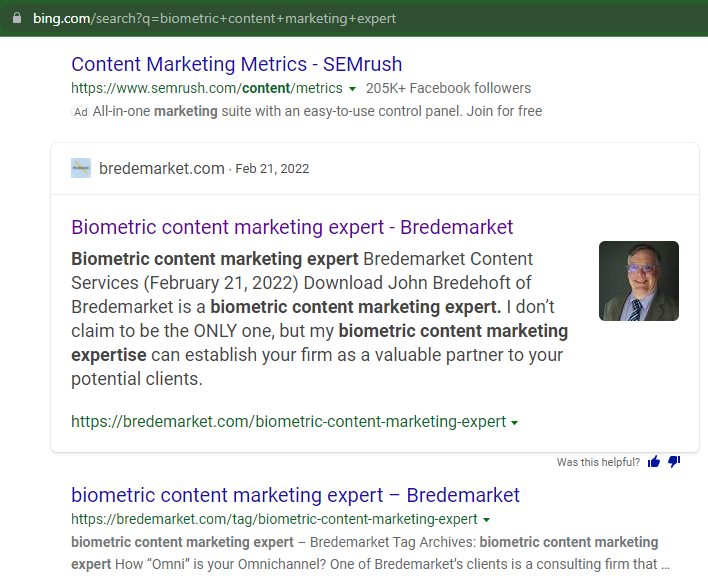
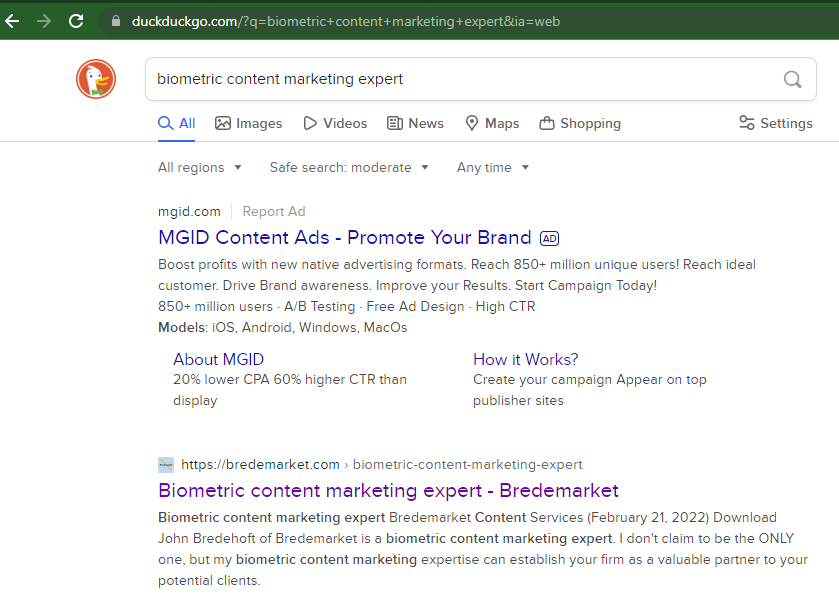
Let’s say that it’s December 2022, and someone performs a Google, Bing, or DuckDuckGo search for a biometric content marketing expert. The person finds Bredemarket, and excitedly goes to Bredemarket’s biometric content marketing expert page, only to encounter this text at the top of the page:
Update 4/25/2022: Effective immediately, Bredemarket does NOT accept client work for solutions that identify individuals using (a) friction ridges (including fingerprints and palm prints), (b) faces, and/or (c) secure documents (including driver’s licenses and passports).
I’ve already shared some (not all) details about why I’m pivoting with the Bredemarket community, but perhaps you didn’t get the memo.
I have accepted a full-time position as a Senior Product Marketing Manager with an identity company. (I’ll post the details later on my personal LinkedIn account, https://www.linkedin.com/in/jbredehoft/.) This dramatically decreases the amount of time I can spend on my Bredemarket consultancy, and also (for non-competition reasons) limits the companies with which I can do business.
Those of you who have followed Bredemarket from the beginning will remember that Bredemarket was only one part of a two-pronged approach. After becoming a “free agent” (also known as “being laid off”) in July 2020, my initial emphasis was on finding full-time employment. Within a month, however, I found myself accepting independent contracting projects, and formally established Bredemarket to handle that work. Therefore, I was simultaneously (a) looking for full-time work, and (b) growing my consulting business. And I’ve been doing both simultaneously for over a year and a half.
Now that I’ve found full-time employment again, I’m not going to give up the consulting business. But it’s definitely going to have to change, as outlined in my April 25, 2022 update.
So now all of this SEO traction will not benefit you, the potential Bredemarket finger/face client, but it obviously will benefit my new employer. I can see it now when people talk about my new employer: “Isn’t that the company where the biometric content marketing expert is the Senior Product Marketing Manager?”
P.S. There’s a “change” Spotify playlist. Unlike Kevin Meredith, I don’t use my playlists to make sure my presentation is within the alloted time. Especially when I create my longer 100-plus song playlists; no one wants to hear me speak for that long. Thankfully for you, this playlist is only a little over an hour long, and includes various songs on change, moving, endings, beginnings, and time.
I recently announced a change in business scope for my DBA Bredemarket. Specifically, Bredemarket will no longer accept client work for solutions that identify individuals using (a) friction ridges (including fingerprints and palm prints) and/or (b) faces.
This impacts some companies that previously did business with me, and can potentially impact other companies that want to do business with me. If you are one of these companies, I am no longer available.
Since Bredemarket will no longer help you with your friction ridge/face marketing and writing needs, who will? Who has the expertise to help you? I have two suggestions.
Tandem Technical Writing
Do you need someon who is not only an excellent communicator, but also knows the ins and outs of AFIS and ABIS systems? Turn to Tandem Technical Writing LLC.
I first met Laurel Jew back in 1995 when I started consulting with, and then working for, Printrak. In fact, I joined Printrak when Laurel went on maternity leave. (I was one of two people who joined Printrak at that time. As I’ve previously noted, Laurel needed two people to replace her.)
Laurel worked for Printrak and its predecessor De La Rue Printrak for several years in its proposals organization.
Today, her biometric and communication experience is available to you. Tandem Technical Writing provides its clients with “15 years of proposal writing and biometrics technology background with high win %.”
Why does this matter to you? Because Laurel not only understands your biometric business, but also understands how to communicate to your biometric clients. Not many people can do both, so Laurel is a rarity in this industry.
Perhaps your needs are more technical. Maybe you need someone who is a certified forensics professional, and who has also implemented many biometric systems. If that is your need, then you will want to consider Applied Forensic Services LLC.
I met Mike French in 2009 when Safran acquired Motorola’s biometric business and merged it into its U.S. subsidiary Sagem Morpho, creating MorphoTrak (“Morpho” + “Printrak”). I worked with him at MorphoTrak and IDEMIA until 2020.
Unlike me, Mike is a true forensic professional. (See his LinkedIn profile.) Back in 1994, when I was still learning to spell AFIS, Mike joined the latent print unit at the King County (Washington) Sheriff’s Office, where he spent over a decade before joining Sagem Morpho. He is an IAI-certified Latent Print Examiner, an IEEE-certified Biometric Professional, and an active participant in IAI and other forensic activities. I’ve previously referenced his advice on why agencies should conduct their own AFIS benchmarks.
Why does this matter to you? Because Mike’s consultancy, Applied Forensic Services, can provide expert advice on biometric procurements and implementation, ensuring that you get the biometric system that addresses your needs.
There are other companies that can help you with friction ridge and face marketing, writing, and consultation services.
I specifically mention these two because I have worked with their principals both as an employee during my Printrak-to-IDEMIA years, and as a sole proprietor during my Bredemarket years. Laurel and Mike are both knowledgeable, dedicated, and can add value to your firm or agency.
And, unlike some experienced friction ridge and face experts, Laurel and Mike are still working and have not retired. (“Where have you gone, Peter Higgins…”)
(UPDATE: I have indicated portions of this post that include speculation from myself and others.)
When I wrote “About THAT Reuters article” (specifically, the February 4 articlespeculating about a possible sale of IDEMIA by Advent International to Thales Group), I noted that I have no expertise in predicting corporate acquisitions.
However, I’ve experienced three of them, including Motorola’s acquisition of Printrak in 2000, Safran’s acquisition of Motorola’s Biometric Business Unit in 2008-2009, and Advent International’s acquisition of Safran’s Morpho unit in 2016-2017 (and Advent’s merger of Oberthur and Morpho to form OT-Morpho, later IDEMIA).
None of these was a simple matter of the acquiring company and the acquired company approving the acquisition. It was more complicated than that.
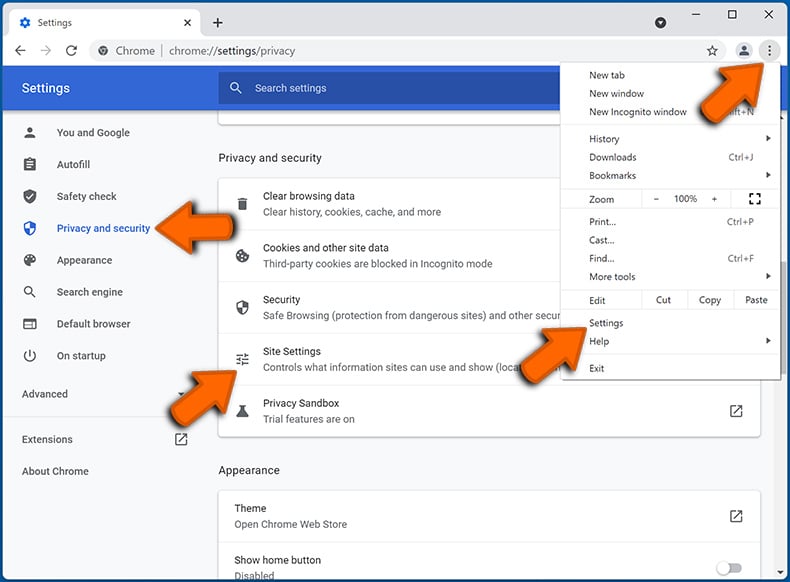
UPDATE 8/20/2025. I just had to disable browser notifications from two rogue sites. See bold paragraph below.
[UPDATE 8/20/2025: I have disabled the links below because the link now redirects to adware malware. Pity, because the original page was an excellent source of the negotiations between Printrak and Motorola.]
Even the most straightforward of the acquisitions that I experienced, the U.S. company Motorola’s acquisition of the U.S. company Printrak, required a number of government approvals.
Under the Hart-Scott-Rodino Antitrust Improvements Act of 1976, and the rules promulgated under the Hart-Scott-Rodino Act, Printrak, Acquisition Sub and Motorola cannot complete the Merger until they notify and furnish information regarding the acquisition of Printrak by Acquisition Sub to the Federal Trade Commission and the Antitrust Division of the U.S. Department of Justice and satisfy specified waiting period requirements. Printrak and Motorola (as the sole stockholder of Acquisition Sub) filed notification and report forms under the Hart-Scott-Rodino Act with the FTC and the Antitrust Division on September 26, 2000 and received early termination of the waiting period from the Federal Trade Commission effective October 11, 2000.
From [REDACTED]/Document/0000912057-00-045478/
And not just from the U.S. government.
In addition, Printrak and Motorola are required to furnish certain information and materials to the antitrust authorities of Argentina, Brazil, the Federal Republic of Germany, and Romania. Filings were made in Argentina on September 22, 2000, in Brazil on September 19, 2000 and in the Federal Republic of Germany on September 27, 2000. German antitrust authorities have one month after the parties file their application to review the transaction. During that one month period, they can either approve the transaction or initiate an examination of the transaction which could take an additional three months, during which time the parties cannot close the transaction. During this three month period, the antitrust authorities will either approve the transaction or prohibit it. Approval may be granted before the initial one month review or before the additional three month review period. If approved, the antitrust authorities can not later challenge the transaction under their merger law but could challenge the transaction under other provisions of their antitrust laws. Printrak and Motorola intend to make a post-closing filing in Romania as soon as practicable after the closing.
From [REDACTED]/Document/0000912057-00-045478/
Why did the Motorola acquisition of Printrak require all of those approvals? Because Printrak did business in these countries (and many others), and the governments of those particular countries wanted to exert control over who does business in their country. For example, Printrak was the automated fingerprint identification system (AFIS) supplier in Romania, and the government of Romania had a need to know what would happen if Motorola were to become the supplier of its AFIS. Would all of the fingerprints be replaced by batwings? Would the new owner require the Romanian employees to apply Six Sigma in their everyday lives? Would Romania have to use Iridium to communicate AFIS data?
Well, everyone in the U.S. and the other countries granted approval, and the Motorola acquisition of Printrak was eventually completed, although it took roughly three months to get all the approvals. I remember that we were at a trade show (IACP, I think) with Printrak signage, and received mid-show approval to string up Motorola banners after receiving final approval.
And that was the relatively EASY acquisition of the three that I experienced. The next one was harder.
CFIUS is an interagency committee authorized to review certain transactions involving foreign investment in the United States and certain real estate transactions by foreign persons, in order to determine the effect of such transactions on the national security of the United States.
Because Motorola not only sold fingerprint identification technology, an export controlled technology, but also managed law enforcement data for a number of states and (on a limited basis) for the U.S. Federal Bureau of Investigation and other federal government agencies.
Never mind the fact that France has been a long-standing ally of the United States. Heck, Israel is an ally of the U.S., and we didn’t like it when Israel spied on us.
CFIUS had to make sure that foreign control of Motorola’s biometric assets wouldn’t cause issues. Would French intelligence personnel steal all of the personal identifiable information (PII) from the AFIS databases in Minnesota, North Carolina, and other states?
Safran acquires other things
Eventually CFIUS decided that there was no critical threat and allowed the Safran acquisition of Motorola’s Biometric Business Unit to go through.
After all, it wasn’t like Motorola managed the main FBI criminal database, or state driver’s license databases, or anything like that.
You see, the main FBI criminal database, then known as IAFIS, was already managed by Safran.
And the state driver’s license databases were managed by neither Safran nor Motorola. A separate company, L-1 Identity Solutions, managed the majority of those databases.
So Safran’s acquisition of Motorola’s biometric assets was approved by all necessary government entities, and everyone was happy.
But Safran wasn’t done with its acquisitions, and a few years later acquired L-1 Identity Systems also. So now U.S. driver’s license production would be under French control.
This time around, CFIUS insisted on mitigating the effects of “Foreign Ownership, Control or Influence” (FOCI). Specifically, L-1 Identity Solutions (renamed “MorphoTrust”) was placed under a proxy structure, in which MorphoTrust’s Board of Directors was entirely composed of U.S. citizens. In addition, a number of MorphoTrust employees who were not U.S. citizens were shifted away from MorphoTrust to other Safran companies (most notably MorphoTrak, the company that contained the former Motorola Biometric Business Unit and other stuff).
By the way, I wrote about this before, but it’s in a Bredemarket Premium article so most of you can’t read it. Consider this information a freebie.
Even though they were owned by the same company, and used some of the same hardware components, MorphoTrust and MorphoTrak were managed separately. MorphoTrust had to log its contacts with foreigners, including U.S. employees of the foreign-owned MorphoTrak. Any transactions between MorphoTrust and MorphoTrak had to be carefully monitored to ensure that “foreign” components didn’t sneak their way into MorphoTrust products. And (most notably) because we couldn’t really talk to each other, MorphoTrust and MorphoTrak actually competed against each other on several occasions, including instances in which both subsidiaries proposed fingerprint livescan stations to the same customers.
But we were one big happy fractured family, and CFIUS was satisfied.
Well, until the next acquisition took place.
Advent International (and Oberthur) acquires part of Safran
Remember how I said that I couldn’t really predict acquisitions? After Safran acquired Motorola’s Biometric Business Unit, I thought I was home free. Printrak was the odd man out in Motorola, since our part of Motorola (later becoming Motorola Solutions) specialized in the sale of lots and lots of police radios, while we in Printrak specialized in the sale of a few AFIS systems. Once we joined Safran, we became part of a huge division (Sagem Sécurité, later known as Morpho) that ONLY performed identity functions.
So now an American investment firm would buy a French company.
You can bet that this required a round of approvals on both sides of the Atlantic.
France and the European Union certainly had an interest. As I noted in a recent post about Alaska’s HB389 bill, Advent International was not the sole owner; Advent had to bring the French government-owned entity Bpifrance on as a minority owner. And the European Union had to grant antitrust approval.
But on the U.S. side, CFIUS got involved again because MorphoTrust was part of the acquisition. Never mind the fact that MorphoTrust was now majority American-owned; MorphoTrust’s corporate parent was headquartered in France, and Bpifrance owned part of MorphoTrust.
So what happened?
MorphoTrust was removed from FOCI control, sort of, and merged with MorphoTrak and some parts of Oberthur to form IDEMIA Identity & Security USA LLC.
And my job became really complicated, because I, a former MorphoTrak employee, reported to someone who was a former MorphoTrust employee. And even though the U.S. part of IDEMIA (excluding IDEMIA NSS) was no longer FOCI-mitigated, some leftovers from the old MorphoTrust days were still around.
Initially there were still two separate computer networks, and I had to have access to both of them, which meant that I had to obtain a second computer from the Billerica, Massachusetts office to access the old MorphoTrust network. (Before obtaining that second computer, I had to undergo a security screening.)
Eventually the two separate networks went away…after I left IDEMIA. Actually, I’m not entirely certain that they COMPLETELY went away, but at least the email addresses were all standardized throughout the United States after I left. (Yes, I had two email addresses also.)
Two new complications when some future entity acquires IDEMIA
So what happens in the future? Reuters has speculated what may happen, and I am speculating also.
As I noted previously, Advent International acquires businesses, revamps them, and sells them (hopefully) at a profit.
So even if the Reuters article turns out to be factuallyincorrect, Advent is going to sell IDEMIA someday.
Based upon past acquisitions, I believe it is pretty likely that the French government is going to have some say in the sale. Reuters speculated that nothing will happen until after next month’s Presidential election in France. (See my LinkedIn post in Bredemarket Identity Firm Services about the French election.) The French President, whoever he or she may be when Advent finally tries to sell IDEMIA in 2022, 2023, or 2033, is going to exert control over who the final buyer will be. Perhaps the President may insist that IDEMIA be sold to a French company, or at least a European Union company.
And based upon past acquisitions, I believe it is pretty likely that the U.S. government is going to have some say in the sale. The U.S. President, whoever he or she may be when Advent tries to sell IDEMIA (again, whenever that may occur), is going to exert control over who the final buyer will be, because of the significant business that IDEMIA NSS and the rest of IDEMIA does with U.S. federal, state, and local government entities. Oh, and there’s also the matter of fingerprint identification export control.
But those are not the two complications that I’m talking about. There are two NEW complications.
Possible Complication Number One: IDEMIA has locations all over the world, including a location in Moscow.
As I write this post, a number of Western businesses are ceasing their business operations in Russia because of the war in Ukraine. This has caused issues with the Russian government.
As of Monday (March 14), at least 375 companies had announced some sort of pullback from Russia, according to a list maintained by the School of Management at Yale University. The list includes companies that have cut ties with Russia completely, as well as those that have suspended operations there while attempting to preserve the option to return.
According to multiple media reports, dozens of Western companies have been contacted by prosecutors in Russia with warnings that their assets, including production facilities, offices, and intellectual property, such as trademarks, may be seized by the government if they withdraw from the country.
Unless IDEMIA is acquired by a Russian company (which is extremely unlikely, given French and U.S. interests), anyone who acquires IDEMIA (or any company with Russian offices) has to consider how Russia will react. Will the Russian portion of the business be a total loss? Will Russian entities acquire IDEMIA intellectual property? (This would be ironic, considering some past allegations that have been made but not IMHO proven.)
But Russia isn’t the only potential complication of a sale of IDEMIA.
Possible Complication Number Two: IDEMIA also has locations in Beijing, Hong Kong, and Shenzen. And it’s possible that the Chinese government is going to have some interest in who IDEMIA’s future owner will be.
It is possible that China’s State Administration for Market Regulation (SAMR) might review any acquisition.
In early September of 2021, China’s competition authority, the State Administration for Market Regulation (“SAMR”) issued a report (“SAMR 2020 Report”) summarizing its Anti-Monopoly Law enforcement activities during the period covering the 13th Five-Year Plan (2016-2020).
While relations between the West and China are certainly better than current relations between the West and Russia, there is always an underlying tension in those relations. For example, if a Taiwanese company were to acquire IDEMIA, this could be considered a declaration of war.
And in the specific case of IDEMIA, the biometric algorithms from IDEMIA directly compete with biometric algorithms from China. The February 2022 printed version of the NIST FRVT 1:1 report indicates that dozens of tested facial recognition algorithms are of Chinese origin, including algorithms from Cloudwalk, Dahua, Fujitsu, Hikvision, Megvii, Sensetime, Tencent, Xforward, and a host of other companies and universities.
What if (again, I’m speculating) China decides to oppose an acquisition of IDEMIA unless it receives assurances that IDEMIA will not threaten the domestic Chinese biometric providers?
Conclusion
So whoever buys IDEMIA from Advent may have to pay attention to government regulators in the U.S., France, the European Union, and possibly Argentina, Brazil, China, Germany, Romania, and Russia.
For the last twenty-five plus years, I have been involved in the identification of individuals.
Who is the person who is going through the arrest/booking process?
Who is the person who claims to be entitled to welfare benefits?
Who is the person who wants to enter the country?
Who is the person who is exiting the country? (Yes, I remember the visa overstay issue.)
Who is the person who wants to enter the computer room in the office building?
Who is the person who is applying for a driver’s license or passport?
Who is the person who wants to enter the sports stadium or concert arena?
These are just a few of the problems that I have worked on solving over the last twenty-five plus years, all of which are tied to individual identity.
From that perspective, I really don’t care if the person entering the stadium/computer room/country whatever is female, mixed race, Muslim, left handed, or whatever. I just want to know if this is the individual that he/she/they claims to be.
If you’ve never seen the list of potential candidates generated by a top-tier facial recognition program, you may be shocked when you see it. That list of candidates may include white men, Asian women, and everything in between. “Well, that’s wrong,” you may say to yourself. “How can the results include people of multiple races and genders?” It’s because the algorithm doesn’t care about race and gender. Think about it – what if a victim THINKS that he was attacked by a white male, but the attacker was really an Asian female? Identify the individual, not the race or gender.
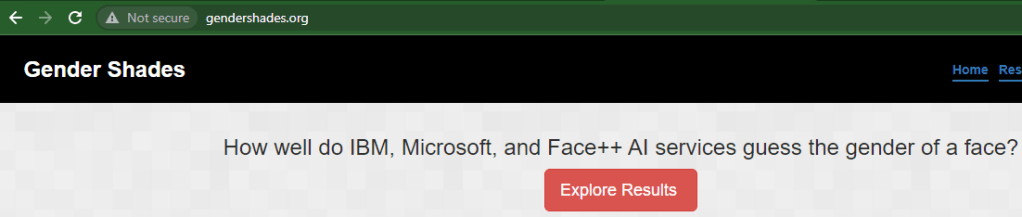
So when Gender Shades came out, stating that IBM, Microsoft, and Face++ AI services had problems recognizing the gender of people, especially those with darker skin, my reaction was “so what”?
(Note that this is a different question than the question of how an algorithm identifies individuals of different genders, races, and ages, which has been addressed by NIST.)
But some people persist in addressing biometrics’ “failure” to properly identify genders and races, ignoring the fact that both gender and race have become social rather than biological constructs. Is the Olympian Jenner male, female, or something else? What are your personal pronouns? What happens when a mixed race person identifies with one race rather than another? And aren’t we all mixed race anyway?
The latest study from AlBdairi et al on computational methods for ethnicity identification
But there’s still a great interest in “race recognition.”
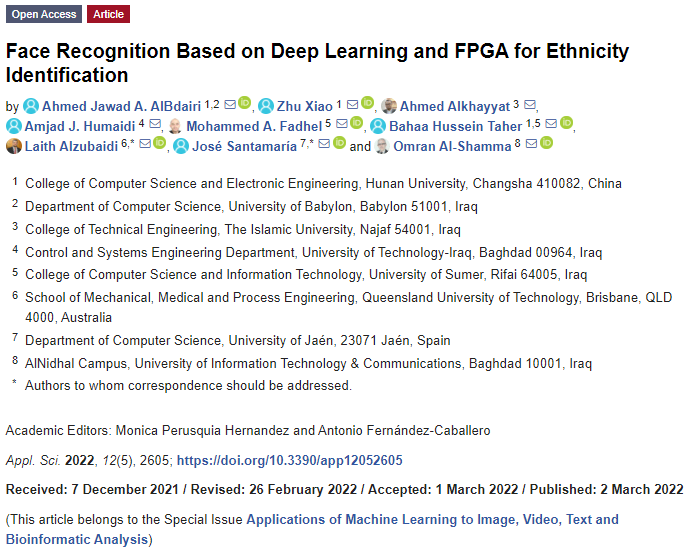
As Jim Nash of Biometric Update notes, a team of scientists has published an open access paper entitled “Face Recognition Based on Deep Learning and FPGA for Ethnicity Identification.”
The authors claim that their study is “the first image collection gathered specifically to address the ethnicity identification problem.”
But what of the NIST demographic study cited above? you may ask. The NIST study did NOT have the races of the individuals, but used the individuals’ country of origin as a proxy for race. Then again, it is possible that this study may have done the same thing.
Despite the fact that there are several large-scale face image databases accessible online, none of these databases are acceptable for the purpose of the conducted study in our research. Furthermore, 3141 photographs were gathered from a variety of sources. Specifically, 1081, 1021, and 1039 Chinese, Pakistani, and Russian face photos were gathered, respectively.
There was no mention of whether any of the Chinese face photos were Caucasian…or how the researchers could tell that they were Caucasian.
Anyway, if you’re interested in the science behind using Deep Convolutional Neural Network (DCNN) models and field-programmable gate arrays (FPGAs) to identify ethnicity, read the paper. Or skip to the results.
The experimental results reported that our model outperformed all the methods of state-of-the-art, achieving an accuracy and F1 score value of 96.9 percent and 94.6 percent, respectively.
But this doesn’t answer the question I raised earlier.
Three possible use cases for race recognition, two of which are problematic
Why would anyone want to identify ethnicity or engage in race recognition? Jim Nash of Biometric Update summarizes three possible use cases for doing this, which I will address one by one. TL;DR two of the use cases are problematic.
The code…could find a role in the growing field of race-targeted medical treatments and pharmacogenomics, where accurately ascertaining race could provide better care.
Note that in this case race IS a biological construct, so perhaps its use is valid here. Regardless of how Nkechi Amare Diallo (formerly Rachel Dolezal) self-identifies, she’s not a targeted candidate for sickle cell treatment.
It could be helpful to some employers. Such as system could “use racial information to offer employers ethnically convenient services, then preventing the offending risk present in many cultural taboos.”
This is where things start to get problematic. Using Diallo as an example, race recognition software based upon her biological race would see no problem in offering her fried chicken and watermelon at a corporate function, but Diallo might have some different feelings about this. And it’s not guaranteed that ALL members of a particular race are affected by particular cultural taboos. (The text below, from 1965, was slightly edited.)
People used to think of (blacks) as going around with fried chicken in a paper bag, (Godfrey) Cambridge says. But things have changed. “Now,” he says, “we carry an attache case—with fried chicken in it. We ain’t going to give up everything just to get along with you people.”
While some employees may be pleased that they receive a particular type of treatment because of their biological race, others may not be pleased at all.
So let’s move on to Nash’s third use case for race recognition. Hold on to your seats.
Ultimately, however, the broadest potential mission for race recognition would be in security — at border stations and deployed in public-access areas, according to the report.
While President Bush was primarily speaking about religious affiliation, he also made the point that we should not judge individuals based upon the color of their skin.
Yet we do.
If I may again return to our current sad reality, there have been allegations that Africans encountered segregation and substandard treatment when trying to flee Ukraine. (When speaking of “African,” note that concerns were raised by officials from Gabon, Ghana, and Kenya – not from Egypt, Libya, or Tunisia. Then again, Indian students also complained of substandard treatment.)
Many people in the United States and western Europe would find it totally unacceptable to treat people at borders and public areas differently by race.
Do we want to encourage this use case?
And if you feel that we should, please provide your picture. I want to see if your concerns are worthy of consideration.
We often get bent out of shape trying to come up with precise definitions of things. While sometimes this precision is warranted, there are times when it is overkill.
Take the answer to this question:
What is the difference between a case study and a testimonial?
Some people have taken some time answering the question about the difference between a case study and a testimonial. For example, here’s what Juliet Platt says:
The difference between Case Studies and Testimonials is really length and depth.
This gets into the difference between quantitative information and qualitative information. By this definition, a case study always has to address return on investment, or it’s not a case study.
I have a different view
While I respect the views of these two people (and others), I have a different view. My answer to the question “What is the difference between a case study and a testimonial” is as follows:
Regardless of what you call the document, a case study or a testimonial allows a firm to attract new customers by showcasing the successes of existing customers.
And as far as I’m concerned, the length of the piece and the choice to use quantitative or qualitative data (or both) is secondary to the primary purpose, which is to present an example that resonates with a potential customer.
Not that I don’t have ANY rules. Whether you’re writing a case study or testimonial, I like to structure it with the following format:
The problem.
The solution.
The results (from using the solution to solve the problem).
This format allows a customer-centric presentation with which the reader can identify. “Hey, Joe’s Garage used this widget to solve their problem. Maybe I can use this widget to solve a similar problem.”
Now perhaps others use a different outline for their case studies or testimonials. And that’s…OK.
So for ease of communication, I’ve decided to adopt a different term. It’s not original with me, but it doesn’t look like anyone else is currently using the term on a regular basis.
Instead of using awkward references to “case studies and/or testimonials,” I’m just going to refer to casetimonials.
I used the casetimonial term a lot on this page (recently revised) on the Bredemarket website, which not only includes a shorter form of the discussion above about the difference between a case study and a testimonial, but also discusses how a casetimonial can be used, how it can be repurposed, the types of firms that can benefit from casetimonials, and how Bredemarket can help you create your own casetimonials.
If you can use Bredemarket’s assistance with communicating past customer successes to future clients:


















 Bredemarket