How Bredemarket Helps in Early Proposal Engagement

Man, I’ve been negative lately.

I figure that it is time to become more positive.

I’m going to describe one example of how Bredemarket has helped its customers, based upon one of my client projects from several years ago.

Stupid Word Tricks. Tell your brother, your sister and your mama too. See below.

I’ve told this story before, but I wanted to take a fresh look at the problem the firm had, and the solution Bredemarket provided. I’m not identifying the firm, but perhaps YOUR firm has a similar problem that I can solve for you. And your firm is the one that matters.

The problem

This happened several years ago, but was one of Bredemarket’s first successes.

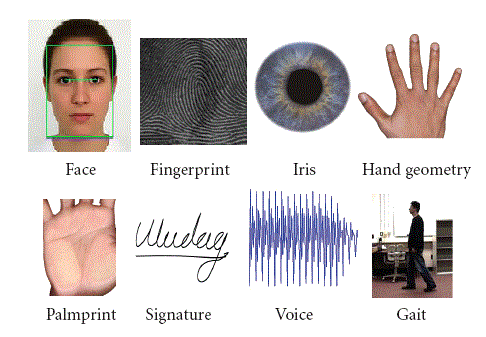
From Sandeep Kumar, A. Sony, Rahul Hooda, Yashpal Singh, in Journal of Advances and Scholarly Researches in Allied Education | Multidisciplinary Academic Research, “Multimodal Biometric Authentication System for Automatic Certificate Generation.”

I should preface this by noting that there are a lot of different biometric modalities, including some that aren’t even listed in the image above.

The firm that asked for my help is one that focuses on one particular biometric modality, and provides a high-end solution for biometric identification.

In addition, the firm’s solution has multiple applications, crime solving and disaster victim identification being two of them.

The firm needed a way to perform initial prospect outreach via budgetary quotations, targeted to the application that mattered to the prospect. A simple proposal problem to be solved…or so it seemed.

Why the obvious proposal solution didn’t work

I had encountered similar problems while employed at Printrak and MorphoTrak and while consulting here at Bredemarket, so the solution was painfully obvious.

Qvidian, one proposal automation software package that I have used. But there are a LOT of proposal automation software packages out there, including some new ones that incorporate artificial intelligence. From https://uplandsoftware.com/qvidian/.

Have your proposal writers create relevant material in their proposal automation software that could target each of the audiences.

So when your salesperson wants to approach a medical examiner involved in disaster victim identification, the proposal writer could just run the proposal automation software, create the targeted budgetary quotation, populate it with the prospect’s contact information, and give the completed quotation to the salesperson.

Unfortuntely for the firm, the painfully obvious solution was truly painful, for two reasons:

  • This firm had no proposal automation software. Well, maybe some other division of the firm had such software, but this division didn’t have access to it. So the whole idea of adding proposal text to an existing software solution, and programming the solution to generate the appropriate budgetary quotation, wasn’t going to fly.
  • In addition, this firm had no proposal writers. The salespeople were doing this on their own. The only proposal writer they had was the contractor from Bredemarket. And they weren’t going to want to pay for me to generate every budgetary quotation they needed.

In this case, the firm needed a way for the salespeople to generate the necessary budgetary quotations as easily as possible, WITHOUT relying on proposal automation software or proposal writers.

Bredemarket’s solution

To solve the firm’s problem, I resorted to Stupid Word Tricks.

(Microsoft Word, not Cameo.)

I created two similar budgetary quotation templates: one for crime solving, and one for disaster victim identification. (Actually I created more than two.) That way the salesperson could simply choose the budgetary quotation they wanted.

The letters were similar in format, but had little tweaks depending upon the audience.

Using document properties to create easy-to-use budgetary quotations.

The Stupid Word Tricks came into play when I used Word document property features to allow the salesperson to enter the specific information for each prospect, which then rippled throughout the document, providing a customized budgetary quotation to the prospect.

The result

The firms’ salespeople used Bredemarket’s templates to generate initial outreach budgetary quotations to their clients.

And the salespeople were happy.

I’ve used this testimonial quote before, but it doesn’t hurt to use it again.

“I just wanted to truly say thank you for putting these templates together. I worked on this…last week and it was extremely simple to use and I thought really provided a professional advantage and tool to give the customer….TRULY THANK YOU!”

Comment from one of the client’s employees who used the standard proposal text

While I actively consulted for the firm I maintained the templates, updating as needed as the firm achieved additional certifications.

Why am I telling this story again?

I just want to remind people that Bredemarket doesn’t just write posts, articles, and other collateral. I can also create collateral such as these proposal templates that you can re-use.

So if you have a need that can’t be met by the painfully obvious solutions, talk to me. Perhaps we can develop our own solution.

What You Don’t Know (About Your Identity/Biometric Company Website) Can Hurt You

The identity/biometric company (not named here) never formally learned why prospects shunned the outdated information on its website.

This is NOT the website I’m discussing in this post. The referenced identity company is not named here. This is the website of some other company, taken from https://www.webdesignmuseum.org/gallery/microsoft-1996.

The identity/biometric company never formally learned how its references to renamed companies and non-existent companies were repelling those very companies…and the prospects who knew the website information was inaccurate.

April 11, 2023: “It’s unclear what the change means for Twitter.” From https://www.seattletimes.com/business/twitter-company-no-longer-exists-is-now-part-of-musks-x/.

With those types of mistakes, the entire company’s positioning became suspect.

It could have learned…if it had met with me. But it chose not to do so.

NOTE TO SELF: INSERT STRONG FEAR UNCERTAINTY AND DOUBT PARAGRAPH HERE. TAKE OUT THESE TWO SENTENCES BEFORE POSTING THE FINAL VERSION!!!

(By the way…while the identity/biometric company never received this information formally, it did receive it informally…because such information is presumably critically important to the company.)

How many other companies are in the same situation, with:

(T)here are clues within the content itself as to its age, such as “Our product is now supported on Windows 7.”

My mini-survey shows that of the 40+ identity firms with blogs, about one-third of them HAVEN’T SAID A SINGLE THING to their prospects and customers in the last two months.

Is there a 29-year veteran of the identity industry, an identity content marketing expert who can help the companies fix these gaps?

Let’s talk.

And yes, the ALL CAPS paragraph was a setup. But I’m sure you can compose a FUD paragraph on your own without my help.

The Best Way to Talk About Complex Technology Features? Don’t.

Are you a product marketer or content marketer at an engineering-focused technology firm?

The ALMA correlator. The full system has four identical quadrants, with over 134 million processors, performing up to 17 quadrillion operations per second. By ESO – http://www.eso.org/public/images/eso1253a/, CC BY 4.0, https://commons.wikimedia.org/w/index.php?curid=23340651.

Have you been asked to tell your prospects about the marvelously complex features of your firm’s dazzling engineering products?

Well…why would you want to do that?

The complex product with a lengthy feature list

Many years ago I worked at a firm in which the products were driven by engineers, and therefore resulted in engineering marvels.

Two kinds of Segway PTs. By Source: aleehk82 [1]Derivative work: 丁 (talk) – https://www.flickr.com/photos/aleehk82/3144281707/, CC BY 2.0, https://commons.wikimedia.org/w/index.php?curid=11852469

I recall one product in particular (not a Segway, but a biometric product housed in a tower) that was an impressive fusion of algorithmic and mechanical excellence. The complex design that went into developing the tower product resulted in a device that performed its function superbly.

The complex engineering also caused the product to have such a high price that no one would ever buy it…but I digress.

But there was another issue with the product. I was writing proposals at the time, and we certainly could have written up a product description that emphasized the product’s lengthy set of features.

But the people receiving our proposals wouldn’t have cared one bit.

Prospects don’t care about lengthy feature lists

You see, prospects don’t care about lengthy feature lists.

And they don’t care about your product.

Altair 8800 advertisement. By MITS staff – Scanned from the May 1975 Radio-Electronics magazine by Michael Holley Swtpc6800, Public Domain, https://commons.wikimedia.org/w/index.php?curid=7219799

Frankly, they don’t even care about your company.

  • Even if your company has stellar engineers that develop wonderful products.
Elizabeth Holmes “invented a way to run 30 lab tests on only one drop of blood.” WIRED, February 2014, https://www.wired.com/2014/02/elizabeth-holmes-theranos/.
  • Even if your company has won prestigious awards for technical excellence, or as a great place to work, or whatever.
Business Week named Enron Chairman and CEO Ken Lay as one of the top 25 managers for 1999. From https://enroncorp.com/corp/pressroom/awards/executive.html
  • Even if your company just completed a successful funding round.
Transformco (post-bankruptcy parent of Sears and KMart) received $250 million in November 2019. From https://www.cnbc.com/2019/11/07/sears-owner-gets-250-million-lifeline-says-it-will-shut-another-96-stores.html.

It’s painful to admit it, but prospects only care about…themselves.

And the prospects focus on their problems, not your technical superiority.

For example, if your prospects work for certain government agencies, they really care about terrorists who try to board airplanes.

Aerial view of the Pentagon Building, September 14, 2001. By TSGT CEDRIC H. RUDISILL, USAF – http://www.dodmedia.osd.mil/Assets/Still/2004/Air_Force/DF-SD-04-12734.JPEG Alternate: http://www.af.mil/News/Photos/igphoto/2001289439/ archive, Public Domain, https://commons.wikimedia.org/w/index.php?curid=2152737

If your product stops terrorists from boarding airplanes, then and only then will they care about your company or your product.

If your product can’t stop terrorists from boarding airplanes, or if there is another product that is better at stopping terrorists from boarding airplanes, then your prospects won’t care about your product.

So how do you get prospects to care?

You don’t get prospects to care by talking about your extensive feature lists.

Let me give you a tip. If you find an employee at the prospect’s company who wants to spend a lot of time talking about your extensive feature lists, that employee probably DOESN’T have the authority to approve the purchase.

The people who DO have the authority to approve the purchase don’t have time to talk about extensive feature lists.

The approvers want to know, in 30 seconds or less, how your solution BENEFITS them.

Do you need help explaining your benefits?

Talking about benefits rather than features is just one tactic to successfully appeal to your prospects.

If you need help ensuring that your written materials (blog posts, white papers, web pages) resonate with your prospects, you can ask Bredemarket to help you.

Bredemarket Potential Limited Availability, February 5 Through 9

As an independent contractor who doesn’t HAVE to keep set hours this is technically none of your business, but I’m letting you know anyway. San Bernardino County has messaged me about something…and it potentially affects you.

By Ken Lund from Reno, NV, USA – Cropped from the original, Pershing County Courthouse Jury Box, CC BY-SA 2.0, https://commons.wikimedia.org/w/index.php?curid=3074281

I may have limited availability during the week of February 5-9 due to a jury duty summons.

And because of the confidentiality of jury proceedings, that’s all that I will have to say about THAT.

Currently the Bredemarket Calendly page marks me as completely unavailable during the week of February 5-9. I will adjust this as needed.

P.S. Years ago when I received a jury duty summons that potentially involved biometric evidence, I disclosed that I worked for a company that competed with the jurisdiction’s biometric provider. In this case, the PROSECUTION excused me from service.

Are You ConTENT? Balance Your Critical List With Your Prospects’ Critical Lists

Designed by Imgflip.

Normally I talk about CONtent, but today I’m talking about conTENT. (OK, a little bit about CONtent also.)

There are many prospects that may be CRITICALLY IMPORTANT (the highest of my three levels of importance) to your firm—perhaps too many. You can reduce your firm’s list of critically important prospects without losing them altogether. The extra time you receive benefits your firm and your TRUE critically important prospects. And eventually the other prospects may come around anyway.

Let them

You may pursue a prospect because you perceive they have a need. For example, there are identity/biometric companies that have not blogged in over a year, and these companies obviously have a need to increase their visibility with their own prospects by blogging.

But what if the identity/biometric prospects are not HUNGRY to satisfy that need? (Hungry people = true target audience.) Addressing the need may even be “important” to the prospects—but not CRITICALLY important.

  • Now I can create (and have created) content addressing this need and how to fill it. If a prospect searches for this content, they will find it.
  • I can even proactively initiate direct contact with these prospects, and maybe even contact them a second time.

But in most cases a prospect may respond with a “not interested” message—if the prospect even responds at all.

Mel Robbins has a response to this.

Let them.”

When you “Let Them” do whatever it is that they want to do, it creates more control and emotional peace for you and a better relationship with the people in your life.

From https://www.melrobbins.com/podcasts/episode-70.

If the prospect is not hungry for your services at this time, let them.

And at the same time move the prospect from your “critically important” category down to your “important” category. Focus on the critically important prospects, and be content (conTENT) with them rather than stressing out over the uncontrollable prospects.

But don’t eliminate the merely important prospects entirely, because some day they may become hungry for your services. Continue creating content (CONtent) such as your own blogs, plus social media without messaging the merely important people directly. When they DO get hungry, they will emerge from your trust funnel and contact YOU, asking for your services.

Becoming conTENT

What happens when you, in the words of Mel Robbins, “let them”?

You’re focused, your true critically important prospects are happy that you’re paying attention to them, your merely important prospects are happy that you’re no longer pestering them…

…and everyone is conTENT.

The Double Loop Podcast Discusses Research From the Self-Styled “Inventor of Cross-Fingerprint Recognition”

(Part of the biometric product marketing expert series)

Apologies in advance, but if you’re NOT interested in fingerprints, you’ll want to skip over this Bredemarket identity/biometrics post, my THIRD one about fingerprint uniqueness and/or similarity or whatever because the difference between uniqueness and similarity really isn’t important, is it?

Yes, one more post about the study whose principal author was Gabe Guo, the self-styled “inventor of cross-fingerprint recognition.”

In case you missed it

In case you missed my previous writings on this topic:

But don’t miss this

Well, two other people have weighed in on the paper: Glenn Langenburg and Eric Ray, co-presenters on the Double Loop Podcast. (“Double loop” is a fingerprint thing.)

So who are Langenburg and Ray? You can read their full biographies here, but both of them are certified latent print examiners. This certification, administered by the International Association for Identification, is designed to ensure that the certified person is knowledgeable about both latent (crime scene) fingerprints and known fingerprints, and how to determine whether or not two prints come from the same person. If someone is going to testify in court about fingerprint comparison, this certification is recognized as a way to designate someone as an expert on the subject, as opposed to a college undergraduate. (As of today, the list of IAI certified latent print examiners as of December 2023 can be found here in PDF form.)

Podcast episode 264 dives into the Columbia study in detail, including what the study said, what it didn’t say, and what the publicity for the study said that doesn’t match the study.

Eric and Glenn respond to the recent allegations that a computer science undergraduate at Columbia University, using Artificial Intelligence, has “proven that fingerprints aren’t unique” or at least…that’s how the media is mischaracterizing a new published paper by Guo, et al. The guys dissect the actual publication (“Unveiling intra-person fingerprint similarity via deep contrastive learning” in Science Advances, 2024 by Gabe Guo, et al.). They state very clearly what the paper actually does show, which is a far cry from the headlines and even public dissemination originating from Columbia University and the author. The guys talk about some of the important limitations of the study and how limited the application is to real forensic investigations. They then explore some of the media and social media outlets that have clearly misunderstood this paper and seem to have little understanding of forensic science. Finally, Eric and Glenn look at some quotes and comments from knowledgeable sources who also have recognized the flaws in the paper, the authors’ exaggerations, and lack of understanding of the value of their findings.

From https://doublelooppodcast.com/2024/01/fingerprints-proven-by-ai-to-not-be-unique-episode-264/.

Yes, the episode is over an hour long, but if you want to hear a good discussion of the paper that goes beyond the headlines, I strongly recommend that you listen to it.

TL;DR

If you’re in a TL;DR frame of mind, I’ll just offer one tidbit: “uniqueness” and “similarity” are not identical. Frankly, they’re not even similar.

Will Ferrell and Chad Smith, or maybe vice versa. Fair use. From https://www.billboard.com/music/music-news/will-ferrell-chad-smith-red-hot-benefit-chili-peppers-6898348/, originally from NBC.

Intelligently Writing About Biometrics

Let’s say that your identity/biometric firm has decided that silence ISN’T golden, and that perhaps your firm needs to talk about its products and services.

Silence is not an optimal communication strategy. By Lorelei7, CC BY-SA 3.0, https://commons.wikimedia.org/w/index.php?curid=3164780

For example, let’s say that your firm fights crooks who try to fraudulently use synthetic identities, and you want to talk about your solution.

So you turn to your favorite generative AI tool to write something that will represent your company in front of everyone. What could go wrong?

Battling synthetic identities requires a multi-pronged approach. Layering advanced technology is key: robust identity verification using government-issued IDs and biometrics to confirm a person’s existence, data enrichment and validation from diverse sources to check for inconsistencies, and machine learning algorithms to identify suspicious patterns and red flags. Collaboration is crucial too, from financial institutions sharing watchlists to governments strengthening regulations and consumers practicing good cyber hygiene. Ultimately, vigilance and a layered defense are the best weapons against these ever-evolving digital phantoms.

From Google Bard.

Great. You’re done, and you saved a lot of money by NOT hiring an identity blog writing expert. The text makes a lot of important points, so I’m sure that your prospects will be inspired by it.

Bot-speak is not an optimal communication strategy either. Generated at craiyon.com.

Well…

…until your prospects ask what YOU do and how you are better than every other identity firm out there. If you’re the same as all the other “me too” solutions, then your prospects will just go with the lowest price provider.

So how do you go about intelligently writing about biometrics?

No-siree.

Intelligently writing about biometrics requires that you put all of this information together AND effectively communicate your message…

…including why your identity/biometrics firm is great and why all the other identity/biometric firms are NOT great.

If you’re doing this on your own, be sure to ask yourself a lot of questions so that you get started on the right track.

If you’re asking Bredemarket to help you create your identity/biometric content by intelligently writing about biometrics, I’ll take care of the questions.

Oh, and one more thing: if you noted my use of the word “no siree” earlier in this post, it was taken from the Talking Heads song “The Big Country.” Here’s an independent video of that song, especially recommended for people outside of North America who may not realize that the United States and Canada are…well, big countries.

From https://www.youtube.com/watch?v=cvua6zPIi7c.

I’m tired of looking out the window of the airplane
I’m tired of traveling, I want to be somewhere

From https://genius.com/Talking-heads-the-big-country-lyrics.

SOMEONE is Using my 29 Years of Identity/Biometrics Experience

On behalf of a recruiter I am re-examining my consulting experience in the identity/biometric industry, and came to this realization:

If Bredemarket hasn’t consulted for you, it’s a guarantee that Bredemarket has applied its 29 years of identity/biometric experience consulting for your competitors.

Do you want your competitors to realize all the benefits?

I didn’t think so.

Announcing a WhatsApp Channel for Identity, Biometrics, ID Documents, and Geolocation

From NIST.

I’ve previously stated that Bredemarket is present on a bunch of social platforms.

Well, if you’re a subscriber to the Bredemarket mailing list, or to the Bredemarket Threads account, then you already know what I’m about to say. Bredemarket is now on one additional social platform…kinda sorta.

I’ll explain:

  • What WhatsApp channels are.
  • How this impacted me.
  • Most importantly, why this may, or may not, impact you.

(Long-time readers of the Bredemarket blog see what I did there. In reverse.)

What are WhatsApp channels?

Meta, the company that owns Facebook, Instagram, WhatsApp, Threads, and half the known universe, wants to keep people on those social platforms. They can check out any time they like, but they can never leave.

Scanned by Wikipedia user David Fell from the CD cover, Fair use, https://en.wikipedia.org/w/index.php?curid=14790284

So now WhatsApp, the service that was originally intended for PRIVATE communications between people that knew each other’s phone numbers, is now your latest source for Kardashians news. Seriously; there are millions of people who follow the Daily Mail’s “Kardashians News” channel.

No, this is NOT a Kardashian (yet), but this is something that @cultpopcult would post (with a misattribution) so I’m doing it myself. By Office of Congressman Greg Steube – https://twitter.com/RepGregSteube/status/1451579098606620673, Public Domain, https://commons.wikimedia.org/w/index.php?curid=112088903

Some people are kinda sorta breathless about this, if you take the IMM Institute’s LinkedIn article “WhatsApp Channels: Revolutionising Business Communication” as evidence.

WhatsApp, a widely used messaging platform, has recently introduced a revolutionary feature known as WhatsApp Channels. This innovation empowers businesses to thrive by effectively communicating with a broader audience, sharing vital information, and engaging with customers in a more personalised and efficient manner.

From LinkedIn.

Revolutionary? Frankly, this isn’t any more revolutionary than the similar broadcasting feature in Instagram, with one important difference: not everyone can create an Instagram channel, but anyone with WhatsApp channel access can set up their own channel.

    Which got me thinking.

    How I was impacted by WhatsApp Channels

    I began mulling over whether I should create my own WhatsApp channel, but initially decided against it. Bredemarket has enough social media properties already, and the need to put Bredemarket stuff on WhatsApp is not pressing (the “100” WhatsApp group members get enough Bredemarket stuff already). The chances of someone ONLY being on WhatsApp and not on ANY other channel are slim.

    I’d just follow the existing WhatsApp channels on identity, biometrics, and related topics.

    But I couldn’t find any.

    So I created my own channel last Friday entitled “Identity, Biometrics, ID Documents, and Geolocation.”

    Why should you care?

    Why should you care about my WhatsApp identity channel? Maybe you SHOULDN’T.

    If you don’t use WhatsApp, ignore the WhatsApp channel.

    If you use WhatsApp but have other sources for identity industry information (such as my Facebook group/LinkedIn page), ignore the WhatsApp channel.

    But if you love WhatsApp AND identity, here is the follow link for “Identity, Biometrics, ID Documents, and Geolocation.”

    https://whatsapp.com/channel/0029VaARoeEKbYMQE9OVDG3a

    Does Your Identity/Biometric Research Project Need Excel…or Bredemarket?

    Does your identity/biometric firm require research?

    Introduction

    When talking about marketing tools, two words that don’t seem to go together are “marketing” and “Excel” (the Microsoft spreadsheet product). Because I’m in marketing, I encounter images like this all the time.

    Daniel Murrary (of Marketing Millennials fame), who used the image above in a LinkedIn post, noted that the statement is incorrect.

    You never realize how much math marketing has, but excel is an underrated marketing skill.

    From https://www.linkedin.com/posts/daniel-murray-marketing_you-never-realize-how-much-math-marketing-activity-7071849222035177472-Pp_-/

    It’s true that marketing analytics requires a ton of Excel work. I’m not going to talk about marketing analytics here, but if you have an interest in using Excel for marketing analytics, you may want to investigate HubSpot Academy’s free Excel crash course.

    But even if you DON’T pursue the analytic route, Excel can be an excellent ORGANIZATIONAL tool. As you read the description below, ask yourself whether my Bredemarket consultancy can perform similar organization for YOU.

    Excel as an organizational tool

    As I write this, Bredemarket is neck-deep in a research project for a client. A SECRET research project.

    By Unnamed photographer for Office of War Information. – U.S. Office of War Information photo, via Library of Congress website [1], converted from TIFF to .jpg and border cropped before upload to Wikimedia Commons., Public Domain, https://commons.wikimedia.org/w/index.php?curid=8989847

    While I won’t reveal the name of the client or the specifics about the research project, I can say that the project requires me to track the following information:

    • Organization name.
    • Organization type (based upon fairly common classifications).
    • Organization geographic location.
    • Vendor providing services to the organization.
    • Information about the contract between the vendor and the organization.
    • A multitude of information sources about the organization, the vendor, and the relationship between the two.

    To attack the data capture for this project, I did what I’ve done for a number of similar projects for Bredemarket, Incode, IDEMIA, MorphoTrak, et al.

    I threw all the data into a worksheet in an Excel workbook.

    By Microsoft Corporation – Screenshot created and uploaded by Paowee., https://en.wikipedia.org/w/index.php?curid=58004382

    I can then sort and filter it to my heart’s content. Ror example, if I want to just view the rows for which I have contract information, I can just look at that.

    Bredemarket as an identity/biometric research service

    And sometimes I get even fancier.

    From Spreadsheet Web, “How to combine data from multiple sheets.” https://www.spreadsheetweb.com/how-to-combine-data-from-multiple-sheets/

    For one organization I created a number of different worksheets within a single workbook, in which the worksheet data all fed into a summary worksheet. This allowed my clients to view data either at the detailed level or at the summary level.

    For another organization I collected the data from an external source, opened it in Excel, performed some massaging, and then pivoted the data into a new view so that it could then be exported out of Excel and into a super-secret document that I cannot discuss here.

    Now none of this (well, except maybe for the pivot) is fancy stuff, and most of it (except for the formulas linking the summary and detailed worksheets) is all that hard to do. But it turns out that Excel is an excellent tool to deal with this data in certain cases.

    Which brings me to YOUR research needs.

    After all, Bredemarket doesn’t just write stuff.

    Sometimes it researches stuff, especially in the core area of biometrics and identity.

    After all, I offer 29 years of experience in this area, and I draw on that experience to get answers to your questions.

    Unlike the better-bounded projects that require only a single blog post or a single white paper, I quote research projects at an hourly rate or on retainer (where I’m embedded with you).

    By Staff Sgt. Michael L. Casteel – [1], Public Domain, https://commons.wikimedia.org/w/index.php?curid=2407244

    So if you have a research project that you haven’t been able to get going, contact Bredemarket to get it unstuck and to move forward.