Some firms make claims and don’t support them, while others support their claims with quantified benefits. But does quantifying help or harm the firms that do it? This pudding post answers this question…and then twists toward the identity/biometrics market at the end.
The “me too” players in the GCP market
Whoops.
In that heading above, I made a huge mistake by introducing an acronym without explaining it. So I’d better correct my error.
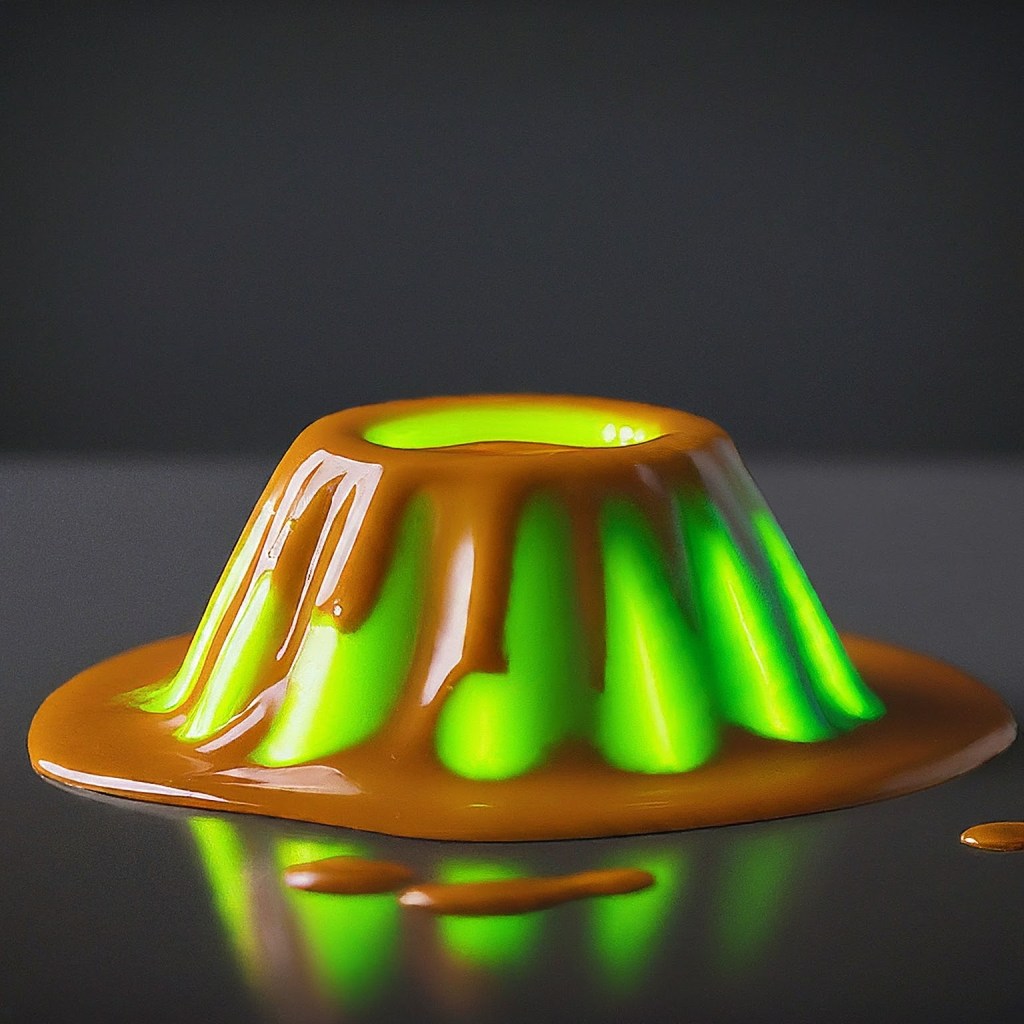
GCP stands for Glowing Carbonated Pudding.
I can’t assume that you already knew this acronym, because I just made it up. But I can assure you that the GCP market is a huge market…at least in my brain. All the non-existent kids love the scientifically advanced and maximally cool pudding that glows in the dark and has tiny bubbles in it.
Glowing Carbonated Pudding. Designed by Google Bard. Yeah, Google Bard creates images now.
Now if you had studied this non-existent market like I have, you’ll realize from the outset that most of the players don’t really differentiate their offerings. Here are a few examples of firms with poor product marketing:
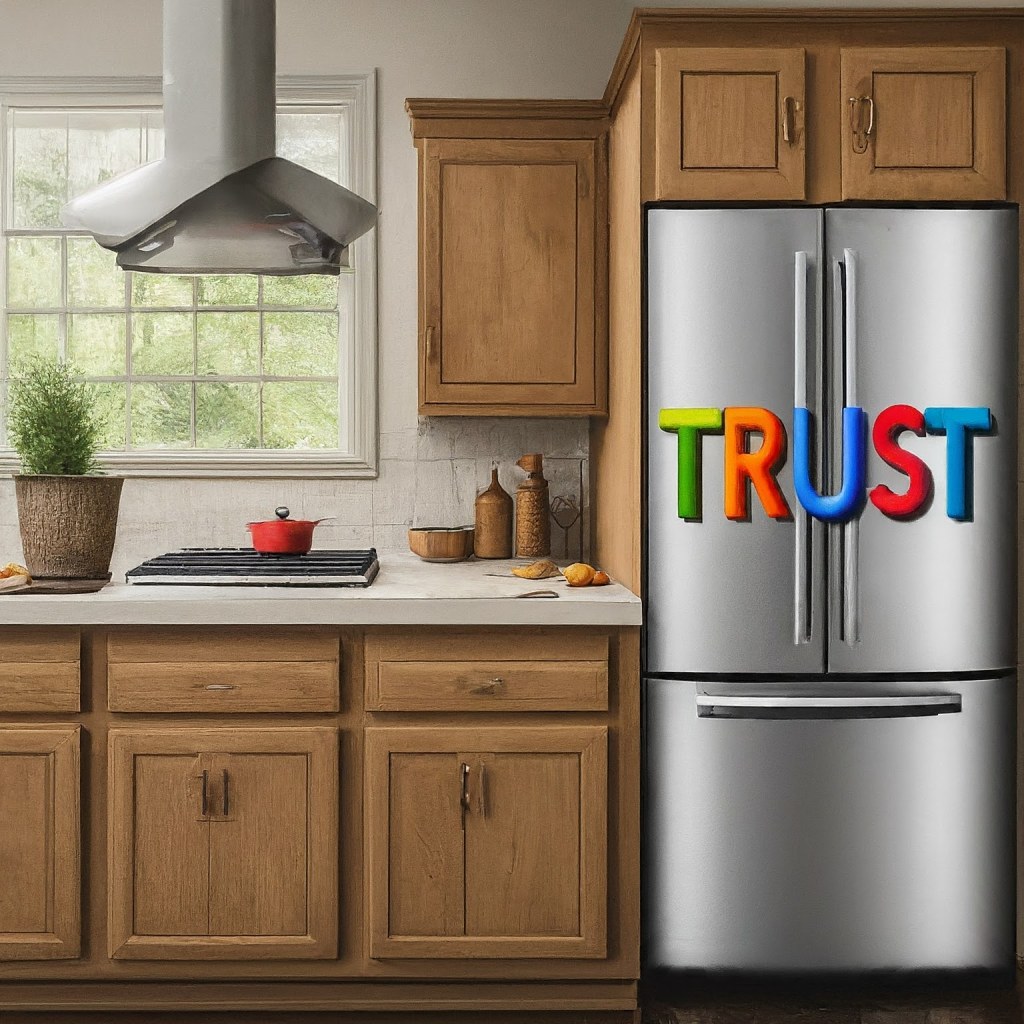
Jane Spain GCP: “Trust us to provide good GCP.”
Betty Brazil GCP: “Trust us to provide really good GCP.”
Clara Canada GCP: “Trust us to provide great GCP.”
You can probably figure out what happened here.
The CEO at Betty Brazil told the company’s product marketers, “Do what Jane Spain did but do it better.”
After that Clara Canada’s CEO commanded, “Do what Betty Brazil did but do it better.” (I’ll let you in on a little secret. Clara Canada’s original slogan refereneced “the best GCP,” but Legal shot that down.)
But another company, Wendy Wyoming, decided to differentiate itself, and cited independent research as its differentiator.
Wendy Wyoming Out of This World GCP satisfies you, and we have independent evidence to prove it!
The U.S. National Institute of Standards and Technology, as part of its Pudding User Made (PUM, not FRTE) Test, confirmed that 80% of all Wendy Wyoming Out of This World GCP mixes result in pudding that both glows and is carbonated. (Mix WW3, submitted November 30, 2023; not omnigarde-003)
Treat your child to science-backed cuisine with Wendy Wyoming Out of This World GCP!Wendy Wyoming is a top tier (excluding Chinese mixes) GCP provider.
But there are other competitors…
The indirect competitor who questions the quantified benefits
There are direct competitors that provide the same product as Wendy Wyoming, Jane Spain, and everyone else.
And then there are indirect competitors who provide non-GCP alternatives that can substitute for GCPs.
For example, Polly Pennsylvania is NOT a GCP provider. It makes what the industry calls a POPS, or a Plain Old Pudding Sustenance. Polly Pennsylvania questions everything about GCP…and uses Wendy Wyoming’s own statistics against it.
Designed by Google Bard.
Fancy technologies have failed us.
If you think that one of these GCP puddings will make your family happy, think again. A leading GCP provider has publicly admitted that 1 out of every 5 children who buy a GCP won’t get a GCP. Either it won’t glow, or it’s not carbonated. Do you want to make your kid cry?
Treat your child to the same pudding that has satisfied many generations. Treat your child to Polly Pennsylvania Perfect POPS.
Pennsylvania Perfect remembers.
So who wins?
It looks like Polly Pennsylvania and Wendy Wyoming have a nasty fight on their hands. One that neck-deep marketers like to call a “war.” Except that nobody dies. (Sadly, that’s not true.)
Some people think that Wendy Wyoming wins because 4 out of 5 of their customers receive true GCP.
Others think that Polly Pennsylvaia wins because 5 out of 5 of their customers get POPS pudding.
But it’s clear who lost.
All the Jane Spains and Betty Brazils who didn’t bother to create a distinctive message.
Don’t be Jane Spain. Explain why your product is the best and all the other products aren’t.
Copying the competition doesn’t differentiate you. Trust me.
The “hungry people” (target audience) for THIS post
Oh, and if you didn’t figure it out already, this post was NOT intended for scientific pudding manufacturers. It was intended for identity/biometric firms who can use some marketing and writing help. Hence the references to NIST and the overused word “trust.”
If you’re hungry to kickstart your identity/biometric firm’s written content, click on the image below to learn about Bredemarket’s services.
We get all sorts of great tools, but do we know how to use them? And what are the consequences if we don’t know how to use them? Could we lose the use of those tools entirely due to bad publicity from misuse?
According to a report released in September by the US Government Accountability Office, only 5 percent of the 196 FBI agents who have access to facial recognition technology from outside vendors have completed any training on how to properly use the tools.
It turns out that the study is NOT limited to FBI use of facial recognition services, but also addresses six other federal agencies: the Bureau of Alcohol, Tobacco, Firearms and Explosives (the guvmint doesn’t believe in the Oxford comma); U.S. Customs and Border Protection; the Drug Enforcement Administration; Homeland Security Investigations; the U.S. Marshals Service; and the U.S. Secret Service.
Initially, none of the seven agencies required users to complete facial recognition training. As of April 2023, two of the agencies (Homeland Security Investigations and the U.S. Marshals Service) required training, two (the FBI and Customs and Border Protection) did not, and the other three had quit using these four facial recognition services.
The FBI stated that facial recognition training was recommended as a “best practice,” but not mandatory. And when something isn’t mandatory, you can guess what happened:
GAO found that few of these staff completed the training, and across the FBI, only 10 staff completed facial recognition training of 196 staff that accessed the service. FBI said they intend to implement a training requirement for all staff, but have not yet done so.
Although not a requirement, FBI officials said they recommend (as a best practice) that some staff complete FBI’s Face Comparison and Identification Training when using Clearview AI. The recommended training course, which is 24 hours in length, provides staff with information on how to interpret the output of facial recognition services, how to analyze different facial features (such as ears, eyes, and mouths), and how changes to facial features (such as aging) could affect results.
However, this type of training was not recommended for all FBI users of Clearview AI, and was not recommended for any FBI users of Marinus Analytics or Thorn.
I should note that the report was issued in September 2023, based upon data gathered earlier in the year, and that for all I know the FBI now mandates such training.
Or maybe it doesn’t.
What about your state and local facial recognition users?
Of course, training for federal facial recognition users is only a small part of the story, since most of the law enforcement activity takes place at the state and local level. State and local users need training so that they can understand:
The anatomy of the face, and how it affects comparisons between two facial images.
How cameras work, and how this affects comparisons between two facial images.
How poor quality images can adversely affect facial recognition.
How facial recognition should ONLY be used as an investigative lead.
If facial recognition users had been trained, none of the false arrests over the last few years would have taken place.
The users would have realized that the poor images were not of sufficient quality to determine a match.
The users would have realized that even if they had been of sufficient quality, facial recognition must only be used as an investigative lead, and once other data had been checked, the cases would have fallen apart.
But the false arrests gave the privacy advocates the ammunition they needed.
Not to insist upon proper training in the use of facial recognition.
Like nuclear or biological weapons, facial recognition’s threat to human society and civil liberties far outweighs any potential benefits. Silicon Valley lobbyists are disingenuously calling for regulation of facial recognition so they can continue to profit by rapidly spreading this surveillance dragnet. They’re trying to avoid the real debate: whether technology this dangerous should even exist. Industry-friendly and government-friendly oversight will not fix the dangers inherent in law enforcement’s discriminatory use of facial recognition: we need an all-out ban.
(And just wait until the anti-facial recognition forces discover that this is not only a plot of evil Silicon Valley, but also a plot of evil non-American foreign interests located in places like Paris and Tokyo.)
Because the anti-facial recognition forces want us to remove the use of technology and go back to the good old days…of eyewitness misidentification.
Eyewitnesses are often expected to identify perpetrators of crimes based on memory, which is incredibly malleable. Under intense pressure, through suggestive police practices, or over time, an eyewitness is more likely to find it difficult to correctly recall details about what they saw.
Apologies in advance, but if you’re NOT interested in fingerprints, you’ll want to skip over this Bredemarket identity/biometrics post, my THIRD one about fingerprint uniqueness and/or similarity or whatever because the difference between uniqueness and similarity really isn’t important, is it?
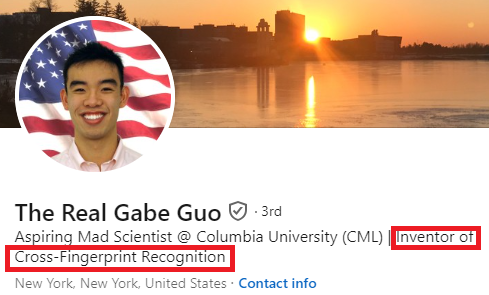
Yes, one more post about the study whose principal author was Gabe Guo, the self-styled “inventor of cross-fingerprint recognition.”
I also wrote something only on LinkedIn (and Facebook) that cited a CNN article that quoted Christophe Champod and Simon Cole. (Interestingly enough, my last post on Cole concerned how words matter, which is appropriate in this discussion.) Unfortunately, the person who wrote the CNN headline (“Are fingerprints unique? Not really, AI-based study finds”) didn’t pay attention to a word that Champod and Simon Cole said.
But don’t miss this
Well, two other people have weighed in on the paper: Glenn Langenburg and Eric Ray, co-presenters on the Double Loop Podcast. (“Double loop” is a fingerprint thing.)
So who are Langenburg and Ray? You can read their full biographies here, but both of them are certified latent print examiners. This certification, administered by the International Association for Identification, is designed to ensure that the certified person is knowledgeable about both latent (crime scene) fingerprints and known fingerprints, and how to determine whether or not two prints come from the same person. If someone is going to testify in court about fingerprint comparison, this certification is recognized as a way to designate someone as an expert on the subject, as opposed to a college undergraduate. (As of today, the list of IAI certified latent print examiners as of December 2023 can be found here in PDF form.)
Podcast episode 264 dives into the Columbia study in detail, including what the study said, what it didn’t say, and what the publicity for the study said that doesn’t match the study.
Eric and Glenn respond to the recent allegations that a computer science undergraduate at Columbia University, using Artificial Intelligence, has “proven that fingerprints aren’t unique” or at least…that’s how the media is mischaracterizing a new published paper by Guo, et al. The guys dissect the actual publication (“Unveiling intra-person fingerprint similarity via deep contrastive learning” in Science Advances, 2024 by Gabe Guo, et al.). They state very clearly what the paper actually does show, which is a far cry from the headlines and even public dissemination originating from Columbia University and the author. The guys talk about some of the important limitations of the study and how limited the application is to real forensic investigations. They then explore some of the media and social media outlets that have clearly misunderstood this paper and seem to have little understanding of forensic science. Finally, Eric and Glenn look at some quotes and comments from knowledgeable sources who also have recognized the flaws in the paper, the authors’ exaggerations, and lack of understanding of the value of their findings.
Yes, the episode is over an hour long, but if you want to hear a good discussion of the paper that goes beyond the headlines, I strongly recommend that you listen to it.
TL;DR
If you’re in a TL;DR frame of mind, I’ll just offer one tidbit: “uniqueness” and “similarity” are not identical. Frankly, they’re not even similar.
This post concentrates on IDENTIFICATION perfection, or the ability to enjoy zero errors when identifying individuals.
The risk of claiming identification perfection (or any perfection) is that a SINGLE counter-example disproves the claim.
If you assert that your biometric solution offers 100% accuracy, a SINGLE false positive or false negative shatters the assertion.
If you claim that your presentation attack detection solution exposes deepfakes (face, voice, or other), then a SINGLE deepfake that gets past your solution disproves your claim.
And as for the pre-2009 claim that latent fingerprint examiners never make a mistake in an identification…well, ask Brandon Mayfield about that one.
In fact, I go so far as to avoid using the phrase “no two fingerprints are alike.” Many years ago (before 2009) in an International Association for Identification meeting, I heard someone justify the claim by saying, “We haven’t found a counter-example yet.” That doesn’t mean that we’ll NEVER find one.
At first glance, it appears that Motorola would be the last place to make a boneheaded mistake like that. After all, Motorola is known for its focus on quality.
But in actuality, Motorola was the perfect place to make such a mistake, since it was one of the champions of the “Six Sigma” philosophy (which targets a maximum of 3.4 defects per million opportunities). Motorola realized that manufacturing perfection is impossible, so manufacturers (and the people in Motorola’s weird Biometric Business Unit) should instead concentrate on reducing the error rate as much as possible.
So one misspelling could be tolerated, but I shudder to think what would have happened if I had misspelled “quality” a second time.
If you listen closely, you can hear about all sorts of wonderful biometric identifiers. They range from the common (such as fingerprint ridges and detail) to the esoteric (my favorite was the 2013 story about Japanese car seats that captured butt prints).
Forget about fingerprints and faces and irises and DNA and gait recognition and butt prints. Tongue prints are the answer!
Benefits of tongue print biometrics
To its credit, the article does point out two benefits of using tongue prints as a biometric identifier.
Consent and privacy. Unlike fingerprints and irises (and faces) which are always exposed and can conceivably be captured without the person’s knowledge, the subject has to provide consent before a tongue image is captured. For the most part, tongues are privacy-perfect.
Liveness. The article claims that “sticking out one’s tongue is an undeniable ‘proof of life.'” Perhaps that’s an exaggeration, but it is admittedly much harder to fake a tongue than it is to fake a finger or a face.
Are tongues unique?
But the article also makes these claims.
Two main attributes are measured for a tongue print. First is the tongue shape, as the shape of the tongue is unique to everyone.
The other notable feature is the texture of the tongue. Tongues consist of a number of ridges, wrinkles, seams and marks that are unique to every individual.
There is serious doubt (if not outright denial) that everyone has a unique face (although NIST is investigating this via the FRTE Twins Demonstration).
But at least these modalities are under study. Has anyone conducted a rigorous study to prove or disprove the uniqueness of tongues? By “rigorous,” I mean a study that has evaluated millions of tongues in the same way that NIST has evaluated millions of fingerprints, faces, and irises?
I did find this 2017 tongue identification pilot study but it only included a whopping 20 participants. And the study authors (who are always seeking funding anyway) admitted that “large-scale studies are required to validate the results.”
Conclusion
So if a police officer tells you to stick out your tongue for identification purposes, think twice.
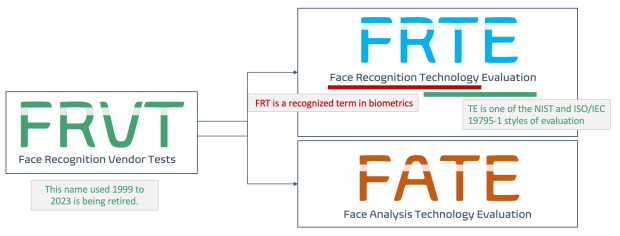
I’ve talked about why NIST separated its FRVT efforts into FRTE and FATE.
But I haven’t talked bout how NIST did this.
And as you all know, the second most important question after why is how.
Why the great renaming took place
As I noted back in August, NIST chose to split its Face Recognition Vendor Test (FRVT) into two parts—FRTE (Face Recognition Technology Evaluation) and FATE (Face Analysis Technology Evaluation).
In essence, the Face Recognition Vendor Test had become a hodgepodge of different things. Some of the older tests were devoted to identification of individuals (face recognition), while some of the newer tests were looking at issues other than individual identification (face analysis).
Of course, this confusion between identification and non-identification is nothing new, which is why some of the people who read Gender Shades falsely concluded that if the three algorithms couldn’t classify people by sex or race, they couldn’t identify them as individuals.
But I digress. (I won’t do it again.)
NIST explained at the time:
Tracks that involve the processing and analysis of images will run under the FATE activity, and tracks that pertain to identity verification will run under FRTE.
To date, most of my personal attention (and probably most of yours) was paid to what was previously called FRVT 1:1 and FRVT 1:N.
These two tests are now part of FRTE, and were simply renamed to FRTE 1:1 and FRTE 1:N. They’ve even (for now) retained the same URLs, although that may change in the future.
Other tests that are now part of the FRTE bucket include:
The “Still Face and Iris 1:N Identification” effort (PDF) has apparently also been reclassified as an FRTE effort.
What is in FATE?
Obviously, presentation attack detection (PAD) testing falls into the FATE category, since this does not measure the identification of an individual, but whether a person is truly there or not. The first results have been released; I previously wrote about this here.
The next obvious category is age estimation testing, which again does not try to identify an individual, but estimate how old the person is. This testing has not yet started, but I talked about the concept of age estimation previously.
It is very possible that NIST will add additional FRTE and FATE tests in the future. These may be brand new tests, or variations of existing tests. For example, when all of us started wearing face masks a couple of years ago, NIST simulated face masks on its existing facial images and created the data for the face mask test described above.
What do you think NIST should test next, either in the FRTE or the FATE category?
More on morphing
And yes, I’m concluding this post with this video. By the way, this is the full version that (possibly intentionally) caused a ton of controversy and was immediately banned for nearly a quarter century. The morphing starts at 5:30. The crotch-grabbing starts right after the 7:00 mark.
Perhaps because of the lack of controversy with Godley & Creme’s earlier effort, Ashley Clark prefers it to the later Michael Jackson/John Landis effort.
Whereas Godley & Creme used editing technology to embrace and reflect the ambiguous murk of thwarted love, Jackson and Landis imposed an artificial sheen on the complexity of identity; a sheen that feels poignant if not outright tragic in the wake of Jackson’s ultimate appearance and fate. Really, it did matter if he was black or white.
One of the main application areas of facial morphing for criminal purposes is forging identity documents. The attack targets face-based identity verification systems and procedures. Most often it involves passports; however, any ID document with a photo can be compromised.
One well-known case happened in 2018 when a group of activists merged together a photo of Federica Mogherini, the High Representative of the European Union for Foreign Affairs and Security Policy, and a member of their group. Using this morphed photo, they managed to obtain an authentic German passport.
I mentioned something in passing in Bredemarket’s recent go-to-market post that I think needs a little more highlighting. So here is a deeper dive into the 22 types of content that product marketers create. (Well, at least 22. I’m probably missing some.)
And by the way, I have created all 22 of these types of content, from blog posts and battlecards to smartphone application content and scientific book chapters. And I can create it for you.
Why is it that so many business-to-business (B2B) marketers confuse product marketing with content marketing?
Because it requires a lot of discipline. That’s why.
B2B marketers who get it right understand the difference between these two fundamentally different types of marketing, what their purposes are and how to use them correctly.
Some firms (especially startups) don’t have the luxury to enforce such definitions. They don’t have separate teams to create awareness content, consideration content, and conversion content. They have one team (or perhaps one person) to create all that content PLUS other stuff that I’ll discuss later.
For example, during my most recent stint as a product marketing employee at a startup, the firm had no official content marketers, so the product marketers had to create a lot of non-product related content. So we product marketers were the de facto content marketers for the company too. (Sadly, we didn’t get two salaries for filling two roles.)
Why did the product marketers end up as content marketers? It turns out that it makes sense—after all, people who write about your product in the lower funnel stages can also write about your product in the upper funnel stages, and also can certainly write about OTHER things, such as company descriptions, speaker submissions, and speaker biographies.
As a result, I’ve written a ton of stuff over my last 29 years in identity/biometrics. It didn’t take a great leap for me to self-identify as the identity content marketing expert and the biometric content marketing expert (and other expert definitions; I’m an expert in creating expert titles).
I’ve compiled a summary of the types of content that I’ve created over the years, not only for Bredemarket’s clients, but also for my employers at Incode Technologies, IDEMIA, MorphoTrak, Motorola, and Printrak.
Not all of these were created when I was in a formal product marketing role, but depending upon your product or service, you may need any of these content types to support the marketing of your product/service.
It’s helpful to divide the list into two parts: the external (customer-facing) content, and the internal (company-only) content.
10 types of external content I have created
External content is what most people think of when they talk about product marketing or content marketing. After all, this is the visible stuff that the prospects see, and which can move them toward a purchase (conversion). The numbers after some content types indicate the quantities of pieces of collateral that I have created.
Articles
Blog Posts (500+, including this one)
Briefs/Data/Literature Sheets
Case Studies (12+)
Proposals (100+)
Scientific Book Chapters
Smartphone Application Content
Social Media (Facebook, Instagram, LinkedIn, Threads, TikTok, Twitter)
Web Page Content
White Papers and E-Books
Here’s an video showing some of the external content that I have created for Bredemarket.
While external content is sexy, internal content is extremely important, since it’s what equips the people inside a firm to promote your product or service. The numbers after some content types indicate the quantities of pieces of collateral that I have created.
Battlecards (80+)
Competitive Analyses
Event/Conference/Trade Show Demonstration Scripts
Plans
Playbooks
Proposal Templates
Quality Improvement Documents
Requirements
Strategic Analyses
And here are 3 more types
Some content can either be external or internal. Again, numbers indicate the quantities of pieces of collateral I have created.
Email Newsletters (200+)
FAQs
Presentations
Content I can create for you
Does your firm need help creating one of these types of content?
Maybe two?
Maybe 22?
I can create content full-time for you
If your firm needs to create a lot of content types for your products, then consider hiring me as your full-time Senior Product Marketing Manager. My LinkedIn profile is here, documenting my 29 years of experience in identity/biometric technology as a product marketer, a strategist, and in other roles.
(D)igital security engineers at the University of Wisconsin–Madison have found these systems are not quite as foolproof when it comes to a novel analog attack. They found that speaking through customized PVC pipes — the type found at most hardware stores — can trick machine learning algorithms that support automatic speaker identification systems.
The project began when the team began probing automatic speaker identification systems for weaknesses. When they spoke clearly, the models behaved as advertised. But when they spoke through their hands or talked into a box instead of speaking clearly, the models did not behave as expected.
(Shimaa) Ahmed investigated whether it was possible to alter the resonance, or specific frequency vibrations, of a voice to defeat the security system. Because her work began while she was stuck at home due to COVID-19, Ahmed began by speaking through paper towel tubes to test the idea. Later, after returning to the lab, the group hired Yash Wani, then an undergraduate and now a PhD student, to help modify PVC pipes at the UW Makerspace. Using various diameters of pipe purchased at a local hardware store, Ahmed, Yani and their team altered the length and diameter of the pipes until they could produce the same resonance as they voice they were attempting to imitate.
Eventually, the team developed an algorithm that can calculate the PVC pipe dimensions needed to transform the resonance of almost any voice to imitate another. In fact, the researchers successfully fooled the security systems with the PVC tube attack 60 percent of the time in a test set of 91 voices, while unaltered human impersonators were able to fool the systems only 6 percent of the time.
We evaluate two state-of-the-art ASI models: (1) the x-vector network [51] implemented by Shamsabadi et al. [45], and (2) the emphasized channel attention, propagation and aggregation time delay neural network (ECAPATDNN) [17], implemented by SpeechBrain.1 Both models were trained on VoxCeleb dataset [15, 36, 37], a benchmark dataset for ASI. The x-vector network is trained on 250 speakers using 8 kHz sampling rate. ECAPA-TDNN is trained on 7205 speakers using 16 kHz sampling rate. Both models report a test accuracy within 98-99%.
So what we know is that this test, which used these two ASI models trained on a particular dataset, demonstrated an ability to fool systems 60 percent of the time.
But…
What does this mean for other ASI algorithms, including the commercial algorithms in use today?
And what does it mean when other datasets are used?
In other words (and I’m adapting my own text here), how do the results of this study affect “current automatic speaker identification products”?
The answer is “We don’t know.”
So pipe down…until we actually test commercial algorithms for this technique.
But I’m sure that the UW-Madison researchers and I agree on one thing: more research is needed.
I know that I’m the guy who likes to say that it’s all semantics. After all, I’m the person who has referred to five-page long documents as “battlecards.”
But sometimes the semantics are critically important. Take the terms “factors” and “modalities.” On the surface they sound similar, but in practice there is an extremely important difference between factors of authentication and modalities of authentication. Let’s discuss.
What is a factor?
To answer the question “what is a factor,” let me steal from something I wrote back in 2021 called “The five authentication factors.”
Something You Know. Think “password.” And no, passwords aren’t dead. But the use of your mother’s maiden name as an authentication factor is hopefully decreasing.
Something You Have. I’ve spent much of the last ten years working with this factor, primarily in the form of driver’s licenses. (Yes, MorphoTrak proposed driver’s license systems. No, they eventually stopped doing so. But obviously IDEMIA North America, the former MorphoTrust, has implemented a number of driver’s license systems.) But there are other examples, such as hardware or software tokens.
Something You Are. I’ve spent…a long time with this factor, since this is the factor that includes biometrics modalities (finger, face, iris, DNA, voice, vein, etc.). It also includes behavioral biometrics, provided that they are truly behavioral and relatively static.
Something You Do. The Cybersecurity Man chose to explain this in a non-behavioral fashion, such as using swiping patterns to unlock a device. This is different from something such as gait recognition, which supposedly remains constant and is thus classified as behavioral biometrics.
Somewhere You Are. This is an emerging factor, as smartphones become more and more prevalent and locations are therefore easier to capture. Even then, however, precision isn’t always as good as we want it to be. For example, when you and a few hundred of your closest friends have illegally entered the U.S. Capitol, you can’t use geolocation alone to determine who exactly is in Speaker Pelosi’s office.
(By the way, if you search the series of tubes for reading material on authentication factors, you’ll find a lot of references to only three authentication factors, including references from some very respectable sources. Those sources are only 60% right, since they leave off the final two factors I listed above. It’s five factors of authentication, folks. Maybe.)
The one striking thing about the five factors is that while they can all be used to authenticate (and verify) identities, they are inherently different from one another. The ridges of my fingerprint bear no relation to my 16 character password, nor do they bear any relation to my driver’s license. These differences are critical, as we shall see.
What is a modality?
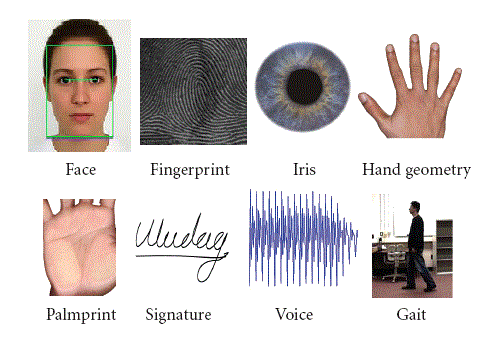
In identity usage, a modality refers to different variations of the same factor. This is most commonly used with the “something you are” (biometric) factor, but it doesn’t have to be.
[M]any businesses and individuals (are adopting) biometric authentication as it been established as the most secure authentication method surpassing passwords and pins. There are many modalities of biometric authentication to pick from, but which method is the best?
After looking at fingerprints, faces, voices, and irises, Aware basically answered its “best” question by concluding “it depends.” Different modalities have their own strengths and weaknesses, depending upon the use case. (If you wear thick gloves as part of your daily work, forget about fingerprints.)
ID R&D goes a step further and argues that it’s best to use multimodal biometrics, in which the two biometrics are face and voice. (By an amazing coincidence, ID R&D offers face and voice solutions.)
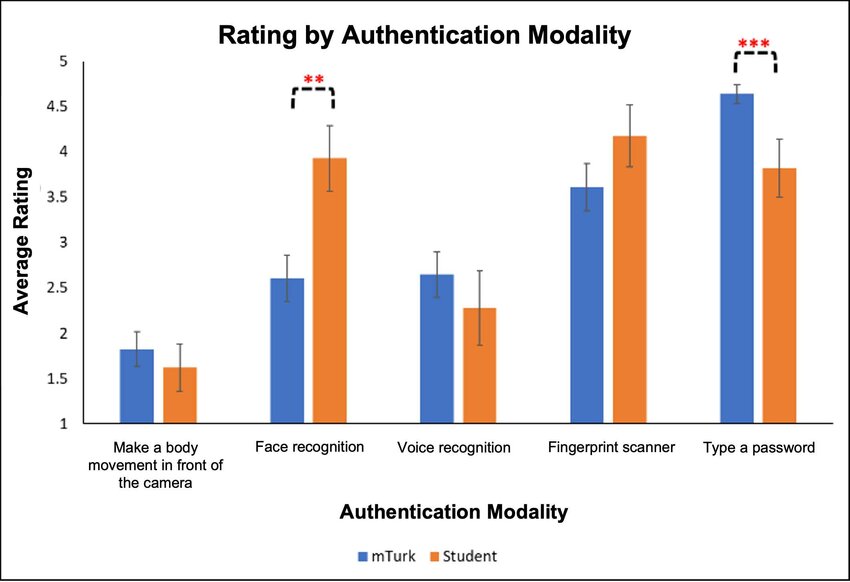
The three modalities in the middle—face, voice, and fingerprint—are all clearly biometric “something you are” modalities.
But the modality on the left, “Make a body movement in front of the camera,” is not a biometric modality (despite its reference to the body), but is an example of “something you do.”
Passwords, of course, are “something you know.”
In fact, each authentication factor has multiple modalities.
For example, a few of the modalities associated with “something you have” include driver’s licenses, passports, hardware tokens, and even smartphones.
Why multifactor is (usually) more robust than multimodal
Modalities within a single authentication factor are more closely related than modalities within multiple authentication factors. As I mentioned above when talking about factors, there is no relationship between my fingerprint, my password, and my driver’s license. However, there is SOME relationship between my driver’s license and my passport, since the two share some common information such as my legal name and my date of birth.
What does this mean?
If I’ve fraudulently created a fake driver’s license in your name, I already have some of the information that I need to create a fake passport in your name.
If I’ve fraudulently created a fake iris, there’s a chance that I might already have some of the information that I need to create a fake face.
However, if I’ve bought your Coinbase password on the dark web, that doesn’t necessarily mean that I was able to also buy your passport information on the dark web (although it is possible).
Can an identity content marketing expert help you navigate these issues?
As you can see, you need to be very careful when writing about modalities and factors.
You need a biometric content marketing expert who has worked with many of these modalities.
Actually, you need an identity content marketing expert who has worked with many of these factors.
So if you are with an identity company and need to write a blog post, LinkedIn article, white paper, or other piece of content that touches on multifactor and multimodal issues, why not engage with Bredemarket to help you out?
If you’re interested in receiving my help with your identity written content, contact me.
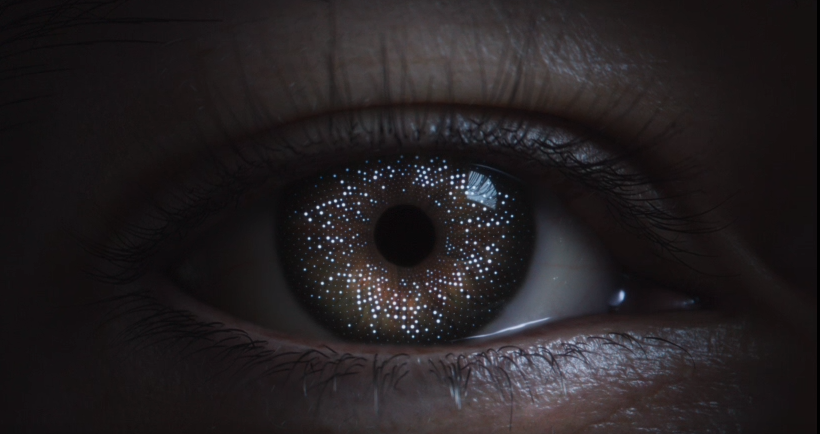
Iris recognition continues to make the news. Let’s review what iris recognition is and its benefits (and drawbacks), why Apple made the news last month, and why Worldcoin is making the news this month.
What is iris recognition?
There are a number of biometric modalities that can identify individuals by “who they are” (one of the five factors of authentication). A few examples include fingerprints, faces, voices, and DNA. All of these modalities purport to uniquely (or nearly uniquely) identify an individual.
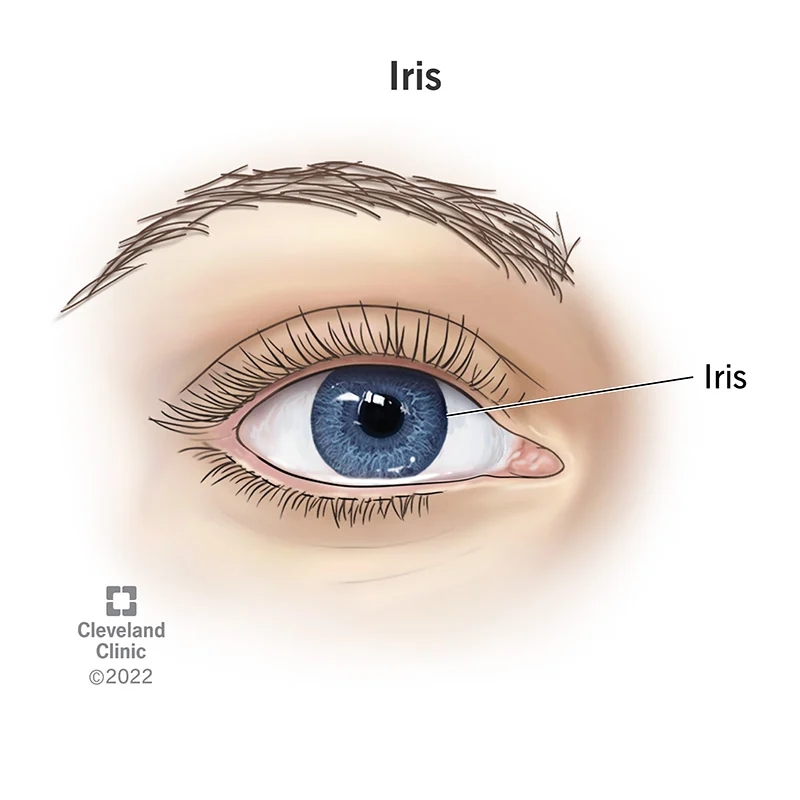
One other way to identify individuals is via the irises in their eyes. I’m not a doctor, but presumably the Cleveland Clinic employs medical professionals who are qualified to define what the iris is.
The iris is the colored part of your eye. Muscles in your iris control your pupil — the small black opening that lets light into your eye.
But why use irises rather than, say, fingerprints and faces? The best person to answer this is John Daugman. (At this point several of you are intoning, “John Daugman.” With reason. He’s the inventor of iris recognition.)
(I)ris patterns become interesting as an alternative approach to reliable visual recognition of persons when imaging can be done at distances of less than a meter, and especially when there is a need to search very large databases without incurring any false matches despite a huge number of possibilities. Although small (11 mm) and sometimes problematic to image, the iris has the great mathematical advantage that its pattern variability among different persons is enormous.
Daugman, John, “How Iris Recognition Works.” IEEE TRANSACTIONS ON CIRCUITS AND SYSTEMS FOR VIDEO TECHNOLOGY, VOL. 14, NO. 1, JANUARY 2004. Quoted from page 21. (PDF)
Or in non-scientific speak, one benefit of iris recognition is that you know it is accurate, even when submitting a pair of irises in a one-to-many search against a huge database. How huge? We’ll discuss later.
Brandon Mayfield and fingerprints
Remember that Daugman’s paper was released roughly two months before Brandon Mayfield was misidentified in a fingerprint comparison. (Everyone now intone “Brandon Mayfield.”)
While some of the issues associated with Mayfield’s misidentification had nothing to do with forensic science (Al Jazeera spends some time discussing bias, and Itiel Dror also looked at bias post-Mayfield), this still shows that fingerprints are remarkably similar and that it takes care to properly identify people.
Police agencies, witnesses, and faces
And of course there are recent examples of facial misidentifications (both by police agencies and witnesses), again not necessarily forensic science related, and again showing the similarity of faces from two different people.
At the root of iris recognition’s accuracy is the data-richness of the iris itself. The IrisAccess system captures over 240 degrees of freedom or unique characteristics in formulating its algorithmic template. Fingerprints, facial recognition and hand geometry have far less detailed input in template construction.
Enough about claims. What about real results? The IREX 10 test, independently administered by the U.S. National Institute of Standards and Technology, measures the identification (one-to-many) accuracy of submitted algorithms. At the time I am writing this, the ten most accurate algorithms provide false negative identification rates (FNIR) between 0.0022 ± 0.0004 and 0.0037 ± 0.0005 when two eyes are used. (Single eye accuracy is lower.) By the time you see this, the top ten algorithms may have changed, because the vendors are always improving.
IREX10 two-eye accuracy, top ten algorithms as of July 28, 2023. (Link)
While the IREX10 one-to-many tests are conducted against databases of less than a million records, it is estimated that iris one-to-many accuracy remains high even with databases of a billion people—something we will return to later in this post.
Iris drawbacks
OK, so if irises are so accurate, why aren’t we dumping our fingerprint readers and face readers and just using irises?
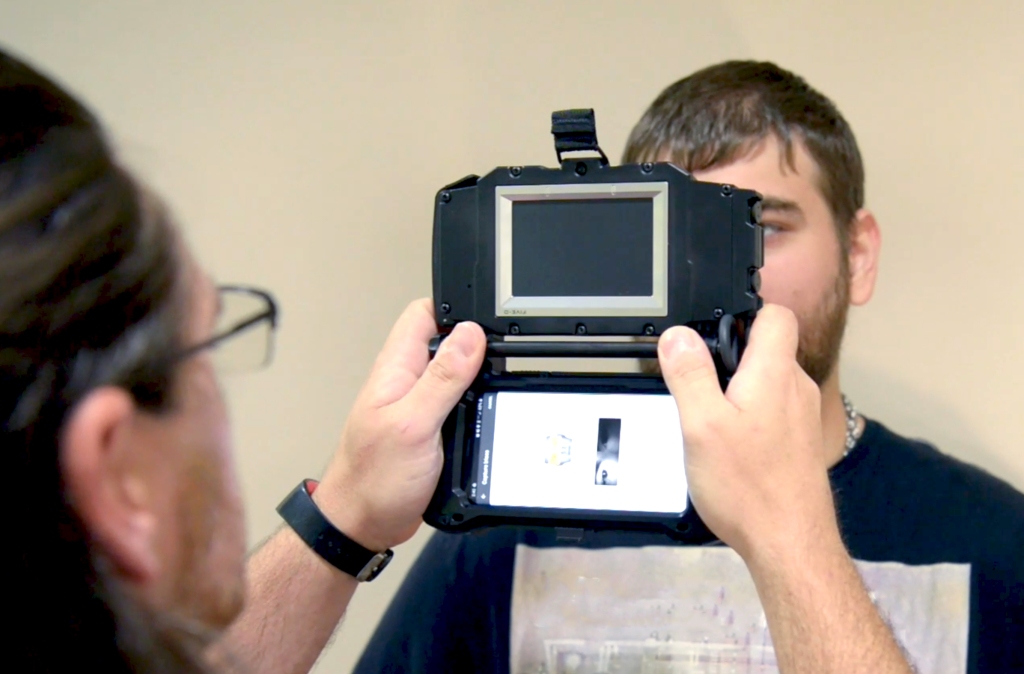
In short, because of the high friction in capturing irises. You can use high-resolution cameras to capture fingerprints and faces from far away, but as of now iris capture usually requires you to get very close to the capture device.
Iris image capture circa 2020 from the U.S. Federal Bureau of Investigation. (Link)
Which I guess is better than the old days when you had to put your eye right up against the capture device, but it’s still not as friendly (or intrusive) as face capture, which can be achieved as you’re walking down a passageway in an airport or sports stadium.
Irises and Apple Vision Pro
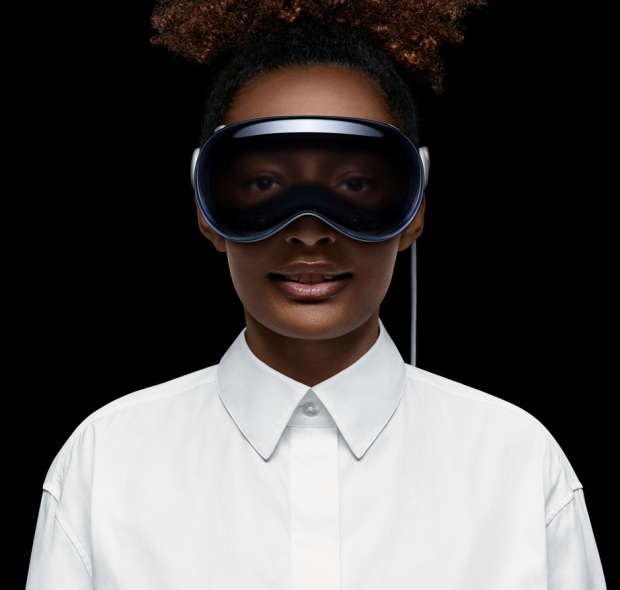
So how are irises being used today? You may or may not have hard last month’s hoopla about the Apple Vision Pro, which uses irises for one-to-one authetication.
I’m not going to spend a ton of time delving into this, because I just discussed Apple Vision Pro in June. In fact, I’m just going to quote from what I already said.
In short, as you wear the headset (which by definition is right on your head, not far away), the headset captures your iris images and uses them to authenticate you.
It’s a one-to-one comparison, not the one-to-many comparison that I discussed earlier in this post, but it is used to uniquely identify an individual.
But iris recognition doesn’t have to be used for identification.
Irises and Worldcoin
“But wait a minute, John,” you’re saying. “If you’re not using irises to determine if a person is who they say they are, then why would anyone use irises?”
Over the past several years, I’ve analyzed a variety of identity firms. Earlier this year I took a look at Worldcoin….Worldcoin’s World ID emphasizes privacy so much that it does not conclusively prove a person’s identity (it only proves a person’s uniqueness)…
That’s the only thing that I’ve said about Worldcoin, at least publicly. (I looked at Worldcoin privately earlier in 2023, but that report is not publicly accessible and even I don’t have it any more.)
The Worldcoin Foundation today announced that Worldcoin, a project co-founded by Sam Altman, Alex Blania and Max Novendstern, is now live and in a production-grade state.
The launch includes the release of the World ID SDK and plans to scale Orb operations to 35+ cities across 20+ countries around the world. In tandem, the Foundation’s subsidiary, World Assets Ltd., minted and released the Worldcoin token (WLD) to the millions of eligible people who participated in the beta; WLD is now transactable on the blockchain….
“In the age of AI, the need for proof of personhood is no longer a topic of serious debate; instead, the critical question is whether or not the proof of personhood solutions we have can be privacy-first, decentralized and maximally inclusive,” said Worldcoin co-founder and Tools for Humanity CEO Alex Blania. “Through its unique technology, Worldcoin aims to provide anyone in the world, regardless of background, geography or income, access to the growing digital and global economy in a privacy preserving and decentralized way.”
Worldcoin does NOT positively identify people…but it can still pay you
A very important note: Worldcoin’s purpose is not to determine identity (that a person is who they say they are). Worldcoin’s purpose is to determine uniqueness: namely, that a person (whoever they are) is unique among all the billions of people in the world. Once uniqueness is determined, the person can get money money money with an assurance that the same person won’t get money twice.
Iris biometrics outperform other biometric modalities and already achieved false match rates beyond 1.2× 10−141.2×10⁻¹⁴ (one false match in one trillion[9]) two decades ago[10]—even without recent advancements in AI. This is several orders of magnitude more accurate than the current state of the art in face recognition.


















 Bredemarket