As some of you know, I’m applying for full-time employment. Every one of my cover letters has a variation on this sentence.
I am in Southern California, five miles from Ontario International Airport, and can easily travel throughout the United States or to other countries as needed.
You will note that I explicitly state that Ontario International Airport is in Southern California, not Canada. Although the phrase “Ontario CA” can be interpreted as referring to the city in the state of California, or the province in the country of Canada, depending upon how you look at it.
Not that anybody pays attention to my explicit California reference. When I was sharing pictures from the February 18 Ontario Art Walk, and labeling the pictures as originating from Ontario, California, I was still asked to promote one of the pictures on a Canadian Instagram page.
The curse that we endure in the town of the Chaffeys. I bet Mildura doesn’t have this problem.
While Ontario International Airport is not the only airport in the Inland Empire, it is (at present) the largest one, and thus has a dramatic effect on those of us who live here.
One impact? Well, in the same way that I can board a flight from ONT to my future employer in San Francisco or Austin or Paris or wherever, visitors can board flights to ONT.
And some of those visitors are business visitors. Years ago, I was one of them, flying from Portland, Oregon to some town I had never heard of before for a job interview. Not only did I fly into the airport (Terminal 1 in those days), but I also stayed at the Red Lion Inn and spent other money while I was in town for the interview.
Ontario International Airport Terminal 1 as of September 2021, 20 years after airport traffic changed forever.
Postscript: I got the job. And other jobs after that.
The economists assign a monetary impact to the activity attributable to the airport.
The impact of economic activity taking place at Ontario International Airport itself, including the activity of the airport authority, airlines and their suppliers, government workers, airport concessions, and logistics companies is estimated at $3.8 billion in 2022. This will support $2.2 billion in GDP and 27,800 jobs. The bulk of these impacts—71% of the GDP impacts and 76% of the jobs impacts— reflect the impact of visitor spending in the region.
But don’t forget the government, which gets its own goodies.
This $2.2 billion of local economic activity (GDP) will result in a total of $571 million in tax impact. This consists of $319 million in federal tax impacts and $253 million in state and local impacts. As with the GDP impacts, the majority (71%) of these tax impacts are driven by the spending of visitors to the region.
And this doesn’t count the impact of the Inland Empire’s logistics industry.
The total economic impact of the logistics activity in the eight zip codes adjacent to Ontario International Airport was $17.8 billion of economic output, $9.9 billion of GDP, and 122,200 jobs. This activity generated $2.3 billion in federal, state, and local taxes.
But what of non-monetary impacts? As the description of the Ontario International Airport – Inter Agency Collaborative (ONT-IAC) makes clear, some of those impacts are negative.
The ONT-IAC implements the policies and criteria of the Airport Land Use Compatibility Plan (ALUCP) to prevent future incompatible land uses surrounding ONT and minimizing the public’s exposure to excessivie noise and safety hazards.
There’s always a balancing act between positive and negative impacts. While I might appreciate the ability to board a flight to Dallas at 6:00 in the morning, someone who lives near the airport may not be as appreciative. And the referenced “incompatible land uses” restrict the types of businesses that can be located near the airport.
While the Amazon LGB3 warehouse in Eastvale, California is some distance from Ontario International Airport, the airport’s presence has a positive impact on the warehouse and its workers.
But the relatively large amount of open space near the airport (again, our beloved warehouses) has helped to ensure that ONT does not need to implement the severe flight restrictions found at John Wayne and our former airport overlord Los Angeles International Airport.
And for better or worse the airport will remain for some time. It’s not like it’s going to close down or anything.
Although 9/11, the 2008 recession, and COVID tried to close it.
And one more thing about your business…
Does your firm need to create content for Inland Empire residents, Inland Empire visitors, and others who use your firm’s services?
Are you ready to take your Ontario, Eastvale, or Inland Empire firm to the next level with a compelling message that increases awareness, consideration, conversion, and long-term revenue?
Are you an Inland Empire business who wants to promote the benefits of your products and services to your clients? If so, don’t assume that these benefits must be quantitative. You can use qualitative benefits also.
Benefits
Before we talk about quantative vs. qualitative benefits, let’s talk about benefits themselves, and how they differ from features.
She explains that your clients don’t care if your meal kit arrives ready to heat (a feature). Your clients care about saving time preparing meals (a benefit).
Quantitative benefits
In certain cases, the client may be even more impressed if the benefits can be expressed in a quantitative way. For example, if you know that your meal kit saves people an average of 37 minutes and 42.634 seconds preparing meals, let your client know this.
I’ll admit that Apple sometimes has some pretty stupid marketing statements (“It’s black!“). But sometimes the company grabs people’s attention with its messaging.
Later in the article, Apple’s chief operating officer (Jeff Williams) emphasizes the power theme: “…they’re no longer passengers on their own health journey. Instead, we want people to be firmly in the driver’s seat.”
Of course, this isn’t the first time that Apple has referred to empowering the individual. The company has done this for decades. Remember (then) Apple Computer’s slogan, “The Power to Be Your Best”? If you missed that particular slogan, here’s a commercial.
There are zero statistics in that commercial. It doesn’t say that the Macintosh computer would equip you to jump 5% higher, or sing on key 99.9% of the time. And Apple Computer didn’t claim that the Macintosh would equip you to draw bridge images 35.2% faster.
But the viewer could see that a Macintosh computer, with its graphical user interface, its support of then-new graphic programs, and (not shown in the ad) the ability to distribute the output of these graphic programs via laser printers, gave Macintosh users the power to…well, the power to be their best.
And some potential computer buyers perceived that this power provided infinite value.
As you work out your benefit statements, don’t give up if the benefits cannot be quantified. As long as the benefits resonate with the customer, qualitative benefits are just fine.
What are your benefits?
Let’s return to you and your Ontario, California area business that needs content marketing promotion. Before you draft your compay’s marketing material, or ask someone to draft it for you, you need to decide what your benefits are.
I’ve written a book about identifying benefits, and five other questions that you need to answer before creating marketing content.
Click on the image below, find the e-book at the bottom of the page, and skip to page 11 to read about benefits.
If I could demonstrate that Bredemarket benefited a firm via a case study, that could help Bredemarket get business from other firms. I said so myself:
A well-crafted case study can be the first step in convincing a potential customer to become a paying customer.
But once I started writing the document, I decided that one case study wasn’t enough.
So I wrote four mini-case studies in the same document, briefly describing how I helped four Bredemarket clients create different types of content so that they could win more business.
I helped one client to quickly generate consistent proposals. One of the client’s salespeople even provided me with a testimonial. (You may have seen it before.)
I helped another client share persuasive case studies. The client kept on coming back to me for more case studies—a dozen in all—and other work.
I helped a third client position via blogs and a white paper.
Finally, I helped position a sole proprietor.
After the four mini-case studies, I briefly described how Bredemarket works with clients. (Sleep is involved.)
I didn’t get into my six questions, since I already wrote an e-book on that topic, but I did provide an overview of the initial meeting, the content iteration process, and my work for hire policy (which explains why I didn’t name the four clients listed above).
So would you like to read my four mini-case studies?
Here is my latest e-book, “How Bredemarket Can Help You Win Business.”
Which is why I like to quote this testimonial that Bredemarket received from a client.
“I just wanted to truly say thank you for putting these templates together. I worked on this…last week and it was extremely simple to use and I thought really provided a professional advantage and tool to give the customer….TRULY THANK YOU!”
Although the testimonial writer wasn’t from Inland Empire business, Bredemarket can provide the same services for local firms. And I hope you are just as happy with the result.
Case studies build trust for Inland Empire businesses
With credibility comes trust. When potential customers read your case studies and find out what you’ve done for others, they’re more inclined to trust that you can provide similar benefits to them.
Case studies increase awareness for Inland Empire businesses
Traditional sales funnels start with awareness, since people won’t buy a product or service unless they’ve actually heard of it.
Case studies offer a mechanism to tell a good story about how someone faced a problem, chose your solution, and achieved wonderful results. Regardless of the specifics of your case study outline, it probably includes a problem, a solution, and results somewhere in there.
And entertaining stories can be told again and again as you share your case studies on social media…and others share your case studies on social media.
Case studies highlight the expertise of Inland Empire businesses
As potential clients learn about you, they also learn about your expertise, or what you can do. For example, people who need proposal templates and who read the testimonial above learn that Bredemarket can create proposal templates. And when they read a case study about your product or service, they learn about your expertise in your particular area.
Case studies increase the online visibility of Inland Empire businesses
Credibility, trust, awareness, expertise.
So what?
The “so what” here is that in the same way that your friends can refer people to your business, your case studies can refer people also.
As your case studies highlight your credibility and trust, provide awareness, and demonstrate your expertise, your products and services (as documented in the case studies) become known to search engines, especially if you’re resharing via social media. And as the search engines record your case study content, you gain a “secret salesperson.” I wrote about this a couple of years ago, quoting Rhonda Salvestrini:
Content for your business is one of the best ways to drive organic traffic. It’s your secret salesperson because it’s out there working for you 24/7. And it’s evergreen, so not only is it working…day in and day out…it’s available years down the road.
Rhonda Salvestrini
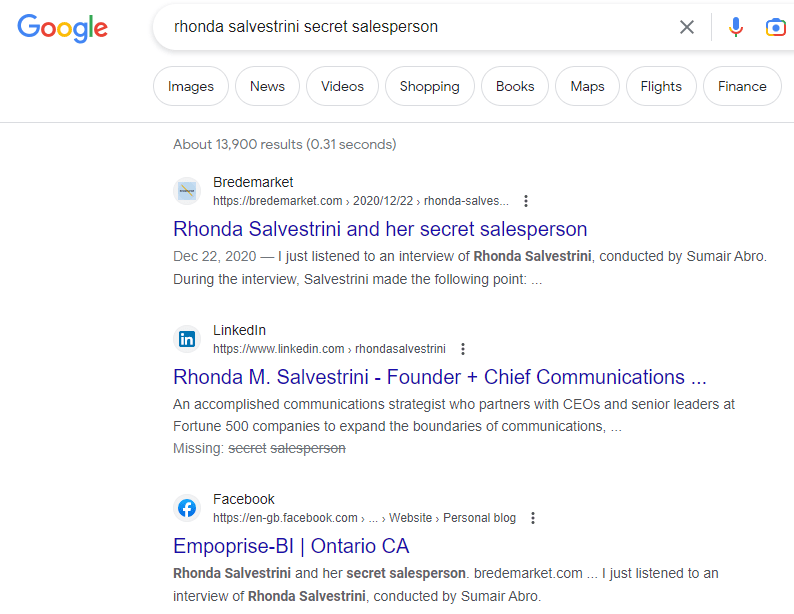
To prove the point that online content provides long-term benefits, I just conducted an incognito Google search for the words rhonda salvestrini secret salesperson.
Salvestrini’s own LinkedIn page was only the second result.
The first result was my 2020 blog post.
The third result wasn’t from Salvestrini either. It was a Facebook page for an old personal blog of mine that happened to reference those four words.
If you were searching for Salvestrini’s website and ended up at my blog post, I should clarify that I didn’t intentionally hijack Salvestrini’s traffic to draw it to my content. By happy accident, I just happened to use the magic words that drew searchers to my post. But if you’re interested in Salvestrini’s services, go to her website RhondaSalvestrini.com.
Now imagine the power if a potential customer is searching for their preferred terms and finds your case study.
And your secret salesperson isn’t secret any more. (Sorry Freddy.)
A well-crafted case study can be the first step in convincing a potential customer to become a paying customer.
So how do you create the case study?
Glad you asked. (Well, you sort of asked. Actually I asked. But you get the point.)
Well, you can just start writing, or get someone to start writing, and call the end result a case study.
But you need to create the right content.
And Bredemarket has a way to work with you to create the right content. To find out how to start a case study writing project or any writing project, click below.
If you don’t move quickly, you may miss your opportunity.
The first post mentioned a company (whom I didn’t name) that hired an international marketing company in December 2021, but that hadn’t created any customer-facing content by March 2022.
The first post also mentioned a bank that put a customer-facing email test togehter in eight weeks.
Oh, and John DeLorean took eight years to get his car out, which didn’t help with his financing issues.
On the positive side, the second post described how one company moved quickly. Rather than waiting for a centralized content creator to distribute content, Intuit provided guidelines so that its employees could extend the reach of Intuit’s content through their own social media posts.
The second post also noted that quick generation of content is appreciated by customers, vendors, and partners.
How can you move quickly?
So let’s say you’re an Inland Empire business who needs to create between 400 and 600 words of content quickly, such as the text for a brochure, a blog post, or a LinkedIn or Facebook post.
How can you get it out quickly?
How can you avoid waiting eight weeks, or three months, or eight years for your customers to see your content?
Here are four actions you can take to get your content out.
Specify your content needs.
Ensure you are available.
Ensure your content creator is available.
Book your content creator.
I’ll describe these four actions below.
One: Specify your content needs
If you rush to create content without thinking through your needs, your content won’t be that effective. Take some time up front to plan what your content will be.
Ask yourself critical questions about your content.
(UPDATE OCTOBER 22, 2023: “SIX QUESTIONS YOUR CONTENT CREATOR SHOULD ASK YOU IS SO 2022. DOWNLOAD THE NEWER “SEVEN QUESTIONS YOUR CONTENT CREATOR SHOULD ASK YOU” HERE.)
Don’t know what to ask? I’ve written an e-book entitled “Six Questions Your Content Creator Should Ask You.”
The six questions (hint: you’ve already seen two of them in the first two parts of this post):
Why?
How?
What?
Goal?
Benefits?
Target Audience?
When Bredemarket meets with a customer, I ask more than these six questions, but they’re the most important ones.
If you can answer these questions, either on your own or with the help of your content creator, then you’ll have a roadmap that allows you to create the content together.
Two: Ensure you are available
Note the word “together” in the paragraph above.
After you meet with your content creator, your part of the task isn’t done. Or shouldn’t be.
When Bredemarket creates content for a customer, there are points within the process where the customer reviews the content and makes suggestions. Normally when I create between 400 and 600 words of content using the Bredemarket 400 Short Writing Service, there are two review cycles. Here’s how I explain them:
Bredemarket iteratively provides two review copies of the draft content within three days per review. (The number of review cycles and review time must agree with any due dates.) The draft content advances your goal, communicates your benefits, and speaks to your target audience in your preferred tone of voice. Relevant examples and key words/hashtags are included.
You return comments on each review copy within three days. For longer content, you may provide the draft formatted copy for the final review.
Why? (If you read my e-book, you know the “why” question is important.)
Maybe I have questions that popped up while I was drafting the content. Maybe something occurs to you after you see the draft content. Whatever the reason, these review cycles provide opportunities to improve the content as I develop it.
But to get your feedback, you have to be available. The standard process gives you three days to return your comments, although of course you can return them faster. But if you don’t return your comments for weeks or months…well, that kind of kills the idea of getting the content out quickly.
Of course, in some cases delays are unavoidable. One of my customers was dependent on a third party to complete his part of the review, but the third party was not delivering. In that case, there was nothing the customer could do, and that content was delayed.
One critical question: what if you need your content very quickly?
Now if you add up all the times in the Bredemarket 400 process, your total comes to fourteen days: one day for the review, three days for me to create the first draft, three days for your review, three days for my second draft, three days for your second review, and one day for the final copy.
If you need it in one week rather than two weeks, then we jointly need to figure out a faster cadence of reviews. I can adjust the schedule to meet your due dates.
But you have to be available for the reviews.
And as I note below, I have to be available for the creation.
So when you’re planning to have Bredemarket or another content creator generate something for you, remember that you’ll need to spend a little bit of time on reviews.
Three: Ensure your content creator is available
You know how I said that the Bredemarket 400 process gives you three days to review each content iteration? Well, at the same time it gives me three days to draft (and redraft) the content.
Can I, or the content creator you select, hold up our end of the process?
Right now I’m going to tell you something that has happened since I wrote those two “In marketing, move quickly” posts in March 2022. In May 2022, I accepted a full-time position with an identity company, and therefore no longer spend full time on Bredemarket activities.
Therefore, if you need to meet with me Monday to Friday between 8 am and 5 pm (Pacific), I can’t meet you. I have my day job to worry about.
I have regular office hours on Saturday mornings when I can meet with you, and I can arrange to be available on weekday evenings or early weekday mornings. And of course I can draft your content and incorporate your suggestions at those times also, outside of regular business hours.
But if you need a content creator that is available during regular (Inland Empire) business hours, then you’ll need to select someone else.
Just make sure that the content creator you select is available when you need them.
Four: Book your content creator
When you’re ready to move, move. If you don’t start the process of creating your critical content, by definition you’ll never finish it.
So take the next step and find someone who will create your content. There are a number of content creators who serve Inland Empire businesses.
But if you want to use the Ontario, California content marketing expert, contact me at Bredemarket and I’ll arrange a meeting. Be prepared for me to ask you a few questions.
Bredemarket has always restricted its business to the United States. (Lately I’ve focused more on California’s Inland Empire West, but that’s another story.) So everyone in my target market is celebrating Labor Day today.
Theoretically.
It’s important to note that most other countries celebrate the contributions of labor on May 1, but for several reasons the United States chose a different day. The Massachusetts AFL-CIO page that explained this no longer exists, but I quoted from that page in a tymshft post a decade ago:
Despite the popularity of May Day and the appeal of an international holiday, the American Federation of Labor pushed to secure Labor Day as America’s primary celebration of its workers. This was due to the more radical tone that May Day had taken. Especially after the 1886 Haymarket riot, where several police officers and union members were killed in Chicago, May Day had become a day to protest the arrests of anarchists, socialists, and unionists, as well as an opportunity to push for better working conditions. Samuel Gompers and the AFL saw that the presence of more extreme elements of the Labor Movement would be detrimental to perception of the festival. To solve this, the AFL worked to elevate Labor Day over May Day, and also made an effort to bring a more moderate attitude to the Labor Day festivities. The AFL, whose city labor councils sponsored many of the Labor Day celebrations, banned radical speakers, red flags, internationalist slogans, and anything else that could shed an unfavorable light upon Labor Day or organized labor.
So for over a century, most Americans have chosen to celebrate Labor Day on the first Monday in September.
Well, some Americans.
I took a walk.
My employer for my day job is closed today (at least for its U.S. workers), so I kinda sorta took it a bit leisurely, waking up at…5:35 in the morning.
You see, this is the last week of my company’s wellness challenge, and because of the current heat wave in Southern California, I wanted to get my walking in while the temperatures were still in double digits (on the Fahrenheit scale; that’s something else that Americans do differently than the rest of the world).
I didn’t take any pictures of myself walking today, but here’s one that I took Saturday while I was walking inside (at the Ontario Mills indoor mall).
At Ontario Mills, Saturday, September 3, 2022. It was about 25 degrees cooler inside than it was outside.
Other people were working.
But while I took my early morning Labor Day walk, I ran across a lot of people…working.
There were the people at the Starbucks in downtown Ontario, busily supplying breakfast sandwiches and drinks to people.
There was the woman at a 7-Eleven in Ontario, letting me hydrate with a cold drink. (She may have been the owner, but owners deserve a day off too.)
Finally, I passed two men who have been working on and off on a residential wall, and today was apparently one of the “on” days. I hope they’re not working in the afternoon.
The truth is that, even in the midst of COVID, the entire workforce can’t shut down entirely. Some people have to work on days when many people don’t work. Remember that even in “blue law” states, preachers certainly work on Sundays.
Me too.
But still my morning walk was somewhat relaxing, because even though it was a weekday, I didn’t have to end the walk by 8:00 to start my day job. So while I got my steps in, I did so somewhat leisurely.
And after I write the post, there’s an email that I need to send.
So I guess I didn’t completely take the day off either.
But at least I’m not buliding a wall out of doors.
Oh, and I work on Saturday mornings also.
Of course, since I’m employed full-time, Bredemarket itself is a weekend job for me. My official office hours fall on Saturday mornings, for example.
While this is work, in a way it’s not work, because it’s a refreshing change from my normal work. (And since I enjoy my normal work, that isn’t so much work either. If you’re not working at something you enjoy, then you’re working.)
And if you don’t enjoy creating written content, let Bredemarket help you create it.
When marketing your Inland Empire business to potential customers, you don’t start the conversation by talking about yourself. You start the conversation with a customer focus by talking about your potential customer’s needs.
And what better way to speak about your potential customer’s needs than by talking about other customers who have faced the same problem, and who solved the problem using a solution from your business?
A case study is one way to share another customer’s successes with your potential customers. Case studies can follow a format such as this:
The problem. Henry’s Horse Rentals couldn’t get any businesses because all of the people in Alta Loma who rented horses preferred dark green horses, and Henry’s horses were brown and black.
The solution (literally). Jane’s Green Widgets and Other Green Stuff offered an environmentally safe horse bath, Jane’s Dark Green Animal Bath, that turned the horses dark green, posed no health hazard to horses or people, gave the scent of a pine forest, and made the horses happy because they looked really cool.
The results. Once Henry’s Horse Rentals posted pictures of the newly-bathed horses on its TikTok account, renters formed lines around the stables, requiring Henry to increase his stable from three horses to seventeen. The fivefold increase in revenue allowed Henry to franchise his operations, bringing in more money and starting a worldwide dark green horse craze.
When potential customers read about the original customer’s success, they will want to do business with your company also.
But aren’t case studies only for large national firms?
National firms can certainly use case studies, and Bredemarket has written its share of case studies for large firms. But any company of any size can benefit from a case study. As long as you have a website or social media site to distribute electronic versions of your case study, or a way to hand out physical copies, a case study can start working for you.
Create the study, and at the end of the study encourage the reader to contact you for more information. (Or request the person’s contact information before letting the person download the case study, then subsequently follow up and see if you can help.)
Should you use case studies, or should you use testimonials instead?
Yes and yes.
You can distribute a two-page case study that describes your company’s benefits to potential customers.
Or you can distribute a one paragraph customer-authored testimonial that does the same thing.
Or you can do both. On a high level, there’s really no difference between the two, which is why I often speak of casetimonials as a catch-all for content written from the end customer point of view.
How can your company take advantage of the power of case studies?
Bredemarket can help Inland Empire firms create case studies, in the same way that I have worked with national firms.
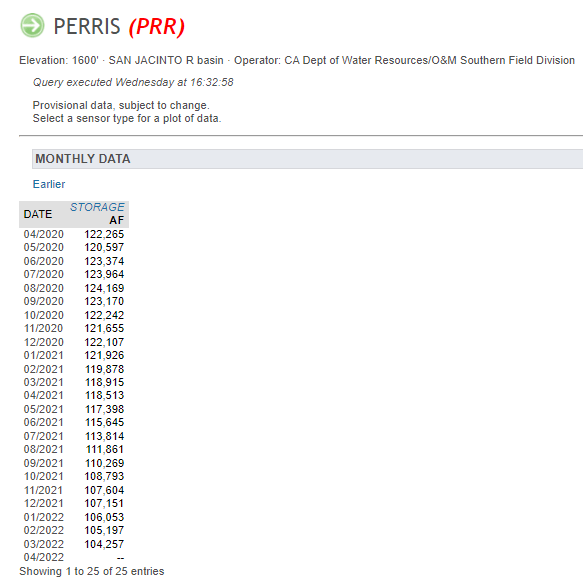
Following the second driest year on record and with near record low storage in California’s largest reservoirs, Governor Gavin Newsom today issued a proclamation extending the drought emergency statewide and further urging Californians to step up their water conservation efforts as the western U.S. faces a potential third dry year.
Regardless of how one feels about governmental powers, I think all of us can agree that if all people and businesses in California use the maximum amount of water, things won’t be so good.
What may IEUA cities do starting June 1?
As a result of the current drought conditions, the Metropolitan Water District has asked the Inland Empire Utilities Agency (IEUA) and five other agencies to take emergency actions effective June 1.
[T]he MWD has asked six of its member agencies to consider requiring its customers to restrict outdoor watering to just one day per week, or find other ways to conserve water, according to the large water agency that provides water to 19 million people in six counties.
As a regional wastewater treatment agency, the Agency provides sewage utility services to seven contracting agencies under the Chino Basin Regional Sewage Service Contract: the cities of Chino, Chino Hills, Fontana, Montclair, Ontario, Upland, and Cucamonga Valley Water District (CVWD) in the city of Rancho Cucamonga.
In addition to the contracting agencies, the Agency provides wholesale imported water from MWD to seven retail agencies: the cities of Chino, Chino Hills, Ontario, Upland, CVWD in the city of Rancho Cucamonga, Fontana Water Company in the city of Fontana, and Monte Vista Water District (MVWD) in the city of Montclair.
Notice that MWD has only asked that the IEUA “consider” restrictions. Why can’t MWD mandate them? Because the MWD is not the only water provider for the agencies in question. Take the city of Upland, for example:
The City water interests are a result of either a direct water right or indirectly through its shareholder interest (entitlement) in two private mutual water companies. The City has a 93% shareholder interest in West End Consolidated Water Company (WECWco.). The water received from WECWCo. is local groundwater. The City has a 68% shareholder interest in San Antonio Water Company (SAW Co.). Both local groundwater and surface water from San Antonio Canyon is provided by SAW Co. San Antonio canyon surface water supply is subject to availability and is closely tied to rain and snowpack. This local surface is treated at the City’s San Antonio Water Treatment Plant. In addition to the local surface and groundwater supplies, the City invested and owns 22% interest in an 81 million gallon imported water treatment plant, Water Facilities Authority (WFA-JPA), Agua de Lejos located on Benson Avenue north of 17th Street. The WFA water treatment plant receives Northern California State Project imported water from Metropolitan Water District of Southern California (MWD) through Inland Empire Utilities Agency (IEUA) our MWD member agency. In 2013, IEUA completed regional pipeline facilities and began delivering recycled water. Recycled water is predominantly available in the southeastern sector of the City and is mostly used for large landscape irrigation areas, such as the Upland Hill Country Club Golf Course, City Parks, several school grounds and the Euclid Avenue median.
Anyway, if you live in one of the named cities, or in any city in California, be sure to keep up with your local city to see if water restrictions will affect you.
It would be nice if my initial plans for my consultancy Bredemarket were perfect and addressed my consulting needs for years to come. But my plans are NOT perfect, in part because I can’t anticipate what will happen in the future.
And so I iterate. Which is why I’m renaming the Bredemarket General Business Services Facebook group and the Bredemarket Local Firm Services LinkedIn showcase page.
In this post I examine why I created Facebook groups and showcase pages in the first place, why I originally named the Facebook group “Bredemarket General Business Services,” why I subsequently named the LinkedIn showcase page “Bredemarket Local Firm Services,” and why I’m changing things.
Why create Facebook groups and LinkedIn showcase pages?
When I established Bredemarket in 2020, I knew that I wanted to target multiple customers. This sentence on the Bredemarket home page has remained unchanged since 2020:
Bredemarket presently offers its services to identity/biometrics, technology, and general business firms, as well as to nonprofits.
These four customer groups have some different needs. A nonprofit’s concerns differ from those of a fingerprint identification software vendor. Because of this, I wanted to find a way to talk directly to these customers.
So Bredemarket…has Facebook groups that are somewhat similar to the Bredemarket LinkedIn showcase pages. One difference is that I have three groups on Facebook. In addition to the identity and technology groups, I also have a general business group. At this point it didn’t make sense to create a LinkedIn showcase page for general business, but it did make sense for Bredemarket to have such a group on Facebook.
You can see how these Facebook groups (and LinkedIn showcase pages) are derived from my original 2020 statement of Bredemarket’s target markets. To a point; as I noted, I didn’t create a general business showcase page on LinkedIn, and even today I don’t have a nonprofit LinkedIn showcase page or a nonprofit Facebook group.
But I would begin to pivot Bredemarket’s business that summer.
Why I created the Bredemarket Local Firm Services LinkedIn showcase page
As I write this, Bredemarket has no clients in my hometown of Ontario, California, or in any of the nearby cities. In fact, my closest clients are located in Orange County, where I worked for 25 years.
It’s no secret that I’ve been working to rectify that gap and drum up more local business.
After attending Jay Clouse’s September 2021 New Client Challenge, I determined to pursue this local market more aggressively and determined how I was NOT going to pursue Inland Empire West customers.
So when I market to local businesses, I’ll want to do that via relevant Facebook Groups. Obviously I won’t market the local services via LinkedIn or Twitter, because those services are not tailored to local service marketing.
Let me draw out the implied assumption in that statement above, that even the Facebook marketing would be via groups created by other people. It wasn’t like I was going to create my OWN local Facebook group or anything like that. I was going to post in the Facebook groups created by others.
Anyway, proving that my initial plans are NOT perfect, I fairly quickly changed my mind regarding LinkedIn, deciding to create a LinkedIn showcase page devoted to local services, even though I didn’t have (or need) a parallel Facebook group.
And in fact I’d cheat by adapting the artwork for the Bredemarket General Business Services Facebook group and repurpose it for use in the Bredemarket Local Business Services LinkedIn showcase page.
This appeared to be a brilliant idea, and the new local LinkedIn showcase page was successful. Not as successful as the Bredemarket Identity Firm Services LinkedIn page, but it certainly provided me with an avenue to speak just to the local community.
Aren’t I brilliant?
Why I’m changing the names of the Facebook group and LinkedIn showcase page
Well, maybe not so brilliant.
Time went on, and I would share identity stuff to the “Identity Firm Services” showcase page and group, and I would share technology stuff to the “Technology Firm Services” showcase page and group. When I wanted to share local stuff, I’d obviously share it on the Bredemarket Local Firm Services LinkedIn showcase page, and sometimes I’d also share it on the Bredemarket General Business services Facebook group.
But this raised two questions.
What is the Bredemarket General Business Services Facebook group?
The third market category that I created in 2020 isn’t making sense in 2022. If you go to the Bredemarket General Business Services Facebook group today, it’s kind of vague. In fact, you could say it’s, um, general.
If you scroll through the group posts, you’ll see a lot of posts from me that have to do with businesses in California’s Inland Empire.
Because I do not moderate the posts in the group, other people like to post, and their posts can be, um, general. For example, there is one person who occasionally posts things like this.
Now I have no reason to reject the post, because the poster isn’t violating any group rule. However, this person could use the services of a marketing and writing professional. The company is doing SOME things right. such as advertising the services provided, including illustrative pictures, and incorporating a call to action. The call to action, of course, is to call…
…061 531 5144?
For those who aren’t familliar with geography, Kempton Park is outside of Pretoria, in South Africa. Which means that if I had wanted the company to provide a quote when my own roof was damaged by winds, I would have to call the country code 27 first, THEN call the local area code 61 and the local number 531 5144.
Somehow I doubt that Ontario, California is in this company’s service area.
Now I could have posted a comment along the lines of “You idiot! Do you really think that people in this group are going to contract with a roofer on another continent?” But I didn’t do that. Instead, I simply commented with this question:
Over a week later, the original poster hasn’t responded to my question. I guess the poster is too busy writing “Thought the group would like this” posts on every “general business service” Facebook group. (Terrible waste of the poster’s time, when you think about it.)
And that’s what can happen when you create a group for “general business services.” It’s too general.
What is the Bredemarket Local Firm Services LinkedIn showcase page?
Thankfully I avoided this same problem when I created the Bredemarket Local Firm Services LinkedIn showcase page.
Or did I?
If you don’t know me or my background and encounter a showcase page devoted to “local firm services,” what are you going to think?
That’s right. The page name doesn’t mention the locality that is the focus of the page.
Next thing I know, my roofing friend is going to discover my Linkedin showcase page and start posting weekly, with an equal lack of success.
How do I make these better?
So it’s obvious that both the LinkedIn showcase page and Facebook group would benefit from a refocus and a rename.
But what name?
If you had asked me this question in September 2021, I would have chosen the name “Bredemarket Inland Empire West Firm Services.” My local marketing target at that point was businesses in Ontario, California and the surrounding cities. “Inland Empire” was too broad a term for those cities, but “Inland Empire West” is a real estate term that fits nicely in my target market area.
This also tied in with a marketing promotion that I was running at the time, in which I would offer a discount for customers in this immediate area. However, I recently rescinded that promotion (as part of the numerous changes I’m currently making to Bredemarket’s business). Since I wasn’t making money (from an opportunity cost perspective) with my regular package pricing, I certainly wouldn’t make money with DISCOUNTED package pricing.
At the same time, I was getting less strict about keeping my target within the Inland Empire West, and was therefore open to extending throughout the Inland Empire. Although most of my online collateral is currently targeted to the Inland Empire West, I won’t turn down business from Moreno Valley or Redlands.
So perhaps I could use the name “Bredemarket Inland Empire Firm Services,” without the “West.”
But I didn’t like that either.
While “Firm” implies that I work with businesses and not individuals (I don’t write resumes), I figured it would be clearer if I used “B2B” instead of firm. “Business-to-Business” would be better, but that would make the page/group title awfully long. Of course some people don’t know what “B2B” means, but that could be an effective filter; if you don’t know what “B2B” means, you’re not going to use Bredemarket’s services anyway.
Having settled on the title “Bredemarket Inland Empire B2B Services,” it was now a matter of making the title change. (Without changing the legacy URLs and potentially breaking existing links.)
Again, the URLs don’t match the page/group titles because of legacy issues, but I think it’s better than what was before. And hopefully this will focus the content and make it more relevant.
Unless you’re a Pretoria homeowner with a leaky roof.
Bredemarket presently offers its services to identity/biometrics, technology, and general business firms, as well as to nonprofits. I offer my services to firms in my hometown of Ontario, California, as well as firms in Eastvale, Fontana, Montclair, Rancho Cucamonga, Upland, other cities of the Inland Empire West, and throughout the United States.
This post concentrates on the services that Bredemarket can provide to businesses in my local area. Read on if you own a small, arty business in the Emporia Arts District of Ontario…
…or perhaps a larger, less arty business north of Holt in Ontario, or perhaps even a business in one of the other cities that I mentioned, or one of the ones I didn’t (sorry Narod).
There are a lot of local businesses out there
Even if you don’t count sole proprietors (such as myself) or freelancers, there are somewhere around 7.7 million businesses in the United States. (This figure is from 2016; I’m not sure if it’s gone up or gone down in the last five years.) Now if you include sole proprietors in the total, then you’re talking about 32 million businesses. (This particular number may have actually increased over time.)
Obviously I can’t target them all. Well, I could try, but it would be a little ridiculous.
So what if I took a subset of those 32 million businesses and tried to see if Bredemarket could serve that subset?
The local small business persona
When you want to market to a particular group, you develop a persona that represents that group. You can then develop a profile of that persona: the persona’s needs, aspirations, and expectations; the persona’s underlying goals and values; and perhaps some other elements. The persona may be developed via extensive research, or perhaps via…a little less quantification.
When I initially looked at this topic last September, I concentrated on a particular persona, but my thoughts on this topic have evolved over time. While I will still serve artists as I initially proposed last September, I’m now thinking of other businesses that can best use the type of content that I provide.
For example, the business may be an incorporated business that is based on the Inland Empire West, provides its products or services to customers in the local area, provides excellent service that is loved by its existing customers, and needs to get the word out to new potential customers by creating content that can be downloaded from a company website, shared via a company social media account, or handed out at a trade show or other in-person event.
Regarding the values of this particular persona, you can probably already deduce some of them based upon the customer love for the company.
The business puts the customer first and strives to provide services that satisfy its customers.
However, the business also prioritizes the well-being of its employees.
While the business may not have explicitly articulated a vision, its actions testify to a vision of excellent service, customer satisfaction, and care for employees.
But what does this business need in terms of types of content? For my example, these businesses are ones that need customer-facing content such as the following:
A document (online or printed) that explains the product(s) or service(s) that the business provides, and that discusses the benefits that the product(s)/service(s) offers to the customers. This document may take the form of a product/service description, or it may take the form of a white paper. For example, your business might issue a white paper entitled “Seven Mandatory Requirements for a Green Widget,” and the white paper just might happen to mention at the end that your green widget just happens to meet all seven mandatory requirements. (Coincidence? I think not.)
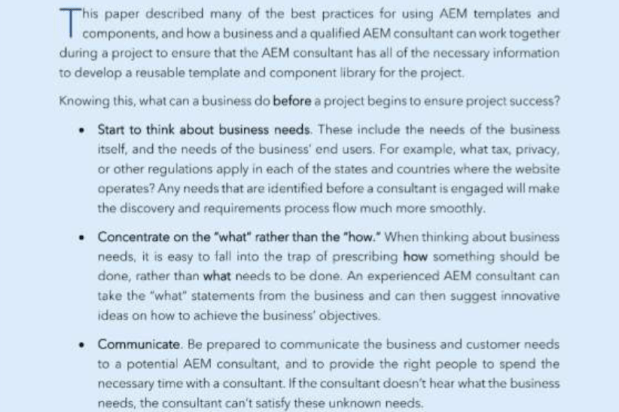
Portion of the concluding section of a white paper in which Bredemarket provided the text.
A document (online or printed) that tells a story about how an individual customer benefited from the product(s) or service(s) that the business provides. You could call such a document a case study, or you could call it a testimonial. Or you could call it a casetimonial.
These types of documents are more valuable to some businesses than to others. Your average convenience store has little need for a 3,000 word white paper. But perhaps your business has this sort of need.
How many words should your content contain?
When I originally wrote this last September, I started off by discussing my two standard packages, based on word length. But now that I’ve thought about it a bit more, there are some questions that you need to ask BEFORE deciding on the content length. (We’ll get to content length later.)
(Owen Lovejoy) “How long should a man’s legs be in proportion to his body?”
(Abraham Lincoln) “I have not given the matter much consideration, but on first blush I should judge they ought to be long enough to reach from his body to the ground.”
Abraham Lincoln. (Legs not shown.) By Hesler, Alexander, 1823-1895 – This image is available from the United States Library of Congress’s Prints and Photographs divisionunder the digital ID cph.3a36988.This tag does not indicate the copyright status of the attached work. A normal copyright tag is still required. See Commons:Licensing for more information., Public Domain, https://commons.wikimedia.org/w/index.php?curid=18705107
So how far away is the ground? Let’s ask some other questions first before we determine the answer to content length.
Bredemarket’s initial questions for you
Before I create a single word, I start by asking you some questions about your content to make sure our project starts on the right foot. (Even though I am left-footed.)
What is the topic of the content?
What is the goal that you want to achieve with the content?
What are the benefits (not features, but benefits) that your end customers can realize by using your product or service?
What is the target audience for the content?
Once I’ve asked you these and other questions (such as a potential outline), we will both have a good idea of how long the final piece needs to be.
The length of the content also dictates the length and complexity of the review process.
Returning to the content length question
Once we have a good idea of the content length, there are three options that we can pursue to actually create the content.
If your content is longer, say 2800 to 3200 words, then I create the content using a similar (but more detailed) process through my Bredemarket 2800 Medium Writing Service.
If your content falls between these two lengths, or is longer than 3200 words, or needs a more rapid delivery time, we’ll talk and come up with a solution.
(And we’ll even come up with a spiffy name if you like)














 Bredemarket
