Of my four top archetypes, the one that I haven’t really, um, explored is the “Royalty” brand archetype. This archetype was a surprise to me, and upon researching it further it fits me…and it doesn’t fit me.
I am Royalty
By United Kingdom Government – Illustrated magazine, 13 December 1952, p. 14. Copyright label: “CROWN COPYRIGHT RESERVED” (no other labels or attributions)., Public Domain, https://commons.wikimedia.org/w/index.php?curid=64590096
Whether you resonate with being a boss, aristocrat, king, queen, politician, or manager, your brand possesses the incredible power to evoke feelings of awe, admiration, and the promise of shared success in those who encounter it.
Let’s face it: I am the strong-willed person who self-brands as the temperamental writer, often moved to take charge of a situation, and frankly craving admiration and protesting indifference.
For example, for the last several weeks I’ve been tracking both impression and (more importantly) engagement statistics for my personal LinkedIn account and the Bredemarket website. What does engagement mean? In its most basic terms, it can be expressed as (in Sally Field’s words) “you like me.”
Ever since I conceived the idea for this blog post, I wanted to work the Lorde song “Royals” into it if possible. But the song doesn’t really fit, since it’s really about established musical royalty who resist young upstarts like Lorde.
(Young but not young. Even a decade ago when the song was released, I was amused at the world-weariness expressed by a teenager. But I digress.)
The great irony of the lyrics is that “we’ll never be royals” but she keeps talking about becoming Queen and talks about “ruling.”…Will Lorde’s new rule be any better than the current regime? Who knows.
All things are NOT equally important. In fact, there are THREE levels of importance (TLOI):
IMPORTANT.
VERY IMPORTANT.
CRITICALLY IMPORTANT.
Maybe you use different words (perhaps “life-or-death important” or “DEFCON 1”), but the basic point remains. Some things are more important than others.
Make sure that everyone has a common understanding of how important a task is. If you think something is “important” but your partner thinks it is “very important,” your partner may think you are indifferent and have hurt emotions.
Enough theory; let’s apply this. Are you interested in an application of TLOI that answers the following questions?
How is the Eisenhower Matrix flawed by its use of only a SINGLE level of importance?
How does the correction of the Eisenhower Matrix with TLOI affect whether or not you will select Bredemarket as your content marketing expert?
The second question may not have ANY importance to you, but it’s critically important to me.
If you want a prospect to do something, stir up the necessary emotions: fear, fear of missing out (FOMO), anger, whatever. The call to action should emphasize that they act NOW. TV Tropes provides a few examples of these calls to action:
“If you call before midnight tonight, we’ll give you a special bonus!”
“Call in the next 5 minutes for a special bonus!”
“Call quickly because we’re only giving this offer to the first 100 callers.”
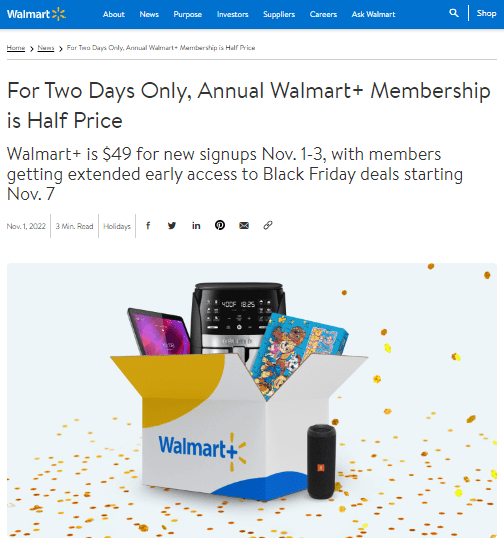
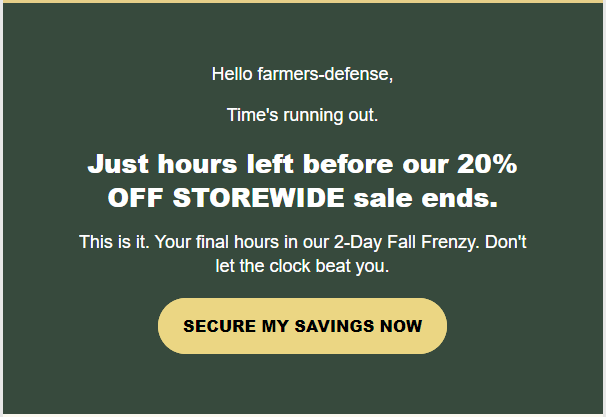
Of course, you don’t need to advertise on television to use these lines. It’s just as easy to use these messages online, as in the Walmart example above, or in this example.
A lot of marketers (and for that matter, a lot of scam artists) listen to the advice of marketing experts. As a result, we are bombarded with “act now” advertising.
In fact, we are bombarded with so much of this junk that we end up tuning it out.
For example, your firm’s website may be in urgent need of an upgrade. Perhaps the information on the website is out of date or completely incorrect. (Maybe you DON’T support Windows XP any more.)
But is that important?
If an issue is urgent and important, you would have updated your website already to avoid being fired.
If an issue is urgent but not important, then it’s something that you could delegate to a content marketing expert. (Ahem. We’ll revisit this later.)
Incidentally, I have some thoughts about the use of “importance” in the Eisenhower matrix, but I’ll save those for another post.
Is a task urgent?
Of course, this assumes that the issue is urgent. Perhaps it’s not urgent at all. As I said before, a lot of sellers like to create a false sense of urgency.
As a consultant, I often find prospects and clients who believe that a particular issue is NOT urgent. You can easily get that Walmart+ membership a few days later, at a minimally higher price. And you can easily wait on updating your online content.
If something is not urgent, then you have two choices depending upon the issue’s importance.
If an issue is not urgent and not important, then why bother taking care of it at all? Let it slide.
If an issue is not urgent but is important, then you had better do it…but there’s no rush. You don’t have to take care of it before midnight tonight. Next week will do…or the week after that.
It takes longer than three days for content marketing to yield results. One source estimates four to five months. Another source says six to twelve months. Joe Pulizzi (quoted by Neil Patel) estimates 15 to 17 months. And all the sources say that their estimates may not apply to your particular case.
So if a content marketing update isn’t going to yield immediate results, what’s the rush? Spending time making the updates, or even spending the time managing someone else to make the updates, takes away from tasks that yield financial results NOW.
…a competitor with up-to-date and accurate content swoops in and loots your prospects AND your existing customers away from you.
(Are you worried?)
Why would old content cause you to lose a customer? Because your outdated information demonstrates that you don’t care about your customers. After all, you’re not focused on your customers’ need for up-to-date information on your products and services.
(Are you angry?)
And if you lose enough prospects and customers to result in a revenue drop, then you may lose your job. Then you won’t have to worry about the company’s outdated content any more. Problem solved!
Of course, there’s the other alternative that I discussed earlier in this post, in which your content issues are urgent, but they’re not important enough to devote your own resources to them.
If you’re sold on using Bredemarket to create customer-focused messaging, there are three ways to move forward with your content project. Or you can just join the Bredemarket mailing list to stay informed.
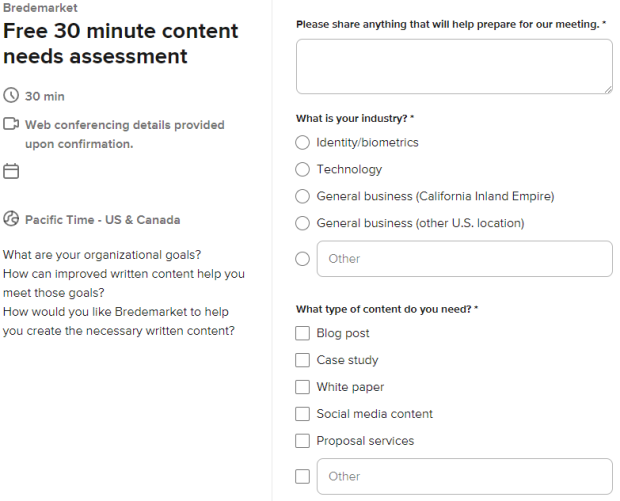
Book a meeting with me at calendly.com/bredemarket. Be sure to fill out the information form so I can best help you.
If you’re familiar with Bredemarket’s “six questions your content creator should ask you”…I came up with a seventh question because I feared the six questions were not enough, and I wanted to provide you with better confidence that Bredemarket-authored content will achieve your goals.
To no one’s surprise, I’ll tell you WHY and HOW I added a seventh question.
If you want to skip to the meat, go to the WHAT section where you can download the new e-book.
Why?
Early Sunday morning I wrote something on LinkedIn and Facebook that dealt with three “e” words: entertainment, emotion, and engagement, and how the first and second words affect the third. The content was very long, and I don’t know if the content itself was engaging. But I figured that this wasn’t the end of the story:
I know THIS content won’t receive 250 engagements, and certainly won’t receive 25,000 impressions, but maybe I can repurpose the thoughts in some future content. (#Repurposing is good.)
Rather than delving into my content with over 25,000 impressions but less than 250 engagements, and rather than delving into the social media group I discussed, and rather than delving into the Four Tops and the Sons of the Pioneers (not as a single supergroup), I decided that I needed to delve into a single word: indifference, and how to prevent content indifference.
Because if your prospects are indifferent to your content, nothing else matters. And indifference saddens me.
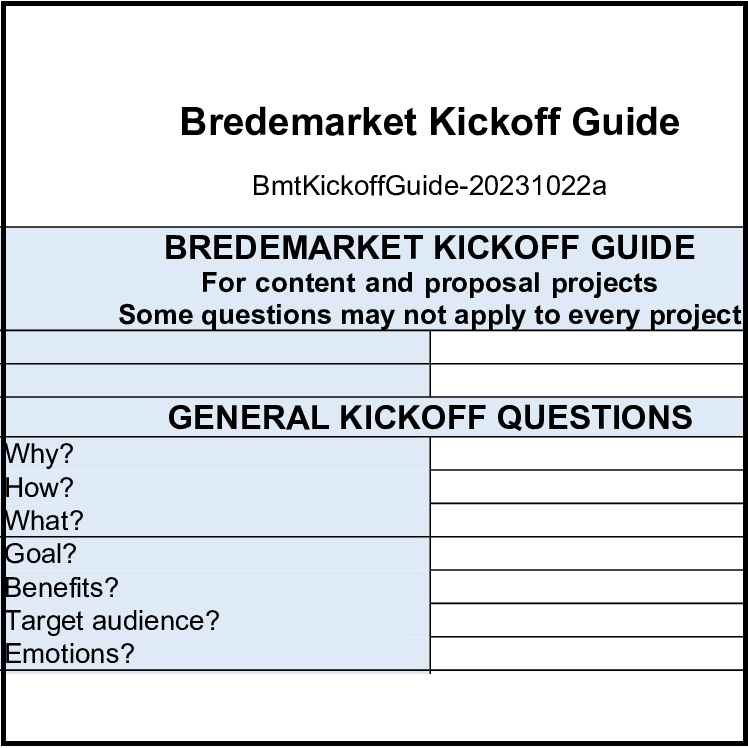
The first questions in the Bredemarket Kickoff Guide, BmtKickoffGuide-20231022a. No, you can’t have the guide; it’s proprietary.
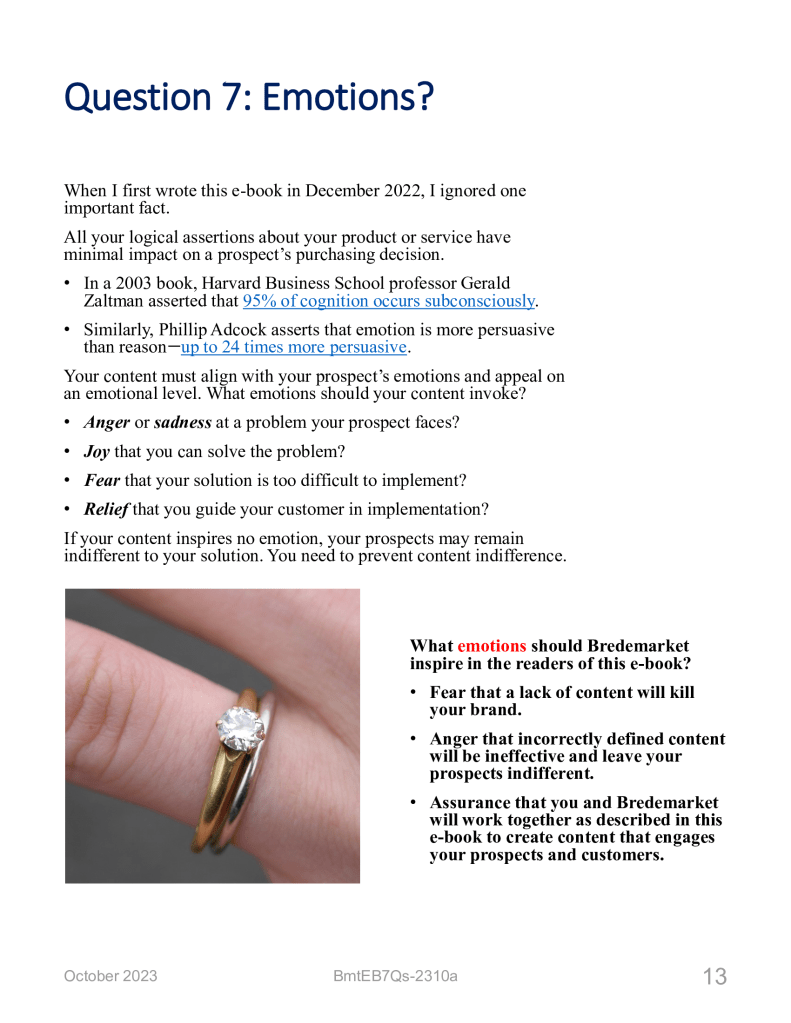
I decided that I needed to update my process, as well as that e-book, and add a seventh question, “Emotions?”
What?
For those who have raced ahead to this section, Bredemarket has a new downloadable e-book (revised from an earlier version) entitled “Seven Questions Your Content Creator Should Ask You.” It includes a new page, “Emotions,” as well as minor revisions to the other pages. You can download it below.
For example, when biometric companies want to justify the use of their technology, they have found that it is very effective to position biometrics as a way to combat sex trafficking.
Similarly, moves to rein in social media are positioned as a way to preserve mental health.
Now that’s a not-so-pretty picture, but it effectively speaks to emotions.
“If poor vulnerable children are exposed to addictive, uncontrolled social media, YOUR child may end up in a straitjacket!”
In New York state, four government officials have declared that the ONLY way to preserve the mental health of underage social media users is via two bills, one of which is the “New York Child Data Protection Act.”
But there is a challenge to enforce ALL of the bill’s provisions…and only one way to solve it. An imperfect way—age estimation.
Because they want to protect the poor vulnerable children.
By Paolo Monti – Available in the BEIC digital library and uploaded in partnership with BEIC Foundation.The image comes from the Fondo Paolo Monti, owned by BEIC and located in the Civico Archivio Fotografico of Milan., CC BY-SA 4.0, https://commons.wikimedia.org/w/index.php?curid=48057924
And because the major U.S. social media companies are headquartered in California. But I digress.
So why do they say that children need protection?
Recent research has shown devastating mental health effects associated with children and young adults’ social media use, including increased rates of depression, anxiety, suicidal ideation, and self-harm. The advent of dangerous, viral ‘challenges’ being promoted through social media has further endangered children and young adults.
Of course one can also argue that social media is harmful to adults, but the New Yorkers aren’t going to go that far.
So they are just going to protect the poor vulnerable children.
CC BY-SA 4.0.
This post isn’t going to deeply analyze one of the two bills the quartet have championed, but I will briefly mention that bill now.
The “Stop Addictive Feeds Exploitation (SAFE) for Kids Act” (S7694/A8148) defines “addictive feeds” as those that are arranged by a social media platform’s algorithm to maximize the platform’s use.
Those of us who are flat-out elderly vaguely recall that this replaced the former “chronological feed” in which the most recent content appeared first, and you had to scroll down to see that really cool post from two days ago. New York wants the chronological feed to be the default for social media users under 18.
The bill also proposes to limit under 18 access to social media without parental consent, especially between midnight and 6:00 am.
And those who love Illinois BIPA will be pleased to know that the bill allows parents (and their lawyers) to sue for damages.
Previous efforts to control underage use of social media have faced legal scrutinity, but since Attorney General James has sworn to uphold the U.S. Constitution, presumably she has thought about all this.
Enough about SAFE for Kids. Let’s look at the other bill.
The New York Child Data Protection Act
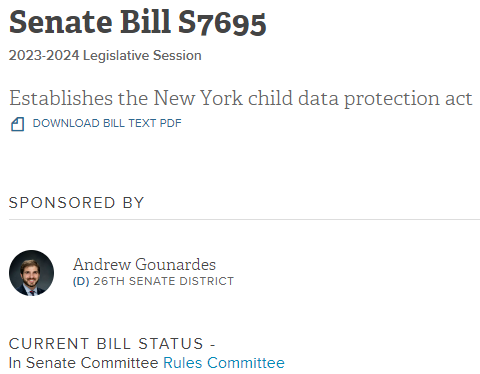
The second bill, and the one that concerns me, is the “New York Child Data Protection Act” (S7695/A8149). Here is how the quartet describes how this bill will protect the poor vulnerable children.
CC BY-SA 4.0.
With few privacy protections in place for minors online, children are vulnerable to having their location and other personal data tracked and shared with third parties. To protect children’s privacy, the New York Child Data Protection Act will prohibit all online sites from collecting, using, sharing, or selling personal data of anyone under the age of 18 for the purposes of advertising, unless they receive informed consent or unless doing so is strictly necessary for the purpose of the website. For users under 13, this informed consent must come from a parent.
And again, this bill provides a BIPA-like mechanism for parents or guardians (and their lawyers) to sue for damages.
But let’s dig into the details. With apologies to the New York State Assembly, I’m going to dig into the Senate version of the bill (S7695). Bear in mind that this bill could be amended after I post this, and some of the portions that I cite could change.
This only applies to natural persons. So the bots are safe, regardless of age.
Speaking of age, the age of 18 isn’t the only age referenced in the bill. Here’s a part of the “privacy protection by default” section:
§ 899-FF. PRIVACY PROTECTION BY DEFAULT.
1. EXCEPT AS PROVIDED FOR IN SUBDIVISION SIX OF THIS SECTION AND SECTION EIGHT HUNDRED NINETY-NINE-JJ OF THIS ARTICLE, AN OPERATOR SHALL NOT PROCESS, OR ALLOW A THIRD PARTY TO PROCESS, THE PERSONAL DATA OF A COVERED USER COLLECTED THROUGH THE USE OF A WEBSITE, ONLINE SERVICE, ONLINE APPLICATION, MOBILE APPLICA- TION, OR CONNECTED DEVICE UNLESS AND TO THE EXTENT:
(A) THE COVERED USER IS TWELVE YEARS OF AGE OR YOUNGER AND PROCESSING IS PERMITTED UNDER 15 U.S.C. § 6502 AND ITS IMPLEMENTING REGULATIONS; OR
(B) THE COVERED USER IS THIRTEEN YEARS OF AGE OR OLDER AND PROCESSING IS STRICTLY NECESSARY FOR AN ACTIVITY SET FORTH IN SUBDIVISION TWO OF THIS SECTION, OR INFORMED CONSENT HAS BEEN OBTAINED AS SET FORTH IN SUBDIVISION THREE OF THIS SECTION.
So a lot of this bill depends upon whether a person is over or under the age of eighteen, or over or under the age of thirteen.
And that’s a problem.
How old are you?
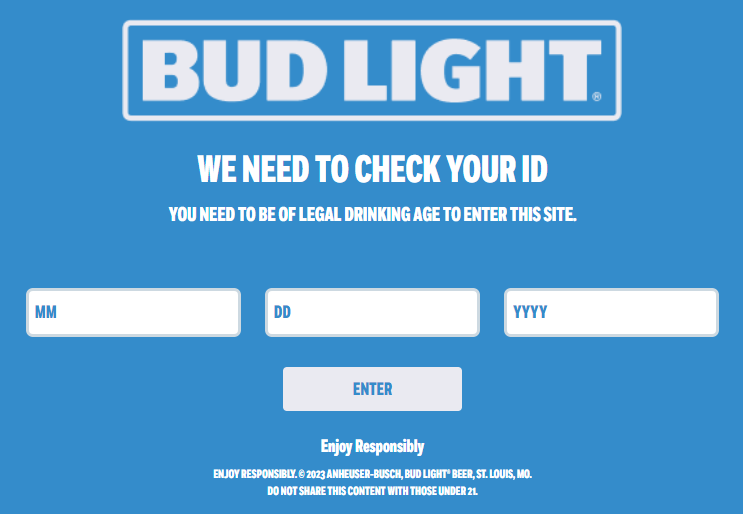
The bill needs to know whether or not a person is 18 years old. And I don’t think the quartet will be satisfied with the way that alcohol websites determine whether someone is 21 years old.
Attorney General James and the others would presumably prefer that the social media companies verify ages with a government-issued ID such as a state driver’s license, a state identification card, or a national passport. This is how most entities verify ages when they have to satisfy legal requirements.
For some people, even some minors, this is not that much of a problem. Anyone who wants to drive in New York State must have a driver’s license, and you have to be at least 16 years old to get a driver’s license. Admittedly some people in the city never bother to get a driver’s license, but at some point these people will probably get a state ID card.
However, there are going to be some 17 year olds who don’t have a driver’s license, government ID or passport.
And some 16 year olds.
And once you look at younger people—15 year olds, 14 year olds, 13 year olds, 12 year olds—the chances of them having a government-issued identification document are much less.
What are these people supposed to do? Provide a birth certificate? And how will the social media companies know if the birth certificate is legitimate?
But there’s another way to determine ages—age estimation.
How old are you, part 2
As long-time readers of the Bredemarket blog know, I have struggled with the issue of age verification, especially for people who do not have driver’s licenses or other government identification. Age estimation in the absence of a government ID is still an inexact science, as even Yoti has stated.
Our technology is accurate for 6 to 12 year olds, with a mean absolute error (MAE) of 1.3 years, and of 1.4 years for 13 to 17 year olds. These are the two age ranges regulators focus upon to ensure that under 13s and 18s do not have access to age restricted goods and services.
So if a minor does not have a government ID, and the social media firm has to use age estimation to determine a minor’s age for purposes of the New York Child Data Protection Act, the following two scenarios are possible:
An 11 year old may be incorrectly allowed to give informed consent for purposes of the Act.
A 14 year old may be incorrectly denied the ability to give informed consent for purposes of the Act.
Is age estimation “good enough for government work”?
While I don’t use all the marketing tools at my disposal, I am certainly curious about them. After all, such tools provide marketers with powerful insights on their prospects and customers.
I became especially curious about one marketing tool when re-examining a phrase I use often.
I use the phrase “biometric content marketing expert” in a non-traditional way. When I use it, I am attempting to say that I am a content marketing expert on the use of biometrics for identification. In other words, I can create multiple types of content that discusses fingerprint identification, facial recognition, and similar technologies.
But if you speak to a normal person, they will assume that a “biometric content marketing expert” is someone who uses biometrics (the broader term, not the narrower term) to support content marketing. This is something very different—something that is generally known as “facial coding,” a technique that purports to provide information to marketers.
We all know that our face conveys emotions through facial expressions; facial coding is the process of measuring those human emotions. With the help of computer vision, powered by AI and machine learning, emotions can be detected via webcam or mobile cam. The tech tracks every muscle movement on the face or all-action units (AU) based on the FACS (facial action coding system).
The differences between facial coding and facial recognition
Unlike the topics in which I usually dwell, facial coding:
Does not identify individuals. Many people can share the same emotions, so detection of a particular emotion does not serve as individualization.
Does not provide permanent information. In the course of watching a movie or even a short advertisement, viewers often exhibit a wide range of emotions. Just because you exhibit a particular emotion at the beginning of an ad doesn’t mean you’ll exhibit the same emotion at the conclusion.
As Rathi describes the practice, it preserves privacy by allowing people to opt-in, and to record the emotions anonymously.
So, the user’s permission is required to access their camera and all this data is captured with consent. And no video is shared. Only the emotion data of the users are captured through their facial expressions and shared in real-time. The emotions on a person’s face are captured as binary units (0 and 1). Hence no PII (Personally Identifiable Information) related to race, ethnicity, gender, or age is captured at any point in time.
But what if another firm chooses to gather more data, thus reducing the anonymity of the data collected? “I don’t only want to know how people react to the content. I want to know how black women in their 30s react to the content.”
And what if another firm (or a government agency, such as the Transportation Security Administration) chooses to gather the data without explicit consent, or with consent buried deep in the terms of service? In that case, people may not even realize that their facial expressions are being watched.
Examining facial expressions is not the only way to decipher what is happening in a person’s mind as they view content. But it’s powerful.
Well, maybe.
Does everyone exhibit the same facial coding?
The underlying assumption behind emotion recognition is that you can identify emotions at a universal level. If content makes me happy, or if it makes a person halfway around the world happy, we will exhibit the same measurable facial characteristics.
Research has not revealed a consistent, physical fingerprint for even a single emotion. When scientists attach electrodes to a person’s face and measure muscle movement during an emotion, they find tremendous variety, not uniformity. They find the same variety with the body and brain. You can experience anger with or without a spike in blood pressure. You can experience fear with or without a change in the amygdala, the brain region tagged as the home of fear.
When scientists set aside the classical view and just look at the data, a radically different explanation for emotion comes to light. We find that emotions are not universal but vary from culture to culture. They are not triggered; you create them. They emerge as a combination of the physical properties of your body, a flexible brain that wires itself to whatever environment it develops in, and your culture and upbringing.
If Barrett is correct, then how reliable is facial coding, even within a particular region? After all, even Southern California does not have a single universal culture, but is made up of many cultures in which people react in many different ways. And if we preserve privacy by NOT collecting this cultural information, then we may not fully understand the codings that the cameras record.
Back to the familiar “biometric” world
And with that, I will retreat from the broader definition of biometrics to the narrower and more familiar one, as described here.
The term “Biometrics” has also been used to refer to the field of technology devoted to the identification of individuals using biological traits, such as those based on retinal or iris scanning, fingerprints, or face recognition. Neither the journal “Biometrics” nor the International Biometric Society is engaged in research, marketing, or reporting related to this technology.
I self-describe as a “you can pry my keyboard out of my cold dead hands” person who likes to use physical or virtual keyboards to communicate. But what about using a telephone handset (when used for voice rather than data purposes)? That’s a different matter entirely.
If you have a personality that gravitates away from verbal communication, you sometimes find that you need to get out of your comfort z…I mean, you need to stray from your normal routine and use your non-preferred communication method.
I just did that earlier this week, and refrained from sending an email or other written message, instead choosing to use good old-fashioned voice communications to contact someone. And it worked, showing that voice and written communication do not have to compete with each other, and can complement each other.
This post takes a look at how writers function, both in textual and verbal environments, and what can happen when writers stray from their normal routine (or comfort zone).
The flip side of my written compulsion
I’ve talked before about my compulsion to write. Whether on a piece of paper, a typewriter (yes, I’m that old), a computer, or a smartphone, I am very accustomed to putting words to a text-based medium.
Writing compulsion, or writing obsession. Designed by Freepik.
Maybe I’m TOO accustomed to typing words into devices.
I communicate to a number of different people on WhatsApp, but recently took a break from non-business WhatsApp communications for a few days—probably to the relief of my friends who saw my FREQUENT written comments at ALL hours. (“Not a text from John again…”)
Which reminds me; I have to ask my younger German daughter if she has returned from her out-of-country trip.
And I also need to ask my artist friend if she has set up her art room yet…
It may not surprise you to learn that my VERBAL communications are less frequent. While I’m not mute in front of crowds, I gravitate toward written rather than verbal communications when I have the choice.
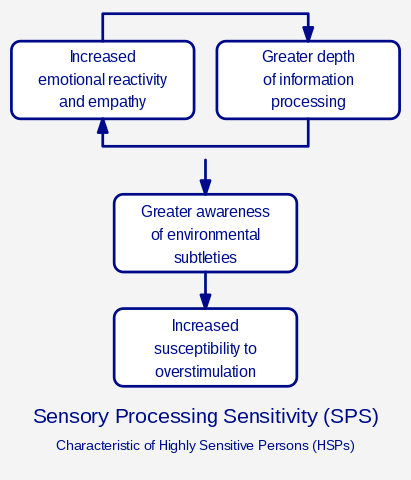
If you have noticed that it’s easier and more enjoyable for you to write rather than speak out your emotions, thoughts, and experiences, you might be a highly sensitive person (HSP). Highly sensitive people are the roughly 30% of the population who are wired at a brain level to process all information more deeply. This makes them more sensitive to the world around them, both emotionally and physically.
In other words: if you’re a highly sensitive person, you’re experiencing the world very differently than others do. You think more deeply, feel more strongly, and have a lot going on in your head. That can make it hard to get your words out — unless you have the time to sort them out in writing.
By Eleven authors named in the source journal article. – Greven, Corina U.; Lionetti, Francesca; Booth, Charlotte; Aron, Elaine N.; Fox, Elaine; Schendan, Haline E.; Pluess, Michael; Bruining, Hilgo; Acevedo, Bianca; Bijttebier, Patricia; Homberg, Judith (March 2019). “Sensory Processing Sensitivity in the context of Environmental Sensitivity: A critical review and development of research agenda”. Neuroscience and Biobehavioral Reviews 98: 287-305. Elsevier. DOI:10.1016/j.neubiorev.2019.01.009. “This is an open access article under the CC BY license (https://creativecommons.org/licenses/BY/4.0/)”.This SVG file contains embedded text that can be translated into your language, using any capable SVG editor, text editor or the SVG Translate tool. For more information see: About translating SVG files., CC BY-SA 4.0, https://commons.wikimedia.org/w/index.php?curid=96282736
I’m not sure if I am a 100% match to the descriptions above; for example, I believe I have a LESSER awareness to environmental subtleties. However, I certainly tend to be sensitive about some things. (Are my WhatsApp friends tired of my incessant messages?) And you already know that I enjoy the process of working in my brain through drafts 0.5 and 1.0 of a piece of content.
But there are drawbacks to staying within your comfort zone.
Excuse me. Sorry, but there’s something going on in my head that I have to address.
Why I’m tired of the phrase “comfort zone”
I’ve decided that I’m tired of the phrase “comfort zone,” in the same way that I’m tired of “game changer,” “thinking out of the box,” and (shudder) “best of breed.”
There’s nothing inherently wrong with the phrase “comfort zone.” Unlike the other phrases above, the literal meaning does not radically differ from the common usage. But “comfort zone” has reached an oversaturation point.
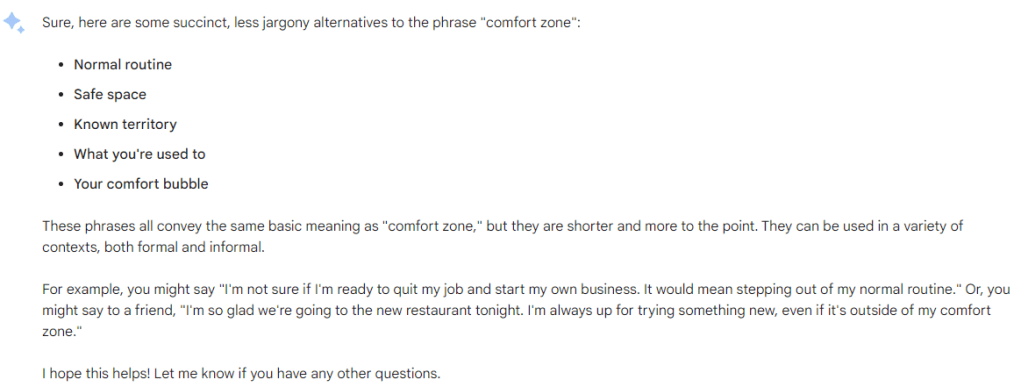
Google search results for the phrase “comfort zone.”
Now I’ll grant that some of these 65,200,000 search results are non-psychological and refer to air conditioning and other things, but the phrase “comfort zone” is used an awful lot.
In my view, a couple of these (“safe space,” “your comfort bubble”) are just as bad as “comfort zone,” but “normal routine” and “what you’re used to” are much better and less jargon-y than “comfort zone.”
So I’ll use that instead.
OK now, where we were?
Returning to the flip side of my words obsession
Sorry about that.
But there are drawbacks to straying from your normal routine. Sometimes written communication just doesn’t cut it. (“Doesn’t cut it” is another piece of jargon I should eliminate. But one per post is enough.)
I don’t know how many times I’ve had this exchange with coworkers, friends, and family.
PERSON: Did you resolve the issue with Jane?
ME: I emailed her a couple of days ago but haven’t heard back.
PERSON: Why don’t you pick up the phone and call her?
ME: I’ll email her again. Or maybe I’ll text her.
PERSON: CALL HER!
ME, IRRITATED: OK, I’ll call her!
From a meaningful apocryphal conversation. Not put to music…yet.
When I strayed from my normal routine, good things happened
I thought about this during a recent interchange with one of my Bredemarket clients.
I had emailed a question to the client, and the very busy client said they would get back to me with the answer. After a while, I emailed the client again. And again.
At this point I started to get worried. (Maybe I am sensitive. A bit.)
But before I jumped to the wrong conclusion, I decided that I had better pick up the phone and call the client.
Not that day, but the next day. I mean, you can’t be rash about things like that.
So the next day I did pick up the phone and called the client…but the client wasn’t available.
A few minutes later, I received an email with an explanation for the delay (the busy client had been even busier than usual due to unanticipated circumstances), AND the client provided the answer to my question. Everything was very good.
But what if I want to know how to work with Bredemarket?
Glad you asked.
After reading Mace’s LinkedIn post, I realized that I have a bunch of different online sources that explain how to work with Bredemarket, but they’re scattered all over the place. This post groups them all the “how to work with Bredemarket” content together, following an outline similar (yet slightly different) to Mace’s.
And no, it’s not a stand-alone PDF, but as you read the content below you’ll discover two stand-alone PDFs that address critical portions of the process.
Question 1: Why would I work with Bredemarket?
As you’ll see below, “why” is a very important question, even more important than “how.” Here are some reasons to work with Bredemarket.
You require the words to communicate the benefits of your identity/biometrics product/service. I offer 29 years of experience in the identity/biometrics industry and am a biometric content marketing expert and an identity content marketing expert. I have created multiple types of content (see below) to share critical points about identity/biometrics offerings.
You require the words to communicate the benefits of your technology product/service. I have also created multiple types of content to share critical points about technology offerings.
You require the words to communicate the benefits of a product/service you provide to California’s Inland Empire. I’ve lived in the Inland Empire for…well, for more than 29 years. I know the area—its past, its present, and its future.
You require one of the following types of content. Blogs, case studies / testimonials, data sheets, e-books, proposals, social media posts / Xs (or whatever tweets are called today), white papers, or anything. I’ve done these for others and can do it for you.
Question 2: Why WOULDN’T I work with Bredemarket?
This question is just as important as the prior one. If you need the following, you WON’T want to work with Bredemarket.
You require high quality graphics. Sorry, that’s not me.
I did not draw this myself. Originally created by Jleedev using Inkscape and GIMP. Redrawn as SVG by Ben Liblit using Inkscape. – Own work, Public Domain, link.
You are based outside of the United States. Foreign laws and exchange rates make my brain hurt, so I only pursue business domestically. But depending upon where you are, I may be able to recommend a content marketer for you.
Question 3: What are Bredemarket’s most popular packages? How much do they cost?
Here are the three most common packages that Bredemarket offers.
Note that these are the standard packages. If your needs are different, I can adapt them, or charge you an hourly rate if the need is not well defined. (But as you will see below, I try to work with you at the outset to define the project.)
If you follow the link above for your desired package and download the first brochure on each page, you’ll get a description of the appropriate service. The pricing is at the bottom of each brochure.
Each brochure also explains how I kick off a project, but the procedure is fairly common for each package.
Question 4: What are Bredemarket’s working practices?
But that’s not all that we address in the kickoff. There are some other lower-level questions that I ask you (such as the long and short form of your company name).
Once we have defined the project, I iteratively provide draft copy and you iteratively review it. The number and length of review cycles varies depending upon the content length and your needs. For example, I use up to two review cycles of up to three days each for short content.
Eventually I provide the final copy, you publish it and pay me, and both of us are happy.
In some cases, a customer’s purchase of a particular product or service indicates possible future interest in that same product or service.
But this indicator only goes so far.
If you just purchased an expensive item such as a refrigerator or a car or a house, chances are you’re not in the market for a second refrigerator or car or house.
People have lost patience with brands who send incorrect or inaccurate marketing materials. In fact, brands that do this are driving their customers away.
Of the 49% that say they were incorrectly targeted to in the last six months, 42% said they immediately unsubscribed from the brand’s marketing content. Another 24% chose to block the brand on social media!
43% said that they received marketing for a product they’d already bought.
From Venn Marketing, “Awareness, Consideration, Conversion: A 4 Minute Intro To Marketing 101.” (Link)
The picture above shows a simple sales funnel example. The second of the three items in the funnel is the “consideration” phase.
In that phase, those people who are aware of you can then consider your products and services.
If they like what they see, they move on to conversion and hopefully buy your products and services.
But how do prospects in the funnel consideration phase evaluate your offering as opposed to competitor offerings? Is it truly a quantitative and logical process, or is it in reality qualitative and emotional?
Quantitative consideration
For purposes of this post, let’s assume that there are two competing companies, Bredemarket and Debamarket, who are fighting each other for business.
Second, let’s assume that Bredemarket and Debamarket offer similar services to their prospects and customers:
Blog posts
Case studies
White papers
Finally, let’s assume that a big government agency (the BGA) has issued a Request for Proposal (RFP) for blog/case study/white paper services, and Bredemarket and Debamarket are the two companies competing for the award.
A pre-acquisition consultant will develop a Source Selection Plan (SSP). In competitive procurements such as the one in this example, the SSP will state exactly how proposals will be evaluated, and how the best proposal will be selected.
Here is the U.S. Government’s guidance on Source Selection Plans. (link)
SSPs can be very complex for certain opportunities, and not so complex for others. In all cases, the SSP dictates the evaluation criteria used to select the best vendor.
The weighted scoring approach breaks down your RFP evaluation criteria and assigns a value to each question or section. For example, your RFP criteria may consider questions of technical expertise, capabilities, data security, HR policies and diversity and sustainability. Weighted scoring prioritizes the criteria that are most important to your business by assigning them a point or percentage value. So your weighted scoring criteria may look like this:
Technical expertise – 25%
Capabilities – 40%
Data security – 10%
HR policies – 10%
Diversity and sustainability – 15%
RFP360, “A guide to RFP evaluation criteria: Basics, tips and examples.” (Link)
Individual question evaluation
In most cases the evaluator doesn’t look at the entire technical expertise section and give it a single score. In large RFPs, the technical expertise section may consist of 96 questions (or even 960 questions), each of which is evaluated and fed into the total technical expertise score.
For example, the RFP may include a question such as this one, and the responses from the bidders (Bredemarket and Debamarket) are evaluated.
Question
Bredemarket
Debamarket
96. The completed blog post shall include no references to 1960s songs.
Example evaluation of a proposal response to an individual RFP question.
Final quantitative recommendation for award
Now repeat this evaluation method for every RFP question in every RFP category and you end up with a report in which one of the vendors receives more points than the other and is clearly the preferred bidder. Here’s an example from a U.S. Nuclear Regulatory Commission proposal source selection process. (And you can bet that a nuclear agency doesn’t use an evaluation method that is, um, haphazard.)
From U.S. Nuclear Regulatory Commission, “FINAL EVALUATION RECOMMENDATION REPORT FOR PROPOSALS SUBMITTED UNDER RFP NO. RQ-CIO-01-0290 ENTITLED, “INFRASTRUCTURE SERVICES AND SUPPORT CONTRACT (ISSC).”” (link)
So what does this example show us? It shows that L-3 Communications/EER received a total score of 83.8, while its closest competitor Logicon only received a score of 80. So EER is the preferred bidder.
So in our example, BGA would evaluate Bredemarket and Debamarket, come up with a number for each bidder, and award the contract to the bidder with the highest evaluation score.
Quantitative recommendation for the little guys
Perhaps people who aren’t big government agencies don’t go to this level of detail, but many prospects who reach the consideration phase use some type of quantitative method.
For example, if the (non-weighted) pros for an item under consideration outnumber the cons, go for it.
Now of course the discussion above assumes that everyone is a logical being who solely evaluates based on objective criteria.
But even Sages such as myself may deviate from the objective norm. Here’s a story of one time when I did just that.
As I previously mentioned, I had never written a proposal response before I started consulting for Printrak. But I had written a Request for Proposal before I joined Printrak. For a prior employer (located in Monterey Park), I worked with an outside consultant to develop an RFP to help my employer select a vendor for a computer system. The questions posed to the bidders were not complex. Frankly, it was a simple checklist. Does your computer system perform function A? Does it perform function B?
The outside consultant and I sent the final RFP to several computer system providers, and received several proposals in response.
A few of the proposals checked every box, saying that they could do anything and everything. We threw those proposals out, because we knew that no one could meet every one of our demanding requirements. (“I can’t trust that response.”)
We focused on the proposals that included more realistic responses. (“That respondent really thought about the questions.”)
As you can see, we introduced a qualitative, emotional element into our consideration phase.
According to Kaye Putnam, this is not uncommon.
Qualitative consideration
Humans think that we are very logical when we consider alternatives, and that our consideration processes are logical and quantitative. Putnam has looked into this assertion and says that it’s hogwash. Take a look at this excerpt from Putnam’s first brand psychology secret:
Your brand has to meet people at that emotional level – if you want them to buy. (And I know you do!)
Findings from several studies support this, but one of the most seminal was outlined in Harvard professor Gerald Zellman’s 2003 book, The Subconscious Mind of the Consumer. Zellman’s research and learnings prompted him to come to the industry-rocking conclusion that, “95 percent of our purchase decision making takes place in the subconscious mind.”
From Kaye Putnam, “7 Brand Psychology Secrets – Revealed!” (link)
But how can the subconscious mind affect quantitative evaluations?
While logic still has to play SOME role in a purchase decision (as Putnam further explains in her first and second brand psychology secrets), a positive or negative predisposition toward a bidder can influence the quantitative scores.
Imagine if the evaluators got together and discussed the Bredmarket and Debamarket responses to question 96, above. The back and forth between the evaluators may sound like this:
“OK, we’re up to question 96. That’s a no brainer, because no one would ever put song references in a BGA blog post.”
“Yeah, but did you see Bredemarket’s own post that has multiple references to the song ‘Dead Man’s Curve’?”
“So what? Bredemarket would never do that when writing for a government agency. That piece was solely for Bredemarket.”
“How do you KNOW that Bredemarket would never slip a song reference into a BGA post? You know, I really don’t trust that guy. He wore two different colored shoes to the orals presentation, a brown one and a black one. Someone as slopy as that could do anything, with huge consequences for BGA communications. I’m deducting points from Bredemarket for question 96.”
“OK. I think you’re being ridiculous, but if you say so.”
And just like that, your quantitative logical consideration process is exposed as a bunch of subconscious emotional feelings.
How does qualitative consideration affect you?
As you develop your collateral for the consideration phase, you need to go beyond logic (even if you have a Sage predisposition) and speak to the needs and pain points of your prospects.
Spock is behaving illogically. Jayenkai, “Pain – Star Trek Remix.” (link)
Here’s a example from my law enforcement automated fingerprint identificaiton system (AFIS) days.
If your prospect is a police chief who is sick and tired of burglars ransacking homes and causing problems for the police department, don’t tell your prospect about your AFIS image detail or independent accuracy testing results. After all, 1000 ppi and 99.967 accuracy are only numbers.
Provide the police chief with customer-focusedbenefit statements about how quickly your AFIS will clean up the burglary problem in the town, giving residents peace of mind and the police department less stress.
If you can appeal to those emotions, that police chief will consider you more highly and move on to conversion (purchase).
Can I help?
If your messaging concentrates on things your prospects don’t care about, most of them will ignore you and not shower you with money. Using the wrong words with your customers impacts your livelihood, and may leave you poor and destitute with few possessions.
If you need a writer to work with you to ensure that your written content includes the right words that speak directly to your prospects, hire…Debamarket!

































 Bredemarket