I have been talking about mobile driver’s licenses for years, ever since my then-employer IDEMIA began issuing them almost a decade ago. When accepted, mobile driver’s licenses can function as the physical equipment of your physical driver’s license. Even at the airport.
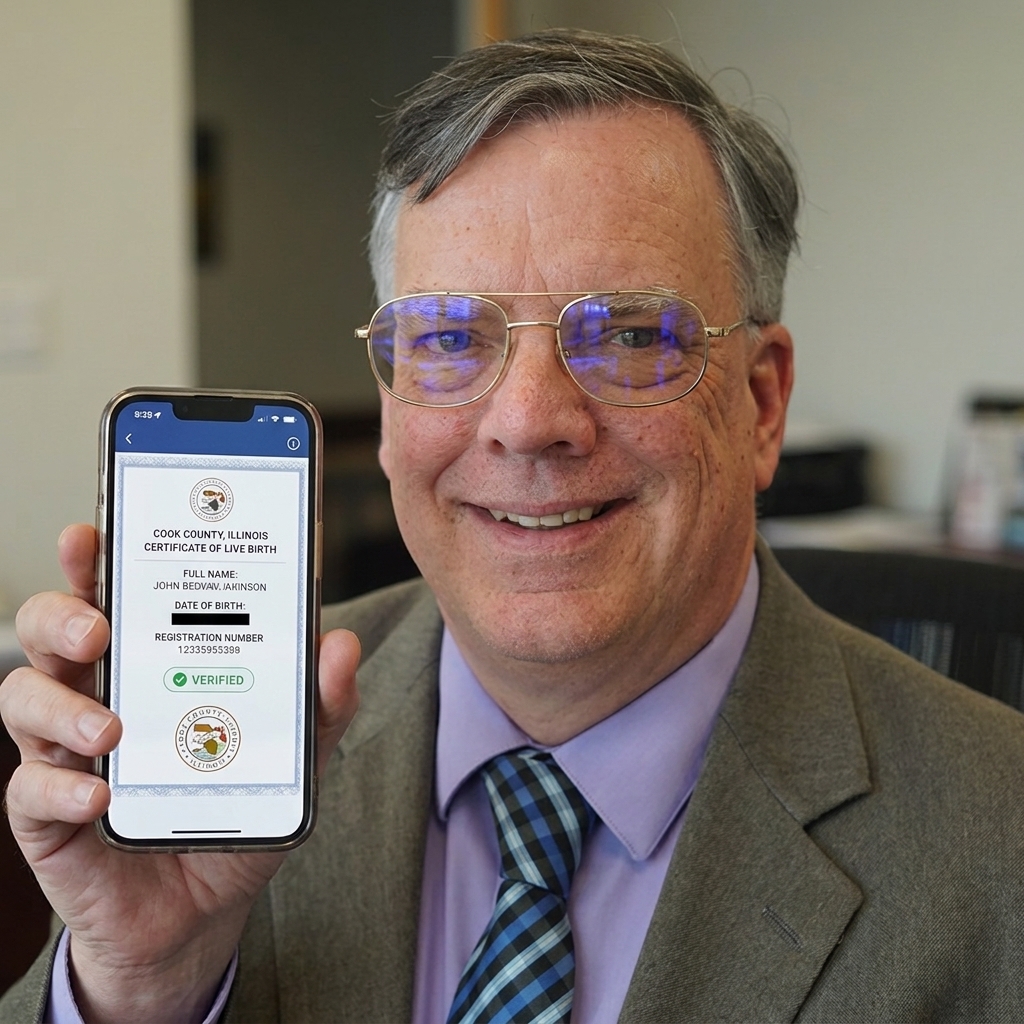
But you know what we haven’t had? Mobile birth certificates.
Mobile driver’s licenses vs. mobile birth certificates
Part of the problem is the complexity of the birth certificate ecosystem.
Yes, there are over 50 driver’s license issuers in the United States alone, and each issuer potentially has dozens of license types (license, ID card, commercial license, license under 21, license under 18, ID card under 21, ID card under 18, etc.). And their format potentially changes every few years. Incode and its competitors recognize thousands upon thousands of driver’s license types.
Birth certificates are even more diverse. Issued by states or counties, and issued in innumerable formats over the past 100 years. My birth certificate, issued…some time ago in Cook County, Illinois, probably looks extremely different from the birth certificate of a 2026 Cook County newborn. Could the identity verfication vendors even BEGIN to recognize all the different birth certificates?
Actually, some have. Several years ago when performing analysis research for a Bredemarket client, I looked at a number of these offerings, including VitalChek.
“Arizona has become the first U.S. state to let residents present a verified digital birth credential from a smartphone during Motor Vehicle Division (MVD) transactions, eliminating the need for a paper birth certificate in eligible cases.
“The program, developed by LexisNexis Risk Solutions, the Arizona Department of Health Services and the Arizona Department of Transportation, delivers the credential through VitalChek.”
So, when accepted, the Arizona mobile birth certificate (I’m calling it an mBC until someone forces me to stop) can function as the equivalent of a physical birth certificate.
What about YOUR mobile birth certificate product?
The birth certificate is probably the most important document you can have. If mobile versions of birth certificates take off, it will be revolutionary.
If your company offers mBCs and needs help marketing your product, let’s set up a free meeting to discuss how Bredemarket can help you with content, proposal, or analysis services.
“Processing civil documents at scale was once a legitimate operational nightmare. Birth certificates vary dramatically in format across states and countries, making manual extraction slow, inconsistent, and error-prone.”
Why the nightmare?
To examine the reasons for the birth certificate operational nightmare, let’s limit ourselves to the United States for the moment.
Driver’s licenses and similar IDs are challenging enough because they are issued by over 50 separate states and territories, and in several different formats (different driver license categories, non driver license IDs, plus special formats for minors and people below legal drinking age). So you’re talking about potentially thousands of formats.
Birth certificates are often NOT renewed (although you could conceivably request a new copy). So as a state changes its birth certificate formats over the decades, it could go through multiple different formats. And in a few cities such as New York City, they issued their own birth certificates independently of the state.
To complicate things further, the security on birth certificates is rudimentary, or perhaps non-existent for older birth certificates. Compare to driver’s licenses which are always incorporating new security features. (And older driver’s licenses without those security features are no longer valid or accepted.)
In short, validating birth certificates is significantly harder than validating driver’s licenses, which is hard enough.
“Modern automated extraction technology changes that reality. What was once a processing bottleneck is now a scalable, deployable component of a serious compliance strategy.”
How?
“Unlike a standardized driver’s license with a predictable layout and a scannable barcode, birth certificates are heavily unstructured….Modern unstructured document technology eliminates this bottleneck. Advanced extraction tools use intelligent models to read and pull key details from complex civil documents, regardless of the layout. By accurately capturing the date of birth, parent or guardian information, and place of birth, these tools turn a clunky manual review process into a fast, scalable verification workflow.”
Apply enough processing power and enough smarts and you can solve anything.
For example, when biometric companies want to justify the use of their technology, they have found that it is very effective to position biometrics as a way to combat sex trafficking.
Similarly, moves to rein in social media are positioned as a way to preserve mental health.
Now that’s a not-so-pretty picture, but it effectively speaks to emotions.
“If poor vulnerable children are exposed to addictive, uncontrolled social media, YOUR child may end up in a straitjacket!”
In New York state, four government officials have declared that the ONLY way to preserve the mental health of underage social media users is via two bills, one of which is the “New York Child Data Protection Act.”
But there is a challenge to enforce ALL of the bill’s provisions…and only one way to solve it. An imperfect way—age estimation.
Because they want to protect the poor vulnerable children.
By Paolo Monti – Available in the BEIC digital library and uploaded in partnership with BEIC Foundation.The image comes from the Fondo Paolo Monti, owned by BEIC and located in the Civico Archivio Fotografico of Milan., CC BY-SA 4.0, https://commons.wikimedia.org/w/index.php?curid=48057924
And because the major U.S. social media companies are headquartered in California. But I digress.
So why do they say that children need protection?
Recent research has shown devastating mental health effects associated with children and young adults’ social media use, including increased rates of depression, anxiety, suicidal ideation, and self-harm. The advent of dangerous, viral ‘challenges’ being promoted through social media has further endangered children and young adults.
Of course one can also argue that social media is harmful to adults, but the New Yorkers aren’t going to go that far.
So they are just going to protect the poor vulnerable children.
CC BY-SA 4.0.
This post isn’t going to deeply analyze one of the two bills the quartet have championed, but I will briefly mention that bill now.
The “Stop Addictive Feeds Exploitation (SAFE) for Kids Act” (S7694/A8148) defines “addictive feeds” as those that are arranged by a social media platform’s algorithm to maximize the platform’s use.
Those of us who are flat-out elderly vaguely recall that this replaced the former “chronological feed” in which the most recent content appeared first, and you had to scroll down to see that really cool post from two days ago. New York wants the chronological feed to be the default for social media users under 18.
The bill also proposes to limit under 18 access to social media without parental consent, especially between midnight and 6:00 am.
And those who love Illinois BIPA will be pleased to know that the bill allows parents (and their lawyers) to sue for damages.
Previous efforts to control underage use of social media have faced legal scrutinity, but since Attorney General James has sworn to uphold the U.S. Constitution, presumably she has thought about all this.
Enough about SAFE for Kids. Let’s look at the other bill.
The New York Child Data Protection Act
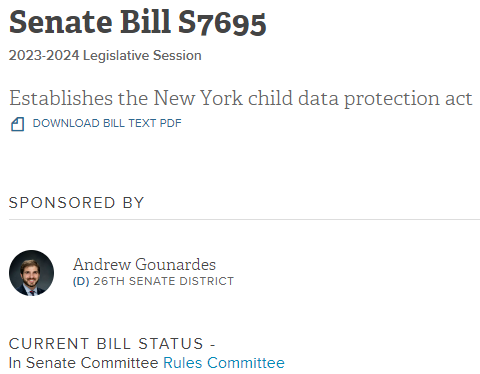
The second bill, and the one that concerns me, is the “New York Child Data Protection Act” (S7695/A8149). Here is how the quartet describes how this bill will protect the poor vulnerable children.
CC BY-SA 4.0.
With few privacy protections in place for minors online, children are vulnerable to having their location and other personal data tracked and shared with third parties. To protect children’s privacy, the New York Child Data Protection Act will prohibit all online sites from collecting, using, sharing, or selling personal data of anyone under the age of 18 for the purposes of advertising, unless they receive informed consent or unless doing so is strictly necessary for the purpose of the website. For users under 13, this informed consent must come from a parent.
And again, this bill provides a BIPA-like mechanism for parents or guardians (and their lawyers) to sue for damages.
But let’s dig into the details. With apologies to the New York State Assembly, I’m going to dig into the Senate version of the bill (S7695). Bear in mind that this bill could be amended after I post this, and some of the portions that I cite could change.
This only applies to natural persons. So the bots are safe, regardless of age.
Speaking of age, the age of 18 isn’t the only age referenced in the bill. Here’s a part of the “privacy protection by default” section:
§ 899-FF. PRIVACY PROTECTION BY DEFAULT.
1. EXCEPT AS PROVIDED FOR IN SUBDIVISION SIX OF THIS SECTION AND SECTION EIGHT HUNDRED NINETY-NINE-JJ OF THIS ARTICLE, AN OPERATOR SHALL NOT PROCESS, OR ALLOW A THIRD PARTY TO PROCESS, THE PERSONAL DATA OF A COVERED USER COLLECTED THROUGH THE USE OF A WEBSITE, ONLINE SERVICE, ONLINE APPLICATION, MOBILE APPLICA- TION, OR CONNECTED DEVICE UNLESS AND TO THE EXTENT:
(A) THE COVERED USER IS TWELVE YEARS OF AGE OR YOUNGER AND PROCESSING IS PERMITTED UNDER 15 U.S.C. § 6502 AND ITS IMPLEMENTING REGULATIONS; OR
(B) THE COVERED USER IS THIRTEEN YEARS OF AGE OR OLDER AND PROCESSING IS STRICTLY NECESSARY FOR AN ACTIVITY SET FORTH IN SUBDIVISION TWO OF THIS SECTION, OR INFORMED CONSENT HAS BEEN OBTAINED AS SET FORTH IN SUBDIVISION THREE OF THIS SECTION.
So a lot of this bill depends upon whether a person is over or under the age of eighteen, or over or under the age of thirteen.
And that’s a problem.
How old are you?
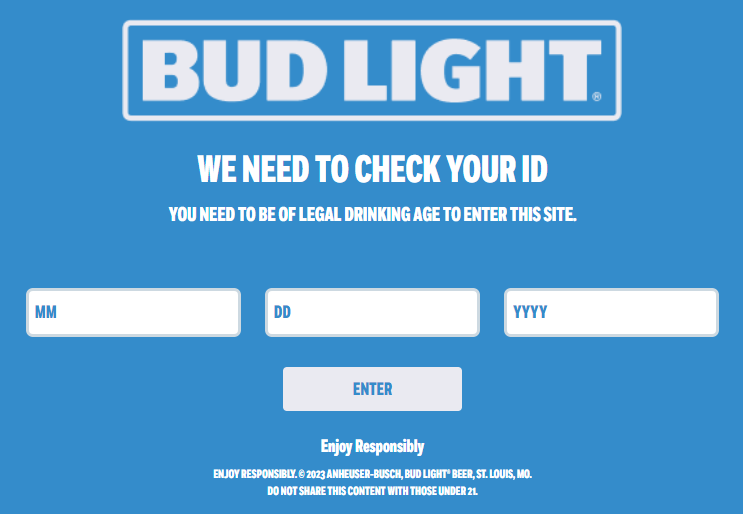
The bill needs to know whether or not a person is 18 years old. And I don’t think the quartet will be satisfied with the way that alcohol websites determine whether someone is 21 years old.
Attorney General James and the others would presumably prefer that the social media companies verify ages with a government-issued ID such as a state driver’s license, a state identification card, or a national passport. This is how most entities verify ages when they have to satisfy legal requirements.
For some people, even some minors, this is not that much of a problem. Anyone who wants to drive in New York State must have a driver’s license, and you have to be at least 16 years old to get a driver’s license. Admittedly some people in the city never bother to get a driver’s license, but at some point these people will probably get a state ID card.
However, there are going to be some 17 year olds who don’t have a driver’s license, government ID or passport.
And some 16 year olds.
And once you look at younger people—15 year olds, 14 year olds, 13 year olds, 12 year olds—the chances of them having a government-issued identification document are much less.
What are these people supposed to do? Provide a birth certificate? And how will the social media companies know if the birth certificate is legitimate?
But there’s another way to determine ages—age estimation.
How old are you, part 2
As long-time readers of the Bredemarket blog know, I have struggled with the issue of age verification, especially for people who do not have driver’s licenses or other government identification. Age estimation in the absence of a government ID is still an inexact science, as even Yoti has stated.
Our technology is accurate for 6 to 12 year olds, with a mean absolute error (MAE) of 1.3 years, and of 1.4 years for 13 to 17 year olds. These are the two age ranges regulators focus upon to ensure that under 13s and 18s do not have access to age restricted goods and services.
So if a minor does not have a government ID, and the social media firm has to use age estimation to determine a minor’s age for purposes of the New York Child Data Protection Act, the following two scenarios are possible:
An 11 year old may be incorrectly allowed to give informed consent for purposes of the Act.
A 14 year old may be incorrectly denied the ability to give informed consent for purposes of the Act.
Is age estimation “good enough for government work”?







 Bredemarket