Blog posts are transitory things, reflecting the views of the author at a particular point in time. Those views can change as the world evolves, or as the author evolves.
Take the author who wrote the following statement in late 2022: “Posts for awareness don’t need CTAs (calls to action).”
The author who wrote that statement was…um, it was me.
This post simply talked about a new candy store in Ontario, California, but never talked about Bredemarket’s content creation or proposal writing services.
So why did I write a post that doesn’t directly lead to business?
While perhaps it’s valid to say that the Candy Street Market blog post didn’t need a CTA (although some would dispute that), I myself have written other “awareness” blog posts and content that DID need a CTA.
(UPDATE OCTOBER 23, 2023: “SIX QUESTIONS YOUR CONTENT CREATOR SHOULD ASK YOU IS SO 2022. DOWNLOAD THE NEWER “SEVEN QUESTIONS YOUR CONTENT CREATOR SHOULD ASK YOU” HERE.)
For example, take another blog post that I wrote in December 2022, “Six Questions Your Content Creator Should Ask You: the e-book version.” It didn’t end with a request to contact me. It didn’t attempt to move the reader down the funnel from awareness to consideration. The blog post merely said that there are six questions.
But it did have a “download” CTA.
While the CTA didn’t in and of itself move the reader to consideration (and hopefully to conversion), it did make them, um, more aware. For those who followed my CTA and downloaded the e-book, they learned why their content creator should ask “why” and other questions. And by the time they got to page 13 14, they saw this:
For some of you, this e-book has helped you to decide on the questions that you will ask your preferred content creator, or the questions that you will ask yourself before you create your own content.
But for others, you might be asking how Bredemarket can help you create content. As I said earlier, you’re probably not ready to contract with me yet. We have to talk first.
If you’re interested in Bredemarket’s services, contact me via one of the methods listed at the https://bredemarket.com/contact/ URL.
From “Six Questions Your Content Creator Should Ask You.” Go here to download.
So THAT’S where I moved the reader on to the considerationphase—AFTER they had read the blog post AND the e-book.
But while they were still on the blog post, I assumed they were still in the awareness phase.
The Candy Street blog post was an awareness blog post that didn’t need a Bredemarket-focused CTA, because it only alerted people of Bredemarket’s existence.
The Six Questions e-book blog post was an awareness blog post that DID need a Bredemarket-focused CTA, because I wanted them to download and read the e-book and THEN move on to consideration.
I’m going to update the old blog/CTA blog post to refer to THIS one.
I may change my mind again.
As for the CTA to THIS blog post, there isn’t one—yet. This post was written for a purpose that I will reveal shortly.
I just ran across an excellent example of how a content marketing expert can raise fear, uncertainty, and doubt (FUD) in the mind of a prospect in the “consideration” phase.
These prospects need people to monitor their facilities and protect them against threats. In today’s world, it’s technically possible for facility monitoring professionals to work from anywhere, including their own homes.
Our preparation gives us the endurance to continuously provide professional monitoring services from within our hardened facilities. Since our founding, our choice has been to keep critical monitoring operations staff on-site. Monitoring from home provides lower-quality service (security issues/distractions). We believe you deserve more.
Take a look at Rapid Response Monitoring’s picture and see what this communicates to prospects in the consideration phase for facility monitoring services.
I’ve talked about the words “why,” “how,” and “what” and their relation to writing, but I haven’t talked about the word “which.”
Not in relation to sandwiches, but in relation to words.
If you are a marketing executive, you know that the words you use in your marketing content can make or break your success. When your company asks employees or consultants to write marketing content for you, which words should they use?
Here are four suggestions for you and your writers to follow.
Your writers should use the right words for your brand.
Your writers should use the right words for your industry.
Your writers should use words that get results.
Your writers should be succinct.
Your writers should use the right words for your brand
Your company has a tone of voice, and your writers should know what it is. If you can’t tell them what it is, they will figure it out themselves.
Your company has a particular writing style—hopefully one that engages your prospects and customers. Regardless of your writer’s personal style, they must create copy that aligns with your own style. In effect, they put on a “mask” that aligns the words they create with the words that your company needs.
Your writers should use the right words for your industry
Similarly, your company provides products and services in one or more industries, and your copy must align with the terms those industries use, and the way industry participants express themselves.
For example, a writer who is writing content for the biometric industry will use different terms than a writer who is writing content for art collectors because of the differences in the two target audiences.
Biometric readers (the people, not the devices) care about matching accuracy measurements, such as those compiled by the U.S. National Institute of Standards and Technology (NIST) in its Face Recognition Vendor Test, or as measured in agency-managed benchmarks. (Mike French’s example.) They often respond to quantitative things, although more high-level concepts like “keeping citizens safe from repeat offenders” (a public safety-related benefit) also resonate.
Art collectors care about more qualitative things, such as not being scared of handing over their dream to a commissioned artist whose work will inspire affection. (Well, unless the collector is an art investor and not an art lover; investors use different terminology than lovers.)
So make sure your writers get the words right. Otherwise, it’s as if someone is speaking Italian to a bunch of French speakers. (Kaye Putnam’s example.) Your prospects will tune you out if you use words they don’t understand.
Your writers should use words that get results
There is one important exception to my suggestions above. If your company’s current words don’t result in action, quit using your current words and use better ones that support your awareness, consideration, conversion, or other goals.
If you start talking about your solution without addressing your prospect’s pain points or problems, they won’t know why they should care about your solution.
For example, let’s say that the message you want to give to your prospects is that your company makes wireless headphones.
The prospect doesn’t care about wireless headphones per se. The prospect cares about the troubles they face with tangled cords, and how your company offers a solution to their problem of tangled cords.
Features are important to you. Benefits are important to your prospects. Since the prospects are the ones with the money, listen to them and talk about benefits that change their lives, not how great your features are.
Your writers should be succinct
I have struggled with succinctness for decades. I could give you countless examples of my long-windedness, but…that wouldn’t be appropriate.
So how do I battle this personally? By creating a draft 0.5 before I create my draft 1. I figure out what I’m going to say, say it, and then sleep on the text—sometimes literally. When I take a fresh look at the text, I usually ruthlessly chop a bunch of it out and focus on the beef.
Now there are times in which detail is appropriate, but there are also times in which a succinct message gets better results.
Selecting your content marketer
If your company needs employees or consultants to write marketing content for you, make sure they create the right content.
If your company’s views on content creation parallel my own, maybe I can help you.
If you need a full-time employee on your staff to drive revenue as your personal Senior Product Marketing Manager or Senior Content Marketing Manager, take a look at my 29 years of technology (identity/biometric) and marketing experience on my LinkedIn profile. If you like what you see, contact me via LinkedIn or at jebredcal@gmail.com.
If you need a marketing consultant for a single project, then you can reach me via my Bredemarket consultancy.
This post explains what “pillar pages” are, the pros and cons of Bredemarket’s pillar pages, what I’ve learned from the “Target Audience” pillar page that I created, and how this can help your business deliver effective, converting messages to your prospects.
What are pillar pages?
I’ve been working on “pillar pages” for the Bredemarket website for over a year now.
As I stated before in an April 2022 blog post, a “pillar page” is simply a central “cluster” page on your website that discusses an important topic, and which is linked to other pages that provide more detail on the topic.
Think of a wheel with a hub and spokes. The pillar page is the hub, and the related pages are the spokes.
Now these pillar pages aren’t as mature as I’d like them to be.
I haven’t really multi-layered my keywords that link to the pillar; currently things are fairly simplistic where benefit “spoke” blog posts link to the benefits “hub” pillar. I haven’t explicitly optimized the “hub and spokes” for people who search for, say, features.
Similarly, the organization of each pillar page is fairly simplistic. Each pillar starts with a brief discussion of the topic in question, and is then followed by excerpts from and links to blog posts that provide more detail on the topic. (And the blog posts themselves link back to the pillar, providing bidirectional…um, benefits.) It’s functional, but perhaps you’d be better served if the pillars grouped subtopics together, rather than listing all the blog posts in reverse chronological order.
But the pillars do their work in terms of navigation and search engine optimization. If you want to find out what Bredemarket says about a topic such as benefits, it’s fairly easy to find this.
What have I learned from the Bredemarket Target Audience pillar page?
This post delves into the fifth of my five pillar pages, the Target Audience page.
I’ve recently worked on beefing up this pillar page by linking to more Bredemarket blog posts that discuss target audiences. And in the process of making these additions, I’ve realized some things about target audiences that I wanted to summarize here. (Repurposing content refocuses the mind, I guess.)
In the process of improving my pillar page, I’ve gleaned five truths about target audiences:
You need to define at least one target audience.
It’s not illegal to have multiple target audiences.
Different target audiences get different messages.
You can create personas, or you can not create personas. Whatever floats your boat.
Target audience definition focuses your content.
I’ll discuss each of these truths and suggest how they can improve your firm’s content.
One: You Need to Define At Least One Target Audience.
The first and most important thing is that you need a target audience before you start writing.
If you have no target audience, who is receiving your message? How do you know what to say?
For example, the primary target audience for THIS blog post is anyone from any type of company who could use Bredemarket’s marketing and writing services. It’s not limited to just the identity folks, or just the Inland Empire folks. If it were, I’d write it differently.
The content addressed two target audiences at the same time, although this post prioritized the companies looking for full-time employees.
As long as you know in advance what you’re going to do, you can define multiple target audiences. Just don’t define a dozen target audiences for a 288-character tweet.
Three: Different Target Audiences Get Different Messages.
Perhaps you are writing a single piece of content that must address multiple target audiences. A proposal is an example of this. For example, a proposal in response to a request for proposal (RFP) for an automated biometric identification system (ABIS) affects multiple target audiences.
Here’s an example of multiple target audiences for a theoretical Ontario, California ABIS proposal, taken from a May 2021 Bredemarket post:
Field investigators.
Examiners.
People who capture biometrics.
Information Technologies.
Purchasing.
The privacy advocate.
The mayor.
Others.
That’s a lot of target audiences, but if you’re submitting a 300 page proposal that answers hundreds of individual questions, you have the ability to customize each of the hundreds of responses to address the affected target audience(s).
For example, if the RFP asks about the maximum resolution of captured latent fingerprint images, your response will address the needs of the “examiner” target audience. Your response to that question won’t need to say anything about your compliance with city purchasing regulations. (Unless you have a really weird city, which is possible I guess.)
At the same time, if the RFP asks if you comply with E-Verify, this is NOT the time to brag about supporting 4,000 pixels per inch image capture.
Four: You Can Create Personas, Or You Can Not Create Personas. Whatever Floats Your Boat.
If you haven’t read the Bredemarket blog that much, you should know that I’m not very hung up on processes—unless my client (or my employer) insists on them. Then they’re the most important thing in the world.
If you find yourself trapped in a room (preferably padded) with a bunch of certified marketing professionals, they’ll probably toss around the word “persona” a lot. A persona helps you visualize your target audience by writing to someone with a particular set of attributes. Here’s an example from the October 2022 post I cited earlier:
Jane Smith is a 54 year old single white owner of a convenience store in a rural area with an MBA and a love for Limp Bizkit…
If I’m going to write a particular piece of content, this persona helps me focus my writing. As I write, I can picture Jane in my mind, fetching the giant cups for the soda dispenser, planning her next trip to the big city, and wondering if her customers would mind if she started blasting this song.
Not the Seldom Scene.
Having this persona in my mind can be an excellent writing support.
What would Jane think about a list of target audience truths?
What would Jane think if a Limp Bizkit song appeared in the middle of the list? (She’d like that.)
So you can create personas, either on the fly (take a LinkedIn profile of a real person and change a few facts so that the persona becomes Jim, a 35 year old product/content marketer who specializes in healthcare) or through an extensive and expensive persona research program.
But what if you escape from the padded room, run away from the marketing professionals, and swear up and down that you will never ever create a persona?
Will your marketing efforts die?
No they won’t.
You can still target your writing without inventing demographic information about the person reading your content.
It depends upon the effort you want to invest in the task.
Five: Target Audience Definition Focuses Your Content.
I kind of already said this, but I wanted to explicitly repeat it and emphasize it.
Regardless of whether your target audience is defined by an expensive research effort, a tweak of a real person’s LinkedIn profile, or the simple statement “we want to target latent fingerprint examiners,” the simple act of defining your target audience focuses your content.
Your text addresses the target audience, and doesn’t go off on tangents that bear no relation to your target audience.
This makes your message much more effective.
But is the message of this post resonating with companies needing content creators?
If you’re still reading, I guess it is.
Bredemarket can help you define your target audience for your content, and can help you define other things also that are necessary for effective content.
Would you like to talk to me about the content you want to create, and the message you want to deliver to your target audience?
Are you ready to take your firm to the next level with a compelling message that addresses your target audience(s) and increases awareness, consideration, conversion, and long-term revenue?
As some of you know, I’m applying for full-time employment. Every one of my cover letters has a variation on this sentence.
I am in Southern California, five miles from Ontario International Airport, and can easily travel throughout the United States or to other countries as needed.
You will note that I explicitly state that Ontario International Airport is in Southern California, not Canada. Although the phrase “Ontario CA” can be interpreted as referring to the city in the state of California, or the province in the country of Canada, depending upon how you look at it.
Not that anybody pays attention to my explicit California reference. When I was sharing pictures from the February 18 Ontario Art Walk, and labeling the pictures as originating from Ontario, California, I was still asked to promote one of the pictures on a Canadian Instagram page.
The curse that we endure in the town of the Chaffeys. I bet Mildura doesn’t have this problem.
While Ontario International Airport is not the only airport in the Inland Empire, it is (at present) the largest one, and thus has a dramatic effect on those of us who live here.
One impact? Well, in the same way that I can board a flight from ONT to my future employer in San Francisco or Austin or Paris or wherever, visitors can board flights to ONT.
And some of those visitors are business visitors. Years ago, I was one of them, flying from Portland, Oregon to some town I had never heard of before for a job interview. Not only did I fly into the airport (Terminal 1 in those days), but I also stayed at the Red Lion Inn and spent other money while I was in town for the interview.
Ontario International Airport Terminal 1 as of September 2021, 20 years after airport traffic changed forever.
Postscript: I got the job. And other jobs after that.
The economists assign a monetary impact to the activity attributable to the airport.
The impact of economic activity taking place at Ontario International Airport itself, including the activity of the airport authority, airlines and their suppliers, government workers, airport concessions, and logistics companies is estimated at $3.8 billion in 2022. This will support $2.2 billion in GDP and 27,800 jobs. The bulk of these impacts—71% of the GDP impacts and 76% of the jobs impacts— reflect the impact of visitor spending in the region.
But don’t forget the government, which gets its own goodies.
This $2.2 billion of local economic activity (GDP) will result in a total of $571 million in tax impact. This consists of $319 million in federal tax impacts and $253 million in state and local impacts. As with the GDP impacts, the majority (71%) of these tax impacts are driven by the spending of visitors to the region.
And this doesn’t count the impact of the Inland Empire’s logistics industry.
The total economic impact of the logistics activity in the eight zip codes adjacent to Ontario International Airport was $17.8 billion of economic output, $9.9 billion of GDP, and 122,200 jobs. This activity generated $2.3 billion in federal, state, and local taxes.
But what of non-monetary impacts? As the description of the Ontario International Airport – Inter Agency Collaborative (ONT-IAC) makes clear, some of those impacts are negative.
The ONT-IAC implements the policies and criteria of the Airport Land Use Compatibility Plan (ALUCP) to prevent future incompatible land uses surrounding ONT and minimizing the public’s exposure to excessivie noise and safety hazards.
There’s always a balancing act between positive and negative impacts. While I might appreciate the ability to board a flight to Dallas at 6:00 in the morning, someone who lives near the airport may not be as appreciative. And the referenced “incompatible land uses” restrict the types of businesses that can be located near the airport.
While the Amazon LGB3 warehouse in Eastvale, California is some distance from Ontario International Airport, the airport’s presence has a positive impact on the warehouse and its workers.
But the relatively large amount of open space near the airport (again, our beloved warehouses) has helped to ensure that ONT does not need to implement the severe flight restrictions found at John Wayne and our former airport overlord Los Angeles International Airport.
And for better or worse the airport will remain for some time. It’s not like it’s going to close down or anything.
Although 9/11, the 2008 recession, and COVID tried to close it.
And one more thing about your business…
Does your firm need to create content for Inland Empire residents, Inland Empire visitors, and others who use your firm’s services?
Are you ready to take your Ontario, Eastvale, or Inland Empire firm to the next level with a compelling message that increases awareness, consideration, conversion, and long-term revenue?
Are you an executive with a small or medium sized identity/biometrics firm?
If so, you want to share the story of your identity firm. But what are you going to say?
How will you figure out what makes your firm better than all the inferior identity firms that compete with you?
How will you get the word out about why your identity firm beats all the others?
Are you getting tired of my repeated questions?
Are you ready for the answers?
Your identity firm differs from all others
Over the last 29 years, I (John E. Bredehoft of Bredemarket) have worked for and with over a dozen identity firms, either as an employee or as a consultant.
You’d think that since I have worked for so many different identity firms, it’s an easy thing to start working with a new firm by simply slapping down the messaging that I’ve created for all the other identity firms.
The messaging that I created in my various roles at IDEMIA and its corporate predecessors was dramatically different than the messaging I created as a Senior Product Marketing Manager at Incode Technologies, which was also very different from the messaging that I created for my previous Bredemarket clients.
IDEMIA benefits such as “servicing your needs anywhere in the world” and “applying our decades of identity experience to solve your problems” are not going to help with a U.S.-only firm that’s only a decade old.
Similarly, messaging for a company that develops its own facial recognition algorithms will necessarily differ from messaging for a company that chooses the best third-party facial recognition algorithms on the market.
So which messaging is right?
It depends on who is paying me.
How your differences affect your firm’s messaging
When creating messaging for your identity firm, one size does not fit all, for the reasons listed above.
The content of your messaging will differ, based upon your differentiators.
For example, if you were the U.S.-only firm established less than ten years ago, your messaging would emphasize the newness of your solution and approach, as opposed to the stodgy legacy companies that never updated their ideas.
And if your firm has certain types of end users, such as law enforcement users, your messaging would probably feature an abundance of U.S. flags.
In addition, the channels that you use for your messaging will differ.
Identity firms will not want to market on every single social media channel. They will only market on the channels where their most motivated buyers are present.
That may be your own website.
Or LinkedIn.
Or Facebook.
Or Twitter.
Or Instagram.
Or YouTube.
Or TikTok.
Or a private system only accessible to people with a Top Secret Clearance.
It may be more than one of these channels, but it probably won’t be all of them.
But before you work on your content or channels, you need to know what to say, and how to communicate it.
How to know and communicate your differentiators
As we’ve noted, your firm is different than all others.
How do you know the differences?
How do you know what you want to talk about?
How do you know what you DON’T want to talk about?
Here are three methods to get you started on knowing and communicating your differentiators in your content.
Method One: The time-tested SWOT analysis
If you talk to a marketer for more than two seconds about positioning a company, the marketer will probably throw the acronym “SWOT” back at you. I’ve mentioned the SWOT acronym before.
For those who don’t know the acronym, SWOT stands for
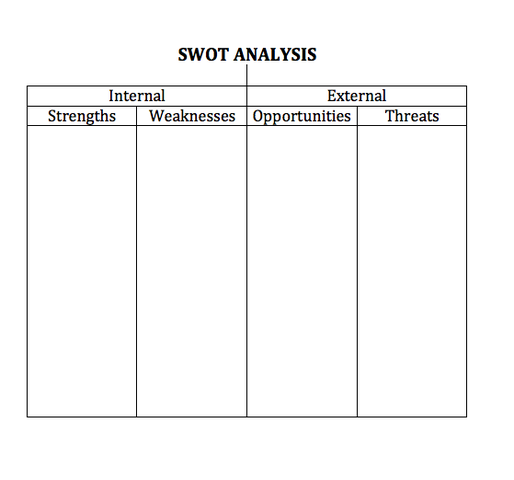
Strengths. These are internal attributes that benefit your firm. For example, your firm is winning a lot of business and growing in customer count and market share.
Weaknesses. These are also internal attributes, but in this case the attributes that detract from your firm. For example, you have very few customers.
Opportunities. These are external factors that enhance your firm. One example is a COVID or similar event that creates a surge in demand for contactless solutions.
Threats. The flip side is external factors that can harm your firm. One example is increasing privacy regulations that can slow or halt adoption of your product or service.
If you’re interested in more detail on the topic, there are a number of online sources that discuss SWOT analyses. Here’s TechTarget’s discussion of SWOT.
The common way to create the output from a SWOT analysis is to create four boxes and list each element (S, W, O, and T) within a box.
Once this is done, you’ll know that your messaging should emphasize the strengths and opportunities, and downplay or avoid the weaknesses and threats.
Or alternatively argue that the weaknesses and threats are really strengths and opportunities. (I’ve done this before.)
Method Two: Think before you create
Personally, I believe that a SWOT analysis is not enough. Before you use the SWOT findings to create content, there’s a little more work you have to do.
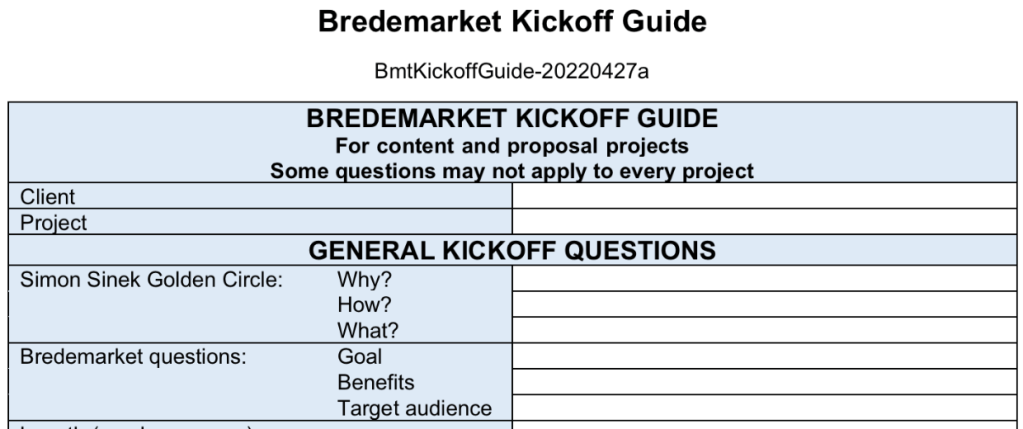
I recommend that before you create content, you should hold a kickoff of the content creation process and figure out what you want to do before you do it.
During that kickoff meeting, you should ask some questions to make sure you understand what needs to be done.
I’ve written about kickoffs and questions before, and I’m not going to repeat what I already said. If you want to know more:
Now that you’ve locked down the messaging, it’s time to actually create the content that differentiates your identity firm from all the inferior identity firms in the market. While some companies can proceed right to content creation, others may run into one of two problems.
The identity firm doesn’t have any knowledgeable writers on staff. To create the content, you need people who understand the identity industry, and who know how to write. Some firms lack people with this knowledge and capability.
The identity firm has knowledgeable writers on staff, but they’re busy. Some companies have too many things to do at once, and any knowledgeable writers that are on staff may be unavailable due to other priorities.
This is where you supplement you identity firm’s existing staff with one or more knowledgeable writers who can work with you to create the content that leaves your inferior competitors in the dust.
What is next?
So do you need a knowledgeable biometric content marketing expert to create your content?
One who has been in the biometric industry for 29 years?
One who has been writing short and long form content for more than 29 years?
Are you getting tired of my repeated questions again?
Well then I’ll just tell you that Bredemarket is the answer to your identity/biometric content marketing needs.
Are you ready to take your identity firm to the next level with a compelling message that increases awareness, consideration, conversion, and long-term revenue? Let’s talk today!
If you want a content marketing expert to write for your business, do you just say “Write this, and make it viral”?
Not THAT viral. (Too soon?) By Alexey Solodovnikov (Idea, Producer, CG, Editor), Valeria Arkhipova (Scientific Сonsultant) – Own work. Scientific consultants:Nikitin N.A., Doctor of Biological Sciences, Department of Virology, Faculty of Biology, Lomonosov Moscow State University.Borisevich S.S. Candidate of Chemical Sciences, Specialist in Molecular Modeling of Viral Surface Proteins, Senior Researcher, Laboratory of Chemical Physics, Ufa Institute of Chemistry RASArkhipova V.I., specialization in Fundamental and Applied chemistry, senior engineer, RNA Chemistry Laboratory, Institute of chemical biology and fundamental medicine SB RAS, CC BY-SA 4.0, https://commons.wikimedia.org/w/index.php?curid=104914011
Six words of instruction will not result in great content.
Even if you just say “Write this” and leave off the viral part, this will not work either.
You and your content creator have to have a shared understanding of what the content will be.
For example, as I indicated in a previous post, you and your content creator have to agree on the tone of voice to use in the content. The content creator could write something in a tone of voice that may not match your voice at all, which would mean that the content would sound horribly wrong to your audience.
Imagine a piece for financial executives written in the style of Crazy Eddie. Ouch.
And that’s just one thing that could go wrong when you and your content creator are not on the same…um, page.
Bredemarket’s content creation process includes six questions
When Bredemarket works with you to create content, I use a content creation process. I’ve revised my original content creation process severaltimes, and I’m sure I’ll revise it more as I work with more of you.
But as of today, Bredemarket’s kickoff meetings with clients begin with six high-level questions that set the scene for everything that follows.
Question One: Why?
As I noted in my Simon Sinek post, the “why?” question needs to be answered before any other question is asked.
Before you ask a content creator to write a case study about how your Magnificent Gizmo cures bad breath, you need to understand why you’re in the good breath business in the first place. Did you have an unpleasant childhood experience? Were you abandoned at the altar? WHY did you care enough to create the Magnificent Gizmo in the first place?
(As I write this post, I’m going to look at how each of these six questions can be answered for the post itself. After all, it’s fair to ask: Why does Bredemarket do what it does? Short answer: because I write. You can pry my keyboard out of my cold dead hands. For the longer answer, read the “Who I Am” page on the Bredemarket website.)
Question Two: How?
You also need to make sure your content creator can explain how you do what you do. Have you created your own set of algorithms that make breath good? Do you conduct extensive testing with billions of people, with their consent? How is your way of doing things superior to that of your competitors?
Once these are clear in your mind, you’re ready to talk about the “what.” As Sinek notes, many people start with the “what” and then proceed to the “how,” and may or may not even answer the “why.” But when you ask the “why” first and the “how” second, your “what” description is much better.
(Again, you may be asking what Bredemarket does. I craft the words to communicate with technical and non-technical audiences. For additional clarification, read “What I Do,” which also notes what I don’t do. Sorry, finger/face/ID document vendors.)
Question Four: Goal?
Once the Golden Circle is defined, we’re ready to dig a little deeper into the specific piece of content you want. We’re not ready to talk about page count and fonts, yet, though. There’s a few other things we need to settle.
What is the goal of the content? Simple awareness of the product or service you provide? Or are you ready for consideration? Or is it time for conversion? The goal affects the content dramatically.
(In the case of this post, the goal is primarily awareness, but if you’re ready for conversion to become a paying customer, I won’t turn you away.)
Question Five: Benefits?
I’ve written ad nauseum on the difference between benefits and features, so for this question five about benefits I’ll just briefly say that written content works best when it communicates how the solution will help (benefit) the customer. A list of features will not make a difference to a customer who has specific needs. Do you meet those needs? Maintain a customer focus.
(Bredemarket’s primary benefit is focused content that meets your needs. There are others, depending upon your industry and the content you require.)
Question Six: Target Audience?
This one is simple to understand.
If you’re a lollipop maker and you’re writing for kids who buy lollipops in convenience stores, you’ll write one way.
If you’re a lollipop maker and you’re writing to the convenience stores who could carry your lollipops, you’ll write another way.
Now sometimes content creators get fancy and create personas and all that (Jane Smith is a 54 year old single white owner of a convenience store in a rural area with an MBA and a love for Limp Bizkit), but the essential thing is that you understand who you want to read your content.
(This particular piece is targeted for business owners, executives, directors, and managers, especially in California’s Inland Empire, who have a need to create focused content that speaks to their customers. The target audience not only affects how I am writing this post, but also how I will distribute it.)
What if you use a different content creator?
I am forced to admit that not everyone chooses Bredemarket to create their content.
Maybe you create your content yourself.
Maybe you already have access to content creators.
Or maybe you have a limited budget and can only pay a penny a word to your content creator. Let’s face it, a five dollar blog post does sound attractive.
But that doesn’t mean that you can’t use these six questions. I did publish them, after all, and they’re based on questions that others have asked.
If you create your own content, ask yourself these six questions before you begin. They will focus your mind and make your final content better.
If you have someone else create your content, make sure that you provide the answers for your content creator. For example, if you seek a content creator on Upwork or Fiverr, put the answers to these questions in your request for quotes. Experienced writers will appreciate that you’re explaining the why, how, what, goal, benefits, and target audience at the very beginning, and you’ll get better quotes that way. If someone knows your target audience is crime scene examiners, then you’ll (hopefully) see some quotes that describe the writer’s experience in writing for crime scene examiners.
And if you provide the answers to those six questions and your content creator says, “That doesn’t matter. I write the same for everyone,” run away.











 Bredemarket