Technology marketers, do you need written content?
If you don’t use written content to communicate with your prospects and clients, save yourself some time and stop reading this.
But if you realize that written content is essential for prospect awareness, consideration, and especially conversion…
And if you need someone adept at creating a variety of written content, from blog posts and articles to case studies and white papers to smartphone application content and scientific book chapters…
Bredemarket can help.
Technology marketers, do you need written content?
I have created all of these types of content, plus internal content such as market/competitor analyses and proposal templates. And I can create this content for your company.
When your company attends events, you’ll want to maximize your event return on investment (ROI) by creating marketing content that you publish before, during, and after the event.
The two things (first, second) you need to do NOW, well before your event.
And I’ll spill a couple of secrets along the way.
The first secret (about events)
I’m going to share two secrets in this post. OK, maybe they’re not that secret, but you’d think they ARE secrets because no one acknowledges them.
The first one has to do with event attendance. You personally might be awed and amazed when you’re in the middle of an event and surrounded by hundreds, or thousands, or tens of thousands of people. All of whom are admiring your exhibit booth or listening to your CEO speak.
Technically not a CEO (Larry Ellison’s official title is Chief Technology Officer, and the CEO is Safra Catz), but you get the idea. By Oracle PR Hartmann Studios – CC BY 2.0, https://commons.wikimedia.org/w/index.php?curid=47277811.
But guess what?
Many, many more people are NOT at the event.
They can’t see your exhibit booth, and can’t hear your speaker. They’re on the outside, TRYING to look in.
And all the money you spent on booth space and travel and light-up pens does NOTHING for the people who aren’t there…
Unless you bring the event to them. Your online content can bring the event to people who were never there.
But you need to plan, create, and approve your content before, during, and after the event. Here’s how you do that.
Three keys to creating event-related content
Yes, you can just show up at an event, take some pictures, and call it a day. But if you want to maximize your event return on investment, you’ll be a bit more deliberate in executive your event content. Ideally you should be:
Before the event begins, you need to plan your content. While you can certainly create some content on a whim as opportunity strikes, you need to have a basic idea of what content you plan to create.
Before the event. Why should your prospects and customers care about the event? How will you get prospects and customers to attend the event? What will attendees and non-attendees learn from the event?
During the event. What event activities require content generation? Who will cover them? How will you share the content?
Some dude creating Morphoway-related content for Biometric Update at the (then) ConnectID Expo in 2015.
After the event. What lessons were learned? How will your prospects and customers benefit from the topics covered at the event? Why should your prospects buy the product you showcased at the event?
Creating your event content
Once you have planned what you want to do, you need to do it. Before, during, and after the event, you may want to create the following types of content:
Blog posts. These can announce your attendance at the event before it happens, significant goings-on at the event (such as your CEO’s keynote speech or the evening party launching your new product), or lessons learned from the event (what your CEO’s speech or your new product means for your prospects and clients). Blog posts can be created relatively quickly (though not as quick as some social media posts), and definitely benefit your bottom line.
Social media. Social media such as Facebook, Instagram, and LinkedIn can also be used before, during, and after the event. Social media excels at capturing the atmosphere of the event, as well as significant activities. When done right, it lets people experience the event who were never there.
E-mails. Don’t forget about e-mails before, during, and after the event. I forgot about e-mails once and paid the price. I attended an event but neglected to tell my e-mail subscribers that I was going to be there. When I got to the event, I realized that hardly any of the attendees understood the product I was offering, and were not the people who were hungry for my product. If I had stocked the event with people from my e-mail list, the event would have been more productive for me.
Data sheets. Are you announcing a new product at an event? Have the data sheet ready.
Demonstration scripts. Are you demonstrating a new or existing product at the event? Script out your demonstration so that your demonstrators start with the same content and make the points YOU want them to make.
Case studies and white papers. While these usually come into play after the event, you may want to release an appropriate case study or white paper before or during the event, tied to the event topic. Are you introducing a new product at an industry conference? Time your product-related white paper for release during the conference. And promote the white paper with blog posts, social media, and e-mails.
Other types of content. There are many other types of content that you can release before, during, or after an event. Here’s a list of them.
Approving your event content
Make sure that your content approval process is geared for the fast-paced nature of events. I can’t share details, but:
If your content approval process requires 24 hours, then you can kiss on-site event coverage goodbye. What’s the point in covering your CEO’s Monday 10:00 keynote speech if the content doesn’t appear until 11:00…on Tuesday?
If your content approval process doesn’t have a timeline, then you can kiss ALL event coverage goodbye. There have been several times when I’ve written blog posts announcing my company’s attendance at an event…and the blog posts weren’t approved until AFTER the event was already over. I salvaged the blog posts via massive rewrites.
So how are you going to generate all this content? This brings us to my proposed solution…and the second secret.
The rest of this post talks about one of Bredemarket’s services, the Bredemarket 2800 Medium Writing Service. For those who haven’t heard about it, it’s a service where I provide between 2,800 and 3,200 words of written text.
“But John,” you’re asking. “How is a single block of 3,200 words of text going to help me with my event marketing?”
Time to reveal the second secret…
You can break up those 3,200 words any way you like.
For example, let’s say that you’re planning on attending an event. You could break the text up as follows:
One 500-word blog post annnouncing your attendance at the event.
Three 100-word social media posts before the event.
One 500-word blog post as the event begins.
One 300-word product data sheet prepared before the event and released on the second day of the event.
One 500-word blog post announcing the new product.
Three 100-word social media posts tied to the new product announcement.
One 500-word post-event blog post with lessons learned.
Three 100-word social media posts after the event.
For $2,000 (as of June 2024), you can benefit from written text for complete event coverage, arranged in any way you need.
So how can you and your company receive these benefits?
Read about the Bredemarket 2800 Medium Writing Service
First, read the data sheet for the Bredemarket 2800 Medium Writing Service so you understand the offer and process.
Second, contact Bredemarket to get the content process started well BEFORE your event. Book a meeting with me at calendly.com/bredemarket. Be sure to fill out the information form so I can best help you.
When I write about space aliens, there’s a reason. And that reason may be to warn identity vendors that silence is NOT golden.
Fake LinkedIn stories
As a frequent reader and writer on LinkedIn, I’ve seen all the tips and tricks to drive engagement. One popular trick is to make up a story that will resonate with the LinkedIn audience.
For example, the writer (usually a self-proclaimed career expert who is ex-FAANG) will tell the entirely fictional story of a clueless hiring manager and an infinitely wise recruiter. The clueless hiring manager is shocked that a candidate accepted a competing job offer. “Didn’t she like us?” asks the hiring manager. The wise recruiter reminds the clueless hiring manager that the candidate had endured countless delays in numerous interviews with the company, allowing another company to express interest in and snatch her.
Job seekers have endured countless delays in their own employment searches. When they read the post, they hoot and holler for the candidate and boo the clueless hiring manager. Most importantly, readers like and love the writer’s post until it goes viral, making the author an ex-FAANG top recruiting voice.
Even though no sources are cited and the story is fictional, it is very powerful.
Well…until you’ve read the same story a dozen times from a dozen recruiters. Then it gets tiresome.
My improvement on fake stories
But those fake stories powerfully drive clicks on LinkedIn, so I wanted to get in on the action. But I was going to add two wrinkles to my fake story.
First, I would explicitly admit that my story is fake. Because authenticity. Sort of.
Second, my story would include space aliens to make it riveting. And to hammer the point that the story is fake.
Now I just had to write a fake story with space aliens.
Or did I?
A repurposed and adapted fake story with space aliens
I just needed to make one of the characters a space alien, and since Jones was based on the striking Grace Jones, I went ahead and did it. If you can imagine Grace Jones with tentacles, two noses, and eight legs.
As the space alien’s tentacles quivered, I snuck something else into the LinkedIn story—some facts.
Kids who watched Fat Albert on TV not only enjoyed the antics, but also learned an Important Life Lessons. Now I don’t have multiple advanced degrees like Cosby, but then again I never had multiple degrees rescinded either.
But my life lesson wasn’t to stay in school or pull your pants up. My life lesson was to blog. The lesson was in the form of a statement by Jones’ humanoid colleague Smith, taken verbatim from the Pizza Stories post.
“Take blogging,” replied Smith. “The average company that blogs generates 55% more website visitors. B2B marketers that use blogs get 67% more leads than those who do not. Marketers who have prioritized blogging are 13x more likely to enjoy positive ROI. And 92% of companies who blog multiple times per day have acquired a customer from their blog.”
Bredemarket’s services are grouped into two distinct and separate functions: content marketing (blog posts, white papers, etc.) and proposals (RFI responses, RFP responses, sole source letters, etc.).
My division of my services makes sense in the real world. After all, in some employment situations, content marketing and proposals employ distinct and separate sets of employees.
But other companies are different. In fact, I’ve seen employment ads seeking marketing/proposals managers. Sounds like a lot of work, unless the company submits few proposals or performs minimal marketing.
And in many companies there are NOT dedicated proposals specialists. Which is why Bredemarket makes its money by helping the salespeople at these firms get the documents out.
Time for the truth
And if we’re truthful with ourselves, content marketing and proposals are pretty much the same thing.
I know this angers some people, who insist that they are content marketing professionals or proposal professionals, with all the proper certifications that a mere mortal could never attain. Or they did attain it, but it lapsed. Or is about to lapse unless I renew it in time.
But hear me out. I’m going to list four aspects of a particular document, and you tell me whether I’m talking about a piece of marketing content, or a proposal.
The document describes benefits the customer will realize.
The document targets one or more sets of people hungry for the solution.
The document shall be in Aptos 12 point, single spaced, with 1 inch margins, and shall not exceed 20 pages.
Guess what? From that description you CAN’T tell if it’s a piece of content or a proposal.
Yes, I know some of you thought item 4 was a dead giveaway because it sounded like an RFP requirement, but maybe some company’s brand guidelines dictate that the firm’s white papers must conform to that format. You never know.
And I know that when you get into the minutiae, there are certain things that proposal writers do that content marketers don’t have to worry about, and vice versa.
But at a high level, the content marketer already knows 90% of the things they need to know to write proposals. And vice versa.
Bredemarket spends a lot of its time on competitive analysis, either as part of client projects, or for my own personal edification. For example, right now I’m working on a client project and analyzing 20 of the client’s competitors in over 20 markets serving hundreds of customers.
But when I perform competitive analysis, I use entirely ethical and legal methods to obtain my competitive information. Nothing clandestine that will get me in trouble.
But sometimes the well of competitive information goes dry. Companies go silent and then come back, with no explanation of why its former communications were…um…incomplete.
Of course, I don’t know why a particular company suddenly decides that prospect/customer communication isn’t critically important.
But this got me thinking. How often DO companies go silent?
And I had an excellent way to conduct a mini-survey and find out.
Are the 40+ blogging identity firms still blogging?
Back in September, I identified over 40 identity firms that were blogging, some more frequently than others. Blogging provides quantifiable benefits, and these companies were obviously taking advantage of those benefits.
But that was back in September. How many of those companies were still actively blogging in mid-December? I wanted to find out, so I conducted a mini-survey of those identity blogs. Of the 40+ companies whose blogs and articles had identifiable posting dates:
21 had blogged at least once this month (December).
11 had last blogged in November.
3 had last blogged in October.
7 hadn’t blogged since the 3rd calendar quarter of 2023 (July – September).
4 hadn’t blogged since the 2nd calendar quarter (April – June).
1 hadn’t blogged since the 1st calendar quarter (January – March).
1 hadn’t blogged at all in 2023. Perhaps it forgot it had a blog, or a former employee never surrendered the password.
My mini-survey shows that of the 40+ identity firms with blogs, about one-third of them HAVEN’T SAID A SINGLE THING to their prospects and customers in the last two months.
To be fair, this is not a complete measure of corporate content marketing. While some of these companies hadn’t blogged on their own websites, they HAD communicated on Instagram (Mark Zuckerberg’s website), LinkedIn (Satya Nadella’s website), X (Elon Musk’s website), YouTube (Sundar Pichai’s website), and other websites controlled by other people. Great traffic for Zuck et al…not so great traffic for the companies.
More importantly, some of these companies communicate via email, which is a great way to find out what the company is doing…if the company has your email address.
If the company doesn’t have your email address, and if it isn’t blogging, then it’s going to be hard for prospects to find company information.
So why is your identity firm ignoring your customers?
Some identity companies with blogs and similar mechanisms are consciously making the choice to NOT communicate with their prospects and customers.
A couple of them have already been addressed by Bredemarket, such as “we don’t have the time.” (Bredemarket has the time.)
But I would like to dive into Full Funnel’s fourth reason: “we don’t have anything to say.” I encourage you to read Full Funnel’s response to that objection, because I agree with it. Your firm MUST have something to say if it wants to differentiate itself and remain viable. If you don’t have anything to say, prospects will go to your more talkative competitors.
When is your identity company going to start communicating with your prospects and customers?
If your identity company has fallen down on the blogging front, it’s best to restart the process as soon as possible. As I’ve said before, content marketing doesn’t yield immediate results. A particular piece of content may not result in a sale until six or twelve months later, or longer. Delaying the implementation simply delays the benefits I mentioned above.
So if your identity company is failing to reach your prospects and customers with content, why don’t you talk with Bredemarket now and develop a plan to reach them?
Yes, I know we’re right in the middle of the holidays, and some of you will put this off until next week, or probably the week after next.
For me, that’s just as well. That gives me more time to talk to your competitors and get their content process moving.
If you DON’T want your competitors to get in line ahead of you, click the image below and schedule a meeting. I’m available this week and most of next week.
Last Saturday I hoped to gain inspiration so that I could shoot a video or capture an image to promote Bredemarket’s technology writing services—namely, writing blog posts, case studies, white papers, or other content to empower technology firms.
By mid-morning, with no inspiration, I captured a technology image of…something.
Chaffey High School, Ontario, California, November 11, 2023.
As I confessed in my “behind the scenes” video that day, I have no idea what this thing is, or whether this is used for water, gas, or something else entirely.
Chaffey High School, Ontario, California, November 11, 2023.
Why I did not know
And do you want to know WHY I couldn’t describe what I saw?
Because I failed to get a collaborator to work with me.
If an appropriate person from Chaffey High School presented themselves to me, they could have described:
Why this technology was necessary.
How the technology worked.
What the technology was.
You’ll notice that I asked the “why” question BEFORE I asked the “how” and “what” questions. Because “why” is most important. If a student or staff member sees this thing on the Chaffey campus, they naturally want to know why it’s there. They don’t really care if it pumps 100 liters of whatever per second.
How I can produce the right words for your technology firm
And that’s how I will work with YOUR technology firm when Bredemarket creates content. We work TOGETHER to create the content you need.
Do you need to create content that converts prospects for your technology product/service and drives content results?
As identity/biometric professionals well know, there are five authentication factors that you can use to gain access to a person’s account. (You can also use these factors for identity verification to establish the person’s account in the first place.)
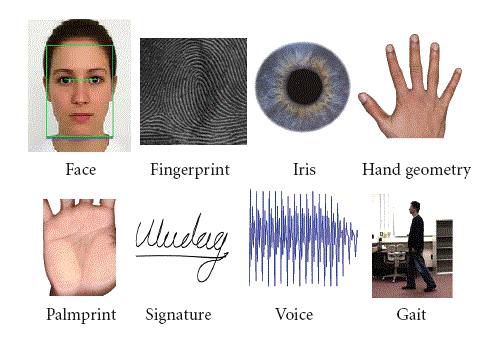
Something You Are. I’ve spent…a long time with this factor, since this is the factor that includes biometrics modalities (finger, face, iris, DNA, voice, vein, etc.). It also includes behavioral biometrics, provided that they are truly behavioral and relatively static.
As I mentioned in August, there are a number of biometric modalities, including face, fingerprint, iris, hand geometry, palm print, signature, voice, gait, and many more.
If your firm offers an identity solution that partially depends upon “something you are,” then you need to create content (blog, case study, social media, white paper, etc.) that converts prospects for your identity/biometric product/service and drives content results.














 Bredemarket