What I Missed About QR Codes in 2021

A lot has happened with QR codes since I last wrote about them in October 2021. (For example, the Coinbase Super Bowl ad in 2022, and its demonstration of security risks.)

Now that I’m revisiting my October 2021 post on QR codes, I wish I could change one word to make myself look smarter.

See if you can guess which word I want to change.

I have since chosen to adopt QR codes for some of my Bredemarket work, especially in cases where an online reader may need additional information.

From https://bredemarket.com/2021/10/15/a-qr-code-is-not-a-way-of-life/

Did you find it?

Instead of writing “online,” I should have written “offline.”

I don’t know whether I just made a typo, or if I intentionally wrote “online,” but I shouldn’t have.

Why QR codes rarely make sense online

Because if you’re online, you don’t need a QR code, since you presumably have access to a clickable URL.

But if you’re offline—for example, if you’re watching a commercial on an old-fashioned TV screen—a QR code makes perfect sense. Well, as long as you explicitly identify where the QR code will lead you, something Coinbase failed to do in 2022. “Just click on the bouncing QR code and don’t worry where you’ll go!”

But there’s one more place where QR codes make sense. I didn’t explicitly refer to it in my 2021 post, but QR codes make sense when you’re looking at printed material, such as printed restaurant menus.

Or COVID questionnaires.

Which reminds me…

What I didn’t tell you about the Ontario Art Walk

…there’s one story about the Ontario Art Walk that I didn’t share in yesterday’s post.

After leaving Dragon Fruit Skincare, but before visiting the Chaffey Community Museum of Art, I visited one other location that I won’t identify. This location wanted you to answer a COVID questionnaire, which you accessed via a QR code.

I figured I’d do the right thing and answer the questionnaire, since I had nothing to worry about.

  • I was vaccinated.
  • I was boosted.
  • I hadn’t been around anyone with COVID.
  • I didn’t have a fever.

I entered the “right” response to every single question, except for the one that asked if I had a runny or stuffy nose. Since I had a stuffy nose, I indicated this.

But hey, it’s just a stuffy nose. What could go wrong?

When I finished the questionnaire, I was told that based on my answers, I was not allowed in the premises, and if I was already in the premises I should leave immediately.

Which I did.

And which is why I didn’t write about that particular location in yesterday’s post.

Bredemarket, pressing the flesh (sometimes six feet away)

But back to non-health related aspects of QR codes.

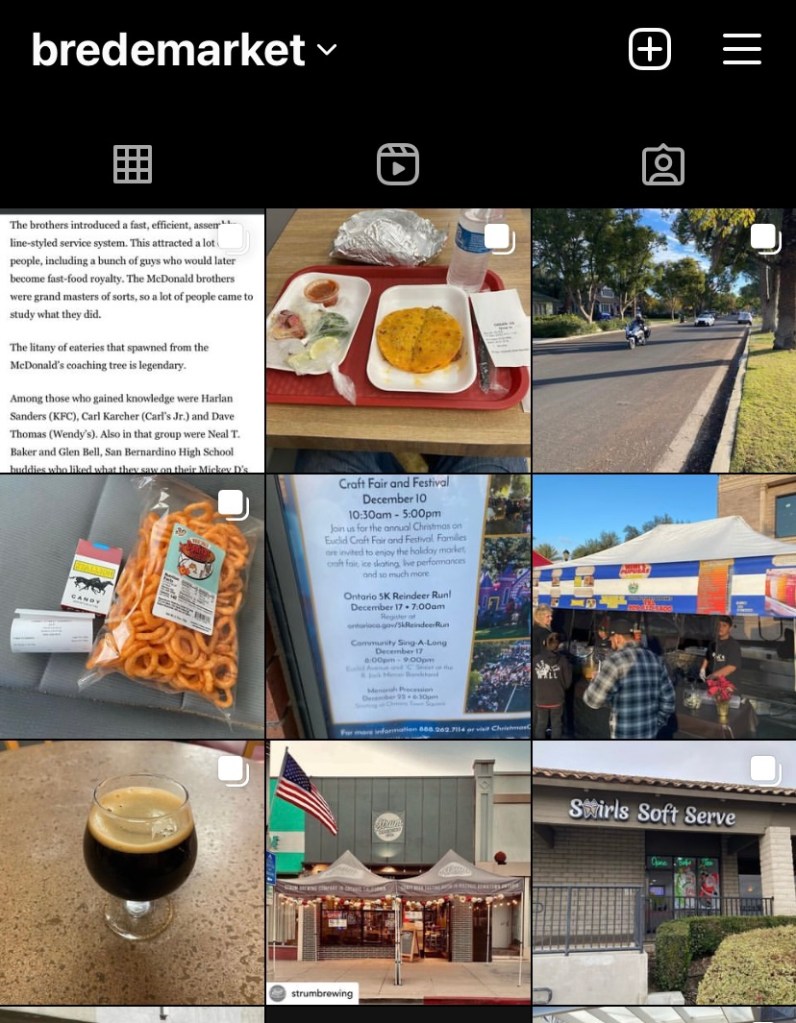
The Ontario Art Walk was actually the second in-person event that I had attended that week. As I noted on Instagram, I also went to a City of Ontario information session about a proposed bike lane.

Now that COVID has (mostly) receded, more of us are going to these in-person events. My target market (businesspeople in the United States) is mostly familiar with the century-old term “press the flesh.” While it usually applies to politicians attending in-person events, it can equally apply to non-political events.

Whenever I go out to these local events, I like to have some printed Bredemarket collateral handy in case I find a local businessperson looking for marketing services. After all, since I am the Ontario, California content marketing expert, I should let relevant people in Ontario know this.

In those cases, a QR code makes sense, since I can hand it to the person, the person can scan the QR code on their phone, and the person can immediately access whatever web page or other content I want to share with them.

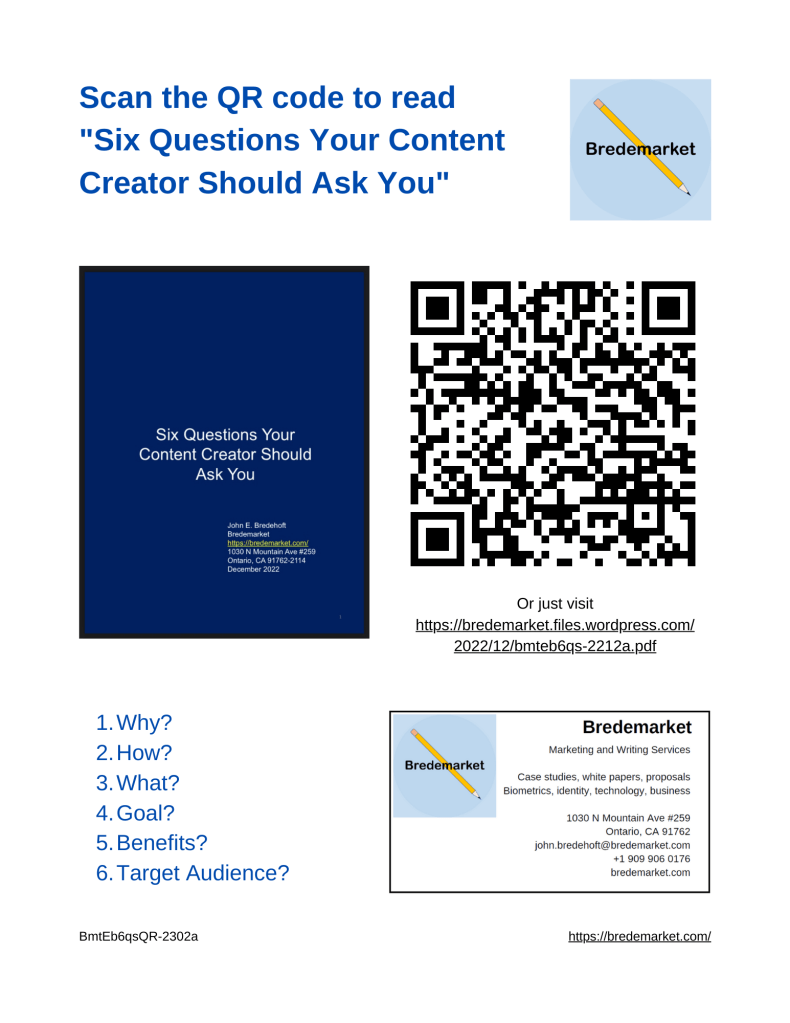
On Saturday, it occurred to me that if I ran across a possible customer during the Ontario Art Walk, I could use a QR code to share my e-book “Six Questions Your Content Creator Should Ask You.”

Unfortunately, this bright idea came to my mind at 5:30 pm for an event that started at 6. I dummied up a quick and dirty page with the cover and a QR code, but it was…dirty. Just as well I didn’t share that on Saturday.

But now that I have more time, I’ve created a better-looking printed handout so that I’m ready at the next in-person event I attend.

If we meet, ask me for it.

Making myself look less smart

Well, now that I’ve gone through all of this trouble explaining how QR codes are great for offline purposes, I’m going to share the aforementioned handout…online.

(UPDATE OCTOBER 22, 2023: “SIX QUESTIONS YOUR CONTENT CREATOR SHOULD ASK YOU IS SO 2022. DOWNLOAD THE NEWER “SEVEN QUESTIONS YOUR CONTENT CREATOR SHOULD ASK YOU” HERE.)

Which has probably prompted the following question from you.

“Why?”

Four reasons:

  1. It gave me the excuse to post the question “Why?” above, thus reiterating one of the major points of the e-book.
  2. Because I felt like sharing it.
  3. Just in case you don’t make “Event X” that I attend in the future, you can experience the joy of printing the flyer and scanning the QR code yourself. Just like you were there!
  4. To demonstrate that even when you provide a piece of content with a QR code, it’s also helpful to explicitly reveal the URL where you’ll head if you scan the code. (Look just below the QR code in the flyer above.) And if you receive the flyer in online form rather than printed form, that URL is clickable.

400 Words Are Worth Many Pictures

As I pivot Bredemarket’s writing services (due to my exit from some biometric writing) and return to a more regular blog posting schedule, I’ve discovered that Bredemarket isn’t the only Inland Empire West business that could use some additional text content.

There are local business websites with blogs that are nearly dormant. And that’s not good.

Sure, some of them have active image-based accounts on popular social services (Instagram, TikTok, etc.).

Not that there’s anything wrong with that. Bredemarket has an Instagram account of its own.

But their websites have blogs that are gathering dust.

Imagine if those blogs had a regular cadence of content, attracting content to YOUR website – not Mark Zuckerberg’s website or Bytedance’s website.

Content that not only describes what you do, but how you do it and why you do it.

Content that answers a lot of questions about your business – six questions in particular. Actually more than that, but there are six questions that will get you started with your personal content creator. I know; I wrote the book on it.

The answers to those questions launch an iterative process to create your blog content. Perhaps a one-time post, or better yet a blog post every month, attracting customers on a regular basis. Your own secret salesperson, as it were.

I offer the Bredemarket 400 Short Writing Service, a package that starts with a kickoff session and ends with between 400 and 600 words of blog or social content.

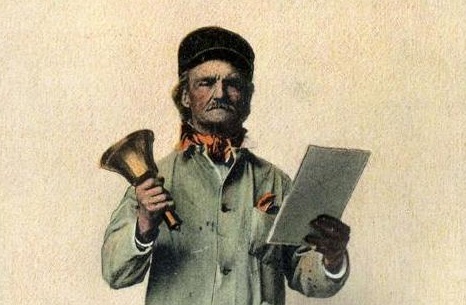
By Unknown author – postcard, Public Domain, https://commons.wikimedia.org/w/index.php?curid=7691878

Can you use Bredemarket to attract new customers?

If so, let’s talk.

Don’t Send ALL Your Traffic to Zhang Yiming and Mark Zuckerberg

Most of you don’t know Zhang Yiming.

But you promote him anyway.

If you use TikTok to promote your business, you are sending traffic to tiktok.com.

Zhang Yiming’s website.

Or maybe you don’t use TikTok, but instead promote your business on Instagram, sending traffic to instagram.com.

Mark Zuckerberg’s website.

Not yours.

By Lobo Studio Hamburg – https://pixabay.com/photos/phone-display-apps-applications-292994/, CC0, https://commons.wikimedia.org/w/index.php?curid=126385924

If you own a business, don’t you want at least some of your traffic to go to your website, rather than their websites?

For example, this blog post attracts people to bredemarket.com, Bredemarket’s website. People who read the post can see other things on the Bredemarket website – who I am, what I do, where I do it, and why things like customer focus and benefits are important.

People who read Instagram posts learn why the metaverse is important to Mark. They don’t learn why you do what you do.

So how can you use blog posts to attract traffic to your website?

I’ll tell you how in a future post.

Six Questions Your Content Creator Should Ask You: the e-book version

I love repurposing.

So I’ve repurposed my October 30 blog post into an e-book.

This gave me an opportunity to revisit the topic and add critical information on wildebeests, George (H.W.) Bush, and Yogi Berra.

But more importantly, it allows me to share my thoughts with a wider audience.

If you missed the October blog post, I state that there are six critical questions that your content creator must ask before creating content. These questions apply whether your content creator is a consultant, an employee at your company, or you.

The e-book discusses each of these six questions:

  1. Why?
  2. How?
  3. What?
  4. Goal?
  5. Benefits?
  6. Target Audience?

And as I note in the e-book, that’s just the beginning of the content creation process.

Whether you intend to use Bredemarket as your content creator, use someone else as your content creator, or create your own content, the points in this e-book are helpful. They can be applied to content creation (case studies, white papers, blog posts) or proposal work, and apply whether you are writing for Inland Empire West businesses or businesses anywhere.

And if you read the e-book, you’ll discover why I’m NOT sharing it on the Bredemarket Identity Firm Services LinkedIn page and Facebook group.

You can download the e-book here. And you can be a content marketing expert also.

(UPDATE OCTOBER 22, 2023: “SIX QUESTIONS YOUR CONTENT CREATOR SHOULD ASK YOU IS SO 2022. DOWNLOAD THE NEWER “SEVEN QUESTIONS YOUR CONTENT CREATOR SHOULD ASK YOU” HERE.)

Does Every Blog Post Need a Call to Action?

Does every blog post need a CTA?

No.

Let me explain.

What is a call to action?

No, not the Western Electric kind of call. By Jonathan Mauer – Own work, CC BY-SA 4.0, https://commons.wikimedia.org/w/index.php?curid=50534668

For those who are not familiar with the term, a “call to action,” abbreviated as CTA, is just what it sounds like: a summons to do something. So if you want to call it a STDS, feel free. (Although I wouldn’t.)

Of course, calls to action have been used long before the digital world appeared. For several decades, automobile dealer Cal Worthington (and his dog Spot) wanted people to come to his car dealerships, so in between the entertaining animals, the call to action “Go see Cal” was repeated in commercials like this one.

From https://www.youtube.com/watch?v=8hT2oP–NSU

And things haven’t changed in the 21st century, except that most of us have retired the dog Spot. For example, some of my blog posts include the following call to action:

These three bullets, when used, are preceded by a statement such as “If I can work with you to create your written content, please contact me.” Or whatever makes sense for the particular blog post.

But not all of my posts include the three CTA bullets.

Posts for awareness don’t need CTAs

(UPDATE 7/24/2023: Upon further reflection, I should have said “Posts for awareness don’t ALWAYS need CTAs.” See my updated blog post, “Awareness Calls to Action.”)

Take my post from last Saturday, “Candy Street Market is coming.”

Candy Street Market, 110 W Holt, Ontario, California

This post simply talked about a new candy store in Ontario, California, but never talked about Bredemarket’s content creation or proposal writing services.

So why did I write a post that doesn’t directly lead to business?

For the awareness.

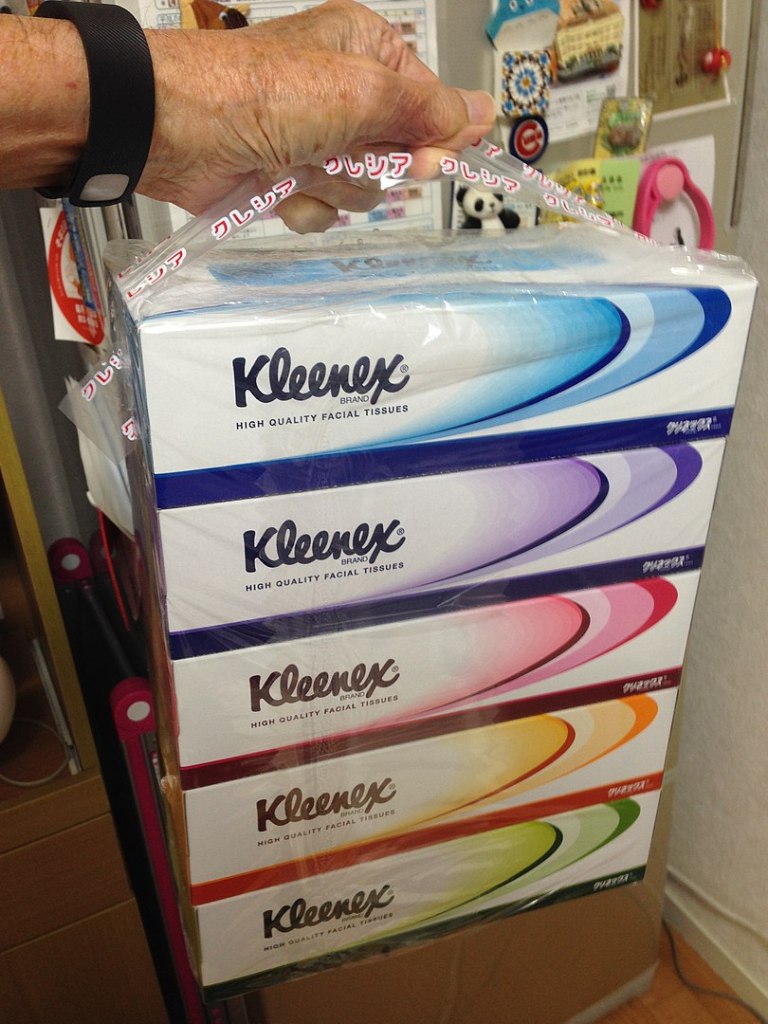
The awareness of Bredemarket doesn’t equal the awareness of Kleenex. But I’m working on it. By kimubert – Flickr, CC BY 2.0, https://commons.wikimedia.org/w/index.php?curid=40263441

Ever since I exited some of my prior identity-related markets in the spring of 2022, I’ve pivoted my marketing activity and am concentrating more on serving local firms in California’s Inland Empire. This isn’t a new activity; I’ve targeted local businesses since September 2021. But since I am no longer serving my former clientele of companies that identify individuals using fingerprints, faces, and identity documents, the local business is obviously extremely important.

But the locals need to know that I’m here.

Hence I wrote about a local candy store to provide awareness to businesses that Bredemarket is out there.

If their curiosity is piqued, then perhaps they’ll subscribe to the blog or explore what I do to find out what Bredemarket can do for them.

And even if not, at least the readers know another place to get candy in downtown Ontario.

CTAs on some posts wouldn’t be prudent

And then there are posts in which a CTA plain doesn’t belong.

I already linked to one such post above: my April 22 post announcing my change in business scope.

In short, the post let people know all of the business that I wouldn’t accept in the future.

Why post a call to action after announcing that?

And how would I word it? “If you are a biometric identity company that needs content marketing or proposal writing services, don’t call me”?

It comes down to goals

But you don’t need to detailed list of do’s and don’ts to determine which blog posts need CTAs.

It all boils down to one simple question:

What is the goal of the blog post?

As I stated in October, one of the six questions that you (or your content creator) should ask before starting work is about the goal for the piece of content.

  • Do you want people to keep you in mind if they need your product or service in the future? (“That guy knows Ontario, and he writes content; maybe he can help me.”)
  • Do you want people get more information on something (such as a service description)?
  • Do you want people to contact you personally if they want more information?
  • Do you want people to pull out their credit card immediately and buy something?

The answers to those questions will shape the final content, whether a CTA is needed, and the type of CTA.

This post DOES have a CTA

So let’s say you’re an Inland Empire business that needs a content marketing expert to write a blog post for you.

And let’s say that you have specific goals for this blog post.

And you’re targeting a particular audience for this blog post. (Maybe candy lovers.)

And you realize that buyers aren’t persuaded by a list of features you offer, but by a list of benefits for them. (Yes, benefits are important.)

Before Bredemarket writes a blog post for you, I’ll ask you about these items and others (see the list here), to make sure that my work is aligned with what you need.

So do you want to talk to me about that blog post that your business needs?

Here’s the call to action. Talk to me.

Who’s laboring on Labor Day?

Bredemarket has always restricted its business to the United States. (Lately I’ve focused more on California’s Inland Empire West, but that’s another story.) So everyone in my target market is celebrating Labor Day today.

Theoretically.

It’s important to note that most other countries celebrate the contributions of labor on May 1, but for several reasons the United States chose a different day. The Massachusetts AFL-CIO page that explained this no longer exists, but I quoted from that page in a tymshft post a decade ago:

Despite the popularity of May Day and the appeal of an international holiday, the American Federation of Labor pushed to secure Labor Day as America’s primary celebration of its workers. This was due to the more radical tone that May Day had taken. Especially after the 1886 Haymarket riot, where several police officers and union members were killed in Chicago, May Day had become a day to protest the arrests of anarchists, socialists, and unionists, as well as an opportunity to push for better working conditions. Samuel Gompers and the AFL saw that the presence of more extreme elements of the Labor Movement would be detrimental to perception of the festival. To solve this, the AFL worked to elevate Labor Day over May Day, and also made an effort to bring a more moderate attitude to the Labor Day festivities. The AFL, whose city labor councils sponsored many of the Labor Day celebrations, banned radical speakers, red flags, internationalist slogans, and anything else that could shed an unfavorable light upon Labor Day or organized labor.

From https://tymshft.com/2012/05/01/the-american-perspective-on-may-day-or-i-am-not-a-commie/

So for over a century, most Americans have chosen to celebrate Labor Day on the first Monday in September.

Well, some Americans.

I took a walk.

My employer for my day job is closed today (at least for its U.S. workers), so I kinda sorta took it a bit leisurely, waking up at…5:35 in the morning.

You see, this is the last week of my company’s wellness challenge, and because of the current heat wave in Southern California, I wanted to get my walking in while the temperatures were still in double digits (on the Fahrenheit scale; that’s something else that Americans do differently than the rest of the world).

I didn’t take any pictures of myself walking today, but here’s one that I took Saturday while I was walking inside (at the Ontario Mills indoor mall).

At Ontario Mills, Saturday, September 3, 2022. It was about 25 degrees cooler inside than it was outside.

Other people were working.

But while I took my early morning Labor Day walk, I ran across a lot of people…working.

  • There were the people at the Starbucks in downtown Ontario, busily supplying breakfast sandwiches and drinks to people.
  • There was the woman at a 7-Eleven in Ontario, letting me hydrate with a cold drink. (She may have been the owner, but owners deserve a day off too.)
  • Finally, I passed two men who have been working on and off on a residential wall, and today was apparently one of the “on” days. I hope they’re not working in the afternoon.

The truth is that, even in the midst of COVID, the entire workforce can’t shut down entirely. Some people have to work on days when many people don’t work. Remember that even in “blue law” states, preachers certainly work on Sundays.

Me too.

But still my morning walk was somewhat relaxing, because even though it was a weekday, I didn’t have to end the walk by 8:00 to start my day job. So while I got my steps in, I did so somewhat leisurely.

So what did I do after my walk was done?

Well, I did Bredemarket work.

  • I renewed my City of Ontario business license. (Online, of course, since city offices are closed for Labor Day.)
  • Right now I’m writing this post.
  • And after I write the post, there’s an email that I need to send.

So I guess I didn’t completely take the day off either.

But at least I’m not buliding a wall out of doors.

Oh, and I work on Saturday mornings also.

Of course, since I’m employed full-time, Bredemarket itself is a weekend job for me. My official office hours fall on Saturday mornings, for example.

While this is work, in a way it’s not work, because it’s a refreshing change from my normal work. (And since I enjoy my normal work, that isn’t so much work either. If you’re not working at something you enjoy, then you’re working.)

And if you don’t enjoy creating written content, let Bredemarket help you create it.

I can help you with white papers, case studies, blog posts, proposal responses, or other written content. (Well, unless the written content involves finger, face, driver’s license, or related identity services. There’s the day job, you know.)

If I can work with you to create your written content, please contact me.

Retabulating the work that Bredemarket has done for clients (as of February 16, 2022)

My biometric/identity collateral wasn’t the only thing that I updated yesterday.

As part of my preparation for yesterday evening’s Ontario IDEA Exchange meeting, I took the time to update my “local” brochure. (Because local is important: see the first of my three goals for 2022.) This brochure includes a section that discusses the types and numbers of pieces that I have prepared for clients, including the number of case studies, the number of RFx responses, and so forth.

Those numbers hadn’t been updated since last September.

Before going to the meeting, I wanted to make sure my “local” brochure had the latest numbers.

I’ll go ahead and share them with you. This covers the projects that Bredemarket has completed for clients over the last 18 months, as of February 16, 2022:

  • Fourteen (14) case studies
  • Eight (8) articles (blog posts)
  • Three (3) service offering descriptions
  • Three (3) white papers
  • Nine (9) RFx responses
  • Four (4) sole source responses
  • Six (6) proposal templates
  • One (1) technical leave behind
  • Two (2) biometric analyses
Inland Empire B2B Content Services from Bredemarket.

As it turns out, I didn’t hand out my local brochure to anyone at last night’s IDEA Exchange. (It was a small crowd, most of whom I already knew.)

But at least I’ve tabulated the numbers.

Now I just have to update all of my NON local collateral…

Meta-repurposing

I like to publish “in case you missed it” (ICYMI) posts over the weekend, just in case my Facebook, LinkedIn, or Twitter followers might have missed something that I originally published in the preceding week.

Last weekend I tried something a little different. Now that Bredemarket has been a going concern for over a year, I chose to publish some items that my followers might have missed when I originally published them in the preceding YEAR.

Although there are some parts of 2020 that aren’t fun to revisit.

But this past weekend, I went back to October 2020 for my latest #ICYMI offerings. I want to talk about two of these offerings in particular.

The first #ICYMI item

The first item that I shared last weekend was a Bredemarket blog post from October 17, 2020 entitled “You go back, Jack, do it again” that talked about repurposing content. Here’s a brief excerpt that links to a Neil Patel post.

Why repurpose content?

To reach audiences that you didn’t reach with your original content, and thus amplify your message. (There’s data behind this.)

If you’re a data lover, check the link.

The second ICYMI item

Waylon Jennings promotional picture for RCA, circa 1974. By Waylon_Jennings_RCA.jpg: RCA Records derivative work: GDuwenTell me! – This file was derived from:  Waylon Jennings RCA.jpg:, Public Domain, https://commons.wikimedia.org/w/index.php?curid=17091525

The second item that I shared last weekend was a Bredemarket Spotify podcast episode from the same period entitled “A special episode for Spotify subscribers, with Waylon Jennings’ ‘Do It Again.'” You can probably guess that it was about repurposing content.

To answer a few questions about the podcast:

  • Yes, it was a repurposing of the blog post.
  • Yes, this particular podcast episode was only on Spotify because it included a song sample.
  • Yes, I chose Waylon’s version of the song rather than Steely Dan’s because I like Waylon’s version better.
  • Yes, you have to be on Spotify Premium to hear the whole song, rather than a 30-second snippet. (I’m not on Spotify Premium, so even I haven’t heard the entire podcast as envisioned.)

I don’t really have anything profound to say about repurposing that hasn’t been said already, so treat this as a reminder that you can easily repurpose content on new platforms to reach new readers/listeners.

As I just did.

Again.

Postscripts

For the record, I haven’t created any other Spotify-only podcast episodes with music since that initial one a year ago. So all of the other podcast episodes that I’ve recorded are available on ALL of my platforms, including Anchor.

By the way, there was a third #ICYMI item that I re-shared last weekend on Facebook, LinkedIn, and Twitter. But it didn’t deserve its own re-blog.

(You gotta know when to hold ’em. Yes, that’s Kenny, not Waylon.)

Bredemarket and September 2021 on the content side

I was looking over the Bredemarket blog posts for September, and I found some posts that addressed the content side of Bredemarket’s services. (There are also blog posts that address the proposal side; see here for a summary of those posts.)

As a starting point, what content services has Bredemarket created for its clients? I quantified these around the middle of the month and came up with this list.

And I’ve been working on additional content projects for clients that I haven’t added to the list yet.

At the same time, in accordance with Bredemarket’s 2021 goals, I’ve been working on expanding my content services beyond the technology arena to address the needs of local businesses in the Ontario, California area.

The Emporia Arts District in downtown Ontario. From https://www.emporiaartsdistrict.com/

So now I am not only providing content for biometric firms (after all, I am a biometric content marketing expert), but also for technology firms (including one for which I completed a project this month) and for local small businesses.

If I can provide content services for you:

Now that I quantified my proposal service accomplishments, it’s time for the content side

I won’t belabor you with the process of summing up Bredemarket’s content accomplishments for clients. Suffice it to say that I used Toggl Track and other sources, in a manner similar to the way in which I summed up Bredemarket’s proposal accomplishments for clients.

If you don’t want to be bothered with downloading a brochure, here’s a picture.

Or you can download the PDF.

Until I added everything up, I didn’t realize how many case studies I had written.

If you want to receive my 12th case study…