“a word used in order to evade or retreat from a direct or forthright statement or position”
I don’t know how weasels became the subject of a negative phrase like this, but here we are.
I learned the phrase “weasel word” when I started working in proposals. I’ve been writing proposals for nearly 15 years, and I’ve run into many cases where I don’t comply with the written word of a mandatory requirement, and I end up having to…evade or retreat.
“This rule ensures that Federal agencies have appropriate flexibility to implement the card-based enforcement provisions of the REAL ID regulations after the May 7, 2025, enforcement deadline by explicitly permitting agencies to implement these provisions in phases….The rule also requires agencies to coordinate their plans with DHS, make the plans publicly available, and achieve full enforcement by May 5, 2027.”
As I have ranted repeatedly, the REAL ID enforcement DEADLINE is May 7, 2025, but FULL enforcement will be achieved by May 5, 2027. There are enough weasel words to distract from the fact that full enforcement is not taking place on May 7, 2025.
“Flexibility,” “implement in phases”…I’m taking notes. The next time I respond to a DHS RFI, I may use some of these.
Because Bredemarket does respond to Requests for Information, Requests for Proposal, and similar documents. One of Bredemarket’s clients recently received an award, with possible lucrative add-on work in the future.
Does your identity/biometric or technology conpany want the government to give you money? I can help. Talk to me: https://bredemarket.com/cpa/
From the early 1990s to 2019, the majority of my identity/biometric proposal work was with U.S. state and local agencies, with some work with foreign agencies (such as Canada’s RCMP), private entities, and a few proposals to U.S. federal agencies.
I had no idea what was going to happen in 2020, and one of the surprises is that the majority of my identity/biometric proposal work since 2020 has been with U.S. federal agencies. Many requests for information (RFIs) as well as other responses.
The L & N, not M, but close enough for government work.
I’ve worked on client proposals (and Bredemarket’s own responses) to the Departments of Defense, Homeland Security, Justice, and perhaps some others along the way.
And no, there’s no uniformity
Same department, different requirements.
Coincidentally, the two most recent identity/biometric proposals I managed for Bredemarket clients went to the same government department. But that’s where the similarities ended.
The first required an e-mail submission of a PDF (10 pages maximum) to two email addresses. A relative piece of cake.
Mmm…cake. Always reward your proposal people.
The last required an online submission. No, not a simple upload of a PDF to a government website. While my client did have to upload 2 PDFs, the majority of the submission required my client to complete a bunch of online screens.
And there were two separate sets of instructions regarding how to complete these online screens…which contradicted each other. So I had to ask a clarification question…and you know how THAT can go.
Oh, and as the consulting proposal expert, I could not complete the online screens on behalf of the client. The client’s company had a single login, which was assigned to a single person (a company executive) and could NOT be used by anybody else.
So on the day of proposal submission the executive and I videoconferenced, and I watched as the executive answered the responses, in part using a document in which I had drafted responses.
And of course things were not perfect. The executive pasted one of my responses into the space provided, and only THEN did we discover that the response had an unadvertised character limit. So I rewrote it…at the same time that I resized a required image with unadvertised dimension restrictions.
But there’s some uniformity
Perhaps if I had written more federal proposals at Printrak, Motorola, MorphoTrak, IDEMIA, and Incode, I would have known these things. Perhaps not; as late as 2014 I was still printing proposals on paper and submitting 10 or more volumes of binders (yes, binders) along with CDs that had to be virus-checked.
Some Requests for Proposal (RFPs) provide helpful checklists.
But regardless of whether you submit proposals online, via CD, or in paper volumes, some things remain constant.
Follow the instructions.
Answer the questions.
Emphasize the benefits.
And don’t misspell the name of the Contracting Officer.
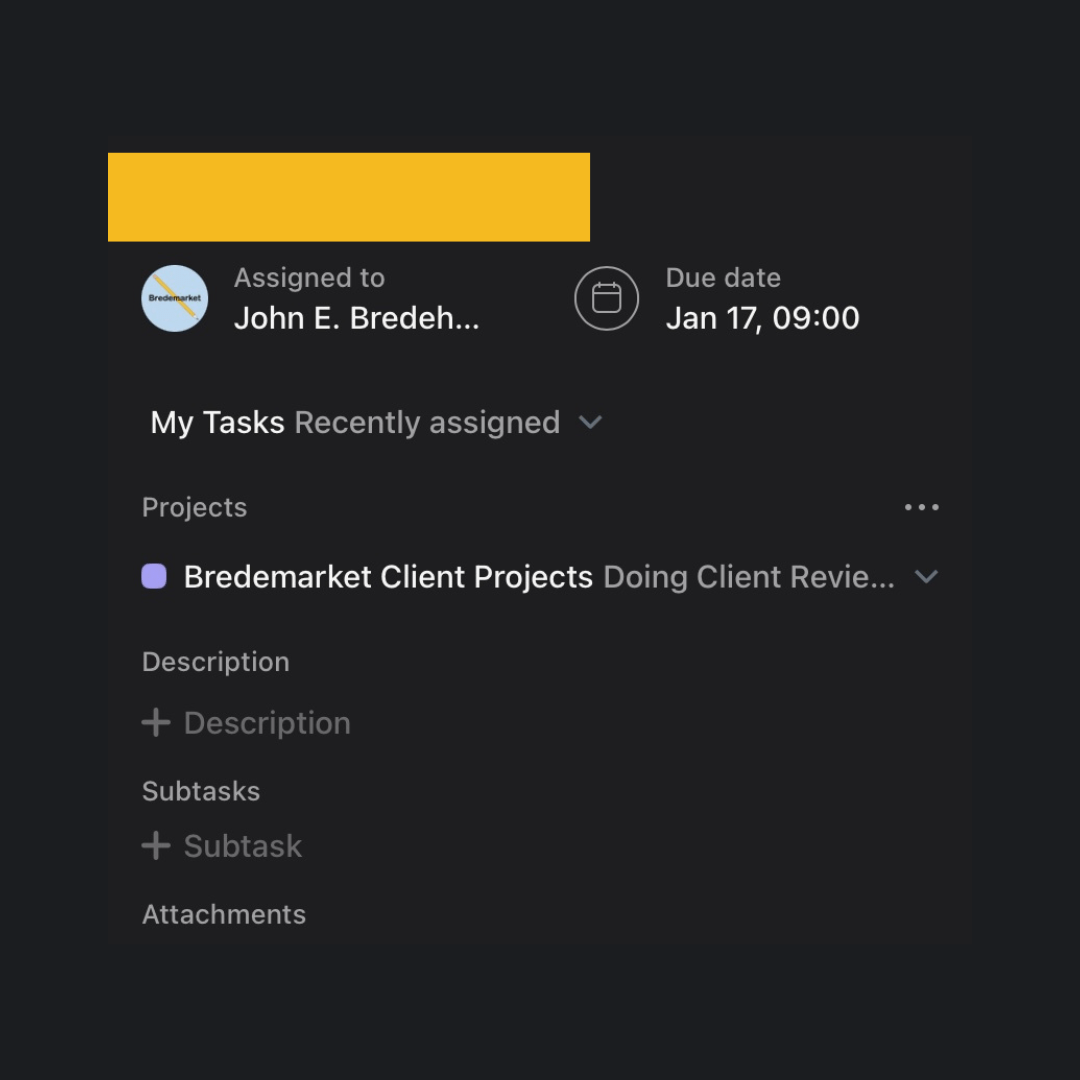
When I was last a full-time Proposal Manager a decade ago (for MorphoTrak), a proposal due date extension did not necessitate an update to an Asana task end date. Asana existed (its iOS and Android apps were both released by 2015), but MorphoTrak wasn’t using them.
Things are different now.
My consulting firm Bredemarket has helped (at least) four identity/biometric companies with proposal work over the years, including RFI responses, RFP responses, proposal letters, and similar communications; proposal templates; and proposal standard text (what the machinists call “boilerplate”).
I signed non-disclosure agreements with all these companies, which is why I redacted my current client’s name and its prospective customer from the accompanying image. But if my client wins, I will celebrate. Quietly.
Incidentally, since my Asana is only accessible to me, it only includes minimal information. In Asana, this entire response is a single entry. I use other means to communicate the more detailed schedule to my clients.
Incidentally, if you were one of MY prospects and received a communication saying that I was wrapping up a project today…I’m not. But it’s almost wrapped up, bearing in mind that any gas fills up the available space.
Proposal work (the P) is just one of several services Bredemarket provides to identity, biometric, and technology clients. In fact, all 4 of the referenced Proposal clients have also used my Content services, my Analysis services, or both.
In my circles, people generally understand ‘biometrics’ to refer to one of several ways to identify an individual.
But for the folks at Merriam-Webster, this is only a secondary definition of the word “biometrics.” From their perspective, biometrics is primarily biometry, which can refer to “the statistical analysis of biological observations and phenomena” or to “measurement (as by ultrasound or MRI) of living tissue or bodily structures.” In other words, someone’s health, not someone’s identity.
Fun fact: if you go to the International Biometric Society and ask it for its opinion on the most recent FRVT 1:N tests, it won’t have an answer for you.
So Abbott salespeople, real or imagined, won’t be interested in what I’ve been doing for the last 30 years. ‘Cause you know sometimes words have two meanings.
But those of you who use biometrics (and other factors) for individualization WILL be interested. Click on the image to find out more.
Drive content results with Bredemarket Identity Firm Services.
Bredemarket’s services are grouped into two distinct and separate functions: content marketing (blog posts, white papers, etc.) and proposals (RFI responses, RFP responses, sole source letters, etc.).
My division of my services makes sense in the real world. After all, in some employment situations, content marketing and proposals employ distinct and separate sets of employees.
But other companies are different. In fact, I’ve seen employment ads seeking marketing/proposals managers. Sounds like a lot of work, unless the company submits few proposals or performs minimal marketing.
And in many companies there are NOT dedicated proposals specialists. Which is why Bredemarket makes its money by helping the salespeople at these firms get the documents out.
Time for the truth
And if we’re truthful with ourselves, content marketing and proposals are pretty much the same thing.
I know this angers some people, who insist that they are content marketing professionals or proposal professionals, with all the proper certifications that a mere mortal could never attain. Or they did attain it, but it lapsed. Or is about to lapse unless I renew it in time.
But hear me out. I’m going to list four aspects of a particular document, and you tell me whether I’m talking about a piece of marketing content, or a proposal.
The document describes benefits the customer will realize.
The document targets one or more sets of people hungry for the solution.
The document shall be in Aptos 12 point, single spaced, with 1 inch margins, and shall not exceed 20 pages.
Guess what? From that description you CAN’T tell if it’s a piece of content or a proposal.
Yes, I know some of you thought item 4 was a dead giveaway because it sounded like an RFP requirement, but maybe some company’s brand guidelines dictate that the firm’s white papers must conform to that format. You never know.
And I know that when you get into the minutiae, there are certain things that proposal writers do that content marketers don’t have to worry about, and vice versa.
But at a high level, the content marketer already knows 90% of the things they need to know to write proposals. And vice versa.
I’m going to describe one example of how Bredemarket has helped its customers, based upon one of my client projects from several years ago.
Stupid Word Tricks. Tell your brother, your sister and your mama too. See below.
I’ve told this story before, but I wanted to take a fresh look at the problem the firm had, and the solution Bredemarket provided. I’m not identifying the firm, but perhaps YOUR firm has a similar problem that I can solve for you. And your firm is the one that matters.
The problem
This happened several years ago, but was one of Bredemarket’s first successes.
The firm that asked for my help is one that focuses on one particular biometric modality, and provides a high-end solution for biometric identification.
In addition, the firm’s solution has multiple applications, crime solving and disaster victim identification being two of them.
The firm needed a way to perform initial prospect outreach via budgetary quotations, targeted to the application that mattered to the prospect. A simple proposal problem to be solved…or so it seemed.
Why the obvious proposal solution didn’t work
I had encountered similar problems while employed at Printrak and MorphoTrak and while consulting here at Bredemarket, so the solution was painfully obvious.
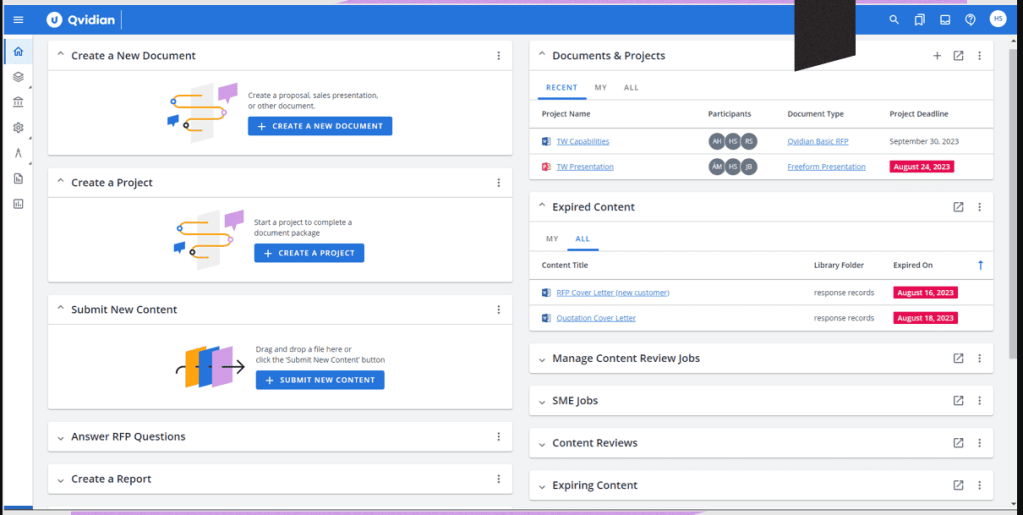
Qvidian, one proposal automation software package that I have used. But there are a LOT of proposal automation software packages out there, including some new ones that incorporate artificial intelligence. From https://uplandsoftware.com/qvidian/.
Have your proposal writers create relevant material in their proposal automation software that could target each of the audiences.
So when your salesperson wants to approach a medical examiner involved in disaster victim identification, the proposal writer could just run the proposal automation software, create the targeted budgetary quotation, populate it with the prospect’s contact information, and give the completed quotation to the salesperson.
Unfortuntely for the firm, the painfully obvious solution was truly painful, for two reasons:
This firm had no proposal automation software. Well, maybe some other division of the firm had such software, but this division didn’t have access to it. So the whole idea of adding proposal text to an existing software solution, and programming the solution to generate the appropriate budgetary quotation, wasn’t going to fly.
In addition, this firm had no proposal writers. The salespeople were doing this on their own. The only proposal writer they had was the contractor from Bredemarket. And they weren’t going to want to pay for me to generate every budgetary quotation they needed.
In this case, the firm needed a way for the salespeople to generate the necessary budgetary quotations as easily as possible, WITHOUT relying on proposal automation software or proposal writers.
Bredemarket’s solution
To solve the firm’s problem, I resorted to Stupid Word Tricks.
I created two similar budgetary quotation templates: one for crime solving, and one for disaster victim identification. (Actually I created more than two.) That way the salesperson could simply choose the budgetary quotation they wanted.
The letters were similar in format, but had little tweaks depending upon the audience.
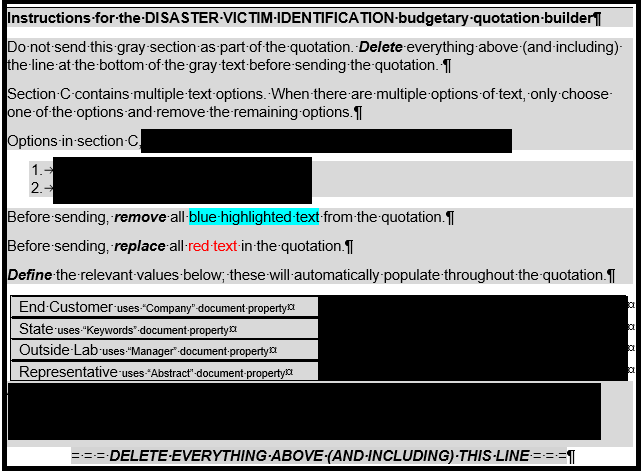
Using document properties to create easy-to-use budgetary quotations.
The Stupid Word Tricks came into play when I used Word document property features to allow the salesperson to enter the specific information for each prospect, which then rippled throughout the document, providing a customized budgetary quotation to the prospect.
The result
The firms’ salespeople used Bredemarket’s templates to generate initial outreach budgetary quotations to their clients.
And the salespeople were happy.
I’ve used this testimonial quote before, but it doesn’t hurt to use it again.
“I just wanted to truly say thank you for putting these templates together. I worked on this…last week and it was extremely simple to use and I thought really provided a professional advantage and tool to give the customer….TRULY THANK YOU!”
Comment from one of the client’s employees who used the standard proposal text
While I actively consulted for the firm I maintained the templates, updating as needed as the firm achieved additional certifications.
Why am I telling this story again?
I just want to remind people that Bredemarket doesn’t just write posts, articles, and other collateral. I can also create collateral such as these proposal templates that you can re-use.
For example, during my most recent stint as a product marketing employee at a startup, the firm had no official content marketers, so the product marketers had to create a lot of non-product related content. So we product marketers were the de facto content marketers for the company too. (Sadly, we didn’t get two salaries for filling two roles.)
Why did the product marketers end up as content marketers? It turns out that it makes sense—after all, people who write about your product in the lower funnel stages can also write about your product in the upper funnel stages, and also can certainly write about OTHER things, such as company descriptions, speaker submissions, and speaker biographies.
I mentioned something in passing in Bredemarket’s recent go-to-market post that I think needs a little more highlighting. So here is a deeper dive into the 22 types of content that product marketers create. (Well, at least 22. I’m probably missing some.)
And by the way, I have created all 22 of these types of content, from blog posts and battlecards to smartphone application content and scientific book chapters. And I can create it for you.
Why is it that so many business-to-business (B2B) marketers confuse product marketing with content marketing?
Because it requires a lot of discipline. That’s why.
B2B marketers who get it right understand the difference between these two fundamentally different types of marketing, what their purposes are and how to use them correctly.
Some firms (especially startups) don’t have the luxury to enforce such definitions. They don’t have separate teams to create awareness content, consideration content, and conversion content. They have one team (or perhaps one person) to create all that content PLUS other stuff that I’ll discuss later.
For example, during my most recent stint as a product marketing employee at a startup, the firm had no official content marketers, so the product marketers had to create a lot of non-product related content. So we product marketers were the de facto content marketers for the company too. (Sadly, we didn’t get two salaries for filling two roles.)
Why did the product marketers end up as content marketers? It turns out that it makes sense—after all, people who write about your product in the lower funnel stages can also write about your product in the upper funnel stages, and also can certainly write about OTHER things, such as company descriptions, speaker submissions, and speaker biographies.
As a result, I’ve written a ton of stuff over my last 29 years in identity/biometrics. It didn’t take a great leap for me to self-identify as the identity content marketing expert and the biometric content marketing expert (and other expert definitions; I’m an expert in creating expert titles).
I’ve compiled a summary of the types of content that I’ve created over the years, not only for Bredemarket’s clients, but also for my employers at Incode Technologies, IDEMIA, MorphoTrak, Motorola, and Printrak.
Not all of these were created when I was in a formal product marketing role, but depending upon your product or service, you may need any of these content types to support the marketing of your product/service.
It’s helpful to divide the list into two parts: the external (customer-facing) content, and the internal (company-only) content.
10 types of external content I have created
External content is what most people think of when they talk about product marketing or content marketing. After all, this is the visible stuff that the prospects see, and which can move them toward a purchase (conversion). The numbers after some content types indicate the quantities of pieces of collateral that I have created.
Articles
Blog Posts (500+, including this one)
Briefs/Data/Literature Sheets
Case Studies (12+)
Proposals (100+)
Scientific Book Chapters
Smartphone Application Content
Social Media (Facebook, Instagram, LinkedIn, Threads, TikTok, Twitter)
Web Page Content
White Papers and E-Books
Here’s an video showing some of the external content that I have created for Bredemarket.
While external content is sexy, internal content is extremely important, since it’s what equips the people inside a firm to promote your product or service. The numbers after some content types indicate the quantities of pieces of collateral that I have created.
Battlecards (80+)
Competitive Analyses
Event/Conference/Trade Show Demonstration Scripts
Plans
Playbooks
Proposal Templates
Quality Improvement Documents
Requirements
Strategic Analyses
And here are 3 more types
Some content can either be external or internal. Again, numbers indicate the quantities of pieces of collateral I have created.
Email Newsletters (200+)
FAQs
Presentations
Content I can create for you
Does your firm need help creating one of these types of content?
Maybe two?
Maybe 22?
I can create content full-time for you
If your firm needs to create a lot of content types for your products, then consider hiring me as your full-time Senior Product Marketing Manager. My LinkedIn profile is here, documenting my 29 years of experience in identity/biometric technology as a product marketer, a strategist, and in other roles.
Have you ever had a piece of content go viral, but wish that ANOTHER piece of content had gone viral instead? Join the club.
Three examples of unintentional viral content
Here are three examples in which the “wrong” content went viral. Two of the examples are personal, but the first example has nothing to do with me, the Internet, or even the 21st century.
Example 1: Steam behind the wrong song
Back in the 1960s, a singer named Gary DeCarlo was working under the pseudonym Garrett Scott. “Garrett Scott” needed a single, so he was slotted to record a song called “Sweet Laura Lee.”
Because it was a 1960s single, it needed to have a B-side. You couldn’t let all that vinyl on the back of the record go to waste. Any song would do, since it was just filler for “Sweet Laura Lee.”
So DeCarlo and two of his friends resurrected a 1961 song called “Kiss Him Goodbye,” went to the studio, added a silly chant because the 1961 song lacked a chorus, and cranked out the B-side in an evening session. They did it so quickly that the chorus didn’t even have any real words, just “na na.” Actually, the B-side was SUPPOSED to be bad so that disc jockeys would play the A-side:
B-sides in the ’60s were often ad-hoc affairs designed to be clearly inferior to the A-side so that disc jockeys wouldn’t flip the record. The three musicians who recorded this had that in mind for this song, and kept it simple: there is no bass or guitar on the track….
The song “Sweet Laura Lee” went nowhere, but who cares? The record company liked the B-side, invented a fake band name Steam, and the song “Na Na Hey Hey Kiss Him Goodbye” went to the number 1 position on the Billboard charts. A real band named Steam was formed and went on tour…without Gary DeCarlo (although DeCarlo received songwriting royalties).
Example 2: Becoming the unintentional Shipley expert
Fast forward to the 21st century and my creation of blog content for Bredemarket.
I needed to populate my blog with both content marketing-related content and proposal-related content, so in December 2021 I wrote a post entitled “96 Smiles: All about the Shipley Business Development Lifecycle.” I’ve been familiar with the Shipley lifecycle for decades, but probably not as familiar as hundreds if not thousands of proposal practitioners.
So now, right behind Shipley Associates itself, the next leading authority on the Shipley Business Development Lifecycle is…ME.
So now the bredemarket.com website is getting all sorts of traffic related to Shipley, and my Ubersuggest account is, um, suggesting that I optimize the website to capture even more Shipley traffic.
Except that I’m not really doing much with the Shipley process itself; I just talked about it.
Of course, the traffic may have nothing to do with capture and proposal management, since the post makes several explicit and implicit references to the ? and the Mysterians song “96 Tears.”
What I HAVEN’T ignored is the slew of social media channels for Bredemarket. Some of you are aware of this, since you’ve recently received invitations from me to follow Bredemarket on LinkedIn, Facebook, Instagram, Threads, TikTok, and YouTube. If you haven’t, feel free to click on the appropriate links and subscribe now.
So as I’ve been building up my Bredemarket social/content presence and spending a lot of time on this, I received a notification from Facebook this week that, with no effort on my own, my neglected ontarioemperor Facebook page now has over 600 followers.
Now I’m not sure how much Ontario Emperor’s Facebook popularity can benefit Bredemarket, since there’s little or no discernable overlap between synthetic music fans and people requiring marketing and writing services. But who knows? I could be wrong there also.
So sometimes things you want to promote don’t get popular, and things you don’t necessary want to promote get popular.
Rather than being disappointed, just go with the flow, say “na na” to the naysayers, and speak about Shipley with soothing instrumental music behind you.
Companies often have a lot of things they want to do, but don’t have the people to do them. It takes a long time to hire someone, and it even takes time to find a consultant that knows your industry and can do the work.
This affects identity/biometric companies just like it affects other companies. When an identity/biometric company needs a specific type of expertise and needs it NOW, it’s often hard to find the person they need.
If your company needs a biometric content marketing expert (or an identity content marketing expert) NOW, you’ve come to the right place—Bredemarket. Bredemarket has no identity learning curve, no content learning curve, and offers proven results.
Identity/biometric consulting in the 1990s
I remember when I first started working as an identity/biometric consultant, long before Bredemarket was a thing.
OK, not quite THAT long ago. I started working in biometrics in the 1990s—NOT the 1940s.
In 1994, the proposals department at Printrak International needed additional writers due to the manager’s maternity leave, and she was so valuable that Printrak needed to bring in TWO consultants to take her place.
At least initially, the other consultant and I couldn’t fill the manager’s shoes.
Both of us could spell “RAID.” Not the bug spray, but the storage mechanism that stored all those “huge” fingerprint images.
But on that first night that I was cranking out proposal letters for something called a “Latent Station 2000,” I didn’t really know WHAT I was writing about.
As time went on, the other consultant and I learned much more—so much that the company brought both of us on as full-time employees.
After we were hired full-time, we spent a combined 45+ years at Printrak and its corporate successors in proposals, marketing, and product management positions, contributing to industry knowledge.
But neither of us knew biometrics before we started consuting at Printrak.
And I had never written a proposal before I started consulting at Printrak. (I had written an RFP. Sort of.)
But frankly, there weren’t a lot of identity/biometric consultants out in the field in the 1990s. There were the 20th century equivalents of Applied Forensic Services LLC, but at the time I don’t think there were any 20th century equivalents of Tandem Technical Writing LLC.
Unlike the 1990s, identity/biometric firms that need consulting help have many options. In addition to Applied Forensic Services and Tandem Technical Writing you have…me.
Mike and Laurel can tell you what they can do, and I heartily endorse both of them.
Let me share with you why I call myself a biometric content marketing expert who can help your identity/biometric company get marketing content out now:
No identity learning curve
No content learning curve
Proven results
No identity learning curve
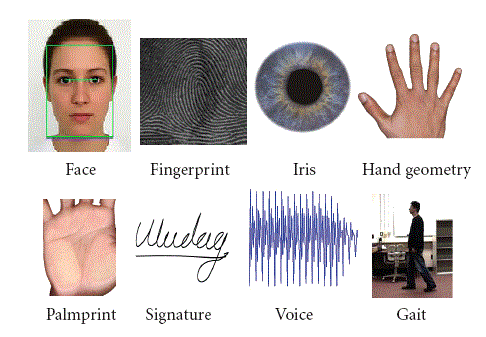
I have worked with finger, face, iris, DNA, and other biometrics, as well as government-issued identity documents and geolocation. If you are interested, you can read my Bredemarket blog posts that mention the following topics:
Because I’ve produced both external and internal content on identity/biometric topics, I offer the experience to produce your content in a number of formats.
External content: account-based marketing content, articles, blog posts (I am the identity/biometric blog expert), case studies, data sheets, partner comarketing content, presentations, proposals, sales literature sheets, scientific book chapters, smartphone application content (events), social media posts, web page content, and white papers.



















 Bredemarket