When the “Wrong” Content Goes Viral

Have you ever had a piece of content go viral, but wish that ANOTHER piece of content had gone viral instead? Join the club.

Three examples of unintentional viral content

Here are three examples in which the “wrong” content went viral. Two of the examples are personal, but the first example has nothing to do with me, the Internet, or even the 21st century.

Example 1: Steam behind the wrong song

Back in the 1960s, a singer named Gary DeCarlo was working under the pseudonym Garrett Scott. “Garrett Scott” needed a single, so he was slotted to record a song called “Sweet Laura Lee.”

Because it was a 1960s single, it needed to have a B-side. You couldn’t let all that vinyl on the back of the record go to waste. Any song would do, since it was just filler for “Sweet Laura Lee.”

So DeCarlo and two of his friends resurrected a 1961 song called “Kiss Him Goodbye,” went to the studio, added a silly chant because the 1961 song lacked a chorus, and cranked out the B-side in an evening session. They did it so quickly that the chorus didn’t even have any real words, just “na na.” Actually, the B-side was SUPPOSED to be bad so that disc jockeys would play the A-side:

B-sides in the ’60s were often ad-hoc affairs designed to be clearly inferior to the A-side so that disc jockeys wouldn’t flip the record. The three musicians who recorded this had that in mind for this song, and kept it simple: there is no bass or guitar on the track….

From https://www.songfacts.com/facts/steam/na-na-hey-hey-kiss-him-goodbye

The song “Sweet Laura Lee” went nowhere, but who cares? The record company liked the B-side, invented a fake band name Steam, and the song “Na Na Hey Hey Kiss Him Goodbye” went to the number 1 position on the Billboard charts. A real band named Steam was formed and went on tour…without Gary DeCarlo (although DeCarlo received songwriting royalties).

From https://open.spotify.com/track/5xMLcSEstX1jN4arpNXqtX

Example 2: Becoming the unintentional Shipley expert

Fast forward to the 21st century and my creation of blog content for Bredemarket.

I needed to populate my blog with both content marketing-related content and proposal-related content, so in December 2021 I wrote a post entitled “96 Smiles: All about the Shipley Business Development Lifecycle.” I’ve been familiar with the Shipley lifecycle for decades, but probably not as familiar as hundreds if not thousands of proposal practitioners.

But I’m the one who wrote the blog post about it.

And it kinda sorta became popular. I went to Google on Friday morning and searched for the words shipley 96 step, and these are the results:

So now, right behind Shipley Associates itself, the next leading authority on the Shipley Business Development Lifecycle is…ME.

So now the bredemarket.com website is getting all sorts of traffic related to Shipley, and my Ubersuggest account is, um, suggesting that I optimize the website to capture even more Shipley traffic.

Except that I’m not really doing much with the Shipley process itself; I just talked about it.

Of course, the traffic may have nothing to do with capture and proposal management, since the post makes several explicit and implicit references to the ? and the Mysterians song “96 Tears.”

From https://open.spotify.com/track/4PEeZ2U4UfP2Jo8EtIOjus

You may detect a music theme in these examples. It gets better.

Example 3: When neglected music becomes more popular than my current gig

Bredemarket started in August 2020, but it isn’t my first foray into Internet money-making.

I’ve been creating instrumental music for decades, and in 2017 I started creating and selling music on Bandcamp under the name “Ontario Emperor.” While I haven’t created any new music there since 2019, and while I haven’t done any promotion in years, I did do a little bit of promotion back in 2017, going so far as to set up a Facebook page called “ontarioemperor,” which I’ve mostly ignored.

What I HAVEN’T ignored is the slew of social media channels for Bredemarket. Some of you are aware of this, since you’ve recently received invitations from me to follow Bredemarket on LinkedIn, Facebook, Instagram, Threads, TikTok, and YouTube. If you haven’t, feel free to click on the appropriate links and subscribe now.

So as I’ve been building up my Bredemarket social/content presence and spending a lot of time on this, I received a notification from Facebook this week that, with no effort on my own, my neglected ontarioemperor Facebook page now has over 600 followers.

So as long as you’re following me everywhere else, go ahead and follow me there also.

Now I’m not sure how much Ontario Emperor’s Facebook popularity can benefit Bredemarket, since there’s little or no discernable overlap between synthetic music fans and people requiring marketing and writing services. But who knows? I could be wrong there also.

Sadly there is no Spotify link here since Ontario Emperor’s music has never been uploaded to Spotify, but you can listen to the song “For a Meaningful Apocryphal Animation” on Bandcamp. Coincidentally, I recently posted a free version (with no listening restrictions) on one of the Bredemarket web pages. Or you can listen to it below.

“For a Meaningful Apocryphal Animation.” Recorded May 15, 2017 in Ontario, California. Composed by John E. Bredehoft. © All rights reserved.

A final thought

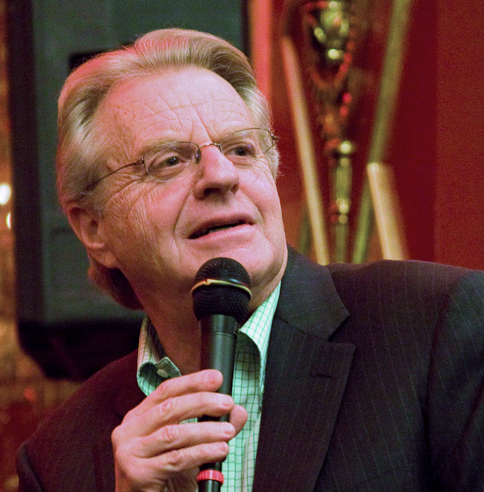
Jerry Springer. By Justin Hoch, CC BY 2.0, https://commons.wikimedia.org/w/index.php?curid=16673259

So sometimes things you want to promote don’t get popular, and things you don’t necessary want to promote get popular.

Rather than being disappointed, just go with the flow, say “na na” to the naysayers, and speak about Shipley with soothing instrumental music behind you.

Take care of yourself, and each other.

Fill Your Company Gap With A Biometric Content Marketing Expert

Companies often have a lot of things they want to do, but don’t have the people to do them. It takes a long time to hire someone, and it even takes time to find a consultant that knows your industry and can do the work.

This affects identity/biometric companies just like it affects other companies. When an identity/biometric company needs a specific type of expertise and needs it NOW, it’s often hard to find the person they need.

If your company needs a biometric content marketing expert (or an identity content marketing expert) NOW, you’ve come to the right place—Bredemarket. Bredemarket has no identity learning curve, no content learning curve, and offers proven results.

Identity/biometric consulting in the 1990s

I remember when I first started working as an identity/biometric consultant, long before Bredemarket was a thing.

OK, not quite THAT long ago. I started working in biometrics in the 1990s—NOT the 1940s.

In 1994, the proposals department at Printrak International needed additional writers due to the manager’s maternity leave, and she was so valuable that Printrak needed to bring in TWO consultants to take her place.

At least initially, the other consultant and I couldn’t fill the manager’s shoes.

Designed by Freepik.
  • Both of us could write.
  • Both of us could spell “AFIS.”
  • Both of us could spell “RAID.” Not the bug spray, but the storage mechanism that stored all those “huge” fingerprint images.
  • But on that first night that I was cranking out proposal letters for something called a “Latent Station 2000,” I didn’t really know WHAT I was writing about.

As time went on, the other consultant and I learned much more—so much that the company brought both of us on as full-time employees.

After we were hired full-time, we spent a combined 45+ years at Printrak and its corporate successors in proposals, marketing, and product management positions, contributing to industry knowledge.

Which shows that learning how to spell “AFIS” can have long-term benefits.

Printrak’s problem

When Printrak needed biometric proposal writing experts quickly, it found two people who filled the bill. Sort of.

But neither of us knew biometrics before we started consuting at Printrak.

And I had never written a proposal before I started consulting at Printrak. (I had written an RFP. Sort of.)

But frankly, there weren’t a lot of identity/biometric consultants out in the field in the 1990s. There were the 20th century equivalents of Applied Forensic Services LLC, but at the time I don’t think there were any 20th century equivalents of Tandem Technical Writing LLC.

The 21st century solution

Unlike the 1990s, identity/biometric firms that need consulting help have many options. In addition to Applied Forensic Services and Tandem Technical Writing you have…me.

Mike and Laurel can tell you what they can do, and I heartily endorse both of them.

Let me share with you why I call myself a biometric content marketing expert who can help your identity/biometric company get marketing content out now:

  • No identity learning curve
  • No content learning curve
  • Proven results

No identity learning curve

I have worked with finger, face, iris, DNA, and other biometrics, as well as government-issued identity documents and geolocation. If you are interested, you can read my Bredemarket blog posts that mention the following topics:

No content learning curve

Because I’ve produced both external and internal content on identity/biometric topics, I offer the experience to produce your content in a number of formats.

  • External content: account-based marketing content, articles, blog posts (I am the identity/biometric blog expert), case studies, data sheets, partner comarketing content, presentations, proposals, sales literature sheets, scientific book chapters, smartphone application content (events), social media posts, web page content, and white papers.
  • Internal content: battlecards, competitive analyses, demonstration scripts (events), email internal newsletters, FAQs, multi-year plans, playbooks, project plans, proposal templates, quality improvement documents, requirements documents, strategic analyses, and website/social media analyses.

Proven results

Read about them here.

So how can you take advantage of my identity/biometric expertise?

If you need day-one help for an identity/biometric content marketing or proposal writing project, consider Bredemarket.

How Can Your Identity Business Create the RIGHT Written Content?

Does your identity business provide biometric or non-biometric products and services that use finger, face, iris, DNA, voice, government documents, geolocation, or other factors or modalities?

Does your identity business need written content, such as blog posts (from the identity/biometric blog expert), case studies, data sheets, proposal text, social media posts, or white papers?

How can your identity business (with the help of an identity content marketing expert) create the right written content?

For the answer, click here.

Updates, updates, updates…

When keeping your websites updated, I advise you to do as I say, not as I do. Two of my websites were significantly out of date and needed hurried corrections.

Designed by Freepik.

I realized this morning that the “My Experience” page on my jebredcal website was roughly a year out of date, so I hurriedly added content to it. Now the page will turn up in searches for the acronym “ABM” (OK, maybe not on the first page of the search results).

Then I had to return to this website to make some hurried updates, since my April 2022 prohibition on taking certain types of work is no longer in effect as of June 2023. Hence, my home page, my “What I Do” page, and (obviously) my identity page are all corrected.

Oh yeah, I updated my Calendly availability hours also. Which is good, because I already have two meetings booked this week.

Which reminds me…if you need Bredemarket’s services:

My…Umm..Opportunity is YOUR Opportunity

A little over a year ago, Bredemarket announced two changes in my business scope and business hours. I stopped accepting work from clients who marketed systems to identify individuals, and I reduced my business hours to Saturday mornings only.

Generated at craiyon.com.

I had to change my business scope and business hours. On May 9, 2022, I started a full-time position with a company in the identity industry, which meant that I couldn’t consult on weekdays and couldn’t consult on identity projects.

But things change.

As of May 31, 2023, I will no longer be employed at my day job.

Which is my misfortune…um…opportunity.

Generated at craiyon.com.

Has Bredemarket changed its business scope and business hours a second time?

Yes.

As of June 1, 2023:

  • If you need a consultant for marketing or proposal work, and your company is involved in the identification of individuals, Bredemarket can accept the work.
  • If you need a consultant who can meet with you during normal business hours, Bredemarket can accept the work.

So what?

My…um…opportunity is your opportunity.

Now that I can expand my business scope and business hours again, you can take advantage of my extensive marketing expertise, including deep experience in the identity industry.

This means you can obtain quickly-generated and expert content with an agreed-upon focus.

This means you can get content that increases your revenue.

What kind of content?

Blog posts, case studies and testimonials, proposals and proposal text, white papers, and many other types of content.

How about e-books?

Yes I also write e-books.

These two e-books explain (a) how Bredemarket starts a project with you, and (b) how Bredemarket has helped other businesses over the years.

(UPDATE OCTOBER 22, 2023: “SIX QUESTIONS YOUR CONTENT CREATOR SHOULD ASK YOU IS SO 2022. DOWNLOAD THE NEWER “SEVEN QUESTIONS YOUR CONTENT CREATOR SHOULD ASK YOU” HERE.)

How can I find out more information about Bredemarket?

Contact me.

But wait…what if Bredemarket changes its business hours and business scope a THIRD time?

I very well could change Bredemarket’s business hours/scope again.

Maybe I’ll find a new full-time position in a couple of weeks, and I’ll again have to reduce hours and scope.

Which basically means that you have to ACT QUICKLY to ensure you can reserve my services.

(See “how to create a sense of urgency.”)

Generated at craiyon.com.

I’m still the biometric content marketing and proposal writing expert…but who benefits?

Beginning about a year ago, I began marketing myself as the biometric proposal writing expert and biometric content marketing expert. From a search engine optimization perspective, I have succeeded at this, so that Bredemarket tops the organic search results for these phrases.

Well, it seemed like a good idea at the time.

And maybe it still is.

Let’s look at why I declared myself the biometric proposal writing expert (BPWE) and biometric content marketing expert (BCME) in mid-2021, what happened over the last few months, why it happened, and who benefits.

Why am I the BPWE and BCME?

At the time that I launched this marketing effort, I wanted to establish Bredemarket’s biometric credentials. I was primarily providing my expertise to identity/biometric firms, so it made sense to emphasize my 25+ years of identity/biometric expertise, coupled with my proposal, marketing, and product experience. Some of my customers already knew this, but others did not.

So I coupled the appropriate identity words with the appropriate proposal and content words, and plunged full-on into the world of biometric proposal writing expert (BPWE within Bredemarket’s luxurious offices) and biometric content marketing expert (BCME here) marketing.

What happened?

There’s been one more thing that’s been happening in Bredemarket’s luxurious offices over the last couple of months.

I’ve been uttering the word “pivot” a lot.

Since March 2022, I’ve made a number of changes at Bredemarket, including pricing changes and modifications to my office hours. But this post concentrates on a change that affects the availability of the BPWE and BCME.

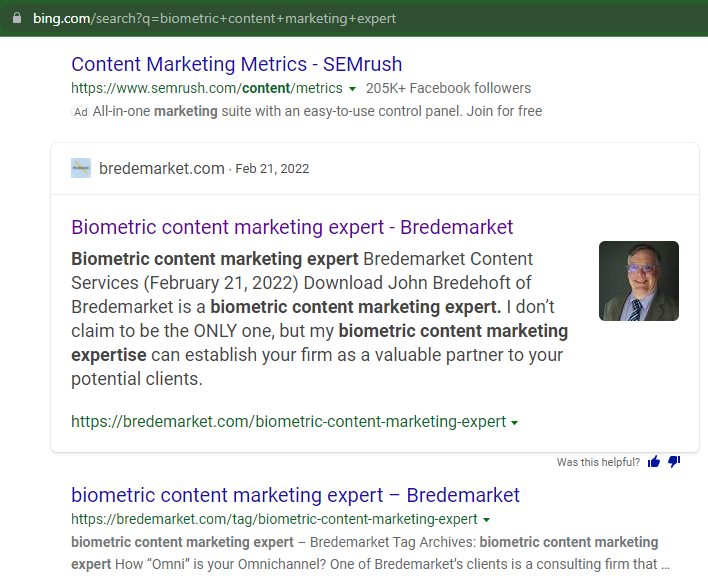
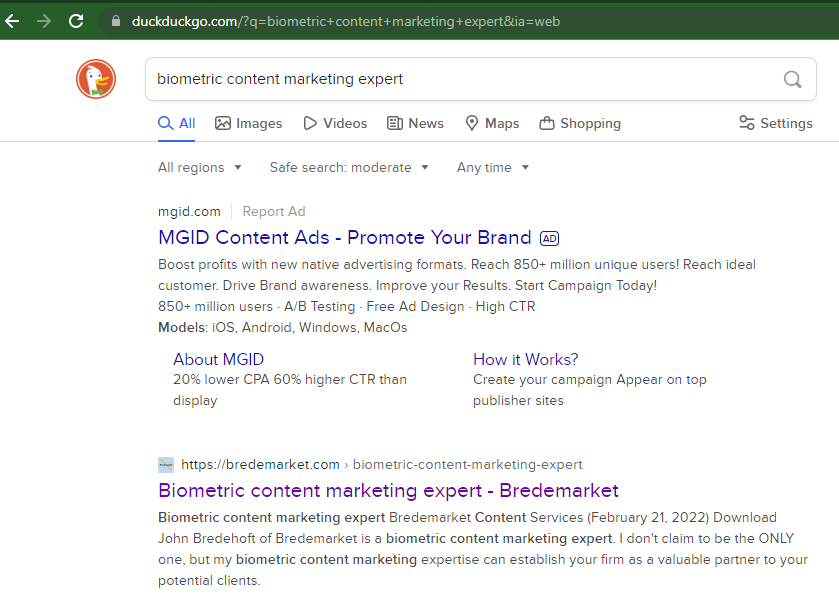
Let’s say that it’s December 2022, and someone performs a Google, Bing, or DuckDuckGo search for a biometric content marketing expert. The person finds Bredemarket, and excitedly goes to Bredemarket’s biometric content marketing expert page, only to encounter this text at the top of the page:

Update 4/25/2022: Effective immediately, Bredemarket does NOT accept client work for solutions that identify individuals using (a) friction ridges (including fingerprints and palm prints), (b) faces, and/or (c) secure documents (including driver’s licenses and passports). 

“Thanks a lot,” thinks the searcher.

Granted, there are others such as Tandem Technical Writing and Applied Forensic Services who can provide biometric consulting services, but the searcher won’t get the chance to work with ME.

Should have contacted me before April 2022.

Sheila Sund from Salem, United States, CC BY 2.0 https://creativecommons.org/licenses/by/2.0, via Wikimedia Commons

Why did it happen?

I’ve already shared some (not all) details about why I’m pivoting with the Bredemarket community, but perhaps you didn’t get the memo.

I have accepted a full-time position as a Senior Product Marketing Manager with an identity company. (I’ll post the details later on my personal LinkedIn account, https://www.linkedin.com/in/jbredehoft/.) This dramatically decreases the amount of time I can spend on my Bredemarket consultancy, and also (for non-competition reasons) limits the companies with which I can do business. 

Those of you who have followed Bredemarket from the beginning will remember that Bredemarket was only one part of a two-pronged approach. After becoming a “free agent” (also known as “being laid off”) in July 2020, my initial emphasis was on finding full-time employment. Within a month, however, I found myself accepting independent contracting projects, and formally established Bredemarket to handle that work. Therefore, I was simultaneously (a) looking for full-time work, and (b) growing my consulting business. And I’ve been doing both simultaneously for over a year and a half. 

Now that I’ve found full-time employment again, I’m not going to give up the consulting business. But it’s definitely going to have to change, as outlined in my April 25, 2022 update.

So now all of this SEO traction will not benefit you, the potential Bredemarket finger/face client, but it obviously will benefit my new employer. I can see it now when people talk about my new employer: “Isn’t that the company where the biometric content marketing expert is the Senior Product Marketing Manager?”

At least somebody will benefit.

P.S. There’s a “change” Spotify playlist. Unlike Kevin Meredith, I don’t use my playlists to make sure my presentation is within the alloted time. Especially when I create my longer 100-plus song playlists; no one wants to hear me speak for that long. Thankfully for you, this playlist is only a little over an hour long, and includes various songs on change, moving, endings, beginnings, and time.

Bredemarket announcement: change in business scope

Effective immediately:

  1. Bredemarket does not accept client work for solutions that identify individuals using (a) friction ridges (including fingerprints and palm prints) and/or (b) faces.
  2. Bredemarket does not accept client work for solutions that identify individuals using secure documents, such as driver’s licenses or passports. 

How “Omni” is your Omnichannel?

One of Bredemarket’s clients is a consulting firm that advises other companies on the use of a particular enterprise content management system. Among other things, this consulting firm can help its client companies configure the outbound information the companies’ systems provide.

Which leads us to our word for today, omnichannel.

In marketing, “omnichannel” refers to “the process of driving customer engagement across all channels with seamless, targeted messaging.”

Across ALL marketing channels. That’s what omnichannel talks about.

Here’s what Erin O’Connor says:

Omnichannel marketing lets marketers create seamless, integrated customer experiences spanning both online and offline channels to connect with customers as they move through the buying cycle. Omnichannel marketing focuses on the life cycle of the customer. For example, when a customer is in the acquisition phase, the marketer will send a different type of message compared to a loyal customer

Omnichannel marketing is …a holistic approach in the sense that it’s looking at all of the potential touchpoints customers can use to communicate with brands, both online and offline.

From https://business.adobe.com/glossary/omnichannel-marketing.html

An omnichannel marketing strategy may encompass a number of marketing tools, including email, white paper downloads, videos, mobile SMS responses, automated call centers, and anything else that marketers use to communicate with clients.

One of the key benefits of an omnichannel marketing strategy is, or should be, consistency. If your emails say that your product is supported on Windows 11, your data sheets had better not say that your product is only supported up to Windows 10. This is a definite problem; see my checklist item 2 in this post.

(Incidentally, I recently ran across a company that is still talking about NIST FRVT results from several years ago. Since the NIST FRVT tests are ongoing, any reference to old results is outdated because of all the new algorithms that have been submitted and that have better performance.)

So factual consistency is important. Omnichannel marketing also allows for visual consistency (well, not in the automated call center) in which all of the company’s content looks like it came from the same company.

Obviously there are a number of benefits from omnichannel marketing, including easier management and consistency of marketing messages. But all of this raises a question:

Is omnichannel marketing truly OMNIchannel? Or does omnichannel marketing leave some things out?

Before you point me to the definition of “omni” and say that omnichannel marketing by definition can’t exclude anything, read on.

When product marketers don’t market

If you’re a marketer, I hope you’re sitting down.

The world does not revolve around marketing.

(My college roommates who were physics majors made sure to remind me of this.)

Thus, anything that isn’t marketing is automatically excluded from omnichannel marketing. And there are a number of things that companies do that aren’t marketing per se.

I recently held a discussion with a product marketer which got me thinking. We were talking about the things product marketers do, which include content creation (case studies/testimonials, white papers, social media content, and the like) and other product-related tasks such as competitive analysis of other products.

But then the product marketer mentioned something else.

What about having the product marketer author product technical documentation, such as user guides?

(By the way, I’ve written technical documentation in the past; see the “Benefiting from my experience and expertise” section of the Bredemarket “Who I Am” page.)

Now technical documentation is (usually) not the place for overt marketing messaging, but at the same time technical documentation authorship benefits the product marketer and the company by immersing the product marketer into the details of the product, thus increasing the marketer’s product understanding.

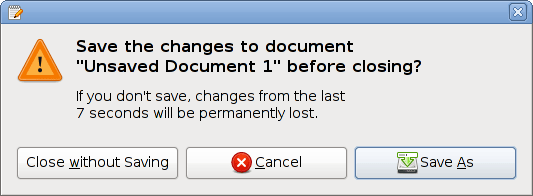
I’ll grant you need a different writing style when writing technical documentation; after all, there are no earthshaking benefits from clicking on the “Save As” button.

By Later version were uploaded by Bruce89 at en.Wikipedia. – Transfered from en.Wikipedia; en:File:Dialog1.pngtransfered to Commons by User:IngerAlHaosului using CommonsHelper., GPL, https://commons.wikimedia.org/w/index.php?curid=8988455

But you need different writing styles for the different types of marketing output anyway. The mechanics of writing a tweet differ from the mechanics of filming a video. So a marketer who isn’t experienced in technical documentation can adjust to the new style.

However, finding marketers slash technical documentation writers in the wild is unusual. Every company that I’ve worked with since 1991 has built some type of wall between the marketing function and the technical documentation function. But oddly enough, one of my former employers (MorphoTrak) moved managers around between the different functions. One manager in particular headed up the technical documentation group, then headed up the proposals group (where I worked for her), then headed up a multi-functional marketing team (where I worked for her again), then specialized in product marketing.

And now the product marketer (not the one from MorphoTrak, but the one I had been talking to) got the hamster in my brain to start generating ideas.

If omnichannel marketing is limited, and your omnichannel efforts should include activities outside of marketing such as technical documentation, what else should be included in your omnichannel efforts?

Including proposal writing in omnichannel efforts

OK, the subtitle gave it away. (But I refused to write the subtitle “This marketer wrote a user guide. You won’t believe what he did next!”)

If anything, proposal writing is closer to marketing than technical documentation is to marketing. While proposal writing is often considered a sales function (though some would disagree), there are obvious overlaps between the benefits that you espouse in a proposal and the benefits that you espouse in a case study.

Including standard proposal text/template creation as part of your omnichannel efforts also helps to ensure consistency in your product messaging. Again, if your data sheet says one thing, and your user guide says the same thing, then your proposal had better say the same thing also. (Unless you’re proposing something that won’t be implemented for another one or two years, in which case the proposal will discuss things that won’t appear in the present data sheets and user guides, but in future versions.)

Now those of you who are familiar with what Bredemarket does can appreciate why I love this idea.

By Loudon dodd – Own work, CC BY-SA 3.0, https://commons.wikimedia.org/w/index.php?curid=7404342

I’ve positioned Bredemarket as a two-headed (but not two-faced) marketing and writing service provider: for example, with separate descriptions of my status as a biometric content marketing expert and a biometric proposal writing expert. And that pretty much mirrors how I work. With one exception, most of my clients only use me for either my proposal services or my content marketing services.

What if companies entrusted Bredemarket with their total solution, both inside and outside of traditional marketing?

Of course there are complications in implementing this.

But when can you implement true omnichannel efforts?

Now most companies are ill-fitted to have one person, or even one department, handle all the omnichannel marketing (case studies, white papers, data sheets, tweets, LinkedIn posts, competitive intelligence, etc.) AND all the omnichannel non-marketing (technical documentation, proposals, and all the other stuff that my hamster brain didn’t realize yet).

So how do you get multiple departments to communicate the same messaging? It’s a difficult task, especially since most department members are so focused on their own work that they don’t have the bandwidth to worry about what another department is doing. (“I don’t care about the data sheet error. I just write the manuals.”)

There are several ways to achieve this: central ownership of the messaging for all departments, outside quality audits, and peer-to-peer interdepartmental review come to mind.

But you’re not going to solve the problem of inconsistent messaging between your departments unless you realize that the problem exists…and that “omnichannel marketing” won’t solve it.

Does your biometric/identity firm need proposal or content marketing services?

I really need to update my own website more frequently.

About a year ago, I created a web page and an accompanying brochure entitled “Bredemarket and Identity Firms.” I’ve updated the web page a time or two in the last year, but until a few minutes ago both the web page and the brochure were significantly out of date, and didn’t include some of the projects that I’ve worked on during the past few months.

You can view the updated web page or download the updated brochure (at the end of this post) if you like, but I’ll create a frictionless experience for you by reproducing (repurposing) the list of ALL of Bredemarket’s biometric/identity projects as of today. (And there are more projects in work that I haven’t listed yet.)

By Zhe Wang, Paul C. Quinn, James W. Tanaka, Xiaoyang Yu, Yu-Hao P. Sun, Jiangang Liu, Olivier Pascalis, Liezhong Ge and Kang Lee – https://www.frontiersin.org/articles/10.3389/fpsyg.2015.00559/full, CC BY 4.0, https://commons.wikimedia.org/w/index.php?curid=96233011

If I can perform similar services for your biometric/identity firm, contact me.

How can Bredemarket help identity firms?

Here are a few examples of services that I have provided to identity firms under the Bredemarket banner as a biometric proposal writing expert, a biometric content marketing expert, an identity content marketing expert (biometrics alone is not enough), and an expert in other areas of identity/biometric writing.

  • Proposal Writing: Created five proposal letter templates to let a biometric firm’s sales staff propose two products to five separate markets. After completing the first three templates, I received this unsolicited testimonial:

“I just wanted to truly say thank you for putting these templates together. I worked on this…last week and it was extremely simple to use and I thought really provided a professional advantage and tool to give the customer….TRULY THANK YOU!”

  • More Proposal Writing: Responded to three Requests for Information (RFIs) for two biometric firms, positioning the firms for future work from government agencies.
  • Even More Proposal Writing: Assisted a biometric firm in responding to multiple Requests for Proposal (RFPs) and sole source letters.
  • And more…: Created a proposal letter template for a biometric firm.
  • And still more…: Created a Microsoft Word-based response library for a biometric firm.
  • Proposal Analyzing: Monitored the social media activity of a biometric firm’s competition and created responsive proposal text to position the firm against its competition.
  • Proposal Editing: Assisted a biometric firm in the final stages of an RFP response, editing its proposal both before and after its Gold Team review.
  • Strategic Marketing: Updated customer counts and technical data for a secure document firm.
  • More Strategic Marketing: Assisted a leading biometric vendor in analyzing its NIST FRVT 1:1 and 1:N results, providing both public information the firm could share with its clients, and private information for the firm’s internal use.
  • Online Marketing: Analyzed a biometric website and its social media channels, looking for broken links, outdated information, synchronization errors, and other problems, and provided a report to the firm upon completion.
  • More Online Marketing: Wrote three service descriptions for a biometric consulting firm.
  • Online Writing: Interviewed customers and wrote case study text for 14 case studies a biometric firm.
  • More Online Writing: Wrote blog posts for multiple biometric firms. After all, I am the identity/biometric blog expert.

The difference between biometrics and biometrics

(Part of the biometric product marketing expert series)

We’ll get to Bob a little later. But let me start off by telling you something.

AAABWTCI.

That stands for “acronyms are a bad way to convey information.”

But you didn’t know that.

Many of us like to use acronyms to quickly convey information, but we need to remember that different people use acronyms in different ways.

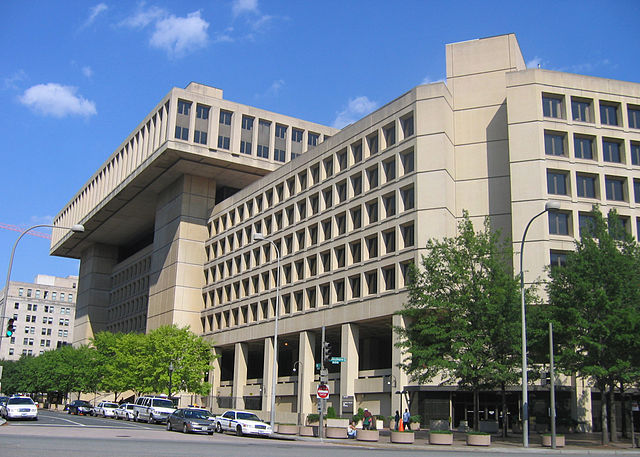
For example, in my circles, people generally understand “FBI” to refer to the United States Federal Bureau of Investigation.

But try telling that to the Faith Bible Institute, or to an employee of Frontier Booking International. (I’ll admit that the founder of the latter company, Ian Copeland, chose the company name deliberately. After all, his brother Miles founded I.R.S. Records, and their father worked for the Central Intelligence Agency.)

It’s best not to use acronyms at all and instead use full words. Because if you use full words, then (as Ed McMahon would say) you will ensure that EVERYONE knows exactly what you mean.

By photo by Alan Light, CC BY 2.0, https://commons.wikimedia.org/w/index.php?curid=3048124

Allow me to play the Johnny Carson role and say that Ed was WRONG.

By Johnny_Carson_with_fan.jpg: Peter Martorano from Cleveland, Ohio, USAderivative work: TheCuriousGnome (talk) – Johnny_Carson_with_fan.jpg, CC BY 2.0, https://commons.wikimedia.org/w/index.php?curid=12750959

After all, the great English philosopher Robert Plant (I told you we’d get to Bob eventually) noted,

“You know sometimes words have two meanings.”

“Stairway to Heaven.” https://genius.com/Led-zeppelin-stairway-to-heaven-lyrics

Take the word “biometrics.” In my circles, people generally understand “biometrics” to refer to one of several ways to identify an individual.

By Dawid Weber – Praca własna, CC BY 3.0, https://commons.wikimedia.org/w/index.php?curid=102148689

But for the folks at Merriam-Webster, this is only a secondary definition of the word “biometrics.” From their perspective, biometrics is primarily biometry, which can refer to “the statistical analysis of biological observations and phenomena” or to “measurement (as by ultrasound or MRI) of living tissue or bodily structures.” In other words, someone’s health, not someone’s identity.

Fun fact: if you go to the International Biometric Society and ask it for its opinion on the most recent FRVT 1:N tests, it won’t have an answer for you.

The terms “Biometrics” and “Biometry” have been used since early in the 20th century to refer to the field of development of statistical and mathematical methods applicable to data analysis problems in the biological sciences.

Recently, the term “Biometrics” has also been used to refer to the emerging field of technology devoted to the identification of individuals using biological traits, such as those based on retinal or iris scanning, fingerprints, or face recognition. Neither the journal “Biometrics” nor the International Biometric Society is engaged in research, marketing, or reporting related to this technology. Likewise, the editors and staff of the journal are not knowledgeable in this area.  

From https://www.biometricsociety.org/about/what-is-biometry

This can confuse people when I refer to myself as a biometric proposal writing expert or a biometric content marketing expert. I’ve been approached by people who wanted my expertise, but who walked away disappointed that I had never written about a clinical trial.

Despite this, there are some parallels between biometrics and biometrics. After all, both biometrics and biometrics take body measurements (albeit for different reasons), and therefore some devices that can be used for biometry can sometimes also be used for identification, and vice versa.

But only sometimes. Your run-of-the-mill optical fingerprint reader won’t contribute to any medical diagnosis, and I’m still on the fence regarding whether brain waves can be used to identify individuals. I need a sample size larger than 50 people before I’ll claim brain waves as a reliable biometric.

Of course, a biometric device such as an Apple Watch can not only measure your biometrics, but also your geolocation, which is another authentication factor.