I have a telehealth appointment next week with a medical professional whom I have previously met. And I assume she will participate in the telehealth appointment.
In the future, of course, she may not.
Way back in April 2013, I wrote a tymshft piece entitled “You will still take a cab to the doctor’s office. For a while.” It speculated about a future 2023 medical appointment in which the patient took a driverless cab to a medical facility. In the office, the patient was examined by remote staff…or so she thought.
“Well, I’m glad you’ve gotten used to the procedure,” replied the friendly voice. “I hope you like me!”
“I do,” said Edith. “You’ve been very helpful. But I’ve always wondered exactly WHERE you were. If you were in Los Angeles, or in Mississippi, or perhaps in India or China, or perhaps even in one of the low-cost places such as Chad. If you don’t mind my asking, exactly where ARE you?”
“I don’t mind answering the question,” replied the friendly voice, “and I hope you don’t take my response the wrong way, but I’m not really a person as you understand the term. I’m actually an application within the software package that runs the medical center. But my programmers want me to tell you that they’re really happy to serve you, and that Stanford sucks.” The voice paused for a moment. “I’m sorry, Edith. You have to forgive the programmers – they’re Berkeley grads.”
“Oh,” said Edith after a moment. “This is something new. I’m used to it in banking, but I didn’t realize that a computer program could run an entire medical center. Well…who picks up the trash?”
“That’s an extra question! Just kidding,” replied the friendly voice. “Much of the trash pickup is automated, but we do have a person to supervise the operation. Ron Hussein. You actually know him – he was your cab driver in 2018 when you came here.”
Re-reading this 2013 piece, I was amused at three things I got wrong.
First, Google, Facebook, and Apple did NOT merge to form Gaceapple, “the important merger that saved the tech industry in the United States from extinction.” American tech firms are still powerful…for now.
Second, my assumption of cab companies adopting driverless cars assumed the continued existence of cab companies. Ride share services have reduced the presence of traditional companies dramatically.
Third, my assumption that medical firms would sink untold sums of money into centralized automated medical examination rooms could be questioned…especially for routine appointments like Edith’s. Why not just let Edith’s smartphone—perhaps with a single attachment—gather the data?
Of course, there are medical ethics questions that underlie this entire discussion of remote telehealth and the use of non-person entities (NPEs). And we are struggling with those right now.
While the words “consolidation” and “contraction” have a similar sound and are often linked, they are actually two separate conditions, as you can see in the identity/biometric industry.
Consolidation occurs when separate entities become one. Ping Identity and ForgeRock (Ping Identity). Sagem Morpho and Motorola’s Biometric Business Unit (MorphoTrak). Digital Biometrics and Identix and Viisage and Visionics and Iridian and ComnetiX and don’t forget the ID part of Digimarc and many others (L-1 Identity Solutions).
Contraction occurs when an existing entity becomes smaller. Hikvision’s reported layoff of 1,000 employees is a recent and relevant example.
“Ah, but Hikvision is a special case,” you may be saying. “They’re linked to human rights abuses and sanctioned by Western governments. Many identity/biometric players are not sanctioned.”
But I’m not hearing loud celebrations from these other firms.
I’ve privately heard three separate stories, one of which I just heard on Monday, involving major identity/biometric companies. All three stories involve firms that are not sanctioned. In all three cases the firms perform major business with Western governments. And all three stories involve contraction which would have been unthinkable a mere five years ago.
Not too long ago I compiled a list of four significant events that positively impacted the identity/biometric industry. That list included 9/11, the Boston Marathon bombings, Apple’s Touch ID, and COVID.
I’m starting to wonder whether that last event was, in the long term, a net positive or a net negative.
To install iOS 18 on my older 64GB IPhone I had to offload or outright remove many apps, including most of my game apps.
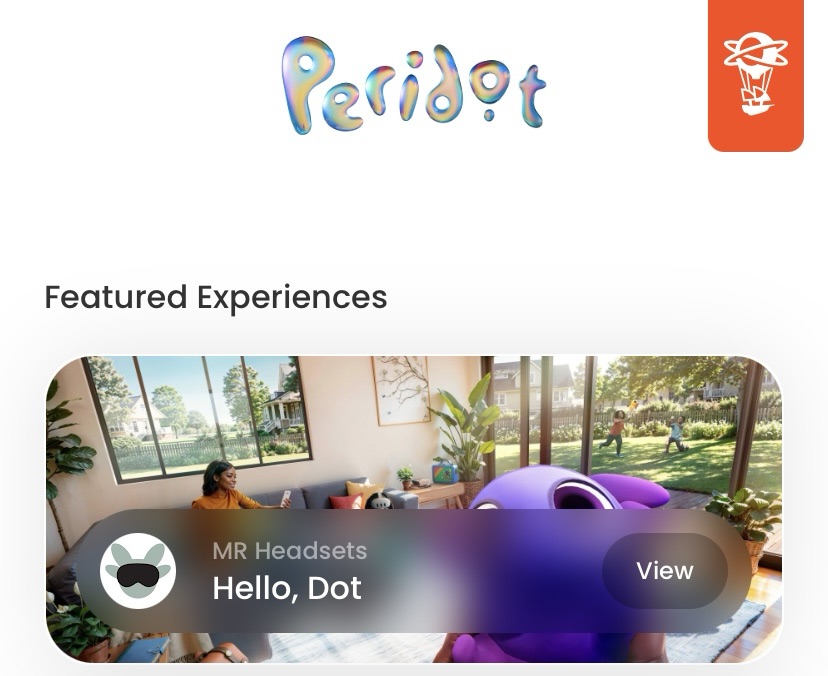
One of those game apps was Niantic’s most recent location-based app, Peridot. Like many other Niantic games, Peridot encourages outdoor activity—and heavy smartphone use while playing the game.
Today was the first day that I took my usual Saturday morning walk WITHOUT Peridot on my phone. Ordinarily, my phone desperately needs a charge at the end of my walk. Today, despite filming a number of video clips for a personal October video, I returned home with over 75% battery remaining.
But with a paucity of virtual sandwiches, flowers, and tomatoes.
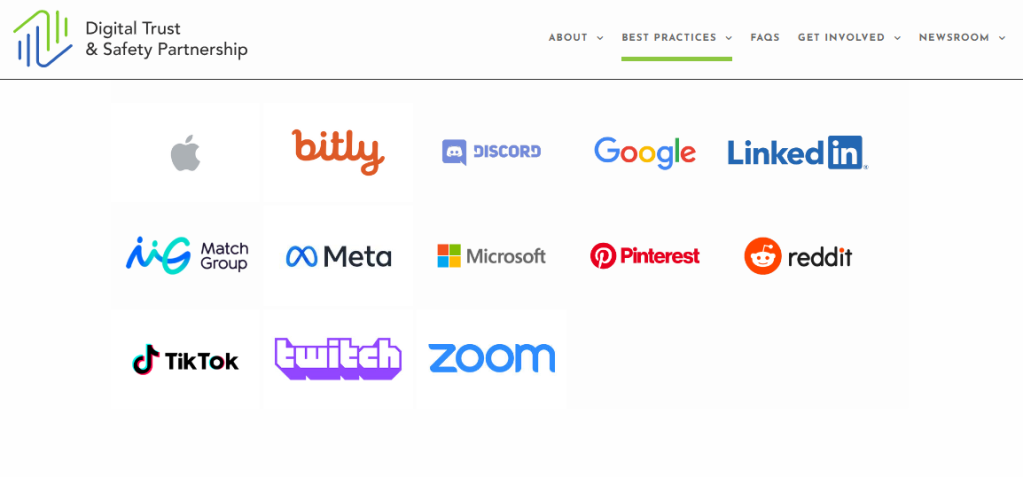
The Digital Trust & Safety Partnership (DTSP) consists of “leading technology companies,” including Apple, Google, Meta (parent of Facebook, Instagram, and WhatsApp), Microsoft (and its LinkedIn subsidiary), TikTok, and others.
DTSP appreciates and shares Ofcom’s view that there is no one-size-fits-all approach to trust and safety and to protecting people online. We agree that size is not the only factor that should be considered, and our assessment methodology, the Safe Framework, uses a tailoring framework that combines objective measures of organizational size and scale for the product or service in scope of assessment, as well as risk factors.
We’ll get to the “Safe Framework” later. DTSP continues:
Overly prescriptive codes may have unintended effects: Although there is significant overlap between the content of the DTSP Best Practices Framework and the proposed Illegal Content Codes of Practice, the level of prescription in the codes, their status as a safe harbor, and the burden of documenting alternative approaches will discourage services from using other measures that might be more effective. Our framework allows companies to use whatever combination of practices most effectively fulfills their overarching commitments to product development, governance, enforcement, improvement, and transparency. This helps ensure that our practices can evolve in the face of new risks and new technologies.
But remember that the UK’s neighbors in the EU recently prescribed that USB-3 cables are the way to go. This not only forced DTSP member Apple to abandon the Lightning cable worldwide, but it affects Google and others because there will be no efforts to come up with better cables. Who wants to fight the bureaucratic battle with Brussels? Or alternatively we will have the advanced “world” versions of cables and the deprecated “EU” standards-compliant cables.
So forget Ofcom’s so-called overbearing approach and just adopt the Safe Framework. Big tech will take care of everything, including all those age assurance issues.
Incorporating each characteristic comes with trade-offs, and there is no one-size-fits-all solution. Highly accurate age assurance methods may depend on collection of new personal data such as facial imagery or government-issued ID. Some methods that may be economical may have the consequence of creating inequities among the user base. And each service and even feature may present a different risk profile for younger users; for example, features that are designed to facilitate users meeting in real life pose a very different set of risks than services that provide access to different types of content….
Instead of a single approach, we acknowledge that appropriate age assurance will vary among services, based on an assessment of the risks and benefits of a given context. A single service may also use different approaches for different aspects or features of the service, taking a multi-layered approach.
If you want to learn WHY I regard these four events as revolutionary, and why I DON’T regard the introduction of the Apple Vision Pro as revolutionary, see my June 2023 post.
At least in the United States, the mobile driver’s license world is fragmented.
Because driver’s license issuance in the U.S. is a state and not a federal responsibility, each state has to develop its own mobile driver’s license implementation. Subject to federal and international standards, of course.
To date there have been two parties helping the states with this:
mDL vendors such as Envoc and IDEMIA, who work with the states to create mDLs.
Operating system vendors such as Apple and Google, who work with the states to incorporate mDLs in smartphone wallets.
But because the Android ecosystem is more fragmented than the iOS ecosystem, we now have a third party that is involved in mDLs. In addition to mDL vendors and operating system vendors, we also have really large smartphone providers.
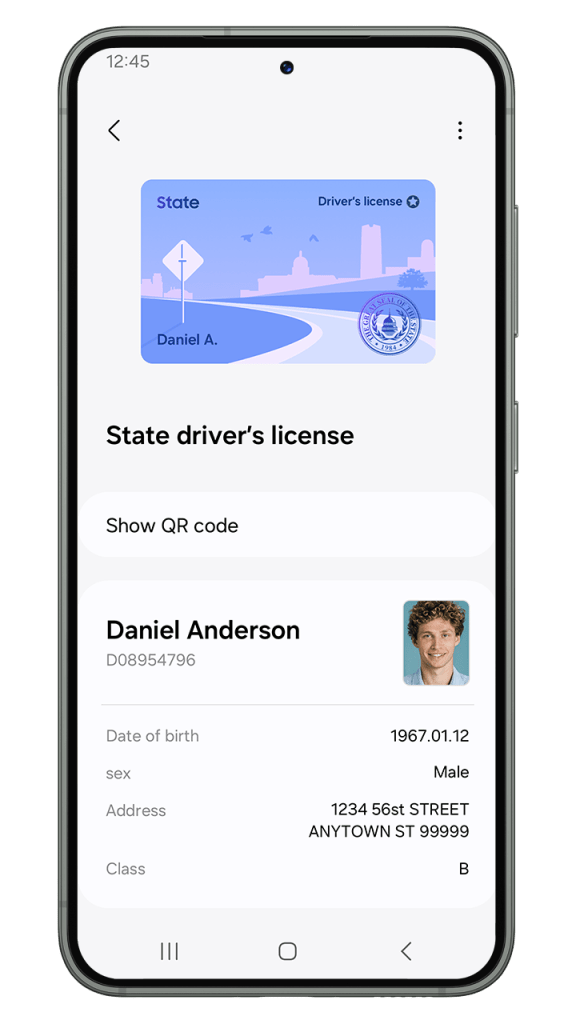
Samsung Electronics America today announced it is bringing mobile driver’s licenses and state IDs to Samsung Wallet. Arizona and Iowa will be the first states to offer a mobile version of its driver’s license to their residents. The update expands the Samsung Wallet experience by adding a convenient and secure way to use state-issued IDs and driver’s licenses
In this particular case Samsung is working with IDEMIA (the mDL provider for Arizona and Iowa), but Samsung announced that it is working with other states and with the Transportation Security Administration (TSA).
On a personal note, I’m still working on validating my driver’s license for California’s pilot mDL program. It probably didn’t help that I renewed my physical driver’s license right in the middle of the mDL validation process.
We often use the phrase “four-letter word” to refer to cuss words that shouldn’t be said in polite company. Occasionally, we have our own words that we personally consider to be four-letter words. (Such as “BIPA.”)
There are some times when we resign ourselves to the fact that “tech” can be a four-letter word also. But there’s actually a good reason for the problems we have with today’s technology.
Tech can be dim
Just this week I was doing something on my smartphone and my screen got really dim all of a sudden, with no explanation.
So I went to my phone’s settings, and my brightness setting was down at the lowest level.
For no reason.
“Any sufficiently advanced technology is indistinguishable from magic.”
So I increased my screen’s brightness, and everything was back to normal. Or so I thought.
A little while later, my screen got dim again, so I went to the brightness setting…and was told that my brightness was very high. (Could have fooled me.)
I can’t remember what I did next (because when you are trying to fix something you can NEVER remember what you did next), but later my screen brightness was fine.
Was Arthur C. Clarke right? And if so, WHY was he right?
Perhaps it’s selective memory, but I don’t recall having this many technology problems when I was younger.
The shift to multi-purpose devices
Part of the reason for the increasing complexity of technology is that we make fewer and fewer single-purpose devices, and are manufacturing more and more multi-purpose devices.
One example of the shift: if I want to write a letter today, I can write it on my smartphone. (Assuming the screen is bright enough.) This same smartphone can perform my banking activities, play games, keep track of Bredemarket’s earnings…oh, and make phone calls.
Technological convergence is a term that describes bringing previously unrelated technologies together, often in a single device. Smartphones might be the best possible example of such a convergence. Prior to the widespread adoption of smartphones, consumers generally relied on a collection of single-purpose devices. Some of these devices included telephones, wrist watches, digital cameras and global positioning system (GPS) navigators. Today, even low-end smartphones combine the functionality of all these separate devices, easily replacing them in a single device.
From a consumer perspective, technological convergence is often synonymous with innovation.
And the smartphone example certainly demonstrates innovation from the previous-generation single-purpose devices.
When I was a kid, if I wanted to write a letter, I had two choices:
I could set a piece of paper on the table and write the letter with a writing implement such as a pen or pencil.
I could roll a piece of paper into a typewriter and type the letter.
These were, for the most part, single purpose devices. Sure I could make a paper airplane out of the piece of paper, but I couldn’t use the typewriter to play a game or make a phone call.
Turning our attention to the typewriter, it certainly was a manufacturing marvel, and intricate precision was required to design the hammers that would hit the typewritter ribbon and leave their impressions on the piece of paper. And typewriters could break, and repairmen (back then they were mostly men) could fix them.
A smartphone is much more innovative than a smartphone. But it’s infinitely harder to figure out what is wrong with a smartphone.
The smartphone hardware alone is incredibly complex, with components from a multitude of manufacturers. Add the complexities of the operating system and all the different types of software that are loaded on a smartphone, and a single problem could result from a myriad of causes.
No wonder it seems like magic, even for the best of us.
Explaining technology
But this complexity has provided a number of jobs:
The helpful person at your cellular service provider who has acquired just enough information to recognize and fix an errant application.
The many people in call centers (the legitimate call centers, not the “we found a problem with your Windows computer” call scammers) who perform the same tasks at a distance.
All the people who write instructions on how to use and fix all of our multi-purpose devices, from smartphones to computers to remote controls.
Oh, and the people that somehow have to succinctly explain to prospects why these multi-purpose devices are so great.
Because no one’s going to run into problems with technology unless they acquire the technology. And your firm has to get them to acquire your technology.
Crafting a technology marketing piece
So your firm’s marketer or writer has to craft some type of content that will make a prospect aware of your technology, and/or induce the prospect to consider purchasing the technology, and/or ideally convert the prospect into a paying customer.
Before your marketer or writer crafts the content, they have to answer some basic questions.
Using a very simple single-purpose example of a hammer, here are the questions with explanations:
Why does the prospect need this technology? And why do you provide this technology? This rationale for why you are in business, and why your product exists, will help you make the sale. Does your prospect want to buy a hammer from a company that got tired of manufacturing plastic drink stirrers, or do they want to buy a hammer from a forester who wants to empower people to build useful items?
How does your firm provide this technology? If I want to insert a nail into a piece of wood, do I need to attach your device to an automobile or an aircraft carrier? No, the hammer will fit in your hand. (Assuming you have hands.)
What is the technology? Notice that the “why” and “how” questions come before the “what” question, because “why” and “how” are more critical. But you still have to explain what the technology is (with the caveat I mention below). Perhaps some of your prospects have no idea what a hammer is. Don’t assume they already know.
What is the goal of the technology? Does a hammer help you floss your teeth? No, it puts nails into wood.
What are the benefitsof the technology? When I previously said that you should explain what the technology is, most prospects aren’t looking for detailed schematics. They primarily care about what the technology will do for them. For example, that hammer can keep their wooden structure from falling down. They don’t care about the exact composition of the metal in the hammer head.
Finally, who is the target audience for the technology? I don’t want to read through an entire marketing blurb and order a basic hammer, only to discover later that the product won’t help me keep two diamonds together but is really intended for wood. So don’t send an email to jewelers about your hammer. They have their own tools.
(UPDATE OCTOBER 23, 2023: “SIX QUESTIONS YOUR CONTENT CREATOR SHOULD ASK YOU IS SO 2022. DOWNLOAD THE NEWER “SEVEN QUESTIONS YOUR CONTENT CREATOR SHOULD ASK YOU” HERE.)
Once you answer these questions (more about the six questions in the Bredemarket e-book available here), your marketer or writer can craft your content.
Or, if you need help, Bredemarket (the technology content marketing expert) can craft your content, whether it’s a blog post, case study, white paper, or something else.
I’ve helped other technology firms explain their “hammers” to their target audiences, explaining the benefits, and answering the essential “why” questions about the hammers.
Can I help your technology firm communicate your message? Contact me.
Iris recognition continues to make the news. Let’s review what iris recognition is and its benefits (and drawbacks), why Apple made the news last month, and why Worldcoin is making the news this month.
What is iris recognition?
There are a number of biometric modalities that can identify individuals by “who they are” (one of the five factors of authentication). A few examples include fingerprints, faces, voices, and DNA. All of these modalities purport to uniquely (or nearly uniquely) identify an individual.
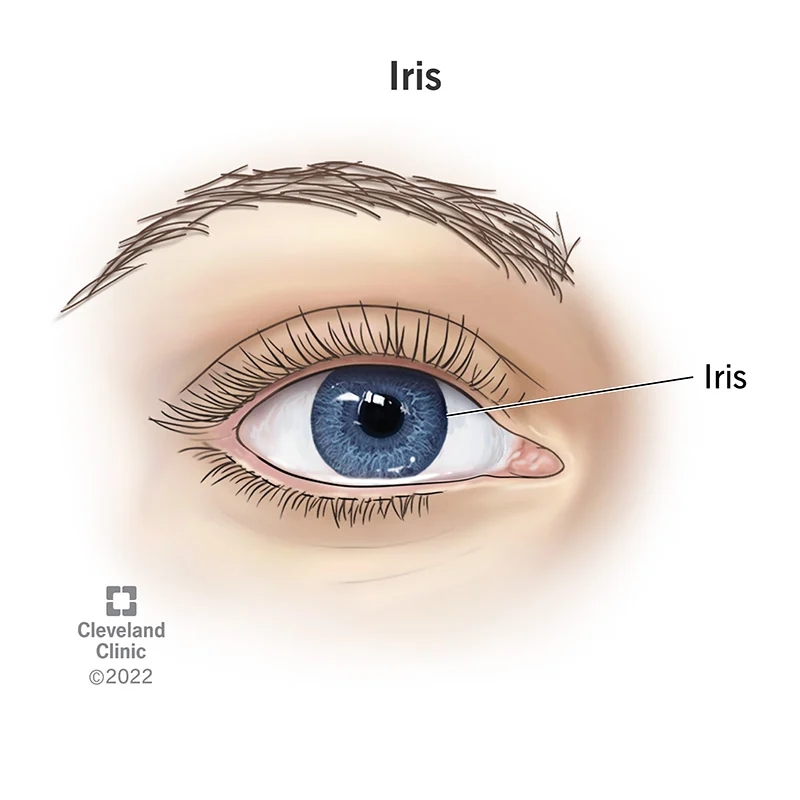
One other way to identify individuals is via the irises in their eyes. I’m not a doctor, but presumably the Cleveland Clinic employs medical professionals who are qualified to define what the iris is.
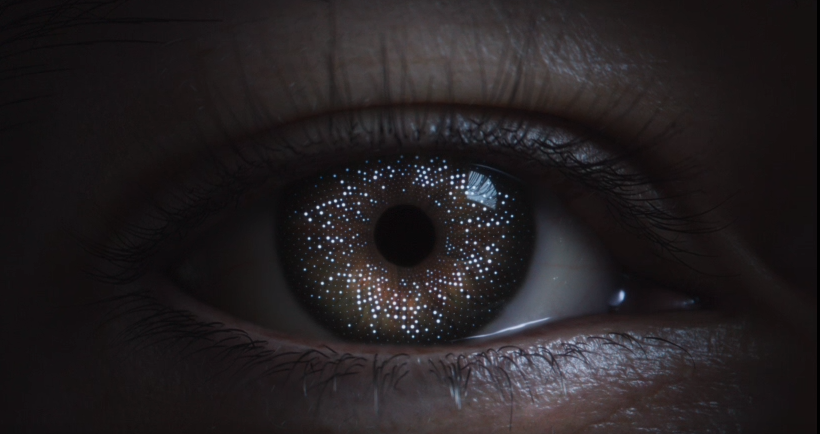
The iris is the colored part of your eye. Muscles in your iris control your pupil — the small black opening that lets light into your eye.
But why use irises rather than, say, fingerprints and faces? The best person to answer this is John Daugman. (At this point several of you are intoning, “John Daugman.” With reason. He’s the inventor of iris recognition.)
(I)ris patterns become interesting as an alternative approach to reliable visual recognition of persons when imaging can be done at distances of less than a meter, and especially when there is a need to search very large databases without incurring any false matches despite a huge number of possibilities. Although small (11 mm) and sometimes problematic to image, the iris has the great mathematical advantage that its pattern variability among different persons is enormous.
Daugman, John, “How Iris Recognition Works.” IEEE TRANSACTIONS ON CIRCUITS AND SYSTEMS FOR VIDEO TECHNOLOGY, VOL. 14, NO. 1, JANUARY 2004. Quoted from page 21. (PDF)
Or in non-scientific speak, one benefit of iris recognition is that you know it is accurate, even when submitting a pair of irises in a one-to-many search against a huge database. How huge? We’ll discuss later.
Brandon Mayfield and fingerprints
Remember that Daugman’s paper was released roughly two months before Brandon Mayfield was misidentified in a fingerprint comparison. (Everyone now intone “Brandon Mayfield.”)
While some of the issues associated with Mayfield’s misidentification had nothing to do with forensic science (Al Jazeera spends some time discussing bias, and Itiel Dror also looked at bias post-Mayfield), this still shows that fingerprints are remarkably similar and that it takes care to properly identify people.
Police agencies, witnesses, and faces
And of course there are recent examples of facial misidentifications (both by police agencies and witnesses), again not necessarily forensic science related, and again showing the similarity of faces from two different people.
At the root of iris recognition’s accuracy is the data-richness of the iris itself. The IrisAccess system captures over 240 degrees of freedom or unique characteristics in formulating its algorithmic template. Fingerprints, facial recognition and hand geometry have far less detailed input in template construction.
Enough about claims. What about real results? The IREX 10 test, independently administered by the U.S. National Institute of Standards and Technology, measures the identification (one-to-many) accuracy of submitted algorithms. At the time I am writing this, the ten most accurate algorithms provide false negative identification rates (FNIR) between 0.0022 ± 0.0004 and 0.0037 ± 0.0005 when two eyes are used. (Single eye accuracy is lower.) By the time you see this, the top ten algorithms may have changed, because the vendors are always improving.
IREX10 two-eye accuracy, top ten algorithms as of July 28, 2023. (Link)
While the IREX10 one-to-many tests are conducted against databases of less than a million records, it is estimated that iris one-to-many accuracy remains high even with databases of a billion people—something we will return to later in this post.
Iris drawbacks
OK, so if irises are so accurate, why aren’t we dumping our fingerprint readers and face readers and just using irises?
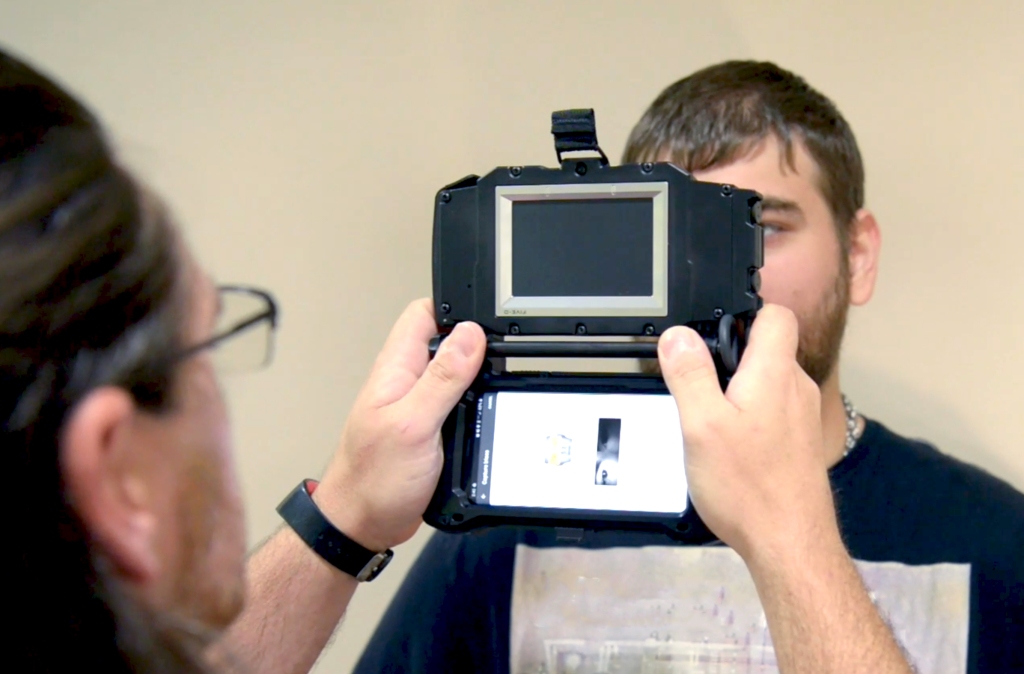
In short, because of the high friction in capturing irises. You can use high-resolution cameras to capture fingerprints and faces from far away, but as of now iris capture usually requires you to get very close to the capture device.
Iris image capture circa 2020 from the U.S. Federal Bureau of Investigation. (Link)
Which I guess is better than the old days when you had to put your eye right up against the capture device, but it’s still not as friendly (or intrusive) as face capture, which can be achieved as you’re walking down a passageway in an airport or sports stadium.
Irises and Apple Vision Pro
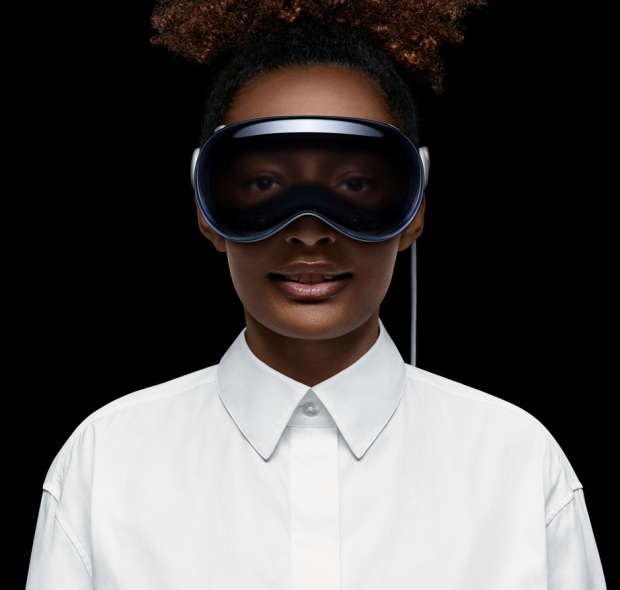
So how are irises being used today? You may or may not have hard last month’s hoopla about the Apple Vision Pro, which uses irises for one-to-one authetication.
I’m not going to spend a ton of time delving into this, because I just discussed Apple Vision Pro in June. In fact, I’m just going to quote from what I already said.
In short, as you wear the headset (which by definition is right on your head, not far away), the headset captures your iris images and uses them to authenticate you.
It’s a one-to-one comparison, not the one-to-many comparison that I discussed earlier in this post, but it is used to uniquely identify an individual.
But iris recognition doesn’t have to be used for identification.
Irises and Worldcoin
“But wait a minute, John,” you’re saying. “If you’re not using irises to determine if a person is who they say they are, then why would anyone use irises?”
Over the past several years, I’ve analyzed a variety of identity firms. Earlier this year I took a look at Worldcoin….Worldcoin’s World ID emphasizes privacy so much that it does not conclusively prove a person’s identity (it only proves a person’s uniqueness)…
That’s the only thing that I’ve said about Worldcoin, at least publicly. (I looked at Worldcoin privately earlier in 2023, but that report is not publicly accessible and even I don’t have it any more.)
The Worldcoin Foundation today announced that Worldcoin, a project co-founded by Sam Altman, Alex Blania and Max Novendstern, is now live and in a production-grade state.
The launch includes the release of the World ID SDK and plans to scale Orb operations to 35+ cities across 20+ countries around the world. In tandem, the Foundation’s subsidiary, World Assets Ltd., minted and released the Worldcoin token (WLD) to the millions of eligible people who participated in the beta; WLD is now transactable on the blockchain….
“In the age of AI, the need for proof of personhood is no longer a topic of serious debate; instead, the critical question is whether or not the proof of personhood solutions we have can be privacy-first, decentralized and maximally inclusive,” said Worldcoin co-founder and Tools for Humanity CEO Alex Blania. “Through its unique technology, Worldcoin aims to provide anyone in the world, regardless of background, geography or income, access to the growing digital and global economy in a privacy preserving and decentralized way.”
Worldcoin does NOT positively identify people…but it can still pay you
A very important note: Worldcoin’s purpose is not to determine identity (that a person is who they say they are). Worldcoin’s purpose is to determine uniqueness: namely, that a person (whoever they are) is unique among all the billions of people in the world. Once uniqueness is determined, the person can get money money money with an assurance that the same person won’t get money twice.
Iris biometrics outperform other biometric modalities and already achieved false match rates beyond 1.2× 10−141.2×10⁻¹⁴ (one false match in one trillion[9]) two decades ago[10]—even without recent advancements in AI. This is several orders of magnitude more accurate than the current state of the art in face recognition.
If you’re starting out in business, you’ve probably heard the advice that as your business branches out into social platforms, you shouldn’t try to do everything at once. Instead you should make sure that your business offering is really solid on one platform before branching out into others.
Yes, I’ve been naughty again and didn’t listen to the expert advice.
One reason is because of my curiosity. With one notable exception, I’m intrigued with the idea of trying out a new platform and figuring out how it works. Audio? Video? Let’s try it.
And as long as I’m trying it out, why not create a Bredemarket account and put content out there?
So there’s a reasonably good chance that Bredemarket is already on one of your favorite social platforms. If so, why not subscribe to Bredemarket so that you’ll get my content?
Here’s a list of Bredemarket’s text, image, audio, and video accounts on various social platforms. Be sure to follow or subscribe!
It ISN’T time for me to jump on the Apple Vision Pro bandwagon, because while Apple Vision Pro affects the biometric industry, it’s not a REVOLUTIONARY biometric event.
The four revolutionary biometric events in the 21st century
How do I define a “revolutionary biometric event”?
I define it as something that completely transforms the biometric industry.
When I mention three of the four revolutionary biometric events in the 21st century, you will understand what I mean.
9/11. After 9/11, orders of biometric devices skyrocketed, and biometrics were incorporated into identity documents such as passports and driver’s licenses. Who knows, maybe someday we’ll actually implement REAL ID in the United States. The latest extension of the REAL ID enforcement date moved it out to May 7, 2025. (Subject to change, of course.)
The Boston Marathon bombings, April 2013. After the bombings, the FBI was challenged in managing and analyzing countless hours of video evidence. Companies such as IDEMIA National Security Solutions, MorphoTrak, Motorola, Paravision, Rank One Computing, and many others have tirelessly worked to address this challenge, while ensuring that facial recognition results accurately identify perpetrators while protecting the privacy of others in the video feeds.
COVID-19, spring 2020 and beyond. COVID accelerated changes that were already taking place in the biometric industry. COVID prioritized mobile, remote, and contactless interactions and forced businesses to address issues that were not as critical previously, such as liveness detection.
These three are cataclysmic world events that had a profound impact on biometrics. The fourth one, which occurred after the Boston Marathon bombings but before COVID, was…an introduction of a product feature.
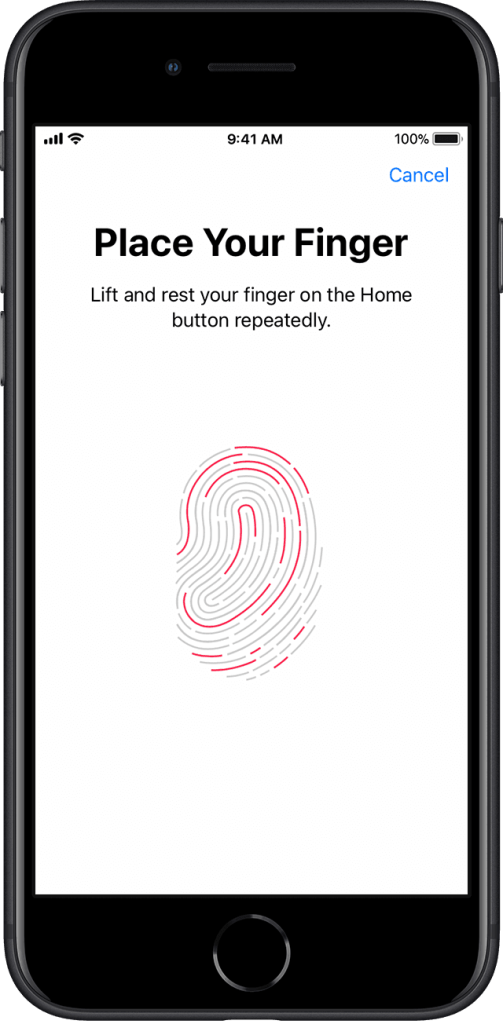
Touch ID, September 2013. When Apple introduced the iPhone 5s, it also introduced a new way to log in to the device. Rather than entering a passcode, iPhone 5S users could just use their finger to log in. The technical accomplishment was dwarfed by the legitimacy that this brought to using fingerprints for identification. Before 2013, attempts to implement fingerprint verification for benefits recipients were resisted because fingerprinting was something that criminals did. After September 2013, fingerprinting was something that the cool Apple kids did. The biometric industry changed overnight.
Of course, Apple followed Touch ID with Face ID, with adherents of the competing biometric modalities sparring over which was better. But Face ID wouldn’t have been accepted as widely if Touch ID hadn’t paved the way.
So why hasn’t iris verification taken off?
Iris verification has been around for decades (I remember Iridian before L-1; it’s now part of IDEMIA), but iris verification is nowhere near as popular in the general population as finger and face verification. There are two reasons for this:
Compared to other biometrics, irises are hard to capture. To capture a fingerprint, you can lay your finger on a capture device, or “slap” your four fingers on a capture device, or even “wave” your fingers across a capture device. Faces are even easier to capture; while older face capture systems required you to stand close to the camera, modern face devices can capture your face as you are walking by the camera, or even if you are some distance from the camera.
Compared to other biometrics, irises are expensive to capture. Many years ago, my then-employer developed a technological marvel, an iris capture device that could accurately capture irises for people of any height. Unfortunately, the technological marvel cost thousands upon thousands of dollars, and no customers were going to use it when they could acquire fingerprint and face capture devices that were much less costly.
So while people rushed to implement finger and face capture on phones and other devices, iris capture was reserved for narrow verticals that required iris accuracy.
The Apple Vision Pro is not the first headset that was ever created, but the iPhone wasn’t the first smartphone either. And coming late to the game doesn’t matter. Apple’s visibility among trendsetters ensures that when Apple releases something, people take notice.
According to Apple, Optic ID works by analyzing a user’s iris through LED light exposure and then comparing it with an enrolled Optic ID stored on the device’s Secure Enclave….Optic ID will be used for everything from unlocking Vision Pro to using Apple Pay in your own headspace.
So why did Apple incorporate Optic ID on this device and not the others?
There are multiple reasons, but one key reason is that the Vision Pro retails for US$3,499, which makes it easier for Apple to justify the cost of the iris components.
But the high price of the Vision Pro comes at…a price
However, that high price is also the reason why the Vision Pro is not going to revolutionize the biometric industry. CNET admitted that the Vision Pro is a niche item:
With Vision Pro, Apple is trying to establish what it believes will be the next major evolution of the personal computer. That’s a bigger goal than selling millions of units on launch day, and a shift like that doesn’t happen overnight, no matter what the price is. The version of Vision Pro that Apple launches next year likely isn’t the one that most people will buy.
Certainly Vision Pro and Optic ID have the potential to revolutionize the computing industry…in the long term. And as that happens, the use of iris biometrics will become more popular with the general public…in the long term.
But not today. You’ll have to wait a little longer for the next biometric revolution. And hopefully it won’t be a catastrophic event like three of the previous revolutions.
















 Bredemarket