No, not THAT type of engagement, although there are parallels between engagement with a person and engagement with content.
In the same way that content impressions can move a prospect to awareness, content engagement can move a prospect to consideration. And even if you don’t believe in the traditional funnel, it’s obviously a good idea to get prospects to engage with your content.
Morisette’s six-step strategy
Jessica Morisette of JM Virtual Solutions recently wrote a blog post entitled “Increase Instagram Engagement With This One-Hour Strategy.” Although I’m sure that she wouldn’t object if you spent 59 or 61 minutes (rather than an exact 60 minutes) on daily engagement, and she DEFINITELY wouldn’t mind if you took some of her techniques and applied them to social media platforms other than Instagram.
Personally, I started trying to put her engagement strategy in practice over the weekend, both on Instagram and (with some adaptation) on LinkedIn. Depending upon time, I may try to apply it on your favorite social platform.
Building engagement on Instagram involves creating a genuine connection with your audience. It’s not just about getting likes and comments; it’s about creating meaningful interactions that lead to brand loyalty and growth. To achieve this, you need a strategy that focuses on targeted accounts, not just random.
She then lists six steps to her suggested media engagement strategy. Now I could rip her off and reprint all six here, but then you wouldn’t read her post (which you should do).
So instead I’m going to briefly cover her step 5, engaging with your peers and community.
Skipping to step 5
After devoting time to particular portions of the Instagram platform, Morisette suggests that you start engagement with particular segments. One of those segments is peers and community.
Why?
Supporting others in your niche can encourage them to reciprocate.
I know that content creators are often perceived to be in competition with other content creators, but since each of us is targeting different ideal clients, that competition is less than you think. Since content creators are all in this together, there’s a clear benefit from us supporting each other.
In fact, Morisette believes that this mutual support is so important that she recommends that you engage with your peers and community BEFORE you engage with your ideal client (step 6).
Sounds reasonable, but Faucheux points out an inherent flaw in this approach.
[T]he perspective considered would be based on how I would respond if I were placed in that situation, which is still anchored in my own personal biography and is therefore subject to my own personal biases.
The basic concept behind “voice of the customer” calls for you to sell to his or her stated needs. After all, your customers (clients/prospects) know their situation and what they need. Right?
But this assumes that the customer knows what they need. Often they may not know what they truly need.
To stand out from the crowd, you need a different approach. You need a way to lay the groundwork for change by telling prospects something they don’t already know about their status quo situation.
I won’t go as far as McDonald and say that VOC should be ignored. Instead, VOC should be augmented by probing questions—and responses—that go beyond “we need a better mousetrap” surface solutions.
For a long time, each ML (machine learning) model operated in one data mode – text (translation, language modeling), image (object detection, image classification), or audio (speech recognition).
However, natural intelligence is not limited to just a single modality. Humans can read and write text. We can see images and watch videos. We listen to music to relax and watch out for strange noises to detect danger. Being able to work with multimodal data is essential for us or any AI to operate in the real world.
As you can see from the title, Huyen uses an acronym “LMM” that is very similar to another generative AI acronym, “LLM” (large language model).
So what’s the difference?
Not all multimodal systems are LMMs. For example, text-to-image models like Midjourney, Stable Diffusion, and Dall-E are multimodal but don’t have a language model component.
If you’re interested in delving into the topic, Huyen’s long three-part post covers the context for multimodality, the fundamentals of a multimodal system, and active research areas.
Whenever I see these pieces that proclaim that the author can help you brainstorm x ideas for content, I ignore them. For better or worse, I have no problem coming up with content ideas.
And when I come up with the content ideas, I don’t just use them in one piece of content. I’ll use the idea in several pieces of content. Yes, I love repurposing.
I think I’ve set a new record for myself over the last few days by creating 31 pieces of content from a single idea.
The post doesn’t aim to tell you how you should create and reshare your content, but perhaps while you’re reading the post you may get some fresh ideas that fit your own working practices.
Three years of preparation
Before you can share content in numerous places, you need numerous places to share your content. It’s obvious, but it’s true. After all, it would be repetitive to post the exact same content multiple times in the Bredemarket blog.
So since I started Bredemarket in 2020, I not only developed the Bredemarket blog, but I have also developed (or made use of) other social platforms.
If you’re starting out in business, you’ve probably heard the advice that as your business branches out into social platforms, you shouldn’t try to do everything at once. Instead you should make sure that your business offering is really solid on one platform before branching out into others.
Yes, I’ve been naughty again and didn’t listen to the expert advice.
Four pages on LinkedIn, not counting my personal profile (we’ll get to my personal profile later).
Four pages/groups on Facebook.
Other image/text platforms such as Instagram and Threads.
Two video-only platforms: TikTok and YouTube.
Numerous audio outlets for my podcast.
My personal X account.
To the content marketing experts that say that I should just concentrate on LinkedIn and ignore everything else, note that I then have a 0% chance of reaching non-LinkedIn users. Who knows? Perhaps that TikTok video may result in a conversion that I couldn’t have made otherwise.
One idea
The idea that struck me last weekend was not original to me, and it’s been bouncing around in my head (and on these pages) for some time now. But I thought I’d reword it in a different way. After a few tweaks, I came up with the following statement:
Your Customers Don’t Care About Your Product’s Technology
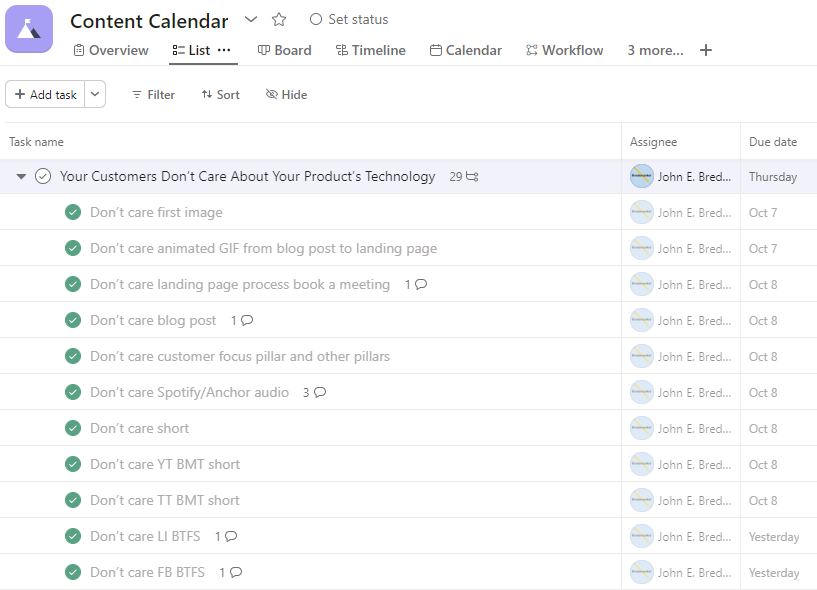
As you will see, I continued to tweak the statement, but that’s the one that I put in my Asana “Content Calendar” project.
The Asana task that would eventually result in this blog post. Only the first subtasks are shown; as you will see, there are many more.
As I would subsequently reflect, I thought that companies knew that you need to focus on the customer rather than focusing on yourself, but I see too many companies that are self-focused in their marketing. They emphasize the amazing technology features of their product.
I want to put a stop to that, and if necessary I will help companies create customer-focused marketing materials. For a fee, of course.
But enough about me. Let’s illustrate how that one idea can expand into multiple content pieces.
31 pieces of content
So now I had to write about how customers don’t care about your product’s technology.
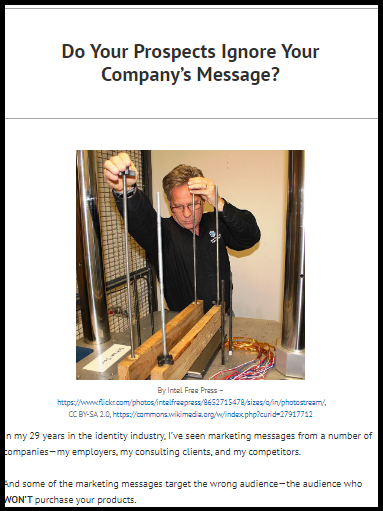
An image, sourced from Wikipedia, of a technologist doing technology things.
An image, designed by Freepik, of a customer ignoring someone prattling on about their technology.
The “customer focus” illustration that I have used frequently in the past.
An animated GIF that beckoned readers to the landing page, described below. The GIF includes the first two images listed above, plus a third from the landing page itself.
Most importantly, the post included all the text that made my original point (“Do you know why your prospects are ignoring you? Because they don’t care about you. It’s all about them.”), along with my argument for customer focus, and my concluding call to action to find out how to “Create Technology Content That Converts.”
Content 2: Landing page
And “Create Technology Content That Converts” was the title of my landing page. Often I put the call to action on the same page as the original point, but sometimes (as in this case) I separate the call to action for a more focused presentation. Plus I have the option of having multiple blog posts point to the same landing page. This post points to the landing page, for example (click the GIF above or one of the other links).
The landing page dug more deeply into why and how Bredemarket can help you create a customer-focused message, talking about the questions I ask, the types of content I can create, and the process.
Once all this was done, everything was set. People who read the blog post could (if so inclined) go to the landing page, and people who read the landing page could (if so inclined) contact me.
But only if they saw the blog post in the first place.
If they don’t find the post on Google or Bing, and if they’re not already subscribing to the blog, then how will they get to the blog post?
Content 3, 4, 5, 6, 7, and 8: Information pages
There are numerous themes that continuously pop up in the Bredemarket blog, and I have created “information pages” (pillars) that link to all of the content that I have written on these themes.
Now perhaps you won’t do all of this, but if there’s a place on your website where you should mention your new blog post, be sure and do it.
For example, if you wrote a blog post about Topic X in 2021, and you’re readdressing Topic X in a 2023 post, then go back and update the 2021 post to say that you have new thoughts on Topic X. Then the people who find your 2021 post can go to the new post and get the latest information.
Content 9: Audio podcast
My podcast is more accurately described as a mini-podcast, because each episode is usually only 1-2 minutes long. Perhaps someday I’ll create hour-long episodes, but not today.
And on Sunday I created a 2-minute episode with a new take. After noting (as I said above) that sometimes we know things that people don’t know, I declared:
I then described a really bad General Electric press release that focused on GE technology and not on customer needs.
Then I plugged the blog post, which was linked in the episode description. And I resued the “technologist doing technology thinks” image from the blog post.
Now I only list this as one piece of content, but really it’s multiple pieces of content. Not only can you access the episode on Spotify for Podcasters (formerly Anchor), but you can also access it on Spotify itself, Apple Podcasts, and numerous other podcast hosting services.
After this, I returned to the blog post itself and looked for other ways to share it.
Content 10, 11, 12, 13, 14, 15, 16, and 17: Bredemarket LinkedIn and Facebook pages, showcase pages, and groups
Because the blog post explicitly mentioned “technology” in the title, the best fit for a reshare of the blog post was on the Bredemarket Technology Firm Services LinkedIn showcase page (reshare here) and Facebook group (reshare here).
Why do I have a myriad of LinkedIn and Facebook outlets?
Because often people who are interested in technology don’t care about identity, and people who are interested in the Inland Empire don’t care about technology, and people who care about Bredemarket in general don’t care about every identity company reshare that I post.
And of course, some people who love LinkedIn hate Facebook, and some people who love Facebook hate LinkedIn.
So I could have just shared this to the technology outlets, but this particular post had a broader application. Inland Empire businesses, identity companies, and general marketers all have the problem of referring to self rather than the customer.
So I reshared the original technology shares to the other relevant groups.
You know how the Instagram experts say that you should post reels? Or you should post carousels? Or whatever?
I say that you should post a healthy balance of all sorts of things.
I wanted to reshare the blog post on Instagram, so I posted an Instagram carousel post using the two images from the blog post and the “money” image from the landing page.
Even though Instagram is a terrible platform to reshare content on other platforms, because the links aren’t clickable.
Unless you reshare the post as a story and use the “link” feature to embed a link.
Content 19 and 20: Bredemarket Threads and JEBredCal X
Oh, and there are two other places where I reshared the link to the blog post:
As a xeet or whatever tweets are called these days. (This is not an official Bredemarket X account, but my “professional” X account where I share Bredemarket stuff and other stuff.)
So that encompassed the first set of content reshares. But before I go on…
Content 21: LinkedIn reshare of podcast
All of the stuff listed above was stuff that I meticulously planned by listing subtasks to the original Asana task “Your Customers Don’t Care About Your Product’s Technology.”
But I forgot that I deviated from Asana and also shared a link to the podcast in the Bredemarket Technology Firm Services LinkedIn showcase page.
Some people are horrified that I deviated from Asana and didn’t record this important share. (And they’ll really be horrified later in this post when I create another piece of content and don’t log it in Asana.)
Others are horrified that I put all the other stuff in Asana in the first place.
As for me, well, I got the content out. Cool.
But the blog post wasn’t enough. I needed to convey the same message in a different way, for those who think words and stuff aren’t cool.
Content 22, 23, 24, and 25: The short
In the same way that I created an audio podcast that made the same points as the blog post (while linking to the blog post), I wanted to create a video vertical short that did the same thing.
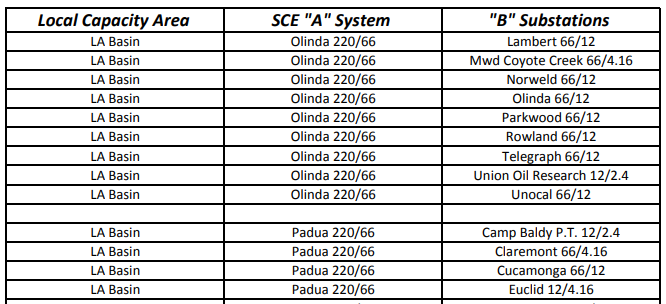
So I headed out to the Southern California Edison Euclid Substation.
I then stood in front of some very technological stuff, and filmed 27 seconds of me talking about the prospect’s problems…and your problem…and how Bredemarket can solve your problem.
By the time I was finished, the video short was available on:
So now both WordPress and Instagram had two pieces of content that kinda sorta said the same thing. But this is good. Maybe some people like the video version, while others like the text version. I’ll catch them one way or ther other.
But before I actually shot the video at the SCE Euclid Substation…
Content 26: Instagram Live/Reel
…I was scouting out locations. (If you know the Talking Heads song “Found a Job” you’ll recognize the phrase.)
When I arrived at the SCE Euclid Substation, I walked around the south and west sides of the substation, looking for the best place to shoot my video.
And I was broadcasting on Instagram Live as I was doing this, offering my adoring fans a rare “behind the scenes” look at Bredmarket activities. And, incidentally, proving that Bredemarket behind the scenes is pretty boring.
But the Instagram Live session was recorded, and was posted as a reel a couple of days before my video short was posted.
I don’t know if it made a huge difference in the subsequent reception of the short, but one of my relatives liked the “behind the scenes” look so that’s good.
So those 26 pieces of content addressed Bredemarket’s views on customer focus and benefits.
But my life is not confined to Bredemarket. Time for one huge repurpose.
Content 27: jebredcal blog post
At the same time that I’m asking Bredemarket prospects to contract with me, I’m asking technology companies (including identity companies) to hire me as a Senior Product Marketing Manager.
And the same message can, with some adaptation, be delivered to hiring companies.
If you compare the jebredcal blog post with the original Bredemarket blog post, you can see some clear similarities…with some noticeable differences. For example, I don’t ask employers to use Bredemarket’s calendly, email, or web messaging channels. I use my personal email and my LinkedIn profile messaging capability instead.
Now that the blog post was written, I was ready to share it on LinkedIn where the employers are. (No Facebook. No TikTok.)
Correction: I was ALMOST ready to share a link to the post on LinkedIn. I had to complete one thing first.
Content 28: Personal short
I decided that on the day before I shared the post on LinkedIn, I’d create a personal video short that introduced the content.
But this one, rather than taking place in front of a cool electrical facility, would be a behind-the-scenes view of Bredemarket’s world headquarters. Since the city of Ontario restricts you from viewing this yourself (restriction 3), this is the only way that you will ever see Bredemarket’s world headquarters.
Exciting?
No, completely boring.
But I did it anyway, and posted the video on LinkedIn yesterday. (And if you look to the left, you can see Bredemarket’s business license as required by restriction 1.)
Content 29: The LinkedIn share of the jebredcal post
Once I realized that I was going to write one blog post for Bredmarket prospects and one post for potential employers, I decided to write a third post that talked out how you create different content for different target audiences. As I noted above, the two pieces of content have significant similarities, but also significant differences.
But as I thought about it, I thought it would be more important to illustrate how you could take a single idea and repurpose it as 30 different pieces of content.
Well, 30 so far. I still have to figure out how and where to reshare THIS blog post…
Content 31: LinkedIn post about a job rejection
Stop the presses!
And here’s another EXCITING behind-the-scenes look at how Bredemarket works!
By Tuesday afternoon (October 10, 2023), I had substantially completed writing this blog post on “How I Expanded 1 Idea Into 30 Pieces of Content.” But since there was no huge rush to publish the post—after all, I had just published 29 other pieces of content over the past few days—I figured I’d take advantage of the opportunity to “sleep on it” and look at the post one more time before publication.
Then something happened early Wednesday morning.
Every day, potential employers tell thousands of job candidates that they are “moving in a different direction.” By Original: Jack Ver at Dutch Wikipedia Vector: Ponor – Own work based on: Plaatsvector.png by Jack Ver at Dutch Wikipedia, CC BY-SA 4.0, https://commons.wikimedia.org/w/index.php?curid=95477901
I received a “you have not been selected for this position” email from a potential employer. I had only applied for the position two days earlier, on Monday, right in the midst of all of this content creation.
If you are one of the lucky talent acquisition professionals who is still employed, there is ONE CRITICAL THING that you MUST impress upon your employers.
Please tell your employers NOT to list positions as “remote/hybrid.”
That’s kind of like listing a food as “vegan/beef.” Is it vegan, or is it beef? It’s a mystery until you take a bite, and there’s a 50% chance you will be disappointed or horrified with what you find.
You may ask what a LinkedIn post about “remote/hybrid” job listings has to do with incorrectly-focused product marketing messaging.
It’s all in the call to action. Those who read to the end of the post encountered these words.
Anyway, if you’ve read this far and are seeking an experienced identity/biometrics/technology Senior Product Marketing Manager for a #remote position (or a position within 25 miles of Ontario, California), please message me. The linked post below includes my contact information, as well as my philosophy on product marketing messaging.
If you listen closely, you can hear about all sorts of wonderful biometric identifiers. They range from the common (such as fingerprint ridges and detail) to the esoteric (my favorite was the 2013 story about Japanese car seats that captured butt prints).
Forget about fingerprints and faces and irises and DNA and gait recognition and butt prints. Tongue prints are the answer!
Benefits of tongue print biometrics
To its credit, the article does point out two benefits of using tongue prints as a biometric identifier.
Consent and privacy. Unlike fingerprints and irises (and faces) which are always exposed and can conceivably be captured without the person’s knowledge, the subject has to provide consent before a tongue image is captured. For the most part, tongues are privacy-perfect.
Liveness. The article claims that “sticking out one’s tongue is an undeniable ‘proof of life.'” Perhaps that’s an exaggeration, but it is admittedly much harder to fake a tongue than it is to fake a finger or a face.
Are tongues unique?
But the article also makes these claims.
Two main attributes are measured for a tongue print. First is the tongue shape, as the shape of the tongue is unique to everyone.
The other notable feature is the texture of the tongue. Tongues consist of a number of ridges, wrinkles, seams and marks that are unique to every individual.
There is serious doubt (if not outright denial) that everyone has a unique face (although NIST is investigating this via the FRTE Twins Demonstration).
But at least these modalities are under study. Has anyone conducted a rigorous study to prove or disprove the uniqueness of tongues? By “rigorous,” I mean a study that has evaluated millions of tongues in the same way that NIST has evaluated millions of fingerprints, faces, and irises?
I did find this 2017 tongue identification pilot study but it only included a whopping 20 participants. And the study authors (who are always seeking funding anyway) admitted that “large-scale studies are required to validate the results.”
Conclusion
So if a police officer tells you to stick out your tongue for identification purposes, think twice.
Technologists, you know how tough it is to create a technology product.
You have to assemble the technology, or perhaps create the technology yourself.
You have to work on the most minute details and make sure that everything is just right.
It takes a great deal of effort.
What if your product story is ignored?
But when you want to tell the story about your product, and all the effort you put into it, your prospects ignore everything you say. You might as well not be there.
Because they don’t care about you. It’s all about them.
People want to satisfy their own needs
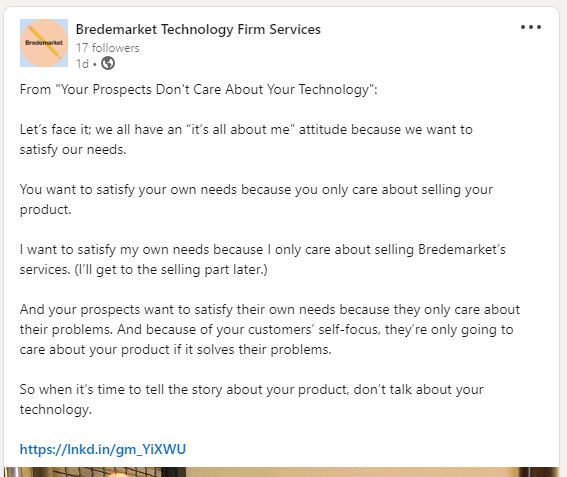
But the “it’s all about me” attitude is actually a GOOD thing, if you can harness it in your messaging. Let’s face it; we all have an “it’s all about me” attitude because we want to satisfy our needs.
You want to satisfy your own needs because you only care about selling your product.
I want to satisfy my own needs because I only care about selling Bredemarket’s services. (I’ll get to the selling part later.)
And your prospects want to satisfy their own needs because they only care about their problems. And because of your customers’ self-focus, they’re only going to care about your product if it solves their problems.
So when it’s time to tell the story about your product, don’t talk about your technology.
If you ask any one of us in the identity verification industry, we’ll tell you how identity verification proves that you know who is accessing your service.
During the identity verification/onboarding step, one common technique is to capture the live face of the person who is being onboarded, then compare that to the face captured from the person’s government identity document. As long as you have assurance that (a) the face is live and not a photo, and (b) the identity document has not been tampered, you positively know who you are onboarding.
The authentication step usually captures a live face and compares it to the face that was captured during onboarding, thus positively showing that the right person is accessing the previously onboarded account.
Sound like the perfect solution, especially in industries that rely on age verification to ensure that people are old enough to access the service.
Therefore, if you are employing robust identity verification and authentication that includes age verification, this should never happen.
Eduardo Montanari, who manages delivery logistics at a burger shop north of São Paulo, has noticed a pattern: Every time an order pickup is assigned to a female driver, there’s a good chance the worker is a minor.
On YouTube, a tutorial — one of many — explains “how to deliver as a minor.” It has over 31,000 views. “You have to create an account in the name of a person who’s the right age. I created mine in my mom’s name,” says a boy, who identifies himself as a minor in the video.
Once a cooperative parent or older sibling agrees to help, the account is created in the older person’s name, the older person’s face and identity document is used to create the account, and everything is valid.
Outsmarting authentication
Yes, but what about authentication?
That’s why it’s helpful to use a family member, or someone who lives in the minor’s home.
Let’s say little Maria is at home, during her homework, when her gig economy app rings with a delivery request. Now Maria was smart enough to have her older sister Irene or her mama Cecile perform the onboarding with the delivery app. If she’s at home, she can go to Irene or Cecile, have them perform the authentication, and then she’s off on her bike to make money.
(Alternatively, if the app does not support liveness detection, Maria can just hold a picture of Irene or Cecile up to the camera and authenticate.)
The onboarding process was completed by the account holder.
The authentication was completed by the account holder.
But the account holder isn’t the one that’s actually using the service. Once authentication is complete, anyone can access the service.
So how do you stop underage gig economy use?
According to Rest of World, one possible solution is to tattle on underage delivery people. If you see something, say something.
But what’s the incentive for a restaurant owner or delivery recipient to report that their deliveries are being performed by a kid?
“The feeling we have is that, at least this poor boy is working. I know this is horrible, but here in Brazil we end up seeing it as an opportunity … It’s ridiculous,” (psychologist Regiane Couto) said.
A much better solution is to replace one-time authetication with continuous authentication, or at least be smarter in authentication. For example, a gig delivery worker could be required to authenticate at multiple points in the process:
When the worker receives the delivery request.
When the worker arrives at the restaurant.
When the worker makes the delivery.
It’s too difficult to drag big sister Irene or mama Cecile to ALL of these points.
As an added bonus, these authetications provide timestamps of critical points in the delivery process, which the delivery company and/or restaurant can use for their analytics.
Problem solved.
Except that little Maria doesn’t have any excuse and has to complete her homework.
At the highest level, debates regarding government and enterprise use of biometric technology boil down to a debate about whether to keep people safe, or whether to preserve individual privacy.
In the state of Montana, school safety is winning over school privacy—for now.
The state Legislature earlier this year passed a law barring state and local governments from continuous use of facial recognition technology, typically in the form of cameras capable of reading and collecting a person’s biometric data, like the identifiable features of their face and body. A bipartisan group of legislators went toe-to-toe with software companies and law enforcement in getting Senate Bill 397 over the finish line, contending public safety concerns raised by the technology’s supporters don’t overcome individual privacy rights.
School districts, however, were specifically carved out of the definition of state and local governments to which the facial recognition technology law applies.
At a minimum Montana school districts seek to abide by two existing Federal laws when installating facial recognition and video surveillance systems.
Without many state-level privacy protection laws in place, school policies typically lean on the Children’s Online Privacy Protection Act (COPPA), a federal law requiring parental consent in order for websites to collect data on their children, or the Family Educational Rights and Privacy Act (FERPA), which protects the privacy of student education records.
If a vendor doesn’t agree to abide by these laws, then the Montana School Board Association recommends that the school district not do business with the vendor.
The Family Educational Rights and Privacy Act was passed by the US federal government to protect the privacy of students’ educational records. This law requires public schools and school districts to give families control over any personally identifiable information about the student.
(The Sun River Valley School District’s) use of the technology is more focused on keeping people who shouldn’t be on school property away, he said, such as a parent who lost custody of their child.
(Simms) High School Principal Luke McKinley said it’s been more frequent to use the facial recognition technology during extra-curricular activities, when football fans get too rowdy for a high school sports event.
Technology (in this case from Verkada) helps the Sun River School District, especially in its rural setting. Back in 2022, it took law enforcement an estimated 45 minutes to respond to school incidents. The hope is that the technology could identify those who engaged in illegal activity, or at least deter it.
What about other school districts?
When I created my educational identity page, I included the four key words “When permitted by law.” While Montana school districts are currently permitted to use facial recognition and video surveillance, other school districts need to check their local laws before implementing such a system, and also need to ensure that they comply with federal laws such as COPPA and FERPA.
I may be, um, biased in my view, but as long as the school district (or law enforcement agency, or apartment building owner, or whoever) complies with all applicable laws, and implements the technology with a primary purpose of protecting people rather than spying on them, facial recognition is a far superior tool to protect people than manual recognition methods that rely on all-too-fallible human beings.
At least in the United States, the mobile driver’s license world is fragmented.
Because driver’s license issuance in the U.S. is a state and not a federal responsibility, each state has to develop its own mobile driver’s license implementation. Subject to federal and international standards, of course.
To date there have been two parties helping the states with this:
mDL vendors such as Envoc and IDEMIA, who work with the states to create mDLs.
Operating system vendors such as Apple and Google, who work with the states to incorporate mDLs in smartphone wallets.
But because the Android ecosystem is more fragmented than the iOS ecosystem, we now have a third party that is involved in mDLs. In addition to mDL vendors and operating system vendors, we also have really large smartphone providers.
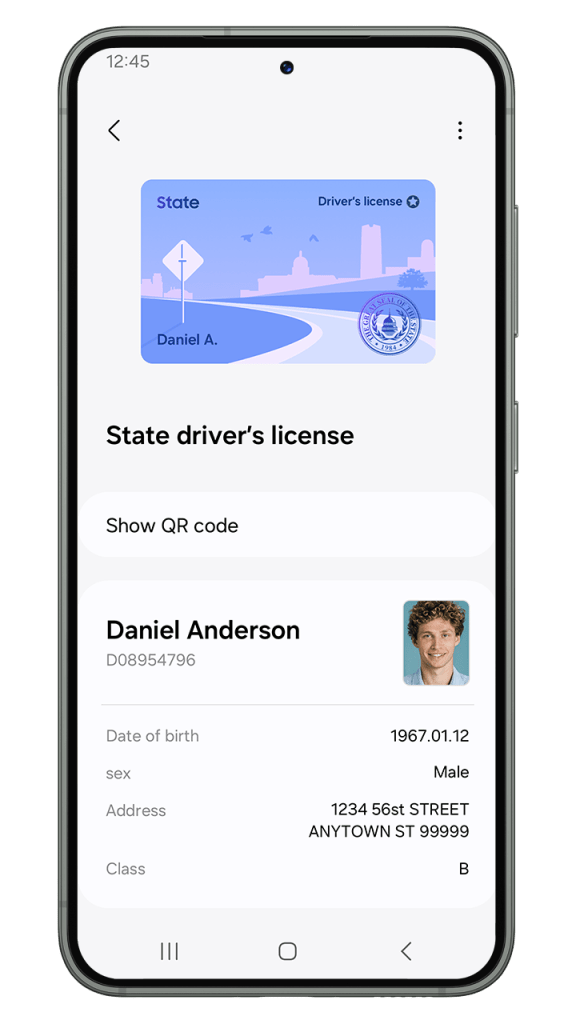
Samsung Electronics America today announced it is bringing mobile driver’s licenses and state IDs to Samsung Wallet. Arizona and Iowa will be the first states to offer a mobile version of its driver’s license to their residents. The update expands the Samsung Wallet experience by adding a convenient and secure way to use state-issued IDs and driver’s licenses
In this particular case Samsung is working with IDEMIA (the mDL provider for Arizona and Iowa), but Samsung announced that it is working with other states and with the Transportation Security Administration (TSA).
On a personal note, I’m still working on validating my driver’s license for California’s pilot mDL program. It probably didn’t help that I renewed my physical driver’s license right in the middle of the mDL validation process.
















 Bredemarket