Don’t count your chickens, but don’t forget them either

Six eggs.
Don’t count your chickens before they’re hatched. By TudorTulok – Own work, CC BY-SA 4.0, https://commons.wikimedia.org/w/index.php?curid=91343399

A business owner needs to prepare Plan A and Plan B, and usually several other plans besides.

  • What if one part of the business takes off beyond the business owner’s wildest expectations? (“Bredemarket will NEVER have to hire any employees…what, HOW many documents?”)
  • What if that part of the business instead becomes an abandoned haven for crickets?
Seemingly empty paddy field.
By Thamizhpparithi Maari – Own work, CC BY-SA 4.0, https://commons.wikimedia.org/w/index.php?curid=50847636

It’s important that the business remain as flexible as possible to prepare for possible eventualities, or at least the most likely ones. Don’t worry about the unlikely scenarios – for example, I never have to plan for a scenario in which Will Smith slaps someone and cusses the person out on live TV…wait, what’s that?

Planning…and writing

At Bredemarket, I’ve had business spring out of nowhere quickly, and I’ve had business not spring out of nowhere quickly.

  • In one case the time from initial contact to completed work and invoice was less than a day.
  • In other cases it took a little longer; it took me nearly eleven months to land a particular contract.
  • In other cases…I’m still waiting.

But that was the past, and now I face the future. I’ve been thinking about this a lot, especially as I explore various ways to reach my goals for 2022 (including the super-secret unpublished third goal). And I’m wondering how various events could affect these goals…and how the events can affect other events.

  • If event X occurs, how does this affect goal 1 and 3?
  • If event Y occurs, how does this affect goal 1 and 3?
  • If event X and event Y occur, then what happens?

Because I’m a writer, I have to write, and I’ve already started thinking through some of the “what ifs” attached to some of these events, and writing some draft communications that deal with the various events, should they happen.

But I’m leaving them in draft mode.

Because maybe neither event X nor event Y will occur.

But I’ll be ready if event Z occurs two years from now.

Planning…and planning

So how do you plan for events that may or may not occur?

Like any project, you start by taking a step back and examining the potential event at a high level.

And you start questioning, with not only “so what?” questions, but also with repeated “why?” questions (five whys is popular, but it can be any number). If you’ve never seen the five whys in action, watch this video. (H/T Mark Paradies at TapRooT.)

From https://www.youtube.com/watch?v=wdm-23pdS-I

OK, maybe not that video.

But the important thing is to think about a potential event, what it means, and what ramifications emerge from that event if it occurs.
And then proceed accordingly…if the event happens.
The case FOR do not reply email addresses

I’m in the midst of a project. Not a project for Bredemarket clients, but a project for Bredemarket itself. I’m taking a brief break from the project to share some thoughts on “do not reply” email addresses.

Have you ever received an email and noticed that the sender’s email address includes some form of “do not reply”?

In effect, this means that the sender can transmit an email to you, but you cannot transmit an email back to the sender.

By Jacksoncolvett – Own work, CC BY-SA 3.0, https://commons.wikimedia.org/w/index.php?curid=21231033

Because these “do not reply” email addresses are used so often, I figured that there was a good reason to do so. There HAS to be, if so many companies are using them; right?

While searching for good reasons to use “do not reply” email addresses, I instead found a bunch of reasons why you SHOULDN’T use this type of address.

Example articles that explain why NOT to use a “do not reply” email address.

Reasons to use a “do not reply” email address

After modifying my search, however, I found a Zendesk article that listed both the pros and the cons of “do not reply” emails. So there MUST be pros. Finally, a justification for this practice!

Pro: Reduce your team’s workload

From https://www.zendesk.com/blog/reply-emails-pros-cons-best-practices/

That is…it.

After additional searching, I found a ClickZ article that attempted to find some justification for the practice.

To be honest, it’s hard to find a good reason to ever use no-reply emails. There are emails which brands can send which don’t necessarily need a reply, such as:

Transactional emails – emails confirming a purchase, or sending invoice details.

Newsletters. No need to reply, just read the articles.

Marketing emails. Brands obviously want a response here, but not by replying to the email.

The problem with no reply is that, even when no response is needed, it doesn’t look good.

From https://www.clickz.com/should-brands-ever-use-do-not-reply-email-addresses/101887/

And even in the first two instances, I’m sure that ClickZ would agree that while these don’t necessarily need a reply, it would be nice to allow a reply.

  • Maybe after reading that transactional email, someone wants to add to the initial purchase. (You want to receive that reply.)
  • Maybe someone is so excited about a newsletter article that the person wants to respond. (You want to receive that reply.)

So smart people never use “do not reply” email addresses.

Unless they do.

When you use a “do not reply” email address and don’t know it

I recently signed up for a newsletter. I know that this person who writes the newsletter would be happy to engage with her subscribers.

But her newsletter provider doesn’t know this.

When I signed up for the newsletter, the acknowledgement of my subscription came from a “do not reply” email address.

Now I didn’t attribute this faux pas to the person. She may not even know that her tool is so marketing-unfriendly. And there isn’t much she can do about it, other than switch to another subscription tool.

But what am I doing?

But that got me thinking: do my own online properties similarly alienate people?

  • If someone goes to the bottom of this post and subscribes to this blog via email, does WordPress send out a “do not reply” email address?
  • If someone subscribes to the separate Bredemarket mailing list, does Mailchimp send out a “do not reply” email address?

There was only one way to find out: subscribe to these services myself, using one of my alternate email addresses.

Testing WordPress

Test number one was to use email to subscribe to the Bredemarket blog. Most of my subscribers read my posts in the WordPress site or app itself, but there is an email subscription option that a few people use.

Using one of my alternate email addresses, I subscribed to test the process and see if I’m sending out messages with “do not reply” email addresses.

Back at my Bredemarket email address, I received notification of my new subscriber.

Back at the alternate email address, I waited for the promised email with “details of (my) subscription and an unsubscribe link.”

And waited.

And checked my spam folder.

And waited more.

And decided to conduct another test instead. Now that I was subscribed to the Bredemarket blog via email, I composed a test post to see what happened when email subscribers to the Bredemarket blog received test posts.

Now I received an email. While it didn’t provide details of my subscription, it did include an unsubscribe link.

And, most importantly, the email didn’t come from a “do not reply” address, but from the address “comment-reply@wordpress.com.”

Hmm…

So if I reply to this email, will the reply become a comment in the test post?

Actually it did become a comment, once I (putting my Bredemarket hat on again) approved the comment. Scroll to the bottom of the test post to see the comment.

Summary: while I ran into an issue with the subscription confirmation, emails generated by the WordPress email subscription itself do NOT come from a “do not reply” email address. And if you reply to the email, you can post a comment. Very functional two-way communication.

Good. Now for test number two, let’s check Mailchimp.

Testing Mailchimp

This will be a bit harder, because the “empoprises” email address already subscribes to Mailchimp. (I wanted to test out various email formats.) Luckily, I have more than two email addresses.

So I navigated through the Bredemarket website to the Mailchimp subscription page (still need to figure out how to embed that), and subscribed.

I’ve configured my Mailchimp to require a subscription confirmation, and here’s the subscription confirmation I received at my alternate alternate email address.

So if I reply to this message, the reply goes to the Bredemarket email address, not to a “do not reply” black hole.

Summary: emails generated by Mailchimp’s subscription function allow recipients to reply to…me.

One drawback of NOT using a “do not reply” email message

It turns out there’s only one teeny tiny problem with Mailchimp’s implementation, in which all emails appear to come from me.

After my alternate alternate email successfully confirmed a subscription to the Bredemarket mailing list, Mailchimp sent a message from the Bredemarket email address to the Bredemarket email address.

When I received it, there was a big yellow caution.

Be careful with this message

This may be a spoofed message. The message claims to have been sent from your account, but Bredemarket Mail couldn’t verify the actual source. Avoid clicking links or replying with sensitive information, unless you are sure you actually sent this message. (No need to reset your password, the real sender does not actually have access to your account!)

Well, it looked safe to me.

Conclusion

Now I may have forgotten some service somewhere that generates emails on Bredemarket’s behalf, but as far as I know at the moment, none of the Bredemarket properties is guilty of sending out emails with a “do not reply” email address.

Now if we could just eliminate these fake “addresses” on a universal basis. Maybe the EU or California or Illinois can ban them.

When should you target a competitor?

Companies must choose how their marketing will address their competitors. Some choose to ignore the competition, while others publicly target them. And some companies do both simultaneously.

Trellix et al: targeting competitors

Trellix, the company that emerged from the combination of McAfee Enterprise and FireEye, chose the to target its competitors. Trellix’s website contains two pages that target two specific competitors.

  • Trellix vs. CrowdStrike claims that Trellix delivers “earlier, better protection across all phases of the attack chain.” It follows this with a comparison chart that claims security lags.
  • Trellix vs. SentinelOne makes the same claim, but with a different comparison chart that claims a lack of expertise.

For its part, CrowdStrike offers comparisons against both SentinelOne and “McAfee,” while SentinelOne offers comparisons against both CrowdStrike and “McAfee.” Apparently these firms need to update their pages to reflect the new company name (and possibly new features) of Trellix.

Obviously the endpoint protection industry demands these types of comparisons to sway buyers to choose one product over another.

Apple: targeting industry leaders (and ignoring other competitors)

But competitor targeting is also used by upcoming firms to displace established ones. I’ve previously talked about (then) Apple Computer’s famous “Welcome, IBM. Seriously” ad “welcoming” IBM to the personal computer industry. This was part of Steve Jobs’ multi-year effort to grow Apple by targeting and displacing IBM. But while IBM was the clear target, Apple also targeted everyone else, as Bill Murphy, Jr. noted:

Added benefit: There were actually other personal computer companies that were just as successful as Apple at the time, like Commodore, Tandy, and Osborne. The Apple ad ignored them.

From https://www.inc.com/bill-murphy-jr/37-years-ago-steve-jobs-ran-apples-most-amazing-ad-heres-story-its-almost-been-forgotten.html

By framing the circa 1981 computer industry as a battle between the Apple and IBM, Jobs captured the world’s attention. Not only by positioning Apple as David in a battle against Goliath, but by positioning Apple as one of only two companies that mattered. This marketing would reach its peak three years later, in 1984.

From https://www.youtube.com/watch?v=R706isyDrqI

When the targeter becomes the target

After 1984, the computer world changed dramatically (as it always does), with other companies creating what were then called “clones,” as well as the massive changes at both IBM and “Apple Computer” (now Apple).

Eventually, small spunky outfits challenged Apple itself, with Fortnite in particular targeting Apple’s requirement that Fortnite exclusively use Apple payments.

From https://www.youtube.com/watch?v=fHLuKumkASg

So when should you target competitors?

The decision on whether or not to publicly acknowledge and target competitors varies depending upon a company’s culture and its market position.

  • As seen above, some markets such as the endpoint protection market demand competitor comparisons. Others (Apple 1981-1984, Fortnite 2020) target competitors to buttress their own positions. And don’t forget how Avis targeted Hertz in 1962, and Hertz subsequently responded.
  • Then again, sometimes it’s best to not acknowledge the competition. Again note that Apple only acknowledged one competitor in the early 1980s, refusing to acknowledge that the other competitors even existed.
  • In some cases, companies don’t acknowledge the competition because they don’t believe they measure up to the competition on benefits, features, or even price. For these companies, their challenge is to identify some advantage over the competition and promote that advantage, even if the relevant competitors are not explicitly mentioned.

In marketing, move quickly

I need to step up my act regarding marketing, both for Bredemarket and my clients. In both cases, it’s critical that the word gets out quickly to potential clients.

For example, I drafted this post on Monday, but am not getting around to posting it until Wednesday. That’s two days of views lost right there!

By Malene Thyssen – Own work, CC BY-SA 3.0, https://commons.wikimedia.org/w/index.php?curid=10119596

I’m not the only one who needs to generate marketing material quickly.

The marketing goal, December 2021

I ran across a local company (which I will not name) that issued a press release in December 2021. In part, the press release mentioned the local company’s new dedication to the marketing function. The press release, in part, stated the following:

The Company has hired an international marketing firm…to support the Company’s efforts to increase revenue growth and brand recognition in the coming year.  The firm focuses on working with companies to develop comprehensive marketing strategies that identify competitive delineation, drive-focused campaigns, and develop sales leads designed to materialize revenue.  We expect their work to incorporate a website redesign, brand refresh, new strategic messaging and content, as well as focused video and digital campaigns that target markets such as [REDACTED].  We believe that a natural result of a formal marketing program, with a regular cadence of activity, will translate into market recognition of [REDACTED] as a highly-competitive brand that stands apart from the competition.

This sounds like an intelligent plan, or probably set of plans, that will address the firm’s strategic messaging, content, branding, and website, and a regular cadence of activity will keep the company visible. I certainly can’t argue with that.

The marketing results, March 2022

Well, now we’re three months into the implementation of this comprehensive marketing strategy. As an outsider posing as a potential customer for the firm’s products and services, what can I observe?

  • The website has a full slew of data sheets on the company’s products, and I found a 2017 brochure that effectively served as a white paper. But that’s it; no other white papers, and no case studies describing happy customers’ experiences.
  • The company’s YouTube channel has two videos from 2021.
  • The company’s Facebook page hasn’t posted anything since 2017.
  • Neither of the company’s LinkedIn pages (yes, the company has two LinkedIn pages) has any posts.

In short, as far as outside customers are concerned, the firm has not improved its marketing at all.

What happened? Did the international marketing firm concentrate on creating a stellar plan for the company’s content? If so, when will the content be available? Mid 2022? Late 2022? 2023?

Don’t go jumping waterfalls

When I was a product manager twenty years ago, my company used a “waterfall” product development method in which the marketing requirements document, engineering requirements document, design documents, test documents, and other documents were developed sequentially. While some companies still use the waterfall method today, others don’t because it takes so long to do anything.

These days, product developers are moving to agile methods to release products. And marketers are moving to agile methods also.

Agile marketing

Back in 2016, David Edelman, Jason Heller, and Steven Spittaels of McKinsey explained why marketing needs to be agile.

An international bank recently decided it wanted to see how customers would respond to a new email offer. They pulled together a mailing list, cleaned it up, iterated on copy and design, and checked with legal several times to get the needed approvals. Eight weeks later, they were ready to go.

In a world where people decide whether to abandon a web page after three seconds and Quicken Loans gives an answer to online mortgage applicants in less than ten minutes, eight weeks for an email test pushes a company to the boundaries of irrelevance.

From https://www.mckinsey.com/business-functions/marketing-and-sales/our-insights/agile-marketing-a-step-by-step-guide

The McKinsey authors then described how an agile marketing team organizes itself, sets goals, tests, and iterates.

The scrum master leads review sessions to go over test findings and decide how to scale the tests that yield promising results, adapt to feedback, and kill off those that aren’t working—all within a compressed timeframe.

From https://www.mckinsey.com/business-functions/marketing-and-sales/our-insights/agile-marketing-a-step-by-step-guide

While agile processes something result in things being wrong, the same agile processes can quickly correct the problem.

Back to the past

And waterfall methods can result in things being wrong also, especially when it takes so long to develop something that the initial assumptions have radically changed.

By en:user:Grenex – Wikipedia en, CC BY-SA 3.0, https://commons.wikimedia.org/w/index.php?curid=2500249

It took John DeLorean eight years to change his car concept into something coming off the production line. By that time, the automotive environment had changed.

Despite promising early sales the queue of willing buyers had dried up by the end of year – the chill wind of recession had struck the US automotive sector, and stockpiles of unsold cars started to mount up, both in Dunmurry and dockside in the USA. The worst winter in 50 years also played its part.

From https://www.aronline.co.uk/cars/de-lorean/dmc-12/the-cars-delorean-dmc-12/

This didn’t help DeLorean’s constant financing issues, and after DeLorean was caught (or entrapped by the FBI) in a $24 million cocaine deal, the DeLorean automobile was relegated to a movie prop.

If Agile processes had existed at the time, could they have reduced the 8-year gap from concept to the assembly line? Perhaps.

Conclusion

And if you can speed up production of a car, you can speed up production of marketing content and start putting your messaging on your Facebook, LinkedIn, and YouTube accounts, as well as your website immediately so that your customers can get your message.

Don’t wait two days, or eight years, for things to be just right.

Three Redlands “Shacks” Restaurants Tell a Story. What’s Your Story?

Fielding Buck of the Southern California News Group (including my local Inland Valley Daily Bulletin) recently told a story about the opening of a restaurant in Redlands called Pizza Shack.

Google Street View, 1711 West Lugonia, Redlands, California. Image captured February 2022. Fair use.

Sounds like a nice place for pizza, but Buck’s story didn’t end there.

Pizza Shack, at 1711 W. Lugonia, Suite 104, has the same owners as Taco Shack and Breakfast Shack in other parts of town.

From Redlands gets a third Shack: Pizza Shack on Lugonia – San Bernardino Sun (sbsun.com). Repurposed at other SCNG websites.

I couldn’t confirm the common ownership myself, so I’ll take Fielding Buck’s word for it. After all, he’s a professional with a quarter century of journalism experience (check his biography, which lists his 1995 award from his time at the Desert Sun), so I’m sure he got his facts straight. And you know that I like people with a quarter century of experience.

As Buck noted, the other two “Shack” restaurants are also in Redlands.

  • Taco Shack is at 510 East State Street.
  • Breakfast Shack (couldn’t find a website, but I found an Instagram page) is at 615 West State Street.

The three “shacks” are all within three miles of each other, which means that you could start the day at Breakfast Shack, go to Taco Shack for lunch, and then walk the breakfast and tacos off before enjoying a Pizza Shack dinner.

From west to east: Pizza Shack, Breakfast Shack, and Taco Shack. Via Google Maps.

I had nothing to do with Fielding Buck’s story, or with the three “shacks” in Redlands, but this story caught my eye.

Does your Inland Empire business have a story to tell?

Perhaps you don’t own a restaurant, but you may be in another type of business that has a story that you want to share.

  • Perhaps it’s a shorter story of around 400 to 600 words.
  • Or maybe it’s a medium length story of 2800 to 3200 words.
  • Something that you could share in a blog post, a social media Facebook or LinkedIn post, or in a downloadable form on your website.
  • Something that speaks to your potential customers’ needs, and clearly communicates the benefits that your business’ product or service provides to your potential customers.

Bredemarket’s content creation process ensures that the final written content (a) advances your GOAL, (b) communicates your BENEFITS, and (c) speaks to your TARGET AUDIENCE. It is both iterative and collaborative. For the full process, read this.

Bredemarket can help your Inland Empire business tell that story. Even if you’re west of Redlands and don’t serve food.

(Psst: local readers should scroll to the end of this page for a special “locals only” discount.)

If you would like Bredemarket to help your business tell your story…

Inland Empire B2B Content Services from Bredemarket.

Remember the newer factors of authentication

Sometimes our mental horizons are limited, and we fail to notice things just outside of our sphere of vision. And when we ignore these things, we may receive nasty surprises.

The first step in competitive analysis is to identify your competitors. Some companies utterly fail at this by declaring, “We have no competitors.” (Voiceover: “You do.”) But even those companies that successfully identify their competitors do not always identify ALL of them.

By Users Omnibus, Uris on en.wikipedia – Uris took this photograph. Originally from en.wikipedia; description page is (was) here22:21, 31 January 2006 Omnibus 1001×745 (223,243 bytes) (Better crop.)02:40, 6 July 2005 Uris 1912×1920 (773,657 bytes) (en:Kodak color reproduction.)03:28, 4 July 2005 Uris 1912×1920 (671,537 bytes) (The famous yellow en:taxicabs of en:New York City. Photograph taken July 3, 2005. {{PD-user|Uris}}), BSD, https://commons.wikimedia.org/w/index.php?curid=965121

For example, if you owned a taxicab company circa 2008, you might count other taxicab companies and buses as competitors, but you might not include the possibility of a competitor raising over $25 billion to create an infrastructure that allowed people to use their own cars to pick up people who needed rides. Of course, Uber and other companies did just that, while at the same time dodging taxicab industry regulations that mandated purchase of medallions. The rideshare companies weren’t always successful at dodging these regulations, but sometimes they were. As a result, by 2015 the taxicab industry was dying.

This is just one of many examples of competitors that seemingly arise out of nowhere and decimate existing businesses.

One biometric modality for authentication

When considering authentication of individuals, we sometimes fail to, um, identify ALL the ways in which individuals can be identified.

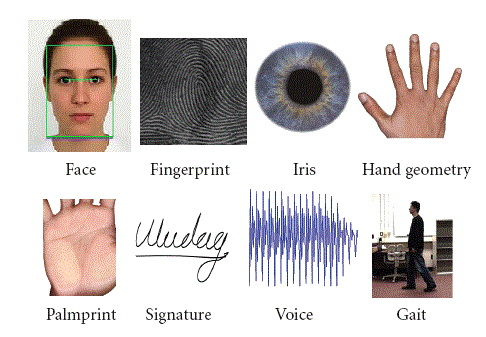
When I entered the biometric industry in the mid-1990s, people were individually identified by something they had (such as a credit card), something they knew (such as a personal identification number or PIN associated with the credit card), and with a rudimentary form of something they were (a signature that matched the signature on the back of the credit card).

My employer and two other companies thought that we had a better solution than the rudimentary signature verification check—fingerprints. All three companies proposed solutions in which welfare benefit recipients would use fingerprints to authenticate themselves as the persons entitled to the welfare benefits. (Another ramification: the fingerprints could also be used to confirm that people weren’t receiving benefits under multiple names.) But in those pre-iPhone days signatures were associated with law enforcement, and benefit recipients feared that the benefit agencies would forward their fingerprints to the cops, and the use of fingerprints by welfare benefits agencies decreased.

But many people still felt that fingerprints could be used to identify individuals, and therefore people began to look at the fingerprint industry and identify competitors in that industry. Around 2000, those competitors included Cogent, Morpho, NEC, Printrak, livescan companies such as Digital Biometrics and Identix, and a few others.

But fingerprints aren’t the only biometric modality, and there were other competitors outside of the fingerprint companies.

Multiple biometric modalities for authentication

By the early 2000s, other biometric modalities matured enough to be used for authentication purposes. Faces were tested for identification of people at Super Bowl XXXV. Irises began to be used for authentication at airports in Amsterdam (and elsewhere) in 2001, although they were cumbersome to capture. Individuals could eventually be identified via their voices.

All of these different biometric modalities got people excited. Some people, um, “advanced” the notion that biometrics (something you are) was THE way to identify people, and that passwords were of necessity going to die. Bill Gates predicted the death of the password in 2004, but he wasn’t (and isn’t) the only one to assert this view. Some assert that biometrics are clearly better than passwords. Opponents, however, objected to a reliance on only biometrics because of the ability to spoof biometrics, and because of perceived and actual racial disparities. (See my comments on faulty conclusions, and on the racist methods that people use when they DON’T use computerized facial recognition.)

Multiple factors of authentication

The solution, as many people recognized, was to use multiple factors of authentication, not just “something you are” (biometrics).

Why multiple factors? Because if you use multiple methods to identify an individual, the ability to fraudulently impersonate an individual decreases rapidly.

Even if someone spoofed your fingerprint or face, it would be much harder for them to spoof your fingerprint/face and your driver’s license, or your fingerprint/face and your driver’s license and your password.

The National Institute of Standards and Technology (NIST) has helpfully defined the term multi-factor authentication, or MFA, for standardized U.S. government use.

Authentication using two or more factors to achieve authentication. Factors include: (i) something you know (e.g. password/personal identification number (PIN)); (ii) something you have (e.g., cryptographic identification device, token); or (iii) something you are (e.g., biometric). See authenticator.
Source(s):
CNSSI 4009-2015 under multifactor authentication from NIST SP 800-53 Rev. 4

From https://csrc.nist.gov/glossary/term/Multi_Factor_Authentication

But are three factors of authentication enough?

Sometimes the government moves more slowly than the industry. This is one of those times.

While NIST only discusses the three factors of something you know, have, and are as factors of authentication, other sources identify two additional factors. I personally use a model which includes five authentication factors, in which the other two factors are “something you do” and “somewhere you are.”

Let me illustrate how the fifth authentication factor could have helped me out several years ago.

In mid-2009, roughly fifteen years after joining the biometric industry, I had just become an employee of the new company MorphoTrak, but had not yet shifted from product management to proposals. MorphoTrak still operated as two separate divisions, and an opportunity arose for me to demonstrate a product from the Printrak division to customers of the Morpho division.

Description of Motorola (later MorphoTrak) Metro ID system From Motorola brochure BIO-CRMBRO-1. Retrieved from ersdatasolutions.com.

So I, along with a Metro ID demonstration system, flew to Atlantic City, New Jersey to attend a trade show which would have many attendees from New Jersey, a Morpho customer. Theoretically, local New Jersey agencies could buy Metro ID and submit results from that system to the New Jersey MetaMorpho system.

By Dough4872 – Own work, Public Domain, https://commons.wikimedia.org/w/index.php?curid=24102903

I had just acquired a new credit card for business purposes, which I would use for the first time at the trade show.

When I first tried to use the card, it was declined.

Look at it from the credit card issuer’s perspective:

  • Someone had just received a credit card, which had never been used.
  • The first time that someone tried to use the credit card, it was used thousands of miles from the California location where the customer lived and worked.
  • Sure the transaction was for a low dollar amount (I think I was at a McDonald’s), but there’s always the danger that if that transaction were approved, the user would next walk a few blocks to a casino and withdraw thousands of dollars.
  • Because this seems suspicious, we’d better check it out before approving any transactions. Maybe the card was stolen.

So the credit card company had to verify that the use in Atlantic City was legitimate. To do so, they called my house in California.

Which ordinarily would be fine, but I was not at my house in California. I was in Atlantic City.

Eventually, everything worked out, but wouldn’t it be nice if the credit card company realized that not only did

  • the person using John Bredehoft’s credit card actually have possession of the card, and that
  • the person using John Bredehoft’s credit card knew the PIN associated with the card, but also that
  • John Bredehoft was physically in Atlantic City, New Jersey, where the card was being used?

Now you can see how “somewhere you are,” or geolocation, could be used as an identifier. Of course this would be very hard to authenticate in 1994, and wasn’t even a common authenticator in 2009, but clearly in 2022 everyone can figure out where you are.

Incognia and (not) zero factor authentication

Enter Incognia, a company that states that is offers an identification solution that uses what they call “zero factor authentication.” Tyler Choi of Biometric Update explains why Incognia’s solution is important:

Incognia points to an increase in revenue and activity across apps in financial services, crypto, social networks, and online gaming, which accentuates the need for fraud prevention.

From https://www.biometricupdate.com/202203/incognia-adds-location-fraud-detection-to-mobile-onboarding-and-authentication

While I have a problem with the “zero authentication factor” / “0FA” semantics Incognia uses (location IS an authentication factor, at least in my model), I can appreciate what the company does.

Incognia’s award-winning location identity technology is highly resistant to location spoofing and offers superior location precision for accurate fraud detection on mobile with very low false-positive rates. Incognia uses network, location, and device intelligence data to silently recognize trusted users based on their unique behavior patterns….

Incognia’s location technology uses data from not only GPS, but also WiFi, cellular and Bluetooth sensors, which makes it highly effective at detecting location spoofing, unlike fraud detection based on IP and GPS alone.

From https://www.incognia.com/location-behavioral-analytics?hsLang=en

Incognia asserts that the vast majority of transactions can be authenticated based on location alone. For example, if I perform a transaction when at my house, the chance is high that I am truly the person performing the transaction.

But what if I perform a transaction on the other side of the country, in a location that I have never visited before? Then Incognia uses additional factors of authentication to verify my identity.

For example, I could provide the password or a biometric identifier. The very fact that I possess a phone that was previously associated with me is another indicator that I may be who I say I am.

But we’re not really using geolocation yet

However, geolocation is not commonly used as an authentication factor, something that I subsequently discovered several years after my trip to Atlantic City.

By this time I had acquired another credit card for business purposes, and my credit card provider noticed some strange behavior. Not a single attempt to purchase food across the country at a restaurant in New Jersey, but multiple repeated purchases across the country at a store in Virginia.

The credit card provider got suspicious when the person made repeated small balance purchases at the same store, and froze the account until it could check with me to see if those purchases were legitimate. This time I was home in California and was able to confirm that the purchases were fraudulent.

Of course, the credit card provider could have detected this much more quickly if it knew that I was not in Virginia, but California.

So when you perform competitive analysis on authentication companies, don’t forget about competitors that use geolocation.

I want you to question my Frequently Asked Questions

During the lunch hour of Thursday, March 17, AmPac Business Capital hosted a webinar to help small businesses make the most of Google features. (Note: if you missed this one-hour session, there will be a four-week session offered in May.)

Today’s session was led by Israel Serna, a speaker and trainer for Grow with Google. Serna offered a number of tips to attendees, some of which I had already implemented, and some of which I had not.

One that I hadn’t implemented was to create a Frequently Asked Questions (FAQ) page for Bredemarket. However, Serna pointed out that both potential customers and Google itself search for FAQ pages as a quick way to answer questions. And others, such as StrategyBeam, agree with Serna on the importance of a FAQ page.

Before the AmPac Business Capital session, I had answers to questions on the Bredemarket website, but they were scattered all over the place. I decided that a FAQ page would offer a convenient one-stop shop for question answering.

So I created a FAQ page.

Image of the Bredemarket FAQ page as of March 17, 2022. https://bredemarket.com/faq/
From https://bredemarket.com/faq/ as of March 17, 2022.

Now when I created this page, I am absolutely certain that the FAQ page covers EVERY single question that a potential Bredemarket client would think to ask.

Picture of Ed McMahon
By photo by Alan Light, CC BY 2.0, https://commons.wikimedia.org/w/index.php?curid=3048124

Well, you know what Ed’s buddy Johnny would say to THAT assertion.

Picture of ohnny Carson
By Johnny_Carson_with_fan.jpg: Peter Martorano from Cleveland, Ohio, USAderivative work: TheCuriousGnome (talk) – Johnny_Carson_with_fan.jpg, CC BY 2.0, https://commons.wikimedia.org/w/index.php?curid=12750959

Seriously, I need YOUR help.

If you could take a look at the Bredemarket FAQ page at https://bredemarket.com/faq/, I would appreciate it.

Let me know if you like the answers to the questions that are asked.

Let me know if any questions are missing.

If anything is missing or needs to be improved, contact me. My contact information is in the FAQ. (Twice.)

Two POSSIBLE complications to a future Advent International sale of IDEMIA

(UPDATE: I have indicated portions of this post that include speculation from myself and others.)

When I wrote “About THAT Reuters article” (specifically, the February 4 article speculating about a possible sale of IDEMIA by Advent International to Thales Group), I noted that I have no expertise in predicting corporate acquisitions.

However, I’ve experienced three of them, including Motorola’s acquisition of Printrak in 2000, Safran’s acquisition of Motorola’s Biometric Business Unit in 2008-2009, and Advent International’s acquisition of Safran’s Morpho unit in 2016-2017 (and Advent’s merger of Oberthur and Morpho to form OT-Morpho, later IDEMIA).

None of these was a simple matter of the acquiring company and the acquired company approving the acquisition. It was more complicated than that.

From https://www.yourtango.com/201168184/facebook-relationship-status-what-does-its-complicated-mean

Motorola acquires Printrak

UPDATE 8/20/2025. I just had to disable browser notifications from two rogue sites. See bold paragraph below.

[UPDATE 8/20/2025: I have disabled the links below because the link now redirects to adware malware. Pity, because the original page was an excellent source of the negotiations between Printrak and Motorola.]

Even the most straightforward of the acquisitions that I experienced, the U.S. company Motorola’s acquisition of the U.S. company Printrak, required a number of government approvals.

Under the Hart-Scott-Rodino Antitrust Improvements Act of 1976, and the rules promulgated under the Hart-Scott-Rodino Act, Printrak, Acquisition Sub and Motorola cannot complete the Merger until they notify and furnish information regarding the acquisition of Printrak by Acquisition Sub to the Federal Trade Commission and the Antitrust Division of the U.S. Department of Justice and satisfy specified waiting period requirements. Printrak and Motorola (as the sole stockholder of Acquisition Sub) filed notification and report forms under the Hart-Scott-Rodino Act with the FTC and the Antitrust Division on September 26, 2000 and received early termination of the waiting period from the Federal Trade Commission effective October 11, 2000.

From [REDACTED]/Document/0000912057-00-045478/

And not just from the U.S. government.

In addition, Printrak and Motorola are required to furnish certain information and materials to the antitrust authorities of Argentina, Brazil, the Federal Republic of Germany, and Romania. Filings were made in Argentina on September 22, 2000, in Brazil on September 19, 2000 and in the Federal Republic of Germany on September 27, 2000. German antitrust authorities have one month after the parties file their application to review the transaction. During that one month period, they can either approve the transaction or initiate an examination of the transaction which could take an additional three months, during which time the parties cannot close the transaction. During this three month period, the antitrust authorities will either approve the transaction or prohibit it. Approval may be granted before the initial one month review or before the additional three month review period. If approved, the antitrust authorities can not later challenge the transaction under their merger law but could challenge the transaction under other provisions of their antitrust laws. Printrak and Motorola intend to make a post-closing filing in Romania as soon as practicable after the closing.

From [REDACTED]/Document/0000912057-00-045478/

Why did the Motorola acquisition of Printrak require all of those approvals? Because Printrak did business in these countries (and many others), and the governments of those particular countries wanted to exert control over who does business in their country. For example, Printrak was the automated fingerprint identification system (AFIS) supplier in Romania, and the government of Romania had a need to know what would happen if Motorola were to become the supplier of its AFIS. Would all of the fingerprints be replaced by batwings? Would the new owner require the Romanian employees to apply Six Sigma in their everyday lives? Would Romania have to use Iridium to communicate AFIS data?

Before Omnitrak, RAZR, and PEBL, there was Iridium. From https://www.logo.wine/logo/Iridium_Communications

Well, everyone in the U.S. and the other countries granted approval, and the Motorola acquisition of Printrak was eventually completed, although it took roughly three months to get all the approvals. I remember that we were at a trade show (IACP, I think) with Printrak signage, and received mid-show approval to string up Motorola banners after receiving final approval.

And that was the relatively EASY acquisition of the three that I experienced. The next one was harder.

Safran acquires part of Motorola

It became more complicated when Motorola, a U.S. supplier of export-controlled fingerprint identification software and hardware, sought to sell a portion of itself to Safran, a French company.

By the time that Safran announced its intent to acquire Motorola’s Biometric Business Unit, a new government entity entered the picture – the Committee for Foreign Investment in the United States (CFIUS).

CFIUS is an interagency committee authorized to review certain transactions involving foreign investment in the United States and certain real estate transactions by foreign persons, in order to determine the effect of such transactions on the national security of the United States.

From https://home.treasury.gov/policy-issues/international/the-committee-on-foreign-investment-in-the-united-states-cfius

Why did CFIUS get involved?

Because Motorola not only sold fingerprint identification technology, an export controlled technology, but also managed law enforcement data for a number of states and (on a limited basis) for the U.S. Federal Bureau of Investigation and other federal government agencies.

Never mind the fact that France has been a long-standing ally of the United States. Heck, Israel is an ally of the U.S., and we didn’t like it when Israel spied on us.

CFIUS had to make sure that foreign control of Motorola’s biometric assets wouldn’t cause issues. Would French intelligence personnel steal all of the personal identifiable information (PII) from the AFIS databases in Minnesota, North Carolina, and other states?

Safran acquires other things

Eventually CFIUS decided that there was no critical threat and allowed the Safran acquisition of Motorola’s Biometric Business Unit to go through.

After all, it wasn’t like Motorola managed the main FBI criminal database, or state driver’s license databases, or anything like that.

  • You see, the main FBI criminal database, then known as IAFIS, was already managed by Safran.
  • And the state driver’s license databases were managed by neither Safran nor Motorola. A separate company, L-1 Identity Solutions, managed the majority of those databases.

So Safran’s acquisition of Motorola’s biometric assets was approved by all necessary government entities, and everyone was happy.

But Safran wasn’t done with its acquisitions, and a few years later acquired L-1 Identity Systems also. So now U.S. driver’s license production would be under French control.

This time around, CFIUS insisted on mitigating the effects of “Foreign Ownership, Control or Influence” (FOCI). Specifically, L-1 Identity Solutions (renamed “MorphoTrust”) was placed under a proxy structure, in which MorphoTrust’s Board of Directors was entirely composed of U.S. citizens. In addition, a number of MorphoTrust employees who were not U.S. citizens were shifted away from MorphoTrust to other Safran companies (most notably MorphoTrak, the company that contained the former Motorola Biometric Business Unit and other stuff).

By the way, I wrote about this before, but it’s in a Bredemarket Premium article so most of you can’t read it. Consider this information a freebie.

Even though they were owned by the same company, and used some of the same hardware components, MorphoTrust and MorphoTrak were managed separately. MorphoTrust had to log its contacts with foreigners, including U.S. employees of the foreign-owned MorphoTrak. Any transactions between MorphoTrust and MorphoTrak had to be carefully monitored to ensure that “foreign” components didn’t sneak their way into MorphoTrust products. And (most notably) because we couldn’t really talk to each other, MorphoTrust and MorphoTrak actually competed against each other on several occasions, including instances in which both subsidiaries proposed fingerprint livescan stations to the same customers.

But we were one big happy fractured family, and CFIUS was satisfied.

Well, until the next acquisition took place.

Advent International (and Oberthur) acquires part of Safran

Remember how I said that I couldn’t really predict acquisitions? After Safran acquired Motorola’s Biometric Business Unit, I thought I was home free. Printrak was the odd man out in Motorola, since our part of Motorola (later becoming Motorola Solutions) specialized in the sale of lots and lots of police radios, while we in Printrak specialized in the sale of a few AFIS systems. Once we joined Safran, we became part of a huge division (Sagem Sécurité, later known as Morpho) that ONLY performed identity functions.

Little did I know that Safran, whose main business was in aerospace, would decide to jettison the entire Morpho division.

So now an American investment firm would buy a French company.

You can bet that this required a round of approvals on both sides of the Atlantic.

France and the European Union certainly had an interest. As I noted in a recent post about Alaska’s HB389 bill, Advent International was not the sole owner; Advent had to bring the French government-owned entity Bpifrance on as a minority owner. And the European Union had to grant antitrust approval.

But on the U.S. side, CFIUS got involved again because MorphoTrust was part of the acquisition. Never mind the fact that MorphoTrust was now majority American-owned; MorphoTrust’s corporate parent was headquartered in France, and Bpifrance owned part of MorphoTrust.

So what happened?

MorphoTrust was removed from FOCI control, sort of, and merged with MorphoTrak and some parts of Oberthur to form IDEMIA Identity & Security USA LLC.

IDEMIA created a new FOCI-mitigated entity, IDEMIA National Security Solutions.

And my job became really complicated, because I, a former MorphoTrak employee, reported to someone who was a former MorphoTrust employee. And even though the U.S. part of IDEMIA (excluding IDEMIA NSS) was no longer FOCI-mitigated, some leftovers from the old MorphoTrust days were still around.

By Loudon dodd – Own work, CC BY-SA 3.0, https://commons.wikimedia.org/w/index.php?curid=7404342

Initially there were still two separate computer networks, and I had to have access to both of them, which meant that I had to obtain a second computer from the Billerica, Massachusetts office to access the old MorphoTrust network. (Before obtaining that second computer, I had to undergo a security screening.)

Eventually the two separate networks went away…after I left IDEMIA. Actually, I’m not entirely certain that they COMPLETELY went away, but at least the email addresses were all standardized throughout the United States after I left. (Yes, I had two email addresses also.)

Two new complications when some future entity acquires IDEMIA

So what happens in the future? Reuters has speculated what may happen, and I am speculating also.

As I noted previously, Advent International acquires businesses, revamps them, and sells them (hopefully) at a profit.

So even if the Reuters article turns out to be factually incorrect, Advent is going to sell IDEMIA someday.

Based upon past acquisitions, I believe it is pretty likely that the French government is going to have some say in the sale. Reuters speculated that nothing will happen until after next month’s Presidential election in France. (See my LinkedIn post in Bredemarket Identity Firm Services about the French election.) The French President, whoever he or she may be when Advent finally tries to sell IDEMIA in 2022, 2023, or 2033, is going to exert control over who the final buyer will be. Perhaps the President may insist that IDEMIA be sold to a French company, or at least a European Union company.

And based upon past acquisitions, I believe it is pretty likely that the U.S. government is going to have some say in the sale. The U.S. President, whoever he or she may be when Advent tries to sell IDEMIA (again, whenever that may occur), is going to exert control over who the final buyer will be, because of the significant business that IDEMIA NSS and the rest of IDEMIA does with U.S. federal, state, and local government entities. Oh, and there’s also the matter of fingerprint identification export control.

But those are not the two complications that I’m talking about. There are two NEW complications.

Possible Complication Number One: IDEMIA has locations all over the world, including a location in Moscow.

As I write this post, a number of Western businesses are ceasing their business operations in Russia because of the war in Ukraine. This has caused issues with the Russian government.

As of Monday (March 14), at least 375 companies had announced some sort of pullback from Russia, according to a list maintained by the School of Management at Yale University. The list includes companies that have cut ties with Russia completely, as well as those that have suspended operations there while attempting to preserve the option to return.

According to multiple media reports, dozens of Western companies have been contacted by prosecutors in Russia with warnings that their assets, including production facilities, offices, and intellectual property, such as trademarks, may be seized by the government if they withdraw from the country.

From https://www.voanews.com/a/putin-threatens-to-privatize-western-companies-that-exit-russia-/6485253.html

Unless IDEMIA is acquired by a Russian company (which is extremely unlikely, given French and U.S. interests), anyone who acquires IDEMIA (or any company with Russian offices) has to consider how Russia will react. Will the Russian portion of the business be a total loss? Will Russian entities acquire IDEMIA intellectual property? (This would be ironic, considering some past allegations that have been made but not IMHO proven.)

But Russia isn’t the only potential complication of a sale of IDEMIA.

Possible Complication Number Two: IDEMIA also has locations in Beijing, Hong Kong, and Shenzen. And it’s possible that the Chinese government is going to have some interest in who IDEMIA’s future owner will be.

It is possible that China’s State Administration for Market Regulation (SAMR) might review any acquisition.

In early September of 2021, China’s competition authority, the State Administration for Market Regulation (“SAMR”) issued a report (“SAMR 2020 Report”) summarizing its Anti-Monopoly Law enforcement activities during the period covering the 13th Five-Year Plan (2016-2020).

From https://www.competitionpolicyinternational.com/a-reflection-on-chinas-merger-reviews-key-messages-from-the-latest-five-year-report-and-insights-from-economists/

Yes, Five-Year Plan. While China has private companies, the Communist Party still oversees things.

From 2016 to 2020, SAMR concluded 2,147 merger reviews and completed 179 antitrust investigations, imposing fines totaling RMB 2.79 billion (or USD 413 million).

From https://www.competitionpolicyinternational.com/a-reflection-on-chinas-merger-reviews-key-messages-from-the-latest-five-year-report-and-insights-from-economists/

While relations between the West and China are certainly better than current relations between the West and Russia, there is always an underlying tension in those relations. For example, if a Taiwanese company were to acquire IDEMIA, this could be considered a declaration of war.

And in the specific case of IDEMIA, the biometric algorithms from IDEMIA directly compete with biometric algorithms from China. The February 2022 printed version of the NIST FRVT 1:1 report indicates that dozens of tested facial recognition algorithms are of Chinese origin, including algorithms from Cloudwalk, Dahua, Fujitsu, Hikvision, Megvii, Sensetime, Tencent, Xforward, and a host of other companies and universities.

What if (again, I’m speculating) China decides to oppose an acquisition of IDEMIA unless it receives assurances that IDEMIA will not threaten the domestic Chinese biometric providers?

Conclusion

So whoever buys IDEMIA from Advent may have to pay attention to government regulators in the U.S., France, the European Union, and possibly Argentina, Brazil, China, Germany, Romania, and Russia.

International business is complicated.

How “Omni” is your Omnichannel?

One of Bredemarket’s clients is a consulting firm that advises other companies on the use of a particular enterprise content management system. Among other things, this consulting firm can help its client companies configure the outbound information the companies’ systems provide.

Which leads us to our word for today, omnichannel.

In marketing, “omnichannel” refers to “the process of driving customer engagement across all channels with seamless, targeted messaging.”

Across ALL marketing channels. That’s what omnichannel talks about.

Here’s what Erin O’Connor says:

Omnichannel marketing lets marketers create seamless, integrated customer experiences spanning both online and offline channels to connect with customers as they move through the buying cycle. Omnichannel marketing focuses on the life cycle of the customer. For example, when a customer is in the acquisition phase, the marketer will send a different type of message compared to a loyal customer

Omnichannel marketing is …a holistic approach in the sense that it’s looking at all of the potential touchpoints customers can use to communicate with brands, both online and offline.

From https://business.adobe.com/glossary/omnichannel-marketing.html

An omnichannel marketing strategy may encompass a number of marketing tools, including email, white paper downloads, videos, mobile SMS responses, automated call centers, and anything else that marketers use to communicate with clients.

One of the key benefits of an omnichannel marketing strategy is, or should be, consistency. If your emails say that your product is supported on Windows 11, your data sheets had better not say that your product is only supported up to Windows 10. This is a definite problem; see my checklist item 2 in this post.

(Incidentally, I recently ran across a company that is still talking about NIST FRVT results from several years ago. Since the NIST FRVT tests are ongoing, any reference to old results is outdated because of all the new algorithms that have been submitted and that have better performance.)

So factual consistency is important. Omnichannel marketing also allows for visual consistency (well, not in the automated call center) in which all of the company’s content looks like it came from the same company.

Obviously there are a number of benefits from omnichannel marketing, including easier management and consistency of marketing messages. But all of this raises a question:

Is omnichannel marketing truly OMNIchannel? Or does omnichannel marketing leave some things out?

Before you point me to the definition of “omni” and say that omnichannel marketing by definition can’t exclude anything, read on.

When product marketers don’t market

If you’re a marketer, I hope you’re sitting down.

The world does not revolve around marketing.

(My college roommates who were physics majors made sure to remind me of this.)

Thus, anything that isn’t marketing is automatically excluded from omnichannel marketing. And there are a number of things that companies do that aren’t marketing per se.

I recently held a discussion with a product marketer which got me thinking. We were talking about the things product marketers do, which include content creation (case studies/testimonials, white papers, social media content, and the like) and other product-related tasks such as competitive analysis of other products.

But then the product marketer mentioned something else.

What about having the product marketer author product technical documentation, such as user guides?

(By the way, I’ve written technical documentation in the past; see the “Benefiting from my experience and expertise” section of the Bredemarket “Who I Am” page.)

Now technical documentation is (usually) not the place for overt marketing messaging, but at the same time technical documentation authorship benefits the product marketer and the company by immersing the product marketer into the details of the product, thus increasing the marketer’s product understanding.

I’ll grant you need a different writing style when writing technical documentation; after all, there are no earthshaking benefits from clicking on the “Save As” button.

By Later version were uploaded by Bruce89 at en.Wikipedia. – Transfered from en.Wikipedia; en:File:Dialog1.pngtransfered to Commons by User:IngerAlHaosului using CommonsHelper., GPL, https://commons.wikimedia.org/w/index.php?curid=8988455

But you need different writing styles for the different types of marketing output anyway. The mechanics of writing a tweet differ from the mechanics of filming a video. So a marketer who isn’t experienced in technical documentation can adjust to the new style.

However, finding marketers slash technical documentation writers in the wild is unusual. Every company that I’ve worked with since 1991 has built some type of wall between the marketing function and the technical documentation function. But oddly enough, one of my former employers (MorphoTrak) moved managers around between the different functions. One manager in particular headed up the technical documentation group, then headed up the proposals group (where I worked for her), then headed up a multi-functional marketing team (where I worked for her again), then specialized in product marketing.

And now the product marketer (not the one from MorphoTrak, but the one I had been talking to) got the hamster in my brain to start generating ideas.

If omnichannel marketing is limited, and your omnichannel efforts should include activities outside of marketing such as technical documentation, what else should be included in your omnichannel efforts?

Including proposal writing in omnichannel efforts

OK, the subtitle gave it away. (But I refused to write the subtitle “This marketer wrote a user guide. You won’t believe what he did next!”)

If anything, proposal writing is closer to marketing than technical documentation is to marketing. While proposal writing is often considered a sales function (though some would disagree), there are obvious overlaps between the benefits that you espouse in a proposal and the benefits that you espouse in a case study.

Including standard proposal text/template creation as part of your omnichannel efforts also helps to ensure consistency in your product messaging. Again, if your data sheet says one thing, and your user guide says the same thing, then your proposal had better say the same thing also. (Unless you’re proposing something that won’t be implemented for another one or two years, in which case the proposal will discuss things that won’t appear in the present data sheets and user guides, but in future versions.)

Now those of you who are familiar with what Bredemarket does can appreciate why I love this idea.

By Loudon dodd – Own work, CC BY-SA 3.0, https://commons.wikimedia.org/w/index.php?curid=7404342

I’ve positioned Bredemarket as a two-headed (but not two-faced) marketing and writing service provider: for example, with separate descriptions of my status as a biometric content marketing expert and a biometric proposal writing expert. And that pretty much mirrors how I work. With one exception, most of my clients only use me for either my proposal services or my content marketing services.

What if companies entrusted Bredemarket with their total solution, both inside and outside of traditional marketing?

Of course there are complications in implementing this.

But when can you implement true omnichannel efforts?

Now most companies are ill-fitted to have one person, or even one department, handle all the omnichannel marketing (case studies, white papers, data sheets, tweets, LinkedIn posts, competitive intelligence, etc.) AND all the omnichannel non-marketing (technical documentation, proposals, and all the other stuff that my hamster brain didn’t realize yet).

So how do you get multiple departments to communicate the same messaging? It’s a difficult task, especially since most department members are so focused on their own work that they don’t have the bandwidth to worry about what another department is doing. (“I don’t care about the data sheet error. I just write the manuals.”)

There are several ways to achieve this: central ownership of the messaging for all departments, outside quality audits, and peer-to-peer interdepartmental review come to mind.

But you’re not going to solve the problem of inconsistent messaging between your departments unless you realize that the problem exists…and that “omnichannel marketing” won’t solve it.