Who are the competitors in the market for my product?
Which features do competitive products offer? How do they compare to the features my product offers?
Which industries do competitors target? How do they compare with the industries my company targets?
Which contracts have the competitors won? How do they compare with the contracts my company has won?
How effective is my company’s product marketing? My website? My social media? My key employees’ social media?
Bredemarket can help you answer these questions.
Types of analyses Bredemarket performs
For those who don’t know, or who missed my previous discussion on the topic, Bredemarket performs analyses that contain one or more of the following:
Analysis of one or more markets/industries for a particular product or product line.
Analysis of one or more (perhaps tens or hundreds) of competitors and/or competitive products for a particular product or product line.
Analysis of a firm’s own product or product line, including how it is marketed.
How Bredemarket conducts its analyses
Bredemarket analyses only use publicly available data.
I’m not hacking websites to get competitor prices or plans.
I’m not asking past employees to violate their non-disclosure agreements.
How Bredemarket packages its analyses
These analyses can range in size from very small to very large. On the very small side, I briefly analyzed the markets of three prospect firms in advance of calls with them. On the large side, I’ve performed analyses that take between one and six weeks to complete.
For the small self-analyses (excluding the very small quick freebies before a prospect call), I deliver these under my Bredemarket 404 Web/Social Media Checkup banner. When I first offered this service in 2020, I had a complex price calculation mechanism that depended upon the number of pages I had to analyze. Now I’ve simplified it and charge one of two flat rates.
Because the larger analyses are of undetermined length, I offer these at an hourly rate under my Bredemarket 4000 Long Writing Service banner. These reports can number 40 pages or more in length, sometimes accompanied by a workbook describing 700 or more competitor products or contracts.
Obviously I can’t provide specifics upon the analyses I’ve already performed since those are confidential to my customers, but I always discuss the customers’ needs before launching the analysis to ensure that the final product is what you want. I also provide drafts along the way in case we need to perform a course correction.
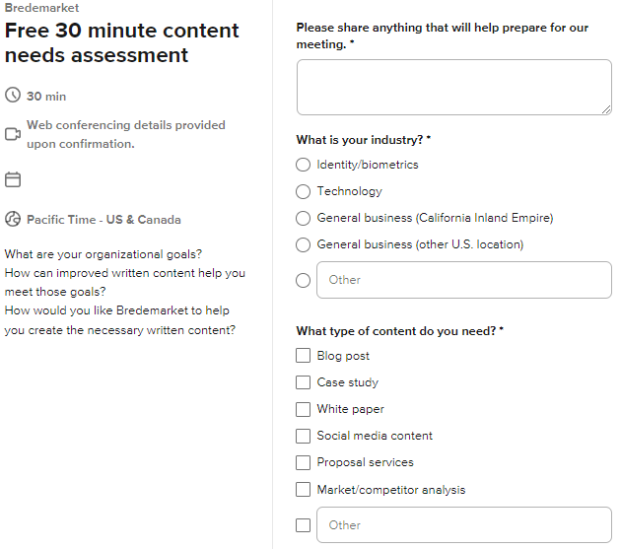
Do you need a market, competitor, or self analysis? Contact me. Or book a meeting with me at calendly.com/bredemarket to talk about your needs (and check the “Market/competitor analysis” check box).
When your company attends events, you’ll want to maximize your event return on investment (ROI) by creating marketing content that you publish before, during, and after the event.
The two things (first, second) you need to do NOW, well before your event.
And I’ll spill a couple of secrets along the way.
The first secret (about events)
I’m going to share two secrets in this post. OK, maybe they’re not that secret, but you’d think they ARE secrets because no one acknowledges them.
The first one has to do with event attendance. You personally might be awed and amazed when you’re in the middle of an event and surrounded by hundreds, or thousands, or tens of thousands of people. All of whom are admiring your exhibit booth or listening to your CEO speak.
Technically not a CEO (Larry Ellison’s official title is Chief Technology Officer, and the CEO is Safra Catz), but you get the idea. By Oracle PR Hartmann Studios – CC BY 2.0, https://commons.wikimedia.org/w/index.php?curid=47277811.
But guess what?
Many, many more people are NOT at the event.
They can’t see your exhibit booth, and can’t hear your speaker. They’re on the outside, TRYING to look in.
And all the money you spent on booth space and travel and light-up pens does NOTHING for the people who aren’t there…
Unless you bring the event to them. Your online content can bring the event to people who were never there.
But you need to plan, create, and approve your content before, during, and after the event. Here’s how you do that.
Three keys to creating event-related content
Yes, you can just show up at an event, take some pictures, and call it a day. But if you want to maximize your event return on investment, you’ll be a bit more deliberate in executive your event content. Ideally you should be:
Before the event begins, you need to plan your content. While you can certainly create some content on a whim as opportunity strikes, you need to have a basic idea of what content you plan to create.
Before the event. Why should your prospects and customers care about the event? How will you get prospects and customers to attend the event? What will attendees and non-attendees learn from the event?
During the event. What event activities require content generation? Who will cover them? How will you share the content?
Some dude creating Morphoway-related content for Biometric Update at the (then) ConnectID Expo in 2015.
After the event. What lessons were learned? How will your prospects and customers benefit from the topics covered at the event? Why should your prospects buy the product you showcased at the event?
Creating your event content
Once you have planned what you want to do, you need to do it. Before, during, and after the event, you may want to create the following types of content:
Blog posts. These can announce your attendance at the event before it happens, significant goings-on at the event (such as your CEO’s keynote speech or the evening party launching your new product), or lessons learned from the event (what your CEO’s speech or your new product means for your prospects and clients). Blog posts can be created relatively quickly (though not as quick as some social media posts), and definitely benefit your bottom line.
Social media. Social media such as Facebook, Instagram, and LinkedIn can also be used before, during, and after the event. Social media excels at capturing the atmosphere of the event, as well as significant activities. When done right, it lets people experience the event who were never there.
E-mails. Don’t forget about e-mails before, during, and after the event. I forgot about e-mails once and paid the price. I attended an event but neglected to tell my e-mail subscribers that I was going to be there. When I got to the event, I realized that hardly any of the attendees understood the product I was offering, and were not the people who were hungry for my product. If I had stocked the event with people from my e-mail list, the event would have been more productive for me.
Data sheets. Are you announcing a new product at an event? Have the data sheet ready.
Demonstration scripts. Are you demonstrating a new or existing product at the event? Script out your demonstration so that your demonstrators start with the same content and make the points YOU want them to make.
Case studies and white papers. While these usually come into play after the event, you may want to release an appropriate case study or white paper before or during the event, tied to the event topic. Are you introducing a new product at an industry conference? Time your product-related white paper for release during the conference. And promote the white paper with blog posts, social media, and e-mails.
Other types of content. There are many other types of content that you can release before, during, or after an event. Here’s a list of them.
Approving your event content
Make sure that your content approval process is geared for the fast-paced nature of events. I can’t share details, but:
If your content approval process requires 24 hours, then you can kiss on-site event coverage goodbye. What’s the point in covering your CEO’s Monday 10:00 keynote speech if the content doesn’t appear until 11:00…on Tuesday?
If your content approval process doesn’t have a timeline, then you can kiss ALL event coverage goodbye. There have been several times when I’ve written blog posts announcing my company’s attendance at an event…and the blog posts weren’t approved until AFTER the event was already over. I salvaged the blog posts via massive rewrites.
So how are you going to generate all this content? This brings us to my proposed solution…and the second secret.
The rest of this post talks about one of Bredemarket’s services, the Bredemarket 2800 Medium Writing Service. For those who haven’t heard about it, it’s a service where I provide between 2,800 and 3,200 words of written text.
“But John,” you’re asking. “How is a single block of 3,200 words of text going to help me with my event marketing?”
Time to reveal the second secret…
You can break up those 3,200 words any way you like.
For example, let’s say that you’re planning on attending an event. You could break the text up as follows:
One 500-word blog post annnouncing your attendance at the event.
Three 100-word social media posts before the event.
One 500-word blog post as the event begins.
One 300-word product data sheet prepared before the event and released on the second day of the event.
One 500-word blog post announcing the new product.
Three 100-word social media posts tied to the new product announcement.
One 500-word post-event blog post with lessons learned.
Three 100-word social media posts after the event.
For $2,000 (as of June 2024), you can benefit from written text for complete event coverage, arranged in any way you need.
So how can you and your company receive these benefits?
Read about the Bredemarket 2800 Medium Writing Service
First, read the data sheet for the Bredemarket 2800 Medium Writing Service so you understand the offer and process.
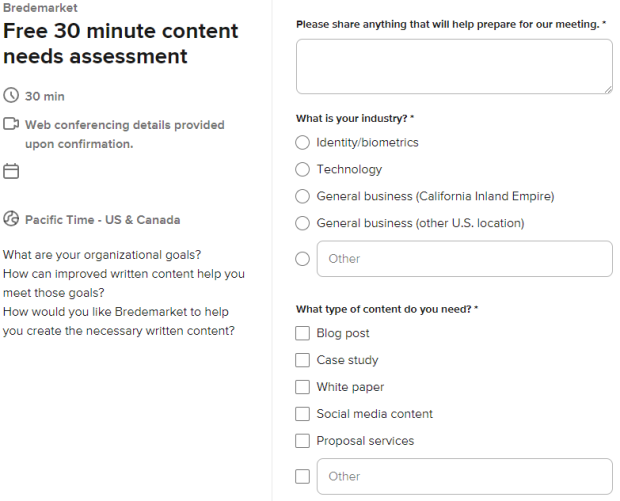
Second, contact Bredemarket to get the content process started well BEFORE your event. Book a meeting with me at calendly.com/bredemarket. Be sure to fill out the information form so I can best help you.
When marketing your facial recognition product (or any product), you need to pay attention to your positioning and messaging. This includes developing the answers to why, how, and what questions. But your positioning and your resulting messaging are deeply influenced by the characteristics of your product.
If facial recognition is your only modality
There are hundreds of facial recognition products on the market that are used for identity verification, authentication, crime solving (but ONLY as an investigative lead), and other purposes.
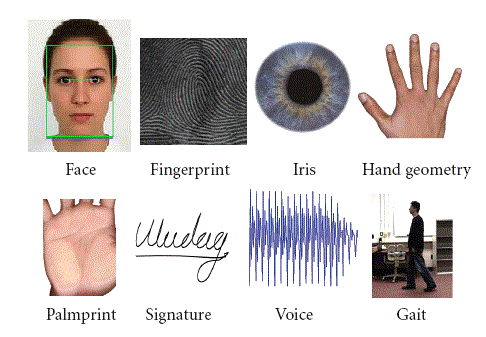
Some of these solutions ONLY use face as a biometric modality. Others use additional biometric modalities.
Similarly, a face-only company will argue that facial recognition is a very fast, very secure, and completely frictionless method of verification and authentication. When opponents bring up the demonstrated spoofs against faces, you will argue that your iBeta-conformant presentation attack detection methodology guards against such spoofing attempts.
Of course, if you initially only offer a face solution and then offer a second biometric, you’ll have to rewrite all your material. “You know how we said that face is great? Well, face and gait are even greater!”
It seems that many of the people that are waiting the long-delayed death of the password think that biometrics is the magic solution that will completely replace passwords.
For this reason, your company might have decided to use biometrics as your sole factor of identity verification and authentication.
Or perhaps your company took a different approach, and believes that multiple factors—perhaps all five factors—are required to truly verify and/or authenticate an individual. Use some combination of biometrics, secure documents such as driver’s licenses, geolocation, “something you do” such as a particular swiping pattern, and even (horrors!) knowledge-based authentication such as passwords or PINs.
This naturally shapes your positioning and messaging.
The single factor companies will argue that their approach is very fast, very secure, and completely frictionless. (Sound familiar?) No need to drag out your passport or your key fob, or to turn off your VPN to accurately indicate your location. Biometrics does it all!
The multiple factor companies will argue that ANY single factor can be spoofed, but that it is much, much harder to spoof multiple factors at once. (Sound familiar?)
So position yourself however you need to position yourself. Again, be prepared to change if your single factor solution adopts a second factor.
A final thought
Every company has its own way of approaching a problem, and your company is no different. As you prepare to market your products, survey your product, your customers, and your prospects and choose the correct positioning (and messaging) for your own circumstances.
And if you need help with biometric positioning and messaging, feel free to contact the biometric product marketing expert, John E. Bredehoft. (Full-time employment opportunities via LinkedIn, consulting opportunities via Bredemarket.)
In the meantime, take care of yourself, and each other.
Of all the technologies I don’t know about, jobseeker technology is the most important. Between July 2000 and today, I’ve spent over 30 months searching for full-time employment. So it helps to know how employers search for potential employees.
And a lot of those 30-plus months have been filled with self-styled experts advising people “how to beat the applicant tracking system (ATS)” (as if there were only one) and “how to access the hidden job market” (because of course employers don’t want anyone to know that they’re searching for talent).
So when Melanie Woods of CGL Recruiting offered 20 jobseekers the chance to see how their LinkedIn Profile appears to users of LinkedIn Recruiter, I really wanted to win one of those 20 slots.
If I could boil all 7 tips down to 1, I’d emphasize that recruiters have limited time, and something a recruiter can understand in 0 seconds is much better than something that would take a recruiter 5 seconds to understand.
Instead of spending money on advertising, my team is going to be taking a different approach and it involves YOU #jobseekers!
Sounds like a plan, since a word-of-mouth testimonial converts more effectively than copy written by a marketing hack. (But what if the testimonial is FROM a marketing hack?)
The offer
She then described the offer.
We are going to be offering 20 free 20 minute sessions to job seekers who are currently out of work. During your session I will pull you up live in LinkedIn Recruiter and test your profile to show you where you are coming up in searches and where you are falling out. I will help you adjust your profile so you can appear in more searches for the jobs you are targeting.
What is LinkedIn Recruiter?
As you can probably guess, LinkedIn Recruiter is the premium-priced service that recruiters use to search LinkedIn for job candidates. The top-tier package (“contact Sales” for the price) includes:
Unlimited LinkedIn network access: Find and engage anyone on LinkedIn
150 InMail messages/month per license and bulk messaging
40+ advanced search filters, including “Open to work” and “More likely to respond”
Multi-user collaboration tools
Prepaid slots to rotate job postings in and out as needed
If your company is recruiting more than 4 positions a year, the high-end version of LinkedIn Recruiter could be the tool for you.
But when recruiters use LinkedIn Recruiter, they don’t look at a candidate’s LinkedIn profile—they look at the LinkedIn Recruiter view of the candidate’s profile, optimized for their purposes.
Hence Melanie was offering job applicants the opportunity to see how their profile appears to a recruiter. Valuable information to have.
What CGL Recruiting wanted in return
But remember that the lucky winners had to provide “advertising” to CGL Recruiting in return.
Here is where the advertising piece comes in….if you feel that the 20 minutes was helpful to you and your job search, we would appreciate you doing a review of our services on LinkedIn and one other social media platform (your choice), sharing how the time spent was useful to you and your job search.
Melanie and I met via Zoom early Monday afternoon Pacific Time (late afternoon Central Time), and I received a firehose of information during the 20-minute session. I’m not going to cover ALL the information she provided; instead, I’ll confine myself to the top 7 tips.
The first job on the LinkedIn profile is the most important.
Use all 5 “job title” slots.
Some employers AREN’T 1st and 2nd degree connections.
You can have 6 on-site job locations, not just 5.
Consider listing at least one college-related date.
Ampersands are bad.
Temperamental writers shouldn’t fall in love with pet phrases.
Tip 1: The first job on the LinkedIn profile is the most important
For my job search for a Senior Product Marketing Manager role, my Incode position is (maybe) more important than my current Bredemarket position. On my resume, I take care of this by listing Incode BEFORE Bredemarket. But because LinkedIn profiles are chronological, and Bredemarket is my current “employer,” I can’t reorder like that.
The LinkedIn Recruiter view of the profile doesn’t show all the positions, but only the top 3. And the first position takes great prominence.
LinkedIn Recruiter view of my LinkedIn profile, Monday, May 13, 2024, 1:30 pm PDT.
In the default view, the recruiter can’t see my fourth position (Strategic/Product Marketing Manager from 2015 to 2017), but only the first three. And only one of those three positions is product marketing-related.
Melanie zeroed in on my “Sole Proprietor” position, which tells a recruiter nothing about what I actually DO at Bredemarket. Sure the recruiter could click through and read about the marketing and writing services that Bredemarket provides…but recruiters have limited time.
I thought about her advice after the call, and for LinkedIn (and resume) purposes I’m changing my Bredemarket job title to “Product Marketing Consultant.” My work for my clients is all product/service-related, so the job title makes sense.
Now recruiters will see that two of my three most recent positions were product marketing-related, which makes me more attractive to the one position that I’m targeting.
One position? Wait a minute…
Tip 2: Use all 5 “job title” slots
That’s right. In my “job preferences,” my only listed job title was “Senior Product Marketing Manager.”
I can list up to 5.
Why not use all 5?
So now my job titles include the following:
Senior Product Marketing Manager
Product Marketing Manager
Marketing Content Manager
Global Product Marketing Manager
Product Marketing Consultant
So I have the position title from Incode, the consulting title from Bredemarket, two product marketing title variants, and a content marketing title for good measure (Bredemarket readers know why).
Now some people question why I’d list all these similar titles, since anyone who takes a few seconds can figure out that I’d be interested in a global product marketing manager position or whatever.
That’s the problem. Recruiters DON’T HAVE a few seconds. When hundreds or thousands of people apply for positions, recruiters need to get through the profiles as quickly as possible.
So Melanie wanted me to make her job easier.
Tip 3: Some employers AREN’T 1st and 2nd degree connections
You can control the visibility of your email address and your phone number on LinkedIn. While I don’t list a phone number on my LinkedIn profile, I do make my jobseeking email address (which is separate from my Bredemarket email address) visible. In fact, I configured my email address visibility for viewing by my 1st degree and 2nd degree connections.
But there was a fallacy in that tactic.
It became obvious in the session because Melanie (not a connection since her LinkedIn connections are maxed out) could NOT see my email address. Therefore, if recruiter Melanie wanted to contact me, she could ONLY contact me via InMail.
If you want ANY potential recruiter to see your email, increase its visibility to all connections. Obviously there are risks to this, so you need to judge what visibility is right for you. (Especially for phone numbers.)
Tip 4: You can have 6 on-site job locations, not just 5
While all of Bredemarket’s work is remote, and my previous work at Incode was remote, I’m not averse to on-site work. As long as it’s within driving distance.
To help local companies, I listed a selected five cities (the maximum) where I am available for on-site work:
Ontario, California, United States
San Bernardino, California, United States
Covina, California, United States
Pasadena, California, United States
Anaheim, California, United States
But Melanie pointed out that I didn’t need to list Ontario, since my profile already states that I live in Ontario. That freed up one slot to add another city. I chose to list Riverside, although I could have listed Brea or Fullerton or Industry or Pomona or Corona or many other cities. (LinkedIn, your on-site locations feature needs work.)
Tip 5: Consider listing at least one college-related date
Now let’s get into age discrimination talk.
If a company desires to discriminate against job applicants due to age, one effective way to do so is to look at the dates the applicants attended college. It’s pretty easy to quietly filter out the geezer applicants with no one the wiser.
For this reason I didn’t bother to add my college attendance dates to my LinkedIn profile. Why give the discriminating (in a negative way, not a positive way) firm the ammo they need to get the young, cheap workers they really want? (Of course those workers are inexperienced, but that’s another topic entirely.)
But Melanie pointed out one truth about companies that want to discriminate: if they don’t discriminate against you when they read your LinkedIn profile or resume, they can easily discriminate against you when they SEE you.
Oh, and there’s one more thing: if recruiters search for candidates based upon their graduation dates, profiles without graduation dates will never been seen by recruiters.
So I mulled over her advice.
I decided not to list the date that I started attending Cal State Fullerton’s MBA program.
And I decided not to list the date I graduated from Reed College.
I certainly didn’t list the date I started attending Reed College. (But I will confess that this song blasted from the Old Dorm Block. And I’ll also confess that I could lose the last 4 1/2 minutes.)
But I did pencil in my 1991 graduation date from Cal State Fullerton’s MBA program. Since my LinkedIn profile includes ALL my biometric positions going back to 1994, this isn’t a shocking revelation.
Tip 6: Ampersands are bad
LinkedIn profiles can include skills. I’ve listed near the limit of 50 skills, some of which are tied to particular positions, LinkedIn Learning courses, and other education and certifications.
Among many others, two of my listed skills are “identity & access management” and “sales & marketing management.”
Technology experts immediately see where this is going. So why didn’t I?
Melanie immediately noted that the ampersand character in those two skill descriptions can wreak havoc with some computerized systems.
I swapped out those skills for some new ones: identity and access management, and sales and marketing management, removing the problem.
Tip 7: Temperamental writers shouldn’t fall in love with pet phrases
Melanie’s biggest concern about my LinkedIn profile involved the very first sentence.
The one that appears below my profile, name, and preferred pronouns, but above my city of residence.
John Bredehoft LinkedIn profile, public view, Monday, May 13, 2024, 1:30 pm PDT.
Senior Product Marketing Manager in identity/technology who is expert in describing why customers benefit.
She read that sentence word for word.
“Senior Product Marketing Manager”? She liked that.
“In identity/technology”? I guess she liked that; at least she didn’t comment on it.
The rest of the sentence? Not so much.
Regular Bredemarket readers are familiar with the last three words of that sentence, and realize that every one of those three words is critically important. Why rather than what, customers rather than producers, and benefits rather than features. I’ve devoted a post (plus another post) to those three words. If I only had a few seconds to explain the importance of those three words…
Um, yet again, recruiters aren’t interested in taking a few minutes to read everything I have written about Simon Sinek’s Golden Circle, customer focus, or benefits. They don’t even want to watch a short reel on the topic.
So I have to rewrite the last part of that first sentence. As I write this post, I’m still mulling over alternatives.
CGL Recruiting’s expertise was highly beneficial
The 7 items above were just some of the tips that Melanie Woods imparted to me, all in the space of 20 minutes.
Again, the common theme is that recruiters have limited time, LinkedIn Recruiter lets them maximize that limited time, and jobseeker data also has to let recruiters maximize that limited time. If you can do something in 0 seconds, don’t take 5 seconds to do it.
I haven’t even explored some of the other features that CGL Recruiting offers, including Melanie Woods’ YouTube channel.
But the 20 minutes I spent with her were certainly valuable.
Now I just have to figure out another way to say “why customers benefit.”
I recall one product in particular (not a Segway, but a biometric product housed in a tower) that was an impressive fusion of algorithmic and mechanical excellence. The complex design that went into developing the tower product resulted in a device that performed its function superbly.
The complex engineering also caused the product to have such a high price that no one would ever buy it…but I digress.
But there was another issue with the product. I was writing proposals at the time, and we certainly could have written up a product description that emphasized the product’s lengthy set of features.
But the people receiving our proposals wouldn’t have cared one bit.
Prospects don’t care about lengthy feature lists
You see, prospects don’t care about lengthy feature lists.
If your product stops terrorists from boarding airplanes, then and only then will they care about your company or your product.
If your product can’t stop terrorists from boarding airplanes, or if there is another product that is better at stopping terrorists from boarding airplanes, then your prospects won’t care about your product.
So how do you get prospects to care?
You don’t get prospects to care by talking about your extensive feature lists.
Let me give you a tip. If you find an employee at the prospect’s company who wants to spend a lot of time talking about your extensive feature lists, that employee probably DOESN’T have the authority to approve the purchase.
The people who DO have the authority to approve the purchase don’t have time to talk about extensive feature lists.
The approvers want to know, in 30 seconds or less, how your solution BENEFITS them.
Do you need help explaining your benefits?
Talking about benefits rather than features is just one tactic to successfully appeal to your prospects.
If you need help ensuring that your written materials (blog posts, white papers, web pages) resonate with your prospects, you can ask Bredemarket to help you.
So far the best alternative to “target audience” that I’ve found is “hungry people,” which not only focuses on people rather than an abstraction, but also focuses on those who are ready to purchase your product or service.
But I just found an instance in which “thirsty people” may be better than “hungry people.” Specifically, for the Colorado spirits company Friday Deployment, which engages in product marketing in a very…um…targeted way. Including the use of a micro-influencer who is well-known to Friday Deployment’s thirsty people.
Heads up for regular Bredemarket blog readers: the “why” and “how” questions are coming.
Why are Friday Deployment’s “thirsty people” technologists?
Why does Friday Deployment aim its product marketing at technologists?
Presumably because of this background, Friday Deployment’s product marketing is filled with tech references. Here’s a sample from Friday Deployment’s web page (as of Friday, February 2, 2024).
It was inevitable. The tree is out of date, the history is a mess, and you just want to start your weekend. Maybe you just do a quick little git push --force? Maybe someone already did, and you now get to figure out the correct commit history?
But that isn’t the only way that Friday Deployment markets to its “thirsty people.”
How does Friday Deployment’s marketing resonate with its thirsty people?
How else does Friday Deployment address a technologist audience?
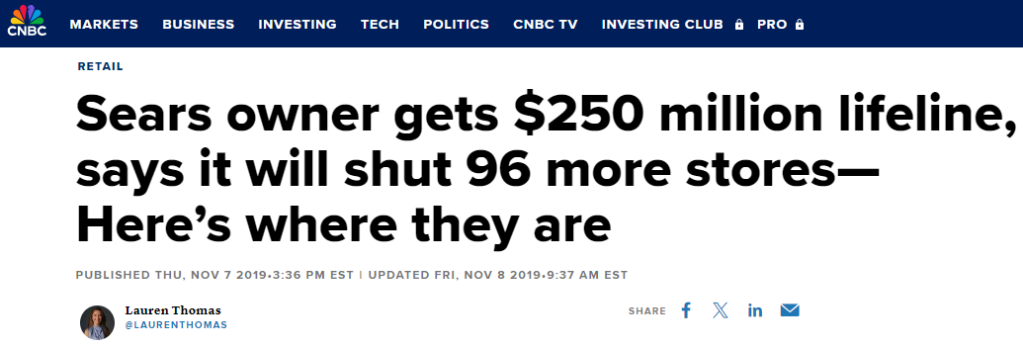
Those of you who are familiar with LinkedIn’s tempests in a teapot realize that LinkedIn users don’t spend all of their time talking about green banners or vaping during remote interviews.
Well, she was until one day when she and about 40 others were terminated.
Pietsch was terminated by two people that she didn’t know and who could not tell her why she was terminated.
This story would have disappeared under the rug…except that Pietsch knew that people were losing their jobs, so when she was invited to a meeting she videorecorded the first part of the termination, and shared it on the tubes.
The video went viral and launched a ton of discussion both for and against what Pietsch did. I lean toward the “for,” if you’re wondering.
Since Friday Deployment’s “thirsty people” were probably familiar with the Brittany Pietsch story, the company worked with her to re-create her termination video…with a twist. (Not literally, since Pietsch drank the gin straight.)
Well, the product marketing ploy worked, since I clicked on the website of a spirits company that was new to me, and now I’m on their mailing list.
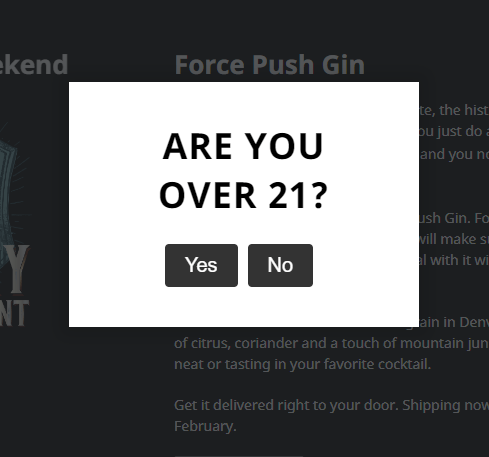
But let’s talk alcohol age verification
The Friday Deployment product marketing partnership with Brittany Pietsch worked…mostly. Except that I have one word of advice for company owner Rishi Malik.
With your Varo Bank engineering experience, you of all people should realize that Friday Deployment’s age verification system is hopelessly inadequate. A robust age verification system, or even an age estimation system, or even a question asking you to provide your date of birth would be better.
Bredemarket can’t create a viral video for your tech firm, but…
But enough about Friday Deployment. Let’s talk about YOUR technology firm.
How can your company market to your thirsty (or hungry) people? Bredemarket can’t create funny videos with micro-influencers, but Bredemarket can craft the words that speak to your audience.
To learn more about Bredemarket’s marketing and writing services for technology firms, click on the image below.
Some firms make claims and don’t support them, while others support their claims with quantified benefits. But does quantifying help or harm the firms that do it? This pudding post answers this question…and then twists toward the identity/biometrics market at the end.
The “me too” players in the GCP market
Whoops.
In that heading above, I made a huge mistake by introducing an acronym without explaining it. So I’d better correct my error.
GCP stands for Glowing Carbonated Pudding.
I can’t assume that you already knew this acronym, because I just made it up. But I can assure you that the GCP market is a huge market…at least in my brain. All the non-existent kids love the scientifically advanced and maximally cool pudding that glows in the dark and has tiny bubbles in it.
Glowing Carbonated Pudding. Designed by Google Bard. Yeah, Google Bard creates images now.
Now if you had studied this non-existent market like I have, you’ll realize from the outset that most of the players don’t really differentiate their offerings. Here are a few examples of firms with poor product marketing:
Jane Spain GCP: “Trust us to provide good GCP.”
Betty Brazil GCP: “Trust us to provide really good GCP.”
Clara Canada GCP: “Trust us to provide great GCP.”
You can probably figure out what happened here.
The CEO at Betty Brazil told the company’s product marketers, “Do what Jane Spain did but do it better.”
After that Clara Canada’s CEO commanded, “Do what Betty Brazil did but do it better.” (I’ll let you in on a little secret. Clara Canada’s original slogan refereneced “the best GCP,” but Legal shot that down.)
But another company, Wendy Wyoming, decided to differentiate itself, and cited independent research as its differentiator.
Wendy Wyoming Out of This World GCP satisfies you, and we have independent evidence to prove it!
The U.S. National Institute of Standards and Technology, as part of its Pudding User Made (PUM, not FRTE) Test, confirmed that 80% of all Wendy Wyoming Out of This World GCP mixes result in pudding that both glows and is carbonated. (Mix WW3, submitted November 30, 2023; not omnigarde-003)
Treat your child to science-backed cuisine with Wendy Wyoming Out of This World GCP!Wendy Wyoming is a top tier (excluding Chinese mixes) GCP provider.
But there are other competitors…
The indirect competitor who questions the quantified benefits
There are direct competitors that provide the same product as Wendy Wyoming, Jane Spain, and everyone else.
And then there are indirect competitors who provide non-GCP alternatives that can substitute for GCPs.
For example, Polly Pennsylvania is NOT a GCP provider. It makes what the industry calls a POPS, or a Plain Old Pudding Sustenance. Polly Pennsylvania questions everything about GCP…and uses Wendy Wyoming’s own statistics against it.
Designed by Google Bard.
Fancy technologies have failed us.
If you think that one of these GCP puddings will make your family happy, think again. A leading GCP provider has publicly admitted that 1 out of every 5 children who buy a GCP won’t get a GCP. Either it won’t glow, or it’s not carbonated. Do you want to make your kid cry?
Treat your child to the same pudding that has satisfied many generations. Treat your child to Polly Pennsylvania Perfect POPS.
Pennsylvania Perfect remembers.
So who wins?
It looks like Polly Pennsylvania and Wendy Wyoming have a nasty fight on their hands. One that neck-deep marketers like to call a “war.” Except that nobody dies. (Sadly, that’s not true.)
Some people think that Wendy Wyoming wins because 4 out of 5 of their customers receive true GCP.
Others think that Polly Pennsylvaia wins because 5 out of 5 of their customers get POPS pudding.
But it’s clear who lost.
All the Jane Spains and Betty Brazils who didn’t bother to create a distinctive message.
Don’t be Jane Spain. Explain why your product is the best and all the other products aren’t.
Copying the competition doesn’t differentiate you. Trust me.
The “hungry people” (target audience) for THIS post
Oh, and if you didn’t figure it out already, this post was NOT intended for scientific pudding manufacturers. It was intended for identity/biometric firms who can use some marketing and writing help. Hence the references to NIST and the overused word “trust.”
If you’re hungry to kickstart your identity/biometric firm’s written content, click on the image below to learn about Bredemarket’s services.
You can express a single thought on multiple channels. And as far as I’m concerned, the more the merrier.
Me on “expert” advice on social media channel adoption
Incidentally, that’s why I object to the “expert” advice that I master one social media channel first before branching out into others.
If I adopt that strategy and ONLY market on LinkedIn and ignore Instagram and TikTok, I am automatically GUARANTEEING that the potential Instagram and TikTok audiences will never hear about my offer.
“How I Expanded 1 Idea into 31 Pieces of Content”
I’ve expressed my thoughts on this social media “expert” advice before:
The latter post, entitled “How I Expanded 1 Idea into 31 Pieces of Content,” described how…well, the title is pretty self-explanatory. I created 31 pieces of content based on a single idea.
The 31 pieces of content, published both through the Bredemarket channels (see above) and via my personal channels (including my jebredcal blog and my LinkedIn page), all increased the chance that SOMEONE would see the underlying message: “Your prospects don’t care about your technology.” Each piece of content was tuned for the particular channel and its target audience, ensuring that the message would resonate.
Speaking of repurposing, I’ve already adapted the words above and published them in four different ways (this is the fourth)…and counting. No TikTok video yet though.
Can Bredemarket help you repurpose or create content?
And if I can do this for me, I can do this for you.
Bredemarket can help you create content that converts prospects and drives content results. Why?
If you’re sold on using Bredemarket to create customer-focused messaging (remember: your prospects don’t care about your technology), or even if you’re not and just want to talk about your needs, there are three ways to move forward with your content project. Or you can just join the Bredemarket mailing list to stay informed.
Book a meeting with me at calendly.com/bredemarket. Be sure to fill out the information form so I can best help you.





















 Bredemarket