(Pizza Stories) The Worst Time to READ a Pizza Post on Social Media

Designed by Freepik.

Have you ever seen those posts from self-appointed gurus?

Specifically, the ones that authoritatively state the BEST time to WRITE a post on Instagram, or LinkedIn, or TikTok, or whatever?

I religiously ignore those posts for a simple reason: My country has multiple time zones. So the best time in one time zone may be the worst time in another time zone.

However, I can tell you the WORST time to READ a post in the PACIFIC Time Zone…if the post concerns pizza.

And I’ll explain what all this means…eventually.

Ophir Tal on awareness

In addition to saying WHEN to post, the gurus also provide authoritative (and often contradictory) advice about WHAT to post.

For example, some gurus assert that you MUST prioritize bottom of funnel (conversion) content over top of funnel (awareness) content because it’s most important to get people to buy.

Ophir Tal disagrees, and has evidence to support his position.

Ophir Tal on pizza

Ophir Tal self-identifies as a “LinkedIn Ghostwriter & Personal brand Builder for CEOs & Founders”…and part of the way he builds personal brands is via awareness. Here’s where Tal made this assertion about the importance of awareness.

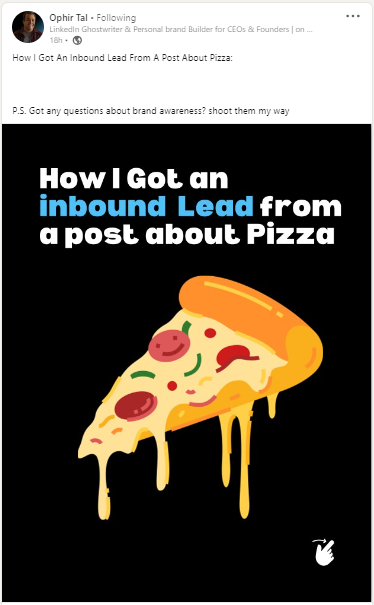
Let’s look at Tal’s hook:

How I Got An Inbound Lead From A Post About Pizza

From Ophir Tal on LinkedIn.

This hook caught my attention. People want leads, and people like pizza, so I paid attention. But I also paid attention for a third reason that I’ll discuss later.

Tal describes how he wrote a LinkedIn post about a piece of pizza that he dropped by mistake, and how he acquired 9,400 views, 97 likes, and 112 comments from that single post. So he told the story a second time.

Tal then noted that the gurus would have recommended NOT posting this because he was “doing it wrong.” Specifically:

  • The post didn’t solve a problem for his potential clients. (Unless they regularly drop slices of pizza, I guess.)
  • It didn’t have a strong call to action.
  • It wasn’t targeted to his ideal clients. (Again, unless they regularly drop slices of pizza, or unless they love chicken wings.)

But despite doing everything wrong, that particular piece of content attracted the attention of someone “at a 6 figure ecom company.” After viewing the content, the reader looked at Tal’s profile and realized Tal could meet their need for ghostwriting services.

Tal earned a lead from his pizza post.

Again, this is only part of Tal’s story. I encourage you to read the rest here.

And now I’ll tell you the third reason why I paid attention to Tal’s post.

John Bredehoft on birthdays

As I noted above, I paid attention to Ophir Tal’s pizza post for two reasons:

  • People want leads.
  • People like pizza.

Now let’s jump back to a post I wrote all the way back in 2023, one that described why I’ve soured on the term “target audience.” (Or, in Tal’s words, “ideal clients.”) I started that post by wondering if the term “needy people” would be better than “target audience.” Yes, but not good enough.

I’ll grant that “needy people” has a negative connotation, like the person who is sad when people forget their birthday.

From “I’m Questioning Everything About Target Audiences, Including the Name.”

Why did I include that sentence?

I’ll let you in on a personal secret. When I wrote that, I was myself sad because a few people had forgotten my birthday.

Teddy alone at his pizza birthday party in 2018. Picture shared by Nick VinZant. Story here.

It turns out that these people had a VERY GOOD reason for forgetting my birthday. However, I cannot reveal this reason to you because the disclosure would force me to reveal someone’s personal identifiable information, or PII. (Mine.)

So after they remembered my birthday, one of them asked what I did for my birthday…and I told them that my wife, father-in-law, and brother-in-law went out to dinner.

For pizza.

And I also told them that there were leftovers, which my wife and I enjoyed a few days later.

Leftover pizza is the best pizza. Preparation credit: Pizza N Such, Claremont, California. Can I earn free pizza as a powerful influencer? Probably not, but I’ll disclose on the 0.00001% chance that I do.

A nice story, and while I was reading Ophir Tal’s story on dropped pizza, I realized that I had missed an opportunity to tell my own story about leftover pizza.

Time to channel Steve Jobs…

Oh, and there’s one more thing

I forgot to mention one thing about the Ophir Tal story.

When I read the story, it was around 4:00 pm in California.

So when I read about Tal’s dropped pizza, and thought about my leftover pizza (which I had already eaten)…I was hungry.

Target audience, needy people…hungry people

Coincidentally, “hungry people” is the phrase that I eventually decided was better than “needy people.”

Tal’s lead was hungry for ghostwriting services, and when they saw that Tal offered such a service, they contacted him.

What does this mean? I’ll go into that in a separate post.

But for now, remember that stories that raise awareness with your “hungry people” (target audience) are good stories to tell.

Maybe I should tell more stories.

Clean Data is the New Oxygen, and Dirty Data is the New Carbon Monoxide

I have three questions for you, but don’t sweat; I’m giving you the answers.

  1. How long can you survive without pizza? Years (although your existence will be hellish).
  2. OK, how long can you survive without water? From 3 days to 7 days.
  3. OK, how long can you survive without oxygen? Only 10 minutes.

This post asks how long a 21st century firm can survive without data, and what can happen if the data is “dirty.”

How does Mika survive?

Have you heard of Mika? Here’s her LinkedIn profile.

From Mika’s LinkedIn profile at https://www.linkedin.com/in/mika-ai-ceo/

Yes, you already know that I don’t like LinkedIn profiles that don’t belong to real people. But this one is a bit different.

Mika is the Chief Executive Officer of Dictador, a Polish-Colombian spirits firm, and is responsible for “data insight, strategic provocation and DAO community liaison.” Regarding data insight, Mika described her approach in an interview with Inside Edition:

My decision making process relies on extensive data analysis and aligning with the company’s strategic objectives. It’s devoid of personal bias ensuring unbiased and strategic choices that prioritize the organization’s best interests.

From the transcript to https://www.youtube.com/watch?v=8BQEyQ2-awc
From https://www.youtube.com/watch?v=8BQEyQ2-awc

Mika was brought to my attention by accomplished product marketer/artist Danuta (Dana) Deborgoska. (She’s appeared in the Bredemarket blog before, though not by name.) Dana is also Polish (but not Colombian) and clearly takes pride in the artificial intelligence accomplishments of this Polish-headquartered company. You can read her LinkedIn post to see her thoughts, one of which was as follows:

Data is the new oxygen, and we all know that we need clean data to innovate and sustain business models.

From Dana Debogorska’s LinkedIn post.

Dana succinctly made two points:

  1. Data is the new oxygen.
  2. We need clean data.

Point one: data is the new oxygen

There’s a reference to oxygen again, but it’s certainly appropriate. Just as people cannot survive without oxygen, Generative AI cannot survive without data.

But the need for data predates AI models. From 2017:

Reliance Industries Chairman Mukesh Ambani said India is poised to grow…but to make that happen the country’s telecoms and IT industry would need to play a foundational role and create the necessary digital infrastructure.

Calling data the “oxygen” of the digital economy, Ambani said the telecom industry had the urgent task of empowering 1.3 billion Indians with the tools needed to flourish in the digital marketplace.

From India Times.

And we can go back centuries in history and find examples when a lack of data led to catastrophe. Like the time in 1776 when the Hessians didn’t know that George Washington and his troops had crossed the Delaware.

Point two: we need clean data

Of course, the presence or absence of data alone is not enough. As Debogorska notes, we don’t just need any data; we need CLEAN data, without error and without bias. Dirty data is like carbon monoxide, and as you know carbon monoxide is harmful…well, most of the time.

That’s been the challenge not only with artificial intelligence, but with ALL aspects of data gathering.

The all-male board of directors of a fertilizer company in 1960. Fair use. From the New York Times.

In all of these cases, someone (Amazon, Enron’s shareholders, or NIST) asked questions about the cleanliness of the data, and then set out to answer those questions.

  • In the case of Amazon’s recruitment tool and the company Enron, the answers caused Amazon to abandon the tool and Enron to abandon its existence.
  • Despite the entreaties of so-called privacy advocates (who prefer the privacy nightmare of physical driver’s licenses to the privacy-preserving features of mobile driver’s licenses), we have not abandoned facial recognition, but we’re definitely monitoring it in a statistical (not an anecdotal) sense.

The cleanliness of the data will continue to be the challenge as we apply artificial intelligence to new applications.

Clean room of a semiconductor manufacturing facility. Uploaded by Duk 08:45, 16 Feb 2005 (UTC) – http://www.grc.nasa.gov/WWW/ictd/content/labmicrofab.html (original) and https://images.nasa.gov/details/GRC-1998-C-01261 (high resolution), Public Domain, https://commons.wikimedia.org/w/index.php?curid=60825

Point three: if you’re not saying things, then you’re not selling

(Yes, this is the surprise point.)

Dictador is talking about Mika.

Are you talking about your product, or are you keeping mum about it?

I have more to…um…say about this. Follow this link.

Kelly Shepherd, #fakefakefake

My belief that everything on the Internet is true has been irrevocably shattered, all because of what an entertainment executive ordered in his spare time. But the Casey Bloys / “Kelly Shepherd” story is just a tiny bit of what is going on with synthetic identities. And X isn’t the only platform plagued by them, as my LinkedIn experience attests.

By the way, this blog post contains pictures of a lot of people. Casey Bloys is real. Some of the others, not so much.

Blame COVID

Casey Bloys. Fair use. From https://wbd.com/leadership/casey-bloys/

Casey Bloys is the Chairman and CEO of HBO and Max Content. Bloys had to start a recent 2024 schedule presentation with an apology, according to Variety. After explaining how passionate he is about his programming, he went back in time a couple of years to a period that we all remember.

So when you think of that mindset, and then think of 2020 and 2021, I’m home, working from home and spending an unhealthy amount of scrolling through Twitter. And I come up with a very, very dumb idea to vent my frustration.

From Variety.

Casey Bloys’ very, very dumb idea

So why did Bloys have to apologize on Thursday? Because of an article that Rolling Stone published on Wednesday. The article led off with this juicy showbiz tidbit about Bloys’ idea for responding to a critic.

“Maybe a Twitter user should tweet that that’s a pretty blithe response to what soldiers legitimately go through on [the] battlefield,” he texted. “Do you have a secret handle? Couldn’t we say especially given that it’s D-Day to dismiss a soldier’s experience like that seems pretty disrespectful … this must be answered!”

From Rolling Stone.

(A note to my younger readers: Twitter used to be a popular social media service that no longer exists. It was replaced by X.)

Eventually Bloys found someone to create the “secret handle.” Sully Temori is now alleging wrongful termination by HBO (which is why we’re learning about these juicy tidbits, via court filings). But in 2021 he was an executive assistant who wanted to get ahead by pleasing his bosses.

This is where Kelly Shepherd enters the story.

Kelly Shepherd, fake vegan mom

Ms. Shepherd seems like a nice woman. A mom, a Texan, a herbalist and aromatherapist, and a vegan. (The cows love that last part.)

Most critically, Shepherd is a normal person, not one of those Hollywood showbiz folks. Although Shepherd, who never posted anything on her own, seems to have a distinct motivation to respond to critics of HBO shows. Take her first reply to a critic from (checks notes) Rolling Stone. (Two years later, Rolling Stone would gleefully report on this story. Watch out who you anger.)

alan is always predictably safe and scared in his opinions

From https://twitter.com/KellySh33889356/status/1379101699969720323

Kelly’s other three replies were along the same lines.

  • All were short one-sentence blurbs.
  • Most were completely in lower case, because that’s how regular non-Hollywood folk tweet.
  • All were critical of those who were critical of HBO, accusing them of “shitting on a show about women,” getting their “panties in a bunch,” and being “busy virtue signaling.”

Hey, if I couldn’t eat hamburgers and my home was filled with weird herbs and aromas, I’d be a little mad too.

And then, a little over a week later, it was over, and Kelly Shepherd never tweeted again. Although Temori apparently performed other activities against HBO critics via other methods. Well, until he was terminated.

Did Kelly Shepherd open a LinkedIn account?

But as part of the plan to satisfy Casey Bloys’ angry whims, Kelly Shepherd acquired a social media account, which she could use as a possible proof of identity.

Even though we now know she doesn’t exist.

But X isn’t the only platform plagued with synthetic identities, and some synthetic identities can do much more than anger an entertainment reviewer.

Many of us on LinkedIn are regularly receiving InMails and connection requests (in my case, from profiles with pictures of beautiful women) who say that we are constantly recommended by LinkedIn, who tell us how impressive our profiles are, and who want to contact us outside of the LinkedIn platform via text message or WhatsApp.

Now perhaps some of these messages are from real people, but I seriously doubt that so many of the employees at John Q Wine & Liquor Winery in New York happen to have the last name “Walter.” And the exact same job title.

Partial results from a LinkedIn search.

Let’s take a close look at what Karina has been doing for the last 4+ years. Other than posing in front of her car, of course.

Ms. Walter is a pretty busy freelance general manager / director / content partnerships manager.

As for her colleague Ms. Alice Walter, she has more experience (having started in 2018) but also has an extensive biography that begins:

The United States is a country with innovative challenges, and there is more room for development in the wine industry at John Q Wine & Liquor Winery. I am motivated and love to learn, and like to be exposed to more different cultures, and hope to develop more careers in my future life.

From https://www.linkedin.com/in/alice-walter-b97bb2113/

Sound familiar?

And you can check out Maria Walter’s profile if you’re so inclined. Or at least check out “her” picture.

Now none of the Walters women tried to contact me, but another “employee” (or maybe it was a “freelancer,” I forget) of this company tried to do so, which led my curious nature to discover yet another hive of fake LinkedIn profiles.

Sadly, one person from this company is a second-degree connection, which means that one of my connections accepted “her” connection request.

Synthetic identities are harmless…right?

Who knows what Karina, Alice, and Maria will do with their LinkedIn profiles?

  • Will they connect with other professionals?
  • Will they ask said professionals to move the conversation to SMS or WhatsApp, for whatever reason?
  • Will they apply for new jobs, using their impressive work history? A 98.8% customer satisfaction rate while managing 1,800 sub-partnerships is remarkable.
  • Will they apply for bank accounts…or loans?

The fraud possibilities from fake LinkedIn accounts are endless, and could be very costly for any company who falls for a fake synthetic identity. In fact, FiVerity reports that “in 2020, an estimated $20 billion was lost to SIF” (synthetic identity fraud). Which means that LinkedIn account holders and Partnerships Managers Karina, Alice, and Maria Walter could make a LOT of money.

Now banks and other financial institutions have safeguards to verify financial identities of people who open accounts and apply for loans, because fraud reduction is critically important to financial institutions.

Social media companies? Identity is only “important” to them.

They don’t even care about uniqueness (as Worldcoin does), evidenced by the fact that I have more than two X accounts (but none in which I portray a female Texas mom and vegan).

So if someone comes up to you on X or LinkedIn, remember that all may not be as it seems.

The Eisenhower Matrix is Flawed

I’ve been wanting to share my thoughts about this topic for a long time because it was important to me.

So now you’re probably asking, “John, if it’s important to you, why has it taken you so long to write the post?”

Read the post to find out!

Introduction

In past posts I’ve mentioned the Eisenhower Matrix, and I’ve also talked about how Bredemarket’s services fit into the Eisenhower Matrix.

Namely: if something is urgent, but not important enough for your own people to do, then perhaps Bredemarket can do it.

But in my previous discussions about the Eisenhower Matrix, I haven’t talked about the matrix gap. (Unrelated to the missile gap that Eisenhower’s successor claimed.)

Eisenhower Didn’t Invent the Eisenhower Matrix

Eisenhower’s half contribution to the Eisenhower Matrix

First, I guess most of you already know that Dwight D. Eisenhower never viewed an Eisenhower Matrix before his death in 1969, since the matrix didn’t appear until 1989. Eisenhower may have been (literally) a Supreme Commander, but he could not time travel. (His great-granddaughter? Maybe.)

By White House – Eisenhower Presidential Library, Public Domain, https://commons.wikimedia.org/w/index.php?curid=3025709

While the Eisenhower Matrix originates in something Eisenhower said, his statement ignores half of the matrix.

In a 1954 speech, Eisenhower quoted an unnamed university president when he said, “I have two kinds of problems, the urgent and the important. The urgent are not important, and the important are never urgent.” 

From https://asana.com/resources/eisenhower-matrix

If you were to illustrate what Eisenhower actually said, there would only be two boxes—one for the urgent tasks, and one for the important tasks. There would be no need for a matrix per se, since Eisenhower claimed that the two categories never overlapped.

Stephen Covey thought differently.

Covey’s full contribution to the Eisenhower Matrix

In essence Covey asked, “What if Ike was wrong and there IS an overlap between the urgent and important?” Or, in his words:

In a knowledge-worker world where we are paid to think, create, and innovate, our primary tool for creating value is our brain. There are two basic parts of the brain: the Reactive Brain and the Thinking Brain….

We make choices based on two factors:

  • Importance (how valuable is the result of doing it)
  • Urgency (how soon does it need to be done)

The Reactive brain chooses urgency over importance because it wants to quiet the pressing, noisy issue.  The Thinking brain chooses importance because it looks for high-payoff outcomes.

From https://www.franklincovey.com/the-5-choices/choice-1/

Covey then created the four-box matrix that indicates how items can have importance AND urgency, importance OR urgency, or neither. This created the Eisenhower Matrix we know and love, and which many of us find to be, um, “highly effective.”

The Eisenhower Matrix’s simplicity is its flaw

Part of the power of the Eisenhower Matrix is that it’s so simple to use. You just have to answer two questions to plug EVERY task into one of the four available boxes, and you’re then ready to do, decide, delegate, or delete as required.

But the simplicity of the matrix is misleading.

I’ll cite an example. How many times have you called a business and received an automated response saying, “Your call is important to us”?

By Jonathan Mauer – Own work, CC BY-SA 4.0, https://commons.wikimedia.org/w/index.php?curid=50534668

Now I don’t go as far as Jessica Lim and claim that the “Your call is important to us” statement is an outright lie. Similar statements can be found far from the customer service world.

Before LinkedIn. By Flickr user Dick Thomas Johnson (Dick Johnson) – https://www.flickr.com/photos/31029865@N06/6554188007/, CC BY 2.0, https://commons.wikimedia.org/w/index.php?curid=18130998

I am in the midst of a job hunt, and when I hold the first interview (usually with a Talent Acquisition Specialist), I make a point of asking when they expect to extend an offer and place someone in the position. Most of them respond, “As soon as possible,” and mean it. But they can’t provide an actual date.

Yes, it’s important for the customer service department to answer that phone, and it’s important for the talent acquisition department to fill that position.

But “importance” doesn’t mean that if all the customer service lines are busy that the VP of Customer Success will order new phone lines to be installed RIGHT NOW, and that everyone in the company will be mandated to answer phones RIGHT NOW until the backlog is cleared.

  • Is there no budget for new phone lines? Rob a bank if you must. This is important.
  • Is your Chief Financial Officer preparing for a quarterly earnings call tomorrow? Get to the phones. This is important.

And “importance” doesn’t mean that if a position needs to be hired, the Talent Acquisition Specialist is empowered to order every person in the interviewing and selection process to drop everything that they’re doing RIGHT NOW and devote 100% of their time to selecting a candidate.

  • Are you on vacation or holiday? It doesn’t matter. Put down your drink! This is important.
  • Are you in New Delhi? It doesn’t matter. Wake up! This is important.

In the Eisenhower Matrix, all “important” things are of equal importance, with no attempt to prioritize them.

Fixing the flaw

How do we solve the “everything is equally important” problem?

By defining four levels, including three levels of importance (TLOI).

  • Important.
  • Very important.
  • Critically important.
  • Not important.

(You can do the same with urgency and come up with gradations of urgency, but I’m not going to dive into that now. It’s…not important for what I want to say.)

Use of a more granular definition of importance provides benefits well beyond customer service and talent acquisition. Whenever you have to evaluate the importance of something, these more specific definitions will help.

Applying the correction to using Bredemarket

Let’s apply these gradations to my favorite topic—whether you should contract with Bredemarket to create your content marketing collateral. (OK, I doubt it’s your favorite topic, but trust me; there’s a “customer focus” issue here.)

For urgent content marketing needs, the existing Eisenhower Matrix provides only two choices:

  • If the need is not important, delegate by contracting with Bredemarket.
  • If the need is important, create the content yourself.
More…um…stories provide more choices. By Beyond My Ken – Own work, CC BY-SA 4.0, https://commons.wikimedia.org/w/index.php?curid=27173008

But when we apply the gradations, we have many more possible choices. In this case, we have four:

  • If the need is not important, delegate it, but it doesn’t really matter to whom or what you delegate it. ChatGPT or Bard is “good enough,” even if the result is awful.
  • If the need is important, delegate it to someone you trust to create very good content. Let them create the content, you approve it, and you’re done.
  • If the need is very important, then you may delegate some of the work, but you don’t want to delegate all of it. You need to be involved in the content creation process from the initial meeting, through the review of every draft, and of course for the final approval. The goal is stellar content. We’ll come back to this later.
  • If the need is critically important, then you probably don’t want to delegate the work and will want to do it yourself—unless you can find someone who is better than you in creating content.
Bredemarket logo

So where does Bredemarket fit in to this list of expanded choices?

Depending upon your own talents, I fall in either the very important or the critically important category. I collaborate with you throughout the content creation process to ensure that you receive the best content possible.

If you agree that Bredemarket’s content creation services are very important (or critically important) to expanding your firm, let’s talk.

  • Book a meeting with me at calendly.com/bredemarket. Be sure to fill out the information form so I can best help you.

You’re Doing It Wrong™: One Piece of Collateral Isn’t Enough

If you create a single piece of collateral for your product or service and say that you’ve completed your job, “you’re doing it wrong™.”

Product marketers and content marketers know that you’re just starting.

John Bonini on content vs. channel

John Bonini advises that you separate the content from the channel.

What most companies practice is not actually content marketing. It’s channel marketing.

They’re not marketing the content. They’re marketing the channel.

From LinkedIn.

You can express a single thought on multiple channels. And as far as I’m concerned, the more the merrier.

Me on “expert” advice on social media channel adoption

Incidentally, that’s why I object to the “expert” advice that I master one social media channel first before branching out into others.

If I adopt that strategy and ONLY market on LinkedIn and ignore Instagram and TikTok, I am automatically GUARANTEEING that the potential Instagram and TikTok audiences will never hear about my offer.

“How I Expanded 1 Idea into 31 Pieces of Content”

I’ve expressed my thoughts on this social media “expert” advice before:

The latter post, entitled “How I Expanded 1 Idea into 31 Pieces of Content,” described how…well, the title is pretty self-explanatory. I created 31 pieces of content based on a single idea.

The 31 pieces of content, published both through the Bredemarket channels (see above) and via my personal channels (including my jebredcal blog and my LinkedIn page), all increased the chance that SOMEONE would see the underlying message: “Your prospects don’t care about your technology.” Each piece of content was tuned for the particular channel and its target audience, ensuring that the message would resonate.

By Christian Gidlöf – Photo taken by Christian Gidlöf, Public Domain, https://commons.wikimedia.org/w/index.php?curid=2065930

As I often say, repurposing is good.

Speaking of repurposing, I’ve already adapted the words above and published them in four different ways (this is the fourth)…and counting. No TikTok video yet though.

Can Bredemarket help you repurpose or create content?

And if I can do this for me, I can do this for you.

Bredemarket can help you create content that converts prospects and drives content results. Why?

If you’re sold on using Bredemarket to create customer-focused messaging (remember: your prospects don’t care about your technology), or even if you’re not and just want to talk about your needs, there are three ways to move forward with your content project. Or you can just join the Bredemarket mailing list to stay informed.

  • Book a meeting with me at calendly.com/bredemarket. Be sure to fill out the information form so I can best help you.
Bredemarket logo

How I Expanded 1 Idea Into 31 Pieces of Content

Whenever I see these pieces that proclaim that the author can help you brainstorm x ideas for content, I ignore them. For better or worse, I have no problem coming up with content ideas.

And when I come up with the content ideas, I don’t just use them in one piece of content. I’ll use the idea in several pieces of content. Yes, I love repurposing.

I think I’ve set a new record for myself over the last few days by creating 31 pieces of content from a single idea.

This post talks about:

The post doesn’t aim to tell you how you should create and reshare your content, but perhaps while you’re reading the post you may get some fresh ideas that fit your own working practices.

Three years of preparation

Before you can share content in numerous places, you need numerous places to share your content. It’s obvious, but it’s true. After all, it would be repetitive to post the exact same content multiple times in the Bredemarket blog.

So since I started Bredemarket in 2020, I not only developed the Bredemarket blog, but I have also developed (or made use of) other social platforms.

But how many social platforms should you use? In July, I noted what the experts advise, and how I responded to that advice.

If you’re starting out in business, you’ve probably heard the advice that as your business branches out into social platforms, you shouldn’t try to do everything at once. Instead you should make sure that your business offering is really solid on one platform before branching out into others.

Yes, I’ve been naughty again and didn’t listen to the expert advice.

From https://bredemarket.com/2023/07/18/is-bredemarket-on-your-favorite-social-platform/

The July post lists all of the social platforms that publish Bredemarket content, but for brevity’s sake, I’ll just note a few of the platforms:

  • Four pages on LinkedIn, not counting my personal profile (we’ll get to my personal profile later).
  • Four pages/groups on Facebook.
  • Other image/text platforms such as Instagram and Threads.
  • Two video-only platforms: TikTok and YouTube.
  • Numerous audio outlets for my podcast.
  • My personal X account.

To the content marketing experts that say that I should just concentrate on LinkedIn and ignore everything else, note that I then have a 0% chance of reaching non-LinkedIn users. Who knows? Perhaps that TikTok video may result in a conversion that I couldn’t have made otherwise.

One idea

The idea that struck me last weekend was not original to me, and it’s been bouncing around in my head (and on these pages) for some time now. But I thought I’d reword it in a different way. After a few tweaks, I came up with the following statement:

Your Customers Don’t Care About Your Product’s Technology

As you will see, I continued to tweak the statement, but that’s the one that I put in my Asana “Content Calendar” project.

The Asana task that would eventually result in this blog post. Only the first subtasks are shown; as you will see, there are many more.

As I would subsequently reflect, I thought that companies knew that you need to focus on the customer rather than focusing on yourself, but I see too many companies that are self-focused in their marketing. They emphasize the amazing technology features of their product.

I want to put a stop to that, and if necessary I will help companies create customer-focused marketing materials. For a fee, of course.

But enough about me. Let’s illustrate how that one idea can expand into multiple content pieces.

31 pieces of content

So now I had to write about how customers don’t care about your product’s technology.

Content 1: Blog post

The first step was to work on the content required for a blog post on the topic. By the time I was done, the post (now called “Your Prospects Don’t Care About Your Technology“) included:

  • An image, sourced from Wikipedia, of a technologist doing technology things.
  • An image, designed by Freepik, of a customer ignoring someone prattling on about their technology.
  • The “customer focus” illustration that I have used frequently in the past.
  • An animated GIF that beckoned readers to the landing page, described below. The GIF includes the first two images listed above, plus a third from the landing page itself.

Most importantly, the post included all the text that made my original point (“Do you know why your prospects are ignoring you? Because they don’t care about you. It’s all about them.”), along with my argument for customer focus, and my concluding call to action to find out how to “Create Technology Content That Converts.”

Content 2: Landing page

And “Create Technology Content That Converts” was the title of my landing page. Often I put the call to action on the same page as the original point, but sometimes (as in this case) I separate the call to action for a more focused presentation. Plus I have the option of having multiple blog posts point to the same landing page. This post points to the landing page, for example (click the GIF above or one of the other links).

The landing page dug more deeply into why and how Bredemarket can help you create a customer-focused message, talking about the questions I ask, the types of content I can create, and the process.

The landing page concluded with the call to action encouraging interested parties to schedule a meeting on my recently-improved Calendly page, email me, or use my contact form. (Or subscribe to my Mailchimp mailing list.)

Once all this was done, everything was set. People who read the blog post could (if so inclined) go to the landing page, and people who read the landing page could (if so inclined) contact me.

But only if they saw the blog post in the first place.

If they don’t find the post on Google or Bing, and if they’re not already subscribing to the blog, then how will they get to the blog post?

Content 3, 4, 5, 6, 7, and 8: Information pages

There are numerous themes that continuously pop up in the Bredemarket blog, and I have created “information pages” (pillars) that link to all of the content that I have written on these themes.

Now perhaps you won’t do all of this, but if there’s a place on your website where you should mention your new blog post, be sure and do it.

For example, if you wrote a blog post about Topic X in 2021, and you’re readdressing Topic X in a 2023 post, then go back and update the 2021 post to say that you have new thoughts on Topic X. Then the people who find your 2021 post can go to the new post and get the latest information.

Content 9: Audio podcast

My podcast is more accurately described as a mini-podcast, because each episode is usually only 1-2 minutes long. Perhaps someday I’ll create hour-long episodes, but not today.

And on Sunday I created a 2-minute episode with a new take. After noting (as I said above) that sometimes we know things that people don’t know, I declared:

Am I smarter than General Electric? Yes I am.

From https://podcasters.spotify.com/pod/show/bredemarket/episodes/Why-Should-I-Care-That-General-Electric-Uses-AI-e2aaenl

I then described a really bad General Electric press release that focused on GE technology and not on customer needs.

Then I plugged the blog post, which was linked in the episode description. And I resued the “technologist doing technology thinks” image from the blog post.

Now I only list this as one piece of content, but really it’s multiple pieces of content. Not only can you access the episode on Spotify for Podcasters (formerly Anchor), but you can also access it on Spotify itself, Apple Podcasts, and numerous other podcast hosting services.

From Spotify.

After this, I returned to the blog post itself and looked for other ways to share it.

Content 10, 11, 12, 13, 14, 15, 16, and 17: Bredemarket LinkedIn and Facebook pages, showcase pages, and groups

Because the blog post explicitly mentioned “technology” in the title, the best fit for a reshare of the blog post was on the Bredemarket Technology Firm Services LinkedIn showcase page (reshare here) and Facebook group (reshare here).

Why do I have a myriad of LinkedIn and Facebook outlets?

Because often people who are interested in technology don’t care about identity, and people who are interested in the Inland Empire don’t care about technology, and people who care about Bredemarket in general don’t care about every identity company reshare that I post.

And of course, some people who love LinkedIn hate Facebook, and some people who love Facebook hate LinkedIn.

So I could have just shared this to the technology outlets, but this particular post had a broader application. Inland Empire businesses, identity companies, and general marketers all have the problem of referring to self rather than the customer.

So I reshared the original technology shares to the other relevant groups.

From LinkedIn.

Content 18: Instagram carousel

You know how the Instagram experts say that you should post reels? Or you should post carousels? Or whatever?

I say that you should post a healthy balance of all sorts of things.

I wanted to reshare the blog post on Instagram, so I posted an Instagram carousel post using the two images from the blog post and the “money” image from the landing page.

Even though Instagram is a terrible platform to reshare content on other platforms, because the links aren’t clickable.

Unless you reshare the post as a story and use the “link” feature to embed a link.

Content 19 and 20: Bredemarket Threads and JEBredCal X

Oh, and there are two other places where I reshared the link to the blog post:

  • As a thread.
  • As a xeet or whatever tweets are called these days. (This is not an official Bredemarket X account, but my “professional” X account where I share Bredemarket stuff and other stuff.)

So that encompassed the first set of content reshares. But before I go on…

Content 21: LinkedIn reshare of podcast

All of the stuff listed above was stuff that I meticulously planned by listing subtasks to the original Asana task “Your Customers Don’t Care About Your Product’s Technology.”

But I forgot that I deviated from Asana and also shared a link to the podcast in the Bredemarket Technology Firm Services LinkedIn showcase page.

Some people are horrified that I deviated from Asana and didn’t record this important share. (And they’ll really be horrified later in this post when I create another piece of content and don’t log it in Asana.)

Others are horrified that I put all the other stuff in Asana in the first place.

As for me, well, I got the content out. Cool.

But the blog post wasn’t enough. I needed to convey the same message in a different way, for those who think words and stuff aren’t cool.

Content 22, 23, 24, and 25: The short

In the same way that I created an audio podcast that made the same points as the blog post (while linking to the blog post), I wanted to create a video vertical short that did the same thing.

So I headed out to the Southern California Edison Euclid Substation.

From Southern California Edition PDF.

I then stood in front of some very technological stuff, and filmed 27 seconds of me talking about the prospect’s problems…and your problem…and how Bredemarket can solve your problem.

By the time I was finished, the video short was available on:

Originaly posted at https://bredemarket.com/2023/10/08/a-short-on-non-caring-prospects/

So now both WordPress and Instagram had two pieces of content that kinda sorta said the same thing. But this is good. Maybe some people like the video version, while others like the text version. I’ll catch them one way or ther other.

But before I actually shot the video at the SCE Euclid Substation…

Content 26: Instagram Live/Reel

…I was scouting out locations. (If you know the Talking Heads song “Found a Job” you’ll recognize the phrase.)

When I arrived at the SCE Euclid Substation, I walked around the south and west sides of the substation, looking for the best place to shoot my video.

And I was broadcasting on Instagram Live as I was doing this, offering my adoring fans a rare “behind the scenes” look at Bredmarket activities. And, incidentally, proving that Bredemarket behind the scenes is pretty boring.

But the Instagram Live session was recorded, and was posted as a reel a couple of days before my video short was posted.

I don’t know if it made a huge difference in the subsequent reception of the short, but one of my relatives liked the “behind the scenes” look so that’s good.

So those 26 pieces of content addressed Bredemarket’s views on customer focus and benefits.

But my life is not confined to Bredemarket. Time for one huge repurpose.

Content 27: jebredcal blog post

At the same time that I’m asking Bredemarket prospects to contract with me, I’m asking technology companies (including identity companies) to hire me as a Senior Product Marketing Manager.

And the same message can, with some adaptation, be delivered to hiring companies.

So I wrote a separate blog post on my jebredcal personal blog, “Do Your Prospects Ignore Your Company’s Message?” that addressed the latter target audience.

If you compare the jebredcal blog post with the original Bredemarket blog post, you can see some clear similarities…with some noticeable differences. For example, I don’t ask employers to use Bredemarket’s calendly, email, or web messaging channels. I use my personal email and my LinkedIn profile messaging capability instead.

Now that the blog post was written, I was ready to share it on LinkedIn where the employers are. (No Facebook. No TikTok.)

Correction: I was ALMOST ready to share a link to the post on LinkedIn. I had to complete one thing first.

Content 28: Personal short

I decided that on the day before I shared the post on LinkedIn, I’d create a personal video short that introduced the content.

But this one, rather than taking place in front of a cool electrical facility, would be a behind-the-scenes view of Bredemarket’s world headquarters. Since the city of Ontario restricts you from viewing this yourself (restriction 3), this is the only way that you will ever see Bredemarket’s world headquarters.

Exciting?

No, completely boring.

But I did it anyway, and posted the video on LinkedIn yesterday. (And if you look to the left, you can see Bredemarket’s business license as required by restriction 1.)

Content 29: The LinkedIn share of the jebredcal post

After a day’s wait, the jebredcal blog post was shared on LinkedIn. I haven’t been swamped with job offers yet, but content marketing doesn’t work like that.

Content 30: You’re reading it right now

Once I realized that I was going to write one blog post for Bredmarket prospects and one post for potential employers, I decided to write a third post that talked out how you create different content for different target audiences. As I noted above, the two pieces of content have significant similarities, but also significant differences.

But as I thought about it, I thought it would be more important to illustrate how you could take a single idea and repurpose it as 30 different pieces of content.

Well, 30 so far. I still have to figure out how and where to reshare THIS blog post…

Content 31: LinkedIn post about a job rejection

Stop the presses!

And here’s another EXCITING behind-the-scenes look at how Bredemarket works!

By Tuesday afternoon (October 10, 2023), I had substantially completed writing this blog post on “How I Expanded 1 Idea Into 30 Pieces of Content.” But since there was no huge rush to publish the post—after all, I had just published 29 other pieces of content over the past few days—I figured I’d take advantage of the opportunity to “sleep on it” and look at the post one more time before publication.

Then something happened early Wednesday morning.

Every day, potential employers tell thousands of job candidates that they are “moving in a different direction.” By Original: Jack Ver at Dutch Wikipedia Vector: Ponor – Own work based on: Plaatsvector.png by Jack Ver at Dutch Wikipedia, CC BY-SA 4.0, https://commons.wikimedia.org/w/index.php?curid=95477901

I received a “you have not been selected for this position” email from a potential employer. I had only applied for the position two days earlier, on Monday, right in the midst of all of this content creation.

Proving that I can create content out of ANYTHING, I authored a LinkedIn post that began as follows:

If you are one of the lucky talent acquisition professionals who is still employed, there is ONE CRITICAL THING that you MUST impress upon your employers.

Please tell your employers NOT to list positions as “remote/hybrid.”

That’s kind of like listing a food as “vegan/beef.” Is it vegan, or is it beef? It’s a mystery until you take a bite, and there’s a 50% chance you will be disappointed or horrified with what you find.

From LinkedIn.

You may ask what a LinkedIn post about “remote/hybrid” job listings has to do with incorrectly-focused product marketing messaging.

It’s all in the call to action. Those who read to the end of the post encountered these words.

Anyway, if you’ve read this far and are seeking an experienced identity/biometrics/technology Senior Product Marketing Manager for a #remote position (or a position within 25 miles of Ontario, California), please message me. The linked post below includes my contact information, as well as my philosophy on product marketing messaging.

From LinkedIn.

And then I linked to my personal jobseeking blog post “Do Your Prospects Ignore Your Company’s Message?

  • For those keeping score, that blog post was content number 27.
  • Even though I already posted a link to that post on LinkedIn already. See content number 29.
  • And no, I didn’t list this content in Asana either (see content number 21).

I guess this 31st item is a special treat. Like ice cream.

By Baskin-Robbins – Own work based on: Baskin-Robbins logo 2022.png, Public Domain, https://commons.wikimedia.org/w/index.php?curid=116914428

Ranking on Google is Not Enough. What About Ranking on Generative AI?

The vast majority of people who visit the Bredemarket website arrive via Google. Others arrive via Bing, DuckDuckGo, Facebook, Feedspot, Instagram, LinkedIn, Meltwater, Twitter (WordPress’ Stats page didn’t get the memo from Elon), WordPress itself, and other sites.

Not on the list yet: TikTok, the search engine that is reputed to rival Google. I need to work on optimizing my TikTok content to drive viewers to the website. (And yes, TikTok is relevant, since there are Gen Z marketers who need services from a B2B content marketing expert.)

But TikTok is not the only site that is missing in Bredemarket’s list of visitor sources. Let’s look at an example.

Who is recommending Neil Patel Digital?

Neil Patel just shared a post in which he talked about a prospect who approached him. The prospect already knew about Patel, but added this comment:

(interestingly, I asked ChatGPT to search for good DM agencies for me and your agency is on the list haha)

From https://neilpatel.com/blog/how-to-rank-your-website-on-chatgpt/

Yes, people are using ChatGPT and other generative AI tools as search engines.

Patel was curious about why ChatGPT recommended Neil Patel Digital, and he started to investigate. The details are in his post, but here are the two main takeaways that I found:

  1. I hope you’re not shocked by this statement, but sometimes ChatGPT yields inaccurate results. One example: Patel asked ChatGPT to recommend ad agencies who could provide SEO help, and received two inaccurate recommendations. “2 of the top 4 results… Moz and HubSpot are software companies and not ad agencies. They don’t really offer services.”
  2. After a lot of experimentation and number-crunching, Patel identified six specific factors that correlated with ChatGPT’s recommendation of a particular brand: brand mentions, reviews, relevancy, age, recommendations, and authority.

For a detailed discussion of these six factors, see Patel’s post. Let’s look at one of those factors, brand mentions, that has a relatively high (0.87) correlation.

How do you increase brand mentions?

So, how do you increase brand mentions across the web to rank higher on ChatGPT, other generative AI platforms, and more traditional search engines like TikTok?

By mentioning your brand. (And getting relevant authorities to mention your brand also.)

Yes, this is a Captain Obvious statement, but it’s important. There are at least ten places where you can mention your brand.

  • Articles
  • Blog Posts
  • Briefs/Data/Literature Sheets
  • Case Studies
  • Proposals
  • Scientific Book Chapters
  • Smartphone Application Content
  • Social Media (Facebook, Instagram, LinkedIn, Threads, TikTok, Twitter)
  • Web Page Content
  • White Papers and E-Books

If this list appears familiar to some of you, that’s intentional. It’s a list of the 10 types of external content that I have created for others, and can create for you. See my post “The 22 (or more) Types of Content That Product Marketers Create” for more information on both external and internal content types that I can create.

Because the more you look at my brand content, the more my brand will be recognized by generative AI.

I was curious myself, so I tested this. ChatGPT was at capacity when I wrote this post, so I asked Bard “Who is the biometric content marketing expert?”

From Google Bard, September 26, 2023.

John Bredehoft, of the company Bredemarket, is a biometric content marketing expert. He has over 25 years of experience in biometrics and other identity modalities, including friction ridge, face, iris, voice, and DNA. He has created content for Bredemarket clients and his previous employers, including case studies, white papers, and blog posts, that have positioned his firms as biometric authorities.

Bredehoft’s expertise in biometrics and content marketing allows him to create content that is both informative and engaging for his target audience. He understands the issues behind biometric technologies and can explain them in a clear and concise way. He also knows how to write content that is optimized for search engines and social media.

If you are looking for a biometric content marketing expert, John Bredehoft is a great choice. He has the knowledge and experience to create content that will help you achieve your marketing goals.

From Google Bard, September 26, 2023.

Now I don’t know yet if ChatGPT will yield a similar response, and if not I have some more work to do.

But enough about me.

How can you increase YOUR brand mentions?

Let’s talk about you, your content marketing needs, and your need for prospects and customers to know about your brand.

Whether you want to rank in a traditional search engine or generative AI, the key is the creation of content. When you work with Bredemarket as your content creation partner, we start by discussing your goals and other critical information that is important to you. We do this before I start writing your blog post, social media post, case study, white paper, or other piece of content (car show posters, anyone?).

Let’s hold that (complimentary) discussion to see if Bredemarket’s services are a fit for your needs. Book a meeting with me at calendly.com/bredemarket. Be sure to fill out the information form so I can best help you. 

Alternatively:

Bredemarket logo

I Guess I Was Fated to Write About NIST IR 8491 on Passive Presentation Attack Detection

Remember in mid-August when I said that the U.S. National Institute of Standards and Technology was splitting its FRVT tests into FRTE and FATE tests?

Well, the FATE side of the house has released its first two studies, including one entitled “Face Analysis Technology Evaluation (FATE) Part 10: Performance of Passive, Software-Based Presentation Attack Detection (PAD) Algorithms” (NIST Internal Report NIST IR 8491; PDF here).

By JamesHarrison – Own work, Public Domain, https://commons.wikimedia.org/w/index.php?curid=4873863

I’ve written all about this study in a LinkedIn article under my own name that answers the following questions:

  • What is a presentation attack?
  • How do you detect presentation attacks?
  • Why does NIST care about presentation attacks?
  • And why should you?

My LinkedIn article, “Why NIST Cares About Presentation Attack Detection…and Why You Should Also,” can be found at the link https://www.linkedin.com/pulse/why-nist-cares-presentation-attack-detectionand-you-should-bredehoft/.

Start Your Engines: Writing Your Non-Traditional Words

All too often, Bredemarket confines its writing discussions to the traditional ABCW (articles, blog posts, case studies, white papers) categories.

But what if your content needs are non-traditional and fall outside of the usual nice neat business writing categories?

From the 2023 Route 66 Cruisin’ Reunion, Saturday, September 16, 2023.

If you are an Inland Empire business who needs words, but not in the traditional “ABCW” (articles, blog posts, case studies, white papers) business types, Bredemarket will help you with your non-traditional writing needs.

Take a look at the examples I’ve provided below, and if these spark interest within you, authorize Bredemarket, Ontario California’s content marketing expert, to help your firm produce words that return results.

  • Email me at john.bredehoft@bredemarket.com.
  • Book a meeting with me at calendly.com/bredemarket. Be sure to fill out the information form so I can best help you. For example, if you’re an Inland Empire business requiring non-traditional content, fill out the form accordingly.
Bredemarket logo

Here’s what I’m going to talk about in this post.

The traditional 22+ content categories

Sometimes I’m guilty of traditional thinking. Too traditional.

I won’t say a lot about this because I’ve said it before, but I’ve defined 22 fairly traditional categories of content that I (and Bredemarket) have created and can create.

22 traditional content types.

I won’t go into all 22 types again, especially since some of them are internal content rather than customer-facing content. But I’d like to highlight the “ABCW” four types that I mentioned at the beginning of this blog post, plus a couple of others.

Articles and blog posts

I’m lumping articles and blog posts together, because while some “experts” try to draw hard-and-fast distinctions between the two, they’re pretty much the same thing.

Whether it’s a blog post on your website, a post or article on LinkedIn, or even some extended text associated with an Instagram picture or a TikTok video, what you’re creating is some text that entertains, persuades, inspires, or educates your reader, or perhaps all four. You set the goal for the article or blog post, then tailor the content to meet the goal. (I’ll talk more about goals later.)

Case studies

From “How Bredemarket Can Help You Win Business,” available via this post.

Case studies show your readers how your solution was applied to someone else’s problem, and how your solution can benefit your prospects with similar problems.

Maybe your prospect is a city police agency that needs a tool to solve crimes, and your case study describes how your solution solved crimes in a similar city. Again, you set the goal for the case study, then tailor the content to meet the goal.

White papers

On the surface, white papers are informational, but when a company issues a white paper, the “information” that the white paper provides should gently guide the reader toward doing business with the company that issued the paper. Using the example above, you could write a white paper that outlines “Five Critical Elements for a Local Crime-Solving Solution.” By remarkable coincidence, your own solution happens to include all five of those critical elements. Again, you set the goal and tailor the content.

Briefs, data sheets, and literature sheets

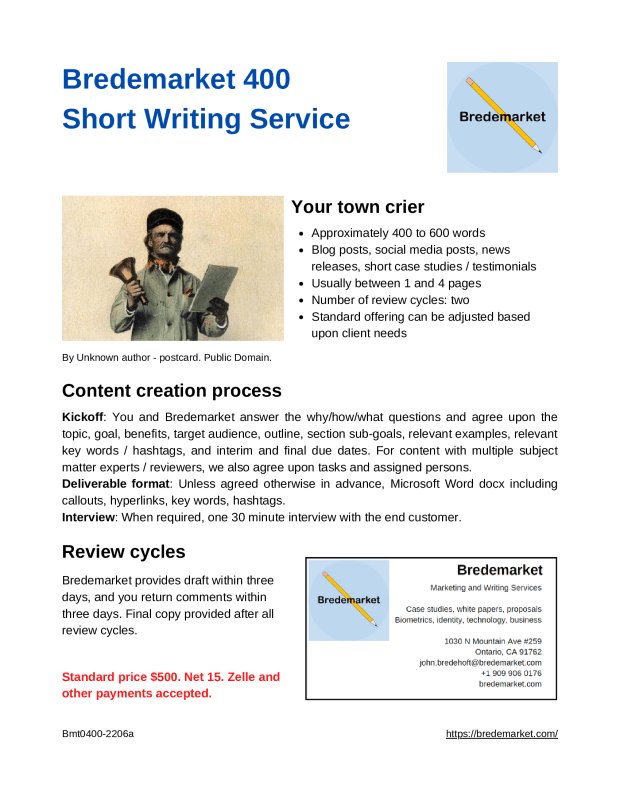
One-page sheet for the Bredemarket 400 Short Writing Service. More information here.

Perhaps you need to provide handouts to your prospects that describe your product or service.

Regardless of whether you call these handouts briefs, data, sheets, literature sheets, or something else, they should at a minimum contain both “educate” and “persuade” elements—educate your prospects on the benefits of your product or service, and persuade your prospects to move closer to a sale (conversion).

Again, you set the goal and tailor the content.

Web page content

If your business has a web page, I hope that it has more words than “Under construction.” Whether you have imagery, video, audio, text, or all four on your web page, it needs to answer the questions that your prospects and customers have.

You know what I’m going to say here, but it’s still important. You set the goal and tailor the content.

But…what if your business needs content that doesn’t fall into these traditional business categories?

Non-traditional content: going to a car show

I went to a car show this weekend—specifically, this year’s Route 66 Cruisin’ Reunion in downtown Ontario, California. (Yes, I know that Route 66 actually passed three miles north of downtown Ontario, but work with me here.)

While some of the exhibitors were personal, some of them were businesses. As businesses, what was the major marketing collateral that they generated?

Not a blog post, or LinkedIn article, or any of the traditional business media collateral.

Their marketing tools were the cars themselves.

So perhaps you may assume that car show exhibitors don’t need textual content. Your assumption would be incorrect.

From https://www.youtube.com/shorts/Ed9bn7lmtzA

In addition to the car itself, this exhibitor included poster boards with words describing the car.

Another exhibitor did the same thing.

So while these car show exhibitors didn’t choose a traditional way to convey their words, they shared written text anyway.

Your non-traditional business communication needs

Maybe you don’t have a classic car. Maybe you don’t have a car at all. Do you need to share words with your prospects and customers anyway?

Now I don’t know your business communication needs. You do. But I can guess a few things.

  1. Do you need to tell your clients/potential clients why you do what you do?
  2. Do you need to tell them how you do it?
  3. And last but not least, do you need to tell them what you do?

I know that this may seem like an unusual order to you. Why not start with what you do?

Because your customers don’t care about what you do. Your customers care about themselves.

If you keep the focus on your customers, the answer to the “why” question will induce your customers to care about you, because it shows how you can solve their problems.

Let’s illustrate this.

Why and how Bredemarket creates non-traditional content

You may be asking why I create content in the first place. There are countless content creators, both human and non-human. Why turn to me when OpenAI and its bot buddies are a lot cheaper and faster?

Normally I include my recent professional picture, but I have been writing since my college days (on a typewriter back then).

The simple answer is that I am obsessed with writing, and in this era of self-description, I self-describe as a “you can pry my keyboard out of my cold dead hands” type. (It used to be a typewriter, but let’s stick to this millennium.) And with my many years of personal and professional writing, I’ve honed my ability to take concepts and make them meaningful to readers.

Which brings me to how Bredemarket works.

  1. Bredemarket’s service is independent of content type. I don’t have a “Bredemarket blog writing service” or “Bredemarket data sheet writing service” or “Bredemarket case study writing service.” My services are based on word length, not content type, with my most popular service targeted to customers who need between 400 and 600 words of text. From this perspective, I don’t care if you want the words to appear on your website or your social media channel or a paper flyer or a sign next to your car or a really really long banner towed behind an airplane. (Read about the Bredemarket 400 Short Writing Service here.)
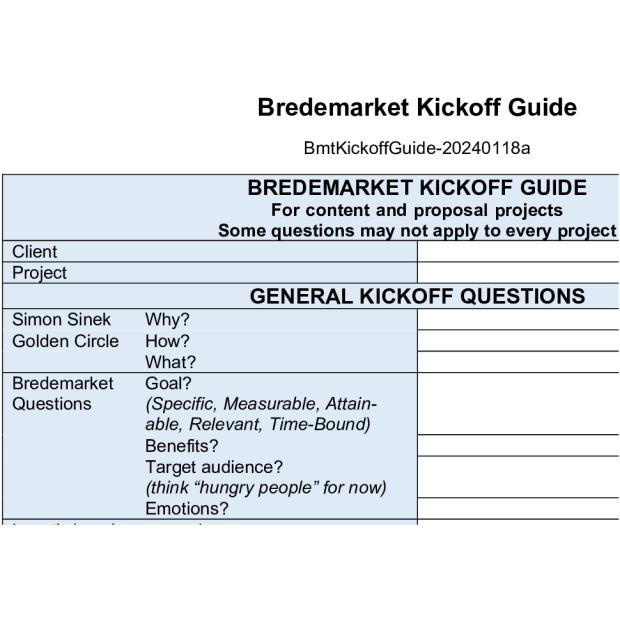
  2. Before I write a thing, I ask your some questions. It won’t surprise you to learn that my first questions to you are why, how, and what. I then move on to questions about your goal for the content, the benefits of your solution, the target audience for your solution, and many additional questions. (Read about the Six Questions Your Content Creator Should Ask You here.)
  3. Once the questions are out of the way, content creation is collaborative and iterative. I create a draft, you review it, and we repeat. The Bredemarket 400 service includes two review cycles; longer content needs include three review cycles. The goal is to ensure that both of us are happy with the final product.

Bredemarket’s process applies regardless of the specific content type, so I should be able to support whatever content you need, whether it’s traditional or non-traditional.

Can I help you?

And as an added bonus, here are some additional images from this weekend’s Cruisin’ Reunion. Enjoy.

From https://www.youtube.com/watch?v=0SboKOAmL5w

Product Marketers vs. Product Managers vs. Content Marketers

I’ve performed product marketing since 2015 (arguably earlier), and I performed that other similar-sounding role, product management, from 2000 to 2009. The two roles certainly have similarities such as customer focus, but they may be different.

Or may not. There’s no standard job description for a product marketer, and product marketing needs vary between companies.

I say more about this, and about the responsibilities shown in the survey above (including the fact that the majority of product marketers are also content marketers), in a LinkedIn post (not an article) that I published on my personal profile today.