Why Apple Vision Pro Is a Technological Biometric Advance, but Not a Revolutionary Biometric Event

(Part of the biometric product marketing expert series)

(UPDATE JUNE 24: CORRECTED THE YEAR THAT COVID BEGAN.)

I haven’t said anything publicly about Apple Vision Pro, so it’s time for me to be “how do you do fellow kids” trendy and jump on the bandwagon.

Actually…

It ISN’T time for me to jump on the Apple Vision Pro bandwagon, because while Apple Vision Pro affects the biometric industry, it’s not a REVOLUTIONARY biometric event.

The four revolutionary biometric events in the 21st century

How do I define a “revolutionary biometric event”?

By Alberto Korda – Museo Che Guevara, Havana Cuba, Public Domain, https://commons.wikimedia.org/w/index.php?curid=6816940

I define it as something that completely transforms the biometric industry.

When I mention three of the four revolutionary biometric events in the 21st century, you will understand what I mean.

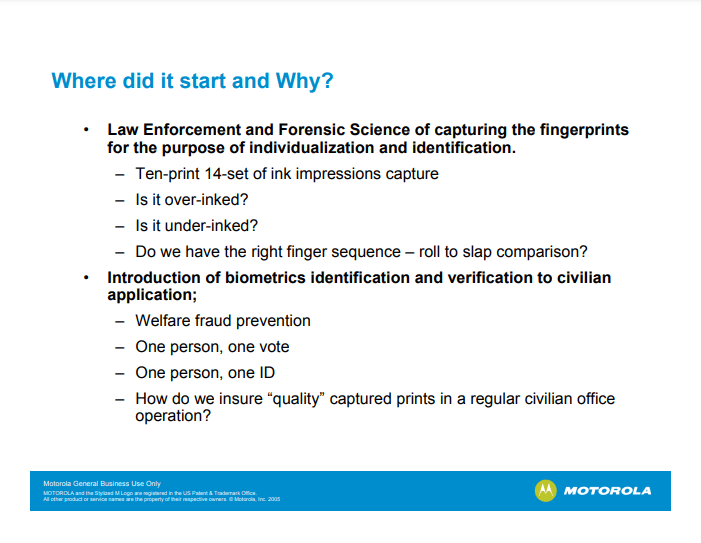
  • 9/11. After 9/11, orders of biometric devices skyrocketed, and biometrics were incorporated into identity documents such as passports and driver’s licenses. Who knows, maybe someday we’ll actually implement REAL ID in the United States. The latest extension of the REAL ID enforcement date moved it out to May 7, 2025. (Subject to change, of course.)
  • The Boston Marathon bombings, April 2013. After the bombings, the FBI was challenged in managing and analyzing countless hours of video evidence. Companies such as IDEMIA National Security Solutions, MorphoTrak, Motorola, Paravision, Rank One Computing, and many others have tirelessly worked to address this challenge, while ensuring that facial recognition results accurately identify perpetrators while protecting the privacy of others in the video feeds.
  • COVID-19, spring 2020 and beyond. COVID accelerated changes that were already taking place in the biometric industry. COVID prioritized mobile, remote, and contactless interactions and forced businesses to address issues that were not as critical previously, such as liveness detection.

These three are cataclysmic world events that had a profound impact on biometrics. The fourth one, which occurred after the Boston Marathon bombings but before COVID, was…an introduction of a product feature.

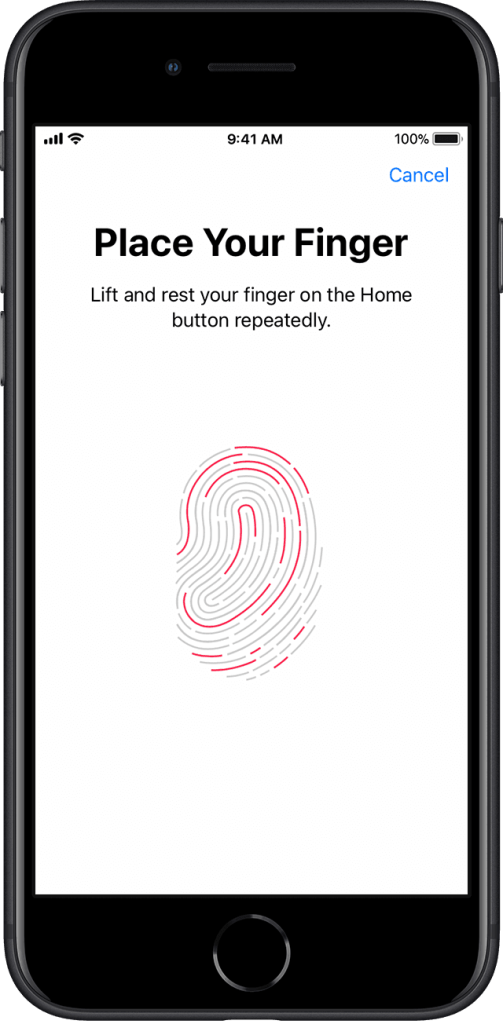
  • Touch ID, September 2013. When Apple introduced the iPhone 5s, it also introduced a new way to log in to the device. Rather than entering a passcode, iPhone 5S users could just use their finger to log in. The technical accomplishment was dwarfed by the legitimacy that this brought to using fingerprints for identification. Before 2013, attempts to implement fingerprint verification for benefits recipients were resisted because fingerprinting was something that criminals did. After September 2013, fingerprinting was something that the cool Apple kids did. The biometric industry changed overnight.

Of course, Apple followed Touch ID with Face ID, with adherents of the competing biometric modalities sparring over which was better. But Face ID wouldn’t have been accepted as widely if Touch ID hadn’t paved the way.

So why hasn’t iris verification taken off?

Iris verification has been around for decades (I remember Iridian before L-1; it’s now part of IDEMIA), but iris verification is nowhere near as popular in the general population as finger and face verification. There are two reasons for this:

  • Compared to other biometrics, irises are hard to capture. To capture a fingerprint, you can lay your finger on a capture device, or “slap” your four fingers on a capture device, or even “wave” your fingers across a capture device. Faces are even easier to capture; while older face capture systems required you to stand close to the camera, modern face devices can capture your face as you are walking by the camera, or even if you are some distance from the camera.
  • Compared to other biometrics, irises are expensive to capture. Many years ago, my then-employer developed a technological marvel, an iris capture device that could accurately capture irises for people of any height. Unfortunately, the technological marvel cost thousands upon thousands of dollars, and no customers were going to use it when they could acquire fingerprint and face capture devices that were much less costly.

So while people rushed to implement finger and face capture on phones and other devices, iris capture was reserved for narrow verticals that required iris accuracy.

With one exception. Samsung incorporated Princeton Identity technology into its Samsung Galaxy S8 in 2017. But the iris security was breached by a “dummy eye” just a month later, in the same way that gummy fingers and face masks have defeated other biometric technologies. (This is why liveness detection is so important.) While Samsung continues to sell iris verification today, it hadn’t been adopted by Apple and therefore wasn’t cool.

Until now.

About the Apple Vision Pro and Optic ID

The Apple Vision Pro is not the first headset that was ever created, but the iPhone wasn’t the first smartphone either. And coming late to the game doesn’t matter. Apple’s visibility among trendsetters ensures that when Apple releases something, people take notice.

And when all of us heard about Vision Pro, one of the things that Apple shared about it was its verification technique. Not Touch ID or Face ID, but Optic ID. (I like naming consistency.)

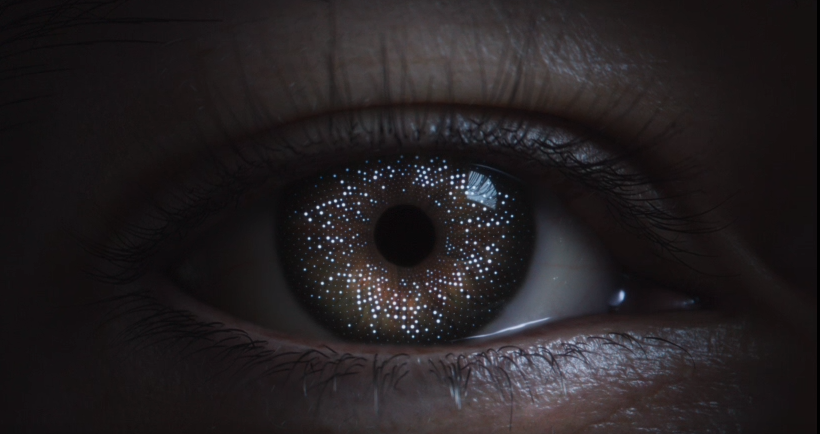
According to Apple, Optic ID works by analyzing a user’s iris through LED light exposure and then comparing it with an enrolled Optic ID stored on the device’s Secure Enclave….Optic ID will be used for everything from unlocking Vision Pro to using Apple Pay in your own headspace.

From The Verge, https://www.theverge.com/2023/6/5/23750147/apple-optic-id-vision-pro-iris-biometrics

So why did Apple incorporate Optic ID on this device and not the others?

There are multiple reasons, but one key reason is that the Vision Pro retails for US$3,499, which makes it easier for Apple to justify the cost of the iris components.

But the high price of the Vision Pro comes at…a price

However, that high price is also the reason why the Vision Pro is not going to revolutionize the biometric industry. CNET admitted that the Vision Pro is a niche item:

At $3,499, Apple’s Vision Pro costs more than three weeks worth of pay for the average American, according to Bureau of Labor Statistics data. It’s also significantly more expensive than rival devices like the upcoming $500 Meta Quest 3, $550 Sony PlayStation VR 2 and even the $1,000 Meta Quest Pro

From CNET, https://www.cnet.com/tech/computing/why-apple-vision-pros-3500-price-makes-more-sense-than-you-think/

Now CNET did go on to say the following:

With Vision Pro, Apple is trying to establish what it believes will be the next major evolution of the personal computer. That’s a bigger goal than selling millions of units on launch day, and a shift like that doesn’t happen overnight, no matter what the price is. The version of Vision Pro that Apple launches next year likely isn’t the one that most people will buy.

From CNET, https://www.cnet.com/tech/computing/why-apple-vision-pros-3500-price-makes-more-sense-than-you-think/

Certainly Vision Pro and Optic ID have the potential to revolutionize the computing industry…in the long term. And as that happens, the use of iris biometrics will become more popular with the general public…in the long term.

But not today. You’ll have to wait a little longer for the next biometric revolution. And hopefully it won’t be a catastrophic event like three of the previous revolutions.

How Can Your Identity Business Create the RIGHT Written Content?

Does your identity business provide biometric or non-biometric products and services that use finger, face, iris, DNA, voice, government documents, geolocation, or other factors or modalities?

Does your identity business need written content, such as blog posts (from the identity/biometric blog expert), case studies, data sheets, proposal text, social media posts, or white papers?

How can your identity business (with the help of an identity content marketing expert) create the right written content?

For the answer, click here.

Using “Multispectral” and “Liveness” in the Same Sentence

(Part of the biometric product marketing expert series)

Now that I’m plunging back into the fingerprint world, I’m thinking about all the different types of fingerprint readers.

  • The optical fingerprint and palm print readers are still around.
  • And the capacitive fingerprint readers still, um, persist.
  • And of course you have the contactless fingerprint readers such as MorphoWave, one that I know about.
  • And then you have the multispectral fingerprint readers.

What is multispectral?

Bayometric offers a web page that covers some of these fingerprint reader types, and points out the drawbacks of some of the readers they discuss.

Latent prints are usually produced by sweat, skin debris or other sebaceous excretions that cover up the palmar surface of the fingertips. If a latent print is on the glass platen of the optical sensor and light is directed on it, this print can fool the optical scanner….

Capacitive sensors can be spoofed by using gelatin based soft artificial fingers.

From https://www.bayometric.com/fingerprint-reader-technology-comparison/

There is another weakness of these types of readers. Some professions damage and wear away a person’s fingerprint ridges. Examples of professions whose practitioners exhibit worn ridges include construction workers and biometric content marketing experts (who, at least in the old days, handled a lot of paper).

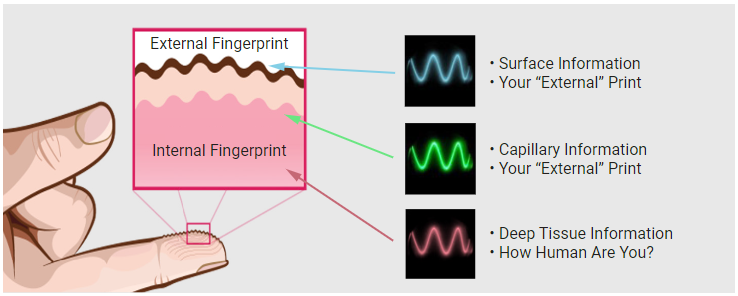
The solution is to design a fingerprint reader that not only examines the surface of the finger, but goes deeper.

From HID Global, “A Guide to MSI Technology: How It Works,” https://blog.hidglobal.com/2022/10/guide-msi-technology-how-it-works

The specialty of multispectral sensors is that it can capture the features of the tissue that lie below the skin surface as well as the usual features on the finger surface. The features under the skin surface are able to provide a second representation of the pattern on the fingerprint surface.

From https://www.bayometric.com/fingerprint-reader-technology-comparison/

Multispectral sensors are nothing new. When I worked for Motorola, Motorola Ventures had invested in a company called Lumidigm that produced multispectral fingerprint sensors; they were much more expensive than your typical optical or capacitive sensor, but were much more effective in capturing true fingerprints to the subdermal level.

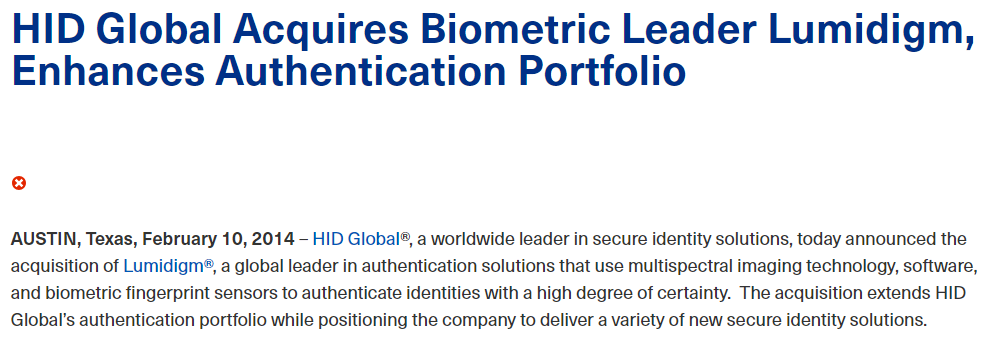
Lumidigm was eventually acquired in 2014: not by Motorola (who sold off its biometric assets such as Printrak and Symbol), but by HID Global. This company continues to produce Lumidigm-branded multispectral fingerprint sensors to this day.

But let’s take a look at the other word I bandied about.

What is liveness?

KISS, Alive! By Obtained from allmusic.com., Fair use, https://en.wikipedia.org/w/index.php?curid=2194847

“Gelatin based soft artificial fingers” aren’t the only way to fool a biometric sensor, whether you’re talking about a fingerprint sensor or some other sensor such as a face sensor.

Regardless of the biometric modality, the intent is the same; instead of capturing a true biometric from a person, the biometric sensor is fooled into capturing a fake biometric: an artificial finger, a face with a mask on it, or a face on a video screen (rather than a face of a live person).

This tomfoolery is called a “presentation attack” (becuase you’re attacking security with a fake presentation).

But the standards folks have developed ISO/IEC 30107-3:2023, Information technology — Biometric presentation attack detection — Part 3: Testing and reporting.

And an organization called iBeta is one of the testing facilities authorized to test in accordance with the standard and to determine whether a biometric reader can detect the “liveness” of a biometric sample.

(Friends, I’m not going to get into passive liveness and active liveness. That’s best saved for another day.)

[UPDATE 4/24/2024: I FINALLY ADDRESSED THE DIFFERENCE BETWEEN ACTIVE AND PASSIVE LIVENESS HERE.]

Multispectral liveness

While multispectral fingerprint readers aren’t the only fingerprint readers, or the only biometric readers, that iBeta has tested for liveness, the HID Global Lumidigm readers conform to Level 2 (the higher level) of iBeta testing.

There’s a confirmation letter and everything.

From the iBeta website.

This letter was issued in 2021. For some odd reason, HID Global decided to publicize this in 2023.

Oh well. It’s good to occasionally remind people of stuff.

Updates, updates, updates…

When keeping your websites updated, I advise you to do as I say, not as I do. Two of my websites were significantly out of date and needed hurried corrections.

Designed by Freepik.

I realized this morning that the “My Experience” page on my jebredcal website was roughly a year out of date, so I hurriedly added content to it. Now the page will turn up in searches for the acronym “ABM” (OK, maybe not on the first page of the search results).

Then I had to return to this website to make some hurried updates, since my April 2022 prohibition on taking certain types of work is no longer in effect as of June 2023. Hence, my home page, my “What I Do” page, and (obviously) my identity page are all corrected.

Oh yeah, I updated my Calendly availability hours also. Which is good, because I already have two meetings booked this week.

Which reminds me…if you need Bredemarket’s services:

My…Umm..Opportunity is YOUR Opportunity

A little over a year ago, Bredemarket announced two changes in my business scope and business hours. I stopped accepting work from clients who marketed systems to identify individuals, and I reduced my business hours to Saturday mornings only.

Generated at craiyon.com.

I had to change my business scope and business hours. On May 9, 2022, I started a full-time position with a company in the identity industry, which meant that I couldn’t consult on weekdays and couldn’t consult on identity projects.

But things change.

As of May 31, 2023, I will no longer be employed at my day job.

Which is my misfortune…um…opportunity.

Generated at craiyon.com.

Has Bredemarket changed its business scope and business hours a second time?

Yes.

As of June 1, 2023:

  • If you need a consultant for marketing or proposal work, and your company is involved in the identification of individuals, Bredemarket can accept the work.
  • If you need a consultant who can meet with you during normal business hours, Bredemarket can accept the work.

So what?

My…um…opportunity is your opportunity.

Now that I can expand my business scope and business hours again, you can take advantage of my extensive marketing expertise, including deep experience in the identity industry.

This means you can obtain quickly-generated and expert content with an agreed-upon focus.

This means you can get content that increases your revenue.

What kind of content?

Blog posts, case studies and testimonials, proposals and proposal text, white papers, and many other types of content.

How about e-books?

Yes I also write e-books.

These two e-books explain (a) how Bredemarket starts a project with you, and (b) how Bredemarket has helped other businesses over the years.

(UPDATE OCTOBER 22, 2023: “SIX QUESTIONS YOUR CONTENT CREATOR SHOULD ASK YOU IS SO 2022. DOWNLOAD THE NEWER “SEVEN QUESTIONS YOUR CONTENT CREATOR SHOULD ASK YOU” HERE.)

How can I find out more information about Bredemarket?

Contact me.

But wait…what if Bredemarket changes its business hours and business scope a THIRD time?

I very well could change Bredemarket’s business hours/scope again.

Maybe I’ll find a new full-time position in a couple of weeks, and I’ll again have to reduce hours and scope.

Which basically means that you have to ACT QUICKLY to ensure you can reserve my services.

(See “how to create a sense of urgency.”)

Generated at craiyon.com.

Two companies that can provide friction ridge/face marketing and writing services, now that Bredemarket won’t

I recently announced a change in business scope for my DBA Bredemarket. Specifically, Bredemarket will no longer accept client work for solutions that identify individuals using (a) friction ridges (including fingerprints and palm prints) and/or (b) faces.

This impacts some companies that previously did business with me, and can potentially impact other companies that want to do business with me. If you are one of these companies, I am no longer available.

Fingerprint evidence
From https://nvlpubs.nist.gov/nistpubs/SpecialPublications/NIST.SP.500-290e3.pdf (a/k/a “leisure reading for biometric system professionals”).

Since Bredemarket will no longer help you with your friction ridge/face marketing and writing needs, who will? Who has the expertise to help you? I have two suggestions.

Tandem Technical Writing

Do you need someon who is not only an excellent communicator, but also knows the ins and outs of AFIS and ABIS systems? Turn to Tandem Technical Writing LLC.

I first met Laurel Jew back in 1995 when I started consulting with, and then working for, Printrak. In fact, I joined Printrak when Laurel went on maternity leave. (I was one of two people who joined Printrak at that time. As I’ve previously noted, Laurel needed two people to replace her.)

Laurel worked for Printrak and its predecessor De La Rue Printrak for several years in its proposals organization.

Today, her biometric and communication experience is available to you. Tandem Technical Writing provides its clients with “15 years of proposal writing and biometrics technology background with high win %.”

Why does this matter to you? Because Laurel not only understands your biometric business, but also understands how to communicate to your biometric clients. Not many people can do both, so Laurel is a rarity in this industry.

The Tandem Technical Writing website is here.

To schedule a consultation, click here.

Applied Forensic Services

Perhaps your needs are more technical. Maybe you need someone who is a certified forensics professional, and who has also implemented many biometric systems. If that is your need, then you will want to consider Applied Forensic Services LLC.

I met Mike French in 2009 when Safran acquired Motorola’s biometric business and merged it into its U.S. subsidiary Sagem Morpho, creating MorphoTrak (“Morpho” + “Printrak”). I worked with him at MorphoTrak and IDEMIA until 2020.

Unlike me, Mike is a true forensic professional. (See his LinkedIn profile.) Back in 1994, when I was still learning to spell AFIS, Mike joined the latent print unit at the King County (Washington) Sheriff’s Office, where he spent over a decade before joining Sagem Morpho. He is an IAI-certified Latent Print Examiner, an IEEE-certified Biometric Professional, and an active participant in IAI and other forensic activities. I’ve previously referenced his advice on why agencies should conduct their own AFIS benchmarks.

Why does this matter to you? Because Mike’s consultancy, Applied Forensic Services, can provide expert advice on biometric procurements and implementation, ensuring that you get the biometric system that addresses your needs.

Applied Forensic Services offers the following consulting services:

The Applied Forensic Services website is here.

To schedule a consultation, click here.

Yes, there are others

There are other companies that can help you with friction ridge and face marketing, writing, and consultation services.

I specifically mention these two because I have worked with their principals both as an employee during my Printrak-to-IDEMIA years, and as a sole proprietor during my Bredemarket years. Laurel and Mike are both knowledgeable, dedicated, and can add value to your firm or agency.

And, unlike some experienced friction ridge and face experts, Laurel and Mike are still working and have not retired. (“Where have you gone, Peter Higgins…”)

Bredemarket announcement: change in business scope

Effective immediately:

  1. Bredemarket does not accept client work for solutions that identify individuals using (a) friction ridges (including fingerprints and palm prints) and/or (b) faces.
  2. Bredemarket does not accept client work for solutions that identify individuals using secure documents, such as driver’s licenses or passports. 

Is “common sense” enough for a jury to consider expert testimony? (min version)

(Welcome to my A/B test. For the other version of this post, click here.)

As I’ve previously noted, the 2009 NAS report on forensic science has revolutionized fingerprint identification and a number of other forensic disciplines.

One part of this revolution was the Department of Justice 2018 document entitled “UNIFORM LANGUAGE FOR TESTIMONY AND REPORTS FOR THE FORENSIC LATENT PRINT DISCIPLINE.” A PDF version of the report can be found here.

This document applies to Department of Justice examiners who are authorized to prepare reports and provide expert witness testimony regarding the forensic examination of latent print evidence.

From https://www.justice.gov/olp/page/file/1083691/download

Based upon the NAS report and subsequent efforts, Part IV of the DOJ document (“Qualifications and Limitations of Forensic Latent Print Examinations”) sets some clear guidelines about how a latent print examiner should describe his or her findings.

From https://www.justice.gov/olp/page/file/1083691/download

So a pre-2009 latent print examiner who appeared in court and said “I am 100% certain that these two fingerprints belong to the same person, to the exclusion of all other persons, because I have never been wrong in the last 25 years” would fail the 2018 DOJ criteria.

But would a jury know that?

That’s what CSAFE discussed in a recent post, “AAFS 2022 RECAP: UNDERSTANDING JUROR COMPREHENSION OF FORENSIC TESTIMONY: ASSESSING JURORS’ DECISION MAKING AND EVIDENCE EVALUATION.” Feel free to read the entire article, or if you like you can read my “succinct” excerpt from two portions of the article:

Koolmees and her colleagues examined whether jurors could distinguish low-quality testimony from high-quality testimony of forensic experts, using the language guidelines released by the Department of Justice (DOJ) in 2018 as an indicator of quality….

Only when comparing the conditions of zero guideline violations and four and five violations were there any changes in guilty verdicts, signifying jurors may notice a change in the quality of forensic testimony only when the quality is severely low.

From https://forensicstats.org/blog/2022/03/29/aafs-2022-recap-understanding-juror-comprehension-of-forensic-testimony-assessing-jurors-decision-making-and-evidence-evaluation/

So this raises the question of whether the NAS report, for all of its revolutionary effects, will have any true results in courtroom testimony.

  • Will jurors heed the advice from the DOJ guidelines to accurately consider the testimony of a forensic expert?
  • Or will the jurors’ “common sense,” based on old Perry Mason and C.S.I. TV shows, prevent jurors from consiering expert testimony in the correct light?

Is “common sense” enough for a jury to consider expert testimony? (max version)

(Welcome to my A/B test. For the other version of this post, click here.)

I feel like Ben Maller, a sports radio broadcaster who likes to take three seemingly unrelated phrases and spin them into a monologue.

For this post, the three phrases are “common sense,” “succinct,” and “expert juror testimony.”

I want to (succinctly) pose the question, “Is ‘common sense’ enough for a jury to consider expert testimony?'”

Common Sense

Mitch Wagner recently shared a New Yorker article by Matthew Hutson that claimed that artificial intelligence was lacking in “common sense.” Here is one of the examples cited in the article:

By definition, common sense is something everyone has; it doesn’t sound like a big deal. But imagine living without it and it comes into clearer focus. Suppose you’re a robot visiting a carnival, and you confront a fun-house mirror; bereft of common sense, you might wonder if your body has suddenly changed. 

From https://www.newyorker.com/tech/annals-of-technology/can-computers-learn-common-sense

But is the human ability to discern that one’s body was NOT modified truly “common sense”? I argued otherwise in a comment on Wagner’s LinkedIn post.

But is there really a difference between “common sense” and the data acquisition that AI engines perform?

Take the fun-house mirror example in the article. When I first encountered a fun-house mirror, I would either (a) think like a robot and wonder if my body had changed, or (b) draw upon a vast reservoir of past experiences with mirrors and bent objects to deduce that this particular mirror had properties that would display my body in a different way. A person who had never encountered a mirror or a bent object would not have the “common sense” to realize how a fun-house mirror operates.

From https://www.linkedin.com/feed/update/urn:li:activity:6917849217554100225/?commentUrn=urn%3Ali%3Acomment%3A%28activity%3A6917849217554100225%2C6917865639671980032%29

Perhaps I’m wrong, but it seems that everyone takes cues from their past experiences (touching a hot stove, or watching “Perry Mason” or “C.S.I.” on TV), and that helps form our “common sense.”

Succinct

If you read my original comment on Wagner’s post, you’ll notice that I only reproduced the first part here, since the other parts weren’t relevant to this post.

Concise writing is something that Becca Phengvath of Robin Writers reminded us about in a recent post. She started by telling a story about a meeting with one of her college English teachers to review a writing assignment.

“This is good,” she said. But I felt her preparing to say more. 

“But look what happens when you remove ‘able to’,” she added, pointing to several spots where I wrote the phrase. “It’s never really needed, see?” 

She read a few of my sentences with “able to” omitted and I was shocked at how it immediately strengthened my writing. Since then, I have very very rarely used that phrase in my writing thanks to her.

From https://robinwriters.com/2022/04/07/how-to-make-your-writing-more-concise/

I liked this post so much that I shared in on various social accounts, with the following comment:

I really need to do this more often.

I should do this more.

Expert Juror Testimony

Now let’s get to the meat of the post. (I could have left the first two parts of the post out, I guess, but I wanted to provide some background.)

As I’ve previously noted, the 2009 NAS report on forensic science has revolutionized fingerprint identification and a number of other forensic disciplines.

One part of this revolution was the Department of Justice 2018 document entitled “UNIFORM LANGUAGE FOR TESTIMONY AND REPORTS FOR THE FORENSIC LATENT PRINT DISCIPLINE.” A PDF version of the report can be found here.

This document applies to Department of Justice examiners who are authorized to prepare reports and provide expert witness testimony regarding the forensic examination of latent print evidence.

From https://www.justice.gov/olp/page/file/1083691/download

Based upon the NAS report and subsequent efforts, Part IV of the DOJ document (“Qualifications and Limitations of Forensic Latent Print Examinations”) sets some clear guidelines about how a latent print examiner should describe his or her findings.

From https://www.justice.gov/olp/page/file/1083691/download

So a pre-2009 latent print examiner who appeared in court and said “I am 100% certain that these two fingerprints belong to the same person, to the exclusion of all other persons, because I have never been wrong in the last 25 years” would fail the 2018 DOJ criteria.

(Remember that even experienced examiners have been wrong before, as was shown in the Brandon Mayfield case.)

But would a jury know that?

That’s what CSAFE discussed in a recent post, “AAFS 2022 RECAP: UNDERSTANDING JUROR COMPREHENSION OF FORENSIC TESTIMONY: ASSESSING JURORS’ DECISION MAKING AND EVIDENCE EVALUATION.” Feel free to read the entire article, or if you like you can read my “succinct” excerpt from two portions of the article:

Koolmees and her colleagues examined whether jurors could distinguish low-quality testimony from high-quality testimony of forensic experts, using the language guidelines released by the Department of Justice (DOJ) in 2018 as an indicator of quality….

Only when comparing the conditions of zero guideline violations and four and five violations were there any changes in guilty verdicts, signifying jurors may notice a change in the quality of forensic testimony only when the quality is severely low.

From https://forensicstats.org/blog/2022/03/29/aafs-2022-recap-understanding-juror-comprehension-of-forensic-testimony-assessing-jurors-decision-making-and-evidence-evaluation/

Think about it. While forensic and criminal justice professionals, who have been immersed in forensic science testimony debates for over a decade, would be unimpressed by someone testifying that two fingerprints are a “100% match,” there’s a good chance that a jury would be very impressed with an “expert” who provided such convincing testimony.

So this raises the question of whether the NAS report, for all of its revolutionary effects, will have any true results in courtroom testimony.

  • Will jurors heed the advice from the DOJ guidelines to accurately consider the testimony of a forensic expert?
  • Or will the jurors’ “common sense,” based on old Perry Mason and C.S.I. TV shows, prevent jurors from consiering expert testimony in the correct light?

Tech5: Updating my contactless fingerprint capture post from October 2021

I’ve worked in the general area of contactless fingerprint capture for years, initially while working for a NIST CRADA partner. While most of the NIST CRADA partners are still pursuing contactless fingerprint technology, there are also new entrants.

In the pre-COVID days, the primary advantage of contactless fingerprint capture was speed. As I noted in an October 2021 post:

Actually this effort launched before that, as there were efforts in 2004 and following years to capture a complete set of fingerprints within 15 seconds; those efforts led, among other things, to the smartphone software we are seeing today.

From https://bredemarket.com/2021/10/04/contactless-fingerprint-scanning-almost-software-at-connectid/

By 2016, several companies had entered into cooperative research and development agreements with NIST to develop contactless fingerprint capture software, either for dedicated devices or for smartphones. Most of those early CRADA participants are still around today, albeit under different names.

Of the CRADA partners, MorphoTrak is now IDEMIA, Diamond Fortress is now Telos ID, Hoyos Labs is now Veridium, AOS is no longer in operation, and 3M’s biometric holdings are now part of Thales. Slide 10 from the NIST presentation posted at https://www.nist.gov/system/files/documents/2016/12/14/iai_2016-nist_contactless_fingerprints-distro-20160811.pdf

I’ve previously written posts about two of these CRADA partners, Telos ID (previously Diamond Fortress) and Sciometrics (the supplier for Integrated Biometrics).

But these aren’t the only players in the contactless fingerprint market. There are always new entrants in a market where there is opportunity.

A month before I wrote my post about Integrated Biometrics/Sciometrics’ SlapShot, a company called Tech5 released its own product.

T5-AirSnap Finger uses a smartphone’s built-in camera to perform finger detection, enhancement, image processing and scaling, generating images that can be transmitted for identity verification or registration within seconds, according to the announcement. The resulting images are suitable for use with standard AFIS solutions, and comparison against legacy datasets…

From https://www.biometricupdate.com/202109/tech5-contactless-fingerprint-biometrics-for-mobile-devices-unveiled

This particular article quoted Tech5 Co-founder/CEO Machiel van der Harst. A subsequent article quoted Tech5 Co-Founder/CTO Rahul Parthe. Both co-founders previously worked for L-1 Identity Solutions (now part of IDEMIA).

Parthe has noted the importance of smartphone-based contactless fingerprint capture:

“We all carry these awesome computers in our hands,” Parthe explains. “It’s a perfectly packaged hardware device that is ideal for any capture technology. Smartphones are powerful compute devices on the edge, with a nice integrated camera with auto-focus and flash. And now phones also come with multiple cameras which can help with better focus and depth estimation. This allows the users to take photos of their fingers and the software takes care of the rest. I’d just like to point out here that we’re talking about using the phone’s camera to capture biometrics and using a smartphone to take the place of a dedicated reader. We’re not talking about the in-built fingerprint acquisition we’re all familiar with on many devices which is the means of accessing the device itself.”

From https://www.biometricupdate.com/202202/contactless-fingerprinting-maturation-allows-the-unification-of-biometric-capture-using-smartphones

I’ve made a similar point before. While dedicated devices may not completely disappear, multi-purpose devices that we already have are the preferable way to go.

For more information about T5-AirSnap Finger, visit this page.

Tech5’s results for NIST’s Proprietary Fingerprint Template (PFT) Evaluation III, possibly using an algorithm similar to that in T5-AirSnap Finger, are detailed here.