There are various types of dedicated fingerprint reader devices, including multispectral readers that can examine the subdermal layers of your fingers. Even if your surface fingerprints are worn away by bricklaying, time, or other factors, multispectral fingerprint readers can identify you anyway.
Before you can fully understand the difference between personally identifiable information (PII) and protected health information (PHI), you need to understand the difference between biometrics and…biometrics. (You know sometimes words have two meanings.)
Designed by Google Gemini.
The definitions of biometrics
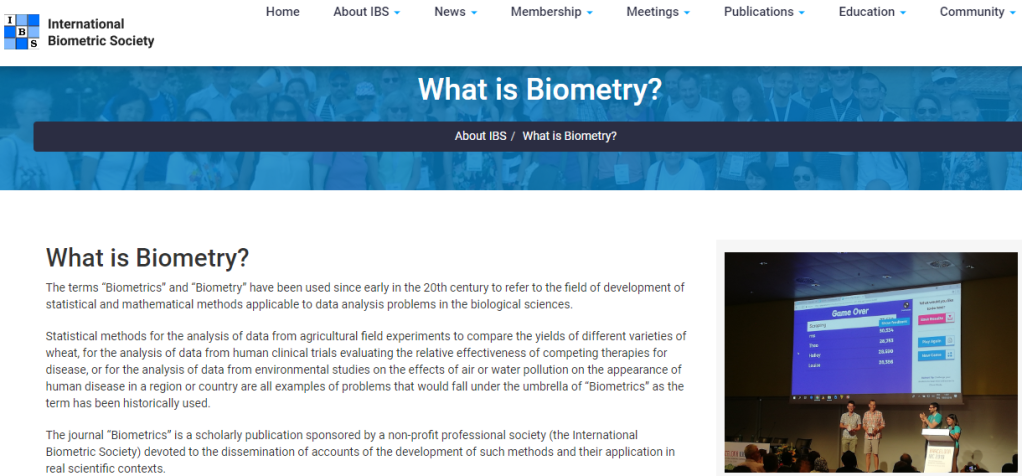
To address the difference between biometrics and biometrics, I’ll refer to something I wrote over two years ago, in late 2021. In that post, I quoted two paragraphs from the International Biometric Society that illustrated the difference.
Since the IBS has altered these paragraphs in the intervening years, I will quote from the latest version.
The terms “Biometrics” and “Biometry” have been used since early in the 20th century to refer to the field of development of statistical and mathematical methods applicable to data analysis problems in the biological sciences.
Statistical methods for the analysis of data from agricultural field experiments to compare the yields of different varieties of wheat, for the analysis of data from human clinical trials evaluating the relative effectiveness of competing therapies for disease, or for the analysis of data from environmental studies on the effects of air or water pollution on the appearance of human disease in a region or country are all examples of problems that would fall under the umbrella of “Biometrics” as the term has been historically used….
The term “Biometrics” has also been used to refer to the field of technology devoted to the identification of individuals using biological traits, such as those based on retinal or iris scanning, fingerprints, or face recognition. Neither the journal “Biometrics” nor the International Biometric Society is engaged in research, marketing, or reporting related to this technology. Likewise, the editors and staff of the journal are not knowledgeable in this area.
In brief, what I call “broad biometrics” refers to analyzing biological sciences data, ranging from crop yields to heart rates. Contrast this with what I call “narrow biometrics,” which (usually) refers only to human beings, and only to those characteristics that identify human beings, such as the ridges on a fingerprint.
The definition of “personally identifiable information” (PII)
Information that can be used to distinguish or trace an individual’s identity, either alone or when combined with other information that is linked or linkable to a specific individual.
Note the key words “alone or when combined.” The ten numbers “909 867 5309” are not sufficient to identify an individual alone, but can identify someone when combined with information from another source, such as a telephone book.
What types of information can be combined to identify a person? The U.S. Department of Defense’s Privacy, Civil Liberties, and Freedom of Information Directorate provides multifarious examples of PII, including:
Social Security Number.
Passport number.
Driver’s license number.
Taxpayer identification number.
Patient identification number.
Financial account number.
Credit card number.
Personal address.
Personal telephone number.
Photographic image of a face.
X-rays.
Fingerprints.
Retina scan.
Voice signature.
Facial geometry.
Date of birth.
Place of birth.
Race.
Religion.
Geographical indicators.
Employment information.
Medical information.
Education information.
Financial information.
Now you may ask yourself, “How can I identify someone by a non-unique birthdate? A lot of people were born on the same day!”
But the combination of information is powerful, as researchers discovered in a 2015 study cited by the New York Times.
In the study, titled “Unique in the Shopping Mall: On the Reidentifiability of Credit Card Metadata,” a group of data scientists analyzed credit card transactions made by 1.1 million people in 10,000 stores over a three-month period. The data set contained details including the date of each transaction, amount charged and name of the store.
Although the information had been “anonymized” by removing personal details like names and account numbers, the uniqueness of people’s behavior made it easy to single them out.
In fact, knowing just four random pieces of information was enough to reidentify 90 percent of the shoppers as unique individuals and to uncover their records, researchers calculated. And that uniqueness of behavior — or “unicity,” as the researchers termed it — combined with publicly available information, like Instagram or Twitter posts, could make it possible to reidentify people’s records by name.
Now biometrics only form part of the multifarious list of data cited above, but clearly biometric data can be combined with other data to identify someone. An easy example is taking security camera footage of the face of a person walking into a store, and combining that data with the same face taken from a database of driver’s license holders. In some jurisdictions, some entities are legally permitted to combine this data, while others are legally prohibited from doing so. (A few do it anyway. But I digress.)
Because narrow biometric data used for identification, such as fingerprint ridges, can be combined with other data to personally identify an individual, organizations that process biometric data must undertake strict safeguards to protect that data. If personally identifiable information (PII) is not adequately guarded, people could be subject to fraud and other harms.
The definition of “protected health information” (PHI)
Protected Health Information. The Privacy Rule protects all “individually identifiable health information” held or transmitted by a covered entity or its business associate, in any form or media, whether electronic, paper, or oral. The Privacy Rule calls this information “protected health information (PHI).”12
“Individually identifiable health information” is information, including demographic data, that relates to:
the individual’s past, present or future physical or mental health or condition,
the provision of health care to the individual, or
the past, present, or future payment for the provision of health care to the individual,
and that identifies the individual or for which there is a reasonable basis to believe it can be used to identify the individual.13 Individually identifiable health information includes many common identifiers (e.g., name, address, birth date, Social Security Number).
The Privacy Rule excludes from protected health information employment records that a covered entity maintains in its capacity as an employer and education and certain other records subject to, or defined in, the Family Educational Rights and Privacy Act, 20 U.S.C. §1232g.
Now there’s obviously an overlap between personally identifiable information (PII) and protected health information (PHI). For example, names, dates of birth, and Social Security Numbers fall into both categories. But I want to highlight two things are are explicitly mentioned as PHI that aren’t usually cited as PII.
Physical or mental health data. This could include information that a medical professional captures from a patient, including biometric (broad biometric) information such as heart rate or blood pressure.
Health care provided to an individual. This not only includes written information such as prescriptions, but oral information (“take two aspirin and call my chatbot in the morning”). Yes, chatbot. Deal with it. Dr. Marcus Welby and his staff retired a long time ago.
Robert Young (“Marcus Welby”) and Jane Wyatt (“Margaret Anderson” on a different show). By ABC TelevisionUploaded by We hope at en.wikipedia – eBay itemphoto informationTransferred from en.wikipedia by SreeBot, Public Domain, https://commons.wikimedia.org/w/index.php?curid=16472486
Because broad biometric data used for analysis, such as heart rates, can be combined with other data to personally identify an individual, organizations that process biometric data must undertake strict safeguards to protect that data. If protected health information (PHI) is not adequately guarded, people could be subject to fraud and other harms.
Simple, isn’t it?
Actually, the parallels between identity/biometrics and healthcare have fascinated me for decades, since the dedicated hardware to capture identity/biometric data is often similar to the dedicated hardware to capture health data. And now that we’re moving away from dedicated hardware to multi-purpose hardware such as smartphones, the parallels are even more fascinating.
Apologies in advance, but if you’re NOT interested in fingerprints, you’ll want to skip over this Bredemarket identity/biometrics post, my THIRD one about fingerprint uniqueness and/or similarity or whatever because the difference between uniqueness and similarity really isn’t important, is it?
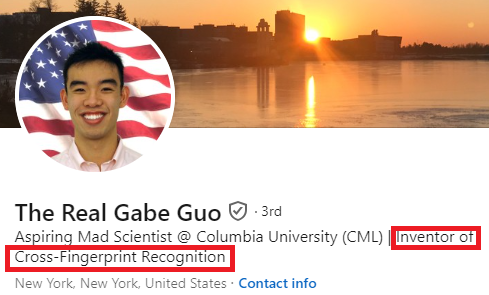
Yes, one more post about the study whose principal author was Gabe Guo, the self-styled “inventor of cross-fingerprint recognition.”
I also wrote something only on LinkedIn (and Facebook) that cited a CNN article that quoted Christophe Champod and Simon Cole. (Interestingly enough, my last post on Cole concerned how words matter, which is appropriate in this discussion.) Unfortunately, the person who wrote the CNN headline (“Are fingerprints unique? Not really, AI-based study finds”) didn’t pay attention to a word that Champod and Simon Cole said.
But don’t miss this
Well, two other people have weighed in on the paper: Glenn Langenburg and Eric Ray, co-presenters on the Double Loop Podcast. (“Double loop” is a fingerprint thing.)
So who are Langenburg and Ray? You can read their full biographies here, but both of them are certified latent print examiners. This certification, administered by the International Association for Identification, is designed to ensure that the certified person is knowledgeable about both latent (crime scene) fingerprints and known fingerprints, and how to determine whether or not two prints come from the same person. If someone is going to testify in court about fingerprint comparison, this certification is recognized as a way to designate someone as an expert on the subject, as opposed to a college undergraduate. (As of today, the list of IAI certified latent print examiners as of December 2023 can be found here in PDF form.)
Podcast episode 264 dives into the Columbia study in detail, including what the study said, what it didn’t say, and what the publicity for the study said that doesn’t match the study.
Eric and Glenn respond to the recent allegations that a computer science undergraduate at Columbia University, using Artificial Intelligence, has “proven that fingerprints aren’t unique” or at least…that’s how the media is mischaracterizing a new published paper by Guo, et al. The guys dissect the actual publication (“Unveiling intra-person fingerprint similarity via deep contrastive learning” in Science Advances, 2024 by Gabe Guo, et al.). They state very clearly what the paper actually does show, which is a far cry from the headlines and even public dissemination originating from Columbia University and the author. The guys talk about some of the important limitations of the study and how limited the application is to real forensic investigations. They then explore some of the media and social media outlets that have clearly misunderstood this paper and seem to have little understanding of forensic science. Finally, Eric and Glenn look at some quotes and comments from knowledgeable sources who also have recognized the flaws in the paper, the authors’ exaggerations, and lack of understanding of the value of their findings.
Yes, the episode is over an hour long, but if you want to hear a good discussion of the paper that goes beyond the headlines, I strongly recommend that you listen to it.
TL;DR
If you’re in a TL;DR frame of mind, I’ll just offer one tidbit: “uniqueness” and “similarity” are not identical. Frankly, they’re not even similar.
As you may have seen elsewhere, I’ve been wondering whether the widely-publicized Columbia University study on the uniqueness of fingerprints isn’t any more than a simple “discovery” of fingerprint patterns, which we’ve known about for years. But to prove or refute my suspicions, I had to read the study first.
My initial exposure to the Columbia study
I’ve been meaning to delve into the minutiae of the Columbia University fingerprint study ever since I initially wrote about it last Thursday.
(And yes, that’s a joke. The so-called experts say that the word “delve” is a mark of AI-generated content. And “minutiae”…well, you know.)
Gabe Guo, who freely admits that he knows nothing about forensic science, is an idiot. For decades we have known that fingerprints ARE unique, and the original forensic journals were correct in not publishing this drivel.
The brave new world of artificial intelligence is fundamentally disproving previously sacred assumptions, and anyone who resists these assumptions is denying scientific knowledge and should go back to their caves.
Well, let’s see what the study actually SAYS.
Until today, I hadn’t had a chance to read the study. But I wanted to do this, because a paragraph in the article that described the study got me thinking. I needed to see the study itself to confirm my suspicions.
“The AI was not using ‘minutiae,’ which are the branchings and endpoints in fingerprint ridges – the patterns used in traditional fingerprint comparison,” said Guo, who began the study as a first-year student at Columbia Engineering in 2021. “Instead, it was using something else, related to the angles and curvatures of the swirls and loops in the center of the fingerprint.”
I’ll preface this by saying that while I have worked with fingerprints for 29 years, I am nowhere near a forensic expert. I know enough to cause trouble.
But I know who the real forensic experts are, so I’m going to refer to a page on onin.com, the site created by Ed German. German, who is talented at explaining fingerprint concepts to lay people, created a page to explain “Level 1, 2 and 3 Details.” (It also explains ACE-V, for people interested in that term.)
Here are German’s quick explanations of Level 1, 2, and 3 detail. These are illustrated at the original page, but I’m just putting the textual definitions here.
“Level 1 includes the general ridge flow and pattern configuration. Level 1 detail is not sufficient for individualization, but can be used for exclusion. Level 1 detail may include information enabling orientation, core and delta location, and distinction of finger versus palm.”
“Level 2 detail includes formations, defined as a ridge ending, bifurcation, dot, or combinations thereof. The relationship of Level 2 detail enables individualization.”
“Level 3 detail includes all dimensional attributes of a ridge, such as ridge path deviation, width, shape, pores, edge contour, incipient ridges, breaks, creases, scars and other permanent details.”
We’re not going to get into Level 3 in this post. But if you look at German’s summary of Level 2, you’ll see that he is discussing the aforementioned MINUTIAE (which, according to German, “enables individualization”). And if you look at German’s summary of Level 1, he’s discussing RIDGE FLOW, or perhaps “the angles and curvatures of the swirls and loops in the center of the fingerprint” (which, according to German, “is not sufficient for individualization”).
I needed to read the original study to see what Guo actually said, and to determine if AI discovered something novel beyond what forensic scientists consider the information “in the center of the fingerprint.”
So let’s look at the study
I finally took the time to read the study, “Unveiling intra-person fingerprint similarity via deep contrastive learning,” as published in Science Advances on January 12. While there is a lot to read here, I’m going to skip to Guo et al’s description of the fingerprint comparison method used by AI. Central to this comparison is the concept of a “feature map.”
Figure 2A shows that all the feature maps exhibit a statistically significant ability to distinguish between pairs of distinct fingerprints from the same person and different people. However, some are clearly better than others. In general, the more fingerprint-like a feature map looks, the more strongly it shows the similarity. We highlight that the binarized images performed almost as well as the original images, meaning that the similarity is due mostly to inherent ridge patterns, rather than spurious characteristics (e.g., image brightness, image background noise, and pressure applied by the user when providing the sample). Furthermore, it is very interesting that ridge orientation maps perform almost as well as the binarized and original images—this suggests that most of the cross-finger similarity can actually be explained by ridge orientation.
(The implied reversal from the forensic order of things is interesting. Specifically, ridge orientation, which yields a bunch of rich data, is considered more authoritative than mere minutiae points, which are just teeny little dots that don’t look like a fingerprint. Forensic examiners consider the minutiae more authoritative than the ridge detail.)
Based upon the initial findings, Guo et al delved deeper. (Sorry, couldn’t help myself.) Specifically, they interrogated the feature maps.
We observe a trend in the filter visualizations going from the beginning to the end of the network: filters in earlier layers exhibit simpler ridge/minutia patterns, the middle layers show more complex multidirectional patterns, and filters in the last layer display high-level patterns that look much like fingerprints—this increasing complexity is expected of deep neural networks that process images. Furthermore, the ridge patterns in the filter visualizations are all generally the same shade of gray, meaning that we can rule out image brightness as a source of similarity. Overall, each of these visualizations resembles recognizable parts of fingerprint patterns (rather than random noise or background patterns), bolstering our confidence that the similarity learned by our deep models is due to genuine fingerprint patterns, and not spurious similarities.
And what are Guo et al’s derived ramifications? I’ll skip to the most eye-opening one, related to digital authentication.
In addition, our work can be useful in digital authentication scenarios. Using our fingerprint processing pipeline, a person can enroll into their device’s fingerprint scanner with one finger (e.g., left index) and unlock it with any other finger (e.g., right pinky). This increases convenience, and it is also useful in scenarios where the original finger a person enrolled with becomes temporarily or permanently unreadable (e.g., occluded by bandages or dirt, ridge patterns have been rubbed off due to traumatic event), as they can still access their device with their other fingers.
However, the researchers caution that (as any good researcher would say when angling for funds) more research is needed. Their biggest concern was the small sample size they used in their experiments (60,000 prints), coupled with the fact that the prints were full and not partial fingerprints.
What is unanswered?
So let’s assume that the study shows a strong similarity between the ridges of fingerprints from the same person. Is this enough to show:
that the prints from two fingers on the same person ARE THE SAME, and
that the prints from two fingers on the same person are more alike than a print from ANY OTHER PERSON?
Or to use a specific example, if we have Mike French’s fingers 2 (right index) and 7 (left index), are those demonstrably from the same person, while my own finger 2 is demonstrably NOT from Mike French?
And what happens if my finger 2 has the same ridge pattern as French’s finger 2, yet is different from French’s finger 7? Does that mean that my finger 2 and French’s finger 2 are from the same person?
If this happens, then the digital authentication example above wouldn’t work, because I could use my finger 2 to get access to French’s data.
This could get messy.
More research IS needed, and here’s what it should be
If you have an innovative idea for a way to build an automobile, is it best to never talk to an existing automobile expert at all?
Same with fingerprints. Don’t just leave the study with the AI folks. Bring the forensic people on board.
And the doctors also.
Initiate a conversation between the people who found this new AI technique, the forensic people who have used similar techniques to classify prints as arches, loops, whorls, etc., and the medical people who understand how the ridges are formed in the womb in the first place.
If you get all the involved parties in one room, then perhaps they can work together to decide whether the technique can truly be used to identify people.
I don’t expect that this discussion will settle once and for all whether every fingerprint is unique. At least not to the satisfaction of scientists.
But bringing the parties together is better than not listening to critical stakeholders at all.
Forensic examiners, YOU’RE DOING IT WRONG based on this bold claim:
“Columbia engineers have built a new AI that shatters a long-held belief in forensics–that fingerprints from different fingers of the same person are unique. It turns out they are similar, only we’ve been comparing fingerprints the wrong way!” (From Newswise)
Couple that claim with the initial rejection of the paper by multiple forensic journals because “it is well known that every fingerprint is unique” (apparently the reviewer never read the NAS report), and you have the makings of a sexy story.
Or do you?
And what is the paper’s basis for the claim that fingerprints from the same person are NOT unique?
““The AI was not using ‘minutiae,’ which are the branchings and endpoints in fingerprint ridges – the patterns used in traditional fingerprint comparison,” said Guo, who began the study as a first-year student at Columbia Engineering in 2021. “Instead, it was using something else, related to the angles and curvatures of the swirls and loops in the center of the fingerprint.”” (From Newswise)
Perhaps there are similarities in the patterns of the fingers at the center of a print, but that doesn’t negate the uniqueness of the bifurcations and ridge ending locations throughout the print. Guo’s method uses less of the distal fingerprint than traditional minutiae analysis.
But maybe there are forensic applications for this alternate print comparison technique, at least as an investigative lead. (Let me repeat that again: “investigative lead.”) Courtroom use will be limited because there is no AI equivalent to explain to the court how the comparison was made, and if any other expert AI algorithm would yield the same results.
As I said, I shared the piece above to several places, including one frequented by forensic experts. One commenter in a private area offered the following observation, in part:
What was the validation process? Did they have a qualified latent print examiner confirm their data?
From a private source.
Before you dismiss the comment as reflecting a stick-in-the-mud forensic old fogey who does not recognize the great wisdom of our AI overlords, remember (as I noted above) that forensic experts are required to testify in court about things like this. If artificial intelligence is claimed to identify relationships between fingers from the same person, you’d better make really sure that this is true before someone is put to death.
I hate to repeat the phrase used by scientific study authors in search of more funding, but…
This post concentrates on IDENTIFICATION perfection, or the ability to enjoy zero errors when identifying individuals.
The risk of claiming identification perfection (or any perfection) is that a SINGLE counter-example disproves the claim.
If you assert that your biometric solution offers 100% accuracy, a SINGLE false positive or false negative shatters the assertion.
If you claim that your presentation attack detection solution exposes deepfakes (face, voice, or other), then a SINGLE deepfake that gets past your solution disproves your claim.
And as for the pre-2009 claim that latent fingerprint examiners never make a mistake in an identification…well, ask Brandon Mayfield about that one.
In fact, I go so far as to avoid using the phrase “no two fingerprints are alike.” Many years ago (before 2009) in an International Association for Identification meeting, I heard someone justify the claim by saying, “We haven’t found a counter-example yet.” That doesn’t mean that we’ll NEVER find one.
At first glance, it appears that Motorola would be the last place to make a boneheaded mistake like that. After all, Motorola is known for its focus on quality.
But in actuality, Motorola was the perfect place to make such a mistake, since it was one of the champions of the “Six Sigma” philosophy (which targets a maximum of 3.4 defects per million opportunities). Motorola realized that manufacturing perfection is impossible, so manufacturers (and the people in Motorola’s weird Biometric Business Unit) should instead concentrate on reducing the error rate as much as possible.
So one misspelling could be tolerated, but I shudder to think what would have happened if I had misspelled “quality” a second time.
As identity/biometric professionals well know, there are five authentication factors that you can use to gain access to a person’s account. (You can also use these factors for identity verification to establish the person’s account in the first place.)
Something You Are. I’ve spent…a long time with this factor, since this is the factor that includes biometrics modalities (finger, face, iris, DNA, voice, vein, etc.). It also includes behavioral biometrics, provided that they are truly behavioral and relatively static.
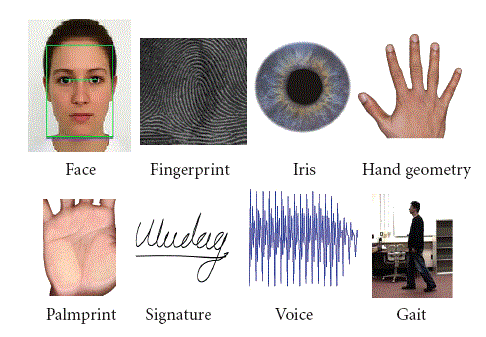
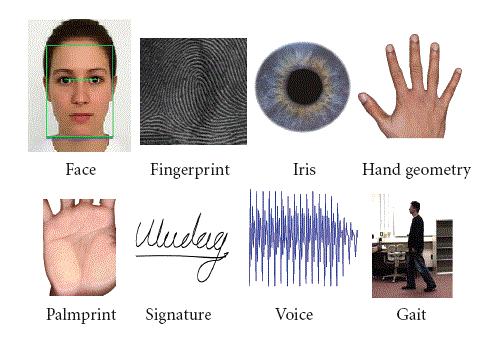
As I mentioned in August, there are a number of biometric modalities, including face, fingerprint, iris, hand geometry, palm print, signature, voice, gait, and many more.
If your firm offers an identity solution that partially depends upon “something you are,” then you need to create content (blog, case study, social media, white paper, etc.) that converts prospects for your identity/biometric product/service and drives content results.
If you listen closely, you can hear about all sorts of wonderful biometric identifiers. They range from the common (such as fingerprint ridges and detail) to the esoteric (my favorite was the 2013 story about Japanese car seats that captured butt prints).
Forget about fingerprints and faces and irises and DNA and gait recognition and butt prints. Tongue prints are the answer!
Benefits of tongue print biometrics
To its credit, the article does point out two benefits of using tongue prints as a biometric identifier.
Consent and privacy. Unlike fingerprints and irises (and faces) which are always exposed and can conceivably be captured without the person’s knowledge, the subject has to provide consent before a tongue image is captured. For the most part, tongues are privacy-perfect.
Liveness. The article claims that “sticking out one’s tongue is an undeniable ‘proof of life.'” Perhaps that’s an exaggeration, but it is admittedly much harder to fake a tongue than it is to fake a finger or a face.
Are tongues unique?
But the article also makes these claims.
Two main attributes are measured for a tongue print. First is the tongue shape, as the shape of the tongue is unique to everyone.
The other notable feature is the texture of the tongue. Tongues consist of a number of ridges, wrinkles, seams and marks that are unique to every individual.
There is serious doubt (if not outright denial) that everyone has a unique face (although NIST is investigating this via the FRTE Twins Demonstration).
But at least these modalities are under study. Has anyone conducted a rigorous study to prove or disprove the uniqueness of tongues? By “rigorous,” I mean a study that has evaluated millions of tongues in the same way that NIST has evaluated millions of fingerprints, faces, and irises?
I did find this 2017 tongue identification pilot study but it only included a whopping 20 participants. And the study authors (who are always seeking funding anyway) admitted that “large-scale studies are required to validate the results.”
Conclusion
So if a police officer tells you to stick out your tongue for identification purposes, think twice.
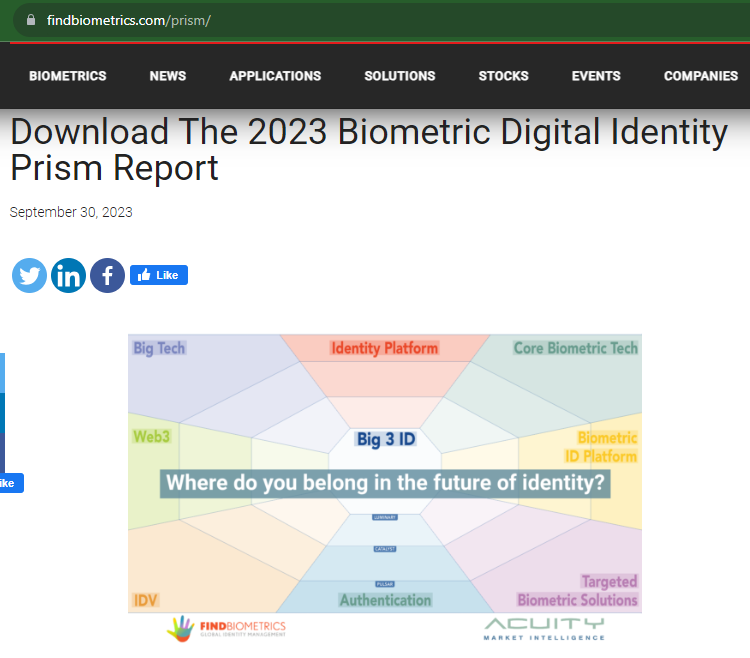
On September 30, FindBiometrics and Acuity Market Intelligence released the production version of the Biometric Digital Identity Prism Report. You can request to download it here.
But FindBiometrics and Acuity Market Intelligence didn’t invent the Big 3. The concept has been around for 40 years. And two of today’s Big 3 weren’t in the Big 3 when things started. Oh, and there weren’t always 3; sometimes there were 4, and some could argue that there were 5.
So how did we get from the Big 3 of 40 years ago to the Big 3 of today?
The Big 3 in the 1980s
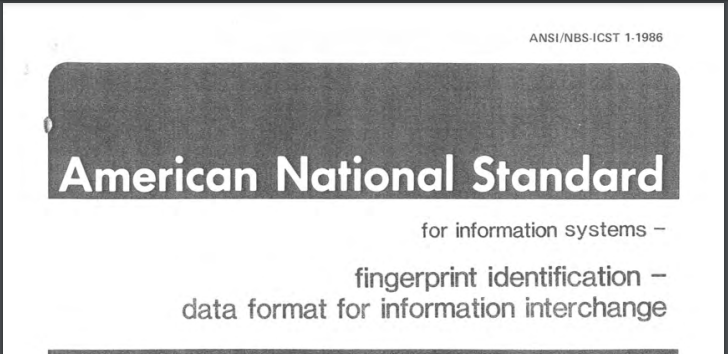
Back in 1986 (eight years before I learned how to spell AFIS) the American National Standards Institute, in conjunction with the National Bureau of Standards, issued ANSI/NBS-ICST 1-1986, a data format for information interchange of fingerprints. The PDF of this long-superseded standard is available here.
When creating this standard, ANSI and the NBS worked with a number of law enforcement agencies, as well as companies in the nascent fingerprint industry. There is a whole list of companies cited at the beginning of the standard, but I’d like to name four of them.
De La Rue Printrak, Inc.
Identix, Inc.
Morpho Systems
NEC Information Systems, Inc.
While all four of these companies produced computerized fingerprinting equipment, three of them had successfully produced automated fingerprint identification systems, or AFIS. As Chapter 6 of the Fingerprint Sourcebook subsequently noted:
Morpho Systems resulted from French AFIS efforts, separate from those of the FBI. These efforts launched Morpho’s long-standing relationship with the French National Police, as well as a similar relationship (now former relationship) with Pierce County, Washington.
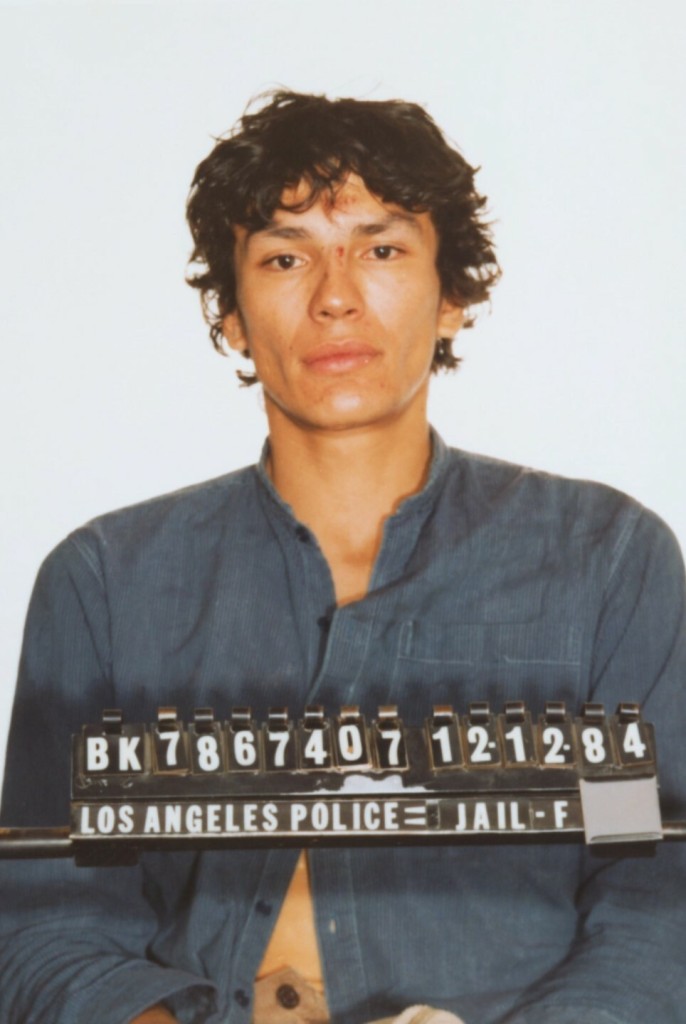
NEC had deployed AFIS equipment for the National Police Academy of Japan, and (after some prodding; read Chapter 6 for the story) the city of San Francisco. Eventually the state of California obtained an NEC system, which played a part in the identification of “Night Stalker” Richard Ramirez.
After the success of the San Francisco and California AFIS systems, many other jurisdictions began clamoring for AFIS of their own, and turned to these three vendors to supply them.
The Big 4 in the 1990s
But in 1990, these three firms were joined by a fourth upstart, Cogent Systems of South Pasadena, California.
While customers initially preferred the Big 3 to the upstart, Cogent Systems eventually installed a statewide system in Ohio and a border control system for the U.S. government, plus a vast number of local systems at the county and city level.
Between 1991 and 1994, the (Immigfation and Naturalization Service) conducted several studies of automated fingerprint systems, primarily in the San Diego, California, Border Patrol Sector. These studies demonstrated to the INS the feasibility of using a biometric fingerprint identification system to identify apprehended aliens on a large scale. In September 1994, Congress provided almost $30 million for the INS to deploy its fingerprint identification system. In October 1994, the INS began using the system, called IDENT, first in the San Diego Border Patrol Sector and then throughout the rest of the Southwest Border.
I was a proposal writer for Printrak (divested by De La Rue) in the 1990s, and competed against Cogent, Morpho, and NEC in AFIS procurements. By the time I moved from proposals to product management, the next redefinition of the “big” vendors occurred.
The Big 3 in 2003
There are a lot of name changes that affected AFIS participants, one of which was the 1988 name change of the National Bureau of Standards to the National Institute of Standards and Technology (NIST). As fingerprints and other biometric modalities were increasingly employed by government agencies, NIST began conducting tests of biometric systems. These tests continue to this day, as I have previously noted.
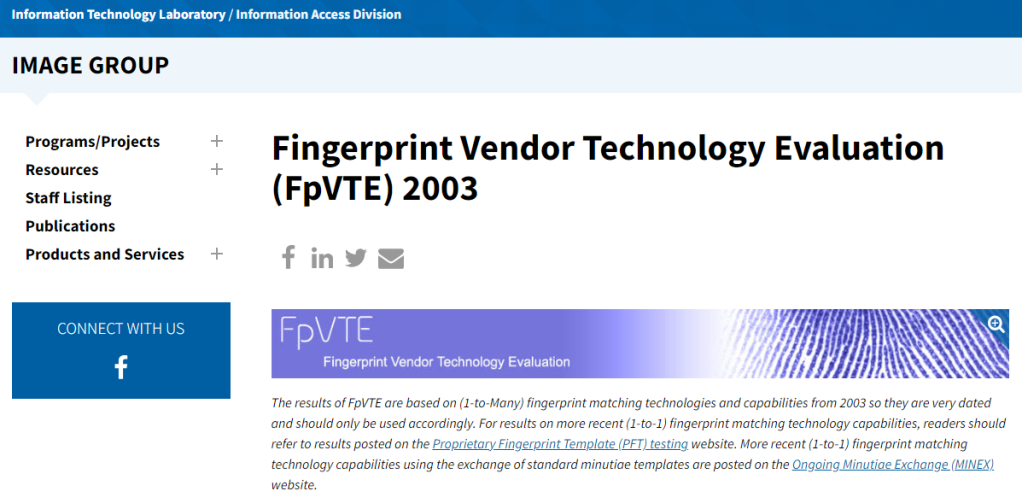
One of NIST’s first tests was the Fingerprint Vendor Technology Evaluation of 2003 (FpVTE 2003).
For those who are familiar with NIST testing, it’s no surprise that the test was thorough:
FpVTE 2003 consists of multiple tests performed with combinations of fingers (e.g., single fingers, two index fingers, four to ten fingers) and different types and qualities of operational fingerprints (e.g., flat livescan images from visa applicants, multi-finger slap livescan images from present-day booking or background check systems, or rolled and flat inked fingerprints from legacy criminal databases).
Eighteen vendors submitted their fingerprint algorithms to NIST for one or more of the various tests, including Bioscrypt, Cogent Systems, Identix, SAGEM MORPHO (SAGEM had acquired Morpho Systems), NEC, and Motorola (which had acquired Printrak). And at the conclusion of the testing, the FpVTE 2003 summary (PDF) made this statement:
Of the systems tested, NEC, SAGEM, and Cogent produced the most accurate results.
Which would have been great news if I were a product manager at NEC, SAGEM, and Cogent.
Unfortunately, I was a product manager at Motorola.
The effect of this report was…not good, and at least partially (but not fully) contributed to Motorola’s loss of its long-standing client, the Royal Canadian Mounted Police, to Cogent.
The Big 3, 4, or 5 after 2003
So what happened in the years after FpVTE was released? Opinions vary, but here are three possible explanations for what happened next.
Did the Big 3 become the Big 4 again?
Now I probably have a bit of bias in this area since I was a Motorola employee, but I maintain that Motorola overcame this temporary setback and vaulted back into the Big 4 within a couple of years. Among other things, Motorola deployed a national 1000 pixels-per-inch (PPI) system in Sweden several years before the FBI did.
Did the Big 3 remain the Big 3?
Motorola’s arch-enemies at Sagem Morpho had a different opinion, which was revealed when the state of West Virginia finally got around to deploying its own AFIS. A bit ironic, since the national FBI AFIS system IAFIS was located in West Virginia, or perhaps not.
Anyway, Motorola had a very effective sales staff, as was apparent when the state issued its Request for Proposal (RFP) and explicitly said that the state wanted a Motorola AFIS.
That didn’t stop Cogent, Identix, NEC, and Sagem Morpho from bidding on the project.
After the award, Dorothy Bullard and I requested copies of all of the proposals for evaluation. While Motorola (to no one’s surprise) won the competition, Dorothy and I believed that we shouldn’t have won. In particular, our arch-enemies at Sagem Morpho raised a compelling argument that it should be the chosen vendor.
Their argument? Here’s my summary: “Your RFP says that you want a Motorola AFIS. The states of Kansas (see page 6 of this PDF) and New Mexico (see this PDF) USED to have a Motorola AFIS…but replaced their systems with our MetaMorpho AFIS because it’s BETTER than the Motorola AFIS.”
But were Cogent, Motorola, NEC, and Sagem Morpho the only “big” players?
Did the Big 3 become the Big 5?
While the Big 3/Big 4 took a lot of the headlines, there were a number of other companies vying for attention. (I’ve talked about this before, but it’s worthwhile to review it again.)
Identix, while making some efforts in the AFIS market, concentrated on creating live scan fingerprinting machines, where it competed (sometimes in court) against companies such as Digital Biometrics and Bioscrypt.
The fingerprint companies started to compete against facial recognition companies, including Viisage and Visionics.
Oh, and there were also iris companies such as Iridian.
And there were other ways to identify people. Even before 9/11 mandated REAL ID (which we may get any year now), Polaroid was making great efforts to improve driver’s licenses to serve as a reliable form of identification.
In short, there were a bunch of small identity companies all over the place.
But in the course of a few short years, Dr. Joseph Atick (initially) and Robert LaPenta (subsequently) concentrated on acquiring and merging those companies into a single firm, L-1 Identity Solutions.
These multiple mergers resulted in former competitors Identix and Digital Biometrics, and former competitors Viisage and Visionics, becoming part of one big happy family. (A multinational big happy family when you count Bioscrypt.) Eventually this company offered fingerprint, face, iris, driver’s license, and passport solutions, something that none of the Big 3/Big 4 could claim (although Sagem Morpho had a facial recognition offering). And L-1 had federal contracts and state contracts that could match anything that the Big 3/Big 4 offered.
So while L-1 didn’t have a state AFIS contract like Cogent, Motorola, NEC, and Sagem Morpho did, you could argue that L-1 was important enough to be ranked with the big boys.
So for the sake of argument let’s assume that there was a Big 5, and L-1 Identity Solutions was part of it, along with the three big boys Motorola, NEC, and Safran (who had acquired Sagem and thus now owned Sagem Morpho), and the independent Cogent Systems. These five companies competed fiercly with each other (see West Virginia, above).
In a two-year period, everything would change.
The Big 3 after 2009
Hang on to your seats.
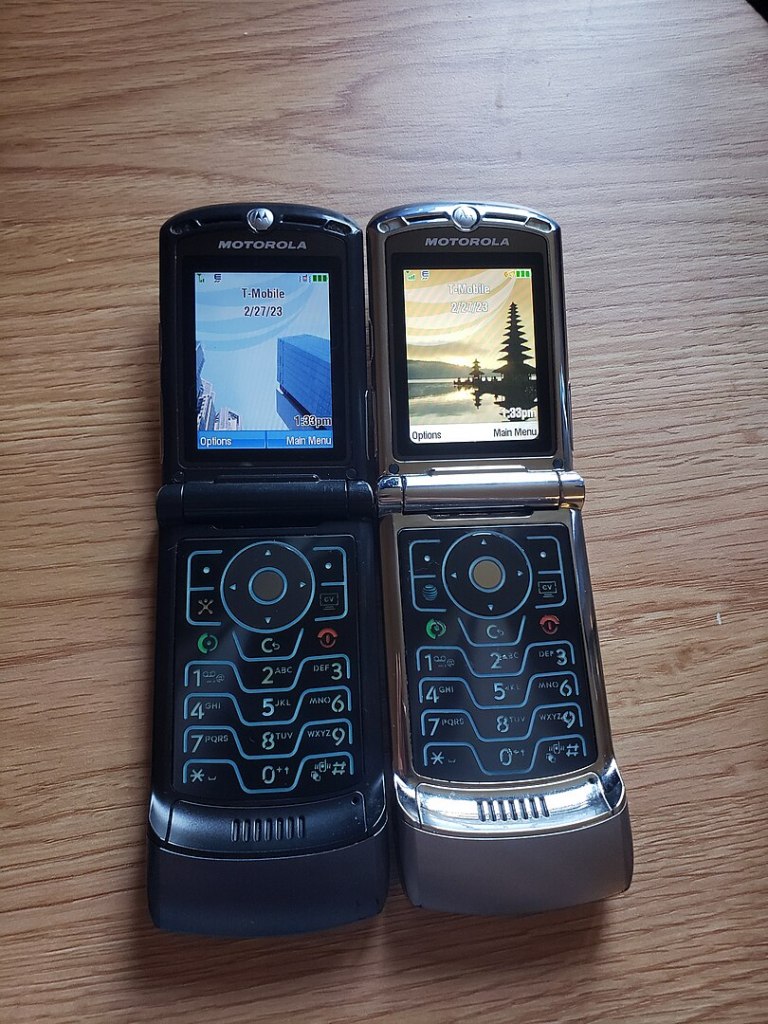
The Motorola RAZR was hugely popular…until it wasn’t. Eventually Motorola split into two companies and sold off others, including the “Printrak” Biometric Business Unit. By NextG50 – Own work, CC BY-SA 4.0, https://commons.wikimedia.org/w/index.php?curid=130206087
By 2009, Safran (resulting from the merger of Sagem and Snecma) was an international powerhouse in aerospace and defense and also had identity/biometric interests. Motorola, in the meantime, was no longer enjoying the success of its RAZR phone and was looking at trimming down (prior to its eventual, um, bifurcation). In response to these dynamics, Safran announced its intent to purchase Motorola’s Biometric Business Unit in October 2008, an effort that was finalized in April 2009. The Biometric Business Unit (adopting its former name Printrak) was acquired by Sagem Morpho and became MorphoTrak. On a personal level, Dorothy Bullard moved out of Proposals and I moved into Proposals, where I got to work with my new best friends that had previously slammed Motorola for losing the Kansas and New Mexico deals. (Seriously, Cindy and Ron are great folks.)
By 2011, Safran decided that it needed additional identity capabilities, so it acquired L-1 Identity Solutions and renamed the acquisition as MorphoTrust.
If you’re keeping notes, the Big 5 have now become the Big 3: 3M, Safran, and NEC (the one constant in all of this).
While there were subsequent changes (3M sold Cogent and other pieces to Gemalto, Safran sold all of Morpho to Advent International/Oberthur to form IDEMIA, and Gemalto was acquired by Thales), the Big 3 has remained constant over the last decade.
And that’s where we are today…pending future developments.
If Alphabet or Amazon reverse their current reluctance to market their biometric offerings to governments, the entire landscape could change again.
Or perhaps a new AI-fueled competitor could emerge.
The 1 Biometric Content Marketing Expert
This was written by John Bredehoft of Bredemarket.
If you work for the Big 3 or the Little 80+ and need marketing and writing services, the biometric content marketing expert can help you. There are several ways to get in touch:
Book a meeting with me at calendly.com/bredemarket. Be sure to fill out the information form so I can best help you.
Always take advantage of your competitors’ weaknesses.
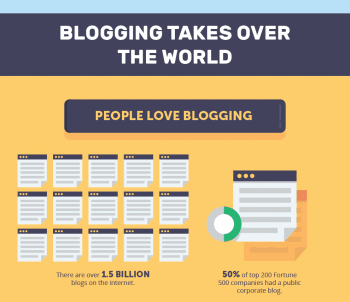
This post describes an easy way to take advantage of your competitors. If they’re not blogging, make sure your firm is blogging. And the post provides hard numbers that demonstrate why your firm should be blogging.
Which means that half of those companies don’t have a public corporate blog.
The same infographic also revealed the following:
86% of B2B companies are blogging. (Or, 14% are not.)
68% of social media marketers use blogs in their social media strategy. (Or, 32% don’t.)
45% of marketers saying blogging is the #1 most important piece of their content strategy.
Small businesses under 10 employees allocate 42% of their marketing budget to content marketing.
So obviously some firms believe blogging is important, while others don’t.
What difference does this make for your firm?
What results do blogging companies receive?
In my view, the figures above are way too low. 100% of all Fortune 500 companies, 100% of B2B companies should be blogging, and 100% of social media marketers should incorporate blogging.
Getting leads from blogging is nice, but show me the money! What about conversions?
Marketers who have prioritized blogging are 13x more likely to enjoy positive ROI.
92% of companies who blog multiple times per day have acquired a customer from their blog.
Take a look at those last two bullets related to conversion again. Blogging is correlated with positive ROI (I won’t claim causation, but anecdotally I believe it), and blogging helps firms acquire customers. So if your firm wants to make money, get blogging.
What should YOUR company do?
With numbers like this, shouldn’t all companies be blogging?
But don’t share these facts with your competitors. Keep them to yourself so that you gain a competitive advantage over them.
Now you just need to write those blog posts.
How can I help?
And if you need help with the actual writing, I, John E Bredehoft of Bredemarket, can help.
And if you’re not in the identity/biometric industry, my general content marketing expertise also applies to technology firms and general business firms.
In most cases, I can provide your blog post via my standard package, the Bredemarket 400 Short Writing Service. I offer other packages and options if you have special needs.
Authorize Bredemarket, Ontario California’s content marketing expert, to help your firm produce words that return results.















 Bredemarket