Well, the FATE side of the house has released its first two studies, including one entitled “Face Analysis Technology Evaluation (FATE) Part 10: Performance of Passive, Software-Based Presentation Attack Detection (PAD) Algorithms” (NIST Internal Report NIST IR 8491; PDF here).
Always take advantage of your competitors’ weaknesses.
This post describes an easy way to take advantage of your competitors. If they’re not blogging, make sure your firm is blogging. And the post provides hard numbers that demonstrate why your firm should be blogging.
Which means that half of those companies don’t have a public corporate blog.
The same infographic also revealed the following:
86% of B2B companies are blogging. (Or, 14% are not.)
68% of social media marketers use blogs in their social media strategy. (Or, 32% don’t.)
45% of marketers saying blogging is the #1 most important piece of their content strategy.
Small businesses under 10 employees allocate 42% of their marketing budget to content marketing.
So obviously some firms believe blogging is important, while others don’t.
What difference does this make for your firm?
What results do blogging companies receive?
In my view, the figures above are way too low. 100% of all Fortune 500 companies, 100% of B2B companies should be blogging, and 100% of social media marketers should incorporate blogging.
Getting leads from blogging is nice, but show me the money! What about conversions?
Marketers who have prioritized blogging are 13x more likely to enjoy positive ROI.
92% of companies who blog multiple times per day have acquired a customer from their blog.
Take a look at those last two bullets related to conversion again. Blogging is correlated with positive ROI (I won’t claim causation, but anecdotally I believe it), and blogging helps firms acquire customers. So if your firm wants to make money, get blogging.
What should YOUR company do?
With numbers like this, shouldn’t all companies be blogging?
But don’t share these facts with your competitors. Keep them to yourself so that you gain a competitive advantage over them.
Now you just need to write those blog posts.
How can I help?
And if you need help with the actual writing, I, John E Bredehoft of Bredemarket, can help.
And if you’re not in the identity/biometric industry, my general content marketing expertise also applies to technology firms and general business firms.
In most cases, I can provide your blog post via my standard package, the Bredemarket 400 Short Writing Service. I offer other packages and options if you have special needs.
Authorize Bredemarket, Ontario California’s content marketing expert, to help your firm produce words that return results.
Let’s address two items before we continue. Trust me; it’s important.
The Gender Shades study evaluated only three algorithms: one from IBM, one from Microsoft, and one from Face++. It did not evaluate the hundreds of other facial recognition algorithms that existed in 2018 when the study was released.
The study focused on gender classification and race classification. Back in those primitive innocent days of 2018, the world assumed that you could look at a person and tell whether the person was male or female, or tell the race of a person. (The phrase “self-identity” had not yet become popular, despite the Rachel Dolezal episode which happened before the Gender Shades study). Most importantly, the study did not address identification of individuals at all.
Gambling is becoming acceptable in more and more places.
When I was young, and even when I got older, the idea of locating a pro sports team in Las Vegas, Nevada was unthinkable. In the last few years, that has changed dramatically.
The Roblox “Robux” gambing lawsuit
Well, now that gambling for adults has become more and more acceptable (although adults in my home state of California still can’t gamble by phone), now attention is focusing on child gambling.
In a new class action lawsuit filed in the Northern District of California this week, two parents accuse Roblox of illegally facilitating child gambling.
While gambling is not allowed on the platform, which hosts millions of virtual games that cater to children and teens, the lawsuit points to third-party gambling sites that invite users to play blackjack, slots, roulette and other games of chance using Roblox’s in-game currency.
But the gambling sites’ terms of service prohibit underage gambling!
I’m not going to concentrate on Roblox here, but on the other defendants—the ones who actually operate the sites that allegedly allow child gambling.
The lawsuit specifically names RBXFlip, Bloxflip and RBLXWild as participants in “an illegal gambling operation that is preying on children nationwide.”
But according to Bloxflip’s Terms of Service, it’s impossible that children can be using the site, because the Terms of Service prohibit this.
By accessing Bloxflip or using the Services, you accept and agree to our website policies, including these Terms of Service, and you certify to us that (i) you are eighteen (18) years of age or older, and are at least the age of majority in your jurisdiction, (ii) you are not a resident of Washington, (iii) you have the legal capacity to enter into and agree to these Terms of Service, (iv) you are using the Services freely, voluntarily, willingly, and for your own personal enjoyment, and (v) you will only provide accurate and complete information to us and promptly update this information as necessary to maintain its accuracy and completeness.
However, stating a minimum age in your TOS is even less effective than other common age verification methods, such as
Asking your customer to check a box to say that they are over 18 years old.
Asking your customer to type in their birthday.
Requiring your customer to read a detailed description of IRA/401(k) funding strategies and the medical need for colonoscopies. (This would be more effective than the first two methods.)
A better way to verify and estimate ages
As more and more companies are realizing, however, there are other ways to measure customer ages, including a comparison of a live face with a government-issued identification card (driver’s license or passport), or the use of “age estimation” software to ensure that a 12 year old isn’t gambling. (And don’t forget that NIST will test age estimation software as part of its FATE testing.)
Even when the kids aren’t gambling legal currency.
(D)igital security engineers at the University of Wisconsin–Madison have found these systems are not quite as foolproof when it comes to a novel analog attack. They found that speaking through customized PVC pipes — the type found at most hardware stores — can trick machine learning algorithms that support automatic speaker identification systems.
The project began when the team began probing automatic speaker identification systems for weaknesses. When they spoke clearly, the models behaved as advertised. But when they spoke through their hands or talked into a box instead of speaking clearly, the models did not behave as expected.
(Shimaa) Ahmed investigated whether it was possible to alter the resonance, or specific frequency vibrations, of a voice to defeat the security system. Because her work began while she was stuck at home due to COVID-19, Ahmed began by speaking through paper towel tubes to test the idea. Later, after returning to the lab, the group hired Yash Wani, then an undergraduate and now a PhD student, to help modify PVC pipes at the UW Makerspace. Using various diameters of pipe purchased at a local hardware store, Ahmed, Yani and their team altered the length and diameter of the pipes until they could produce the same resonance as they voice they were attempting to imitate.
Eventually, the team developed an algorithm that can calculate the PVC pipe dimensions needed to transform the resonance of almost any voice to imitate another. In fact, the researchers successfully fooled the security systems with the PVC tube attack 60 percent of the time in a test set of 91 voices, while unaltered human impersonators were able to fool the systems only 6 percent of the time.
We evaluate two state-of-the-art ASI models: (1) the x-vector network [51] implemented by Shamsabadi et al. [45], and (2) the emphasized channel attention, propagation and aggregation time delay neural network (ECAPATDNN) [17], implemented by SpeechBrain.1 Both models were trained on VoxCeleb dataset [15, 36, 37], a benchmark dataset for ASI. The x-vector network is trained on 250 speakers using 8 kHz sampling rate. ECAPA-TDNN is trained on 7205 speakers using 16 kHz sampling rate. Both models report a test accuracy within 98-99%.
So what we know is that this test, which used these two ASI models trained on a particular dataset, demonstrated an ability to fool systems 60 percent of the time.
But…
What does this mean for other ASI algorithms, including the commercial algorithms in use today?
And what does it mean when other datasets are used?
In other words (and I’m adapting my own text here), how do the results of this study affect “current automatic speaker identification products”?
The answer is “We don’t know.”
So pipe down…until we actually test commercial algorithms for this technique.
But I’m sure that the UW-Madison researchers and I agree on one thing: more research is needed.
I and countless others have spent the last several years referring to the National Institute of Standards and Technology’s Face Recognition Vendor Test, or FRVT. I guess some people have spent almost a quarter century referring to FRVT, because the term has been in use since 1999.
Starting now, you’re not supposed to use the FRVT acronym any more.
To bring clarity to our testing scope and goals, what was formerly known as FRVT has been rebranded and split into FRTE (Face Recognition Technology Evaluation) and FATE (Face Analysis Technology Evaluation). Tracks that involve the processing and analysis of images will run under the FATE activity, and tracks that pertain to identity verification will run under FRTE. All existing participation and submission procedures remain unchanged.
The change actually makes sense, since tasks such as age estimation and presentation attack detection (liveness detection) do not directly relate to the identification of individuals.
Us old folks just have to get used to the change.
I just hope that the new “FATE” acronym doesn’t mean that some algorithms are destined to perform better than others.
What’s more, these results change on a monthly basis, so it’s quite possible that the #1 vendor in some category in February 2022 was no longer than #1 vendor in March 2022. (And if your company markets years-old FRVT results, stop it!)
This is the August 15, 2023 peek at three ways to slice and dice the NIST FRVT results.
And a bunch of vendors will be mad at me because I didn’t choose THEIR preferred slicing and dicing, or their ways to exclude results (not including Chinese algorithms, not including algorithms used in surveillance, etc.). The mad vendors can write their own blog posts (or ask Bredemarket to ghostwrite them on their behalf).
NIST FRVT 1:1, VISABORDER
The phrase “NIST FRVT 1:1, VISABORDER” is shorthand for the NIST one-to-one version of the Face Recognition Vendor Test, using the VISABORDER probe and gallery data. This happens to be the default way in which NIST sorts the 1:1 accuracy results, but of course you can sort them against any other probe/gallery combination, and get a different #1 vendor.
As of August 15, the top two accuracy algorithms for VISABORDER came from Cloudwalk. Here are all of the top ten.
But NIST doesn’t just measure accuracy for a bunch of different probe-target combinations. It also measures performance, since the most accurate algorithm in the world won’t do you any good if it takes forever to compare the face templates.
One caveat regarding these measures is that NIST conducts the tests on a standardized set of equipment, so that results between vendors can be compared. This is important to note, because a comparison that takes 103 milliseconds on NIST’s equipment will yield a different time on a customer’s equipment.
One of the many performance measures is “Comparison Time (Mate).” There is also a performance measure for “Comparison Time (Non-mate).”
So in this test, the fastest vendor algorithm comes from Trueface. Again, here are the top 10.
Now I know what some of you are saying. “John,” you say, “the 1:1 test only measures a comparison against one face against one other face, or what NIST calls verification. What if you’re searching against a database of faces, or identification?”
Well, NIST has a 1:N test to measure that particular use case. Or use cases, because again you can slice and dice the results in so many different ways.
When looking at accuracy, the default NIST 1:N sort is by:
Probe images from the BORDER database.
Gallery images from a 1,600,000 record VISA database.
Cloudwalk happens to be the #1 vendor in this slicing and dicing of the test. Here are the top ten.
The usual cautions apply that everyone, including NIST, emphasizes that these test results do not guarantee similar results in an operational environment. Even if the algorithm author ported its algorithm to an operational system with absolutely no changes, the operational system will have a different hardware configuration and will have different data.
For example, none of the NIST 1:N tests use databases with more than 12 million records. Even 20 years ago, Behnam Bavarian correctly noted that biometric databases would eventually surpass hundreds of millions of records, or even billions of records. There is no way that NIST could assemble a test database that large.
Does your firm fight crooks who try to fraudulently use synthetic identities? If so, how do you communicate your solution?
This post explains what synthetic identities are (with examples), tells four ways to detect synthetic identities, and closes by providing an answer to the communication question.
While this post is primarily intended for identity firms who can use Bredemarket’s marketing and writing services, anyone else who is interested in synthetic identities can read along.
What are synthetic identities?
To explain what synthetic identities are, let me start by telling you about Jason Brown.
Jason Brown wasn’t Jason Brown
You may not have heard of him unless you lived in Atlanta, Georgia in 2019 and lived near the apartment he rented.
Jason Brown’s renting of an apartment isn’t all that unusual.
If you were to visit Brown’s apartment in February 2019, you would find credit cards and financial information for Adam M. Lopez and Carlos Rivera.
Now that’s a little unusual, especially since Lopez and Rivera never existed.
For that matter, Jason Brown never existed either.
A Georgia man was sentenced Sept. 1 (2022) to more than seven years in federal prison for participating in a nationwide fraud ring that used stolen social security numbers, including those belonging to children, to create synthetic identities used to open lines of credit, create shell companies, and steal nearly $2 million from financial institutions….
Cato joined conspiracies to defraud banks and illegally possess credit cards. Cato and his co-conspirators created “synthetic identities” by combining false personal information such as fake names and dates of birth with the information of real people, such as their social security numbers. Cato and others then used the synthetic identities and fake ID documents to open bank and credit card accounts at financial institutions. Cato and his co-conspirators used the unlawfully obtained credit cards to fund their lifestyles.
Talking about synthetic identity at Victoria Gardens
Here’s a video that I created on Saturday that describes, at a very high level, how synthetic identities can be used fraudulently. People who live near Rancho Cucamonga, California will recognize the Victoria Gardens shopping center, proof that synthetic identity theft can occur far away from Georgia.
Note that synthetic identity theft different from stealing someone else’s existing identity. In this case, a new identity is created.
So how do you catch these fraudsters?
Catching the identity synthesizers
If you’re renting out an apartment, and Jason Brown shows you his driver’s license and provides his Social Security Number, how can you detect if Brown is a crook? There are four methods to verify that Jason Brown exists, and that he’s the person renting your apartment.
Method One: Private Databases
One way to check Jason Brown’s story is to perform credit checks and other data investigations using financial databases.
Did Jason Brown just spring into existence within the past year, with no earlier credit record? That seems suspicious.
Does Jason Brown’s credit record appear TOO clean? That seems suspicious.
Does Jason Brown share information such as a common social security number with other people? Are any of those other identities also fraudulent? That is DEFINITELY suspicious.
This is one way that many firms detect synthetic identities, and for some firms it is the ONLY way they detect synthetic identities. And these firms have to tell their story to their prospects.
If your firm offers a tool to verify identities via private databases, how do you let your prospects know the benefits of your tool, and why your solution is better than all other solutions?
Method Two: Check That Driver’s License (or other government document)
What about that driver’s license that Brown presented? There are a wide variety of software tools that can check the authenticity of driver’s licenses, passports, and other government-issued documents. Some of these tools existed back in 2019 when “Brown” was renting his apartment, and a number of them exist today.
Maybe your firm has created such a tool, or uses a tool from a third party.
If your firm offers this capability, how can your prospects learn about its benefits, and why your solution excels?
Method Three: Check Government Databases
Checking the authenticity of a government-issued document may not be enough, since the document itself may be legitimate, but the implied credentials may no longer be legitimate. For example, if my California driver’s license expires in 2025, but I move to Minnesota in 2023 and get a new license, my California driver’s license is no longer valid, even though I have it in my possession.
Why not check the database of the Department of Motor Vehicles (or the equivalent in your state) to see if there is still an active driver’s license for that person?
The American Association of Motor Vehicle Administrators (AAMVA) maintains a Driver’s License Data Verification (DLDV) Service in which participating jurisdictions allow other entities to verify the license data for individuals. Your firm may be able to access the DLDV data for selected jurisdictions, providing an extra identity verification tool.
If your firm offers this capability, how can your prospects learn where it is available, what its benefits are, and why it is an important part of your solution?
Method Four: Conduct the “Who You Are” Test
There is one more way to confirm that a person is real, and that is to check the person. Literally.
If someone on a smartphone or videoconference says that they are Jason Brown, how do you know that it’s the real Jason Brown and not Jim Smith, or a previous recording or simulation of Jason Brown?
This is where tools such as facial recognition and liveness detection come to play.
You can ensure that the live face matches any face on record.
You can also confirm that the face is truly a live face.
In addition to these two tests, you can compare the face against the face on the presented driver’s license or passport to offer additional confirmation of true identity.
Now some companies offer facial recognition, others offer liveness detection, others match the live face to a face on a government ID, and many companies offer two or three of these capabilities.
One more time: if your firm offers these capabilities—either your own or someone else’s—what are the benefits of your algorithms? (For example, are they more accurate than competing algorithms? And under what conditions?) And why is your solution better than the others?
This is for the firms who fight synthetic identities
While most of this post is of general interest to anyone dealing with synthetic identities, this part of this post is specifically addressed to identity and biometric firms who provide synthetic identity-fighting solutions.
When you communicate about your solutions, your communicator needs to have certain types of experience.
Industry experience. Perhaps you sell your identity solution to financial institutions, or educational institutions , or a host of other industries (gambling/gaming, healthcare, hospitality, retailers, or sport/concert venues, or others). You need someone with this industry experience.
Solution experience. Perhaps your communications require someone with 29 years of experience in identity, biometrics, and technology marketing, including experience with all five factors of authentication (and verification).
Communication experience. Perhaps you need to effectively communicate with your prospects in a customer focused, benefits-oriented way. (Content that is all about you and your features won’t win business.)
If you haven’t read a Bredemarket blog post before, or even if you have, you may not realize that this post is jam-packed with additional information well beyond the post itself. This post alone links to the following Bredemarket posts and other content. You may want to follow one or more of the 13 links below if you need additional information on a particular topic:
Here’s my latest brochure for the Bredemarket 400 Short Writing Service, my standard package to create your 400 to 600 word blog posts and LinkedIn articles. Be sure to check the Bredemarket 400 Short Writing Service page for updates.
Basically, I had gone through great trouble to document that Bredemarket would NOT take identity work, so I had to reverse a lot of pages to say that Bredemarket WOULD take identity work.
I may have found a few additional pages after June 1, but eventually I reached the point where everything on the Bredemarket website was completely and totally updated, and I wouldn’t have to perform any other changes.
You can predict where this is going.
Who I…was
Today it occurred to me that some of the readers of the LinkedIn Bredemarket page may not know the person behind Bredemarket, so I took the opportunity to share Bredemarket’s “Who I Am” web page on the LinkedIn page.
So yes, this biometric content marketing expert/identity content marketing expert IS available for your content marketing needs. If you’re interested in receiving my help with your identity written content, contact me.
I know that I’m the guy who likes to say that it’s all semantics. After all, I’m the person who has referred to five-page long documents as “battlecards.”
But sometimes the semantics are critically important. Take the terms “factors” and “modalities.” On the surface they sound similar, but in practice there is an extremely important difference between factors of authentication and modalities of authentication. Let’s discuss.
What is a factor?
To answer the question “what is a factor,” let me steal from something I wrote back in 2021 called “The five authentication factors.”
Something You Know. Think “password.” And no, passwords aren’t dead. But the use of your mother’s maiden name as an authentication factor is hopefully decreasing.
Something You Have. I’ve spent much of the last ten years working with this factor, primarily in the form of driver’s licenses. (Yes, MorphoTrak proposed driver’s license systems. No, they eventually stopped doing so. But obviously IDEMIA North America, the former MorphoTrust, has implemented a number of driver’s license systems.) But there are other examples, such as hardware or software tokens.
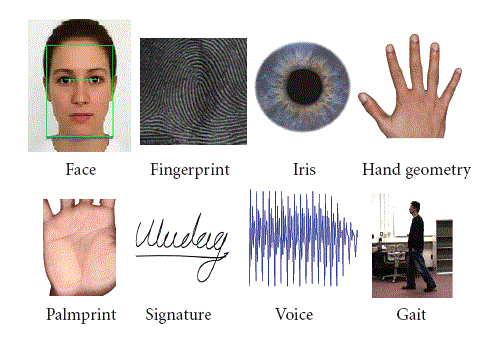
Something You Are. I’ve spent…a long time with this factor, since this is the factor that includes biometrics modalities (finger, face, iris, DNA, voice, vein, etc.). It also includes behavioral biometrics, provided that they are truly behavioral and relatively static.
Something You Do. The Cybersecurity Man chose to explain this in a non-behavioral fashion, such as using swiping patterns to unlock a device. This is different from something such as gait recognition, which supposedly remains constant and is thus classified as behavioral biometrics.
Somewhere You Are. This is an emerging factor, as smartphones become more and more prevalent and locations are therefore easier to capture. Even then, however, precision isn’t always as good as we want it to be. For example, when you and a few hundred of your closest friends have illegally entered the U.S. Capitol, you can’t use geolocation alone to determine who exactly is in Speaker Pelosi’s office.
(By the way, if you search the series of tubes for reading material on authentication factors, you’ll find a lot of references to only three authentication factors, including references from some very respectable sources. Those sources are only 60% right, since they leave off the final two factors I listed above. It’s five factors of authentication, folks. Maybe.)
The one striking thing about the five factors is that while they can all be used to authenticate (and verify) identities, they are inherently different from one another. The ridges of my fingerprint bear no relation to my 16 character password, nor do they bear any relation to my driver’s license. These differences are critical, as we shall see.
What is a modality?
In identity usage, a modality refers to different variations of the same factor. This is most commonly used with the “something you are” (biometric) factor, but it doesn’t have to be.
[M]any businesses and individuals (are adopting) biometric authentication as it been established as the most secure authentication method surpassing passwords and pins. There are many modalities of biometric authentication to pick from, but which method is the best?
After looking at fingerprints, faces, voices, and irises, Aware basically answered its “best” question by concluding “it depends.” Different modalities have their own strengths and weaknesses, depending upon the use case. (If you wear thick gloves as part of your daily work, forget about fingerprints.)
ID R&D goes a step further and argues that it’s best to use multimodal biometrics, in which the two biometrics are face and voice. (By an amazing coincidence, ID R&D offers face and voice solutions.)
The three modalities in the middle—face, voice, and fingerprint—are all clearly biometric “something you are” modalities.
But the modality on the left, “Make a body movement in front of the camera,” is not a biometric modality (despite its reference to the body), but is an example of “something you do.”
Passwords, of course, are “something you know.”
In fact, each authentication factor has multiple modalities.
For example, a few of the modalities associated with “something you have” include driver’s licenses, passports, hardware tokens, and even smartphones.
Why multifactor is (usually) more robust than multimodal
Modalities within a single authentication factor are more closely related than modalities within multiple authentication factors. As I mentioned above when talking about factors, there is no relationship between my fingerprint, my password, and my driver’s license. However, there is SOME relationship between my driver’s license and my passport, since the two share some common information such as my legal name and my date of birth.
What does this mean?
If I’ve fraudulently created a fake driver’s license in your name, I already have some of the information that I need to create a fake passport in your name.
If I’ve fraudulently created a fake iris, there’s a chance that I might already have some of the information that I need to create a fake face.
However, if I’ve bought your Coinbase password on the dark web, that doesn’t necessarily mean that I was able to also buy your passport information on the dark web (although it is possible).
Can an identity content marketing expert help you navigate these issues?
As you can see, you need to be very careful when writing about modalities and factors.
You need a biometric content marketing expert who has worked with many of these modalities.
Actually, you need an identity content marketing expert who has worked with many of these factors.
So if you are with an identity company and need to write a blog post, LinkedIn article, white paper, or other piece of content that touches on multifactor and multimodal issues, why not engage with Bredemarket to help you out?
If you’re interested in receiving my help with your identity written content, contact me.