Perhaps facial recognition product marketers have heard of stories like this. Or perhaps they haven’t.
Tight budgets. Demands that government agencies save money. Is this the solution?
“Milwaukee police are mulling a trade: 2.5 million mugshots for free use of facial recognition technology.
“Officials from the Milwaukee Police Department say swapping the photos with the software firm Biometrica will lead to quicker arrests and solving of crimes.”
Unlike some clickbait-like article titles, this one from Communications Today succinctly encapsulates the problem up front.
It’s not that the TPRM software is failing to find the red flags. Oh, it finds them!
But the folks at Gartner discovered something:
“A Gartner survey of approximately 900 third-party relationship owners…revealed that while 95% saw a third-party red flag in the past 12 months, only around half of them escalate it to compliance teams.”
Among other things, the relationship owners worry about “the perceived return on investment (ROI) of sharing information.”
And that’s not a software issue. It’s a process issue.
And this is not unique to the cybersecurity world. Let’s look at facial recognition.
Another case in point
I’ve said this over and over, but for U.S. criminal purposes, facial recognition results should ONLY be used as investigative leads.
It doesn’t matter whether they’re automated results, or if they have been reviewed by a trained forensic face examiner.
Facial recognition results should only be used as investigative leads.
Sorry for the repetition, but some people aren’t listening.
But it’s not the facial recognition vendors. Bredemarket has worked with numerous facial recognition vendors over the years, and of those who work with law enforcement, ALL of them have emphatically insisted that their software results should only be used as investigative leads.
And that’s not a software issue. It’s a process issue.
No amount of coding or AI can fix that.
I hope the TPRM folks don’t mind my detour into biometrics, but there’s a good reason for it.
Product marketing for TPRM and facial recognition
Some product marketers, including myself, believe that it’s not enough to educate prospects and customers about your product. You also need to educate them about proper use of the product, including legal and ethical concerns.
If you don’t, your customers will do dumb things in Europe, Illinois, or elsewhere—and blame you when they are caught.
Be a leader in your industry by doing or saying the right thing.
And now here’s a word from our sponsor.
Not the “CPA” guy again…
Bredemarket has openings
There’s a reason why this post specifically focused on cybersecurity and facial recognition.
If you need product marketing assistance with your product, Bredemarket has two openings. One for a cybersecurity client, and one for a facial recognition client.
Facial recognition laws and regulations vary from jurisdiction to jurisdiction, and as organizations apply facial recognition, they can’t just assume that facial recognition laws are the same as other privacy laws.
Caution urged as UK supermarkets check out facial recognition
This is the point that UK professor Fraser Sampson makes in a Biometric Update article. Among other things, Sampson (former UK Biometrics & Surveillance Camera Commissioner) notes the following:
This is not just any data processing, this is biometric processing. Major retailers have deep and wide experience handling customer data at macro level, but biometrics are elementally different. Using a biometric recognition system in the UK means they are processing ‘special category data’ and biometric data differs even from other types of special categories. This brings a number of significant risks, obligations and restrictions, some technological, some legal, some societal. The opportunities for missteps are many and the consequences profound. An early decision for the supermarket would be whether they want to be the controller, joint controller or processor; an early mistake would be to think it doesn’t matter.
Data controllers and data processors
For those who don’t inhabit the world of GDPR, the UK GDPR, and other privacy laws, here is Data Grail’s definition of a data controller:
A data controller is a service provider or organization determining the purposes and means of processing personal data. In simpler terms, a data controller decides why and how personal data collection, storage, and use occurs. They have the ultimate responsibility of ensuring data processing activities comply with applicable privacy laws and regulations. Data controllers bear the legal obligations associated with data protection, including providing transparency, obtaining consent, and safeguarding the personal data of data subjects.
Contrast that with a data processor:
Data processors are entities or organizations that process personal data on behalf of data controllers. They act under the authority and instruction of data controllers and handle personal data for the specified purposes defined by the data controller. Data processors are contractually bound to ensure data security and confidentiality. They don’t have the same decision-making power as data controllers and must adhere to the instructions provided by the data controller.
If you’re a supermarket in the United Kingdom, and you’re collecting facial biometric (and other) data, do you want to be a data controller or a data processor? And how will you manage the privacy aspects of your data collection?
Enter the facial recognition vendor
And if you’re a vendor of facial recognition software selling to UK supermarkets, how will you advise them?
And…you should have known this was coming…how will you provide content for your prospects and customers that educates them on the nuances of facial recognition privacy regulations?
If you need help with your facial recognition product marketing, Bredemarket has an opening for a facial recognition client. I can offer
I just read a story about a young man who went to the Metro, was identified by a facial recognition system, and was snatched up by authorities.
Who wanted him to fight in Ukraine.
Now some of you are puzzled and wondering why Trump wants to send U.S. troops to fight in Ukraine. That…um…doesn’t sound like him.
I forgot to clarify something. This wasn’t the Washington DC Metro. This was the MOSCOW Metro.
“Timofey Vaskin, a lawyer with the nonprofit human rights project Shkola Prizyvnika, told independent Russian TV channel Dozhd that the illegal detention of those potentially liable for conscription had become a massive problem this year, with young males most at risk of being snatched while using the Moscow metro, which has an advanced facial recognition system in place and police officers on duty at every station.”
For the record, use of facial recognition for this purpose is legal in Russia. In the same way that use of facial recognition for national security purposes is legal in the U.S.A. Because when national security is at stake—or when government agencies say national security is at stake—most notions of INFORMED consent go out the window.
Know your use cases…or get someone who does
Facial recognition isn’t only used for national security, or for after-the-fact analysis of a crime such as the Boston Marathon bombings. It’s also used for less lethal purposes, such as familiar face detection on doorbell cameras…except in Illinois.
If you are marketing a facial recognition product, you need to understand all the different use cases for facial recognition, and understand which use cases your product marketing should address, and which it should not.
And if you need help with your facial recognition product marketing, Bredemarket has an opening for a facial recognition client. I can offer
(This news was originally supposed to be embargoed until Monday April 21, but…well…things happen.)
Facial recognition and cybersecurity marketing leaders,
Stretched?
Is a stretched team holding you back from creating stellar marketing materials? Are competitors taking your prospects from you while you remain silent?
I’m John Bredehoft from Bredemarket, and I currently have TWO openings to act as your on-demand marketing muscle for facial recognition or cybersecurity:
An interesting variant on fraudulent deepfake scams.
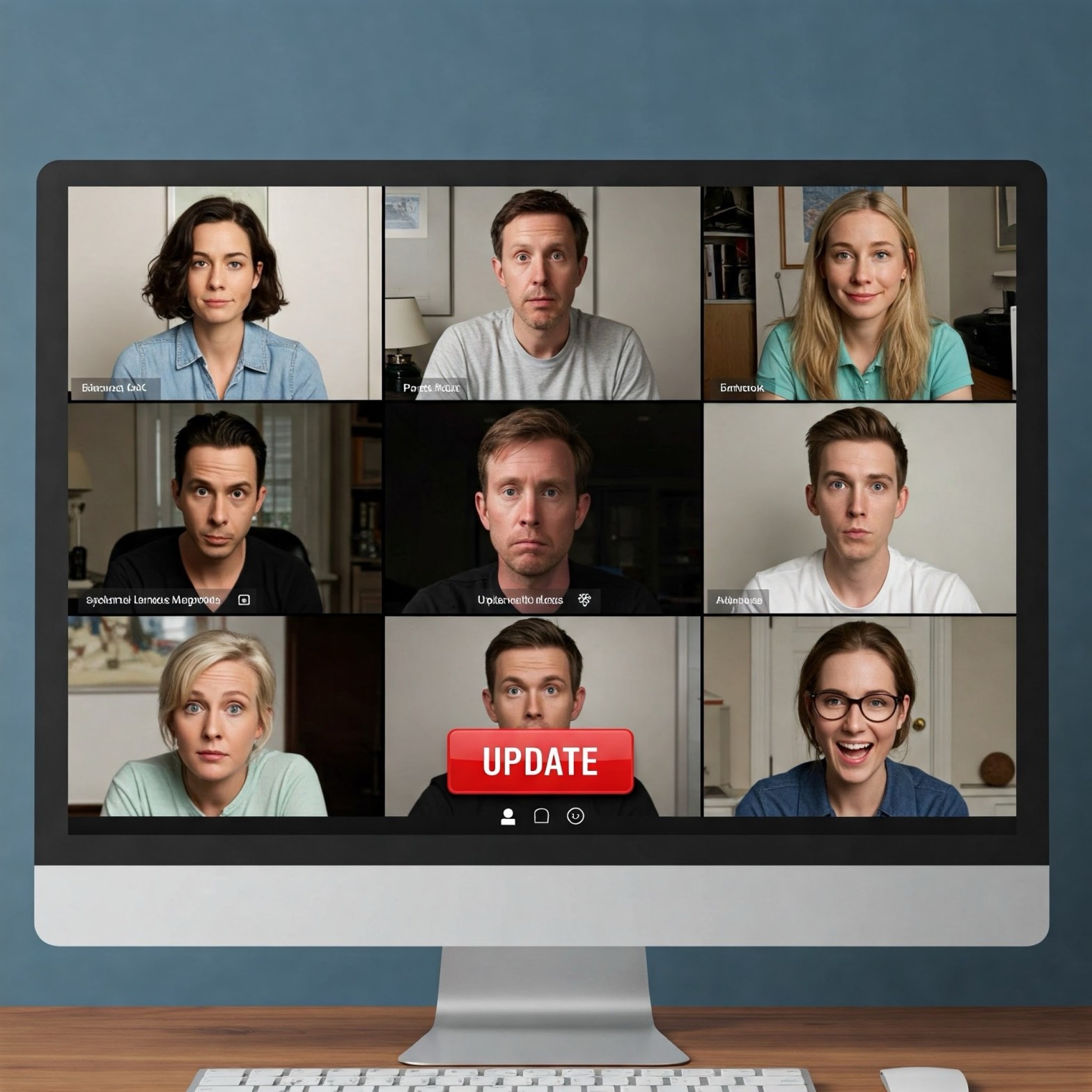
Kenny Li of Manta fame was sucked into a scam attempt, but was able to perceive the scam before any damage was done.
Li responded to a message from a known contact, which resulted in a Telegram conversation, which resulted in a Zoom call.
“In the call, there were team members who had their cameras on, and [the] Manta founder could see their faces. He mentioned that “Everything looked very real. But I couldn’t hear them.” Then came the “Zoom update required” prompt…”
Li didn’t fall for it.
(Imagen 3)
And one more thing…
The formal announcement is embargoed until Monday, but Bredemarket has TWO openings to act as your on-demand marketing muscle for facial recognition or cybersecurity:
Why? Because the facial recognition software the agency has is not accurate enough.
Note “the facial recognition software the agency has.” There’s a story here.
Police and Counter-terrorism Minister Yasmin Catley clarifies that Cognitec has released numerous updates to the product since its deployment, but the police did not purchase them. As with other developers, Cognitec’s legacy algorithms have higher error rates for various demographic groups.
Important clarification.
Now perhaps the agency had its reasons for not upgrading the Cognitec software, and for using other software instead.
But governments and enterprises should not use old facial recognition software. Unless they have to run the software on computers running PC-DOS. Then they have other problems.
(A little aside: when I prompted Google Gemini to create the Imagen 3 image for this post, I asked it to create an image of a 1980s IBM PC running MS-DOS. Those in the know realize my prompt was incorrect. I should have requested a 1980s IBM PC running PC-DOS, not MS-DOS. PC-DOS was the version of MS-DOS that IBM licensed for its own computers, leaving Microsoft able to provide MS-DOS to the “clone computers” that eventually eclipsed IBM’s own offering.)
Remember in January when OpenAI announced some great achievement, and then a few days later we learned that the Chinese firm DeepSeek could boast the same performance, only much better?
These Chinese leapfrogs don’t only happen in artificial intelligence.
One kilometer facial capture
In February, I wrote about something that I initially heard of via Biometric Update. My post, “How to Recognize People From Quite a Long Way Away,” told of an effort at Heriot-Watt University in Edinburgh, Scotland in which the researchers used light detection and ranging (LiDAR) to capture and evaluate faces from as far as a kilometer away.
In normal circumstances, we capture faces from a distance of mere meters. So one kilometer facial capture is impressive.
Scientists in China have created a satellite with laser-imaging technology powerful enough to capture human facial details from more than 60 miles (100 kilometers) away….
According to the South China Morning Post, the scientists conducted a test across Qinghai Lake in the northwest of the country with a new system based on synthetic aperture lidar (SAL), a type of laser radar capable of constructing two-dimensional or three-dimensional images.
Qinghai Lake, from Google Maps.
Writers will note that the acronym SAL incorporates the L from the acronym LiDAR. This is APO, or acronym piling on.
Since I cannot read the original report, I don’t know if the researchers actually performed tests with actual faces. But supposedly SAL “detected details as small as 0.07 inches (1.7 millimeters),” based in part upon the benefits of its technology:
[T]his new system operates at optical wavelengths, which have much shorter wavelengths than microwaves and produce clearer images (though microwaves are better for penetrating into materials, because their longer wavelengths aren’t scattered or absorbed as easily).
All the cited articles make a big deal about the 100 kilometer distance’s equivalence to the boundaries of space. But before you get too excited, remember that a space-hosted SAL will be ABOVE any human subjects, and therefore will NOT capture the face at an optimal angle…