If you ask any one of us in the identity verification industry, we’ll tell you how identity verification proves that you know who is accessing your service.
During the identity verification/onboarding step, one common technique is to capture the live face of the person who is being onboarded, then compare that to the face captured from the person’s government identity document. As long as you have assurance that (a) the face is live and not a photo, and (b) the identity document has not been tampered, you positively know who you are onboarding.
The authentication step usually captures a live face and compares it to the face that was captured during onboarding, thus positively showing that the right person is accessing the previously onboarded account.
Sound like the perfect solution, especially in industries that rely on age verification to ensure that people are old enough to access the service.
Therefore, if you are employing robust identity verification and authentication that includes age verification, this should never happen.
Eduardo Montanari, who manages delivery logistics at a burger shop north of São Paulo, has noticed a pattern: Every time an order pickup is assigned to a female driver, there’s a good chance the worker is a minor.
On YouTube, a tutorial — one of many — explains “how to deliver as a minor.” It has over 31,000 views. “You have to create an account in the name of a person who’s the right age. I created mine in my mom’s name,” says a boy, who identifies himself as a minor in the video.
Once a cooperative parent or older sibling agrees to help, the account is created in the older person’s name, the older person’s face and identity document is used to create the account, and everything is valid.
Outsmarting authentication
Yes, but what about authentication?
That’s why it’s helpful to use a family member, or someone who lives in the minor’s home.
Let’s say little Maria is at home, during her homework, when her gig economy app rings with a delivery request. Now Maria was smart enough to have her older sister Irene or her mama Cecile perform the onboarding with the delivery app. If she’s at home, she can go to Irene or Cecile, have them perform the authentication, and then she’s off on her bike to make money.
(Alternatively, if the app does not support liveness detection, Maria can just hold a picture of Irene or Cecile up to the camera and authenticate.)
The onboarding process was completed by the account holder.
The authentication was completed by the account holder.
But the account holder isn’t the one that’s actually using the service. Once authentication is complete, anyone can access the service.
So how do you stop underage gig economy use?
According to Rest of World, one possible solution is to tattle on underage delivery people. If you see something, say something.
But what’s the incentive for a restaurant owner or delivery recipient to report that their deliveries are being performed by a kid?
“The feeling we have is that, at least this poor boy is working. I know this is horrible, but here in Brazil we end up seeing it as an opportunity … It’s ridiculous,” (psychologist Regiane Couto) said.
A much better solution is to replace one-time authetication with continuous authentication, or at least be smarter in authentication. For example, a gig delivery worker could be required to authenticate at multiple points in the process:
When the worker receives the delivery request.
When the worker arrives at the restaurant.
When the worker makes the delivery.
It’s too difficult to drag big sister Irene or mama Cecile to ALL of these points.
As an added bonus, these authetications provide timestamps of critical points in the delivery process, which the delivery company and/or restaurant can use for their analytics.
Problem solved.
Except that little Maria doesn’t have any excuse and has to complete her homework.
At the highest level, debates regarding government and enterprise use of biometric technology boil down to a debate about whether to keep people safe, or whether to preserve individual privacy.
In the state of Montana, school safety is winning over school privacy—for now.
The state Legislature earlier this year passed a law barring state and local governments from continuous use of facial recognition technology, typically in the form of cameras capable of reading and collecting a person’s biometric data, like the identifiable features of their face and body. A bipartisan group of legislators went toe-to-toe with software companies and law enforcement in getting Senate Bill 397 over the finish line, contending public safety concerns raised by the technology’s supporters don’t overcome individual privacy rights.
School districts, however, were specifically carved out of the definition of state and local governments to which the facial recognition technology law applies.
At a minimum Montana school districts seek to abide by two existing Federal laws when installating facial recognition and video surveillance systems.
Without many state-level privacy protection laws in place, school policies typically lean on the Children’s Online Privacy Protection Act (COPPA), a federal law requiring parental consent in order for websites to collect data on their children, or the Family Educational Rights and Privacy Act (FERPA), which protects the privacy of student education records.
If a vendor doesn’t agree to abide by these laws, then the Montana School Board Association recommends that the school district not do business with the vendor.
The Family Educational Rights and Privacy Act was passed by the US federal government to protect the privacy of students’ educational records. This law requires public schools and school districts to give families control over any personally identifiable information about the student.
(The Sun River Valley School District’s) use of the technology is more focused on keeping people who shouldn’t be on school property away, he said, such as a parent who lost custody of their child.
(Simms) High School Principal Luke McKinley said it’s been more frequent to use the facial recognition technology during extra-curricular activities, when football fans get too rowdy for a high school sports event.
Technology (in this case from Verkada) helps the Sun River School District, especially in its rural setting. Back in 2022, it took law enforcement an estimated 45 minutes to respond to school incidents. The hope is that the technology could identify those who engaged in illegal activity, or at least deter it.
What about other school districts?
When I created my educational identity page, I included the four key words “When permitted by law.” While Montana school districts are currently permitted to use facial recognition and video surveillance, other school districts need to check their local laws before implementing such a system, and also need to ensure that they comply with federal laws such as COPPA and FERPA.
I may be, um, biased in my view, but as long as the school district (or law enforcement agency, or apartment building owner, or whoever) complies with all applicable laws, and implements the technology with a primary purpose of protecting people rather than spying on them, facial recognition is a far superior tool to protect people than manual recognition methods that rely on all-too-fallible human beings.
I tend to view presentation attack detection (PAD) through the lens of iBeta or occasionally of BixeLab. But I need to remind myself that these are not the only entities examining PAD.
A recent paper authored by Koushik Srivatsan, Muzammal Naseer, and Karthik Nandakumar of the Mohamed Bin Zayed University of Artificial Intelligence (MBZUAI) addresses PAD from a research perspective. I honestly don’t understand the research, but perhaps you do.
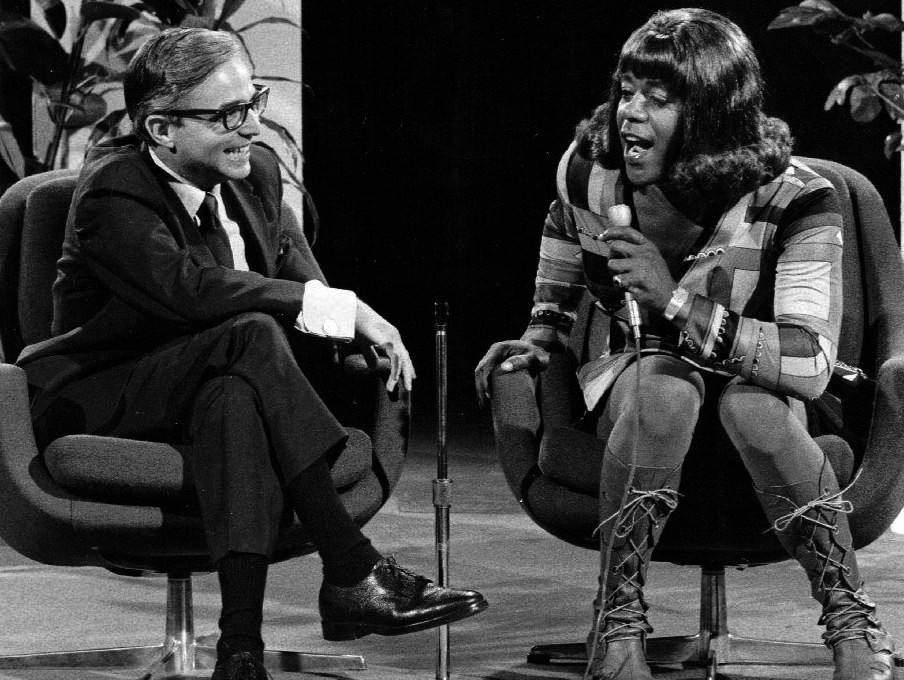
Flip spoofing his natural appearance by portraying Geraldine. Some were unable to detect the attack. By NBC Television. – eBay itemphoto frontphoto back, Public Domain, https://commons.wikimedia.org/w/index.php?curid=16476809
Face anti-spoofing (FAS) or presentation attack detection is an essential component of face recognition systems deployed in security-critical applications. Existing FAS methods have poor generalizability to unseen spoof types, camera sensors, and environmental conditions. Recently, vision transformer (ViT) models have been shown to be effective for the FAS task due to their ability to capture long-range dependencies among image patches. However, adaptive modules or auxiliary loss functions are often required to adapt pre-trained ViT weights learned on large-scale datasets such as ImageNet. In this work, we first show that initializing ViTs with multimodal (e.g., CLIP) pre-trained weights improves generalizability for the FAS task, which is in line with the zero-shot transfer capabilities of vision-language pre-trained (VLP) models. We then propose a novel approach for robust cross-domain FAS by grounding visual representations with the help of natural language. Specifically, we show that aligning the image representation with an ensemble of class descriptions (based on natural language semantics) improves FAS generalizability in low-data regimes. Finally, we propose a multimodal contrastive learning strategy to boost feature generalization further and bridge the gap between source and target domains. Extensive experiments on three standard protocols demonstrate that our method significantly outperforms the state-of-the-art methods, achieving better zero-shot transfer performance than five-shot transfer of “adaptive ViTs”.
CLIP is the first multimodal (in this case, vision and text) model tackling computer vision and was recently released by OpenAI on January 5, 2021….CLIP is a bridge between computer vision and natural language processing.
Sadly, Brems didn’t address ViT, so I turned to Chinmay Bhalerao.
Vision Transformers work by first dividing the image into a sequence of patches. Each patch is then represented as a vector. The vectors for each patch are then fed into a Transformer encoder. The Transformer encoder is a stack of self-attention layers. Self-attention is a mechanism that allows the model to learn long-range dependencies between the patches. This is important for image classification, as it allows the model to learn how the different parts of an image contribute to its overall label.
The output of the Transformer encoder is a sequence of vectors. These vectors represent the features of the image. The features are then used to classify the image.
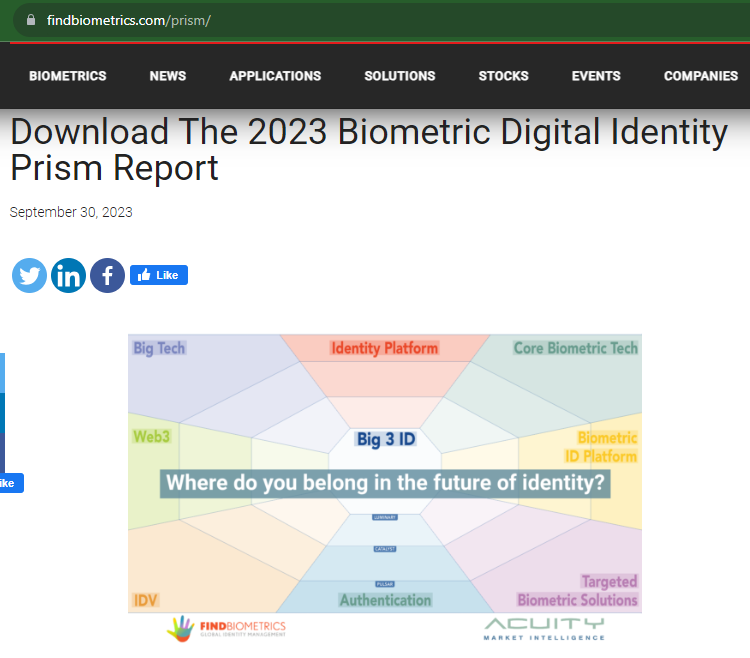
On September 30, FindBiometrics and Acuity Market Intelligence released the production version of the Biometric Digital Identity Prism Report. You can request to download it here.
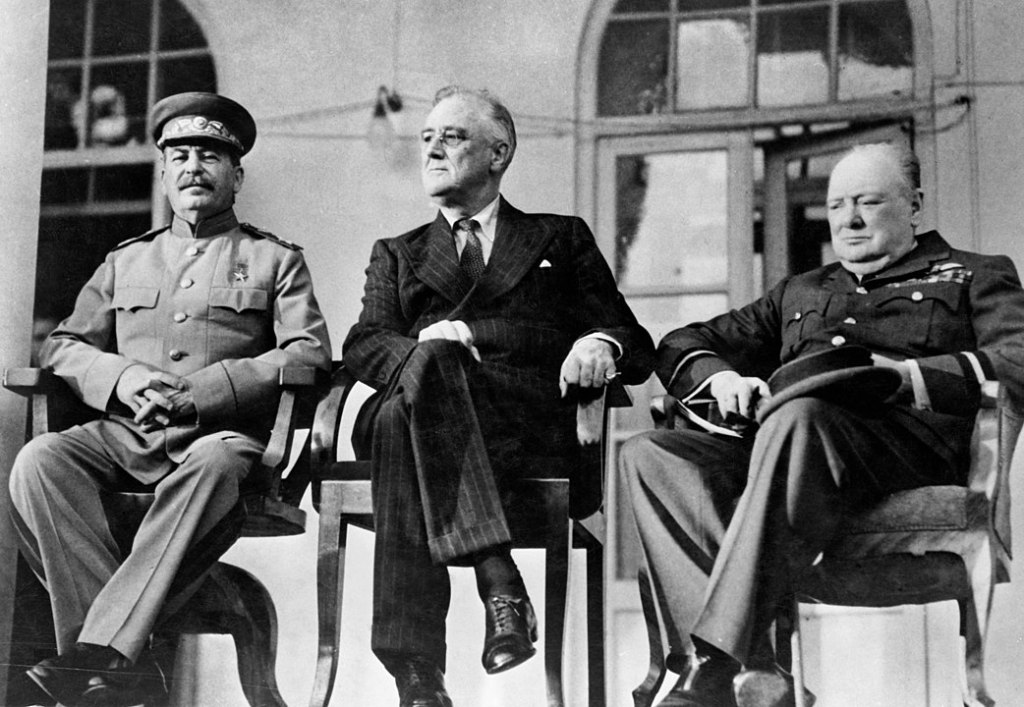
But FindBiometrics and Acuity Market Intelligence didn’t invent the Big 3. The concept has been around for 40 years. And two of today’s Big 3 weren’t in the Big 3 when things started. Oh, and there weren’t always 3; sometimes there were 4, and some could argue that there were 5.
So how did we get from the Big 3 of 40 years ago to the Big 3 of today?
The Big 3 in the 1980s
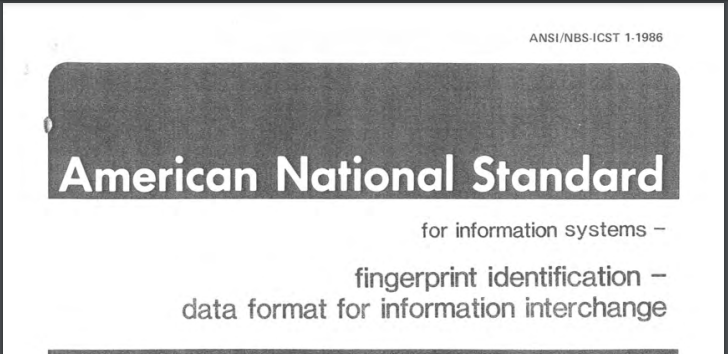
Back in 1986 (eight years before I learned how to spell AFIS) the American National Standards Institute, in conjunction with the National Bureau of Standards, issued ANSI/NBS-ICST 1-1986, a data format for information interchange of fingerprints. The PDF of this long-superseded standard is available here.
When creating this standard, ANSI and the NBS worked with a number of law enforcement agencies, as well as companies in the nascent fingerprint industry. There is a whole list of companies cited at the beginning of the standard, but I’d like to name four of them.
De La Rue Printrak, Inc.
Identix, Inc.
Morpho Systems
NEC Information Systems, Inc.
While all four of these companies produced computerized fingerprinting equipment, three of them had successfully produced automated fingerprint identification systems, or AFIS. As Chapter 6 of the Fingerprint Sourcebook subsequently noted:
Morpho Systems resulted from French AFIS efforts, separate from those of the FBI. These efforts launched Morpho’s long-standing relationship with the French National Police, as well as a similar relationship (now former relationship) with Pierce County, Washington.
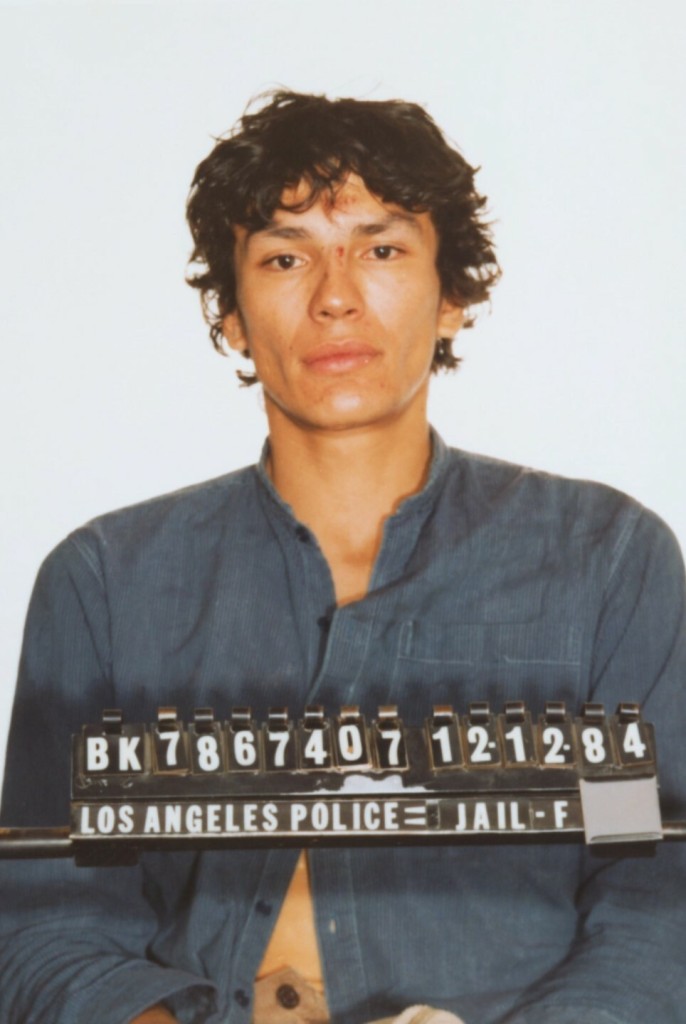
NEC had deployed AFIS equipment for the National Police Academy of Japan, and (after some prodding; read Chapter 6 for the story) the city of San Francisco. Eventually the state of California obtained an NEC system, which played a part in the identification of “Night Stalker” Richard Ramirez.
After the success of the San Francisco and California AFIS systems, many other jurisdictions began clamoring for AFIS of their own, and turned to these three vendors to supply them.
The Big 4 in the 1990s
But in 1990, these three firms were joined by a fourth upstart, Cogent Systems of South Pasadena, California.
While customers initially preferred the Big 3 to the upstart, Cogent Systems eventually installed a statewide system in Ohio and a border control system for the U.S. government, plus a vast number of local systems at the county and city level.
Between 1991 and 1994, the (Immigfation and Naturalization Service) conducted several studies of automated fingerprint systems, primarily in the San Diego, California, Border Patrol Sector. These studies demonstrated to the INS the feasibility of using a biometric fingerprint identification system to identify apprehended aliens on a large scale. In September 1994, Congress provided almost $30 million for the INS to deploy its fingerprint identification system. In October 1994, the INS began using the system, called IDENT, first in the San Diego Border Patrol Sector and then throughout the rest of the Southwest Border.
I was a proposal writer for Printrak (divested by De La Rue) in the 1990s, and competed against Cogent, Morpho, and NEC in AFIS procurements. By the time I moved from proposals to product management, the next redefinition of the “big” vendors occurred.
The Big 3 in 2003
There are a lot of name changes that affected AFIS participants, one of which was the 1988 name change of the National Bureau of Standards to the National Institute of Standards and Technology (NIST). As fingerprints and other biometric modalities were increasingly employed by government agencies, NIST began conducting tests of biometric systems. These tests continue to this day, as I have previously noted.
One of NIST’s first tests was the Fingerprint Vendor Technology Evaluation of 2003 (FpVTE 2003).
For those who are familiar with NIST testing, it’s no surprise that the test was thorough:
FpVTE 2003 consists of multiple tests performed with combinations of fingers (e.g., single fingers, two index fingers, four to ten fingers) and different types and qualities of operational fingerprints (e.g., flat livescan images from visa applicants, multi-finger slap livescan images from present-day booking or background check systems, or rolled and flat inked fingerprints from legacy criminal databases).
Eighteen vendors submitted their fingerprint algorithms to NIST for one or more of the various tests, including Bioscrypt, Cogent Systems, Identix, SAGEM MORPHO (SAGEM had acquired Morpho Systems), NEC, and Motorola (which had acquired Printrak). And at the conclusion of the testing, the FpVTE 2003 summary (PDF) made this statement:
Of the systems tested, NEC, SAGEM, and Cogent produced the most accurate results.
Which would have been great news if I were a product manager at NEC, SAGEM, and Cogent.
Unfortunately, I was a product manager at Motorola.
The effect of this report was…not good, and at least partially (but not fully) contributed to Motorola’s loss of its long-standing client, the Royal Canadian Mounted Police, to Cogent.
The Big 3, 4, or 5 after 2003
So what happened in the years after FpVTE was released? Opinions vary, but here are three possible explanations for what happened next.
Did the Big 3 become the Big 4 again?
Now I probably have a bit of bias in this area since I was a Motorola employee, but I maintain that Motorola overcame this temporary setback and vaulted back into the Big 4 within a couple of years. Among other things, Motorola deployed a national 1000 pixels-per-inch (PPI) system in Sweden several years before the FBI did.
Did the Big 3 remain the Big 3?
Motorola’s arch-enemies at Sagem Morpho had a different opinion, which was revealed when the state of West Virginia finally got around to deploying its own AFIS. A bit ironic, since the national FBI AFIS system IAFIS was located in West Virginia, or perhaps not.
Anyway, Motorola had a very effective sales staff, as was apparent when the state issued its Request for Proposal (RFP) and explicitly said that the state wanted a Motorola AFIS.
That didn’t stop Cogent, Identix, NEC, and Sagem Morpho from bidding on the project.
After the award, Dorothy Bullard and I requested copies of all of the proposals for evaluation. While Motorola (to no one’s surprise) won the competition, Dorothy and I believed that we shouldn’t have won. In particular, our arch-enemies at Sagem Morpho raised a compelling argument that it should be the chosen vendor.
Their argument? Here’s my summary: “Your RFP says that you want a Motorola AFIS. The states of Kansas (see page 6 of this PDF) and New Mexico (see this PDF) USED to have a Motorola AFIS…but replaced their systems with our MetaMorpho AFIS because it’s BETTER than the Motorola AFIS.”
But were Cogent, Motorola, NEC, and Sagem Morpho the only “big” players?
Did the Big 3 become the Big 5?
While the Big 3/Big 4 took a lot of the headlines, there were a number of other companies vying for attention. (I’ve talked about this before, but it’s worthwhile to review it again.)
Identix, while making some efforts in the AFIS market, concentrated on creating live scan fingerprinting machines, where it competed (sometimes in court) against companies such as Digital Biometrics and Bioscrypt.
The fingerprint companies started to compete against facial recognition companies, including Viisage and Visionics.
Oh, and there were also iris companies such as Iridian.
And there were other ways to identify people. Even before 9/11 mandated REAL ID (which we may get any year now), Polaroid was making great efforts to improve driver’s licenses to serve as a reliable form of identification.
In short, there were a bunch of small identity companies all over the place.
But in the course of a few short years, Dr. Joseph Atick (initially) and Robert LaPenta (subsequently) concentrated on acquiring and merging those companies into a single firm, L-1 Identity Solutions.
These multiple mergers resulted in former competitors Identix and Digital Biometrics, and former competitors Viisage and Visionics, becoming part of one big happy family. (A multinational big happy family when you count Bioscrypt.) Eventually this company offered fingerprint, face, iris, driver’s license, and passport solutions, something that none of the Big 3/Big 4 could claim (although Sagem Morpho had a facial recognition offering). And L-1 had federal contracts and state contracts that could match anything that the Big 3/Big 4 offered.
So while L-1 didn’t have a state AFIS contract like Cogent, Motorola, NEC, and Sagem Morpho did, you could argue that L-1 was important enough to be ranked with the big boys.
So for the sake of argument let’s assume that there was a Big 5, and L-1 Identity Solutions was part of it, along with the three big boys Motorola, NEC, and Safran (who had acquired Sagem and thus now owned Sagem Morpho), and the independent Cogent Systems. These five companies competed fiercly with each other (see West Virginia, above).
In a two-year period, everything would change.
The Big 3 after 2009
Hang on to your seats.
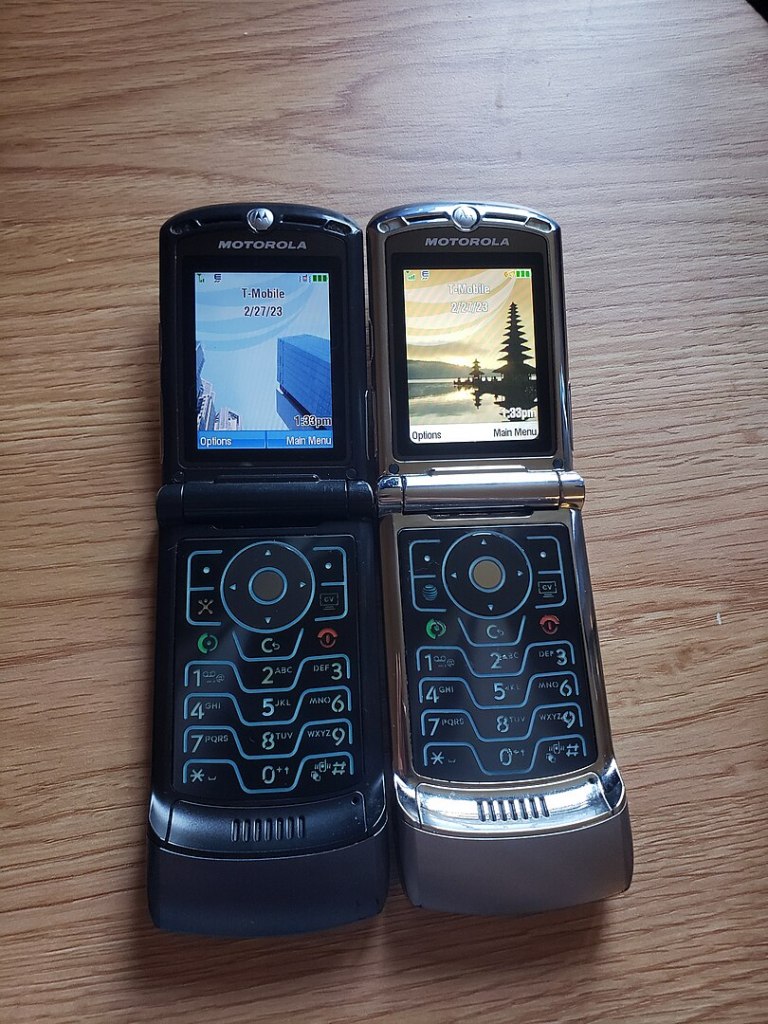
The Motorola RAZR was hugely popular…until it wasn’t. Eventually Motorola split into two companies and sold off others, including the “Printrak” Biometric Business Unit. By NextG50 – Own work, CC BY-SA 4.0, https://commons.wikimedia.org/w/index.php?curid=130206087
By 2009, Safran (resulting from the merger of Sagem and Snecma) was an international powerhouse in aerospace and defense and also had identity/biometric interests. Motorola, in the meantime, was no longer enjoying the success of its RAZR phone and was looking at trimming down (prior to its eventual, um, bifurcation). In response to these dynamics, Safran announced its intent to purchase Motorola’s Biometric Business Unit in October 2008, an effort that was finalized in April 2009. The Biometric Business Unit (adopting its former name Printrak) was acquired by Sagem Morpho and became MorphoTrak. On a personal level, Dorothy Bullard moved out of Proposals and I moved into Proposals, where I got to work with my new best friends that had previously slammed Motorola for losing the Kansas and New Mexico deals. (Seriously, Cindy and Ron are great folks.)
By 2011, Safran decided that it needed additional identity capabilities, so it acquired L-1 Identity Solutions and renamed the acquisition as MorphoTrust.
If you’re keeping notes, the Big 5 have now become the Big 3: 3M, Safran, and NEC (the one constant in all of this).
While there were subsequent changes (3M sold Cogent and other pieces to Gemalto, Safran sold all of Morpho to Advent International/Oberthur to form IDEMIA, and Gemalto was acquired by Thales), the Big 3 has remained constant over the last decade.
And that’s where we are today…pending future developments.
If Alphabet or Amazon reverse their current reluctance to market their biometric offerings to governments, the entire landscape could change again.
Or perhaps a new AI-fueled competitor could emerge.
The 1 Biometric Content Marketing Expert
This was written by John Bredehoft of Bredemarket.
If you work for the Big 3 or the Little 80+ and need marketing and writing services, the biometric content marketing expert can help you. There are several ways to get in touch:
Book a meeting with me at calendly.com/bredemarket. Be sure to fill out the information form so I can best help you.
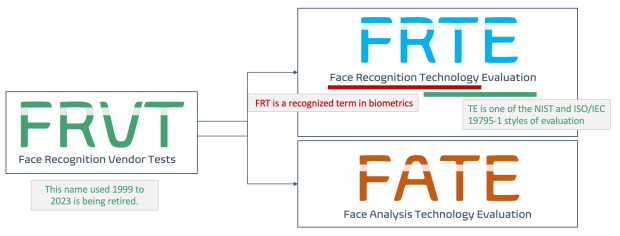
I’ve talked about why NIST separated its FRVT efforts into FRTE and FATE.
But I haven’t talked bout how NIST did this.
And as you all know, the second most important question after why is how.
Why the great renaming took place
As I noted back in August, NIST chose to split its Face Recognition Vendor Test (FRVT) into two parts—FRTE (Face Recognition Technology Evaluation) and FATE (Face Analysis Technology Evaluation).
In essence, the Face Recognition Vendor Test had become a hodgepodge of different things. Some of the older tests were devoted to identification of individuals (face recognition), while some of the newer tests were looking at issues other than individual identification (face analysis).
Of course, this confusion between identification and non-identification is nothing new, which is why some of the people who read Gender Shades falsely concluded that if the three algorithms couldn’t classify people by sex or race, they couldn’t identify them as individuals.
But I digress. (I won’t do it again.)
NIST explained at the time:
Tracks that involve the processing and analysis of images will run under the FATE activity, and tracks that pertain to identity verification will run under FRTE.
To date, most of my personal attention (and probably most of yours) was paid to what was previously called FRVT 1:1 and FRVT 1:N.
These two tests are now part of FRTE, and were simply renamed to FRTE 1:1 and FRTE 1:N. They’ve even (for now) retained the same URLs, although that may change in the future.
Other tests that are now part of the FRTE bucket include:
The “Still Face and Iris 1:N Identification” effort (PDF) has apparently also been reclassified as an FRTE effort.
What is in FATE?
Obviously, presentation attack detection (PAD) testing falls into the FATE category, since this does not measure the identification of an individual, but whether a person is truly there or not. The first results have been released; I previously wrote about this here.
The next obvious category is age estimation testing, which again does not try to identify an individual, but estimate how old the person is. This testing has not yet started, but I talked about the concept of age estimation previously.
It is very possible that NIST will add additional FRTE and FATE tests in the future. These may be brand new tests, or variations of existing tests. For example, when all of us started wearing face masks a couple of years ago, NIST simulated face masks on its existing facial images and created the data for the face mask test described above.
What do you think NIST should test next, either in the FRTE or the FATE category?
More on morphing
And yes, I’m concluding this post with this video. By the way, this is the full version that (possibly intentionally) caused a ton of controversy and was immediately banned for nearly a quarter century. The morphing starts at 5:30. The crotch-grabbing starts right after the 7:00 mark.
Perhaps because of the lack of controversy with Godley & Creme’s earlier effort, Ashley Clark prefers it to the later Michael Jackson/John Landis effort.
Whereas Godley & Creme used editing technology to embrace and reflect the ambiguous murk of thwarted love, Jackson and Landis imposed an artificial sheen on the complexity of identity; a sheen that feels poignant if not outright tragic in the wake of Jackson’s ultimate appearance and fate. Really, it did matter if he was black or white.
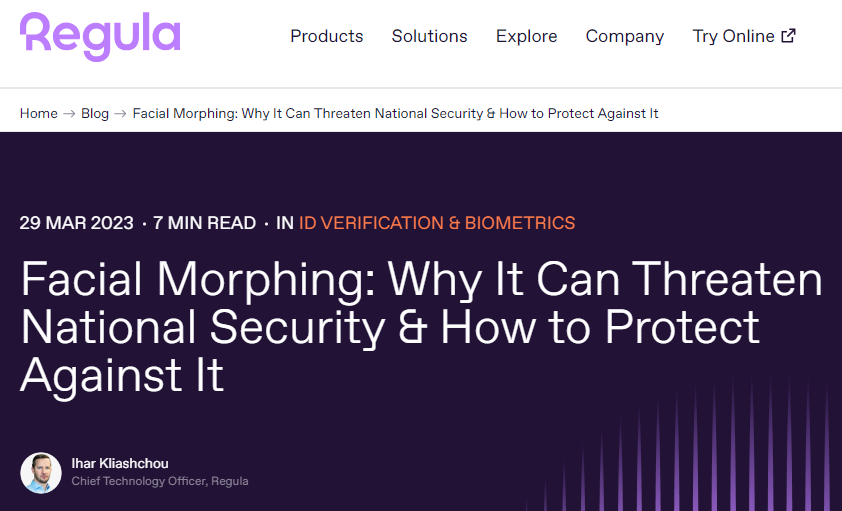
One of the main application areas of facial morphing for criminal purposes is forging identity documents. The attack targets face-based identity verification systems and procedures. Most often it involves passports; however, any ID document with a photo can be compromised.
One well-known case happened in 2018 when a group of activists merged together a photo of Federica Mogherini, the High Representative of the European Union for Foreign Affairs and Security Policy, and a member of their group. Using this morphed photo, they managed to obtain an authentic German passport.
Well, the FATE side of the house has released its first two studies, including one entitled “Face Analysis Technology Evaluation (FATE) Part 10: Performance of Passive, Software-Based Presentation Attack Detection (PAD) Algorithms” (NIST Internal Report NIST IR 8491; PDF here).
Always take advantage of your competitors’ weaknesses.
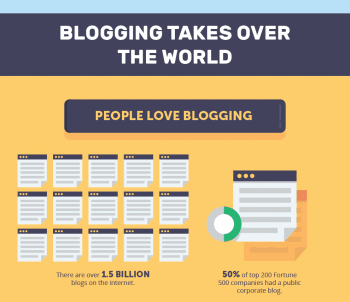
This post describes an easy way to take advantage of your competitors. If they’re not blogging, make sure your firm is blogging. And the post provides hard numbers that demonstrate why your firm should be blogging.
Which means that half of those companies don’t have a public corporate blog.
The same infographic also revealed the following:
86% of B2B companies are blogging. (Or, 14% are not.)
68% of social media marketers use blogs in their social media strategy. (Or, 32% don’t.)
45% of marketers saying blogging is the #1 most important piece of their content strategy.
Small businesses under 10 employees allocate 42% of their marketing budget to content marketing.
So obviously some firms believe blogging is important, while others don’t.
What difference does this make for your firm?
What results do blogging companies receive?
In my view, the figures above are way too low. 100% of all Fortune 500 companies, 100% of B2B companies should be blogging, and 100% of social media marketers should incorporate blogging.
Getting leads from blogging is nice, but show me the money! What about conversions?
Marketers who have prioritized blogging are 13x more likely to enjoy positive ROI.
92% of companies who blog multiple times per day have acquired a customer from their blog.
Take a look at those last two bullets related to conversion again. Blogging is correlated with positive ROI (I won’t claim causation, but anecdotally I believe it), and blogging helps firms acquire customers. So if your firm wants to make money, get blogging.
What should YOUR company do?
With numbers like this, shouldn’t all companies be blogging?
But don’t share these facts with your competitors. Keep them to yourself so that you gain a competitive advantage over them.
Now you just need to write those blog posts.
How can I help?
And if you need help with the actual writing, I, John E Bredehoft of Bredemarket, can help.
And if you’re not in the identity/biometric industry, my general content marketing expertise also applies to technology firms and general business firms.
In most cases, I can provide your blog post via my standard package, the Bredemarket 400 Short Writing Service. I offer other packages and options if you have special needs.
Authorize Bredemarket, Ontario California’s content marketing expert, to help your firm produce words that return results.
Let’s address two items before we continue. Trust me; it’s important.
The Gender Shades study evaluated only three algorithms: one from IBM, one from Microsoft, and one from Face++. It did not evaluate the hundreds of other facial recognition algorithms that existed in 2018 when the study was released.
The study focused on gender classification and race classification. Back in those primitive innocent days of 2018, the world assumed that you could look at a person and tell whether the person was male or female, or tell the race of a person. (The phrase “self-identity” had not yet become popular, despite the Rachel Dolezal episode which happened before the Gender Shades study). Most importantly, the study did not address identification of individuals at all.
Gambling is becoming acceptable in more and more places.
When I was young, and even when I got older, the idea of locating a pro sports team in Las Vegas, Nevada was unthinkable. In the last few years, that has changed dramatically.
The Roblox “Robux” gambing lawsuit
Well, now that gambling for adults has become more and more acceptable (although adults in my home state of California still can’t gamble by phone), now attention is focusing on child gambling.
In a new class action lawsuit filed in the Northern District of California this week, two parents accuse Roblox of illegally facilitating child gambling.
While gambling is not allowed on the platform, which hosts millions of virtual games that cater to children and teens, the lawsuit points to third-party gambling sites that invite users to play blackjack, slots, roulette and other games of chance using Roblox’s in-game currency.
But the gambling sites’ terms of service prohibit underage gambling!
I’m not going to concentrate on Roblox here, but on the other defendants—the ones who actually operate the sites that allegedly allow child gambling.
The lawsuit specifically names RBXFlip, Bloxflip and RBLXWild as participants in “an illegal gambling operation that is preying on children nationwide.”
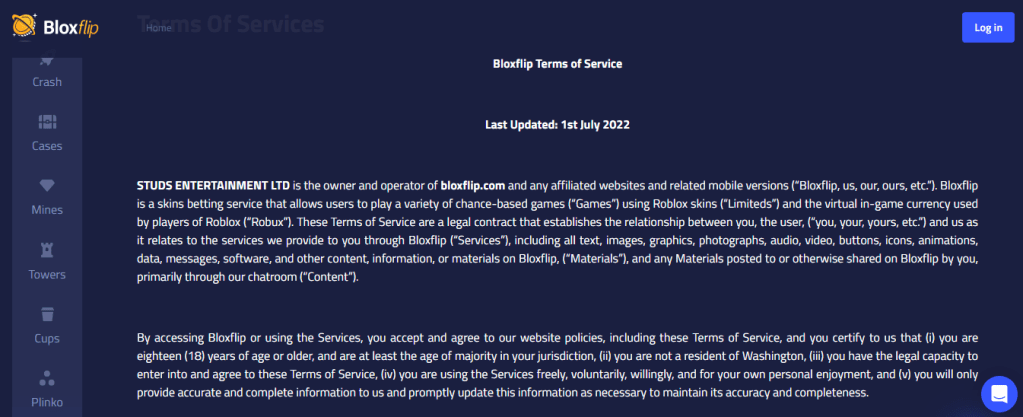
But according to Bloxflip’s Terms of Service, it’s impossible that children can be using the site, because the Terms of Service prohibit this.
By accessing Bloxflip or using the Services, you accept and agree to our website policies, including these Terms of Service, and you certify to us that (i) you are eighteen (18) years of age or older, and are at least the age of majority in your jurisdiction, (ii) you are not a resident of Washington, (iii) you have the legal capacity to enter into and agree to these Terms of Service, (iv) you are using the Services freely, voluntarily, willingly, and for your own personal enjoyment, and (v) you will only provide accurate and complete information to us and promptly update this information as necessary to maintain its accuracy and completeness.
However, stating a minimum age in your TOS is even less effective than other common age verification methods, such as
Asking your customer to check a box to say that they are over 18 years old.
Asking your customer to type in their birthday.
Requiring your customer to read a detailed description of IRA/401(k) funding strategies and the medical need for colonoscopies. (This would be more effective than the first two methods.)
A better way to verify and estimate ages
As more and more companies are realizing, however, there are other ways to measure customer ages, including a comparison of a live face with a government-issued identification card (driver’s license or passport), or the use of “age estimation” software to ensure that a 12 year old isn’t gambling. (And don’t forget that NIST will test age estimation software as part of its FATE testing.)
Even when the kids aren’t gambling legal currency.
(D)igital security engineers at the University of Wisconsin–Madison have found these systems are not quite as foolproof when it comes to a novel analog attack. They found that speaking through customized PVC pipes — the type found at most hardware stores — can trick machine learning algorithms that support automatic speaker identification systems.
The project began when the team began probing automatic speaker identification systems for weaknesses. When they spoke clearly, the models behaved as advertised. But when they spoke through their hands or talked into a box instead of speaking clearly, the models did not behave as expected.
(Shimaa) Ahmed investigated whether it was possible to alter the resonance, or specific frequency vibrations, of a voice to defeat the security system. Because her work began while she was stuck at home due to COVID-19, Ahmed began by speaking through paper towel tubes to test the idea. Later, after returning to the lab, the group hired Yash Wani, then an undergraduate and now a PhD student, to help modify PVC pipes at the UW Makerspace. Using various diameters of pipe purchased at a local hardware store, Ahmed, Yani and their team altered the length and diameter of the pipes until they could produce the same resonance as they voice they were attempting to imitate.
Eventually, the team developed an algorithm that can calculate the PVC pipe dimensions needed to transform the resonance of almost any voice to imitate another. In fact, the researchers successfully fooled the security systems with the PVC tube attack 60 percent of the time in a test set of 91 voices, while unaltered human impersonators were able to fool the systems only 6 percent of the time.
We evaluate two state-of-the-art ASI models: (1) the x-vector network [51] implemented by Shamsabadi et al. [45], and (2) the emphasized channel attention, propagation and aggregation time delay neural network (ECAPATDNN) [17], implemented by SpeechBrain.1 Both models were trained on VoxCeleb dataset [15, 36, 37], a benchmark dataset for ASI. The x-vector network is trained on 250 speakers using 8 kHz sampling rate. ECAPA-TDNN is trained on 7205 speakers using 16 kHz sampling rate. Both models report a test accuracy within 98-99%.
So what we know is that this test, which used these two ASI models trained on a particular dataset, demonstrated an ability to fool systems 60 percent of the time.
But…
What does this mean for other ASI algorithms, including the commercial algorithms in use today?
And what does it mean when other datasets are used?
In other words (and I’m adapting my own text here), how do the results of this study affect “current automatic speaker identification products”?
The answer is “We don’t know.”
So pipe down…until we actually test commercial algorithms for this technique.
But I’m sure that the UW-Madison researchers and I agree on one thing: more research is needed.










 Bredemarket