Quick Thoughts on Product Positioning

I’ve already talked about product launches in my recent On “Go-to-Market” post, but having worked in product marketing for some time, I know that there are a lot of tasks that your firm has to perform even when you’re not launching a new product.

One of those tasks is product positioning. And it’s important.

Product positioning isn’t quite as complex as global positioning (a factor of authentication, by the way). By Paulsava – Own work, CC BY-SA 4.0, https://commons.wikimedia.org/w/index.php?curid=47209685

Six questions for product positioning

There are some complex ways to define product positioning, probably even at the level of Shipley 96-step complexity. But when I can, I gravitate for the simple.

Here’s how I define product positioning:

(UPDATE OCTOBER 23, 2023: “SIX QUESTIONS YOUR CONTENT CREATOR SHOULD ASK YOU IS SO 2022. DOWNLOAD THE NEWER “SEVEN QUESTIONS YOUR CONTENT CREATOR SHOULD ASK YOU” HERE.)

  • Why your product (or service) exists.
  • How your product benefits your customers.
  • What your product is (but note that I asked the first two questions before this one).
  • Other facets of your product (goal, benefits, target audience—if this is new to you, catch up by reading my e-book on the six questions your content creator should ask you).

Why the questions matter

If your product suddenly disappeared from the world, would your target audience (or, in marketing-speak, personas) care?

Would your target audience be just as happy with the competitive offerings, or would the target audience lose out if your product’s distinctive benefits were suddenly no longer available?

Choose one (food) to go forever. Reproduced at https://josephmallozzi.com/2020/10/01/october-1-2020-lets-chat/

There are a number of popular memes that ask you to remove one popular food from a list of foods. What would happen if, instead of asking about pizza and tacos, you asked your target audience about your product and eight others? Would your product survive the cut, or would your prospects happily dump it?

Position your product so that it always remains top of mind for your prospects.

  • Answer the questions above.
  • Create content that is focused on the customer (not focused on your firm).
  • Create content that explains benefits (not features) to your prospects.

On “Go-to-Market”

After I slept on my “trust funnel” post, I decided that it was too long and took the entire “go-to-market” section out. But I saved it and am sharing it with you here.

This little piggy went to market

By Rklawton – Own work, CC BY-SA 2.5, https://commons.wikimedia.org/w/index.php?curid=735848

(Yes, I know that the little piggy didn’t go to market to do their own shopping. But bear with me here.)

If you are creating content as part of the formal launch of a product or service, you are creating SOME type of go-to-market (GTM) plan.

  • Perhaps it’s a well-defined plan.
  • Perhaps it’s a simple document.
  • Maybe it’s a haphazard dictate to “go to market in three days.”

About the “three days” thing

  • product,
  • marketing,
  • product marketing (if it is separate from the first two departments),
  • engineering,
  • customer success/customer service,
  • finance,
  • sales, and
  • legal.

But there ARE teeny tiny GTM efforts

One exception to the four-month guidance: if your “product” or “service” is VERY small (like a single blog post), you can obviously go-to-market much more quickly.

For example, here’s my Asana-based “GTM plan” for a single blog post, “I Changed My Mind on Age Estimation.

From the private Bredemarket Asana Content Calendar, back in the days when Twitter (TW) was still Twitter.

Sometimes. At other times I skip Asana altogether and just take pictures and post stuff, like what I did with my “Coldest Beer in Town” and “Classy by Definition” posts from earlier today. Variety is good.

Back to normal GTM

But when your product or service is more complex, then you need to plan your GTM campaign and make sure that it answers all questions about your product or service.

There are all sorts of GTM guidelines out there, and I was part of a team who collaboratively created three different flavors of GTM guidelines over the course of several months, starting with the complex and ending with the ridiculously simple. And the team STILL couldn’t get the other teams to agree on the parameters of the guidelines.

I’m not going to dictate MY ideas on GTM guidelines, but I will say that whatever guidelines you create, make sure that by the time a GTM effort created under these guidelines is finished, both your prospects and your employees will gain the appropriate understanding of your product or service, and the GTM content will answer all of their questions.

(UPDATE OCTOBER 23, 2023: “SIX QUESTIONS YOUR CONTENT CREATOR SHOULD ASK YOU IS SO 2022. DOWNLOAD THE NEWER “SEVEN QUESTIONS YOUR CONTENT CREATOR SHOULD ASK YOU” HERE.)

If you don’t know what questions to ask, my six questions (why, how, what goal, benefits, target audience) can be adapted for GTM purposes.

What about your GTM content?

Are you executing a go-to-market plan and need to create some content?

  • Do you need customer-facing external content (blog posts, white papers, whatever)?
  • Do you need employee-facing internal content (FAQs, battlecards, whatever)?

Regardless of the content you need, Bredemarket can help you. Here’s a list of the types of content I’ve created over the years:

Articles • Battlecards (80+) • Blog Posts (400+) • Briefs/Data/Literature Sheets • Case Studies (12+) • Competitive Analyses • Email Newsletters (200+) • Event/Conference/Trade Show Demonstration Scripts • FAQs • Plans • Playbooks • Presentations • Proposal Templates • Proposals (100+) • Quality Improvement Documents • Requirements • Scientific Book Chapters • Smartphone Application Content • Social Media (Facebook, Instagram, LinkedIn, Threads, TikTok, Twitter) • Strategic Analyses • Web Page Content • White Papers and E-Books

Whatever you need, talk to me. And be prepared for me to ask you six (or more) questions.

Bredemarket logo

On Trust Funnels

Kasey Jones alerted me to the phrase “trust funnel,” and I’ve been thinking about it and its relationship to content marketing. Here are my thoughts.

The sales funnel

Many of us are familiar with the concept of sales funnels. The idea is that there are a bunch of people at the top of the funnel, and people move through the sales process.

Like sausage making.

By Rklawton – Own work, CC BY-SA 2.5, https://commons.wikimedia.org/w/index.php?curid=735848

As people move down, the funnel gets narrower and narrower as some people exit the funnel. At the bottom of the funnel, there is a very small hole that represents the customers who have converted, or who have actually purchased something.

In a rare instance of my championing simplicity, I like to use an easy three-step sales funnel model with awareness, consideration, and conversion.

From Venn Marketing, “Awareness, Consideration, Conversion: A 4 Minute Intro To Marketing 101.” (Link)

You may use a more complex sales funnel, but the exact number of steps in the funnel really doesn’t matter. What does matter is that your content marketers create content that addresses each step in your funnel.

  • In early steps of the funnel, the content goal is to ensure that prospects know that you’re out there and you have a solution that benefits the prospects.
  • In later steps of the funnel, the content goal is to move prospects to the point where they will purchase something from you, rather than purchasing it from one of your competitors or not purchasing anything at all.

Some of the approaches to sales funnel-based content marketing are based upon the faulty assumption that people progress through the funnel in a logical and predictable manner. In the logical model, you present an awareness piece of content, then follow that with a consideration piece of content, then finally present content to convert the prospect into a customer.

It’s all very orderly.

Like sausage making.

But people are not sausages

This model of the rational buyer is not always reflected in reality because people are not pieces of meat (except for the guy above). Here’s what Magdalena Andreeva says about “the messy middle”:

It’s about time we redefine the classic marketing funnel. It describes the user journey as a rather linear path, while the reality is a lot more messy, complex, and unpredictable.

Let’s scrap the dated marketing funnel and try to map out the real user journey.

It starts with a trigger, and then it goes into an almost infinite loop between exploration and evaluation – over and over again. And finally, the user exits the loop by making a decision or a purchase.

From https://hop.online/digital-strategy/how-to-influence-the-messy-middle-of-the-buyer-journey/

No, it’s not logical, but people are not logical.

Oh, and in addition to assuming logic, standard content creation methods assume that your firm knows where every buyer is on their journey. This assumption is essential so that your firm can detect a prospect in the awareness phase and take the necessary steps to move them downward into the funnel (or toward the endless loop pictured above).

Kasey Jones and the trust funnel

I mentioned Kasey Jones at the beginning of this blog post, based upon something she shared on LinkedIn. She started with an inconvenient truth that blew the second assumption out of the water.

Your buyers will probably never like or comment on your posts.

Kasey Jones LinkedIn post, 8/25/2023. (Link)

So much for all of those fancy tools that identify the sources of interaction with your content. They don’t work if people don’t interact with your content.

Yet Jones notes that these people are still buying. Three of them reached out to her in the last two weeks.

Each mentioned my content as why they wanted to work with me.

But they have never, not once, engaged with anything I’ve done on here.

Still, they were in my trust funnel, just the same.

Kasey Jones LinkedIn post, 8/25/2023. (Link)

This is where I noticed that word “trust funnel.”

It’s different from the sales funnel that we are laboriously tracking in our customer relationship management (CRM) tool. For content marketers, these things literally pop up out of the blue from a “trust funnel” that we know nothing about, even though we’re building it with our content.

If I wished, I could name multiple examples of people reaching out to me because of my content or Bredemarket’s content.

Jones’ point in all this was to emphasize that you need to keep on creating “scroll-stopping content” to attract DREAM (her capitalization) clients.

Even though you don’t know who you are attracting.

You’re not a sausage grinder making sausages. You’re a flower attracting bees.

By The original uploader was Y6y6y6 at English Wikipedia. – Original image located at PDPhoto.org. Transferred from en.wikipedia to Commons by Drilnoth using CommonsHelper., Public Domain, https://commons.wikimedia.org/w/index.php?curid=7365698

Now I could end this discussion right here with Kasey Jones’ comments, but I thought I’d perform a LinkedIn search to see who else was talking about the trust funnel.

And I found Kevin Schmitz.

Kevin Schmitz and the trust funnel

Schmitz approached the topic from a different perspective in his post from earlier this week. He focused on a particular piece of content: a person’s LinkedIn profile and activity.

Schmitz asserted that if someone approaches you with a meeting request, and the person’s LinkedIn presence is (his words) “bare bones,” you’re less likely to take the meeting. But if a meeting requester posts engaging, relevant content, perhaps you’ll take that call.

Schmitz went on to say:

Your presence on LinkedIn is not a “lead funnel”.

It’s a “trust funnel”.

We work so damn hard to establish trust in the meeting.

Yet, most of us are person 1 (the “bare bones” person) with an uphill battle each and every meeting.

Kevin Schmitz LinkedIn post, 8/22/2023 ot 8/23/2023. (Link)

If you’re interested, Schmitz’s post goes on to suggest ways to make your LinkedIn presence more engaging.

The meaning for content marketing

So what does the idea of “creating content that resonates with your invisible trust funnel” mean for content marketing?

Most people realize (or I hope they realize) that organic content often does not have an immediate payoff, especially for complex B2B sales. Even if I write the most amazing automated biometric identification system (ABIS) content for a Bredemarket client, the client won’t get orders within the first three days of posting the content. (I’ll have more to say about “three days” in a future post discussing go-to-market efforts.) Even if I am the biometric content marketing expert. (I’ve been working on promoting THAT piece of content for a while now.)

It takes longer than three days for content marketing to yield results. One source estimates four to five months. Another source says six to twelve months. Joe Pulizzi (quoted by Neil Patel) estimates 15 to 17 months. And all the sources say that their estimates may not apply to your particular case.

But Bredemarket (and I in my personal communications) will continue to cater to that invisible trust funnel and see what happen.

And if you’re reading this post in Janury 2025, thank you. If you want to talk to me about content creation, some of these links may still work!

Bredemarket logo

You Need a Laptop AND a Smartphone For This To Work. Or You Don’t.

If you are reading this on your laptop (or your desktop), point your smartphone to the QR code on your laptop (or desktop) screen to read my first e-book, “Six Questions Your Content Creator Should Ask You.”

(UPDATE OCTOBER 22, 2023: “SIX QUESTIONS YOUR CONTENT CREATOR SHOULD ASK YOU IS SO 2022. DOWNLOAD THE NEWER “SEVEN QUESTIONS YOUR CONTENT CREATOR SHOULD ASK YOU” HERE.)

If you are reading this on your smartphone, just click on this link: https://bredemarket.com/wp-content/uploads/2022/12/bmteb6qs-2212a.pdf.

As I said before, QR codes are sometimes useful, and sometimes not.

If you want to know the “why” about the e-book-see what I did there?-visit my announcement of the e-book. You can view the e-book there also.

By the way, I just checked my WordPress stats. Since this e-book was published in December 2022, it’s been downloaded over 160 times. I hope it’s helping people.

There’s a Reason Why “Tech” is a Four-Letter Word

By Tomia, original image en:User:Polylerus – Own work (Vector drawing based on Image:Profanity.JPG), Public Domain, https://commons.wikimedia.org/w/index.php?curid=3332425

We often use the phrase “four-letter word” to refer to cuss words that shouldn’t be said in polite company. Occasionally, we have our own words that we personally consider to be four-letter words. (Such as “BIPA.”)

There are some times when we resign ourselves to the fact that “tech” can be a four-letter word also. But there’s actually a good reason for the problems we have with today’s technology.

Tech can be dim

Just this week I was doing something on my smartphone and my screen got really dim all of a sudden, with no explanation.

So I went to my phone’s settings, and my brightness setting was down at the lowest level.

For no reason.

“Any sufficiently advanced technology is indistinguishable from magic.”

– Arthur C. Clarke, quoted here.

So I increased my screen’s brightness, and everything was back to normal. Or so I thought.

A little while later, my screen got dim again, so I went to the brightness setting…and was told that my brightness was very high. (Could have fooled me.)

I can’t remember what I did next (because when you are trying to fix something you can NEVER remember what you did next), but later my screen brightness was fine.

For no reason.

Was Arthur C. Clarke right? And if so, WHY was he right?

Perhaps it’s selective memory, but I don’t recall having this many technology problems when I was younger.

The shift to multi-purpose devices

Part of the reason for the increasing complexity of technology is that we make fewer and fewer single-purpose devices, and are manufacturing more and more multi-purpose devices.

One example of the shift: if I want to write a letter today, I can write it on my smartphone. (Assuming the screen is bright enough.) This same smartphone can perform my banking activities, play games, keep track of Bredemarket’s earnings…oh, and make phone calls.

Smartphones are an example of technologial convergence:

Technological convergence is a term that describes bringing previously unrelated technologies together, often in a single device. Smartphones might be the best possible example of such a convergence. Prior to the widespread adoption of smartphones, consumers generally relied on a collection of single-purpose devices. Some of these devices included telephones, wrist watches, digital cameras and global positioning system (GPS) navigators. Today, even low-end smartphones combine the functionality of all these separate devices, easily replacing them in a single device.

From a consumer perspective, technological convergence is often synonymous with innovation.

From https://www.techtarget.com/searchdatacenter/definition/technological-convergence

And the smartphone example certainly demonstrates innovation from the previous-generation single-purpose devices.

When I was a kid, if I wanted to write a letter, I had two choices:

  1. I could set a piece of paper on the table and write the letter with a writing implement such as a pen or pencil.
  2. I could roll a piece of paper into a typewriter and type the letter.

These were, for the most part, single purpose devices. Sure I could make a paper airplane out of the piece of paper, but I couldn’t use the typewriter to play a game or make a phone call.

Turning our attention to the typewriter, it certainly was a manufacturing marvel, and intricate precision was required to design the hammers that would hit the typewritter ribbon and leave their impressions on the piece of paper. And typewriters could break, and repairmen (back then they were mostly men) could fix them.

A smartphone is much more innovative than a smartphone. But it’s infinitely harder to figure out what is wrong with a smartphone.

The smartphone hardware alone is incredibly complex, with components from a multitude of manufacturers. Add the complexities of the operating system and all the different types of software that are loaded on a smartphone, and a single problem could result from a myriad of causes.

No wonder it seems like magic, even for the best of us.

Explaining technology

But this complexity has provided a number of jobs:

  • The helpful person at your cellular service provider who has acquired just enough information to recognize and fix an errant application.
  • The many people in call centers (the legitimate call centers, not the “we found a problem with your Windows computer” call scammers) who perform the same tasks at a distance.
By Earl Andrew at English Wikipedia – Own work, Public Domain, https://commons.wikimedia.org/w/index.php?curid=17793658
  • All the people who write instructions on how to use and fix all of our multi-purpose devices, from smartphones to computers to remote controls.

Oh, and the people that somehow have to succinctly explain to prospects why these multi-purpose devices are so great.

Because no one’s going to run into problems with technology unless they acquire the technology. And your firm has to get them to acquire your technology.

Crafting a technology marketing piece

So your firm’s marketer or writer has to craft some type of content that will make a prospect aware of your technology, and/or induce the prospect to consider purchasing the technology, and/or ideally convert the prospect into a paying customer.

Before your marketer or writer crafts the content, they have to answer some basic questions.

By Evan-Amos – Own work, Public Domain, https://commons.wikimedia.org/w/index.php?curid=11293857

Using a very simple single-purpose example of a hammer, here are the questions with explanations:

  • Why does the prospect need this technology? And why do you provide this technology? This rationale for why you are in business, and why your product exists, will help you make the sale. Does your prospect want to buy a hammer from a company that got tired of manufacturing plastic drink stirrers, or do they want to buy a hammer from a forester who wants to empower people to build useful items?
  • How does your firm provide this technology? If I want to insert a nail into a piece of wood, do I need to attach your device to an automobile or an aircraft carrier? No, the hammer will fit in your hand. (Assuming you have hands.)
  • What is the technology? Notice that the “why” and “how” questions come before the “what” question, because “why” and “how” are more critical. But you still have to explain what the technology is (with the caveat I mention below). Perhaps some of your prospects have no idea what a hammer is. Don’t assume they already know.
  • What is the goal of the technology? Does a hammer help you floss your teeth? No, it puts nails into wood.
  • What are the benefits of the technology? When I previously said that you should explain what the technology is, most prospects aren’t looking for detailed schematics. They primarily care about what the technology will do for them. For example, that hammer can keep their wooden structure from falling down. They don’t care about the exact composition of the metal in the hammer head.
  • Finally, who is the target audience for the technology? I don’t want to read through an entire marketing blurb and order a basic hammer, only to discover later that the product won’t help me keep two diamonds together but is really intended for wood. So don’t send an email to jewelers about your hammer. They have their own tools.
By Mauro Cateb – Own work, CC BY-SA 4.0, https://commons.wikimedia.org/w/index.php?curid=90944472

(UPDATE OCTOBER 23, 2023: “SIX QUESTIONS YOUR CONTENT CREATOR SHOULD ASK YOU IS SO 2022. DOWNLOAD THE NEWER “SEVEN QUESTIONS YOUR CONTENT CREATOR SHOULD ASK YOU” HERE.)

Once you answer these questions (more about the six questions in the Bredemarket e-book available here), your marketer or writer can craft your content.

Or, if you need help, Bredemarket (the technology content marketing expert) can craft your content, whether it’s a blog post, case study, white paper, or something else.

I’ve helped other technology firms explain their “hammers” to their target audiences, explaining the benefits, and answering the essential “why” questions about the hammers.

Can I help your technology firm communicate your message? Contact me.

Bredemarket logo

Blog About Your Identity Firm’s Benefits Now. Why Wait?

As content creators accelerate information generation and distribution, content consumers demand information NOW. Perhaps my prediction of five-minute content creation hasn’t occurred—yet—but firms need to distribute their messages as fast as possible.

OK, maybe not as fast as Brazilian race car driver Antonella Bassani, but fast enough. Fair use, from https://www.racers-behindthehelmet.com/post/first-historic-pole-position-and-podium-for-antonella-bassani-in-porsche-cup-brasil. Photo credits: Porsche Cup Brasil.

This Bredemarket blog post discusses a rapid way for identity/biometric firms to communicate the benefits of their solutions and capture their prospects’ attention immediately.

  • Blogging provides the rapid content generation your identity/biometric firm needs.
  • Benefits are essential in your blog post to help convert your readers.
  • Bredemarket can generate a benefits-laced blog post for your identity/biometric firm…with no learning curve necessary, allowing you to distribute your message quickly.

Why blogging?

While my consultancy Bredemarket creates identity content in a variety of customer-facing formats, including white papers, case studies, and e-books, one of my favorite ways to write about identity is via blog posts.

Why?

  • Blog posts provide an immediate business impact. It’s easier to create a blog post than it is to create a downloadable document. If Bredemarket needs to generate content for its self-marketing, I can get a blog post out in two hours, if not sooner. For a breaking news story, your company’s blogged take may hit your prospects before they’ve even heard about the breaking news story in the first place.
  • Blog posts are easy to share. You can’t just post your blog content and let it sit there. While over 200 people subscribe to the Bredemarket blog, that means that almost 8 billion people will never see it. I increase my viewing odds (slightly) by resharing my blog posts to my hundreds of additional followers on LinkedIn, Instagram, Facebook, and other platforms.
  • Blog posts are easy to repurpose. Once people have read your blog post, your work is not done. It’s easy to repurpose blog content into other forms. For example, I created an e-book from a blog post.

Why benefits?

However, if your identity/biometric blog post merely consists of a list of features of your product or service, then you’re wasting your time.

If your post simply states that your new latent fingerprint station captures print evidence at 2000 pixels per inch, most of your prospects are going to say, “So what?”

On the other hand, if your post talks about how your latent fingerprint station’s high capture resolution benefits your prospects by helping experts to solve crimes more quickly and getting bad people off the street, then your prospects are going to care about your product/service—and will convert from prospects to paying customers.

Why Bredemarket?

That little tip about benefits vs. features is just one of numerous tips that I’ve picked up over my many years as an identity/biometric blog expert. And you can benefit from my ability to start writing immediately because I require no learning curve. My 29 years of identity/biometric expertise comes in handy when your firm requires identity blog post writing.

OK, perhaps it’s an exaggeration to say that I can start writing immediately. Before I type a single word, we need to ensure a common understanding of why we’re writing this blog post. If you want to know how we achieve this common understanding, read the e-book I mentioned earlier.

If you are ready to purchase my Bredemarket 400 Short Writing Service to create a blog post (or other short content) describing the benefits of your identity/biometric product or service, then we should start talking sooner rather than later.

Bredemarket logo

How Bredemarket Works

Bredemarket logo

(Updated question count 10/23/2023)

I’m stealing an idea from Matthew Mace and adapting it to explain how Bredemarket works.

What am I stealing from Matthew Mace?

Matthew Mace is a freelance content writer who recently posted the following on LinkedIn:

Do you need a freelance content writer but don’t know what to expect?

I created a “work with me” pdf that explains what I do and how I can help you.

From https://www.linkedin.com/posts/matthewmace-contentmarketing_cycling-running-wellness-activity-7094675414727450624-8U_Y/

His post then explains what is included in his “work with me” PDF. If you’d like his PDF, send him a message via his LinkedIn profile.

But what if I want to know how to work with Bredemarket?

Glad you asked.

After reading Mace’s LinkedIn post, I realized that I have a bunch of different online sources that explain how to work with Bredemarket, but they’re scattered all over the place. This post groups them all the “how to work with Bredemarket” content together, following an outline similar (yet slightly different) to Mace’s.

And no, it’s not a stand-alone PDF, but as you read the content below you’ll discover two stand-alone PDFs that address critical portions of the process.

Question 1: Why would I work with Bredemarket?

As you’ll see below, “why” is a very important question, even more important than “how.” Here are some reasons to work with Bredemarket.

  • You require the words to communicate the benefits of your identity/biometrics product/service. I offer 29 years of experience in the identity/biometrics industry and am a biometric content marketing expert and an identity content marketing expert. I have created multiple types of content (see below) to share critical points about identity/biometrics offerings.
  • You require the words to communicate the benefits of your technology product/service. I have also created multiple types of content to share critical points about technology offerings.
  • You require the words to communicate the benefits of a product/service you provide to California’s Inland Empire. I’ve lived in the Inland Empire for…well, for more than 29 years. I know the area—its past, its present, and its future.
  • You require one of the following types of content. Blogs, case studies / testimonials, data sheets, e-books, proposals, social media posts / Xs (or whatever tweets are called today), white papers, or anything. I’ve done these for others and can do it for you.

Question 2: Why WOULDN’T I work with Bredemarket?

This question is just as important as the prior one. If you need the following, you WON’T want to work with Bredemarket.

  • You require high quality graphics. Sorry, that’s not me.
I did not draw this myself. Originally created by Jleedev using Inkscape and GIMP. Redrawn as SVG by Ben Liblit using Inkscape. – Own work, Public Domain, link.
  • You are based outside of the United States. Foreign laws and exchange rates make my brain hurt, so I only pursue business domestically. But depending upon where you are, I may be able to recommend a content marketer for you.

Question 3: What are Bredemarket’s most popular packages? How much do they cost?

Here are the three most common packages that Bredemarket offers.

By Staff Sgt. Michael L. Casteel – [1], Public Domain, https://commons.wikimedia.org/w/index.php?curid=2407244

Note that these are the standard packages. If your needs are different, I can adapt them, or charge you an hourly rate if the need is not well defined. (But as you will see below, I try to work with you at the outset to define the project.)

If you follow the link above for your desired package and download the first brochure on each page, you’ll get a description of the appropriate service. The pricing is at the bottom of each brochure.

Each brochure also explains how I kick off a project, but the procedure is fairly common for each package.

Question 4: What are Bredemarket’s working practices?

When I work with a client, I hold a kickoff to make sure that we have a common understanding at the beginning of the project.

The first seven questions that we address are critical. In fact, I wrote an e-book that addresses these seven questions alone.

  1. Why?
  2. How?
  3. What?
  4. Goal?
  5. Benefits?
  6. Target Audience?
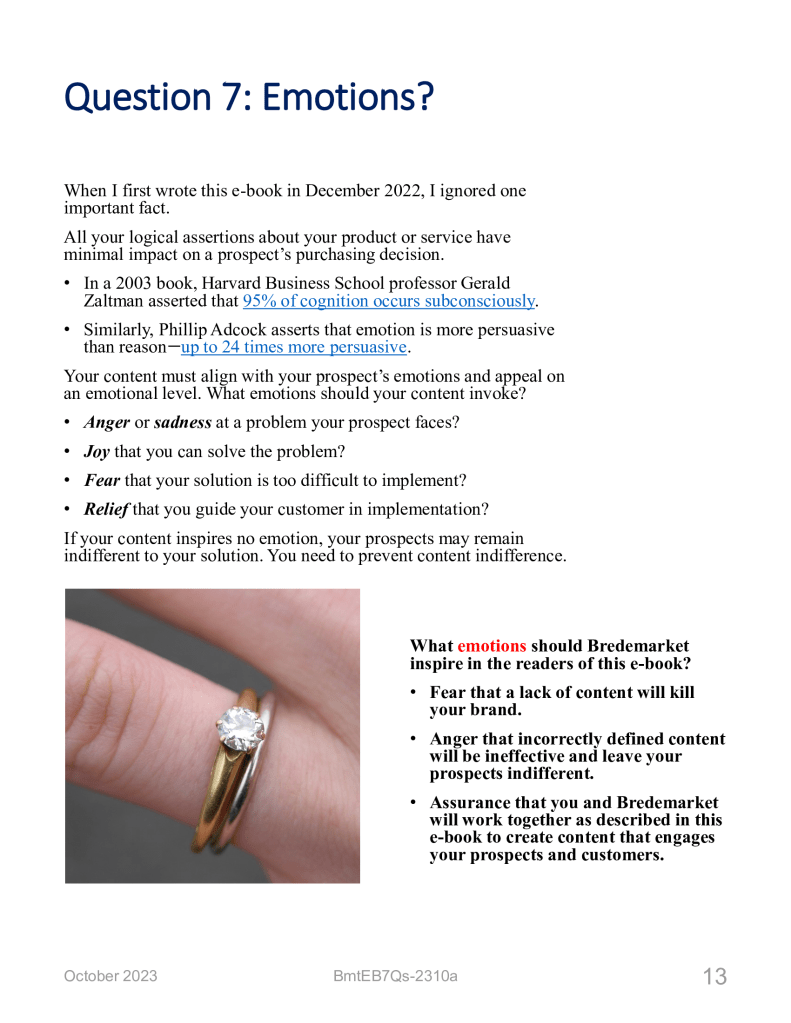
  7. Emotions?

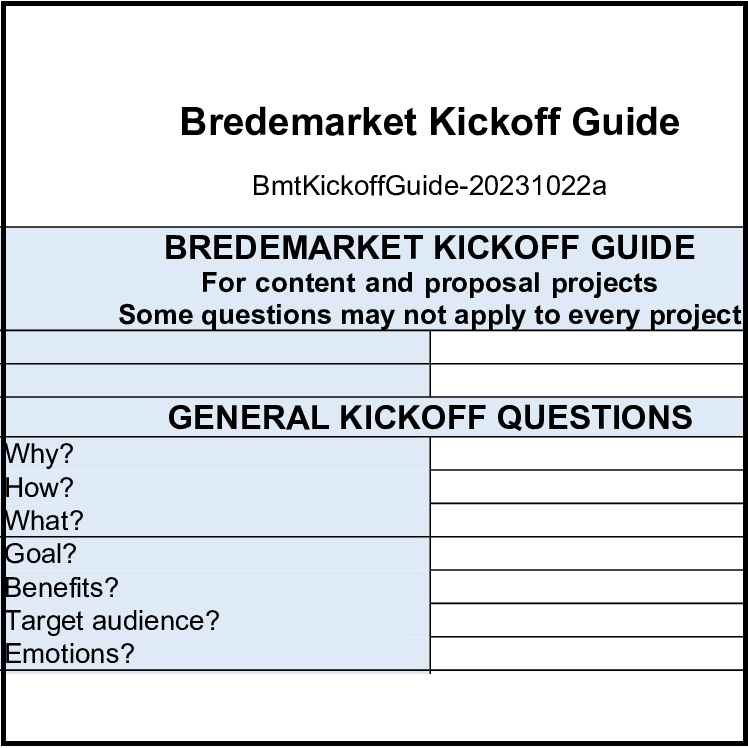
But that’s not all that we address in the kickoff. There are some other lower-level questions that I ask you (such as the long and short form of your company name).

Once we have defined the project, I iteratively provide draft copy and you iteratively review it. The number and length of review cycles varies depending upon the content length and your needs. For example, I use up to two review cycles of up to three days each for short content.

Eventually I provide the final copy, you publish it and pay me, and both of us are happy.

Question 5: What about samples and testimonials?

Because I usually function as a ghostwriter, I cannot publicly provide samples or identity my clients. But I’ve written yet another e-book that anonymously describes some sample projects that I’ve performed for clients, including a testimonial from one of them.

Question 6: What are the next steps to work with Bredemarket?

If you believe that I can help you create the content your firm needs, let’s talk.

Or if Matthew Mace’s content services better fit your needs, use him.

Kenya Concerns About Worldcoin Data: WHAT Data?

Biometric Update linked to an AFP article (via Africanews) that referenced a statement by the Ministry of the Interior Cabinet Secretary Kithure Kindiki, portions of which were quoted by Citizen Digital.

“Relevant security, financial services and data protection agencies have commenced inquiries and investigations to establish the authenticity and legality of the aforesaid activities, the safety and protection of the data being harvested, and how the harvesters intend to use the data,” read part of the statement.

“Further, it will be critical that assurances of public safety and the integrity of the financial transactions involving such a large number of citizens be satisfactorily provided upfront.”

From https://www.citizen.digital/news/government-suspends-activities-of-worldcoin-citing-safety-concerns-n324708

The big brouhaha has occurred because Worldcoin is using a device called the Orb to collect images of people’s irises.

And Worldcoin is also collecting…

well, nothing else.

And even the iris image data that Worldcoin DOES collect isn’t retained unless people request it.

Since no two people have the same iris pattern and these patterns are very hard to fake, the Orb can accurately tell you apart from everyone else without having to collect any other information about you — not even your name.

Importantly, the images of you and your iris pattern are permanently deleted as soon as you have signed up, unless you opt in to Data Custody to reduce the number of times you may need to go back to an Orb. Either way, the images are not connected to your Worldcoin tokens, transactions, or World ID.

From https://worldcoin.org/privacy

Ah, but Worldcoin does retain…an iris code. A lot of good THAT’S gonna do a scammer.

Your biometric data is first processed locally on the Orb and then permanently deleted. The only data that remains is your iris code. This iris code is a set of numbers generated by the Orb and is not linked to your wallet or any of your personal information. As a result, it really tells us — and everyone else — nothing about you. All it does is stop you from being able to sign up again.

Since you are not required to provide personal information like your name, email address, physical address or phone number, this means that you can easily sign up without us ever knowing anything about you.

From https://worldcoin.org/privacy

And no, you cannot reverse engineer an iris image from the iris code. In fact, you can’t reverse engineer any biometric image from its biometric template.

And even if you could reverse engineer an iris image, what are you going to do with it? You don’t know who owns it. It probably doesn’t belong to Bill Gates. It probably belongs to an impoverished Kenyan. (Good luck getting that person’s US$2.00. Which they probably already sold.)

Because—and here’s the thing that people forget about Worldcoin—”Worldcoin’s World ID emphasizes privacy so much that it does not conclusively prove a person’s identity (it only proves a person’s uniqueness).” (Link)

So how are governments and companies supposed to use Worldcoin?

Companies could pay Worldcoin to use its digital identity system, for example if a coffee shop wants to give everyone one free coffee, then Worldcoin’s technology could be used to ensure that people do not claim more than one coffee without the shop needing to gather personal data, Macieira said.

From https://www.reuters.com/technology/worldcoin-says-will-allow-companies-governments-use-its-id-system-2023-08-02/

Yup, that’s the use case. To allow 8 billion people to each claim one cup of coffee.

  • Not just the people who are members of the coffee company’s rewards club.
  • Not just the people who have purchased a certain amount of coffee.
  • Not just the people in the United States and Colombia.

Worldcoin can’t do those things, because even Worldcoin doesn’t know anything about its users.

Which means, by the way, that the World ID can’t be used in elections or national/state government welfare benefits distribution.

  • Sure it can be used to prove that someone hasn’t voted twice, or received benefits under two different names.
  • But it has no way of knowing whether the individual is qualified to vote or receive benefits. Maybe the person doesn’t live in the local jurisdiction. For voting, maybe the person lives there but is not a citizen. For benefits, maybe the person has too much income to qualify. Worldcoin doesn’t have a clue if any of these things are true.

So apparently the Kenyan authorities are worried that Worldcoin is gathering too much data.

I’m worried that Worldcoin is gathering not enough data for most practical use cases.

Well, unless you want to buy the world a Coke.

From https://www.youtube.com/watch?v=1VM2eLhvsSM

Iris Recognition, Apple, and Worldcoin

(Part of the biometric product marketing expert series)

Iris recognition continues to make the news. Let’s review what iris recognition is and its benefits (and drawbacks), why Apple made the news last month, and why Worldcoin is making the news this month.

What is iris recognition?

There are a number of biometric modalities that can identify individuals by “who they are” (one of the five factors of authentication). A few examples include fingerprints, faces, voices, and DNA. All of these modalities purport to uniquely (or nearly uniquely) identify an individual.

One other way to identify individuals is via the irises in their eyes. I’m not a doctor, but presumably the Cleveland Clinic employs medical professionals who are qualified to define what the iris is.

The iris is the colored part of your eye. Muscles in your iris control your pupil — the small black opening that lets light into your eye.

From https://my.clevelandclinic.org/health/body/22502-iris
From Cleveland Clinic. (Link)

And here’s what else the Cleveland Clinic says about irises.

The color of your iris is like your fingerprint. It’s unique to you, and nobody else in the world has the exact same colored eye.

From https://my.clevelandclinic.org/health/body/22502-iris

John Daugman and irises

But why use irises rather than, say, fingerprints and faces? The best person to answer this is John Daugman. (At this point several of you are intoning, “John Daugman.” With reason. He’s the inventor of iris recognition.)

Here’s an excerpt from John Daugman’s 2004 paper on iris recognition:

(I)ris patterns become interesting as an alternative approach to reliable visual recognition of persons when imaging can be done at distances of less than a meter, and especially when there is a need to search very large databases without incurring any false matches despite a huge number of possibilities. Although small (11 mm) and sometimes problematic to image, the iris has the great mathematical advantage that its pattern variability among different persons is enormous.

Daugman, John, “How Iris Recognition Works.” IEEE TRANSACTIONS ON CIRCUITS AND SYSTEMS FOR VIDEO TECHNOLOGY, VOL. 14, NO. 1, JANUARY 2004. Quoted from page 21. (PDF)

Or in non-scientific speak, one benefit of iris recognition is that you know it is accurate, even when submitting a pair of irises in a one-to-many search against a huge database. How huge? We’ll discuss later.

Brandon Mayfield and fingerprints

Remember that Daugman’s paper was released roughly two months before Brandon Mayfield was misidentified in a fingerprint comparison. (Everyone now intone “Brandon Mayfield.”)

If you want to know the details of that episode, the Department of Justice Office of the Inspector General issued a 330 page report (PDF) on it. If you don’t have time to read 330 pages, here’s Al Jazeera’s shorter version of Brandon Mayfield’s story.

While some of the issues associated with Mayfield’s misidentification had nothing to do with forensic science (Al Jazeera spends some time discussing bias, and Itiel Dror also looked at bias post-Mayfield), this still shows that fingerprints are remarkably similar and that it takes care to properly identify people.

Police agencies, witnesses, and faces

And of course there are recent examples of facial misidentifications (both by police agencies and witnesses), again not necessarily forensic science related, and again showing the similarity of faces from two different people.

Iris “data richness” and independent testing

Why are irises more accurate than fingerprints and faces? Here’s what one vendor, Iris ID, claims about irises vs. other modalities:

At the root of iris recognition’s accuracy is the data-richness of the iris itself. The IrisAccess system captures over 240 degrees of freedom or unique characteristics in formulating its algorithmic template. Fingerprints, facial recognition and hand geometry have far less detailed input in template construction.

Iris ID, “How It Compares.” (Link)

Enough about claims. What about real results? The IREX 10 test, independently administered by the U.S. National Institute of Standards and Technology, measures the identification (one-to-many) accuracy of submitted algorithms. At the time I am writing this, the ten most accurate algorithms provide false negative identification rates (FNIR) between 0.0022 ± 0.0004 and 0.0037 ± 0.0005 when two eyes are used. (Single eye accuracy is lower.) By the time you see this, the top ten algorithms may have changed, because the vendors are always improving.

IREX10 two-eye accuracy, top ten algorithms as of July 28, 2023. (Link)

While the IREX10 one-to-many tests are conducted against databases of less than a million records, it is estimated that iris one-to-many accuracy remains high even with databases of a billion people—something we will return to later in this post.

Iris drawbacks

OK, so if irises are so accurate, why aren’t we dumping our fingerprint readers and face readers and just using irises?

In short, because of the high friction in capturing irises. You can use high-resolution cameras to capture fingerprints and faces from far away, but as of now iris capture usually requires you to get very close to the capture device.

Iris image capture circa 2020 from the U.S. Federal Bureau of Investigation. (Link)

Which I guess is better than the old days when you had to put your eye right up against the capture device, but it’s still not as friendly (or intrusive) as face capture, which can be achieved as you’re walking down a passageway in an airport or sports stadium.

Irises and Apple Vision Pro

So how are irises being used today? You may or may not have hard last month’s hoopla about the Apple Vision Pro, which uses irises for one-to-one authetication.

I’m not going to spend a ton of time delving into this, because I just discussed Apple Vision Pro in June. In fact, I’m just going to quote from what I already said.

And when all of us heard about Vision Pro, one of the things that Apple shared about it was its verification technique. Not Touch ID or Face ID, but Optic ID. (I like naming consistency.)

From https://bredemarket.com/2023/06/12/vision-pro-not-revolutionary-biometrics-event/
From Apple, https://www.apple.com/105/media/us/apple-vision-pro/2023/7e268c13-eb22-493d-a860-f0637bacb569/anim/drawer-privacy-optic-id/large.mp4

In short, as you wear the headset (which by definition is right on your head, not far away), the headset captures your iris images and uses them to authenticate you.

It’s a one-to-one comparison, not the one-to-many comparison that I discussed earlier in this post, but it is used to uniquely identify an individual.

But iris recognition doesn’t have to be used for identification.

Irises and Worldcoin

“But wait a minute, John,” you’re saying. “If you’re not using irises to determine if a person is who they say they are, then why would anyone use irises?”

Enter Worldcoin, which I mentioned in passing in my early July age estimation post.

Over the past several years, I’ve analyzed a variety of identity firms. Earlier this year I took a look at Worldcoin….Worldcoin’s World ID emphasizes privacy so much that it does not conclusively prove a person’s identity (it only proves a person’s uniqueness)…

From https://bredemarket.com/2023/07/03/age-estimation/

That’s the only thing that I’ve said about Worldcoin, at least publicly. (I looked at Worldcoin privately earlier in 2023, but that report is not publicly accessible and even I don’t have it any more.)

Worldcoin’s July 24 announcement

I guess it’s time for me to revisit Worldcoin, since the company made a super-big splashy announcement on Monday, July 24.

The Worldcoin Foundation today announced that Worldcoin, a project co-founded by Sam Altman, Alex Blania and Max Novendstern, is now live and in a production-grade state. 

The launch includes the release of the World ID SDK and plans to scale Orb operations to 35+ cities across 20+ countries around the world. In tandem, the Foundation’s subsidiary, World Assets Ltd., minted and released the Worldcoin token (WLD) to the millions of eligible people who participated in the beta; WLD is now transactable on the blockchain….

“In the age of AI, the need for proof of personhood is no longer a topic of serious debate; instead, the critical question is whether or not the proof of personhood solutions we have can be  privacy-first, decentralized and maximally inclusive,” said Worldcoin co-founder and Tools for Humanity CEO Alex Blania. “Through its unique technology, Worldcoin aims to provide anyone in the world, regardless of background, geography or income, access to the growing digital and global economy in a privacy preserving and decentralized way.”

From https://worldcoin.org/blog/announcements/worldcoin-project-launches

Worldcoin does NOT positively identify people…but it can still pay you

A very important note: Worldcoin’s purpose is not to determine identity (that a person is who they say they are). Worldcoin’s purpose is to determine uniqueness: namely, that a person (whoever they are) is unique among all the billions of people in the world. Once uniqueness is determined, the person can get money money money with an assurance that the same person won’t get money twice.

OK, so how are you going to determine the uniqueness of a person among all of the billions of people in the world?

Using the Orb to capture irises

As far as Worldcoin is concerned, irises are the best way to determine uniqueness, echoing what others have said.

Iris biometrics outperform other biometric modalities and already achieved false match rates beyond 1.2× ⁣10−141.2×10⁻¹⁴ (one false match in one trillion[9]) two decades ago[10]—even without recent advancements in AI. This is several orders of magnitude more accurate than the current state of the art in face recognition.

From https://worldcoin.org/blog/engineering/humanness-in-the-age-of-ai

So how is Worldcoin going to capture millions, and eventually billions, of iris pairs?

By using the Orb. (You may intone “the Orb” now.)

To complete your Worldcoin registration, you need to find an Orb that will capture your irises and verify your uniqueness.

Now you probably won’t find an Orb at your nearby 7 Eleven; as I write this, there are only a little over 100 listed locations in the entire world where Orbs are deployed. I happen to live within 50 miles of Santa Monica, where an Orb was recently deployed (by appointment only, unavailable on weekends, and you know how I feel about driving on Southern California freeways on a weekday).

But now that you can get crypto for enrolling at an Orb, people are getting more excited about the process, and there will be wider adoption.

Whether this will make a difference in the world or just be a fad remains to be seen.