I’m going to discuss the acronyms CMMI and NSS, which I’ve kinda sorta discussed before but never in combination. (And as an added bonus I’ll discuss one more acronym.)
Capability Maturity Model Integrated (CMMI)
Back in February and in April I made passing references to CMMI, which stands for the Capability Maturity Model Integration. But I only mentioned it in passing because my experience is with the older Capability Maturity Model (CMM).
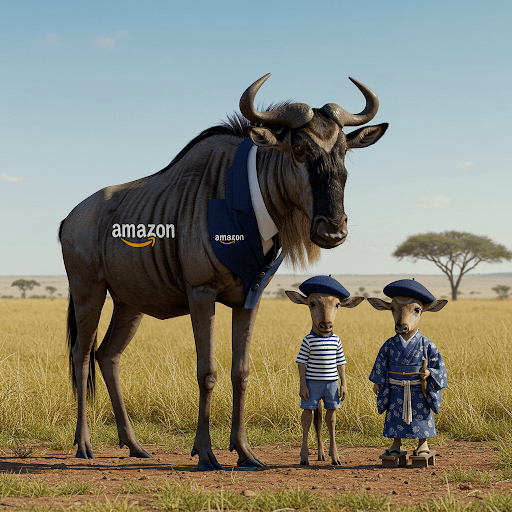
Imagen 4.
Who manages the CMMI?
Information Systems Audit and Control Association (ISACA)
Back in March and in April I either explicitly referenced or implicitly quoted from ISACA, which is the Information Systems Audit and Control Association.
“CMMI was originally developed at the Software Engineering Institute, a federally funded research and development center within Carnegie Mellon University.”
Imagen 4.
Thus ISACA governs all CMMI-related activity, including assessments and certifications.
Which brings us to…
National Security Systems (NSS) and National Security Solutions (NSS)
‘Cause you know sometimes acronyms have two meanings.
When a foreign-owned company wants to do business with the sensitive parts of the U.S. federal government, they have to set up a set up an entity that is free from foreign ownership, control, or influence. This is FOCI, a bonus acronym for you today.
Imagen 4.
In the biometric world, there are two notable FOCI-mitigated subsidiaries of foreign companies:
IDEMIA National Security Solutions (NSS), a subsidiary of the primarily U.S.-owned IDEMIA. Primarily, but not exclusively, because a small sliver of IDEMIA is French-owned.
“IDEMIA National Security Solutions (NSS), a subsidiary of IDEMIA, the leading provider of secure and trusted biometric-based solutions, is proud to announce that it has successfully earned re-certification at level 3 of ISACA’s Capability Maturity Model Integration (CMMI®).”
Imagen 4.
You’ll recall that the CMMI levels go up to Level 5. So IDEMIA NSS is not at the maximum CMMI level, but Level 3 is impressive enough to issue a press release.
IDEMIA NSS’ extensive federal government work dictates that it maintain a number of certifications and conformances. CMMI gives the government agencies assurance that IDEMIA NSS provides its products according to specific quality and process improvement standards.
“This openness to facial recognition could signal a turning point that could affect the biometric industry.
“The so-called “big” biometric players such as IDEMIA, NEC, and Thales are teeny tiny compared to companies like Meta, Alphabet, and Amazon. If the big tech players ever consented to enter the law enforcement and surveillance market in a big way, they could put IDEMIA, NEC, and Thales out of business.
“However, wholesale entry into law enforcement/surveillance could damage their consumer business, so the big tech companies have intentionally refused to get involved – or if they have gotten involved, they have kept their involvement a deep dark secret.”
Then I thought about the “Really Big Bunch” product that offered the greatest threat to the “Big 3” (IDEMIA, NEC, and Thales)—Amazon Rekognition, which directly competed in Washington County, Oregon until Amazon imposed a one-year moratorium on police use of facial recognition in June 2020. The moratorium was subsequently extended until further notice.
“Have appropriately trained humans review all decisions to take action that might impact a person’s civil liberties or equivalent human rights.”
“Train personnel on responsible use of facial recognition systems.”
“Provide public disclosures of your use of facial recognition systems.”
“In all cases, facial comparison matches should be viewed in the context of other compelling evidence, and shouldn’t be used as the sole determinant for taking action.” (In other words, INVESTIGATIVELEAD only.)
Nothing controversial at all, and I am…um…99% certain (geddit?) that IDEMIA, NEC, and Thales would endorse all these points.
But why does Amazon even need such a page, if Rekognition is only used to find missing children?
Maybe this is a pre-June 2020 page that Amazon forgot to take down.
Or maybe not.
Couple this with the news about Meta, and there’s the possibility that the Really Big Bunch may enter the markets currently dominated by the Big Three.
Imagine if the DHS HART system, delayed for years, were resurrected…with Alphabet or Amazon or Meta technology.
When I interact with the worldwide company NEC, I am usually dealing with automated biometric identification systems (ABIS).
Of course, ABIS is only a small part of what NEC does. It’s also involved in healthcare.
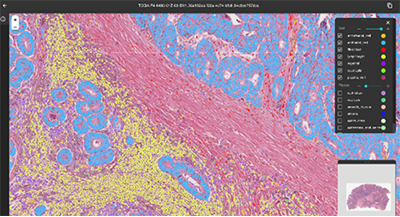
Consider…artificial intelligence and deep learning-powered digital pathology (“a field involving the digitization and computational analysis of pathology slides”).
“NEC Corporation (NEC; TSE: 6701) and Biomy, Inc. (Biomy) have signed a Memorandum of Understanding (MoU) for a joint marketing partnership to develop and expand artificial intelligence/deep learning (AI/DL)-based analytical platforms in the field of digital pathology. Through this partnership, the two companies aim to promote precision medicine for cancer patients and contribute to the advancement of the healthcare industry.”
So what is Biomy contributing?
“Biomy, which aims to realize personalized medicine through pathological AI technology, has developed DeepPathFinder™, a proprietary, cloud-based, AI/DL automated digital pathology analytical platform.”
And NEC?
“NEC has positioned healthcare and life sciences as a core pillar of its growth strategy. With a strong foundation in image analysis and other AI technologies, NEC has a long history of providing medical information systems such as electronic medical records to healthcare institutions.”
As I’ve said before, healthcare must deal with privacy concerns (protected health information, or PHI) similar to those NEC addresses in its other biometric product line (personally identifiable information, or PII). I personally can’t do nefarious things if I fraudulently acquire your digital pathology slide, but some bad actors could. Presumably the Biomy product is well protected.
I remember the first computer I ever owned: a Macintosh Plus with a hard disk with a whopping 20 megabytes of storage space. And that hard disk held ALL my files, with room to spare.
For sake of comparison, the video at the end of this blog post would fill up three-quarters of that old hard drive. Not that the Mac would have any way to play that video.
And its 20 megabyte hard disk illustrates the limitations of those days. File storage was a precious commodity in the 1980s and 1990s, and we therefore accepted images that we wouldn’t even think about accepting today.
This affected the ways in which entities exchanged biometric information.
The 1993 ANSI/NIST standard
The ANSI/NIST standard for biometric data interchange has gone through several iterations over the years, beginning in 1986 when NIST didn’t even exist (it was called the National Bureau of Standards in those days).
Yes, FINGERPRINT information. No faces. No scars/marks/tattoos. signatures, voice recordings, dental/oral data, irises, DNA, or even palm prints. Oh, and no XML-formatted interchange either. Just fingerprints.
No logical record type 99, or even type 10
Back in 1993, there were only 9 logical record types.
For purposes of this post I’m going to focus on logical record types 3 through 6 and explain what they mean.
Type 3, Fingerprint image data (low-resolution grayscale).
Type 4, Fingerprint image data (high-resolution grayscale).
Type 5, Fingerprint image data (low-resolution binary).
Type 6, Fingerprint image data (high-resolution binary).
Image resolution in the 1993 standard
In the 1993 version of the ANSI/NIST standard:
“Low-resolution” was defined in standard section 5.2 as “9.84 p/mm +/- 0.10 p/mm (250 p/in +/- 2.5 p/in),” or 250 pixels per inch (250ppi).
The “high-resolution” definition in sections 5.1 and 5.2 was twice that, or “19.69 p/mm +/- 20 p/mm (500 p/in +/- 5 p/in.”
While you could transmit at these resolutions, the standard still mandated that you actually scan the fingerprints at the “high-resolution” 500 pixels per inch (500ppi) value.
Incidentally, this brings up an important point. The series of ANSI/NIST standards are not focused on STORAGE of data. They are focused on INTERCHANGE of data. They only provided a method for Printrak system users to exchange data with automated fingerprint identification systems (AFIS) from NEC, Morpho, Cogent, and other fingerprint system providers. Just interchange. Nothing more.
Binary and grayscale data in the 1993 standard
Now let’s get back to Types 3 through 6 and note that you were able to exchange binary fingerprint images.
Why the heck would fingerprint experts tolerate a system that transmitted binary images that latent fingerprint examiners considered practically useless?
Because they had to.
Storage and transmission constraints in 1993
Two technological constraints adversely affected the interchange of fingerprint data in 1993:
Storage space. As mentioned above, storage space was limited and expensive in the 1980s and the 1990s. Not everyone could afford to store detailed grayscale images with (standard section 4.2) “eight bits (256 gray levels)” of data. Can you imagine storing TEN ENTIRE FINGERS with that detail, at an astronomical 500 pixels per inch?
Transmission speed. There was another limitation enforced by the modems of the data. Did I mention that the ANSI/NIST standard was an INTERCHANGE standard? Well, you couldn’t always interchange your data via the huge 1.44 megabyte floppy disks of the day. Sometimes you had to pull your your trusty 14.4k or 28.8k modem and send the images over the telephone. Did you want to spend the time sending those huge grayscale images over the phone line?
So as a workaround, the ANSI/NIST standard allowed users to interchange binary (black and white) images to save disk space and modem transmission time.
And we were all delighted with the capabilities of the 1993 ANSI/NIST standard.
Until we weren’t.
The 2015 ANSI/NIST standard
The current standard, ANSI/NIST-ITL 1-2011 Update 2015, supports a myriad of biometric types. For fingerprints (and palm prints), the focus is on grayscale images: binary image Type 5 and Type 6 are deprecated in the current standard, and low-resolution Type 3 grayscale images are also deprecated. Even Type 4 is shunned by most people in favor of new friction ridge image types in which the former “high resolution” is now the lowest resolution that anyone supports:
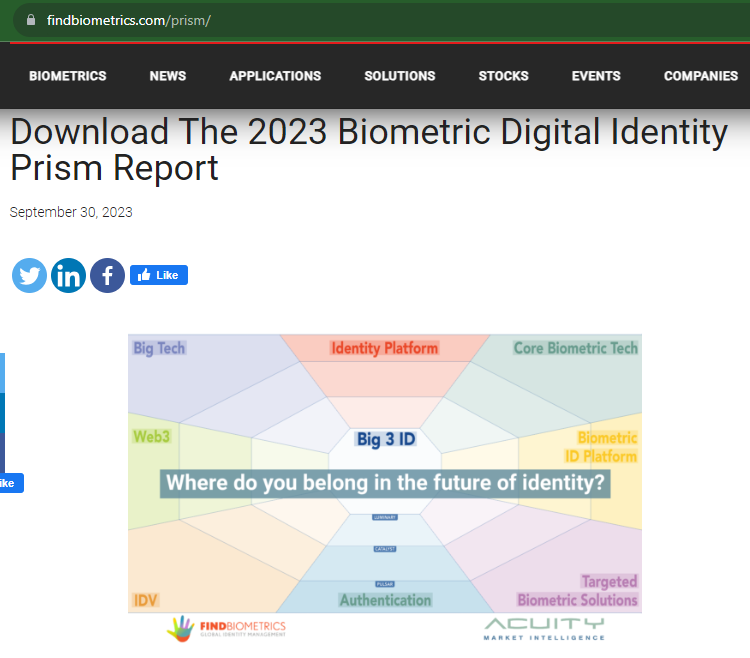
On September 30, FindBiometrics and Acuity Market Intelligence released the production version of the Biometric Digital Identity Prism Report. You can request to download it here.
But FindBiometrics and Acuity Market Intelligence didn’t invent the Big 3. The concept has been around for 40 years. And two of today’s Big 3 weren’t in the Big 3 when things started. Oh, and there weren’t always 3; sometimes there were 4, and some could argue that there were 5.
So how did we get from the Big 3 of 40 years ago to the Big 3 of today?
The Big 3 in the 1980s
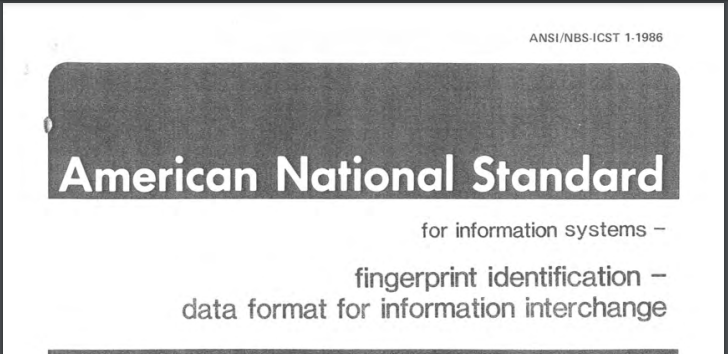
Back in 1986 (eight years before I learned how to spell AFIS) the American National Standards Institute, in conjunction with the National Bureau of Standards, issued ANSI/NBS-ICST 1-1986, a data format for information interchange of fingerprints. The PDF of this long-superseded standard is available here.
When creating this standard, ANSI and the NBS worked with a number of law enforcement agencies, as well as companies in the nascent fingerprint industry. There is a whole list of companies cited at the beginning of the standard, but I’d like to name four of them.
De La Rue Printrak, Inc.
Identix, Inc.
Morpho Systems
NEC Information Systems, Inc.
While all four of these companies produced computerized fingerprinting equipment, three of them had successfully produced automated fingerprint identification systems, or AFIS. As Chapter 6 of the Fingerprint Sourcebook subsequently noted:
Morpho Systems resulted from French AFIS efforts, separate from those of the FBI. These efforts launched Morpho’s long-standing relationship with the French National Police, as well as a similar relationship (now former relationship) with Pierce County, Washington.
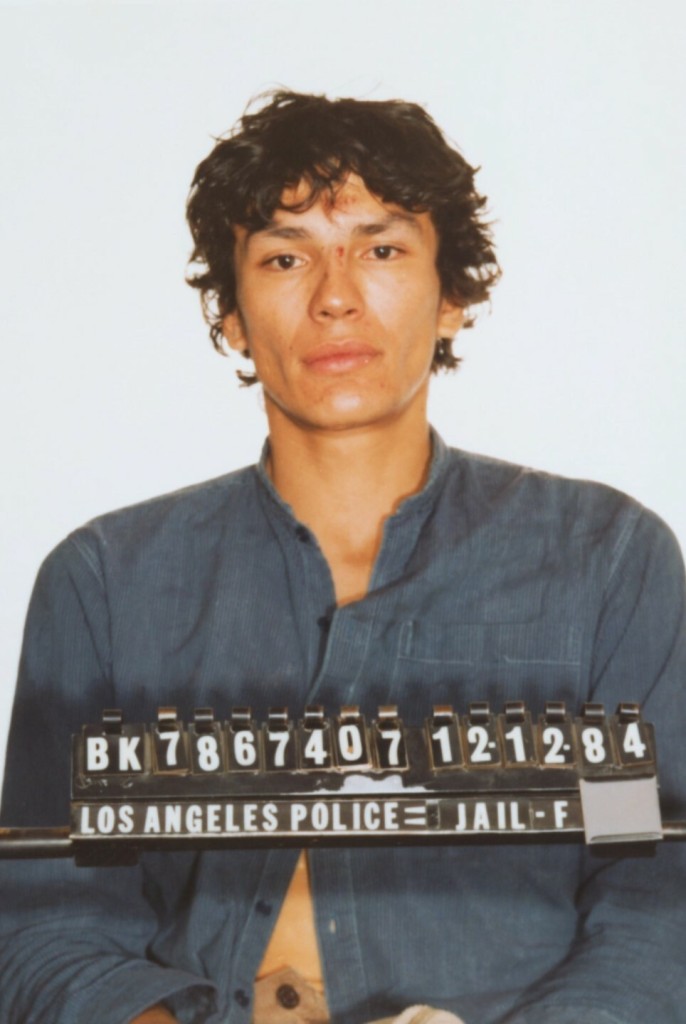
NEC had deployed AFIS equipment for the National Police Academy of Japan, and (after some prodding; read Chapter 6 for the story) the city of San Francisco. Eventually the state of California obtained an NEC system, which played a part in the identification of “Night Stalker” Richard Ramirez.
After the success of the San Francisco and California AFIS systems, many other jurisdictions began clamoring for AFIS of their own, and turned to these three vendors to supply them.
The Big 4 in the 1990s
But in 1990, these three firms were joined by a fourth upstart, Cogent Systems of South Pasadena, California.
While customers initially preferred the Big 3 to the upstart, Cogent Systems eventually installed a statewide system in Ohio and a border control system for the U.S. government, plus a vast number of local systems at the county and city level.
Between 1991 and 1994, the (Immigfation and Naturalization Service) conducted several studies of automated fingerprint systems, primarily in the San Diego, California, Border Patrol Sector. These studies demonstrated to the INS the feasibility of using a biometric fingerprint identification system to identify apprehended aliens on a large scale. In September 1994, Congress provided almost $30 million for the INS to deploy its fingerprint identification system. In October 1994, the INS began using the system, called IDENT, first in the San Diego Border Patrol Sector and then throughout the rest of the Southwest Border.
I was a proposal writer for Printrak (divested by De La Rue) in the 1990s, and competed against Cogent, Morpho, and NEC in AFIS procurements. By the time I moved from proposals to product management, the next redefinition of the “big” vendors occurred.
The Big 3 in 2003
There are a lot of name changes that affected AFIS participants, one of which was the 1988 name change of the National Bureau of Standards to the National Institute of Standards and Technology (NIST). As fingerprints and other biometric modalities were increasingly employed by government agencies, NIST began conducting tests of biometric systems. These tests continue to this day, as I have previously noted.
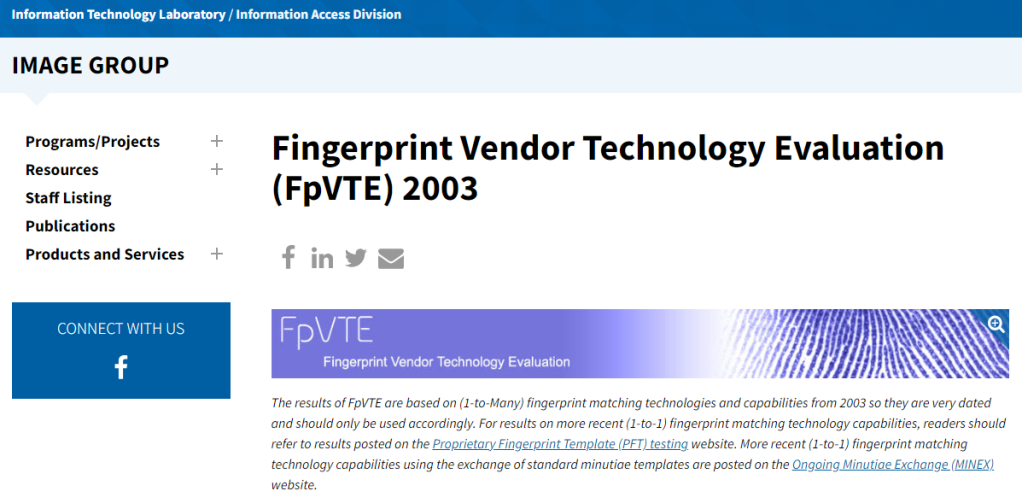
One of NIST’s first tests was the Fingerprint Vendor Technology Evaluation of 2003 (FpVTE 2003).
For those who are familiar with NIST testing, it’s no surprise that the test was thorough:
FpVTE 2003 consists of multiple tests performed with combinations of fingers (e.g., single fingers, two index fingers, four to ten fingers) and different types and qualities of operational fingerprints (e.g., flat livescan images from visa applicants, multi-finger slap livescan images from present-day booking or background check systems, or rolled and flat inked fingerprints from legacy criminal databases).
Eighteen vendors submitted their fingerprint algorithms to NIST for one or more of the various tests, including Bioscrypt, Cogent Systems, Identix, SAGEM MORPHO (SAGEM had acquired Morpho Systems), NEC, and Motorola (which had acquired Printrak). And at the conclusion of the testing, the FpVTE 2003 summary (PDF) made this statement:
Of the systems tested, NEC, SAGEM, and Cogent produced the most accurate results.
Which would have been great news if I were a product manager at NEC, SAGEM, and Cogent.
Unfortunately, I was a product manager at Motorola.
The effect of this report was…not good, and at least partially (but not fully) contributed to Motorola’s loss of its long-standing client, the Royal Canadian Mounted Police, to Cogent.
The Big 3, 4, or 5 after 2003
So what happened in the years after FpVTE was released? Opinions vary, but here are three possible explanations for what happened next.
Did the Big 3 become the Big 4 again?
Now I probably have a bit of bias in this area since I was a Motorola employee, but I maintain that Motorola overcame this temporary setback and vaulted back into the Big 4 within a couple of years. Among other things, Motorola deployed a national 1000 pixels-per-inch (PPI) system in Sweden several years before the FBI did.
Did the Big 3 remain the Big 3?
Motorola’s arch-enemies at Sagem Morpho had a different opinion, which was revealed when the state of West Virginia finally got around to deploying its own AFIS. A bit ironic, since the national FBI AFIS system IAFIS was located in West Virginia, or perhaps not.
Anyway, Motorola had a very effective sales staff, as was apparent when the state issued its Request for Proposal (RFP) and explicitly said that the state wanted a Motorola AFIS.
That didn’t stop Cogent, Identix, NEC, and Sagem Morpho from bidding on the project.
After the award, Dorothy Bullard and I requested copies of all of the proposals for evaluation. While Motorola (to no one’s surprise) won the competition, Dorothy and I believed that we shouldn’t have won. In particular, our arch-enemies at Sagem Morpho raised a compelling argument that it should be the chosen vendor.
Their argument? Here’s my summary: “Your RFP says that you want a Motorola AFIS. The states of Kansas (see page 6 of this PDF) and New Mexico (see this PDF) USED to have a Motorola AFIS…but replaced their systems with our MetaMorpho AFIS because it’s BETTER than the Motorola AFIS.”
But were Cogent, Motorola, NEC, and Sagem Morpho the only “big” players?
Did the Big 3 become the Big 5?
While the Big 3/Big 4 took a lot of the headlines, there were a number of other companies vying for attention. (I’ve talked about this before, but it’s worthwhile to review it again.)
Identix, while making some efforts in the AFIS market, concentrated on creating live scan fingerprinting machines, where it competed (sometimes in court) against companies such as Digital Biometrics and Bioscrypt.
The fingerprint companies started to compete against facial recognition companies, including Viisage and Visionics.
Oh, and there were also iris companies such as Iridian.
And there were other ways to identify people. Even before 9/11 mandated REAL ID (which we may get any year now), Polaroid was making great efforts to improve driver’s licenses to serve as a reliable form of identification.
In short, there were a bunch of small identity companies all over the place.
But in the course of a few short years, Dr. Joseph Atick (initially) and Robert LaPenta (subsequently) concentrated on acquiring and merging those companies into a single firm, L-1 Identity Solutions.
These multiple mergers resulted in former competitors Identix and Digital Biometrics, and former competitors Viisage and Visionics, becoming part of one big happy family. (A multinational big happy family when you count Bioscrypt.) Eventually this company offered fingerprint, face, iris, driver’s license, and passport solutions, something that none of the Big 3/Big 4 could claim (although Sagem Morpho had a facial recognition offering). And L-1 had federal contracts and state contracts that could match anything that the Big 3/Big 4 offered.
So while L-1 didn’t have a state AFIS contract like Cogent, Motorola, NEC, and Sagem Morpho did, you could argue that L-1 was important enough to be ranked with the big boys.
So for the sake of argument let’s assume that there was a Big 5, and L-1 Identity Solutions was part of it, along with the three big boys Motorola, NEC, and Safran (who had acquired Sagem and thus now owned Sagem Morpho), and the independent Cogent Systems. These five companies competed fiercly with each other (see West Virginia, above).
In a two-year period, everything would change.
The Big 3 after 2009
Hang on to your seats.
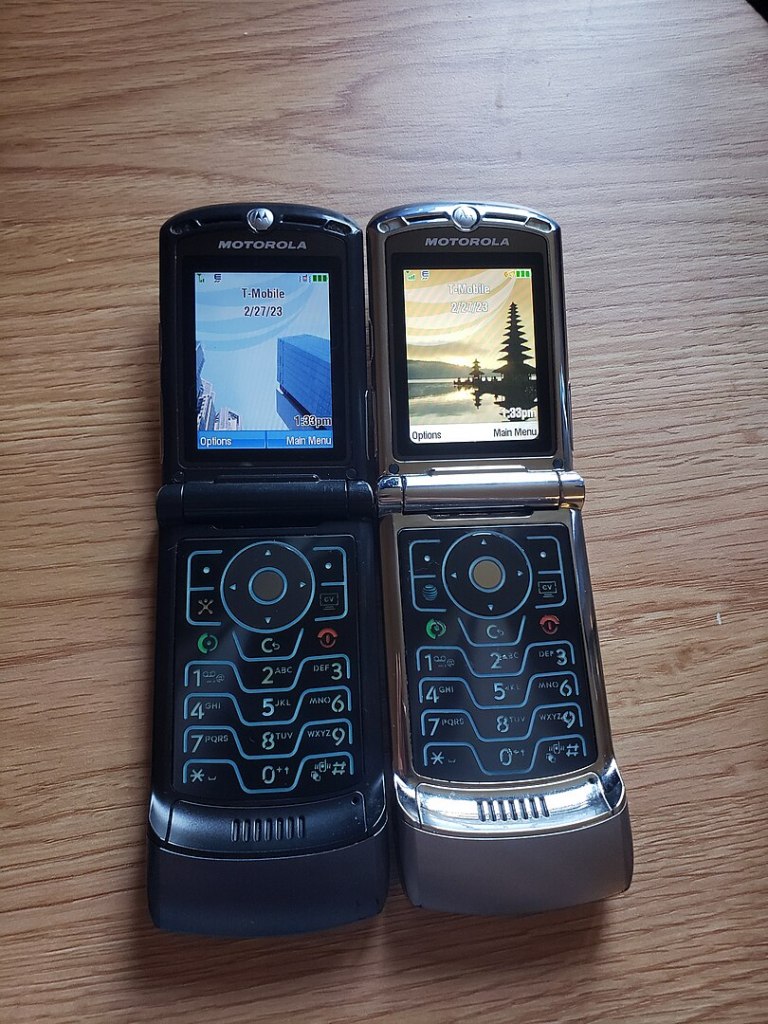
The Motorola RAZR was hugely popular…until it wasn’t. Eventually Motorola split into two companies and sold off others, including the “Printrak” Biometric Business Unit. By NextG50 – Own work, CC BY-SA 4.0, https://commons.wikimedia.org/w/index.php?curid=130206087
By 2009, Safran (resulting from the merger of Sagem and Snecma) was an international powerhouse in aerospace and defense and also had identity/biometric interests. Motorola, in the meantime, was no longer enjoying the success of its RAZR phone and was looking at trimming down (prior to its eventual, um, bifurcation). In response to these dynamics, Safran announced its intent to purchase Motorola’s Biometric Business Unit in October 2008, an effort that was finalized in April 2009. The Biometric Business Unit (adopting its former name Printrak) was acquired by Sagem Morpho and became MorphoTrak. On a personal level, Dorothy Bullard moved out of Proposals and I moved into Proposals, where I got to work with my new best friends that had previously slammed Motorola for losing the Kansas and New Mexico deals. (Seriously, Cindy and Ron are great folks.)
By 2011, Safran decided that it needed additional identity capabilities, so it acquired L-1 Identity Solutions and renamed the acquisition as MorphoTrust.
If you’re keeping notes, the Big 5 have now become the Big 3: 3M, Safran, and NEC (the one constant in all of this).
While there were subsequent changes (3M sold Cogent and other pieces to Gemalto, Safran sold all of Morpho to Advent International/Oberthur to form IDEMIA, and Gemalto was acquired by Thales), the Big 3 has remained constant over the last decade.
And that’s where we are today…pending future developments.
If Alphabet or Amazon reverse their current reluctance to market their biometric offerings to governments, the entire landscape could change again.
Or perhaps a new AI-fueled competitor could emerge.
The 1 Biometric Content Marketing Expert
This was written by John Bredehoft of Bredemarket.
If you work for the Big 3 or the Little 80+ and need marketing and writing services, the biometric content marketing expert can help you. There are several ways to get in touch:
Book a meeting with me at calendly.com/bredemarket. Be sure to fill out the information form so I can best help you.
I didn’t either. Frankly, I didn’t even work in biometrics professionally until I was in my 30s.
If you have a mad adult desire to become a biometric content marketing expert, here are five topics that I (a self-styled biometric content marketing expert) think you need to understand.
Topic One: Biometrics
Sorry to be Captain Obvious, but if you’re going to talk about biometrics you need to know what you’re talking about.
The days in which an expert could confine themselves to a single biometric modality are long past. Why? Because once you declare yourself an iris expert, someone is bound to ask, “How does iris recognition compare to facial recognition?”
And there are a number of biometric modalities. In addition to face and iris, the Biometrics Institute has cataloged a list of other biometric modalities, including fingerprints/palmprints, voice, DNA, vein, finger/hand geometry, and some more esoteric ones such as gait, keystrokes, and odor. (I wouldn’t want to manage the NIST independent testing for odor.)
As far as I’m concerned, the point isn’t to select the best biometric and ignore all the others. I’m a huge fan of multimodal biometrics, in which a person’s identity is verified or authenticated by multiple biometric types. It’s harder to spoof multiple biometrics than it is to spoof a single one. And even if you spoof two of them, what if the system checks for odor and you haven’t spoofed that one yet?
Topic Two: All the other factors
In the same way that I don’t care for people who select one biometric and ignore the others, I don’t care for some in the “passwords are dead” crowd who go further and say, “Passwords are dead. Use biometrics instead.”
Although I admire the rhyming nature of the phrase.
If you want a robust identity system, you need to use multiple factors in identity verification and authentication.
Something you know.
Something you have.
Something you are (i.e. biometrics).
Something you do.
Somewhere you are.
Again, use of multiple factors protects against spoofing. Maybe someone can create a gummy fingerprint, but can they also create a fake passport AND spoof the city in which you are physically located?
It’s not enough to understand the technical ins and outs of biometric capture, matching, and review. You need to know how biometrics are used.
One-to-one vs. one-to-many. Is the biometric that you acquire only compared to a single biometric samples, or to a database of hundreds, thousands, millions, or billions of other biometric samples?
Markets. When I started in biometrics, I only participated in two markets: law enforcement (catch bad people) and benefits (get benefit payments to the right people). There are many other markets. Just recently I have written about financial identity and educational identity. I’ve worked with about a dozen other markets personally, and there are many more.
Use cases. Related to markets, you need to understand the use cases that biometrics can address. Taking the benefits example, there’s a use case in which a person enrolls for benefits, and the government agency wants to make sure that the person isn’t already enrolled under another name. And there’s a use cases when benefits are paid to make sure that the authorized recipient receives their benefits, and no one else receives their benefits.
Legal and privacy issues. It is imperative that you understand the legal ramifications that affect your chosen biometric use case in your locality. For example, if your house has a doorbell camera that uses “familiar face detection” to identify the faces of people that come to your door, and the people that come to your door are residents of the state of Illinois, you have a BIG BIPA (Biometric Information Privacy Act) problem.
Any identity content marketing expert or biometric content marketing expert worth their salt will understand these and related issues.
Topic Four: Content marketing
This is another Captain Obvious point. If you want to present yourself as a biometric contet marketing expert or identity content marketing expert, you have to have a feel for content marketing.
The definition of content marketing is simple: It’s the process of publishing written and visual material online with the purpose of attracting more leads to your business. These can include blog posts, pages, ebooks, infographics, videos, and more.
But content marketers need to be comfortable with creating at least one type of content.
Topic Five: How L-1 Identity Solutions came to be
Yes, an identity content marketing expert needs to thoroughly understand how L-1 Identity Solutions came to be.
I’m only half joking.
Back in the late 1990s and early 2000s (I’ll ignore FpVTE results for a moment), the fingerprint world in which I worked recognized four major vendors: Cogent, NEC, Printrak (later part of Motorola), and Sagem Morpho.
And then there were all these teeny tiny vendors that offered biometric and non-biometric solutions, including the fierce competitors Identix and Digital Biometrics, the fierce competitors Viisage and Visionics, and a bunch of other companies like Iridian.
Wel, there WERE all these teeny tiny vendors.
Until Bob LaPenta bought them all up and combined them into a single company, L-1 Identity Solutions. (LaPenta was one of the “Ls” in L-3, so he chose the name L-1 when he started his own company.)
So around 2008 the Big Four (including a post-FpVTE Motorola) became the Big Five, since L-1 Identity Solutions was now at the table with the big boys.
But then several things happened:
Motorola started selling off parts of itself. One of those parts, its Biometric Business Unit, was purchased by Safran (the company formed after Sagem and Snecma merged). This affected me because I, a Motorola employee, became an employee of MorphoTrak, the subsidiary formed when Sagem Morpho de facto acquired “Printrak” (Motorola’s Biometric Business Unit). So now the Big Five were the Big Four.
Make that the Big Three, because Safran also bought L-1 Identity Solutions, which became MorphoTrust. MorphoTrak and MorphoTrust were separate entities, and in fact competed against each other, so maybe we should say that the Big Four still existed.
Oh, and by the way, the independent company Cogent was acquired by 3M (although NEC considered buying it).
A few years later, 3M sold bits of itself (including the Cogent bit) to Gemalto.
Then in 2017, Advent International (which owned Oberthur) acquired bits of Safran (the “Morpho” part) and merged them with Oberthur to form IDEMIA. As a consequence of this, MorphoTrust de facto acquired MorphoTrak, ending the competition but requiring me to have two separate computers to access the still-separate MorphoTrust and MorphoTrak computer networks. (In passing, I have heard from two sources, but have not confirmed myself, that the possible sale of IDEMIA is on hold.)
Why do I mention all this? Because all these mergers and acquisitions have resulted in identity practitioners working for a dizzying number of firms.
As of August 2023, I myself have worked for five identity firms, but in reality four of the five are the same firm because the original Printrak International kept on getting acquired (Motorola, Safran, IDEMIA).
And that’s nothing. One of my former Printrak coworkers (R.M.) has also worked for Digital Biometrics (now part of IDEMIA), Cross Match Technologies (now part of ASSA ABLOY), Iridian (now part of IDEMIA), Datastrip, Creative Information Technology, AGNITiO, iTouch Biometrics, NDI Recognition Systems, iProov, and a few other firms here and there.
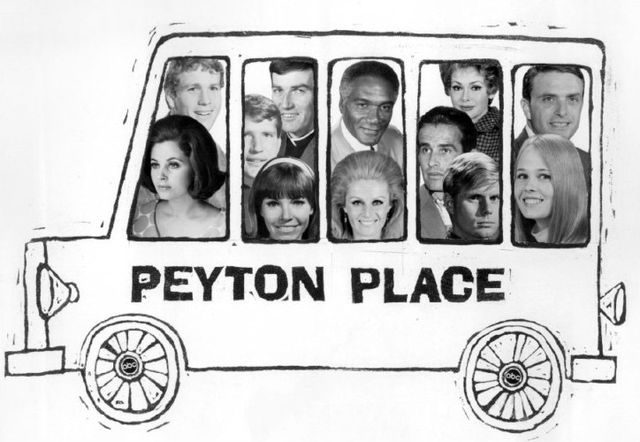
The point is that everybody knows everybody because everybody has worked with (and against) everybody. And with all the job shifts, it’s a regular Peyton Place.
Not sure which one is me, which one is R.M., and who the other people are.
Do you need an identity content marketing expert today?
Do you need someone who not only knows biometrics and content marketing, but also all the other factors, their uses, and even knows the tangled history of L-1?
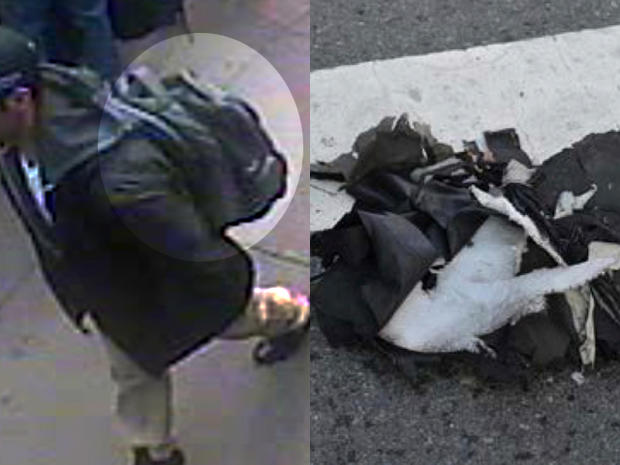
During the last few years of my corporate career, I became involved in video analytics. While there is some overlap between video analytics and biometrics, video analytics is somewhat broader because it not only identifies individuals (via incorporation of facial recognition), but can also count people (for example, to enforce COVID capacity limits), or identify objects (for example, a particular backpack of interest that could contain an explosive device).
Because video analytics involves video rather than still images, there’s much more data that has to move from the cameras to the processing servers. For this reason, some video analytic applications take advantage of edge computing, where the analysis happens right at the edge device, removing the need to clog network bandwidth with complete video feeds.
Perhaps the edge devices only isolate the video of interest and send it off for processing. Or perhaps all of the processing takes place at the edge device.
[B]ecause cooling is difficult to manage and electricity consumption is restricted in edge devices, high-performance processors such as GPUs used in high-performance servers are not available, and processing capacity is constrained.
NEC is developing a solution to address this processing capacity constraint.
Application of NEC’s newly developed gradual deep learning-based object detection technology enables efficient, high-speed, and high-precision detection of subjects from a large amount of images, even in an edge device with limited processing capacity, and enables simultaneous processing of images from multiple cameras in real time.
One benefit of using software to perform the necessary calculations is that it lessens the need to upgrade hardware. As NEC and other video analytics providers well know, many organizations have already invested a lot of money in their camera systems, and would prefer software that operates with the current hardware, rather than obtaining software that requires a complete hardware replacement.
NEC’s new software isn’t available yet, but the company aims to commercialize it in 2022.
And now for the music video that is at best tangentially related to NEC’s technology advance. (And no, I don’t know if NEC’s facial recognition technology has been tested with masking of one side of the face.)
Back on October 23, 2007, I used my then-active Twitter account to tweet about the #sandiegofire. The San Diego fire was arguably the first mass adoption of hashtags, building upon pioneering work by Stowe Boyd and Chris Messina and acted upon by Nate Ritter and others.
The tinyurl link directed followers to my post detailing how the aforementioned San Diego Fire was displacing sports teams, including the San Diego Chargers. (Yes, kids, the Chargers used to play in San Diego.)
So while I was there at the beginning of hashtags, I’m proudest of the post that I wrote a couple of months later, entitled “Hashtagging Challenges When Events Occur at Different Times in Different Locations.” It describes the challenges of talking about the Rose Parade when someone is viewing the beginning of the parade while someone else is viewing the end of the parade at the same time. (This post was cited on PBWorks long ago, referenced deep in a Stowe Boyd post, and cited elsewhere.)
Hashtag use in business
Of course, hashtags have changed a lot since 2007-2008. After some resistance, Twitter formally supported the use of hashtags, and Facebook and other services followed, leading to mass adoption beyond the Factory Joes of the world.
Ignoring personal applications for the moment, hashtags have proven helpful for business purposes, especially when a particular event is taking place. No, not a fire in a major American city, but a conference of some sort. Conferences of all types have rushed to adopt hashtags so that conference attendees will promote their conference attendance. The general rule is that the more techie the conference, the more likely the attendees will use the conference-promoted hashtag.
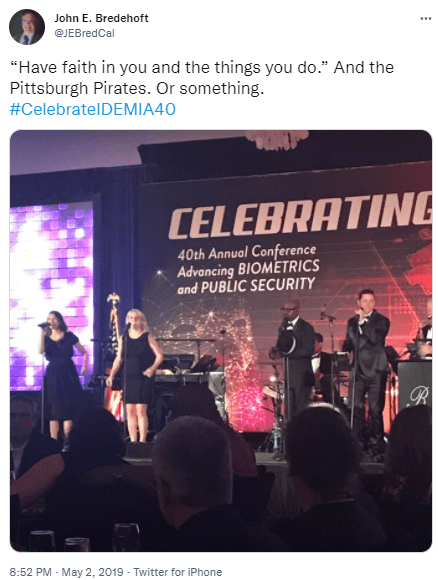
I held various social media responsibilities during my years at MorphoTrak and IDEMIA, some of which were directly connected to the company’s annual user conference, and some of which were connected to the company’s attendance at other events. Obviously we pulled out the stops for our own conferences, including adopting hashtags that coincided with the conference theme.
And then when the conference organizers adopt a hashtag, they fervently hope that people will actually USE the adopted hashtag. As I said before, this isn’t an issue for the technical conferences, but it can be an issue at the semi-technical conferences. (“Hey, everybody! Gather around the screen! Someone used the conference hashtag…oh wait a minute, that’s my burner account.”)
A pleasant surprise with exhibitor/speaker adoption of the #connectID hashtag
Well, I think that we’ve finally crossed a threshold in the biometric world, and hashtags are becoming more and more acceptable.
As I previously mentioned, I’m not attending next week’s connect:ID conference in Washington DC, but I’m obviously interested in the proceedings.
I was pleasantly surprised to see that nearly two dozen exhibitors and speakers were using the #connectID hashtag (or referenced via the hashtag) as of the Friday before the event, including Acuity Market Intelligence, Aware, BIO-key, Blink Identity, Clearview AI, HID Global, IDEMIA, Integrated Biometrics, iProov, Iris ID, Kantara, NEC and NEC NSS, Pangiam, Paravision, The Paypers, WCC, WorldReach Software/Entrust, and probably some others by the time you read this, as well as some others that I may have missed.
And the event hasn’t even started yet.
At least some of the companies will have the presence of mind to tweet DURING the event on Tuesday and Wednesday.
Will yours be one of them?
But company adoption is only half the battle
While encouraging to me, adoption of a hashtag by a conference’s organizers, exhibitors, and speakers is only the beginning.
The true test will take place when (if) the ATTENDEES at the conference also choose to adopt the conference hashtag.
According to Terrapin (handling the logistics of conference organization), more than 2,500 people are registered for the conference. While the majority of these people are attending the free exhibition, over 750 of them are designated as “conference delegates” who will attend the speaking sessions.
How many of these people will tweet or post about #connectID?
I have not been to an identity trade show in years, and sadly I won’t be in Washington DC next week for connect:ID…although I’ll be thinking about it.
I’ve only been to connect:ID once, in 2015. Back in those days I was a strategic marketer with MorphoTrak, and we were demonstrating the MorphoWay. No, not the Morpho Way; the MorphoWay.
As an aside, you’ll notice how big MorphoWay is…which renders it impractical for use in U.S. airports, since space is valuable and therefore security features need a minimum footprint. MorphoWay has a maximum footprint…just ask the tradespeople who were responsible for getting it on and off the trade show floor.
I still remember several other things from this conference. For example, in those days one of Safran’s biometric competitors was 3M. Of course both Safran and 3M have exited the biometric industry, but at the time they were competing against each other. Companies always make a point of checking out the other companies at these conferences, but when I went to 3M’s booth, the one person I knew best (Teresa Wu) was not at the booth. Later that year, Teresa would leave 3M and (re)join Safran, where she remains to this day.
Yes, there is a lot of movement of people between firms. Looking over the companies in the connect:ID 2021 Exhibitor Directory, I know people at a number of these firms. Obviously people from IDEMIA, of course (IDEMIA was the company that bought Safran’s identity business), but I also know people at other companies, all of whom who were former coworkers at IDEMIA or one of its predecessor companies:
Aware.
Clearview AI.
GET Group North America.
HID Global.
Integrated Biometrics.
iProov.
NEC.
Paravision.
Rank One Computing.
SAFR/RealNetworks.
Thales.
Probably some others that I missed.
And I know people at some of the other companies, organizations, and governmental entities that are at connect:ID this year.
Some of these entities didn’t even exist when I was at connect:ID six years ago, and some of these entities (such as Thales) have entered the identity market due to acquisitions (in Thales’ case, the acquisition of Gemalto, which had acquired 3M’s biometric business).
So while I’m not crossing the country next week, I’m obviously thinking of everything that will be going on there.
Incidentally, this is one of the last events of the trade show season, which is starting to wind down for the year. But it will ramp up again next spring (for you Northern Hemisphere folks).
Those portions of the U.S. government that deal with critical infrastructure are naturally concerned about foreign encroachment into U.S. Government operations, even from “friendly” nations. Therefore, the U.S. Government takes steps to mitigate the effects of “Foreign Ownership, Control or Influence” (FOCI).
I’ve worked for two companies that needed to undertake FOCI mitigation, and I know of others that have also done this. And while FOCI mitigation offers benefits to the United States, there are also drawbacks of which everyone involved should be aware.
Subscribe to get access
Subscribe to Bredemarket Premium to access this premium content.
Subscriptions just $5 per month.
Access Bredemarket’s expertise without spending hundreds or thousands of dollars.












 Bredemarket