See this post to understand why the video is only eight seconds long.
As for how I will use this to promote the Bredemarket Identity Firm Services LinkedIn page and Facebook group…I have no words.

Identity/biometrics/technology marketing and writing services

See this post to understand why the video is only eight seconds long.
As for how I will use this to promote the Bredemarket Identity Firm Services LinkedIn page and Facebook group…I have no words.
You’ve probably noticed that I’ve created a lot of Bredemarket videos lately.
But…
Even Bredemarket’s “short” 15 second videos may be TWICE AS LONG as they should be.
In 2015, Time magazine reported on the results of a Microsoft study:
Researchers in Canada surveyed 2,000 participants and studied the brain activity of 112 others using electroencephalograms (EEGs). Microsoft found that since the year 2000 (or about when the mobile revolution began) the average attention span dropped from 12 seconds to eight seconds.
As many noted, a goldfish’s attention span is 9 seconds.
Some argue that the 8 second attention span is not universal and varies according to the task. For example, a 21 minute attention span has been recorded for drivers. If drivers had an 8 second attention span, we would probably all be dead by now.
But watching a video is not a life-or-death situation. Viewers will happily jump away if there’s no reason to watch.
So I have my challenge.
Ironically, I learned about the 8 second rule while watching a LinkedIn Learning course about the 3 minute rule. I haven’t finished the course yet, so I haven’t yet learned how to string someone along for 22.5 8-second segments.

On June 1, I shared a little piece on Bredemarket’s social media channels, including a post on the Bredemarket Technology Firm Services page on LinkedIn.
It was an announcement from Knell Computer.
Knell Computer announced Friday that it is eliminating wi-fi capabilities from its business computer product lines.
“At Knell Computer, we strongly believe that the best work occurs in a traditional office environment,” according to Gabriel Knell, CEO. “Since modern offices are fully equipped with Ethernet cabling, wi-fi is an unnecessary expense. Removal of wi-fi allows us to sell Knell Computers at a lower price point than our competitors, providing cost savings to our customers.”
Knell will promote this innovation with an ad campaign in major city downtown business districts, where it will attract the attention of real workers.
Gabriel Knell: “If you’re an amateur who performs so-called ‘work’ at home in your shorts, rather than from a true cubicle office environment, feel free to buy wi-fi computers from our competitors. We are embarrassed to see the Knell logo in a coffee shop—or in a converted bedroom.”
In a related announcement, Knell will incorporate technology that “red flags” the use of any Knell computer in a residential zone.

For those of you who don’t know much about Knell Computer, LinkedIn’s helpful AI feature provided contextual detail, including answers to critical questions:
All of these answers, sourced from information found in LinkedIn and on the Internet, were undoubtedly helpful.
But LinkedIn AI appears to have missed one teeny tiny thing.

Since I’m not engaged in full-time product marketing (although I perform some product marketing activities for my Bredemarket clients), I sometimes spend my time writing other things.
Like fake press releases for fake products from fake companies.
But I think that most of you figured out that Knell Computer and its head Gabriel Knell are based upon Dell Computer and its head Michael Dell.
(Note the “angelic” naming here. And no, I’m not naming anything after Lucifer.)
And most of you know why Dell Computer was suddenly in the news in May, and actually a little before that, as this Forbes article indicates.

Dell’s new remote-work policy will categorize its workers into two main groups: remote and hybrid.
Hybrid workers must agree to come into an “approved” office at least 39 days each quarter. This is roughly the equivalent of three days per week. Remote workers do not have to come into an approved office at all. However, remote workers aren’t eligible for promotion or to change jobs within the company.
According to the Register, Dell confirmed the 39 days/quarter requirement, and explained why it believed it was important.
In a statement, a Dell spokesperson told The Register, “We shared with team members our updated hybrid work policy. Team members in hybrid roles will be onsite at a Dell Technologies office at least 39 days per quarter (on average three days a week). In today’s global technology revolution, we believe in-person connections paired with a flexible approach are critical to drive innovation and value differentiation.”
But the Dell statement didn’t say HOW Dell would know who was in the office. The Register supplied that additional detail; Dell was reported to use tracking and color coding.
Starting next Monday, May 13, the enterprise hardware slinger plans to make weekly site visit data from its badge tracking available to employees through the corporation’s human capital management software…
Let me just pause right there. Any time that you read something about “human capital management,” your antennae should go up.
But let’s get back to how Dell is managing its carbon-based capital.
…and to give them color-coded ratings that summarize their status. Those ratings are:
Blue flag indicates “consistent onsite presence”
Green flag indicates “regular onsite presence”
Yellow flag indicates “some onsite presence”
Red flag indicates “limited onsite presence”

So that was the situation as of June 1 when Knell Computer issued its press release, complete with “red flag” capability.
I’m forced to confess that Knell Computer’s product marketing efforts didn’t really make an impact. (I KNEW I should have included the press release in the Bredemarket blog. Better late than never.)
But Dell Computer’s efforts truly impacted its employees…but not in the way that Dell Computer wanted.
No, not the Steve Taylor song.
The Dell human capital management method that ranked hybrid employees based upon their willingness to work in the office.

A few weeks after Knell Computer’s product marketing effort, stories began to emerge about what was happening at the real Dell. Here’s part of what Ars Technica said on June 20:
Dell announced a new return-to-office initiative earlier this year. In the new plan, workers had to classify themselves as remote or hybrid.
Those who classified themselves as hybrid are subject to a tracking system….
Alternatively, by classifying themselves as remote, workers agree they can no longer be promoted or hired into new roles within the company.
Business Insider claims it has seen internal Dell tracking data that reveals nearly 50 percent of the workforce opted to accept the consequences of staying remote, undermining Dell’s plan to restore its in-office culture.
“But wait!” you’re saying. “So many people are willing to forgo promotion at Dell, or even to apply to new positions at Dell?”
Yes. Because here’s a dirty little secret:
Dell employees can leave Dell and work for other companies.
Granted many other companies aren’t remote-friendly either (believe me, I know), but those that are have an opportunity to scoop up Dell’s best and brightest.
And as the Dell workers leave, this provides an opportunity for yours truly. After all, I’d be happy to report to Dell’s office in Ontario, California. So I went to see what opportunities I’d have.
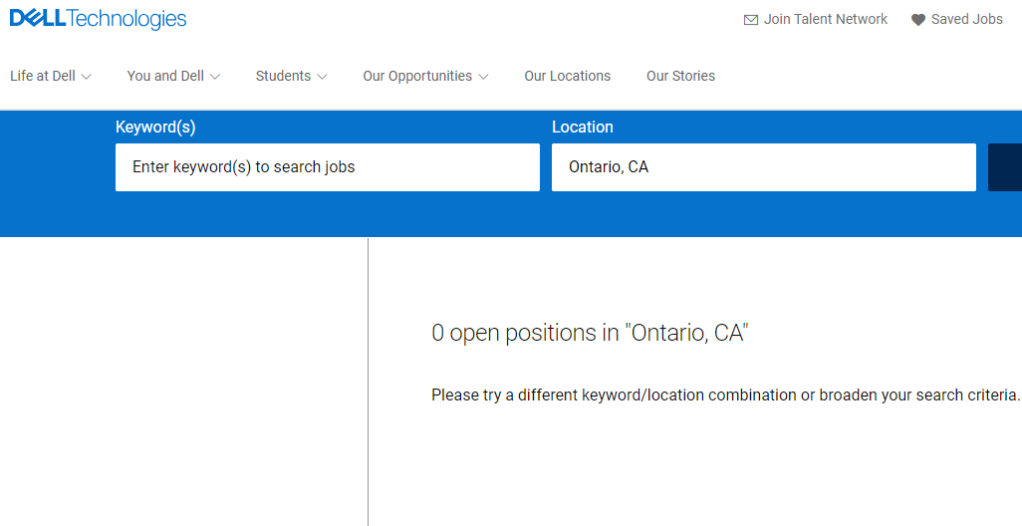
It turns out that Ontario, California is not one of Dell’s officially approved hybrid work locations. I’d have to drive to Utah, Texas, or Oklahoma three days a week.
But hey, I’m not the only marketer affected by Dell’s work policies. Silicon Valley marketers can’t work hybrid at Dell either.
I’ll continue to monitor how this plays out. Perhaps Knell Computer may issue a second press release.
Which LinkedIn AI will take as the truth.

When your company attends events, you’ll want to maximize your event return on investment (ROI) by creating marketing content that you publish before, during, and after the event.
This is how you do it.
Including:
And I’ll spill a couple of secrets along the way.
I’m going to share two secrets in this post. OK, maybe they’re not that secret, but you’d think they ARE secrets because no one acknowledges them.
The first one has to do with event attendance. You personally might be awed and amazed when you’re in the middle of an event and surrounded by hundreds, or thousands, or tens of thousands of people. All of whom are admiring your exhibit booth or listening to your CEO speak.

But guess what?
Many, many more people are NOT at the event.
They can’t see your exhibit booth, and can’t hear your speaker. They’re on the outside, TRYING to look in.

And all the money you spent on booth space and travel and light-up pens does NOTHING for the people who aren’t there…
Unless you bring the event to them. Your online content can bring the event to people who were never there.
But you need to plan, create, and approve your content before, during, and after the event. Here’s how you do that.
Yes, you can just show up at an event, take some pictures, and call it a day. But if you want to maximize your event return on investment, you’ll be a bit more deliberate in executive your event content. Ideally you should be:
Before the event begins, you need to plan your content. While you can certainly create some content on a whim as opportunity strikes, you need to have a basic idea of what content you plan to create.
Once you have planned what you want to do, you need to do it. Before, during, and after the event, you may want to create the following types of content:
Make sure that your content approval process is geared for the fast-paced nature of events. I can’t share details, but:
So how are you going to generate all this content? This brings us to my proposed solution…and the second secret.

The rest of this post talks about one of Bredemarket’s services, the Bredemarket 2800 Medium Writing Service. For those who haven’t heard about it, it’s a service where I provide between 2,800 and 3,200 words of written text.
“But John,” you’re asking. “How is a single block of 3,200 words of text going to help me with my event marketing?”
Time to reveal the second secret…
You can break up those 3,200 words any way you like.
For example, let’s say that you’re planning on attending an event. You could break the text up as follows:
For $2,000 (as of June 2024), you can benefit from written text for complete event coverage, arranged in any way you need.
So how can you and your company receive these benefits?
First, read the data sheet for the Bredemarket 2800 Medium Writing Service so you understand the offer and process.
Second, contact Bredemarket to get the content process started well BEFORE your event. Book a meeting with me at calendly.com/bredemarket. Be sure to fill out the information form so I can best help you.
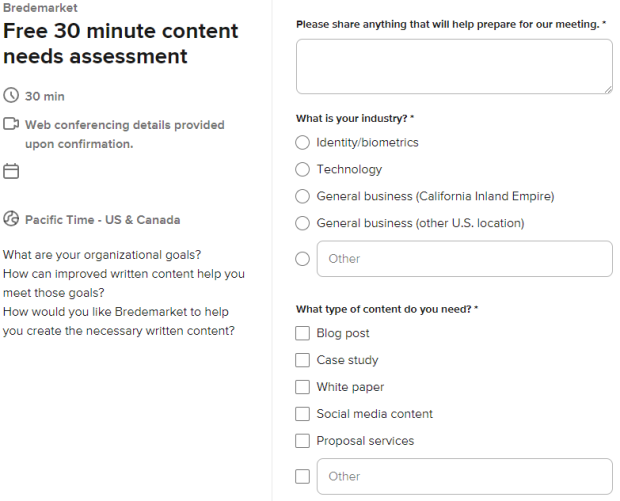
Alternatively, you can
But don’t wait. If your event is in September…don’t contact me in October.

“If you’re not careful, you might learn something before it’s done.”
(Quote from William H. Cosby, M.A., Ed.D., L.H.D. (resc), from the Fat Albert TV show theme song. From https://www.streetdirectory.com/lyricadvisor/song/upujwj/fat_albert/.)
When I write about space aliens, there’s a reason. And that reason may be to warn identity vendors that silence is NOT golden.
As a frequent reader and writer on LinkedIn, I’ve seen all the tips and tricks to drive engagement. One popular trick is to make up a story that will resonate with the LinkedIn audience.
For example, the writer (usually a self-proclaimed career expert who is ex-FAANG) will tell the entirely fictional story of a clueless hiring manager and an infinitely wise recruiter. The clueless hiring manager is shocked that a candidate accepted a competing job offer. “Didn’t she like us?” asks the hiring manager. The wise recruiter reminds the clueless hiring manager that the candidate had endured countless delays in numerous interviews with the company, allowing another company to express interest in and snatch her.
Job seekers have endured countless delays in their own employment searches. When they read the post, they hoot and holler for the candidate and boo the clueless hiring manager. Most importantly, readers like and love the writer’s post until it goes viral, making the author an ex-FAANG top recruiting voice.
Even though no sources are cited and the story is fictional, it is very powerful.
Well…until you’ve read the same story a dozen times from a dozen recruiters. Then it gets tiresome.
But those fake stories powerfully drive clicks on LinkedIn, so I wanted to get in on the action. But I was going to add two wrinkles to my fake story.
First, I would explicitly admit that my story is fake. Because authenticity. Sort of.
Second, my story would include space aliens to make it riveting. And to hammer the point that the story is fake.
Now I just had to write a fake story with space aliens.
Or did I?
It turned out that I had already written a fake story. It didn’t have space aliens, but I liked the story I had spun in the Bredemarket blog post “(Pizza Stories) Is Your Firm Hungry for Awareness?”
I just needed to make one of the characters a space alien, and since Jones was based on the striking Grace Jones, I went ahead and did it. If you can imagine Grace Jones with tentacles, two noses, and eight legs.
With a few additional edits, my fake space alien story was ready for the Sunday night LinkedIn audience.
As the space alien’s tentacles quivered, I snuck something else into the LinkedIn story—some facts.
Kids who watched Fat Albert on TV not only enjoyed the antics, but also learned an Important Life Lessons. Now I don’t have multiple advanced degrees like Cosby, but then again I never had multiple degrees rescinded either.
But my life lesson wasn’t to stay in school or pull your pants up. My life lesson was to blog. The lesson was in the form of a statement by Jones’ humanoid colleague Smith, taken verbatim from the Pizza Stories post.
“Take blogging,” replied Smith. “The average company that blogs generates 55% more website visitors. B2B marketers that use blogs get 67% more leads than those who do not. Marketers who have prioritized blogging are 13x more likely to enjoy positive ROI. And 92% of companies who blog multiple times per day have acquired a customer from their blog.”
The stats originally appeared in an earlier post, “How Identity and Biometrics Firms Can Use Blogging to Grow Their Business.”

And the fake story also talked about companies (unnamed, but real) who ignored these facts and remained silent on their blog and social channels.
A huge mistake, because their competitors ARE engaging with their prospects, with real stories.
Is your company making the same mistake?

I guess I should mention David Byrne. OK, I did.

If you’re not a LinkedIn connection you missed this. Here’s something I wrote on the one year anniversary of losing my job.

Beginning May 2, Bredemarket is on fewer social channels. The information in this post is not new.

But rather than dwelling on the negative aspects of the social channels where Bredemarket has suspended activity, I’m going to concentrate on the social channels where Bredemarket is still active.
Here they are. Be sure to follow or subscribe!
Yes, it’s definitely a shorter list than the old one. But I feel a lot better.
And maybe I’ll return to the other platforms at a later date. You never know.

Of all the technologies I don’t know about, jobseeker technology is the most important. Between July 2000 and today, I’ve spent over 30 months searching for full-time employment. So it helps to know how employers search for potential employees.
And a lot of those 30-plus months have been filled with self-styled experts advising people “how to beat the applicant tracking system (ATS)” (as if there were only one) and “how to access the hidden job market” (because of course employers don’t want anyone to know that they’re searching for talent).
So when Melanie Woods of CGL Recruiting offered 20 jobseekers the chance to see how their LinkedIn Profile appears to users of LinkedIn Recruiter, I really wanted to win one of those 20 slots.
I won a slot, and in our 20-minute session Melanie Woods imparted a great deal of knowledge, including the 7 LinkedIn Recruiter tips highlighted at the end of this post.
If I could boil all 7 tips down to 1, I’d emphasize that recruiters have limited time, and something a recruiter can understand in 0 seconds is much better than something that would take a recruiter 5 seconds to understand.
A few days ago, I ran across Melanie’s post that described her offer. It opened as follows:
Instead of spending money on advertising, my team is going to be taking a different approach and it involves YOU #jobseekers!
Sounds like a plan, since a word-of-mouth testimonial converts more effectively than copy written by a marketing hack. (But what if the testimonial is FROM a marketing hack?)
She then described the offer.
We are going to be offering 20 free 20 minute sessions to job seekers who are currently out of work. During your session I will pull you up live in LinkedIn Recruiter and test your profile to show you where you are coming up in searches and where you are falling out. I will help you adjust your profile so you can appear in more searches for the jobs you are targeting.
As you can probably guess, LinkedIn Recruiter is the premium-priced service that recruiters use to search LinkedIn for job candidates. The top-tier package (“contact Sales” for the price) includes:
A comparison of all of LinkedIn’s talent solutions is provided here.
If your company is recruiting more than 4 positions a year, the high-end version of LinkedIn Recruiter could be the tool for you.
But when recruiters use LinkedIn Recruiter, they don’t look at a candidate’s LinkedIn profile—they look at the LinkedIn Recruiter view of the candidate’s profile, optimized for their purposes.
Hence Melanie was offering job applicants the opportunity to see how their profile appears to a recruiter. Valuable information to have.
But remember that the lucky winners had to provide “advertising” to CGL Recruiting in return.
Here is where the advertising piece comes in….if you feel that the 20 minutes was helpful to you and your job search, we would appreciate you doing a review of our services on LinkedIn and one other social media platform (your choice), sharing how the time spent was useful to you and your job search.
After I indicated my interest, and after Dee Daniel provided a boost to my application, I was one of the lucky 40 winners. (Yes, they increased the number of winners due to high demand.)
Melanie and I met via Zoom early Monday afternoon Pacific Time (late afternoon Central Time), and I received a firehose of information during the 20-minute session. I’m not going to cover ALL the information she provided; instead, I’ll confine myself to the top 7 tips.
For my job search for a Senior Product Marketing Manager role, my Incode position is (maybe) more important than my current Bredemarket position. On my resume, I take care of this by listing Incode BEFORE Bredemarket. But because LinkedIn profiles are chronological, and Bredemarket is my current “employer,” I can’t reorder like that.
The LinkedIn Recruiter view of the profile doesn’t show all the positions, but only the top 3. And the first position takes great prominence.

In the default view, the recruiter can’t see my fourth position (Strategic/Product Marketing Manager from 2015 to 2017), but only the first three. And only one of those three positions is product marketing-related.
Melanie zeroed in on my “Sole Proprietor” position, which tells a recruiter nothing about what I actually DO at Bredemarket. Sure the recruiter could click through and read about the marketing and writing services that Bredemarket provides…but recruiters have limited time.
I thought about her advice after the call, and for LinkedIn (and resume) purposes I’m changing my Bredemarket job title to “Product Marketing Consultant.” My work for my clients is all product/service-related, so the job title makes sense.
Now recruiters will see that two of my three most recent positions were product marketing-related, which makes me more attractive to the one position that I’m targeting.
One position? Wait a minute…
That’s right. In my “job preferences,” my only listed job title was “Senior Product Marketing Manager.”
I can list up to 5.
Why not use all 5?
So now my job titles include the following:
So I have the position title from Incode, the consulting title from Bredemarket, two product marketing title variants, and a content marketing title for good measure (Bredemarket readers know why).
Now some people question why I’d list all these similar titles, since anyone who takes a few seconds can figure out that I’d be interested in a global product marketing manager position or whatever.
That’s the problem. Recruiters DON’T HAVE a few seconds. When hundreds or thousands of people apply for positions, recruiters need to get through the profiles as quickly as possible.
So Melanie wanted me to make her job easier.
You can control the visibility of your email address and your phone number on LinkedIn. While I don’t list a phone number on my LinkedIn profile, I do make my jobseeking email address (which is separate from my Bredemarket email address) visible. In fact, I configured my email address visibility for viewing by my 1st degree and 2nd degree connections.
But there was a fallacy in that tactic.
It became obvious in the session because Melanie (not a connection since her LinkedIn connections are maxed out) could NOT see my email address. Therefore, if recruiter Melanie wanted to contact me, she could ONLY contact me via InMail.
If you want ANY potential recruiter to see your email, increase its visibility to all connections. Obviously there are risks to this, so you need to judge what visibility is right for you. (Especially for phone numbers.)
While all of Bredemarket’s work is remote, and my previous work at Incode was remote, I’m not averse to on-site work. As long as it’s within driving distance.
To help local companies, I listed a selected five cities (the maximum) where I am available for on-site work:
But Melanie pointed out that I didn’t need to list Ontario, since my profile already states that I live in Ontario. That freed up one slot to add another city. I chose to list Riverside, although I could have listed Brea or Fullerton or Industry or Pomona or Corona or many other cities. (LinkedIn, your on-site locations feature needs work.)
Now let’s get into age discrimination talk.
If a company desires to discriminate against job applicants due to age, one effective way to do so is to look at the dates the applicants attended college. It’s pretty easy to quietly filter out the geezer applicants with no one the wiser.
Well, maybe.

For this reason I didn’t bother to add my college attendance dates to my LinkedIn profile. Why give the discriminating (in a negative way, not a positive way) firm the ammo they need to get the young, cheap workers they really want? (Of course those workers are inexperienced, but that’s another topic entirely.)
But Melanie pointed out one truth about companies that want to discriminate: if they don’t discriminate against you when they read your LinkedIn profile or resume, they can easily discriminate against you when they SEE you.
Oh, and there’s one more thing: if recruiters search for candidates based upon their graduation dates, profiles without graduation dates will never been seen by recruiters.
So I mulled over her advice.
But I did pencil in my 1991 graduation date from Cal State Fullerton’s MBA program. Since my LinkedIn profile includes ALL my biometric positions going back to 1994, this isn’t a shocking revelation.
LinkedIn profiles can include skills. I’ve listed near the limit of 50 skills, some of which are tied to particular positions, LinkedIn Learning courses, and other education and certifications.
Among many others, two of my listed skills are “identity & access management” and “sales & marketing management.”
Technology experts immediately see where this is going. So why didn’t I?
Melanie immediately noted that the ampersand character in those two skill descriptions can wreak havoc with some computerized systems.
I swapped out those skills for some new ones: identity and access management, and sales and marketing management, removing the problem.
Melanie’s biggest concern about my LinkedIn profile involved the very first sentence.
The one that appears below my profile, name, and preferred pronouns, but above my city of residence.
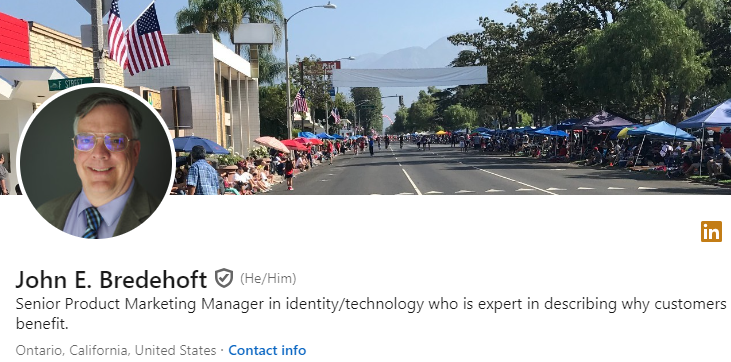
Senior Product Marketing Manager in identity/technology who is expert in describing why customers benefit.
She read that sentence word for word.
Regular Bredemarket readers are familiar with the last three words of that sentence, and realize that every one of those three words is critically important. Why rather than what, customers rather than producers, and benefits rather than features. I’ve devoted a post (plus another post) to those three words. If I only had a few seconds to explain the importance of those three words…
Um, yet again, recruiters aren’t interested in taking a few minutes to read everything I have written about Simon Sinek’s Golden Circle, customer focus, or benefits. They don’t even want to watch a short reel on the topic.
So I have to rewrite the last part of that first sentence. As I write this post, I’m still mulling over alternatives.
The 7 items above were just some of the tips that Melanie Woods imparted to me, all in the space of 20 minutes.
Again, the common theme is that recruiters have limited time, LinkedIn Recruiter lets them maximize that limited time, and jobseeker data also has to let recruiters maximize that limited time. If you can do something in 0 seconds, don’t take 5 seconds to do it.
I haven’t even explored some of the other features that CGL Recruiting offers, including Melanie Woods’ YouTube channel.
But the 20 minutes I spent with her were certainly valuable.
Now I just have to figure out another way to say “why customers benefit.”
I’ve talked about synthetic identity fraud a lot in the Bredemarket blog over the past several years. I’ll summarize a few examples in this post, talk about how to fight synthetic identity fraud, and wrap up by suggesting how to get the word out about your anti-synthetic identity solution.
But first let’s look at a few examples of synthetic identity.
As far back as December 2020, I discussed Kris’ Rides’ encounter with a synthetic employee from a company with a number of synthetic employees (many of who were young females).

More recently, I discussed attempts to create synthetic identities using gummy fingers and fake/fraudulent voices. The topic of deepfakes continues to be hot across all biometric modalities.
I shared a video I created about synthetic identities and their use to create fraudulent financial identities.
I even discussed Kelly Shepherd, the fake vegan mom created by HBO executive Casey Bloys to respond to HBO critics.
And that’s just some of what Bredemarket has written about synthetic identity. You can find the complete list of my synthetic identity posts here.
It isn’t enough to talk about the fact that synthetic identities exist: sometimes for innocent reasons, sometimes for outright fraudulent reasons.
You need to communicate how to fight synthetic identities, especially if your firm offers an anti-fraud solution.

Here are four ways to fight synthetic identities:
If you conduct all four tests, then you have used multiple factors of authentication to confirm that the person is who they say they are. If the identity is synthetic, chances are the purported person will fail at least one of these tests.
If you fight synthetic identity fraud, you should let people know about your solution.
Perhaps you can use Bredemarket, the identity content marketing expert. I work with you (and I have worked with others) to ensure that your content meets your awareness, consideration, and/or conversion goals.
How can I work with you to communicate your firm’s anti-synthetic identity message? For example, I can apply my identity/biometric blog expert knowledge to create an identity blog post for your firm. Blog posts provide an immediate business impact to your firm, and are easy to reshare and repurpose. For B2B needs, LinkedIn articles provide similar benefits.
If Bredemarket can help your firm convey your message about synthetic identity, let’s talk.
WHY does outsourced content marketing work?
Because an outsourced content marketer can help you address gaps in your content.
For example, maybe you have NEVER posted to your company LinkedIn page.
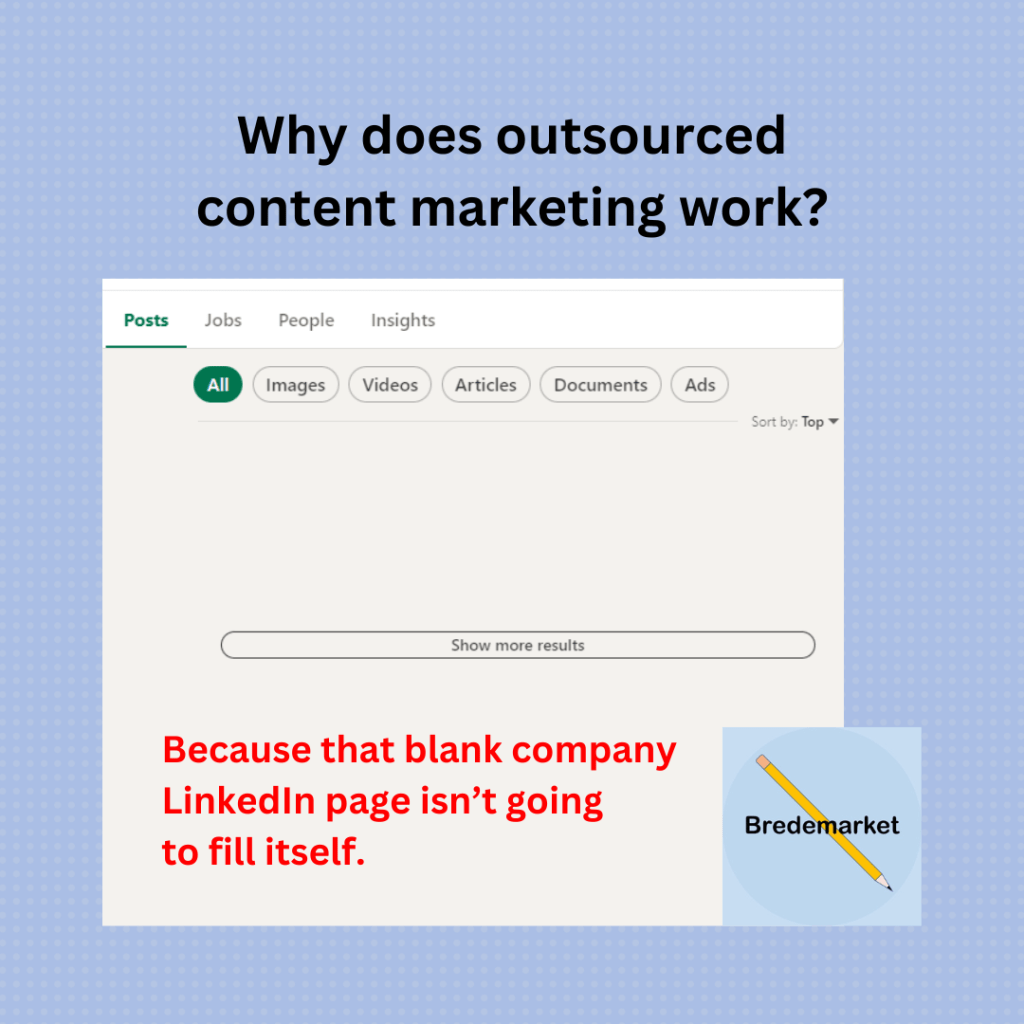
An outsourced content marketer can help. After all, that blank company LinkedIn page isn’t going to fill itself.
Let Bredemarket work with you to create your content.




 Bredemarket