Which Words Should Your Marketers Use? My Four Suggestions.

I’ve talked about the words “why,” “how,” and “what” and their relation to writing, but I haven’t talked about the word “which.”

Not in relation to sandwiches, but in relation to words.

If you are a marketing executive, you know that the words you use in your marketing content can make or break your success. When your company asks employees or consultants to write marketing content for you, which words should they use?

Here are four suggestions for you and your writers to follow.

  1. Your writers should use the right words for your brand.
  2. Your writers should use the right words for your industry.
  3. Your writers should use words that get results.
  4. Your writers should be succinct.

Your writers should use the right words for your brand

Your company has a tone of voice, and your writers should know what it is. If you can’t tell them what it is, they will figure it out themselves.

Your company has a particular writing style—hopefully one that engages your prospects and customers. Regardless of your writer’s personal style, they must create copy that aligns with your own style. In effect, they put on a “mask” that aligns the words they create with the words that your company needs.

Your writers should use the right words for your industry

Similarly, your company provides products and services in one or more industries, and your copy must align with the terms those industries use, and the way industry participants express themselves.

For example, a writer who is writing content for the biometric industry will use different terms than a writer who is writing content for art collectors because of the differences in the two target audiences.

  • Biometric readers (the people, not the devices) care about matching accuracy measurements, such as those compiled by the U.S. National Institute of Standards and Technology (NIST) in its Face Recognition Vendor Test, or as measured in agency-managed benchmarks. (Mike French’s example.) They often respond to quantitative things, although more high-level concepts like “keeping citizens safe from repeat offenders” (a public safety-related benefit) also resonate.
  • Art collectors care about more qualitative things, such as not being scared of handing over their dream to a commissioned artist whose work will inspire affection. (Well, unless the collector is an art investor and not an art lover; investors use different terminology than lovers.)

So make sure your writers get the words right. Otherwise, it’s as if someone is speaking Italian to a bunch of French speakers. (Kaye Putnam’s example.) Your prospects will tune you out if you use words they don’t understand.

Your writers should use words that get results

There is one important exception to my suggestions above. If your company’s current words don’t result in action, quit using your current words and use better ones that support your awareness, consideration, conversion, or other goals.

If you start talking about your solution without addressing your prospect’s pain points or problems, they won’t know why they should care about your solution.

For example, let’s say that the message you want to give to your prospects is that your company makes wireless headphones.

So what?

The prospect doesn’t care about wireless headphones per se. The prospect cares about the troubles they face with tangled cords, and how your company offers a solution to their problem of tangled cords.

Features are important to you. Benefits are important to your prospects. Since the prospects are the ones with the money, listen to them and talk about benefits that change their lives, not how great your features are.

Your writers should be succinct

I have struggled with succinctness for decades. I could give you countless examples of my long-windedness, but…that wouldn’t be appropriate.

So how do I battle this personally? By creating a draft 0.5 before I create my draft 1. I figure out what I’m going to say, say it, and then sleep on the text—sometimes literally. When I take a fresh look at the text, I usually ruthlessly chop a bunch of it out and focus on the beef.

Now there are times in which detail is appropriate, but there are also times in which a succinct message gets better results.

Selecting your content marketer

If your company needs employees or consultants to write marketing content for you, make sure they create the right content.

If your company’s views on content creation parallel my own, maybe I can help you.

If you need a full-time employee on your staff to drive revenue as your personal Senior Product Marketing Manager or Senior Content Marketing Manager, take a look at my 29 years of technology (identity/biometric) and marketing experience on my LinkedIn profile. If you like what you see, contact me via LinkedIn or at jebredcal@gmail.com.
If you need a marketing consultant for a single project, then you can reach me via my Bredemarket consultancy.

Applying the “Six Questions” to LinkedIn Self-promotion

(UPDATE OCTOBER 23, 2023: “SIX QUESTIONS YOUR CONTENT CREATOR SHOULD ASK YOU IS SO 2022. DOWNLOAD THE NEWER “SEVEN QUESTIONS YOUR CONTENT CREATOR SHOULD ASK YOU” HERE.)

I’ve previously talked about the six questions your content creator should ask you. And I eat my own wildebeest food. I used the six questions to create a self-promotion blog post and LinkedIn post.

But since you care about YOUR self-promotion rather than mine, I’ll provide three tips for writing and promoting your own LinkedIn post.

How I promoted my content

Before I wrote the blog post or the LinkedIn post, I used my six questions to guide me. For my specific example, here are the questions and the answers.

QuestionPrimary AnswerSecondary Answer (if applicable)
Why?I want full-time employmentI want consulting work
How?State identity and marketing qualifications, ask employers to hire meState identity and marketing qualifications, ask consulting clients to contract with me
What?Blog post (jebredcal), promoted by a personal LinkedIn postBlog post (jebredcal), promoted by a Bredemarket Identity Firm Services LinkedIn post
Goal?Employers contact me for full-time employmentConsulting prospects contact me for contract work
Benefits?(1) No identity learning curve
(2) No content learning curve
(3) Proven results
(same)
Target Audience?Identity companies hiring Senior Product Marketing Managers and Senior Content Marketing ManagersIdentity companies contracting with content marketing consultants
For more information on the six questions, see https://bredemarket.com/2022/12/18/six-questions-your-content-creator-should-ask-you-the-e-book-version/.

You’ll notice that I immediately broke a cardinal rule by having both a primary goal and a secondary goal. When you perform your own self-promotion, you will probably want to make things less messy by having only a single goal.

So based upon these responses, I created…

First, the blog post

The Bredemarket blog is primarily to promote my consulting work. I have a different blog (jebredcal) to promote my full-time employment (or attempts to secure full-time employment).

Because the primary goal was to secure full-time employment, I posted to jebredcal instead of Bredemarket.

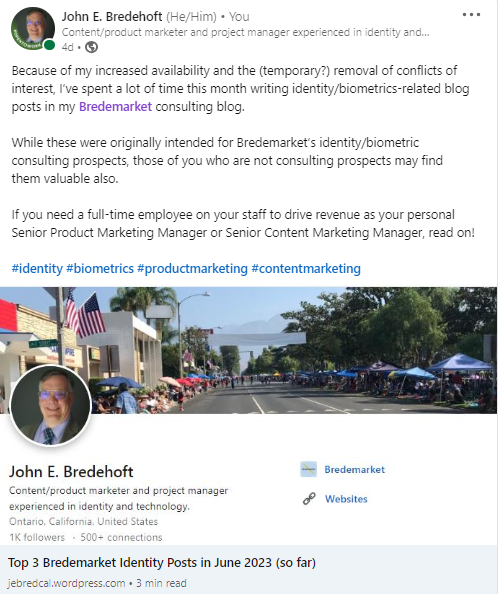
After the introduction (pictured above) with its “If you need a full-time employee” call to action, I then shared three identity-related blog posts from the Bredemarket blog to establish my “biometric content marketing expert” (and “identity content marketing expert”) credentials. I then closed with a dual call to action for employers and potential consulting clients. (I told you it is messy to have two goals.)

If you want to see my jebredcal post “Top 3 Bredemarket Identity Posts in June 2023 (so far),” click here.

So how did I get the word out about this personal blog post? I chose LinkedIn. (In my case, hiring managers probably aren’t going to check my two Instagram accounts.)

Second, the LinkedIn post

I often reshare my Bredemarket blog posts on various Bredemarket social media accounts. In this instance I only reshared it on LinkedIn, since that’s where the hiring managers are. While I shared the blog post to my Bredemarket Identity Firm Services LinkedIn page (since the post talked about identity), my primary goal was to share it to my personal LinkedIn feed.

It was simple to write the LinkedIn text, since I repurposed the introduction of the blog post itself. I added four hashtags, and then the post went live. You can see it here.

And by the way, feel free to like the LinkedIn post, comment on it, or even reshare it. I’ll explain why below.

Third, the “LinkedIn Love” promotion

So how did I promote it? Via the “LinkedIn Love” concept. (Some of you know where I learned about LinkedIn Love.)

To get LinkedIn love, I asked a few trusted friends in the identity industry to like, comment, or reshare the post. This places the post on my friends’ feeds, where their identity contacts will see it.

A few comments:

  • I don’t do this for every post, or else I will have no friends. In fact, this is the first time that I’ve employed “LinkedIn Love” in months.
  • I only asked friends in the identity industry, since these friends have followers who are most likely to hire a Senior Product Marketing Manager or Senior Content Marketing Manager.
  • I only asked a few friends in the identity industry, although eventually some friends that I didn’t ask ended up engaging with the post anyway.

I have wonderful friends. After several of them gave “LinkedIn Love,” The post received significant engagement. As of Friday morning, the post had acquired over 1,700 impresions. That’s many, many more than my posts usually acquire.

I don’t know if this activity will directly result in full-time employment or increased consulting work. But it certainly won’t hurt.

Three steps to promote YOUR content

But the point of this post isn’t MY job search. It’s YOURS (or whatever it is you want to promote).

For example, one of my friends who is also seeking full-time employment wanted to know how to use a LinkedIn post to promote THEIR OWN job search.

Now you don’t need to use my six questions. You don’t need to create a blog post before creating the LinkedIn post. And you certainly don’t need to create two goals. (Please don’t…unless you want to.)

In fact, you can create and promote your own LinkedIn post in just THREE steps.

Step One: What do you want to say?

My six questions obviously aren’t the only method to collect your thoughts. There are many, many other tools that achieve the same purpose. The important thing is to figure out what you want to say.

  • Start at the end. What action do you want the reader to take after reading your LinkedIn post? Do you want them to read your LinkedIn profile, or download your resume, or watch your video, or join your mailing list, or email or call you? Whatever it is, make sure your LinkedIn post includes the appropriate “call to action.”
  • Work on the rest. Now that you know how your post will end, you can work on the rest of the post. Persuade your reader to follow your call to action. Explain how you will benefit them. Address the post to the reader, your customer (for example, a potential employer), and adopt a customer focus.

Step Two: Say it.

If you don’t want to write the post yourself, then ask a consultant, a friend, or even a generative AI tool to write something for you. (Just because I’m a “get off my lawn” guy regarding generative AI doesn’t mean that you have to be.)

(And before you ask, there are better consultants than Bredemarket for THIS writing job. My services are designed and priced for businesses, not individuals.)

After your post is written by you or someone (or something) else, have one of your trusted friends review it and see if the written words truly reflect how amazing and outstanding you are.

Once you’re ready, post it to LinkedIn. Don’t delay, even if it isn’t perfect. (Heaven knows this blog post isn’t perfect, but I posted it anyway.) Remember that if you don’t post your promotional LinkedIn post, you are guaranteed to get a 0% response to it.

Step Three: Promote it.

Your trusted friends will come in handy for the promotion part—if they have LinkedIn accounts. Privately ask your trusted friends to apply “LinkedIn Love” to your post in the same way that my trusted friends did it for me.

By the way—if I know you, and you’d like me to promote your LinkedIn post, contact me via LinkedIn (or one of the avenues on the Bredemarket contact page) and I’ll do what I can.

And even if I DON’T know you, I can promote it anyway.

I’ve never met Mary Smith in my life, but she says that she read my Bredemarket blog post “Applying the “Six Questions” to LinkedIn Self-promotion.” Because she selects such high-quality reading material, I’m resharing Mary’s post about how she wants to be the first human to visit Venus. If you can help her realize her dream, scroll to the bottom of her post and donate to her GoFundMe.

Hey, whatever it takes to get the word out.

Let me know if you use my tips…or if you have better ways to achieve the same purpose.

Why Your Business Needs an Obsessive Content Marketer

Compulsions and obsessions can be bad things, or they can be good things if channeled correctly.

What if Bredemarket provided me an outlet to chnnel my compulsions and obsessions to help your business grow?

Compulsions and obsessions

I recently wrote a three-post series (first post in the series here) that frequently used the word “compulsion.”

I almost used the word “obsession” in conjunction with the word compulsion, but decided not to make light of a medical condition that truly debilitates some people.

I used the word compulsion to refer to two things about me:

Writing compulsion, or writing obsession. Designed by Freepik.

While compulsions and obsessions can certainly be bad things, when harnessed properly they can provide good for the world.

Like a butterfly.

Animotion on embracing an obsession

When people of a certain age hear the word “obsession,” they may think of the 1980s song by the band Animotion.

From https://www.youtube.com/watch?v=hIs5StN8J-0

Unfortunately for us, 90% of the song deals with the negative aspects of a person obsessing over another person. If you pick through the lyrics of the Animotion song “Obsession” and forget about what (or who) the singer is obsessing about, you can find isolated phrases that describe how an obsession can motivate you.

  • “I cannot sleep”
  • “Be still”
  • “I will not accept defeat”

But thankfully, there are more positive ways to embrace an obsession.

Justin Welsh on embracing an obsession

While Justin Welsh’s July 2022 post “TSS #028: Don’t Pick a Niche. Embrace an Obsession” is targeted for solopreneurs, it could just as easily apply to those who work for others. Regardless of your compensation structure, why do you choose to work where you do?

For Welsh, the practice of picking a niche risks commoditization.

They end up looking like, sounding like, and acting like all of their competition. The internet is full of copycats and duplicates.

From https://www.justinwelsh.me/blog/dont-pick-a-niche-embrace-an-obsession

(For example, I’d bet that all of the people who are picking a niche know better than to cite the Animotion song “Obsession” in a blog post promoting their business.)

Perhaps it’s semantics, but in Welsh’s way of thinking, embracing an obsession differs from picking a niche. To describe the power of embracing an obsession, Welsh references a tweet from Daniel Vassalo:

Find something you want to do really badly, and you won’t need any goals, habits, systems, discipline, rewards, or any other mental hacks. When the motivation is intrinsic, those things happen on their own.

From https://twitter.com/dvassallo/status/1547230105805754369

I trust you can see the difference between picking something you HAVE to do, versus obsessing over something you WANT to do.

What’s in it for you?

Welsh was addressing this post to me and people like me, and his message resonates with me.

But frankly, YOU don’t care about me and about whether I’m motivated. All that you care about is that YOU get YOUR content that you need from me.

So why should you care what Justin Welsh and Daniel Vassllo told me?

The obvious answer is that if you contract with Bredemarket for your marketing and writing services, you’ll get a “pry my keyboard out of my cold dead hands” person who WANTS to write your stuff, and doesn’t want to turn the writing process over to some two-year-old bot (except for very small little bits).

Regarding the use of two-year-old bots:

“Pry my keyboard,” indeed.

Do you need someone to obsess over YOUR content?

Of course, if you need someone to write YOUR stuff, then I won’t have time to work on a TikTok dance. This is a good thing for me, you, and the world.

As I’ve stated elsewhere, before I write a thing for a Bredemarket client, I make sure that I understand WHY you do what you do, and understand everything else that is relevant to the content that we create.

As I work on the content, you have opportunities to review it and provide your feedback. This ensures that both of us are happy with the final copy.

And that your end users become obsessed with YOU.

So if you need me to create content for you, please contact me.

Feel free to share YOUR favorite 1980s song if you like.

Even if it’s THIS song that your favorite temperamental writer detests.

From https://www.youtube.com/watch?v=aDgHXiWgKlE

Three Reasons Why You Need the Bredemarket 404 Web/Social Media Checkup

I haven’t mentioned my “Bredemarket 404 Web/Social Media Checkup” in years, but we need the service more than ever. In fact, as I mention below, I should probably buy the service for myself.

What is the Bredemarket 404 Web/Social Media Checkup?

Why do I offer the Bredemarket 404 Web/Social Media Checkup? To ensure that your web and social properties are correctly communicating your business benefits and values to prospects and customers.

How do I provide the service? I not only analyze every page on your business website, but also analyze every social media account associated with your business (and, if you choose, your personal social media accounts also).

What do I do? For each social media account and page within each account, Bredemarket checks for these and other items:

  • Broken links
  • Outdated information
  • Other text and image errors
  • Synchronization between the web page and the social media accounts
  • Content synchronization between the web page and the social media accounts
  • Hidden web pages that still exist

Bredemarket then reports the results to you with recommended actions.

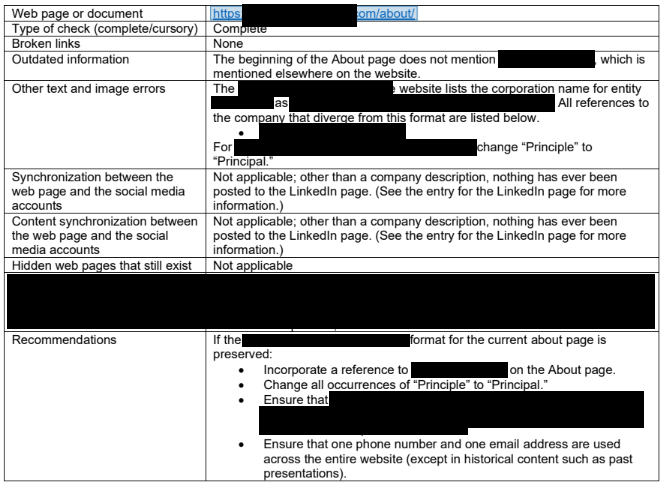
Redacted example of one page of a multi-page Bredemarket 404 report.

If requested, Bredemarket prepares a simple social media communications process for you.

Three reasons why you need a web/social media check

If you’re wondering why your business may need such a check, here are three things that I’ve observed over the years that adversely impact your marketing (and, um, my marketing).

Stale, dated material

Designed by Freepik.

Perhaps you wrote the text for your website or your social media page several years ago. And it was great…at the time. But as the months and years pass, the text becomes outdated.

I’ve discussed the problem of non-current content before, giving examples such as sites that mention Windows 7 support long after Microsoft stopped supporting Windows 7. But sadly, I recently ran across another offender, and this time I’m going to name names.

The company who kept stale content online was…Bredemarket.

As some of you know, last week I announced changes in Bredemarket’s scope and business hours. This necessitated some changes on my website.

Then I had to return to this website to make some hurried updates, since my April 2022 prohibition on taking certain types of work is no longer in effect as of June 2023. Hence, my home page, my “What I Do” page, and (obviously) my identity page are all corrected.

From https://bredemarket.com/2023/06/01/updates-updates-updates/

But earlier this week when I was cruising around the site, I noticed a page that I had missed:

From https://bredemarket.com/biometric-content-marketing-expert/ as of the morning of June 8, 2023.

“Biometric content marketing expert” my…(you know what). By the time you read this post, I will hopefully have fixed this. You can check for yourself to make sure I did fix it, and call me out if I didn’t. (Pressure’s on, Johnny.)

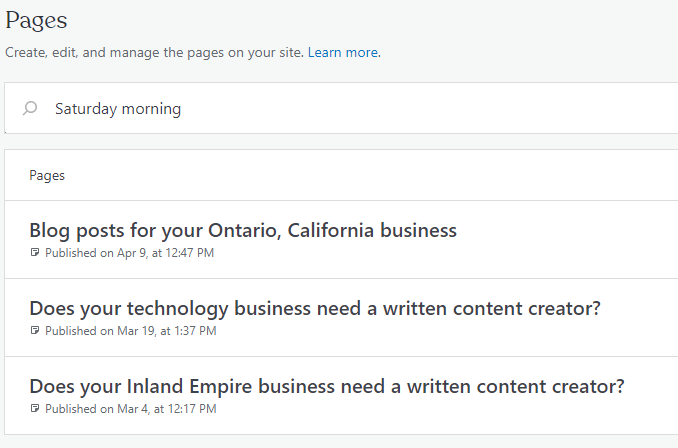
Oh, and there are three other pages that mention the words “Saturday morning” (as in booking a Saturday morning meeting with me). I have to fix those also.

WordPress listing of Bredemarket pages that include(d) the words “Saturday morning.”

Heroic sprints, only partially executed

Designed by Freepik.

In addition to stale, dated, material, sometimes the material on your online properties is only partially complete.

Perhaps you’ve worked with organizations that have sudden inspirations and want to implement them NOW.

From https://www.youtube.com/watch?v=rziG2gn-eQ0

So you’re going to mount a heroic sprint to just do it, process be damned. You’re going to steamroll ahead, working nights and weekends, and get the thing done.

And then, bleary-eyed, you get it done.

But you didn’t get all the other stuff done that needed to be completed along with the heroic sprint.

Maybe you completed a heroic sprint to document something on one of your properties…but you completely forgot to document that same thing on another of your properties. So one property mentions six items, while the other one only mentions five. Hopefully your prospect will go to the property that mentions the correct number of items.

If you’re lucky. Authentically lucky.

From https://www.youtube.com/watch?v=38mE6ba3qj8

(As an aside, a company that relies on heroic sprints is only hurting itself and its employees. See this Moira Lethbridge & Toni Collis LinkedIn article, “Why Having Superhuman Expectations Is Killing Your Career.“)

Forgotten online properties

Designed by Freepik.

A third common problem that your company may face is the existence of old online properties that you may have forgotten about.

  • Maybe you established an online property and completely forgot about it. So as you update all of your other online properties, you neglect to update that one. What happens if the only online property your prospect sees is the one you never bother to update?
  • Maybe you established an online property, then established a second one on the same platform. I previously cited an example in which a company established a Twitter account, then established a second one later without letting followers of the first account know. Guess which Twitter account had fewer followers? The new one.

Forgotten online properties result in disjointed views of your firm, and a confusing online presence.

Here’s how to obtain a web/social media check for yourself

Do your website and social media accounts suffer from these inconsistencies and errors?

Would you like an independent person to analyze your online properties and report the issues so you can fix them?

If you need Bredemarket’s services:

Repurposing My Generative AI Suggestions/Rules as a LinkedIn Article

I have published a number of articles (as opposed to posts) on LinkedIn.

Until today, I had never published an article under the name of the Bredemarket Identity Firm Services LinkedIn showcase page. (That’s the green one, if you pay attention to the color coding.)

Since I’m re-establishing Bredemarket’s identity/biometrics credentials, I decided to repurpose my previous Bredemarket blog post “The Temperamental Writer’s Two Suggestions and One Rule for Using Generative AI” as a new LinkedIn article.

Repurposing is fun, not only because I get to customize the message to a new audience (in this case, specifically to the identity/biometrics crowd rather than the general AI/writing crowd), but also because it gives me a chance to revisit and modify some of the arguments I used or didn’t use in the original post. (For example, I dove into the Samsung AI issue a little more deeply this time around.)

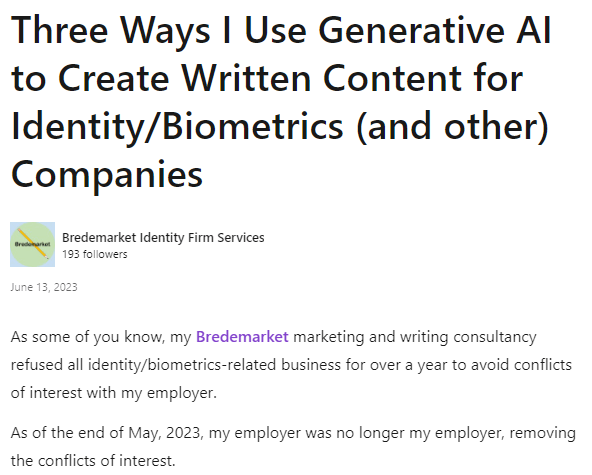
If you want to see my latest take on using generative AI in writing, see the Bredemarket Identity Firm Services LinkedIn article “Three Ways I Use Generative AI to Create Written Content for Identity/Biometrics (and other) Companies.”

And bear in mind that as AI and customer expectations change, I may have to revise it sooner rather than later.

P.S. If you want Bredemarket to create a LinkedIn article for your profile or company page

How Can Your Identity Business Create the RIGHT Written Content?

Does your identity business provide biometric or non-biometric products and services that use finger, face, iris, DNA, voice, government documents, geolocation, or other factors or modalities?

Does your identity business need written content, such as blog posts (from the identity/biometric blog expert), case studies, data sheets, proposal text, social media posts, or white papers?

How can your identity business (with the help of an identity content marketing expert) create the right written content?

For the answer, click here.

(Part Three of Three) Why is There So Much STUFF on the Bredemarket Identity LinkedIn Page These Days?

I’ve spent the first two entries in this post series (Part One, Part Two) talking about my compulsion to share identity information to Slack or LinkedIn or other places.

And you’re probably asking a very important question.

So what?

Talking about my compulsion isn’t really a good customer-focused thing to do.

Unless my compulsion benefits you in some say.

And for some of you, it does.

If you are a professional in the identity industry, you want to remain up-to-date on all the goings-on. And there are a number of sources that provide that information. But in many cases, you have to read the entire article.

That’s where my long-established practice of quoting excerpts can help.

Through force of habit, most of my shares to the Bredemarket Identity Firm Services LinkedIn showcase page begin with a relevant excerpt, and sometimes I include an editorial comment based on my 25-plus years in the identity industry. If the excerpt (and/or editorial) interests you, you can click on the link and read the article. If the excerpt/editorial doesn’t interest you, you can skip the article entirely.

This saves you time that you can devote to other tasks.

And now for the CTA

CTA stands for call to action, and my call to action is this.

Would you like to read the identity-related content that I’m starting to post again to the Bredemarket Identity Firm Services LinkedIn showcase page?

It’s really easy to do so.

  1. Log into your LinkedIn account.
  2. Go to the page: https://www.linkedin.com/showcase/bredemarket-identity-firm-services/.
  3. Click the “Follow” button.
To see my new content, click the “Follow” button at https://www.linkedin.com/showcase/bredemarket-identity-firm-services/

It’s so easy even a wildebeest can do it.

Black wildebeest. By derekkeats – Flickr: IMG_4955_facebook, CC BY-SA 2.0, https://commons.wikimedia.org/w/index.php?curid=14620744

(Well, if they have a wildebeest keyboard.)

(Part Two of Three) Why is There So Much STUFF on the Bredemarket Identity LinkedIn Page These Days?

Part One of this post series talked about my compulsion to write stuff.

Designed by Freepik.

And it also touched upon my compulsion to share stuff. Specifically, articles about identity.

I’ve already told how I’ve created or managed five services over the years to share identity industry information, but I’ve never told any of the behind the scenes story regaridng the creation of the fifth identity information service. This one was created for Incode Technologies, which was (and is) very different from Bredemarket, and very different from IDEMIA, Safran, and Motorola.

Behind the scenes on the fifth identity information service

By the time I joined Incode, I had spent much of my life as an employee working for large bureaucratic multinational companies.

  • I worked for Motorola when there was only one Motorola.
  • MorphoTrak was part of the huge Safran Group (until it wasn’t).
  • IDEMIA was, and is, a combination of dozens of previously independent companies that eventually merged into one big firm.

I was used to process. Motorola WAS process, and Safran and IDEMIA weren’t slouches at process either. You can’t build aircraft parts just by, um, winging it.

But now I found myself at Incode, a rapidly growing startup. It used (and uses) newer tools that didn’t even exist when I worked for Motorola. For example, it used Slack as one of its primary methods to communicate with employees.

As I perused the Slack channels offered at my new employer, a new idea popped into my mind. OK, it was actually a pretty old idea from my perspective, but it would be new to my coworkers.

“Why don’t I create a Slack channel devoted to identity industry information?”

But of course one does not simply create a corporate Slack channel.

Before establishing a Slack channel on a corporate platform, I knew (with the same certainty professed by certain generative AI services) that you obviously need to go through a lengthy approval process. You probably have to get signatures from the corporate headquarters, IT, and probably a few other organizations besides. I mean, I knew this, based upon extensive data that I had acquired up to 2021. (Actually mid-2022, but some of you get the reference.)

So I went to my boss Kevin, told him I wanted to create a Slack channel for identity industry information, and asked him what the official Incode approval process was to create the channel.

From https://www.youtube.com/watch?v=VMin0i_h8PI

(And you wonder why my younger marketing coworkers said “OK Boomer” to me at times.)

Kevin was a patient boss. I don’t know what was going through his mind when I asked the question, but he simply smiled and said, “Just create it. And if no one uses it in a couple of weeks, just delete it.”

(They didn’t do that in La Défense or Issy-les-Moulineaux or Schaumburg, or even in Reston or Billerica or Alexandria or Tacoma or Anaheim or Irvine.)

So I did simply create the new corporate Slack channel, posting articles of interest to it, and letting my coworkers know about the channel’s existence.

And soon other people started posting to the channel.

And soon people other than myself were inviting other people to the channel.

I didn’t delete it.

So the fifth identity information service took off, and I settled into a routine. On many mornings, I did the one thing that experts say you shouldn’t do. I started my morning by reading my corporate email.

(Despite being a Sage, I’m still a Revolutionary/Rebel/Maverick.)

And as I read my various alerts and emails I’d find articles of interest, identify a brief excerpt that encapsulated the main point of the article, and share the excerpt (occasionally with an editorial comment) and article to the Slack channel.

Compulsively.

Of course, because I was devoting time to the company-only fifth identity information service, the Bredemarket LinkedIn showcase page (the fourth identity information service) wasn’t receiving that much attention. Bredemarket wasn’t doing any identity consulting anyway, so I was spending my limited Bredemarket time pursuing other markets. And pouring my identity compulsion into Incode’s Slack channel.

‘Til Tuesday

From https://www.youtube.com/watch?v=uejh-bHa4To

(Couldn’t resist.)

Then on Tuesday my routine was shattered. For purposes of this post, I’ll simply say that I no longer had access to that fifth identity information service, or to any of Incode’s Slack channels.

But I still had my identity information sharing compulsion.

I was still reading articles (albeit from other sources), and I still had the urge to share them on the Slack channel, but then I remembered that I couldn’t.

That’s when I started hearing the plaintive call of the wildebeest.

Black wildebeest. By derekkeats – Flickr: IMG_4955_facebook, CC BY-SA 2.0, https://commons.wikimedia.org/w/index.php?curid=14620744

My old forgotten friend the wildebeest was soothingly telling me that I could go back to the fourth identity information service and share identity stuff there again.

I hadn’t shared anything to that Bredemarket LinkedIn showcase page in over two weeks. But starting that Tuesday, I started sharing several items a day, successfully redirecting my compulsion and sharing to a new target.

So what? I’ll explain why this whole story is important to YOU in Part Three.

(Part One of Three) Why is There So Much STUFF on the Bredemarket Identity LinkedIn Page These Days?

Often I write my Bredemarket posts to target a specific audience. Technologists. Leaders of businesses in California’s Inland Empire. People who like wildebeests.

Well, this post series is specifically targeted to people who follow the LinkedIn showcase page Bredemarket Identity Firm Services. By the time you finish reading this post series, you may choose to follow the page also.

When people scan the posts on that LinkedIn showcase page, they’ll see that earlier in the year, I was posting infrequently, and then a few days ago I started posting all sorts of stuff on the page.

Why?

Well, there’s a story behind that.

Why I am like Charlton Heston, sort of

By Trailer screenshot, from DVD The Ten Commandments, 50th Anniversary Collection Paramount, 2006 – The Ten Commandments trailer, Public Domain, https://commons.wikimedia.org/w/index.php?curid=2216811

Charlton Heston (1923-2008) was a famous actor, and from his roles there were a number of lines that were associated with him.

One of the most famous ones is “Take your stinking paws off me, you damn dirty ape!” from Planet of the Apes.

From https://www.youtube.com/watch?v=Cdmqn9JIuzc

But later in life he was associated with a line that wasn’t spoken on a movie set, but in the Charlotte (North Carolina) Convention Center. The line? “From my cold, dead hands.”

From https://www.youtube.com/watch?v=5ju4Gla2odw

In this case Heston was talking about guns; he was giving a speech to the National Rifle Association.

But that “cold, dead hands” line can be applied to other things, as I did when I created the Bredemarket website about three years ago and created the “Writing, writing, writing” section of the “Who I Am” page.

I am John E. Bredehoft, and I have enjoyed writing for a while now.

And for a while I’ve been able to make a living at it. With the exception of my first jobs as a paperboy and a library assistant, every one of my positions has required some level of writing. Articles for my college newspaper. User manuals. Zines (in my previous brief foray into business, Gresham Press.) Requests for proposals. Responses to requests for proposal. Marketing requirements documents. And other documents that I’ll address a little bit later.

And when I wasn’t getting paid to write, I was writing for free. A college dorm newspaper, the Eastport Enquirer. Nearly a dozen personal blogs since 2003, a few of which are still running. Two professional blogs.

I guess I’m a “you can pry my keyboard out of my cold dead hands” type.

From “Who I Am.”

Yes, that’s me. A compulsion to write stuff.

Designed by Freepik.

My other compulsion

I also compulsively share stuff that other people have written, especially when it relates to a topic that interests me.

Such as identity.

I’ve told the basic story about how I created (or managed) online places where I could share stuff about identity. First at Motorola, then at MorphoTrak, then at IDEMIA. Then at Bredemarket: the aforementioned Bredemarket Identity Information Services LinkedIn showcase page (and Facebook group).

And I’ve told the basic story about how I created a fifth “identity information service,” this time for my then-new employer Incode Technologies.

But I didn’t tell the “behind the scenes” part about the creation.

I’ll tell that in Part Two.

4 Actions for IE Firms Needing Rapid Written Content

About a year ago, I wrote a two-part series of posts entitled “In marketing, move quickly.”

How can you move quickly?

If you’re an Inland Empire business that needs rapid written content creation, I’ll tell you how Bredemarket can help you create that content.

Why move quickly?

On the 99.9% chance that you didn’t read my two posts on this topic, here’s a brief TL;DR on what I (and others) said.

By Malene Thyssen – Own work, CC BY-SA 3.0, https://commons.wikimedia.org/w/index.php?curid=10119596
  • If you don’t move quickly, you may miss your opportunity.
  • The first post mentioned a company (whom I didn’t name) that hired an international marketing company in December 2021, but that hadn’t created any customer-facing content by March 2022.
  • The first post also mentioned a bank that put a customer-facing email test togehter in eight weeks.
  • Oh, and John DeLorean took eight years to get his car out, which didn’t help with his financing issues.
  • On the positive side, the second post described how one company moved quickly. Rather than waiting for a centralized content creator to distribute content, Intuit provided guidelines so that its employees could extend the reach of Intuit’s content through their own social media posts.
  • The second post also noted that quick generation of content is appreciated by customers, vendors, and partners.

How can you move quickly?

So let’s say you’re an Inland Empire business who needs to create between 400 and 600 words of content quickly, such as the text for a brochure, a blog post, or a LinkedIn or Facebook post.

How can you get it out quickly?

How can you avoid waiting eight weeks, or three months, or eight years for your customers to see your content?

Here are four actions you can take to get your content out.

  1. Specify your content needs.
  2. Ensure you are available.
  3. Ensure your content creator is available.
  4. Book your content creator.

I’ll describe these four actions below.

One: Specify your content needs

If you rush to create content without thinking through your needs, your content won’t be that effective. Take some time up front to plan what your content will be.

Ask yourself critical questions about your content.

(UPDATE OCTOBER 22, 2023: “SIX QUESTIONS YOUR CONTENT CREATOR SHOULD ASK YOU IS SO 2022. DOWNLOAD THE NEWER “SEVEN QUESTIONS YOUR CONTENT CREATOR SHOULD ASK YOU” HERE.)

Don’t know what to ask? I’ve written an e-book entitled “Six Questions Your Content Creator Should Ask You.”

The six questions (hint: you’ve already seen two of them in the first two parts of this post):

  1. Why?
  2. How?
  3. What?
  4. Goal?
  5. Benefits?
  6. Target Audience?

When Bredemarket meets with a customer, I ask more than these six questions, but they’re the most important ones.

If you can answer these questions, either on your own or with the help of your content creator, then you’ll have a roadmap that allows you to create the content together.

Two: Ensure you are available

Note the word “together” in the paragraph above.

After you meet with your content creator, your part of the task isn’t done. Or shouldn’t be.

When Bredemarket creates content for a customer, there are points within the process where the customer reviews the content and makes suggestions. Normally when I create between 400 and 600 words of content using the Bredemarket 400 Short Writing Service, there are two review cycles. Here’s how I explain them:

  • Bredemarket iteratively provides two review copies of the draft content within three days per review. (The number of review cycles and review time must agree with any due dates.) The draft content advances your goal, communicates your benefits, and speaks to your target audience in your preferred tone of voice. Relevant examples and key words/hashtags are included.
  • You return comments on each review copy within three days. For longer content, you may provide the draft formatted copy for the final review.

Why? (If you read my e-book, you know the “why” question is important.)

Maybe I have questions that popped up while I was drafting the content. Maybe something occurs to you after you see the draft content. Whatever the reason, these review cycles provide opportunities to improve the content as I develop it.

But to get your feedback, you have to be available. The standard process gives you three days to return your comments, although of course you can return them faster. But if you don’t return your comments for weeks or months…well, that kind of kills the idea of getting the content out quickly.

Of course, in some cases delays are unavoidable. One of my customers was dependent on a third party to complete his part of the review, but the third party was not delivering. In that case, there was nothing the customer could do, and that content was delayed.

One critical question: what if you need your content very quickly?

  • Now if you add up all the times in the Bredemarket 400 process, your total comes to fourteen days: one day for the review, three days for me to create the first draft, three days for your review, three days for my second draft, three days for your second review, and one day for the final copy.
  • If you need it in one week rather than two weeks, then we jointly need to figure out a faster cadence of reviews. I can adjust the schedule to meet your due dates.
  • But you have to be available for the reviews.
  • And as I note below, I have to be available for the creation.

So when you’re planning to have Bredemarket or another content creator generate something for you, remember that you’ll need to spend a little bit of time on reviews.

Three: Ensure your content creator is available

You know how I said that the Bredemarket 400 process gives you three days to review each content iteration? Well, at the same time it gives me three days to draft (and redraft) the content.

Can I, or the content creator you select, hold up our end of the process?

Right now I’m going to tell you something that has happened since I wrote those two “In marketing, move quickly” posts in March 2022. In May 2022, I accepted a full-time position with an identity company, and therefore no longer spend full time on Bredemarket activities.

Therefore, if you need to meet with me Monday to Friday between 8 am and 5 pm (Pacific), I can’t meet you. I have my day job to worry about.

I have regular office hours on Saturday mornings when I can meet with you, and I can arrange to be available on weekday evenings or early weekday mornings. And of course I can draft your content and incorporate your suggestions at those times also, outside of regular business hours.

But if you need a content creator that is available during regular (Inland Empire) business hours, then you’ll need to select someone else.

Just make sure that the content creator you select is available when you need them.

Four: Book your content creator

When you’re ready to move, move. If you don’t start the process of creating your critical content, by definition you’ll never finish it.

So take the next step and find someone who will create your content. There are a number of content creators who serve Inland Empire businesses.

But if you want to use the Ontario, California content marketing expert, contact me at Bredemarket and I’ll arrange a meeting. Be prepared for me to ask you a few questions.