Have you ever seen those posts from self-appointed gurus?
Specifically, the ones that authoritatively state the BEST time to WRITE a post on Instagram, or LinkedIn, or TikTok, or whatever?
I religiously ignore those posts for a simple reason: My country has multiple time zones. So the best time in one time zone may be the worst time in another time zone.
However, I can tell you the WORST time to READ a post in the PACIFIC Time Zone…if the post concerns pizza.
And I’ll explain what all this means…eventually.
Ophir Tal on awareness
In addition to saying WHEN to post, the gurus also provide authoritative (and often contradictory) advice about WHAT to post.
For example, some gurus assert that you MUST prioritize bottom of funnel (conversion) content over top of funnel (awareness) content because it’s most important to get people to buy.
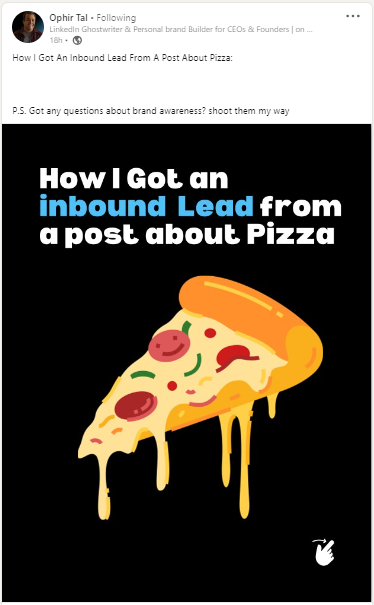
Ophir Tal disagrees, and has evidence to support his position.
This hook caught my attention. People want leads, and people like pizza, so I paid attention. But I also paid attention for a third reason that I’ll discuss later.
Tal then noted that the gurus would have recommended NOT posting this because he was “doing it wrong.” Specifically:
The post didn’t solve a problem for his potential clients. (Unless they regularly drop slices of pizza, I guess.)
It didn’t have a strong call to action.
It wasn’t targeted to his ideal clients. (Again, unless they regularly drop slices of pizza, or unless they love chicken wings.)
But despite doing everything wrong, that particular piece of content attracted the attention of someone “at a 6 figure ecom company.” After viewing the content, the reader looked at Tal’s profile and realized Tal could meet their need for ghostwriting services.
And now I’ll tell you the third reason why I paid attention to Tal’s post.
John Bredehoft on birthdays
As I noted above, I paid attention to Ophir Tal’s pizza post for two reasons:
People want leads.
People like pizza.
Now let’s jump back to a post I wrote all the way back in 2023, one that described why I’ve soured on the term “target audience.” (Or, in Tal’s words, “ideal clients.”) I started that post by wondering if the term “needy people” would be better than “target audience.” Yes, but not good enough.
I’ll grant that “needy people” has a negative connotation, like the person who is sad when people forget their birthday.
It turns out that these people had a VERY GOOD reason for forgetting my birthday. However, I cannot reveal this reason to you because the disclosure would force me to reveal someone’s personal identifiable information, or PII. (Mine.)
So after they remembered my birthday, one of them asked what I did for my birthday…and I told them that my wife, father-in-law, and brother-in-law went out to dinner.
For pizza.
And I also told them that there were leftovers, which my wife and I enjoyed a few days later.
Leftover pizza is the best pizza. Preparation credit: Pizza N Such, Claremont, California. Can I earn free pizza as a powerful influencer? Probably not, but I’ll disclose on the 0.00001% chance that I do.
A nice story, and while I was reading Ophir Tal’s story on dropped pizza, I realized that I had missed an opportunity to tell my own story about leftover pizza.
Time to channel Steve Jobs…
Oh, and there’s one more thing
I forgot to mention one thing about the Ophir Tal story.
When I read the story, it was around 4:00 pm in California.
So when I read about Tal’s dropped pizza, and thought about my leftover pizza (which I had already eaten)…I was hungry.
No, not THAT type of engagement, although there are parallels between engagement with a person and engagement with content.
In the same way that content impressions can move a prospect to awareness, content engagement can move a prospect to consideration. And even if you don’t believe in the traditional funnel, it’s obviously a good idea to get prospects to engage with your content.
Morisette’s six-step strategy
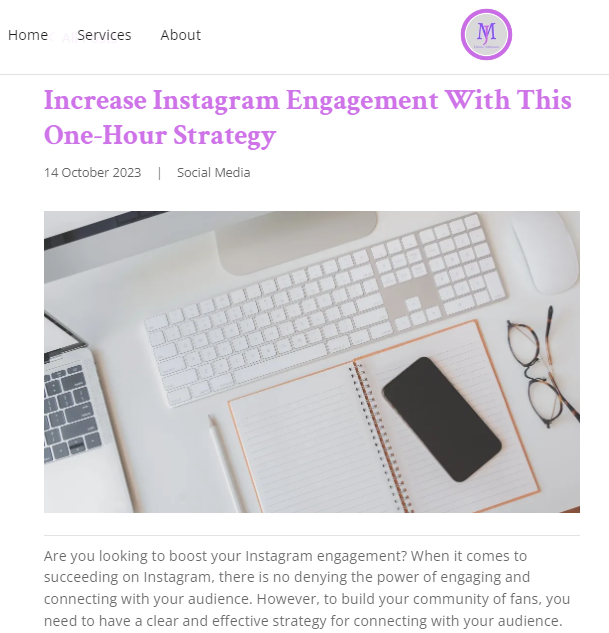
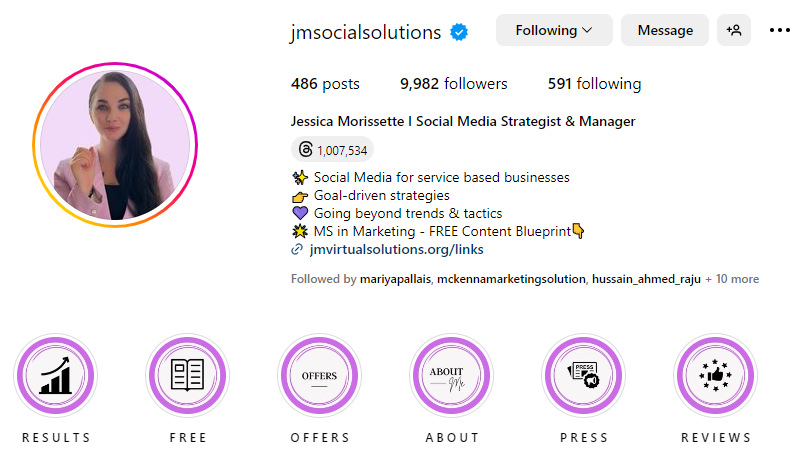
Jessica Morisette of JM Virtual Solutions recently wrote a blog post entitled “Increase Instagram Engagement With This One-Hour Strategy.” Although I’m sure that she wouldn’t object if you spent 59 or 61 minutes (rather than an exact 60 minutes) on daily engagement, and she DEFINITELY wouldn’t mind if you took some of her techniques and applied them to social media platforms other than Instagram.
Personally, I started trying to put her engagement strategy in practice over the weekend, both on Instagram and (with some adaptation) on LinkedIn. Depending upon time, I may try to apply it on your favorite social platform.
Building engagement on Instagram involves creating a genuine connection with your audience. It’s not just about getting likes and comments; it’s about creating meaningful interactions that lead to brand loyalty and growth. To achieve this, you need a strategy that focuses on targeted accounts, not just random.
She then lists six steps to her suggested media engagement strategy. Now I could rip her off and reprint all six here, but then you wouldn’t read her post (which you should do).
So instead I’m going to briefly cover her step 5, engaging with your peers and community.
Skipping to step 5
After devoting time to particular portions of the Instagram platform, Morisette suggests that you start engagement with particular segments. One of those segments is peers and community.
Why?
Supporting others in your niche can encourage them to reciprocate.
I know that content creators are often perceived to be in competition with other content creators, but since each of us is targeting different ideal clients, that competition is less than you think. Since content creators are all in this together, there’s a clear benefit from us supporting each other.
In fact, Morisette believes that this mutual support is so important that she recommends that you engage with your peers and community BEFORE you engage with your ideal client (step 6).
Whenever I see these pieces that proclaim that the author can help you brainstorm x ideas for content, I ignore them. For better or worse, I have no problem coming up with content ideas.
And when I come up with the content ideas, I don’t just use them in one piece of content. I’ll use the idea in several pieces of content. Yes, I love repurposing.
I think I’ve set a new record for myself over the last few days by creating 31 pieces of content from a single idea.
The post doesn’t aim to tell you how you should create and reshare your content, but perhaps while you’re reading the post you may get some fresh ideas that fit your own working practices.
Three years of preparation
Before you can share content in numerous places, you need numerous places to share your content. It’s obvious, but it’s true. After all, it would be repetitive to post the exact same content multiple times in the Bredemarket blog.
So since I started Bredemarket in 2020, I not only developed the Bredemarket blog, but I have also developed (or made use of) other social platforms.
If you’re starting out in business, you’ve probably heard the advice that as your business branches out into social platforms, you shouldn’t try to do everything at once. Instead you should make sure that your business offering is really solid on one platform before branching out into others.
Yes, I’ve been naughty again and didn’t listen to the expert advice.
Four pages on LinkedIn, not counting my personal profile (we’ll get to my personal profile later).
Four pages/groups on Facebook.
Other image/text platforms such as Instagram and Threads.
Two video-only platforms: TikTok and YouTube.
Numerous audio outlets for my podcast.
My personal X account.
To the content marketing experts that say that I should just concentrate on LinkedIn and ignore everything else, note that I then have a 0% chance of reaching non-LinkedIn users. Who knows? Perhaps that TikTok video may result in a conversion that I couldn’t have made otherwise.
One idea
The idea that struck me last weekend was not original to me, and it’s been bouncing around in my head (and on these pages) for some time now. But I thought I’d reword it in a different way. After a few tweaks, I came up with the following statement:
Your Customers Don’t Care About Your Product’s Technology
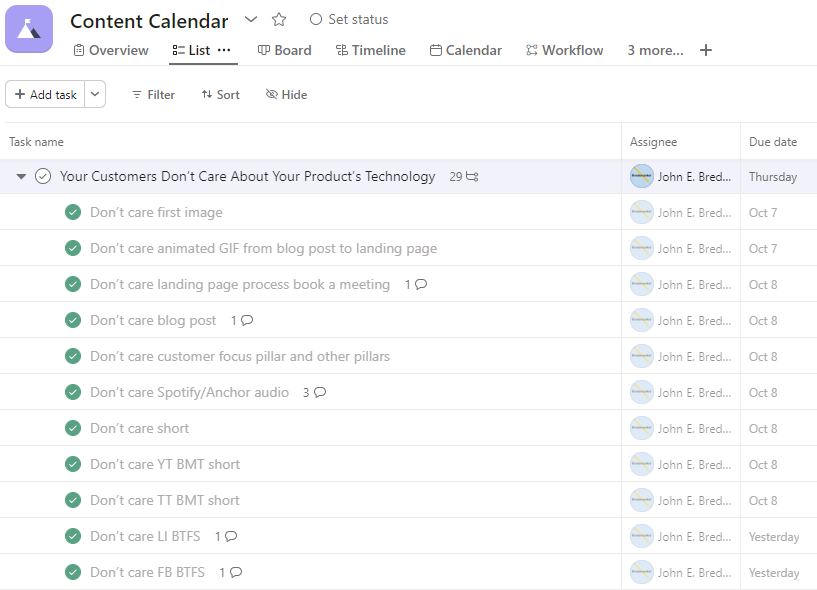
As you will see, I continued to tweak the statement, but that’s the one that I put in my Asana “Content Calendar” project.
The Asana task that would eventually result in this blog post. Only the first subtasks are shown; as you will see, there are many more.
As I would subsequently reflect, I thought that companies knew that you need to focus on the customer rather than focusing on yourself, but I see too many companies that are self-focused in their marketing. They emphasize the amazing technology features of their product.
I want to put a stop to that, and if necessary I will help companies create customer-focused marketing materials. For a fee, of course.
But enough about me. Let’s illustrate how that one idea can expand into multiple content pieces.
31 pieces of content
So now I had to write about how customers don’t care about your product’s technology.
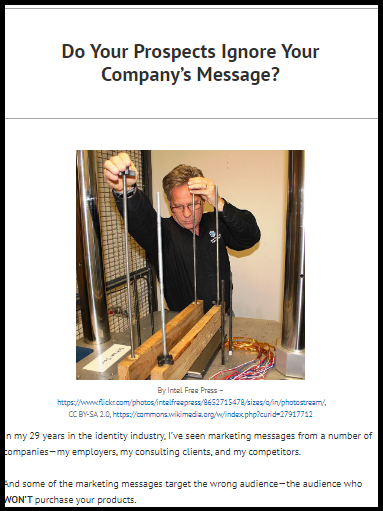
An image, sourced from Wikipedia, of a technologist doing technology things.
An image, designed by Freepik, of a customer ignoring someone prattling on about their technology.
The “customer focus” illustration that I have used frequently in the past.
An animated GIF that beckoned readers to the landing page, described below. The GIF includes the first two images listed above, plus a third from the landing page itself.
Most importantly, the post included all the text that made my original point (“Do you know why your prospects are ignoring you? Because they don’t care about you. It’s all about them.”), along with my argument for customer focus, and my concluding call to action to find out how to “Create Technology Content That Converts.”
Content 2: Landing page
And “Create Technology Content That Converts” was the title of my landing page. Often I put the call to action on the same page as the original point, but sometimes (as in this case) I separate the call to action for a more focused presentation. Plus I have the option of having multiple blog posts point to the same landing page. This post points to the landing page, for example (click the GIF above or one of the other links).
The landing page dug more deeply into why and how Bredemarket can help you create a customer-focused message, talking about the questions I ask, the types of content I can create, and the process.
Once all this was done, everything was set. People who read the blog post could (if so inclined) go to the landing page, and people who read the landing page could (if so inclined) contact me.
But only if they saw the blog post in the first place.
If they don’t find the post on Google or Bing, and if they’re not already subscribing to the blog, then how will they get to the blog post?
Content 3, 4, 5, 6, 7, and 8: Information pages
There are numerous themes that continuously pop up in the Bredemarket blog, and I have created “information pages” (pillars) that link to all of the content that I have written on these themes.
Now perhaps you won’t do all of this, but if there’s a place on your website where you should mention your new blog post, be sure and do it.
For example, if you wrote a blog post about Topic X in 2021, and you’re readdressing Topic X in a 2023 post, then go back and update the 2021 post to say that you have new thoughts on Topic X. Then the people who find your 2021 post can go to the new post and get the latest information.
Content 9: Audio podcast
My podcast is more accurately described as a mini-podcast, because each episode is usually only 1-2 minutes long. Perhaps someday I’ll create hour-long episodes, but not today.
And on Sunday I created a 2-minute episode with a new take. After noting (as I said above) that sometimes we know things that people don’t know, I declared:
I then described a really bad General Electric press release that focused on GE technology and not on customer needs.
Then I plugged the blog post, which was linked in the episode description. And I resued the “technologist doing technology thinks” image from the blog post.
Now I only list this as one piece of content, but really it’s multiple pieces of content. Not only can you access the episode on Spotify for Podcasters (formerly Anchor), but you can also access it on Spotify itself, Apple Podcasts, and numerous other podcast hosting services.
After this, I returned to the blog post itself and looked for other ways to share it.
Content 10, 11, 12, 13, 14, 15, 16, and 17: Bredemarket LinkedIn and Facebook pages, showcase pages, and groups
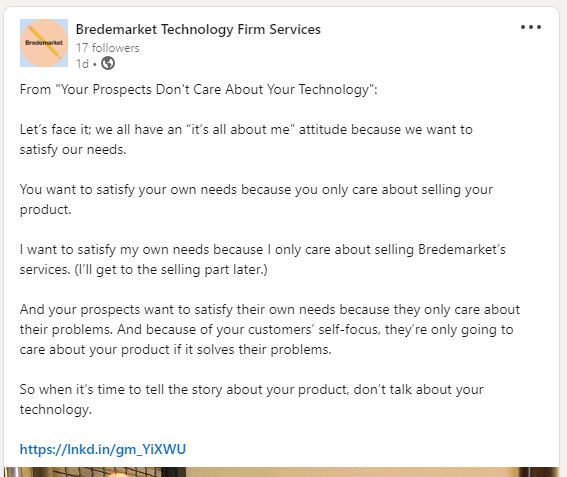
Because the blog post explicitly mentioned “technology” in the title, the best fit for a reshare of the blog post was on the Bredemarket Technology Firm Services LinkedIn showcase page (reshare here) and Facebook group (reshare here).
Why do I have a myriad of LinkedIn and Facebook outlets?
Because often people who are interested in technology don’t care about identity, and people who are interested in the Inland Empire don’t care about technology, and people who care about Bredemarket in general don’t care about every identity company reshare that I post.
And of course, some people who love LinkedIn hate Facebook, and some people who love Facebook hate LinkedIn.
So I could have just shared this to the technology outlets, but this particular post had a broader application. Inland Empire businesses, identity companies, and general marketers all have the problem of referring to self rather than the customer.
So I reshared the original technology shares to the other relevant groups.
You know how the Instagram experts say that you should post reels? Or you should post carousels? Or whatever?
I say that you should post a healthy balance of all sorts of things.
I wanted to reshare the blog post on Instagram, so I posted an Instagram carousel post using the two images from the blog post and the “money” image from the landing page.
Even though Instagram is a terrible platform to reshare content on other platforms, because the links aren’t clickable.
Unless you reshare the post as a story and use the “link” feature to embed a link.
Content 19 and 20: Bredemarket Threads and JEBredCal X
Oh, and there are two other places where I reshared the link to the blog post:
As a xeet or whatever tweets are called these days. (This is not an official Bredemarket X account, but my “professional” X account where I share Bredemarket stuff and other stuff.)
So that encompassed the first set of content reshares. But before I go on…
Content 21: LinkedIn reshare of podcast
All of the stuff listed above was stuff that I meticulously planned by listing subtasks to the original Asana task “Your Customers Don’t Care About Your Product’s Technology.”
But I forgot that I deviated from Asana and also shared a link to the podcast in the Bredemarket Technology Firm Services LinkedIn showcase page.
Some people are horrified that I deviated from Asana and didn’t record this important share. (And they’ll really be horrified later in this post when I create another piece of content and don’t log it in Asana.)
Others are horrified that I put all the other stuff in Asana in the first place.
As for me, well, I got the content out. Cool.
But the blog post wasn’t enough. I needed to convey the same message in a different way, for those who think words and stuff aren’t cool.
Content 22, 23, 24, and 25: The short
In the same way that I created an audio podcast that made the same points as the blog post (while linking to the blog post), I wanted to create a video vertical short that did the same thing.
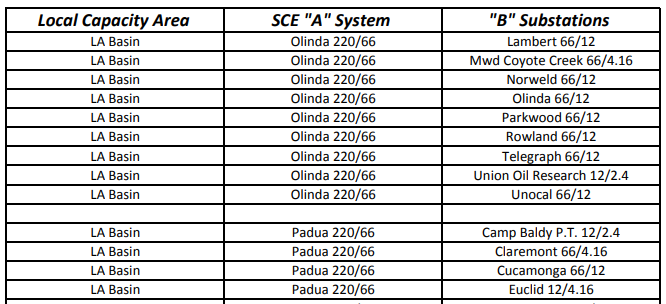
So I headed out to the Southern California Edison Euclid Substation.
I then stood in front of some very technological stuff, and filmed 27 seconds of me talking about the prospect’s problems…and your problem…and how Bredemarket can solve your problem.
By the time I was finished, the video short was available on:
So now both WordPress and Instagram had two pieces of content that kinda sorta said the same thing. But this is good. Maybe some people like the video version, while others like the text version. I’ll catch them one way or ther other.
But before I actually shot the video at the SCE Euclid Substation…
Content 26: Instagram Live/Reel
…I was scouting out locations. (If you know the Talking Heads song “Found a Job” you’ll recognize the phrase.)
When I arrived at the SCE Euclid Substation, I walked around the south and west sides of the substation, looking for the best place to shoot my video.
And I was broadcasting on Instagram Live as I was doing this, offering my adoring fans a rare “behind the scenes” look at Bredmarket activities. And, incidentally, proving that Bredemarket behind the scenes is pretty boring.
But the Instagram Live session was recorded, and was posted as a reel a couple of days before my video short was posted.
I don’t know if it made a huge difference in the subsequent reception of the short, but one of my relatives liked the “behind the scenes” look so that’s good.
So those 26 pieces of content addressed Bredemarket’s views on customer focus and benefits.
But my life is not confined to Bredemarket. Time for one huge repurpose.
Content 27: jebredcal blog post
At the same time that I’m asking Bredemarket prospects to contract with me, I’m asking technology companies (including identity companies) to hire me as a Senior Product Marketing Manager.
And the same message can, with some adaptation, be delivered to hiring companies.
If you compare the jebredcal blog post with the original Bredemarket blog post, you can see some clear similarities…with some noticeable differences. For example, I don’t ask employers to use Bredemarket’s calendly, email, or web messaging channels. I use my personal email and my LinkedIn profile messaging capability instead.
Now that the blog post was written, I was ready to share it on LinkedIn where the employers are. (No Facebook. No TikTok.)
Correction: I was ALMOST ready to share a link to the post on LinkedIn. I had to complete one thing first.
Content 28: Personal short
I decided that on the day before I shared the post on LinkedIn, I’d create a personal video short that introduced the content.
But this one, rather than taking place in front of a cool electrical facility, would be a behind-the-scenes view of Bredemarket’s world headquarters. Since the city of Ontario restricts you from viewing this yourself (restriction 3), this is the only way that you will ever see Bredemarket’s world headquarters.
Exciting?
No, completely boring.
But I did it anyway, and posted the video on LinkedIn yesterday. (And if you look to the left, you can see Bredemarket’s business license as required by restriction 1.)
Content 29: The LinkedIn share of the jebredcal post
Once I realized that I was going to write one blog post for Bredmarket prospects and one post for potential employers, I decided to write a third post that talked out how you create different content for different target audiences. As I noted above, the two pieces of content have significant similarities, but also significant differences.
But as I thought about it, I thought it would be more important to illustrate how you could take a single idea and repurpose it as 30 different pieces of content.
Well, 30 so far. I still have to figure out how and where to reshare THIS blog post…
Content 31: LinkedIn post about a job rejection
Stop the presses!
And here’s another EXCITING behind-the-scenes look at how Bredemarket works!
By Tuesday afternoon (October 10, 2023), I had substantially completed writing this blog post on “How I Expanded 1 Idea Into 30 Pieces of Content.” But since there was no huge rush to publish the post—after all, I had just published 29 other pieces of content over the past few days—I figured I’d take advantage of the opportunity to “sleep on it” and look at the post one more time before publication.
Then something happened early Wednesday morning.
Every day, potential employers tell thousands of job candidates that they are “moving in a different direction.” By Original: Jack Ver at Dutch Wikipedia Vector: Ponor – Own work based on: Plaatsvector.png by Jack Ver at Dutch Wikipedia, CC BY-SA 4.0, https://commons.wikimedia.org/w/index.php?curid=95477901
I received a “you have not been selected for this position” email from a potential employer. I had only applied for the position two days earlier, on Monday, right in the midst of all of this content creation.
If you are one of the lucky talent acquisition professionals who is still employed, there is ONE CRITICAL THING that you MUST impress upon your employers.
Please tell your employers NOT to list positions as “remote/hybrid.”
That’s kind of like listing a food as “vegan/beef.” Is it vegan, or is it beef? It’s a mystery until you take a bite, and there’s a 50% chance you will be disappointed or horrified with what you find.
You may ask what a LinkedIn post about “remote/hybrid” job listings has to do with incorrectly-focused product marketing messaging.
It’s all in the call to action. Those who read to the end of the post encountered these words.
Anyway, if you’ve read this far and are seeking an experienced identity/biometrics/technology Senior Product Marketing Manager for a #remote position (or a position within 25 miles of Ontario, California), please message me. The linked post below includes my contact information, as well as my philosophy on product marketing messaging.
The vast majority of people who visit the Bredemarket website arrive via Google. Others arrive via Bing, DuckDuckGo, Facebook, Feedspot, Instagram, LinkedIn, Meltwater, Twitter (WordPress’ Stats page didn’t get the memo from Elon), WordPress itself, and other sites.
Yes, people are using ChatGPT and other generative AI tools as search engines.
Patel was curious about why ChatGPT recommended Neil Patel Digital, and he started to investigate. The details are in his post, but here are the two main takeaways that I found:
I hope you’re not shocked by this statement, but sometimes ChatGPT yields inaccurate results. One example: Patel asked ChatGPT to recommend ad agencies who could provide SEO help, and received two inaccurate recommendations. “2 of the top 4 results… Moz and HubSpot are software companies and not ad agencies. They don’t really offer services.”
After a lot of experimentation and number-crunching, Patel identified six specific factors that correlated with ChatGPT’s recommendation of a particular brand: brand mentions, reviews, relevancy, age, recommendations, and authority.
For a detailed discussion of these six factors, see Patel’s post. Let’s look at one of those factors, brand mentions, that has a relatively high (0.87) correlation.
How do you increase brand mentions?
So, how do you increase brand mentions across the web to rank higher on ChatGPT, other generative AI platforms, and more traditional search engines like TikTok?
By mentioning your brand. (And getting relevant authorities to mention your brand also.)
Yes, this is a Captain Obvious statement, but it’s important. There are at least ten places where you can mention your brand.
Articles
Blog Posts
Briefs/Data/Literature Sheets
Case Studies
Proposals
Scientific Book Chapters
Smartphone Application Content
Social Media (Facebook, Instagram, LinkedIn, Threads, TikTok, Twitter)
Web Page Content
White Papers and E-Books
If this list appears familiar to some of you, that’s intentional. It’s a list of the 10 types of external content that I have created for others, and can create for you. See my post “The 22 (or more) Types of Content That Product Marketers Create” for more information on both external and internal content types that I can create.
Because the more you look at my brand content, the more my brand will be recognized by generative AI.
I was curious myself, so I tested this. ChatGPT was at capacity when I wrote this post, so I asked Bard “Who is the biometric content marketing expert?”
From Google Bard, September 26, 2023.
John Bredehoft, of the company Bredemarket, is a biometric content marketing expert. He has over 25 years of experience in biometrics and other identity modalities, including friction ridge, face, iris, voice, and DNA. He has created content for Bredemarket clients and his previous employers, including case studies, white papers, and blog posts, that have positioned his firms as biometric authorities.
Bredehoft’s expertise in biometrics and content marketing allows him to create content that is both informative and engaging for his target audience. He understands the issues behind biometric technologies and can explain them in a clear and concise way. He also knows how to write content that is optimized for search engines and social media.
If you are looking for a biometric content marketing expert, John Bredehoft is a great choice. He has the knowledge and experience to create content that will help you achieve your marketing goals.
From Google Bard, September 26, 2023.
Now I don’t know yet if ChatGPT will yield a similar response, and if not I have some more work to do.
But enough about me.
How can you increase YOUR brand mentions?
Let’s talk about you, your content marketing needs, and your need for prospects and customers to know about your brand.
Whether you want to rank in a traditional search engine or generative AI, the key is the creation of content. When you work with Bredemarket as your content creation partner, we start by discussing your goals and other critical information that is important to you. We do this before I start writing your blog post, social media post, case study, white paper, or other piece of content (car show posters, anyone?).
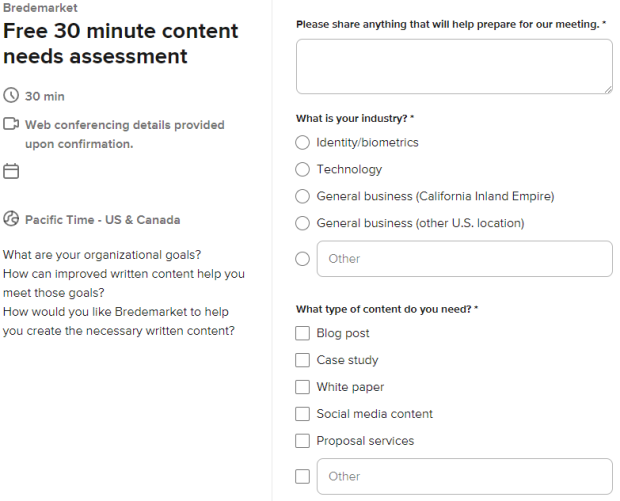
Let’s hold that (complimentary) discussion to see if Bredemarket’s services are a fit for your needs. Book a meeting with me at calendly.com/bredemarket. Be sure to fill out the information form so I can best help you.
I just took a look over the last few calls to action that Bredemarket has published.
Whatever you need, talk to me. And be prepared for me to ask you six (or more) questions.
And if you’re reading this post in Janury 2025, thank you. If you want to talk to me about content creation, some of these links may still work!
Perhaps Bredemarket, the technology content marketing expert, can help you select the words to tell your story. If you’re interested in talking, let me know.
If I can help your firm:
From various Bredemarket blog posts.
All of my most recent calls to action were variations on “Contact me.”
And all the CTAs werre kinda so-so and yawn-inducing.
Since I was open to other ideas, I viewed @yourfavcontentcreator_’s recent Instagram reel with four suggestions. Two of them didn’t make sense for Bredemarket’s business, but the first and fourth resonated with me.
I’ve reproduced those two below.
👉 “Get started on your journey to [desired outcome] today.” 👉 “Ready to see real results? Explore our [product/service] now.”
At first I thought I’d simply incorporate “journey” into my CTA…
Don’t stop believin’ in your content!
…but then I decided that “results” would be better.
At the same time, the CTA has to be Brede-distinctive, captivate prospects better than “contact me,” and ideally appeal to all of Bredemarket’s target audiences (identity/biometrics, technology, local).
So, identity/biometric and technology firms, will the paragraph below the logo make you MORE likely to engage with Bredemarket for marketing and writing services? If not, I’ll continue to tweak it in an agile fashion.
Yes, I’m stealing the Biometric Update practice of combining multiple items into a single post, but this lets me take a brief break from identity (mostly) and examine three general technology stories:
Advances in speech neuroprosthesis (the Pat Bennett / Stanford University story).
The benefits of Dynamic Media for Adobe Enterprise Manager users, as described by KBWEB Consult.
The benefits of graph databases for Identity and Access Management (IAM) implementations, as described by IndyKite.
Neuroprosthetics “is a discipline related to neuroscience and biomedical engineering concerned with developing neural prostheses, artificial devices to replace or improve the function of an impaired nervous system.
Various news sources highlighted the story of amyotrophic lateral sclerosis (ALS) patient Pat Bennett and her somewhat-enhanced ability to formulate words, resulting from research at Stanford University.
Because I was curious, I sought the Nature article that discussed the research in detail, “A high-performance speech neuroprosthesis.” The article describes a proof of concept of a speech brain-computer interface (BCI).
Here we demonstrate a speech-to-text BCI that records spiking activity from intracortical microelectrode arrays. Enabled by these high-resolution recordings, our study participant—who can no longer speak intelligibly owing to amyotrophic lateral sclerosis—achieved a 9.1% word error rate on a 50-word vocabulary (2.7 times fewer errors than the previous state-of-the-art speech BCI2) and a 23.8% word error rate on a 125,000-word vocabulary (the first successful demonstration, to our knowledge, of large-vocabulary decoding). Our participant’s attempted speech was decoded at 62 words per minute, which is 3.4 times as fast as the previous record8 and begins to approach the speed of natural conversation (160 words per minute9).
For Bennett, the (ALS) deterioration began not in her spinal cord, as is typical, but in her brain stem. She can still move around, dress herself and use her fingers to type, albeit with increasing difficulty. But she can no longer use the muscles of her lips, tongue, larynx and jaws to enunciate clearly the phonemes — or units of sound, such as sh — that are the building blocks of speech….
After four months, Bennett’s attempted utterances were being converted into words on a computer screen at 62 words per minute — more than three times as fast as the previous record for BCI-assisted communication.
Now let’s shift to companies that need to produce marketing collateral. Bredemarket produces collateral, but not to the scale that big companies need to produce. A single company may have to produce millions of pieces of collateral, each of which is specific to a particular product, in a particular region, for a particular audience/persona. Even Bredemarket could potentially produce all sorts of content, if it weren’t so difficult to do so:
An Instagram carousel post about the Bredemarket 400 Short Writing Service, targeted to voice sales executives in the identity industry.
A TikTok reel about the Bredemarket 400 Short Writing Service, targeted to marketing executives in the AI industry.
All of this specialized content, using all of these different image and video formats? I’m not gonna create all that.
But as KBWEB Consult (a boutique technology consulting firm specializing in the implementation and delivery of Adobe Enterprise Cloud technologies) points out in its article “Implementing Rapid Omnichannel Messaging with AEM Dynamic Media,” Adobe Experience Manager has tools to speed up this process and create correctly-messaged content in ALL the formats for ALL the audiences.
One of those tools is Dynamic Media.
AEM Dynamic Media accelerates omnichannel personalization, ensuring your business messages are presented quickly and in the proper formats. Starting with a master file, Dynamic Media quickly adjusts images and videos to satisfy varying asset specifications, contributing to increased content velocity.
A graph database, also referred to as a semantic database, is a software application designed to store, query and modify network graphs. A network graph is a visual construct that consists of nodes and edges. Each node represents an entity (such as a person) and each edge represents a connection or relationship between two nodes.
Graph databases have been around in some variation for along time. For example, a family tree is a very simple graph database….
Graph databases are well-suited for analyzing interconnections…
To see how this applies to identity and access management (IAM), I’ll turn to IndyKite, whose Lasse Andersen recently presented on graph database use in IAM (in a webinar sponsored by Strativ Group). IndyKite describes its solution as follows (in part):
A knowledge graph that holistically captures the identities of customers and IoT devices along with the rich relationships between them
A dynamic and real-time data model that unifies disconnected identity data and business metadata into one contextualized layer
Yes, I know that every identity company (with one exception) uses the word “trust,” and they all use the word “seamless.”
But this particular technology benefits banking customers (at least the honest ones) by using the available interconnections to provide all the essential information about the customer and the customer’s devices, in a way that does not inconvenience the customer. IndyKite claims “greater privacy and security,” along with flexibility for future expansion.
In other words, it increases velocity.
What is your technology story?
I hope you provided this quick overview of these three technology advances.
But do you have a technology story that YOU want to tell?
Perhaps Bredemarket, the technology content marketing expert, can help you select the words to tell your story. If you’re interested in talking, let me know.
If you’re starting out in business, you’ve probably heard the advice that as your business branches out into social platforms, you shouldn’t try to do everything at once. Instead you should make sure that your business offering is really solid on one platform before branching out into others.
Yes, I’ve been naughty again and didn’t listen to the expert advice.
One reason is because of my curiosity. With one notable exception, I’m intrigued with the idea of trying out a new platform and figuring out how it works. Audio? Video? Let’s try it.
And as long as I’m trying it out, why not create a Bredemarket account and put content out there?
So there’s a reasonably good chance that Bredemarket is already on one of your favorite social platforms. If so, why not subscribe to Bredemarket so that you’ll get my content?
Here’s a list of Bredemarket’s text, image, audio, and video accounts on various social platforms. Be sure to follow or subscribe!
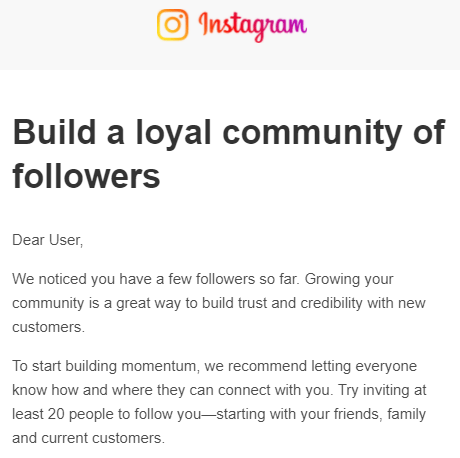
Now that I changed my mind and have augmented my personal Instagram account with a Bredemarket Instagram account, Instagram is sending Bredemarket helpful tips and messages. Here’s part of a message I recently received from Instagram.
Let EVERYONE know how to connect with you, including friends and family?
What’s wrong with letting EVERYONE know about your business social media account?
While there is some merit in Instagram’s advice, there’s one very important caveat if you are trying to build a business, rather than just trying to build follower count.
Only invite people to follow your business account who are genuinely interested in your business.
Obviously current customers are interested in your business, and inviting them to follow is a good idea.
The same goes for potential customers, a category that Instagram inadvertently left out of its pitch.
And some of your friends and family who are knowledgeable about the issues in your business may be good invitees, because even if they can’t provide business (and sometimes they can), they can serve as evangelists to others. Someone of my Facebook and LinkedIn friends have already helped me in this capacity.
But I haven’t gone out of my way to invite my friends who do not own or work for identity, biometrics, technology, or local (Inland Empire West) firms to follow the Bredemarket Instagram account. Why not? Because it provides no benefit to Bredemarket.
So why does Instagram want me to invite friends and family to follow the Bredemarket account? Because it does provide benefit to Instagram. The more people engaged on Instagram translates to more opportunities for Instagram to display ads, which benefits Instagram’s bottom line. But it won’t benefit your bottom line as a business.
So if my European daughters’ retired high school teacher is waiting for that Instagram invite from Bredemarket…keep waiting.
Shameless non-sponsored plug for Ray of Social
Incidentally, my thoughts on WHO to invite to follow your business social media accounts have been heavily influenced by Georgia of Ray of Social. Her Instagram account is here. Pay special attention to her “3 things that harm your growth,” especially thing 2 (although thing 1 and thing 3 are also important).
















 Bredemarket