Creating a Business Page on Facebook for Your Inland Empire Company

There are Inland Empire companies that have an online presence, and companies that don’t.

Yes, the Ontario Convention Center has an online presence, on the web and elsewhere. Picture by Mack Male – originally posted to Flickr as Ontario Convention Center, CC BY-SA 2.0, https://commons.wikimedia.org/w/index.php?curid=9512928

If your Inland Empire company doesn’t have an online presence, one quick way to create one is to create a business page on Facebook.

This post outlines the benefits of establishing an online presence via a Facebook business page. It also provides four examples of Facebook business pages. Finally, the post addresses the thorny question of creating content for your Facebook business page.

Why Faceboook may be the best online presence for your business

For the first time in years, I attended an Ontario IDEA Exchange meeting at AmPac Business Capital on Tuesday afternoon. There was a mixture of attendees: some who had established several businesses, some like me who had run one business for some time, and a few who were just starting out in business.

The ones who were starting out were still trying to figure out all the things you need to do to start a business: figuring out why the business exists in the first place, getting the appropriate business licenses (and in some cases professional licenses), printing business cards (or creating the online equivalent), setting up SOME kind of way to track prospects and customers…and establishing an online presence.

Now some businesses choose to establish their online presence by creating a website.

I believe that this is the best way to establish an online presence since you have more control over the content. Plus, there are several alternative ways to create a business website (I use WordPress, but you can use SquareSpace, Wix, or any of several other website builders).

But even the simplest website can involve a lot of complexity—bredemarket.com currently has 57 pages, not counting tag pages and individual blog post pages.

For many small businesses, it may be much easier to create a Facebook business page then to create an entire website.

  • Facebook business pages are free. (Well, unless you run ads.)
  • Facebook business pages are easy to create.
  • Facebook business pages potentially reach billions of people, including your prospects and customers.

Creating a Facebook business page

So how do you create a Facebook business page?

There’s no need for me to document all of that in detail, since many have already done so.

Starting with Facebook itself.

As long as you have a personal Facebook profile, and as long as you can provide basic information about your business (category, address, areas serviced, email, phone number, website, hours, etc.), you can create a Facebook page from your laptop or desktop computer by following these steps:

  1. From the Pages section, click Create new Page.
  2. Add your Page name and category.
  3. Add your Page’s bio and click Create.
  4. (Optional) Add information, such as Contact, Location and Hours, and click Next.
  5. (Optional) Add profile and cover photos, and edit the action button, and click Next.
  6. (Optional) Invite friends to connect with your Page, and click Next.
  7. Click Done.
From https://www.facebook.com/business/help/473994396650734?id=939256796236247

Don’t worry if you don’t have all the optional items, such as a page cover picture. You can add them later. This will get you going.

Other guides to creating Facebook business pages are available from Buffer (with pictures), Hootsuite (with pictures). Sprout Social (with pictures), and a number of other sources.

But before you create YOUR Facebook business page, let me show you four varied examples of EXISTING Facebook business pages.

Four examples of Facebook business pages

Let’s take a look at some pages that already exist. Perhaps one or more of these will give you ideas for your own page.

The artist page (Paso Artis)

Paso Artis is a European business whose proprietor is a painter who sells her paintings.

The menu options at the bottom of the picture above (some of which cannot be seen) illustrate some of the elements you can include in a Facebook page. Here are just a few of the page elements that Paso Artis uses:

  • Posts. This is the equivalent of a blog on a website, and allows you to post text, images, videos, and other types of content.
  • About. This is where you provide contact and other basic information about your business.
  • Shop. Facebook allows you to include a shop, which Paso Artis uses to sell her paintings.
  • Photos. As you can imagine for an artist’s page, photos of the artwork are essential.

The shirtmaker page (Shirts by Kaytie)

(UPDATE 10/20/2023: Because Shirts by Kaytie is sadly no longer in business, I have removed the, um, live links to her Facebook page.)

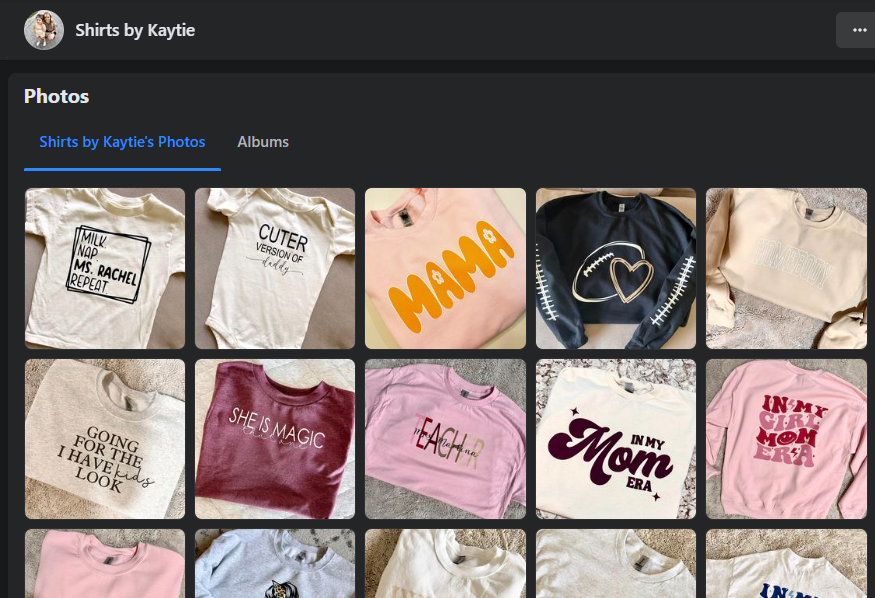
Let’s leave Europe and go to Illinois where we find another artist, but her work is not displayed on paintings, but on shirts. Here is the Shirts by Kaytie Facebook page.

You’ll notice that Shirts by Kaytie has a different menu item order (and different menu items) than Paso Artis. For example, Shirts by Kaytie doesn’t have a Facebook “shop” element; you need to contact her directly to purchase items.

But Shirts by Kaytie certainly has photos.
The marketer/writer page (Bredemarket)

Enough of such exotic locations as Europe and Illinois. Let’s head to California’s Inland Empire and look at my favorite marketing/writing services Facebook page, the Bredemarket Facebook page.
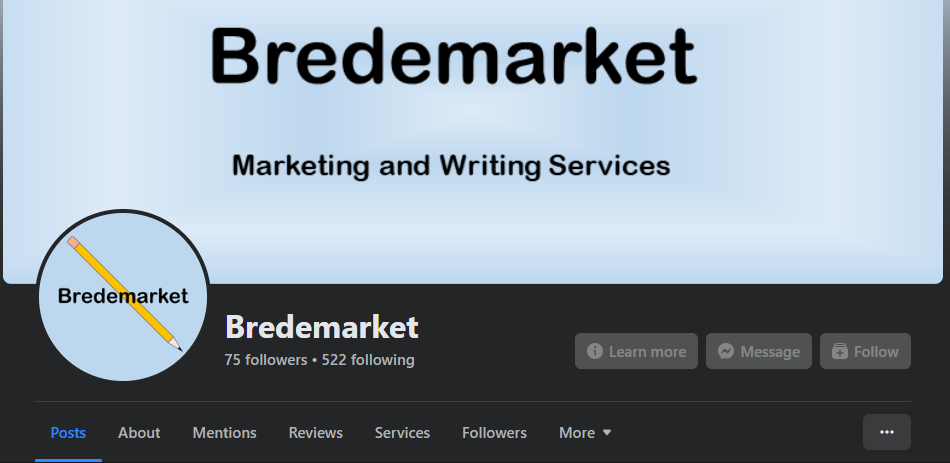
I’d like to point out two things here.

  • First, Bredemarket (unlike Paso Artis and Shirts by Kaytie) provides services rather than tangible products. Therefore, I chose to include a “Services” element as part of my Facebook page.

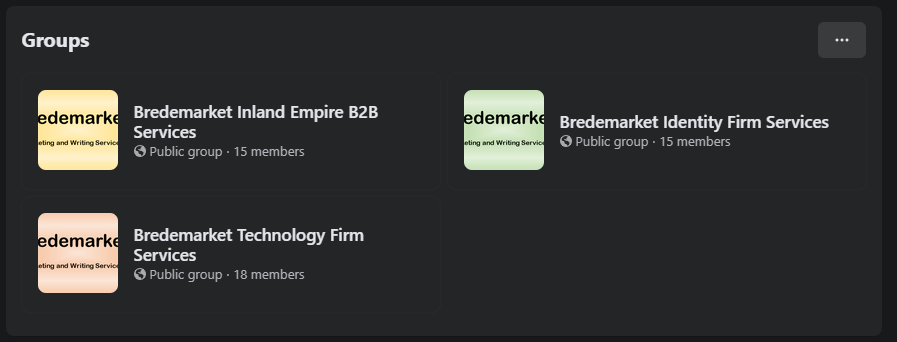
Second, Bredemarket has chosen to implement Facebook’s “groups” feature. In Bredemarket’s case, there are three separate groups that focus on various aspects of Bredemarket’s business. Inland Empire businesses can read the content in the Bredemarket Inland Empire B2B Services group and not get bogged down in out-of-area identity discussions about the change from FRVT to FRTE. (They’re missing out.)
The local technology champion page (Startempire Wire)

I saved the Startempire Wire Facebook page for last because it makes terrific use of Facebook’s capabilities.
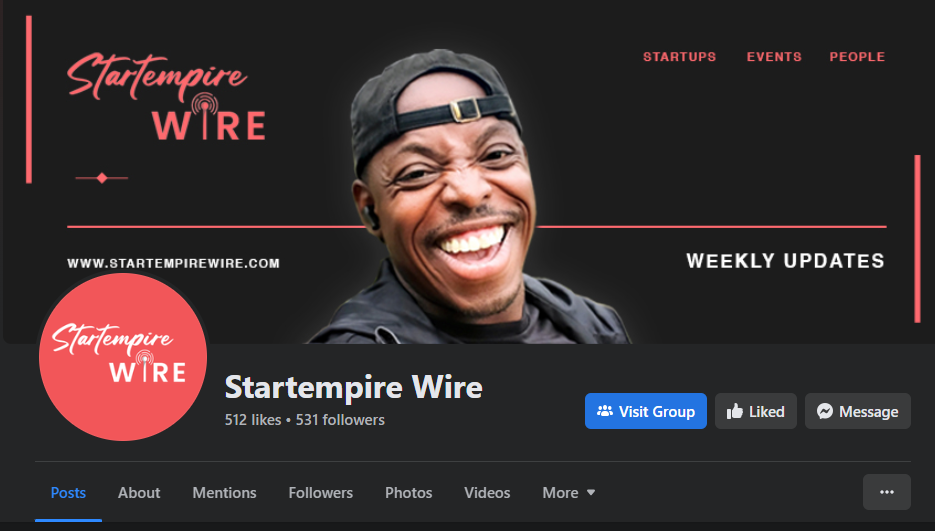
By the way, if you are an Inland Empire business—especially an Inland Empire startup technology business—and you have never heard of Startempire Wire, STOP READING MY POST and go follow Startempire Wire’s Facebook page NOW. Startempire Wire is THE news source for Inland Empire startup tech information, and is a strong champion of the IE tech community.

So what does Startempire Wire’s Facebook page offer? Posts, photos, weekly videos, and the “Inland Empire Startup Scene” group. All of the content is jam-packed with information.

Facebook pages are essential to these firms’ strategies

Now in some cases the Facebook pages are only part of the online presence for these firms. Both Bredemarket and Startempire Wire have their own web pages, and both firms are also active on other online properties such as LinkedIn. (Bredemarket is almost everywhere, but not on Snapchat.) But Facebook is an essential part of the outreach for all four of these firms, allowing them to reach prospects and clients who are only on Facebook and nowhere else.

Perhaps a Facebook page is a perfect solution for YOUR firm’s online presence.

Let’s talk about content

But creating a Facebook page is not enough.

You need to populate it with content, such as images, videos…and posts.

And if your Facebook page doesn’t have any content, it’s useless to your prospects. As I’ve preached for years, an empty page makes your prospects and customers question whether you exist.

Now I’m not saying that you HAVE to update your Facebook page daily, but it’s a good idea to add new content at least once a month.

But what if you aren’t a writer, or don’t have time to write? Do you have to resort to ChatGPT?

Heavens no. (I’ll say more about that later.)

Well, online content creation is where Bredemarket comes in. I help firms create blog posts, Facebook posts, LinkedIn articles, case studies, white papers, and other content (22 different types of content at last count).

Does your product (or company) need these 22 content types?

Let me help you populate your Facebook page (or other online content).

Authorize Bredemarket, Ontario California’s content marketing expert, to help your firm produce words that return results.

Bredemarket logo

Is the Funnel Consideration Phase Quantitative or Qualitative?

From Venn Marketing, “Awareness, Consideration, Conversion: A 4 Minute Intro To Marketing 101.” (Link)

The picture above shows a simple sales funnel example. The second of the three items in the funnel is the “consideration” phase.

  • In that phase, those people who are aware of you can then consider your products and services.
  • If they like what they see, they move on to conversion and hopefully buy your products and services.

But how do prospects in the funnel consideration phase evaluate your offering as opposed to competitor offerings? Is it truly a quantitative and logical process, or is it in reality qualitative and emotional?

Quantitative consideration

For purposes of this post, let’s assume that there are two competing companies, Bredemarket and Debamarket, who are fighting each other for business.

OK, maybe not literally. I have never boxed in my life. By Royal Navy official photographer – http://media.iwm.org.uk/iwm/mediaLib//31/media-31189/large.jpg This photograph A 29806 comes from the collections of the Imperial War Museums., Public Domain, https://commons.wikimedia.org/w/index.php?curid=25124750

Second, let’s assume that Bredemarket and Debamarket offer similar services to their prospects and customers:

  • Blog posts
  • Case studies
  • White papers

Finally, let’s assume that a big government agency (the BGA) has issued a Request for Proposal (RFP) for blog/case study/white paper services, and Bredemarket and Debamarket are the two companies competing for the award.

Source selection

Now I’m not a big-time pre-acquisition consultant like Applied Forensic Services, but I’ve been around long enough to know how pre-acquisition consultants work—especially when working with big government agencies like BGA.

A pre-acquisition consultant will develop a Source Selection Plan (SSP). In competitive procurements such as the one in this example, the SSP will state exactly how proposals will be evaluated, and how the best proposal will be selected.

Here is the U.S. Government’s guidance on Source Selection Plans. (link)

SSPs can be very complex for certain opportunities, and not so complex for others. In all cases, the SSP dictates the evaluation criteria used to select the best vendor.

Michael Ropp of RFP360 has published a very simple example of how a particular group of proposal responses may be evaluated.

The weighted scoring approach breaks down your RFP evaluation criteria and assigns a value to each question or section. For example, your RFP criteria may consider questions of technical expertise, capabilities, data security, HR policies and diversity and sustainability. Weighted scoring prioritizes the criteria that are most important to your business by assigning them a point or percentage value. So your weighted scoring criteria may look like this: 

  • Technical expertise – 25%
  • Capabilities – 40%
  • Data security – 10%
  • HR policies – 10%
  • Diversity and sustainability – 15%
RFP360, “A guide to RFP evaluation criteria: Basics, tips and examples.” (Link)

Individual question evaluation

In most cases the evaluator doesn’t look at the entire technical expertise section and give it a single score. In large RFPs, the technical expertise section may consist of 96 questions (or even 960 questions), each of which is evaluated and fed into the total technical expertise score.

For example, the RFP may include a question such as this one, and the responses from the bidders (Bredemarket and Debamarket) are evaluated.

QuestionBredemarketDebamarket
96. The completed blog post shall include no references to 1960s songs.0.8 points awarded.

While many Bredemarket blog posts comply, “How Remote Work Preserves Your Brain” does not.
1.0 points awarded.

Debamarket fully complies.
Example evaluation of a proposal response to an individual RFP question.

Final quantitative recommendation for award

Now repeat this evaluation method for every RFP question in every RFP category and you end up with a report in which one of the vendors receives more points than the other and is clearly the preferred bidder. Here’s an example from a U.S. Nuclear Regulatory Commission proposal source selection process. (And you can bet that a nuclear agency doesn’t use an evaluation method that is, um, haphazard.)

From U.S. Nuclear Regulatory Commission, “FINAL EVALUATION RECOMMENDATION REPORT FOR
PROPOSALS SUBMITTED UNDER RFP NO. RQ-CIO-01-0290
ENTITLED, “INFRASTRUCTURE SERVICES AND SUPPORT
CONTRACT (ISSC).”” (link)

So what does this example show us? It shows that L-3 Communications/EER received a total score of 83.8, while its closest competitor Logicon only received a score of 80. So EER is the preferred bidder.

So in our example, BGA would evaluate Bredemarket and Debamarket, come up with a number for each bidder, and award the contract to the bidder with the highest evaluation score.

Quantitative recommendation for the little guys

Perhaps people who aren’t big government agencies don’t go to this level of detail, but many prospects who reach the consideration phase use some type of quantitative method.

For example, if the (non-weighted) pros for an item under consideration outnumber the cons, go for it.

“What are Pro and Con Lists?” (link)

Five pros and only three cons. Do it!

All quantative, objective, and straightforward.

If people really evaluate that way.

But is consideration quantitative?

Now of course the discussion above assumes that everyone is a logical being who solely evaluates based on objective criteria.

But even Sages such as myself may deviate from the objective norm. Here’s a story of one time when I did just that.

As I previously mentioned, I had never written a proposal response before I started consulting for Printrak. But I had written a Request for Proposal before I joined Printrak. For a prior employer (located in Monterey Park), I worked with an outside consultant to develop an RFP to help my employer select a vendor for a computer system. The questions posed to the bidders were not complex. Frankly, it was a simple checklist. Does your computer system perform function A? Does it perform function B?

The outside consultant and I sent the final RFP to several computer system providers, and received several proposals in response.

  • A few of the proposals checked every box, saying that they could do anything and everything. We threw those proposals out, because we knew that no one could meet every one of our demanding requirements. (“I can’t trust that response.”)
  • We focused on the proposals that included more realistic responses. (“That respondent really thought about the questions.”)

As you can see, we introduced a qualitative, emotional element into our consideration phase.

According to Kaye Putnam, this is not uncommon.

Qualitative consideration

Humans think that we are very logical when we consider alternatives, and that our consideration processes are logical and quantitative. Putnam has looked into this assertion and says that it’s hogwash. Take a look at this excerpt from Putnam’s first brand psychology secret:

Your brand has to meet people at that emotional level – if you want them to buy. (And I know you do!)  

Findings from several studies support this, but one of the most seminal was outlined in Harvard professor Gerald Zellman’s 2003 book, The Subconscious Mind of the Consumer. Zellman’s research and learnings prompted him to come to the industry-rocking conclusion that, “95 percent of our purchase decision making takes place in the subconscious mind.”

From Kaye Putnam, “7 Brand Psychology Secrets – Revealed!” (link)

But how can the subconscious mind affect quantitative evaluations?

While logic still has to play SOME role in a purchase decision (as Putnam further explains in her first and second brand psychology secrets), a positive or negative predisposition toward a bidder can influence the quantitative scores.

Imagine if the evaluators got together and discussed the Bredmarket and Debamarket responses to question 96, above. The back and forth between the evaluators may sound like this:

  • “OK, we’re up to question 96. That’s a no brainer, because no one would ever put song references in a BGA blog post.”
  • “Yeah, but did you see Bredemarket’s own post that has multiple references to the song ‘Dead Man’s Curve’?”
  • “So what? Bredemarket would never do that when writing for a government agency. That piece was solely for Bredemarket.”
  • “How do you KNOW that Bredemarket would never slip a song reference into a BGA post? You know, I really don’t trust that guy. He wore two different colored shoes to the orals presentation, a brown one and a black one. Someone as slopy as that could do anything, with huge consequences for BGA communications. I’m deducting points from Bredemarket for question 96.”
  • “OK. I think you’re being ridiculous, but if you say so.”

And just like that, your quantitative logical consideration process is exposed as a bunch of subconscious emotional feelings.

How does qualitative consideration affect you?

As you develop your collateral for the consideration phase, you need to go beyond logic (even if you have a Sage predisposition) and speak to the needs and pain points of your prospects.

Yes, pain.

Spock is behaving illogically. Jayenkai, “Pain – Star Trek Remix.” (link)

Here’s a example from my law enforcement automated fingerprint identificaiton system (AFIS) days.

  • If your prospect is a police chief who is sick and tired of burglars ransacking homes and causing problems for the police department, don’t tell your prospect about your AFIS image detail or independent accuracy testing results. After all, 1000 ppi and 99.967 accuracy are only numbers.
  • Provide the police chief with customer-focused benefit statements about how quickly your AFIS will clean up the burglary problem in the town, giving residents peace of mind and the police department less stress.

If you can appeal to those emotions, that police chief will consider you more highly and move on to conversion (purchase).

Can I help?

If your messaging concentrates on things your prospects don’t care about, most of them will ignore you and not shower you with money. Using the wrong words with your customers impacts your livelihood, and may leave you poor and destitute with few possessions.

Remember what I said about pain points? By Unknown author – Library of Congress[1], Public Domain, https://commons.wikimedia.org/w/index.php?curid=6237178

If you need a writer to work with you to ensure that your written content includes the right words that speak directly to your prospects, hire…Debamarket!

Oh wait. Debamarket is fictional.

OK, talk to Bredemarket then.