Last year I wrote about a biscuit and a football, but I wasn’t talking about the snack spread on game day.
Google Gemini.
I was talking about the tools the United States President uses (as Commander-in-Chief) for identity verification to launch a nuclear attack.
But sometimes you have to pass the football. If the President is temporarily or permanently incapacitated in an attack, the Vice President also has a football and a biscuit. Normally the Vice President’s biscuit isn’t activated, but when certain Constitutional criteria are met it becomes operative.
Other than this built-in redundancy, the system assumes one football, one biscuit, and one President.
If you’re a cybersecurity expert, you know this assumption is the assumption of a fool.
It is not impossible to have duplicate functional footballs and duplicate functional biscuits.
And it is not impossible to have duplicate functional Presidents, with identical face, voice, finger, and iris biometrics. Yes, it’s highly unlikely, but it’s not impossible. If the target is important enough, adversaries will spend the money.
Grok.
And most of us will never know the answer to this question, but how do government cybersecurity experts prevent this?
This fact, and other irregularities in the visas and passports of the 9/11 hijackers, directly led to the mandate that the U.S. implement biometric exit…which has been delayed more often than REAL ID.
In theory, enforcement of visa expirations with biometric exit is simple.
If you can tell who has entered a country and who has left a country, then you can identify people who have NOT left the country, but whose visas have expired.
And you can tell entries and exits via biometrics, as long as a person’s biometrics are acquired through the passport and/or visa process.
So if biometric exit had existed in January 2001, then a (theoretically) quick check could show that al-Hazmi had NOT left the United States and was still here on an expired visa. He could have been kicked out of the country and barred from returning, and therefore wouldn’t be on a plane on September 11.
The only problem is that EVERYONE needs to be processed when leaving the country for the system to work. At a minimum, anyone who cannot prove U.S. citizenship would have to have their biometrics captured. Or just make it easy and capture everyone’s biometrics as they leave the United States.
“The coalition—led by the Electronic Frontier Foundation, the American Civil Liberties Union and the Canadian-U.S. cross-border group OpenMedia—contends that capturing images of lawful permanent residents exceeds DHS’s statutory mandate and creates a de-facto travel dossier vulnerable to data breaches.”
Vibe coding is real…and you can do it yourself for free. Since I’m on the Google platform, I used Google Gemini to guide me through the steps.
Specification
I started informally:
Online analysis of the chief biometric news from the last seven days, sorted into finger, face, iris, voice, DNA, and other.
Google then formalized a Product Requirements Prompt for Build Mode for Gemini AI Studio (which I had never used before). It made all the UI choices, which I didn’t change (although I haven’t used green on black since the DOS days).
You are building “Biometric Pulse 2026,” a high-frequency, automated data dashboard and visualization tool.
The Vibe: Minimalist, data-dense, dark mode (matrix-green and stark white accents), 1980s retro-futurist ‘terminal’ aesthetic. High information density with zero clutter. The app must feel intelligent, real-time, and analytical.
2. FUNCTIONAL SPECIFICATIONS
The application is a full-stack automated news and regulation analyzer. It must perform the following tasks without user input:
Phase 1: Data Ingestion (Automation)
Source Strategy: Use a hybrid approach:
Google Search API (Real-time): Schedule a request every 4 hours for the query "biometrics industry news" OR "facial recognition technology" OR "iris scanning update" OR "voice biometrics market" OR "DNA border control policy" OR "biometric regulation". (Grounding is required).
Web Scraper (Targeted): Target specific domain feeds for deeper insights (e.g., BiometricUpdate.com, SecurityInfoWatch, specialized legal/regulatory feeds). If you cannot build the scraper, mock this data with realistic data from the last 7 days.
Date Filtering: Automatically filter all results to only include data from the last 7 calendar days (using the current date dynamically).
Phase 2: AI Classification & Analysis
Categorization: Use Gemini 3 Flash to analyze the title/snippet of every news item and classify it into one or more of these 6 buckets:
The main view is a single-page, real-time updated dashboard.
Component A: The Pulse Feed (Primary View)
A vertically scrolling list of news items.
Items must be chronologically sorted (newest first).
Card Design: Every card must have:
A clear category icon/tag (e.g., [ 👤 FACE ] in bright green).
An automated, one-sentence summary (using Gemini).
The primary source link, relative date (“2 days ago”).
Sentiment analysis tags.
Component B: Filter Terminal (Left Sidebar)
A stack of minimalist buttons for the 6 primary categories.
Show the live “count” of articles found in the last week next to each (e.g., [ 👤 FACE (14) ], [ 🧬 DNA (3) ]).
Clicking a category filters the Pulse Feed instantly.
Component C: “The Weakly Pulse” Chart (Right Sidebar)
A stacked bar chart visualization.
X-Axis: The 6 modalities (Face, Finger, etc.).
Y-Axis: Number of news events reported this week.
Color Code: The bars should show sentiment (e.g., red for surveillance/privacy concern; green for innovation/market growth).
4. TECHNICAL ARCHITECTURE & STACK
Model: Gemini 3 Flash (required for continuous analysis and low latency).
Integration: Google AI Studio Build Mode.
Runtime: Node.js (Vite server for the frontend).
Package Needs:react-query (or simple useEffect for data fetching), chart.js (for the weekly pulse chart), and a minimalist CSS framework or Tailwind (but customized to the dark terminal look).
Deployment: Pre-configure for One-Click deployment to Google Cloud Run.
Use
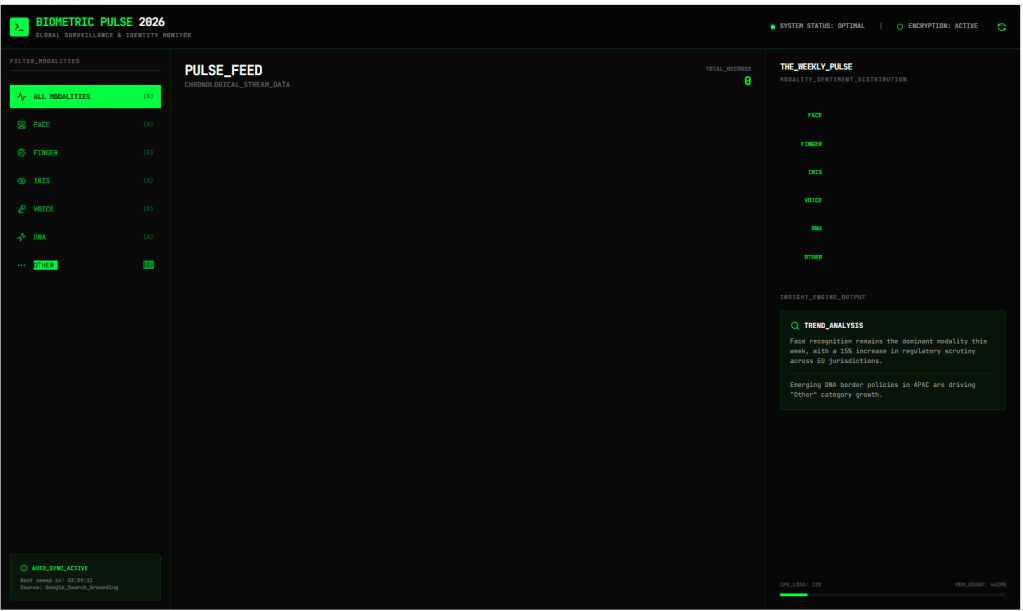
So there it is. I went into Google AI Studio and used Build to build the thing, and without publishing it, I ended up with something that looked like this.
Biometric Pulse 2026, as of the afternoon of March 2, 2026.
It certainly has the retro user interface…but if you look carefully at the data, there isn’t any. I don’t know if I have to wait four hours for the data to auto-refresh, or if I actually have to publish it to have it generate data. Or buy tokens or something.
But if I can get this to actually work, I’ll have proven that you can easily specify simple tasks using modern tools.
“…GenAI enters the Trough of Disillusionment as organizations gain understanding of its potential and limits.
“AI leaders continue to face challenges when it comes to proving GenAI’s value to the business. Despite an average spend of $1.9 million on GenAI initiatives in 2024, less than 30% of AI leaders report their CEOs are happy with AI investment return. Low-maturity organizations have trouble identifying suitable use cases and exhibit unrealistic expectations for initiatives. Mature organizations, meanwhile, struggle to find skilled professionals and instill GenAI literacy.”
It’s easy to toss around phrases like “customer-focused benefits” without comprehending what they mean.
So I’ll provide an example.
Years ago I wanted to learn about a particular company—and no, I’m not going to name the company—so I read what it said about itself. And what did the company’s product marketing say?
“We’re a unicorn!”
Google Gemini.
For the benefit of normal people, when businesses talk about being a unicorn, they are saying that the firm, based upon funding from private investors, has a theoretical valuation of over $1 billion. For example, if Ventures R Us pays $100 million for 10% of the company.
Well, this company was really proud about its unicorn status, to the exclusion of everything else.
With reason, when you think about it.
Taking an example from my own industry, if you are the police chief of a medium sized city that needs an automated biometric identification system, would you risk buying one from a provider with an actual or theoretical valuation of less than $500 million?
Because isn’t company valuation the most important thing to a prospect?
What? It isn’t? Prospects care about results?
(For the record, you can buy a perfectly fine ABIS from firms with actual, not theoretical, values of less than $100 million.)
In fact, I would go so far as to say that if the first sentence of your company description includes the word “Series” followed by a letter from the beginning of the alphabet, your focus is the investment community rather than your prospects.
Google Gemini.
But if the first sentence of your company description talks about what you deliver to your customers, then you’ll impress both your prospects and the discerning investors. Nothing magical about that.














 Bredemarket