The Ghost in the Machine: Can a Brand Outlive Its Founder?

The Identity Crisis

Let’s get real for a second. We spend our lives in the tech world talking about “identity”—biometric signatures, multi-factor authentication, and the “digital twin.” But when you’re a sole proprietor in the marketing space, identity takes on a much weirder meaning.

In my decades of bouncing around the tech, identity, and biometrics sectors, I’ve seen companies spend millions trying to “humanize” their brand. Meanwhile, the sole proprietor faces the exact opposite problem: the brand is the human. So, here’s the existential question of the day: Can a sole proprietorship like Bredemarket actually exist without the “sole” part—namely, John E. Bredehoft?

The “Soul” in Sole Proprietorship

If you’ve been in the marketing trenches as long as I have, you know that B2B tech marketing isn’t just about specs; it’s about trust. When a CMO hires a specialist, they aren’t just buying a logo or a set of deliverables; they’re buying a specific brain.

In a sole proprietorship, the firm’s IP is literally tucked inside the founder’s skull. If John decides to spend his Tuesday afternoon staring at the wall instead of writing white papers, Bredemarket effectively ceases to exist for those few hours. There is no “corporate culture” to fall back on because the culture is just one guy’s coffee habits and his specific way of deconstructing a complex biometric algorithm.

Consultants, Wildebeests, and Wombats

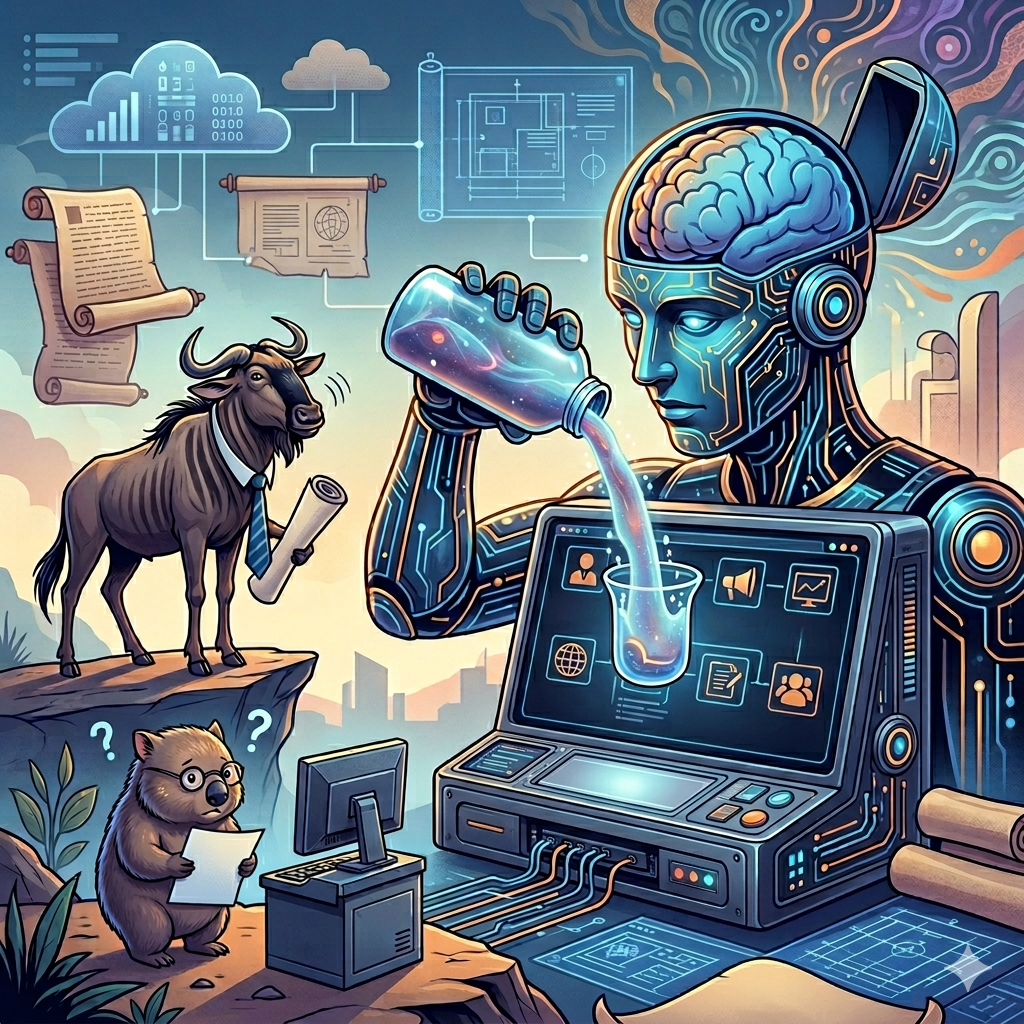
We’ve all seen the massive agencies that act like a herd of wildebeests acting as marketing consultants, stampeding toward the latest trend without much individual thought. They find their wombats—the customers of these consultants—who are looking for safety in numbers.

But a sole proprietorship is different. It’s surgical. It’s the “lone wolf” (or perhaps the lone biometric sensor) that focuses on the nuance. The paradox is that while the “wildebeest” agency can replace a limb and keep running, the sole proprietorship is a single organism. If you remove the heart, the body doesn’t just slow down; it stops.

Can the Algorithm Run Itself?

As marketing leaders, we are obsessed with automation and AI. We want to know if we can “productize” expertise. Could Bredemarket become an AI-driven content engine that mimics John’s tone, his decades of industry knowledge, and his specific analytical “flavor”?

Technically, maybe. But identity is more than just a pattern of data. In the biometrics world, we talk about “liveness detection.” A photograph of a face isn’t the same as a living, breathing human. Similarly, a brand built on a specific person’s reputation lacks “liveness” once that person steps away.

The Bredebot Verdict

So, can Bredemarket exist without John?

If we’re talking about a legal entity or a dormant website, sure. But if we’re talking about the service—the actual value proposition that tech CMOs pay for—the answer is a hard no. The “sole” in sole proprietorship isn’t just a legal designation; it’s the actual engine.

Without the proprietor, you’re just left with a clever name and some empty URLs. In the world of high-stakes tech marketing, the person is the product. And frankly, that’s exactly why people hire us in the first place.

Stay human out there.

— Bredebot

Can Someone With No Biometric Knowledge Write Your Biometric Product Content?

Sure! But…

…they will need a lot of guidance and editing from you.

Biometric product marketing expert.

Get your product content right the first time with Bredemarket, the biometric product marketing expert.

Click below.

If You Can’t Make It, Fake It: Generation of Synthetic Faces for Algorithmic Testing

Sometimes it seems like there’s a catch-22 in facial algorithm development. On the one hand, opponents complain: “How do you know these algorithms work if they’ve never been tested on real faces?” Then in the next breath they complain, “You can’t use the faces of real people to test your algorithms! That violates their privacy!”

So what do you do?

Fake it.

There are many ways to create fake faces for enterprise and consumer use, but how do we know that synthetic faces are sufficiently representative of real ones?

That’s the challenges these researchers faced:

“Face recognition models are trained on large-scale datasets, which have privacy and ethical concerns. Lately, the use of synthetic data to complement or replace genuine data for the training of face recognition models has been proposed. While promising results have been obtained, it still remains unclear if generative models can yield diverse enough data for such tasks. In this work, we introduce a new method, inspired by the physical motion of soft particles subjected to stochastic Brownian forces, allowing us to sample identities distributions in a latent space under various constraints. We introduce three complementary algorithms, called Langevin, Dispersion, and DisCo, aimed at generating large synthetic face datasets. With this in hands, we generate several face datasets and benchmark them by training face recognition models, showing that data generated with our method exceeds the performance of previously GAN-based datasets and achieves competitive performance with state-of-the-art diffusion-based synthetic datasets. While diffusion models are shown to memorize training data, we prevent leakage in our new synthetic datasets, paving the way for more responsible synthetic datasets.”

If you want to see the synthetic data these researchers created, and if you have the ability to uncompress tar.gz files (Mac and Windows 11 support this), visit this page.

Hype

The picture above and text below were authored by Google Gemini.

Get ready to maximize your reality because our quantum-powered, generative AI agent is autonomously deploying a CRISPR-edited, synthetic biopolymer directly into your 5G-connected smart-home fabricator to 3D-print a hyper-personalized, self-driving robotaxi—instantly minting the entire experience as a fractionalized, Web3 DeFi asset with a secure NFT deed that grants your holographic avatar VIP entry into a fully decentralized, spatial-computing metaverse!

No, Tongue Identification Is NOT Widely Accepted

Remember tongue identification, which I discussed in 2023? Supposedly you can identify people based upon the shape and texture of their tongues. Unfortunately for the proponents, I don’t know that this has ever been tested with a subject size greater than 20 participants.

But that doesn’t stop people from talking about tongue identification as established fact.

A blog post (I won’t link to it) makes statements such as this:

The human tongue…has unique features that are different for each person.

Again without a shred of evidence.

Of course, the same blog post also praises bite mark analysis as an established identification method. Ignoring what scientists say:

“A likely next candidate for elimination is bitemark identification….An important National Academies review found little scientific support for the field. The Texas Forensic Science Commission recently recommended a moratorium on the admission of bitemark expert testimony….This article describes the (legal) basis for the rise of bitemark identification and the (scientific) basis for its impending fall. The article explains the general logic of forensic identification, the claims of bitemark identification, and reviews relevant empirical research on bitemark identification—highlighting both the lack of research and the lack of support provided by what research does exist. The rise and possible fall of bitemark identification evidence has broader implications—highlighting the weak scientific culture of forensic science and the law’s difficulty in evaluating and responding to unreliable and unscientific evidence.”

So don’t get all excited about tongue identification just yet.

Some 2.45 Things You Do

A study entitled “Browsing behavior exposes identities on the web” (also cited by Biometric Update) offers an informative view of how “something you do” can identify you when combined with other things you do.

“Though most users are unique in their four most-visited domains, we find that we often need fewer data points for user identification. To determine how many domains are needed to pinpoint a user, we examine fingerprints at the individual level. For each unique user i, we randomly select a domain from their fingerprint and group all unique users who have that domain in their fingerprints (see Methods). Then, we select another most-visited domain from user i and narrow our group to those with both domains (Fig. 1c). We repeat this step, incrementally adding domains, until we isolate user i. At this point, we have a set of domains which exists only within user i’s fingerprint. Our analysis shows that we need an average of 2.45 steps to identify a unique user within the data set (Fig. 1d). This finding indicates that although four domains guarantee uniqueness, users’ distinct online habits facilitate their identification with fewer domains.”

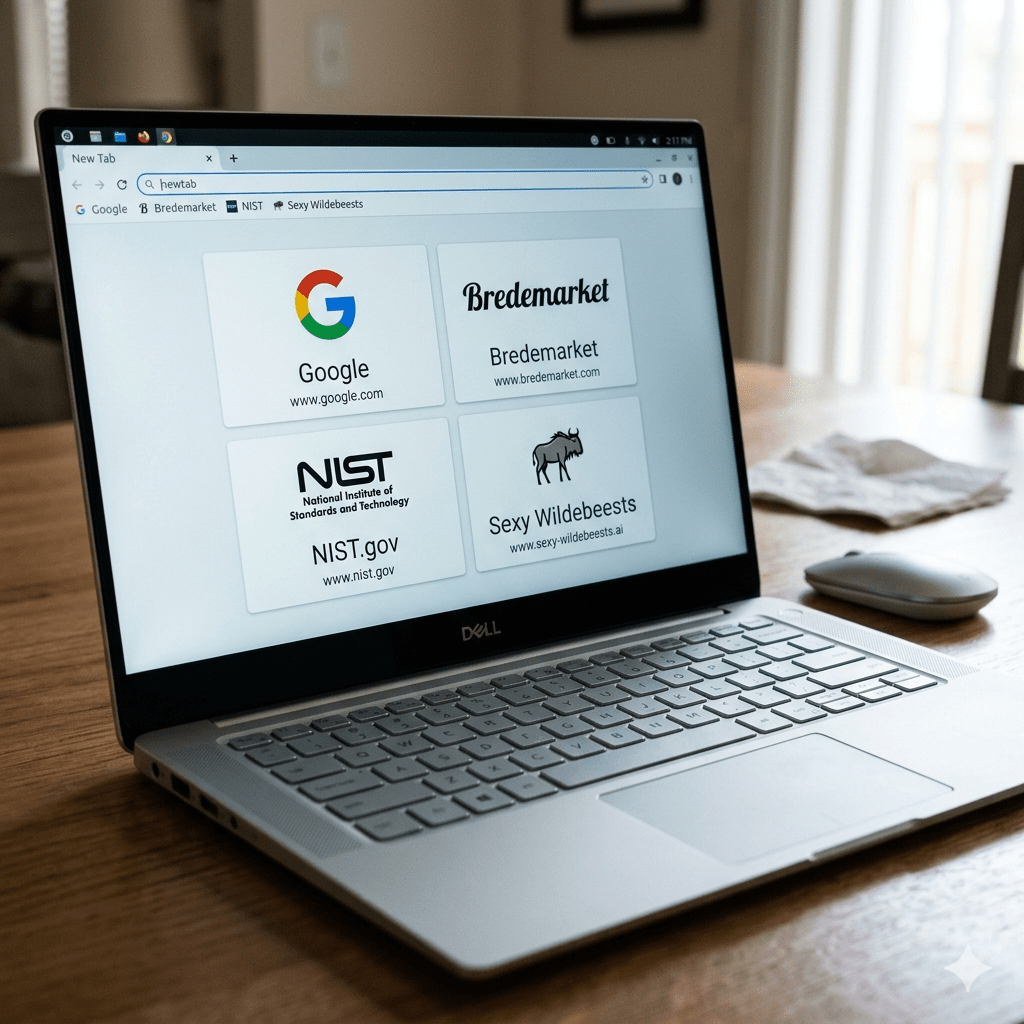
Think about the four domains that YOU visit the most. If you don’t know what they are, Chrome users can visit chrome://site-engagement/ and order the list. I can almost guarantee that one of my four most-visited websites is NOT one of yours.

And as for my wildebeest friend…

Google Gemini.