When I asked Google Lyria to create the first of my two World Cup songs, the result was in Spanish.
Which gave me an idea. And impressed on me that I may never use a standalone translation app again.
Because if I want Uzbeks to promote Bredemarket, it helps them if I (or more accurately my bot) create content.
Because I am the Uzbek sales enablement content marketing expert.
Muvaffaqiyat kaliti. Google Lyria. Public Domain.
What does it mean? Unless Gemini is lying to me, “The Key to Success.”
(Yor-yor-ey…) Bredemarket!
New horizons in the U.S. market,
Your brand will shine, blooming like flowers.
Strategic writing, powerful marketing,
A brand new targeting for your business.
The key to success, Bredemarket!
The key to your business, Bredemarket!
Gemini appears to be interpreting the prompt from a regional perspective. I don’t normally use “new horizons” and “blooming like flowers” to promote my services to Bay Area, San Diego, or New York firms.
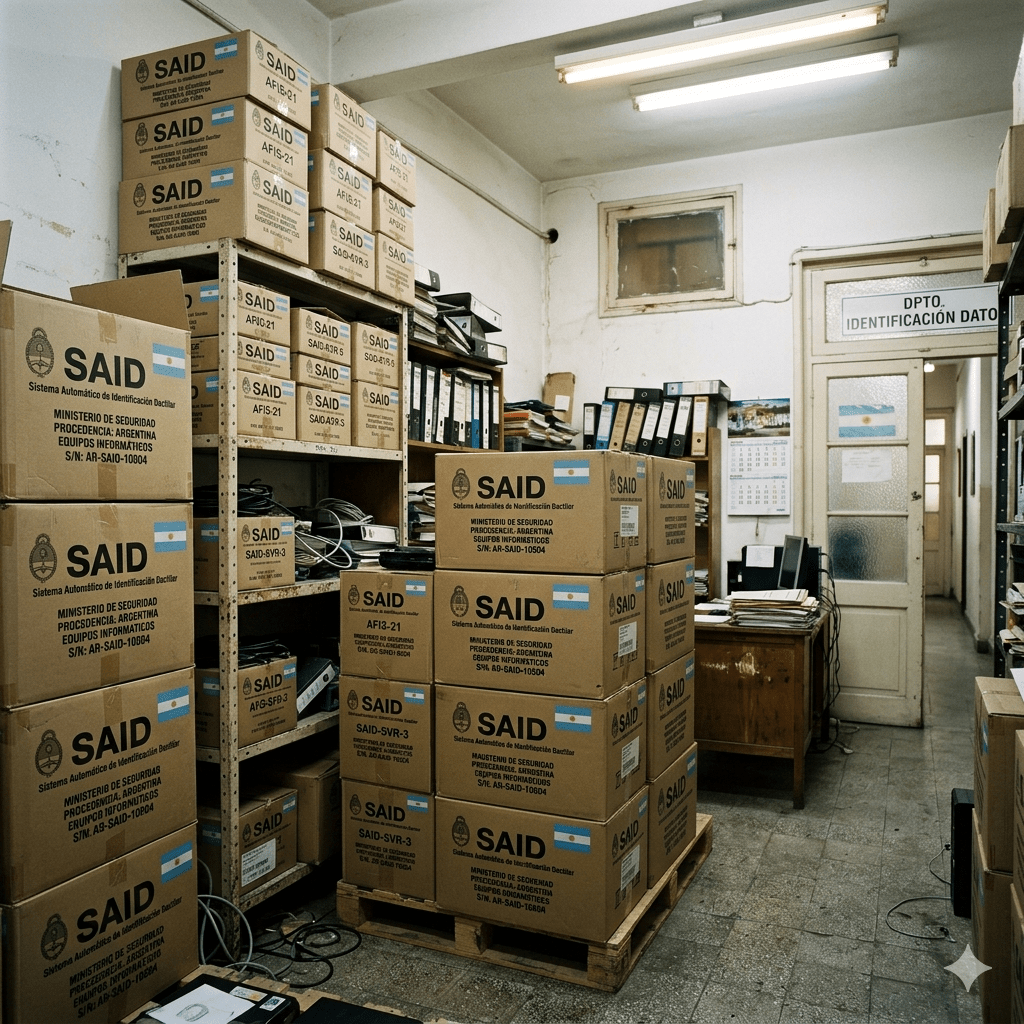
The impressive AFIS purchased in 1998 but never implemented
I was a Printrak employee in 1998 when we signed a huge (for us) contract for US$45 million. We were a subcontractor to Siemens Nixdorf, but since the contract was for a national Automated Fingerprint Identification System, and Printrak built and sold Automated Fingerprint Identification Systems, our portion of the contract was substantial. Well, seemingly substantial; we’ll get to that.
And because Printrak was a publicly traded company (with the ticker symbol AFIS), I was certain the investor community would love this.
It didn’t. I recall that our stock price actually went down the day of the announcement.
But the system was still impressive. In those days most AFIS were law enforcement systems, although there were tentative efforts to use fingerperints for welfare benefits distribution. The Siemens-Printrak system for Argentina was something else entirely.
“When citizens enroll for a new ID card–the country already has an identification system–their fingerprints will be taken on paper, then scanned digitally and added to a massive database. They will then be issued a card with a bar code that will access their prints. These cards, available to all Argentine citizens, will be used to confirm their identity when they apply for jobs, school, immigration status and voting.”
Too bad it was never built.
Google Gemini.
The first issue: the cost
Part of the reason that the system was never built was because of a change of governments in Argentina. As later reported by the U.S. Department of Justice (I’ll say why DOJ got involved in a minute):
“In May 1999, according to the indictment, the Argentine government suspended the DNI [Documentos Nacionales de Identidad] project, due in part to instability in the local economy and an impending presidential election.”
A new government took power in that election, headed by Fernando de la Rúa. This new administration questioned the US$1 billion cost. (Printrak’s portion of the project was relatively small.) Eventually in May 2001 the entire project was terminated.
By that time Printrak was no longer an independent company, having been acquired by Motorola in 2000. But the people who didn’t buy Printrak stock in 1998 made the right decision.
They definitely did.
The second issue: the massive bribery scheme
This is out of scope for this particular Bredemarket post, which concentrates on companies that buy things and don’t use them, but there was an even bigger problem with the Siemens project. It turns out that Siemens officials paid more in bribes to Argentine officials (US$100 million) than the amount that Printrak was supposed to get (US$45 million).
“[D]uring the bidding and implementation phases of the project, the defendants and their co-conspirators caused Siemens to commit to paying nearly $100 million in bribes to sitting officials of the Argentine government, members of the opposition party and candidates for office who were likely to come to power during the performance of the project.”
(After the change in government) “members of the conspiracy allegedly committed Siemens to paying additional bribes to the incoming officials and to satisfying existing obligations to officials of the outgoing administration, many of whom remained in influential positions within the government.”
“When the project was terminated in May 2001, members of the conspiracy allegedly responded with a multi-faceted strategy to overcome the termination. According to the indictment, the conspirators sought to recover the anticipated proceeds of the DNI project, notwithstanding the termination, by causing Siemens AG to file a fraudulent arbitration claim against the Republic of Argentina in Washington, D.C. The claim alleged wrongful termination of the contract for the DNI project and demanded nearly $500 million in lost profits and expenses.”
“In four installments between 2002 and 2007, members of the conspiracy allegedly caused Siemens to pay approximately $28 million in further satisfaction of the obligations.”
This was not known until about a decade later, after guilty pleas in 2008 from Siemens and its Argentina subsidiary regarding criminal violations of the Foreign Corrupt Practice Act (the fraudulent arbitration claim), the 2011 indictment of eight former executives and agents of Siemens, the convictions of three of them (Truppel, Reichert, and Bock), and a civil settlement with a fourth (Sharef). The other four avoided setting foot in a U.S. courtroom because of extradition issues.
And all this took a long time. Reichert’s conviction occurred 20 years after the initial award.
But I seem to have strayed from my original topic.
When companies buy something but people never implement it
Forget everything I just said. For purposes of this post, the Argentine government spent a billion dollars on a system, and decided a few months later to not implement it.
This happens all too often. A company buys something and then says “nah.” Sometimes the company still has to pay for the product even though it never implemented it.
Why don’t companies buy something they paid for? I easily identified five fatal issues.
Issue 1: They bought it by mistake
In 2015 my then-employer MorphoTrak went through some significant transitions. One affected me personally: I moved out of proposals into strategic/product marketing. The others tangentially affected me, as two of my marketing superiors were informed that their services to MorphoTrak would no longer be needed after several months, and another marketing expert left a competitor and joined MorphoTrak.
At the time MorphoTrak had an annual contract with a services company. I won’t name the company, but when you put a heat source next to a block of ice, something happens. This annual contract had an auto-renew policy, and the company informed the known officials that this auto-renew was coming.
The known officials being the two marketing superiors who had already left MorphoTrak, and therefore never responded to the hot ice company.
Neither I nor the new executive from the competitor knew about the auto-renew policy. By the time I contacted the company and said we didn’t want to renew, the company icily informed me, “You already did.”
So I immediately cancelled the contract, ensuring that it wouldn’t auto renew a year later. And even though we were paying for nearly a year of the services, I never used them.
Issue 2: The users didn’t care what the company mandated
In theory, large organizations have a defined process for deciding which products to adopt, and which to not adopt.
For example (and this is based upon a real situation albeit anonymous), a company may mandate that all employees use Asana to track projects. The company buys a corporate Asana license covering all employees.
So an employee starts a project and tells the team that the work will be tracked in Asana.
The decision is not universally accepted.
“Asana sucks! Monday is much better!”
“I’m tracking all my stuff in Trello, and I’m not going to change platforms just for your dumb project!”
“Five years ago we used Microsoft Project for everything, I still use it, and the VP of Product loves my reports. If we don’t use Project she’ll ignore our work.”
“Why are you idiots using project management software? You can do this in Microsoft Excel. Just look at this-“
“A Redmond slave? You can do this in Google Sheets!”
“Can’t we just take care of this via email?”
Google Gemini.
So the Asana license sits unused as the project people use other means. Some already paid for by the company. Some via free versions. And some via purchases that their managers habitually approve.
Issue 3: No benefit to the employee
When decisions flow down, resistance flows up.
Let’s say management needs information about the work habits of hourly employees. Management wants this so they don’t overpay employees.
So management mandates a time clock system. When employees arrive at work they clock in. When they leave they clock out.
What benefit does this provide the employee? For some employees it actually hurts them. Jim the employee who habitually arrives at 8:05, or Grace the employee who habitually leaves at 4:55, actually lose from this new product.
Until Jim and Grace get together and start thinking.
When Grace arrives, she clocks in both herself and Jim before 8.
When Jim leaves, he clocks out both himself and Grace after 5.
Google Gemini.
And now you know why we have biometric time clocks.
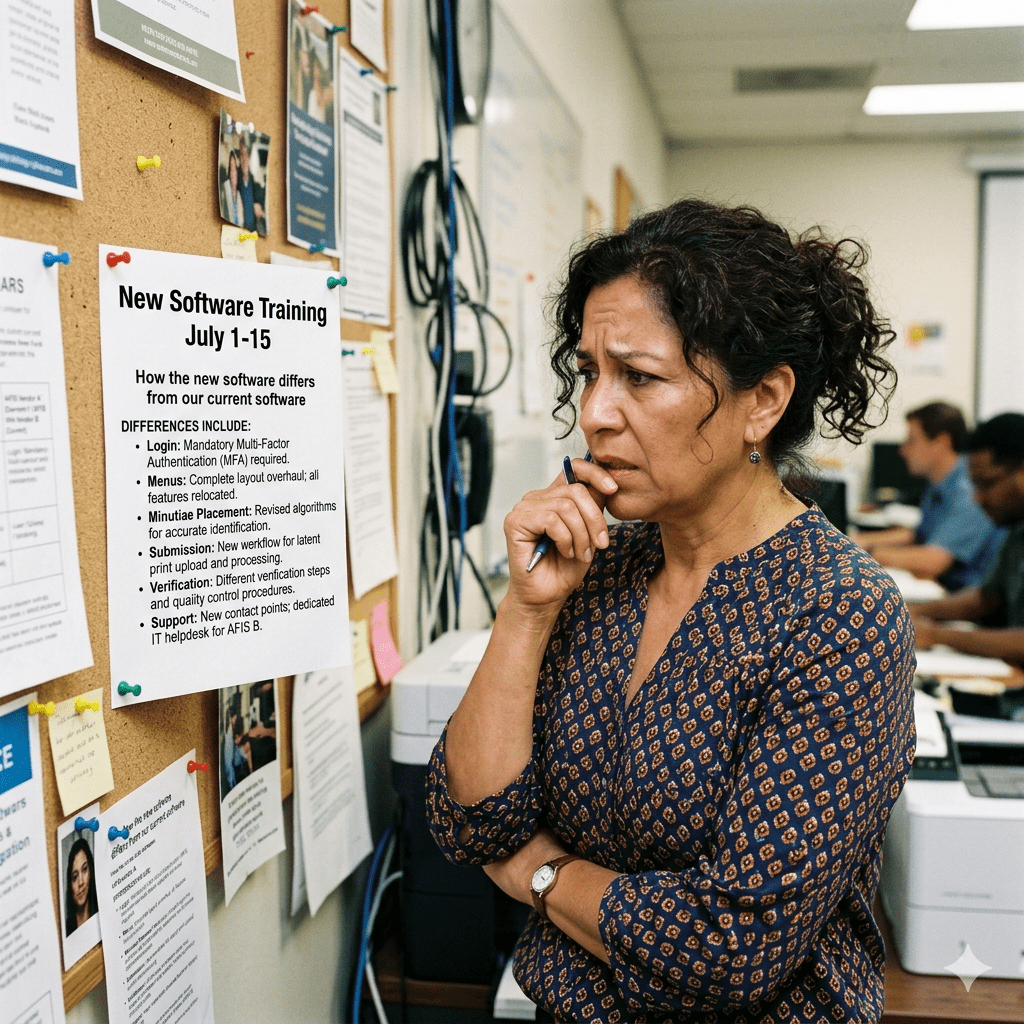
Monica had been a latent examiner for 30 years when her boss made the announcement that the company had awarded the latest AFIS bid to NEC.
Which meant that Monica would no longer use the IDEMIA software. Successor to the MorphoTrak software. Successor to the Motorola software. Successor to the Printrak software.
Google Gemini.
Monica was then informed that mandatory training would take place in three months. Including how to place minutiae in the new system.
She muttered under her breath, saddened that she couldn’t retire in the next three months and avoid putting up with this nonsense.
Issue 5: Leadership doesn’t care about the new tool
But before Monica could stew over that, she received an urgent email from her boss.
“How many hours did you work last week?”
“45. I already entered them in Workday.”
Thankfully, Monica’s employer didn’t use time and attendance machines. You just entered your hours into the official corporate application, in this case Workday.
The boss then sent a follow-up.
“In the future, please send your hours to me via email.”
When leadership mandates a particular process (in this case to enter hours in Workday), but leadership itself doesn’t follow the process, employees get the message.
How do you get people to use mandated and purchased products?
I recently had a conversation with a services company that provides its services to secondary companies. In some cases, the company even donates the necessary hardware and software to the secondary companies.
Having no idea whether the secondary company will even use the donation, or let it gather dust.
For project success, you want adoption. Champions who will encourage others to use your product. Steps to remove roadblocks to using the product.
Internal go-to-market
This is why the best go-to-market projects have both an external AND an internal component.
Externally, the company has to convince prospects that the new product meets their needs and provides real benefits.
Internally, the company has to enable sales by explaining why the new product is important, how the prospects will benefit from it, and how sales itself will benefit by learning how to sell it.
If your go-to-market doesn’t address internal stakeholders, then they won’t learn how to sell or support your product, and the product willl fail.
Do you want your employees to push your new product? Bredemarket will apply its product marketing expertise to plan and provide both external and internal collateral for a go-to-market plan. Let’s talk about your needs and the possibilities.
Whenever product marketers create materials for others—whether for external or internal audiences—they need a feedback loop to ensure the audiences can, and will, use the materials.
Google Gemini.
Those who know me know that I am drawn to complexity like a moth to a candle, and constantly have to resist the urge to detail.
My draft 0.5s that go through severe cutting before anyone sees draft 1.0.
My Incode team’s 80+ “battlecards” that were four pages long.
Regarding the latter, I should have learned the lesson from my MorphoTrak days. I was creating sales playbooks for one of our products that were much more than four pages long. Detailed playbooks that went into detail about the product, the market, the competitors, and everything else.
Sales did NOT like them. I was told the truth about HOW salespeople would use these playbooks.
“I will glance at your playbook five minutes before meeting with a prospect.”
I could wish upon a star that the salespeople would spend four hours in intense study, but just because I wish for it doesn’t mean it is going to happen.
Now I wish…that my Incode battlecards had been shorter.
One: You save money. Why spend hundreds or thousands of dollars on go-to-market or sales enablement materials? Let your competitors incur those costs.
Two: You save time. The best product marketing initiatives occur in a joint process between the marketing leader and the product marketing consultant. But this requires commitment on your part: in initial project definition, draft review, and final publication.
Three: You save trouble. If your product marketing content has an effective call to action, there is the danger that a prospect may act on it, creating more work for your sales organization.
You can save money, time, and trouble by your silence. Let your competitors bear the burden of defining your product to your prospects. They will be more than happy to do so.
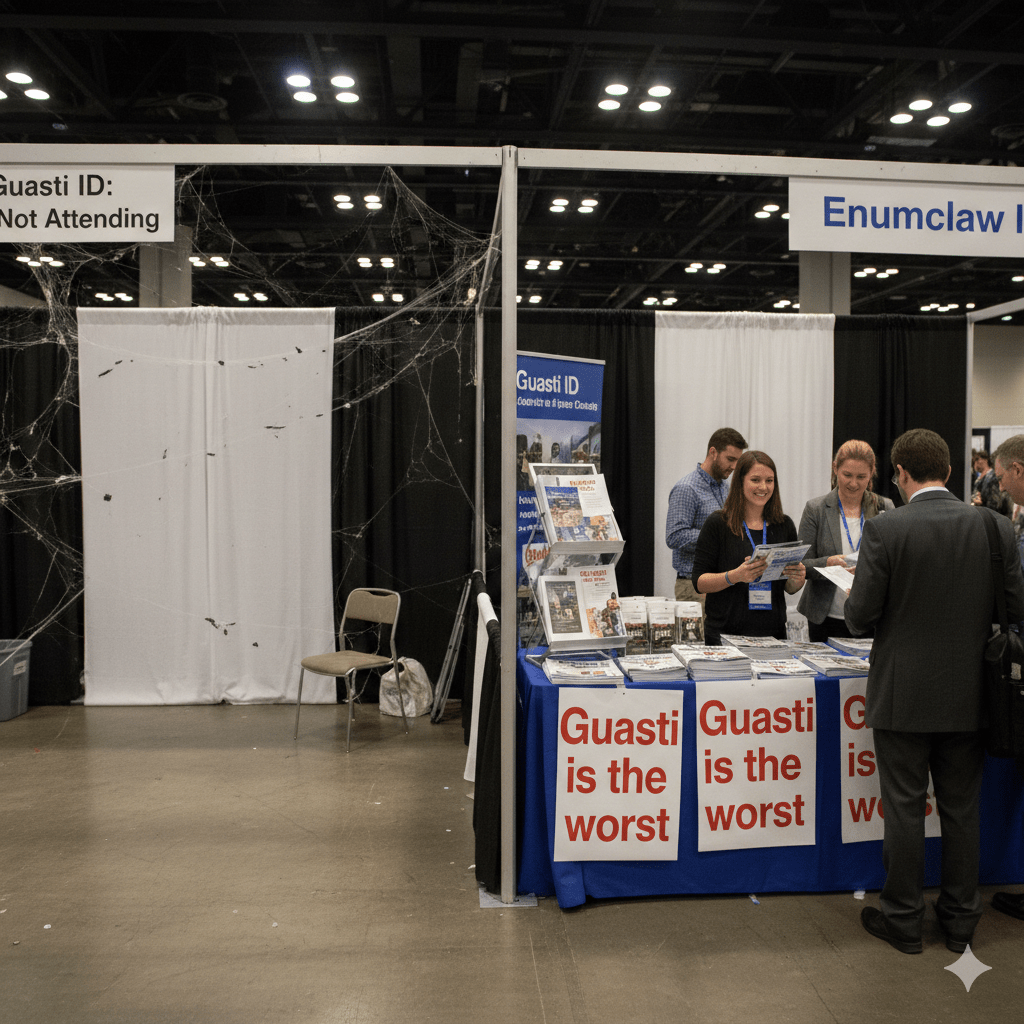
Identity/biometric marketing leaders have a lot on their hands, and the last thing they need is more work. Even if you outsource your product marketing, you must manage the resources.
Rather than do this yourself, why not let your competitors do it?
Imgflip.
If your competitors market your identity/biometric product…
One: You save money. Why spend hundreds or thousands of dollars on go-to-market or sales enablement materials? Let your competitors incur those costs.
Two: You save time. The best product marketing initiatives occur in a joint process between the marketing leader and the product marketing consultant. But this requires commitment on your part: in initial project definition, draft review, and final publication.
Three: You save trouble. If your product marketing content has an effective call to action, there is the danger that a prospect may act on it, creating more work for your sales organization.
You can save money, time, and trouble by your silence. Let your competitors bear the burden of defining your product to your prospects. They will be more than happy to do so.
In fact, you should strongly encourage your competitors to contact Bredemarket about their identity/biometric product marketing needs. Bredemarket will make your competitors spend money and stay busy during and after content creation.








 Bredemarket