Why “Cheers” is an Anachronism

Privacy?

Let’s travel back to 1969 to the Beacon Hill neighborhood in Boston, Massachusetts. In that year and place, a bar started with the name the Bull & Finch Pub. It was popular with the locals, so much so that in 1982 the Bull & Finch Pub was named the “Best Neighborhood Bar” by Boston Magazine.

But something else happened in 1982 that would change the Bull & Finch Pub forever.

Charleses in charge

It turns out that Glen Charles, Les Charles, and James Burrows, the producers of a television show in development, needed an authentic setting and ended up in Boston scouting out locations (we’ll return to that).

“After visiting other Boston bars, they returned to the Bull & Finch and declared, ‘This is the place.’ An American television classic was born, and they would name it Cheers. The TV show premiered on September 30, 1982, and remains one of America’s most beloved situation comedies of all time.”

After the show ended, life imitated art and the Bull & Finch Pub was renamed Cheers Beacon Hill. That was the name it bore when I visited Boston in July 2006 for that year’s International Association for Identification conference.

From Facebook.

But I’m not going to talk about that.

I’m going to talk about the song.

Where everybody knows your name

TV shows need to have theme songs, and “Cheers” was no exception. Charles, Charles, and Burrows turned to a New York songwriting team, Gary Portnoy and Judy Hart-Angelo (known for “People Like Us” for the musical Preppies). After several attempts, the duo came up with a song, and Portnoy recorded the vocal demo to guide whatever big-name singer the producers selected to perform the real song. The producers selected…Gary Portnoy.

So for 11 years (and afterwards in syndication) we heard Portnoy’s voice at the beginning of every episode.

The name of the song?

Where Everybody Knows Your Name.”

“Cheers” season 1 intro.

Say what?

When you read that song title, remember two things;

  • The song was written in 1982, not 2006 or 2026. Today, if someone says “when everybody know your name,” we immediately think of the surveillance state where everybody knows you name, your mother’s maiden name, and the name of your favorite pet.
  • The show was nostalgic, drawing upon the 19th century style illustrations in the show intro (even though the inspiring bar was founded in 1969). The neighborhood feel reminded us of a small community where everybody DID know your name.
Norm!

Was society like this in 1982? Not really. We had spent decades in the anonymity of big cities where we often didn’t know our neighbors.

And the surveillance state we face today was already in existence in 1982. The same band that wrote a song about Bob and Judy “scouting out locations” wrote another song (“Life During Wartine”) with the line “we’re tapping phone lines.”

We know that that ain’t allowed. (4:06)

So even in 1982, “Cheers” and its theme song were a fictional anachronism divorced from reality. The only reason that everybody knew our names was because our privacy had long since been compromised.

And one more thing; THIS song is NOT the one from “Preppies.”

John Goodman in “True Stories.”

And Virgil, Texas is another fictional anachronism, giving Talking Heads a hat trick (cowboy hat) in this post.

Toxic Positivity Did Not Exist in the 1970s, But Temporary Layoffs Did

Most people remember the 1970s television show “Good Times” for its overuse of the word “Dynomite!”

I remember it for its theme song, and one line in particular.

“Good Times” was a Norman Lear show (although Eric Monte and “George Jefferson’s first son” Mike Evans actually created it), and as such it wasn’t always traditional or pleasant. It wasn’t traditional because it depicted an African-American two-parent family, something that had never been done before. (The Cosby Show came much later.) It wasn’t pleasant because it dealt with then-controversial subject matter.

Including unemployment.

Which brings me to the line in the theme song:

“Temporary layoffs

GOOD TIMES!”

Good Times.

Yet this was NOT an early example of 21st century toxic positivity, James, Florida, J.J., and the rest didn’t run around manifesting positive vibes. They KNEW that life in Cabrini Green sucked, but they moved onward; maybe not “moving on up,” but onward.

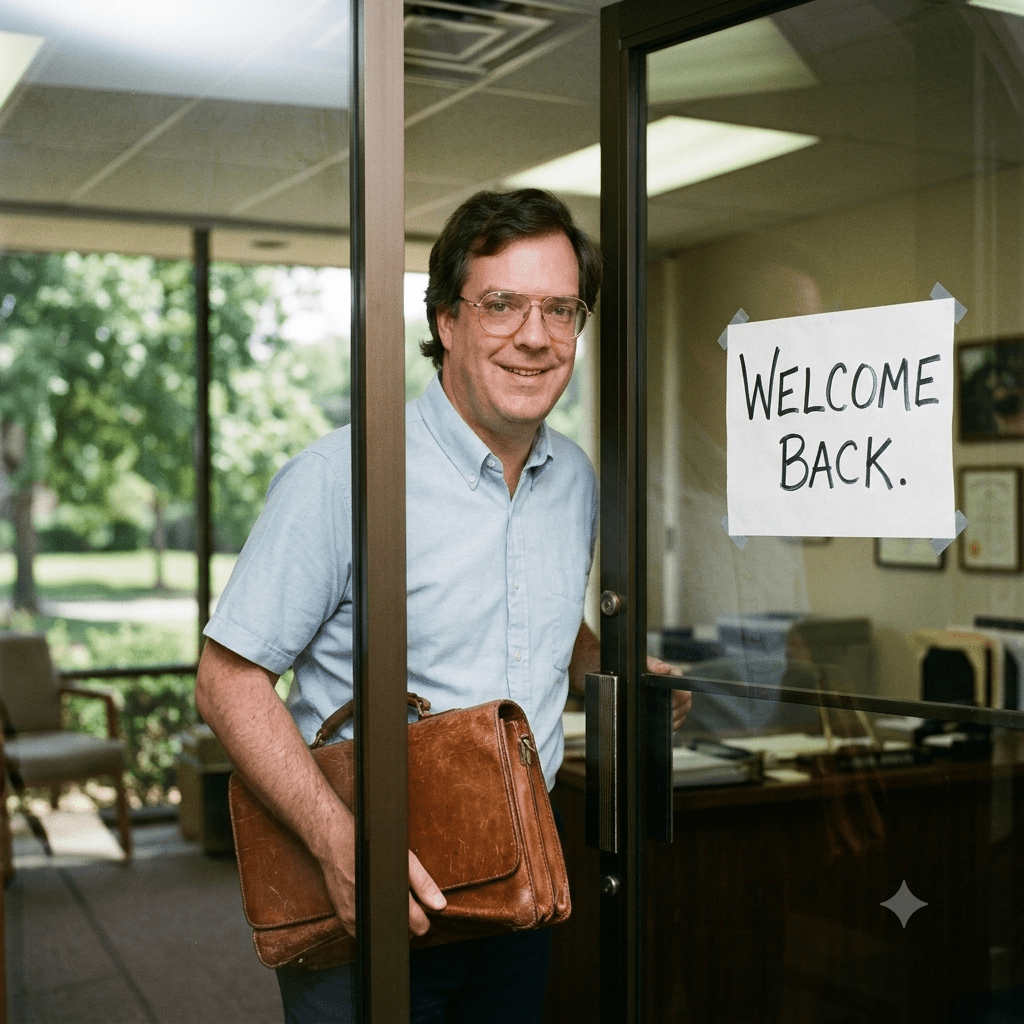
Oh, and by the way, temporary layoffs were not TV sitcom fiction. In the 1970s, layoffs WERE temporary. They would close the plant for around two months, then call you back to your job. Around 70% of workers returned to their employer.

Google Gemini.

A decade later it happened to me. A company laid me off, and I went to work for an associate of the owner. When the second company ran out of work for me, the first company hired me back.

Google Gemini.

After that, temporary layoffs faded away. The next time I was laid off was in 2020. Not surprisingly, the company never called me back.

Why Bredemarket Reshares Old Content On Its Socials

Resharing old content can have surprising beneficial consequences.

It’s safe to assume that even though you are reading this Bredemarket blog post, you haven’t read all 2,000 posts I’ve written since 2020.

OK. I admit I had some help.

Regardless, there’s a lot of old valuable content in the Bredemarket archives, so I like to share it with new audiences via my social channels.

Especially the “deep cuts” that hardly anyone has seen.

But I’m not the only person that revives old things.

From Art to Al

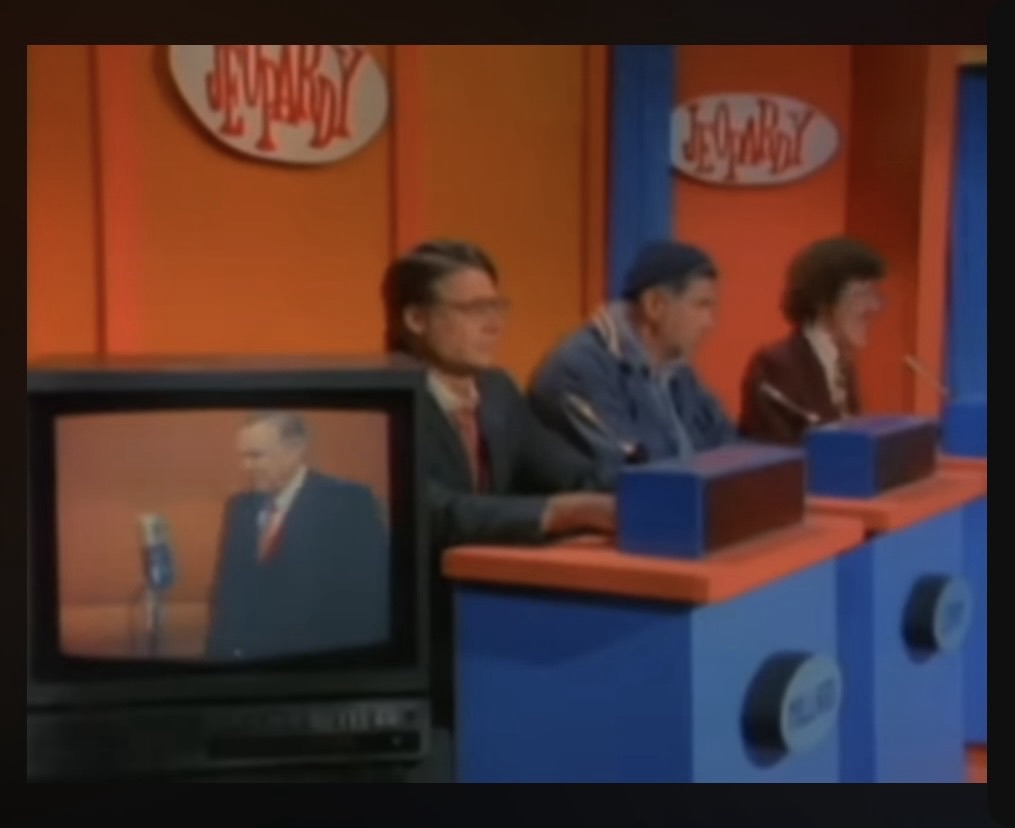
In case you didn’t know this, Merv Griffin developed a game show called Jeopardy that was incredibly successful during its 11 year run on NBC from 1964 to 1975. Its host, Art Fleming, was permanently linked to the show as a result.

While an 11 year run is respectable, Merv wanted more. He tried to bring the show back a couple of times, each with host Art Fleming, but was unsuccessful.

Enter an up and coming song parodist named Weird Al Yankovic.

Yankovic.

Weird Al decided to parody a popular Greg Kihn Band song that happened to be called “Jeopardy.” Yankovic’s parody was entitled “I Lost on Jeopardy,” and the music video was based on the old NBC version and featured Art Fleming himself, as well as Don Pardo.

As I previously noted, I’m prohibited from embedding this video in this blog post. You can find it here.

You won’t believe what happened next

The video was popular, and there are two different versions of the aftermath.

  • Some say that the video’s success gave Merv the push he needed to sell a new syndicated version of Jeopardy. Rather than Fleming, this edition included a Canadian host named Alex Trebek. I understand the revival did fairly well.
  • Others say that Merv had already sold the Trebek version of the show, so the video helped to publicize a show that was already in the works.

So is there a chance that my resharing of an old 2021 Bredemarket blog post will result in a 2026 wave of adulation? Maybe. It can’t hurt.

Way back.

A Dedicated Minority Can Influence Your Product

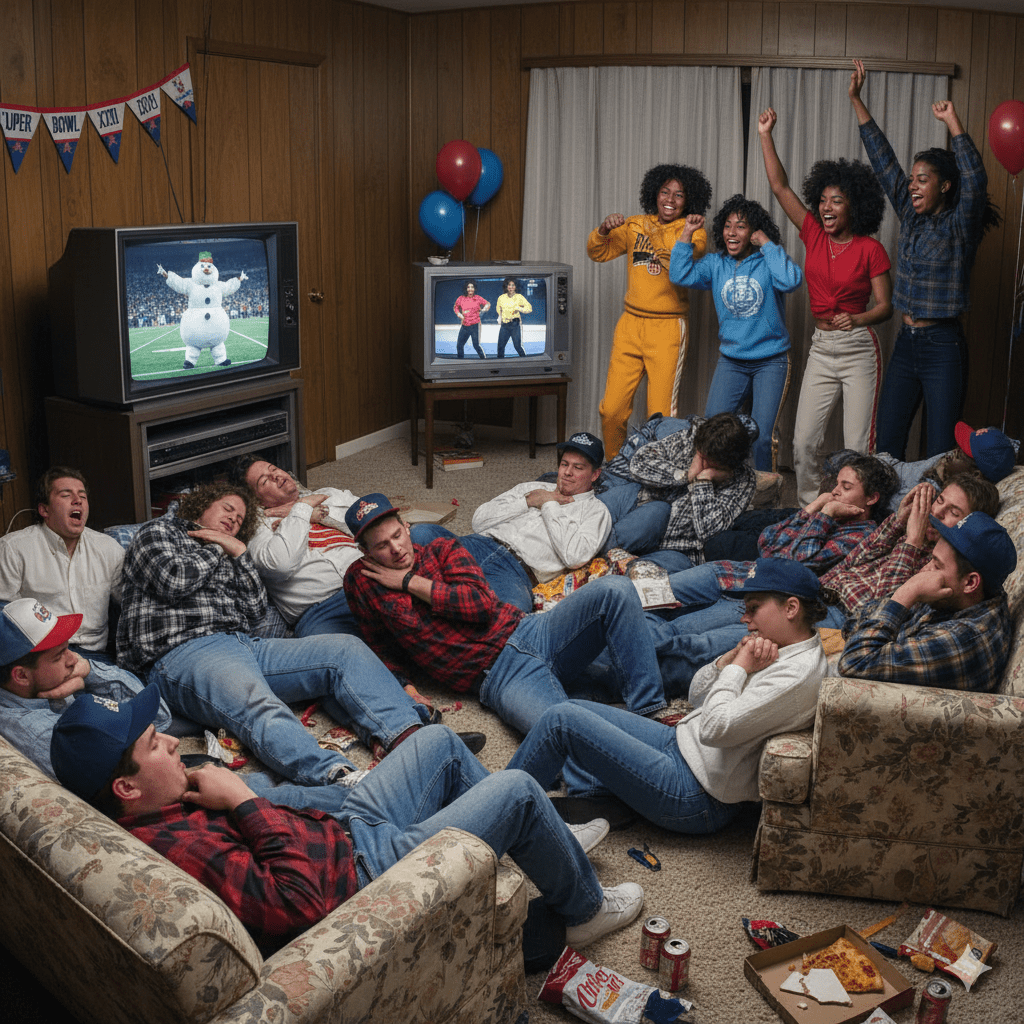
Because of something that happened during halftime at the 2026 Super Bowl, a lot of people are looking at something that happened during halftime at the 1992 Super Bowl.

You know, the story about how NO ONE watched the official 1992 halftime show and EVERYONE watched an unofficial one.

Except…that’s not what happened.

Marching bands at halftime

I was in my high school marching band, initially as a flute player, later as a drum major. I therefore performed in multiple football game halftime shows, entertaining the crowd with such classics as a Star Wars medley and a marching band arrangement of “Disco Duck.” (Cara and Jackie remember that one.)

And that was pretty much par for the course for football halftime shows. Not just at the high school level.

For example, let’s take a look at the Super Bowl. I will choose…Super Bowl XXVI.

It was a little fancier than my high school. Gloria Estefan sang during halftime. But the show also featured figure skaters Brian Boitano and Dorothy Hamill, the 1980 U.S. Olympic Hockey Team…and the University of Minnesota Marching Band. The theme was “Winter Magic.” Not sure how Miami-associated Estefan (who didn’t even appear until 10 minutes in) fit the theme.

Winter Magic.

Back in those days, the Winter Olympics were held on leap years, the same as the Summer Olympics. And therefore the Winter Olympics were just weeks away on CBS, the same network airing the Super Bowl. So this halftime show, in the middle of the Super Bowl, was guaranteed to get high viewership.

But not as high as expected.

The fourth network

Back when I was styling in my marching band uniform, the United States was dominated by three commercial television networks. A few years later a fourth network emerged, Fox.

Back in those days the name “Fox” was associated with innovation, and the fourth network definitely innovated with shows like the anti-Cosby “Married…with Children.” There was also a variety show, “The Tracey Ullman Show,” which spun off a cartoon show, The Samsons or something. And there was also comedy show with mostly black actors called “In Living Color.”

But the Big Three had one thing that Fox didn’t: NFL football. Those agreements were locked in place: the NFC on CBS, the AFC on NBC, and Monday Night Football on ABC. By 1985, Super Bowl telecasts began to rotate between these three networks, with CBS getting the 1992 slot.

Meanwhile, those rambunctious Fox folks were cooking up a surprise.

“During In Living Color’s first season, a marketing impresario named Jay Coleman approached Fox with an idea that would draw even bigger ratings and stick it to CBS, the NFL rights holder and Super Bowl carrier that Murdoch had in his sights: a special episode of In Living Color that would air opposite the Super Bowl intermission.”

An audacious idea, which they executed in a way to ensure that people could turn to Fox at halftime, then turn back to CBS for the second half of the game.

“[Jim] Carrey started by revealing a 26-minute countdown clock at the left bottom corner of the screen that would let viewers know when to switch back for the second half. “You won’t miss any of the senseless brutality!”

And they were off with a show that blew the marching band away in terms of creativity.

In Living Color.

But not in terms of ratings.

CBS won the time slot

The way the story is told today, you would think no one watched Estefan et al.

But statistics show that 79 million people watched the Super Bowl broadcast. 22 million watched In Living Color at halftime.

It’s uncertain how many people watched the Winter Magic portion of the CBS broadcast, but it’s quite possible that as many as 57 million stuck around.

Read that again.

57 million people.

Which is much more than 22 million people.

Of course, maybe all 57 million people didn’t stick around. Perhaps everyone not watching the Homeboy Shopping Network used the time for a bathroom break.

But it’s safe to say that more than 22 million people kept their TVs on CBS during halftime. Probably many, many more.

So on the surface the counter programming failed.

However, 22 million people is a lot of people to lose. In a more recent example, 2026 Turning Point counter programming drew no more than 5 million viewers. Although to be fair, it wasn’t even on TV, but on something called Ew Tube or something like that. And who would watch something on a computer or a phone?

But let’s go back to 1992. Maybe the NFL show won the ratings, but “The Shield” was shamed into revamping next year’s show.

They decided to can the marching band and ONLY go with a singer.

Michael Jackson.

What does this mean for B2B sales?

I will admit that the Super Bowl story is an…um…engaging story. (You see what I did there.)

Bryan Skankman. Hope they’re happy.

But in this case there truly is a lesson to be learned.

When battling against an established product, you don’t necessarily have to beat it. You just have to perform credibly.

But beware, because that may be enough for the established product to wake up and start innovating itself.

Fiction Overlaid on Fiction: What Will the Children Think?

Today, we know that many people are fooled by deepfakes, thinking they are real. But when we look at deepfake damage we think of adults. What about children?

It’s probably just as well that Fred Rogers passed away in 2003, years before technology allowed us to create deepfakes of everything.

Including Fred Rogers.

Grok. Not Fred Rogers.

Rogers occupied a unique role. He transported his young viewers from their real world into a world of make-believe, but took care to explain to his young viewers that there was a difference between make-believe and reality. For example, he once hosted a woman named Margaret Hamilton, who explained that she was not really a witch.

Margaret Hamilton and Fred Rogers.

Note the intelligence with which Hamilton treats her audience, by the way.

But back in Mister Rogers’ day, some people imposed make-believe on Rogers’ own make-believe, something that distressed Rogers because of his fear that it would confuse the children. Rogers objected to most of these portrayals, with the exception of Eddie Murphy’s. Children were fast asleep by the time “Mister Robinson” appeared on TV on Saturday nights. And Murphy’s character addressed serious topics such as gentrification.

Mister Robinson on gentrification, 2019.

But today we see things that are not real, but even adults think they are real. And that’s the adults; how do today’s children respond to deepfakes? If children of the 1930s were confused by a witch in a movie, how do children of today respond to things that look all too real?

And if kids do not have discernment view deepfakes, kids who create them don’t have that discernment either.

“Last October, a 13-year-old boy in Wisconsin used a picture of his classmate celebrating her bat mitzvah to create a deepfake nude he then shared on Snapchat….

“[M]any of the state laws don’t apply to explicit AI-generated deepfakes. Fewer still appear to directly grapple with the fact that perpetrators of deepfake abuse are often minors.”

Once again, technology outpaces our efforts to regulate it or examine its ethical considerations. 

Fred would be horrified.

Winners and Losers, But Even Olympic Losers Can Become Winners

A single loss does not define your entire life. As the sporting world teaches us, Olympic losers and other competitive losers can become winners—if not in sports, then elsewhere.

The human drama of athletic competition

When I was young, the best variety show on television didn’t involve Bob Mackie dresses. It instead featured Jim McKay, introducing the show as follows.

Spanning the globe to bring you the constant variety of sport…the thrill of victory…and the agony of defeat…the human drama of athletic competition…This is ABC’s Wide World of Sports!

A technological marvel when originally introduced, this variety show brought sporting events to American viewers from all over the world.

And these viewers learned that in competitions, there are winners and losers.

But since Wide World of Sports focused on the immediate (well, with a bit of tape delay), viewers never learned about the losers who became winners.

By ABC Network – ebay.com, front of photo, back of photo, Public Domain, https://commons.wikimedia.org/w/index.php?curid=33302515.

Jim McKay and his colleagues were not retrospective, but were known for the moment. In one instance that was NOT on tape delay, Jim McKay spoke his most consequential words, “They’re all gone.”

Vinko Bogataj

(Note: some of this content is repurposed because repurposing is cool.)

Turning to less lethal sporting events, remember Jim McKay’s phrase “the agony of defeat”?

For American TV watchers, this phrase was personified by Vinko Bogataj.

The agony of defeat.

Hailing from a country then known as Yugoslavia (now Slovenia), Bogataj was competing in the 1970 World Ski Flying Championships in Oberstdorf, in a country then known as West Germany (now Germany). His daughter described what happened:

It was bad weather, and he had to wait around 20 minutes before he got permission to start. He remembers that he couldn’t see very good. The track was very bad, and just before he could jump, the snow or something grabbed his skis and he fell. From that moment, he doesn’t remember anything.

While Bogataj suffered a concussion and a broken ankle, the accident was captured by the Wide World of Sports film crew, and Bogataj became famous on the “capitalist” side of the Cold War.

And he had no idea.

“He didn’t have a clue he was famous,” (his daughter) Sandra said. That changed when ABC tracked him down in Slovenia and asked him to attend a ceremony in New York to celebrate the 20th anniversary of “Wide World of Sports” in 1981.

At the gala, Bogataj received the loudest ovation among a group that included some of the best-known athletes in the world. The moment became truly surreal for Bogataj when Muhammad Ali asked for his autograph.

Bogataj is now a painter, but his 1970 performance still follows him.

Over 20 years after the infamous ski jump, Terry Gannon interviewed Bogataj for ABC. As Gannon recounted it on X (then Twitter), Bogataj “got in a fender bender on the way. His first line..’every time I’m on ABC I crash.'”

Some guy at the Athens Olympics in 2004

Since the Paris Olympics is taking place as I write this, people are paying a lot of attention to present and past Olympics.

The 2004 Olympics in Athens was a notable one, taking place in the country where the original Olympics were held.

But during that year, people may have missed some of the important stories that took place. We pay attention to winners, not losers.

Take the men’s 200 meter competition. It began with 7 heats, with the top competitors from the heats advancing.

Within the 7 heats, Heat 4 was a run-of-the-mill race, with the top four sprinters advancing to the next round. If I were to read their names to you you’d probably reward me with a blank stare.

But if I were to read the 5th place finisher to you, the guy who failed to advance to the next round, you’d recognize the name.

Usain Bolt.

Usain Bolt poses with his 200 m gold medal at the 2016 Summer Olympics. By Fernando Frazão/Agência Brasil – http://agenciabrasil.ebc.com.br/rio-2016/foto/2016-08/bolt-se-aposenta-com-medalha-de-ouro-no-4-x-100-metros, CC BY 3.0 br, https://commons.wikimedia.org/w/index.php?curid=50784135.

He did a little better at subsequent Olympics.

Some other guy at the Athens Olympics in 2004

KBWEB Consult tells the story of another competitor in the same 200 meter event in Athens. Chris Lambert participated in Heat 3, but didn’t place in the first four positions and therefore didn’t advance.

Nor did he place in the fifth position like Usain Bolt did in Heat 4.

Actually, he technically didn’t place at all. His performance is marked with a “DNF,” or “did not finish.”

You see, at about the 50 meter point of the 200 meter event, Lambert pulled a hamstring.

And that ended his Olympic competition dreams forever. By the time the Olympics were held in Lambert’s home country of the United Kingdom in 2012, he was not a competitor, but a volunteer for the London Olympics.

But Lambert learned much from his competitive days, and now works for Adobe.

KBWEB Consult (who consults on Adobe Experience Manager implementations) tells the full story of Chris Lambert and what he learned in its post “Expert Coaching From KBWEB Consult.”

A final thought

I haven’t done one of these in a while, but it’s important to remember that just because you lost a particular competition doesn’t mean that all is lost. We need to remember this whether we are a 200 meter runner who didn’t advance from their heat, or whether we are a job applicant receiving yet another “we are moving in a different direction” form letter.

In the meantime, take care of yourself, and each other.

Jerry Springer. By Justin Hoch, CC BY 2.0, https://commons.wikimedia.org/w/index.php?curid=16673259.

The Bredemarket 199 Entertainment Device Remote Juggling Service

As Bredemarket, and in my previous positions, I have written a number of technical pieces of varying lengths. Many of these were designed to communicate non-technical concepts to a technical audience.

I just completed such a piece on Saturday. And no, it wasn’t a blog post or white paper, or even a web page analysis.

It was a set of instructions on how to use three remotes to access three pieces of entertainment hardware.

A couple of years ago, lightning hit the home of one of my relatives. While the home was for the most part undamaged, her living room television set was fried. So for the past two years, she has had to go to her bedroom when she wanted to watch TV.

So on Friday, my wife and I trooped down to the store and purchased a smart TV, along with a newer DVD player, and a swivel mount to hold the smart TV on her cabinet.

Early Saturday afternoon, the mount, TV set, and DVD player needed to be set up. In true Bredemarket fashion, I did not get involved with the drilling or any of the other hardware installation; two friends took care of that part. (I know my limits.) They even took care of the cabling, so that both the cable box and the new DVD were connected to the new TV via the two HDMI ports.

Once that was done, it was time for the software guy (me) to go through the TV setup, and then to pair both of the new entertainment devices with the existing cable remote. If all had worked well, all three of the devices could have been controlled through the single cable remote, with some minimal instructions to my relative on how to switch between all the devices.

(It is relevant to note that my relative is a senior citizen, so the instructions needed to be easy-to-understand AND minimal.)

Sadly, all did NOT work well. I ran into two problems.

  • First, despite trying all of the suggested codes, I was unable to pair the DVD to the cable remote.
  • Second, even if I had successfully paired the DVD, the cable remote was lacking an all-essential “TV input” button, so the cable remote on its own could not switch between the TV’s HDMI1 input (cable) and the HDMI2 input (DVD). The cable company offers newer remote controls, but that didn’t help me on Saturday.

So that’s when the writer kicked in. Using my non-preferred word processing platform (Notes on my iPhone), I drafted a short document with four sections:

  • The introductory section: “When watching [cable system], the [cable system] remote can control [cable system] functions plus the TV volume (and turning the TV on and off)”
  • Five steps “(t)o switch from watching [cable system] to watching the [brand] DVD” (using both the TV remote and the DVD remote, but not the OTHER DVD remote that looks similar)
  • Five steps “(t)o switch from watching the [brand] DVD to watching the [cable system]” (using both the TV remote and the cable remote)
  • A fourth section, “John’s technical notes,” in case someone other than my relative wanted to figure out what was going on

I didn’t try to incorporate graphics into my Notes text, so I had to use textual descriptions such as “the circles control.” After initial testing (me) and a second test (my wife), the instructions were printed.

Technically the project is not complete because the document has not gone through the final testing stage (my relative), but this is probably the most important document that I’ve written this week.

Yes, the project that I completed for my client on Friday was also important, but you have to keep family happy.

And no, Bredemarket cannot offer this service to paying clients because I usually work…um, remotely.