Bredemarket and proposals, part two: sole source responses

This is the second post in a series that discusses the proposal services that Bredemarket can provide. A previous post described Bredemarket’s RFx response services. This post describes Bredemarket’s sole source response services.

Excerpt from https://bredemarket.com/wp-content/uploads/2022/02/bmtprop-20220221a.pdf

The need for sole source response services

The nice thing about sole source responses is that you’re (usually) not competing against anyone else, and therefore have the customer’s full attention. In some cases, the customer has specifically asked you to prepare a proposal. In other cases, you provide an unsolicited proposal to the customer.

Of course, a sole source proposal needs to respond to the customer’s requirements. Obviously the customer hasn’t provided you with a written Request for Proposal, but perhaps the customer has provided some written or verbal list of what is required. And if the customer hasn’t provided you with this information, ask. There’s no point in proposing a 1,000 record fingerprint system when the customer really wants a 10,000 record face system.

In addition, a sole source proposal has to be customer centric, just like a formal RFP response. Far too many sole source proposals spend an inordinate amount of time talking about how great the proposer is, and little or no time talking about what the customer needs.

Bredemarket’s solution for sole source response services

Once I understand what the end customer needs, and what my client can offer to meet the end customer’s needs, I can help the client come up with a story that resonates with the end customer. In some cases, the client already has a proposal library that describes its standard products and services that can be used as a starting point. Remember, however, that standard text often has to be massaged to meet the needs of a specific client. Even when I’ve created a proposal template for a client (foreshadowing a future post in this series!), I’ve often found that the template text needs to be modified a bit when it’s placed in a final letter to a client.

In all cases, my sole source proposal services are similar to my content marketing services in one respect; they are collaborative. Both my input and my client’s input is essential to ensure that the final product makes the case to the customer.

Do you need Bredemarket’s sole source response services?

If I can help you with sole source responses:

And now those who paid attention to my foreshadowing know what I’m going to talk about next

Bredemarket and proposals, part one: RFx responses

If you saw my “two truths and no lies” post, you probably saw that I recently updated my Bredemarket and Proposal Services page and the accompanying collateral.

Excerpt from https://bredemarket.com/wp-content/uploads/2022/02/bmtprop-20220221a.pdf

It occurred to me that some of the acronyms in the red bullets above may be gobbledygook to some people, so I thought I’d delve into some of the bullets, beginning with the first one.

(Warning: post series ahead.)

The need for RFx response services

“RFx” is shorthand for a number of “request for” items, including requests for proposals, requests for information, and requests for comment. These RFx documents ask entities to submit a formal response in the format dictated by the RFx document. The response may be one page long, five pages long, or one thousand pages long. The response may include a simple narrative, or the entity may need to submit specific forms with specially formatted answers to dozens or hundreds or thousands of questions.

  • In the ideal world, the entity knows that the RFx document is coming, and has been working for years on its response. (How can you know how to respond when the RFX hasn’t even been issued? Know your customer.)
  • In the non-ideal world, an account manager goes to the proposal team and says, “Hey, our customer issued an RFP last week. I had no idea it was coming. But the customer really likes us, as long as we get our price down.”

In any case, an entity that wants to respond to an RFx needs to read the document and develop a response that puts the customer first (see Truth Number One here), complies with all requirements, scores high on the RFx’s evaluation criteria, is easy for an evaluator to evaluate (see Truth Number Two here), and wins the business.

Bredemarket’s solution for RFx response services

As you can see from my collateral, Bredemarket has assisted its clients with nine (so far) RFx responses, all of which were either responses to Requests for Information (RFIs), or responses to Requests for Proposal (RFPs).

There are differences between the two.

In the Request for Information stage, you still have an opportunity to shape the final procurement (if a final procurement takes place). For example, if you offer a green widget and your competitors do not, your RFI response will make an important point about how the customer will benefit from a green widget, and a solution without a green widget is substandard.

(One important point here. I didn’t say that the RFI response should say that XYZ Company offers a green widget that is a technological marvel. I said that the RFI response should say that the customer will benefit from a green widget.)

In the Request for Proposal stage, the time to shape the final procurement has already passed. (This is why you engage with a customer years before the customer issues an RFP.) At this stage you have to go all out and win the business, telling the customer how they will benefit from your solution.

The mechanics of writing an RFx response have varied between my clients. In some cases, I have worked with one or two people to come up with the response, and the client then sent it out. In other cases, I have worked as part of a team of dozens of people in multiple companies to come up with the response, and followed multiple processes to ensure that the proposal is not only sound, but is approved at the corporate level of the client. Some processes are dictated by the client, but some clients have no processes which means that I need to implement a simple one to get the job done.

Do you need Bredemarket’s RFx response services?

If you need help responding to an RFP, RFI, or related document:

Oh, and by the way, Bredemarket offers more than RFx response services. Stay tuned for the next installment on sole source responses.

Why am I using the word “casetimonial”?

We often get bent out of shape trying to come up with precise definitions of things. While sometimes this precision is warranted, there are times when it is overkill.

Take the answer to this question:

What is the difference between a case study and a testimonial?

Not that type of case. By Thomas Quine – Lead type case, CC BY 2.0, https://commons.wikimedia.org/w/index.php?curid=51684202

Some people have taken some time answering the question about the difference between a case study and a testimonial. For example, here’s what Juliet Platt says:

The difference between Case Studies and Testimonials is really length and depth.

From https://casestudywriter.co.uk/whats-the-difference-between-a-case-study-and-a-testimonial/

Platt then gives examples of the longer, in-depth nature of case studies vs. the shorter nature of testimonials.

Another person who has addressed the question is Donna St. Jean Conti:

“Show me ROI, or it’s not a case study.” An editor told me this some 15 years ago, and he was so right.

From https://www.agilitypr.com/pr-news/public-relations/whats-the-difference-between-a-case-study-and-a-testimonial/

This gets into the difference between quantitative information and qualitative information. By this definition, a case study always has to address return on investment, or it’s not a case study.

I have a different view

While I respect the views of these two people (and others), I have a different view. My answer to the question “What is the difference between a case study and a testimonial” is as follows:

Who cares?

From https://bredemarket.com/bredemarket-and-case-studies/

Let me explain.

Regardless of what you call the document, a case study or a testimonial allows a firm to attract new customers by showcasing the successes of existing customers.

From https://bredemarket.com/bredemarket-and-case-studies/

And as far as I’m concerned, the length of the piece and the choice to use quantitative or qualitative data (or both) is secondary to the primary purpose, which is to present an example that resonates with a potential customer.

Not that I don’t have ANY rules. Whether you’re writing a case study or testimonial, I like to structure it with the following format:

  1. The problem.
  2. The solution.
  3. The results (from using the solution to solve the problem).

This format allows a customer-centric presentation with which the reader can identify. “Hey, Joe’s Garage used this widget to solve their problem. Maybe I can use this widget to solve a similar problem.”

Now perhaps others use a different outline for their case studies or testimonials. And that’s…OK.

For those of you old enough to remember Stuart Smalley. By http://www.tvacres.com/words_stuart.htm, Fair use, https://en.wikipedia.org/w/index.php?curid=31855280

My own term

So for ease of communication, I’ve decided to adopt a different term. It’s not original with me, but it doesn’t look like anyone else is currently using the term on a regular basis.

Instead of using awkward references to “case studies and/or testimonials,” I’m just going to refer to casetimonials.

I used the casetimonial term a lot on this page (recently revised) on the Bredemarket website, which not only includes a shorter form of the discussion above about the difference between a case study and a testimonial, but also discusses how a casetimonial can be used, how it can be repurposed, the types of firms that can benefit from casetimonials, and how Bredemarket can help you create your own casetimonials.

If you can use Bredemarket’s assistance with communicating past customer successes to future clients:

Who is THE #1 NIST facial recognition vendor?

(Part of the biometric product marketing expert series)

As I’ve noted before, there are a number of facial recognition companies that claim to be the #1 NIST facial recognition vendor. I’m here to help you cut through the clutter so you know who the #1 NIST facial recognition vendor truly is.

You can confirm this information yourself by visiting the NIST FRVT 1:1 Verification and FRVT 1:N Identification pages. FRVT, by the way, stands for “Face Recognition Vendor Test.”

So I can announce to you that as of February 23, 2022, the #1 NIST facial recognition vendor is Cloudwalk.

And Sensetime.

And Beihang University ERCACAT.

And Cubox.

And Adera.

And Chosun University.

And iSAP Solution Corporation.

And Bitmain.

And Visage Techologies.

And Expasoft LLC.

And Paravision.

And NEC.

And Ptakuratsatu.

And Ayonix.

And Rank One.

And Dermalog.

And Innovatrics.

Now how can ALL dozen-plus of these entities be number 1?

Easy.

The NIST 1:1 and 1:N tests include many different accuracy and performance measurements, and each of the entities listed above placed #1 in at least one of these measurements. And all of the databases, database sizes, and use cases measure very different things.

Transportation Security Administration Checkpoint at John Glenn Columbus International Airport. By Michael Ball – Own work, CC0, https://commons.wikimedia.org/w/index.php?curid=77279000

For example:

  • Visage Technologies was #1 in the 1:1 performance measurements for template generation time, in milliseconds, for 480×720 and 960×1440 data.
  • Meanwhile, NEC was #1 in the 1:N Identification (T>0) accuracy measurements for gallery border, probe border with a delta T greater than or equal to 10 years, N = 1.6 million.
  • Not to be confused with the 1:N Identification (T>0) accuracy measurements for gallery visa, probe border, N = 1.6 million, where the #1 algorithm was not from NEC.
  • And not to be confused with the 1:N Investigation (R = 1, T = 0) accuracy measurements for gallery border, probe border with a delta T greater than or equal to 10 years, N = 1.6 million, where the #1 algorithm was not from NEC.

And can I add a few more caveats?

First caveat: Since all of these tests are ongoing tests, you can probably find a slightly different set of #1 algorithms if you look at the January data, and you will probably find a slightly different set of #1 algorithms when the March data is available.

Second caveat: These are the results for the unqualified #1 NIST categories. You can add qualifiers, such as “#1 non-Chinese vendor” or “#1 western vendor” or “#1 U.S. vendor” to vault a particular algorithm to the top of the list.

Third caveat: You can add even more qualifiers, such as “within the top five NIST vendors” and (one I admit to having used before) “a top tier NIST vendor in multiple categories.” This can mean whatever you want it to mean. (As can “dramatically improved” algorithm, which may mean that you vaulted from position #300 to position #200 in one of the categories.)

Fourth caveat: Even if a particular NIST test applies to your specific use case, #1 performance on a NIST test does not guarantee that a facial recognition system supplied by that entity will yield #1 performance with your database in your environment. The algorithm sent to NIST may or may not make it into a production system. And even if it does, performance against a particular NIST test database may not yield the same results as performance against a Rhode Island criminal database, a French driver’s license database, or a Nigerian passport database. For more information on this, see Mike French’s LinkedIn article “Why agencies should conduct their own AFIS benchmarks rather than relying on others.”

So now that you know who the #1 NIST facial recognition vendor is, do you feel more knowledgeable?

Although I’ll grant that a NIST accuracy or performance claim is better than some other claims, such as self-test results.

When you DON’T want to cut the cord

No pretty picture in this post, for reasons that will become apparent.

My home office is (drumroll) at home, which means that my laptop accesses the world via the wi-fi on my home Internet service.

Well, not at the moment, since one of the outside wires that runs to my modem was accidentally cut, and can’t be repaired until tomorrow.

While I can conduct a limited amount of business using my phone’s 4G connection, I can’t do anything substantive. If an emergency pops up I can go to a Starbucks (if not closed due to COVID) or another wi-fi source, but for the most part I am limited in what I can do.

Let’s see how much I CAN do.

Two truths and no lies, the proposals edition

(Updated 4/18/2022 with additional customer focus information.)

You’re probably familiar with “two truths and a lie,” where a person makes three statements and you have to guess which of the three is a falsehood.

As part of my ongoing efforts to update the Bredemarket website, I just updated my “Bredemarket and proposal services” page. Among other things, it now contains two BOLD CAPITALIZED truths…and no lies.

I’ll be the first to admit that these truths, picked up during my time in the proposals industry, are in no way unique to me. Many other people have shared them frequently, and I’ve heard both of these truths shared in the last month alone on a recent proposal engagement.

But I suspect that some people are not aware of these truths, so I thought I’d share them.

Truth Number One

Here’s the first of the two truths from my “Bredemarket and proposal services” page.

THE CUSTOMER DOESN’T CARE ABOUT HOW WONDERFUL YOUR FIRM IS.

From https://bredemarket.com/bredemarket-and-proposal-services/

Allow me to use an example that won’t impact any of my work with my clients.

Mark owns a meat company that provides meat to restaurants and other food services. Carlos owns a taco truck and needs meat for his tacos. The meat has to meet U.S. Food and Drug Administration and California state standards, needs to meet Carlos’ own standards, and needs to be delivered every day at 7:00 am so that Carlos can get his taco truck on the road.

So when Mark approaches Carlos, this is what he says:

Guasti Meat was established on February 23, 1947 in Guasti, California by Michael Smith, a butcher who was originally born in Nowata, Oklahoma. The company was headquartered in Guasti for 17 years before moving to its current facility in Colton, California. Our main building occupies 97,526 feet of floor space and incorporates Guasti Meat’s color scheme, which was established by Morton Smith Jr., an artist and nephew of the founder who has also produced designs for Enron, Kodak, Montgomery Ward, and other well-known firms. We employ 250 personnel, all of whom are entitled to post-secondary educational benefits. We sell meat to over 1,000 customers in 17 U.S. states.

Did Mark ask Carlos about what Carlos likes to see in the meat he purchases?

Did Mark ask Carlos where the meat should be delivered?

No.

Mark’s attitude was that if he shared these important facts about Guasti Meat, Carlos would be so impressed that he would immediately start to do business with such a respectable company.

This is obviously ridiculous, but many companies act in the same fashion when writing proposals. When they write their executive summaries, the first thing that they talk about is themselves.

Who cares?

(4/18/2022: For additional information on customer focus, click here.)

The customer has their OWN problems that they need to solve. Tell the customer how you will solve them.

Truth Number Two

Here’s the second truth from the page.

PROPOSAL EVALUATORS DO NOT READ PROPOSALS.

From https://bredemarket.com/bredemarket-and-proposal-services/

Before I ever wrote a single proposal for Printrak, I actually helped write a Request for Proposal (RFP) for another company. Now frankly it was a pretty simple RFP, in which the respondents merely had to check items in a checklist to indicate whether the respondents’ software packages could do what we wanted. Even with the short responses that we as evaluators had to read, we didn’t spend much time on them.

  1. Did the respondent check every single box? Well, obviously they didn’t read the requirements carefully, because no one does everything. Let’s not look at them.
  2. Did the respondent ignore all of the boxes and write a separate description? Well, if they don’t have time to answer our questions, let’s not look at them either.
  3. How many companies are left? Two? OK, we’ll talk to them.

And that was the evaluation time that was spent on simple proposal responses. How much time do you think evaluators will spend evaluating one of Bredemarket’s recent projects, in which I contributed to a 1,000-page proposal that had hundreds upon hundreds of requirements? Remember that evaluators have to read these responses for ALL of the proposals that are submitted.

The proposal team for this project wrote our responses as follows:

  • In the first part of every requirement response, make sure that we explicitly say that we comply. That way, even if the evaluator only spends ten seconds reading our response, the evaluator will at least know that we claim compliance.

“If the evaluator only spends ten seconds reading our response”?

Yes.

After all, the evaluators have to read ALL of the material in OUR proposal, plus ALL of the material in all the OTHER proposals. They’re not going to have the luxury to spend an inordinate amount of time, such as five minutes, reading each single response. The evaluators are going to plow through the responses as quickly as possible.

Because of this, our writing team also did the following:

  • Use the RFP language in your response.

I gave an example on my page:

Oh, and if the customer refers to a “product demonstration,” then your proposal had better use the exact words “product demonstration.” If you say that you will provide a “capabilities presentation,” the customer will not see the words THEY were looking for and may conclude that you refuse to provide the product demonstration that they want.

From https://bredemarket.com/bredemarket-and-proposal-services/

Let’s face it; if an evaluator is only spending ten seconds on your response, the evaluator is going to look at the RFP requirement that says “product demonstration,” and then skim your response for the words “product demonstration.”

If the evaluator immediately finds those specific words in your response, then the evaluator is happy, marks compliance, and moves on to the next requirement to see how you complied with that one.

If the evaluator doesn’t find those specific words in your response, then the evaluator has to stop, think, and read the words that you used in your response.

  • If you’re lucky, the evaluator will see your words “capabilities presentation,” conclude that you meant to say “product demonstration,” and grudingly give you credit while cussing you out for making the evaluation harder.
  • If you’re NOT lucky, the evaluator will miss your words “capabilities presentation,” conclude that you have NOT committed to a product demonstration, give you no points, regret the ten seconds of life that were lost, and then move on to the next response and wonder if you aren’t compliant with that one either.

I shouldn’t have to say this, but you want your proposal evaluator to LIKE you, not HATE you. Make the evaluator’s job easier.

The rest of the story

These two truths are only part of the new content on my Bredemarket and proposal services page. I also incorporated updated proposal statistics in the brochure at the top of the page, expressed a few other opinions about proposal work (while restraining myself from writing much, much, more). and borrowing some text from this post to beef up the examples of proposal deliverables at the bottom of the page.

So viewers of the Bredemarket and proposal services page will now have updated information about the number of projects I have completed, the services I have offered, and the truths to which I hold.

Now I just have to remember to update my project list on this and other pages on a regular basis.

Friction and emerging threats: two items to consider when implementing multifactor authentication

For my long-time readers, here’s a quiz. Read the four statements below and take a guess as to which one of these statements best reflects my views.

  1. With recent accuracy improvements, facial identification is the only identification method that you will ever need in the future.
  2. Possession of a driver’s license is sufficient to prove identity.
  3. Fingerprints are the tried and true authentication method; you don’t need anything else.
  4. Passwords are dead.

Readers, this was a trick question. I don’t agree with ANY of these statements. It is possible to subvert facial identification methods. Your twin can steal your driver’s license. Fingerprints can be subverted also. And passwords have their place.

If you’ve read my writings for any length of time, you know that I believe that any single authentication factor is not a reliable method of authenticating someone. Multifactor authentication, in which you use more than one of the five authentication factors, is a much stronger method. It’s possible to spoof any single authentication factor (a gummi fingerprint, a fake driver’s license, etc.), but it’s much harder to spoof multiple factors.

No, they don’t have ridges. By Thomas Rosenau – Own work, CC BY-SA 2.5, https://commons.wikimedia.org/w/index.php?curid=685011

Please note that I am referring to multiple FACTORS, not multiple TYPES OF BIOMETRICS (for example, authenticating finger and face and declaring victory). All biometrics fit within the “something you are” category, and it’s much better to combine this factor with one or more of the other four: something you know, something you have, something you do, and somewhere you are. Or perhaps use two factors other than biometrics. The important thing is that you use multiple factors.

What of the vendor that only offers one type of biometric authentication? Or the vendor that only offers biometric authentication? Or the vendor that only processes secure documents? Or the one with really strong password protection schemes? Well, in my humble opinion these vendors need to partner with other vendors who support other authentication factors, to ensure delivery of a robust solution.

Julie Pattison-Gordon made many of these points in a recent GovTech article, “Cyber Refresher: Understanding Multifactor Authentication.” But she made two additional points that are worth mentioning.

Friction and authentication

The first point that Pattison-Gordon makes is the following:

Agencies may need to consider how their selection of authentication methods creates or avoids friction for employees.

Friction, in which a task becomes hard to perform, is bad.

Not sure how Jack feels now that the Lakers are, um, subpar. By May be found at the following website: http://www.impawards.com/2003/anger_management.html, Fair use, https://en.wikipedia.org/w/index.php?curid=11893883

Some authentication methods have, or can have, more friction than others. For example, some password implementations require use of characters from the Roman, Greek, and Cyrillic alphabets and require you to change your password daily. (I exaggerate only slightly.) Older iris readers required you to put your head directly against the reader, like if you were at an opthamologist’s office. Even today, most fingerprint readers require you to touch your finger against a platen. (There are exceptions.)

But why worry about friction? After all, if someone’s required to perform some type of authentication, they’re going to do it regardless of how hard it is.

Oh no they’re not:

Speaking during a panel last month, Delaware Chief Security Officer Solomon Adote said that workers who find MFA processes too cumbersome may adopt unsafe workarounds, such as storing official files on personal devices to let them skip login procedures entirely.

This is worse than an abandoned shopping cart, since it’s the abandonment of an entire security infrastructure. When security is too cumbersome, the result is little or no security at all.

I feel safe now. By IMP Awards, Fair use, https://en.wikipedia.org/w/index.php?curid=42298113

It is possible to improve all authentication methods to reduce friction. Strong yet easy passwords that you don’t have to change all the time. “On the move” capture of all sorts of biometrics, including fingerprints, faces, and irises. The ability to read information on secure documents without sliding them through a card reader (yet incorporating protections against unauthorized reading of the data).

Trust me – frictionless will make people happier and will cause them to use your security methods without objection.

Emerging threats and authentication

Pattison-Gordon makes a second point:

Organizations must also weigh the cyber threats facing each type of authentication, as malicious actors continue evolving their strategies.

No authentication method is foolproof, and every authentication method attracts one or more threats. I’ve mentioned some in passing in this post, such as “gummi fingerprints” in which someone creates a fake fingerprint with the ridge detail from a true fingerprint. Pattison-Gordon mentions another threat, SIM swapping.

There are ways to deal with these two threats. For example, if a gummi fingerprint is literally a piece of non-organic material, there are various methods of liveness detection (tempreature, heartbeat detection, skin features) that can identify the fingerprint as fake.

However, this does not solve the problem, since some day some fraudster will create a fake fingerprint that appears to have human skin, a temperature, a detectable heartbeat, and everything else that a real fingerprint will have.

Security is a constant war between the fraudsters who develop a hack, the cybersecurity folks who develop a block to the hack, and the fraudsters that develop a new hack that avoids the block to the previous hack. No authentication method is foolproof.

This is one of the benefits of multifactor authentication. When this is used, then the fraudster needs to hack something you are AND something you know AND something you have AND something you do AND somewhere you are. MFA hacking is not impossible, but it is much, much more difficult than hacking a single factor.

And you also have to keep up with the latest hacks and continue to research. Don’t quit researching an authentication method just because it seems great now.

(A couple of you may know why I said that.)

Retabulating the work that Bredemarket has done for clients (as of February 16, 2022)

My biometric/identity collateral wasn’t the only thing that I updated yesterday.

As part of my preparation for yesterday evening’s Ontario IDEA Exchange meeting, I took the time to update my “local” brochure. (Because local is important: see the first of my three goals for 2022.) This brochure includes a section that discusses the types and numbers of pieces that I have prepared for clients, including the number of case studies, the number of RFx responses, and so forth.

Those numbers hadn’t been updated since last September.

Before going to the meeting, I wanted to make sure my “local” brochure had the latest numbers.

I’ll go ahead and share them with you. This covers the projects that Bredemarket has completed for clients over the last 18 months, as of February 16, 2022:

  • Fourteen (14) case studies
  • Eight (8) articles (blog posts)
  • Three (3) service offering descriptions
  • Three (3) white papers
  • Nine (9) RFx responses
  • Four (4) sole source responses
  • Six (6) proposal templates
  • One (1) technical leave behind
  • Two (2) biometric analyses
Inland Empire B2B Content Services from Bredemarket.

As it turns out, I didn’t hand out my local brochure to anyone at last night’s IDEA Exchange. (It was a small crowd, most of whom I already knew.)

But at least I’ve tabulated the numbers.

Now I just have to update all of my NON local collateral…

Does your biometric/identity firm need proposal or content marketing services?

I really need to update my own website more frequently.

About a year ago, I created a web page and an accompanying brochure entitled “Bredemarket and Identity Firms.” I’ve updated the web page a time or two in the last year, but until a few minutes ago both the web page and the brochure were significantly out of date, and didn’t include some of the projects that I’ve worked on during the past few months.

You can view the updated web page or download the updated brochure (at the end of this post) if you like, but I’ll create a frictionless experience for you by reproducing (repurposing) the list of ALL of Bredemarket’s biometric/identity projects as of today. (And there are more projects in work that I haven’t listed yet.)

By Zhe Wang, Paul C. Quinn, James W. Tanaka, Xiaoyang Yu, Yu-Hao P. Sun, Jiangang Liu, Olivier Pascalis, Liezhong Ge and Kang Lee – https://www.frontiersin.org/articles/10.3389/fpsyg.2015.00559/full, CC BY 4.0, https://commons.wikimedia.org/w/index.php?curid=96233011

If I can perform similar services for your biometric/identity firm, contact me.

How can Bredemarket help identity firms?

Here are a few examples of services that I have provided to identity firms under the Bredemarket banner as a biometric proposal writing expert, a biometric content marketing expert, an identity content marketing expert (biometrics alone is not enough), and an expert in other areas of identity/biometric writing.

  • Proposal Writing: Created five proposal letter templates to let a biometric firm’s sales staff propose two products to five separate markets. After completing the first three templates, I received this unsolicited testimonial:

“I just wanted to truly say thank you for putting these templates together. I worked on this…last week and it was extremely simple to use and I thought really provided a professional advantage and tool to give the customer….TRULY THANK YOU!”

  • More Proposal Writing: Responded to three Requests for Information (RFIs) for two biometric firms, positioning the firms for future work from government agencies.
  • Even More Proposal Writing: Assisted a biometric firm in responding to multiple Requests for Proposal (RFPs) and sole source letters.
  • And more…: Created a proposal letter template for a biometric firm.
  • And still more…: Created a Microsoft Word-based response library for a biometric firm.
  • Proposal Analyzing: Monitored the social media activity of a biometric firm’s competition and created responsive proposal text to position the firm against its competition.
  • Proposal Editing: Assisted a biometric firm in the final stages of an RFP response, editing its proposal both before and after its Gold Team review.
  • Strategic Marketing: Updated customer counts and technical data for a secure document firm.
  • More Strategic Marketing: Assisted a leading biometric vendor in analyzing its NIST FRVT 1:1 and 1:N results, providing both public information the firm could share with its clients, and private information for the firm’s internal use.
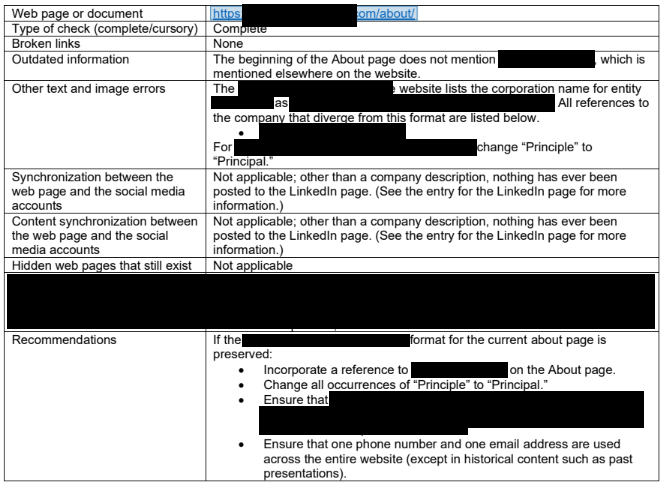
  • Online Marketing: Analyzed a biometric website and its social media channels, looking for broken links, outdated information, synchronization errors, and other problems, and provided a report to the firm upon completion.
  • More Online Marketing: Wrote three service descriptions for a biometric consulting firm.
  • Online Writing: Interviewed customers and wrote case study text for 14 case studies a biometric firm.
  • More Online Writing: Wrote blog posts for multiple biometric firms. After all, I am the identity/biometric blog expert.

The cost of abandoned shopping carts is measurable

People in the biometric and banking industries like to use the word “frictionless.” It refers to the ability to make tasks such as building access and online purchases as easy as possible. When you make a purchase as hard as possible, it’s referred to as “friction.”

And we’ve all encountered friction online.

By Scooooly – Own work, CC BY-SA 4.0, https://commons.wikimedia.org/w/index.php?curid=47265558

(Type the TWO words?)

Provided that the transaction is secure, a frictionless transaction is preferable to a friction one. If you introduce too much friction into an operation, then the person trying to access a building or the person trying to complete an online transaction will give up. In the finance world, the online transaction is “abandoned,” sometimes after the potential buyer has already selected what they want to purchase. The end result is referred to in the industry as an abandoned shopping cart.

By Tim Reckmann from Hamm, Deutschland – Einkaufswagen, CC BY 2.0, https://commons.wikimedia.org/w/index.php?curid=83154898

(And no, I don’t know the German for “abandoned,” but whatever it is, you can pair it with “Einkaufswagen” and come up with a really long description.)

At one point in my corporate career, I was looking at (virtual) abandoned shopping carts, and trying to figure out how digital identity mechanisms could reduce the number of abandoned shopping carts for online transactions. Any reduction would naturally translate to increased sales and increased profits for the online vendor.

Well, at this point in my post-corporate career, I was able to look at abandoned shopping carts from another perspective.

I abandoned a shopping cart this morning.

Not because of a horrendous CAPTCHA.

I abandoned it because the vendor wasn’t there.

Check

When I started Bredemarket in 2020, one of the things that I did was open a business banking account. The process was a little complex because of raging COVID, since I had to submit all of my relevant documents online. (I also looked at THAT issue during my corporate years.)

As I finished setting up the account, my bank provided me with an offer for business checks. The offer was relatively expensive and didn’t include that many checks, but I didn’t care about that because I didn’t need that many checks anyway. In fact, after thinking about it, I decided that I didn’t need ANY checks. My business was just starting, and I couldn’t really afford to throw away money on extravagances such as bank checks.

And I got by for a while, until February 2022. I was considering a particular purchase from a small nonprofit, and I noticed that this small nonprofit didn’t take credit cards, or Zelle, or PayPal, or Venmo. (Or Bitcoin.) This nonprofit accepted payment in…checks.

So I decided that after a year, it’s time that Bredemarket had its own checks like all the cool companies have. I didn’t need that many, but obviously I was going to need one or two or a few.

So I logged in to my bank’s website to order some checks.

Now why would I log into the bank’s website to buy something that I knew was expensive? Again, the frictionless experience. It was worth some money to me to just go directly to my bank and order the expensive item, rather than having to hunt around for some other service and order the less expensive item. After all, my bank had all my information right there, so ordering checks through the bank should be a breeze, right?

Not exactly.

After logging in to my bank account nd searching through several places on the website, I finally found out that I could order checks. Not online on the bank’s own website, but via an 800 number belonging to the bank’s third party check printing partner.

So I called the 800 number…and was disconnected.

So I called the 800 number again.

(For those playing along at home, take a moment and count the number of instances of friction that I have encountered so far in making this purchase that I thought was going to be really really frictionless. There will be more instances as we go along.)

Now telephone customer service centers are wonderful things. (I should know, I just finished a job for a client that included a discussion of a telephone customer service center, and the CSC was a wonderful thing.) While I know of people who despite phone trees, they have the advantage of getting you help as soon as possible. And once you’re routed to the proper department, even if you’re not immediately helped, the phone trees often tell you either how many people are ahead of you in line, or approximately how long it will take before someone helps you. (The REALLY good phone trees take your number and call you back, so you don’t have to sit on hole.)

My bank doesn’t have a good phone tree.

I think I answered one or two simple questions at most, and then learned that all of their representatives were busy. I didn’t learn how many people were ahead of me in line. I didn’t learn how long it would take to answer my call. Instead, I was fed promotional stuff about some streamling TV special of some sort. I didn’t pay attention to the details, because I was thinking to myself:

John, why are you sitting on hold to buy expensive bank checks?

So I abandoned my shopping cart before I even had a chance to put anything into it.

Checkmate

I then went to the website of one of the major warehouse stores (the one that ISN’T based in Arkansas) where I had a personal membership, easily found the link in the business services section where I could order checks online, went to the warehouse store’s check vendor, and (in a fairly frictionless fashion) ordered checks for Bredemarket. The most typing that I did was to input my bank account routing information and account number, and input my warehouse membership number to get the warehouse discount. (My business address is saved in my browser. It’s not a huge security risk to do this.)

I immediately received two emails.

  • One was from the check vendor, with information about my order, including the items ordered, the anticipated delivery date, and a link to track the status of my order. (It’s in production.)
  • The other was from my bank, informing me that an online purchase had just been made from my bank account.

Unfortunately for the bank, it probably doesn’t have the advanced analytics to link that purchase from a check printing company to my unanswered phone call to the bank’s own check printing company a few minutes prior.

Because if the bank was able to put two and two together, it would realize that the money I paid to that check printing company could have gone to the bank’s check printing company instead.

But how to measure?

There’s one interesting wrinkle in the measurement of this abandoned shopping cart.

I never got to the point of receiving a price quote from the bank’s check printer, but from my hazy recollections from 2020, I think that the price that I paid for checks today was roughly half what the bank’s check printer would have charged me. (And I got more checks, but since I probably won’t use them all, that isn’t really a factor.)

So the warehouse’s check printer made a sale of $x, while the bank’s check printer lost a sale of roughly twice that amount, or $2x.

And I have an additional $x in my pocket which I wouldn’t have had if the bank’s check printer had answered its phone before I had second thoughts.

So what am I going to do with that $x?

Well, there’s that nonprofit, I guess…