“At Walt Disney World Resort, we’re always looking for innovative and convenient ways to improve our guests’ experience—especially as we navigate the impact of COVID-19. With the future in mind and the shift in focus to more touchless experiences, we’re conducting a limited 30-day test using facial recognition technology.”
If the test is successful and facial recognition is implemented, it would be a replacement for (touch) fingerprint technology, which the Disney parks suspended last July for health reasons. (Although touchless fingerprint options are available.)
Businesses are often faced with the question of whether to buy a product or service from a third party, or make the product or service itself.
And airports are no exception to this.
The Metropolitan Washington Airports Authority (MWAA), the entity that manages two of the airports in the Washington, DC area, needed a biometric boarding (biometric exit) solution. Such solutions allow passengers to skip the entire “pull out the paper ticket” process, or even the “pull out the smartphone airline app” process, and simply stand and let a camera capture a picture of the passenger’s face. While there are several companies that sell such solutions, MWAA decided to create its own solution, veriScan.
And once MWAA had implemented veriScan at its own airports, it started marketing the solution to other airports, and competing against other providers who were trying to sell their own solutions to airports.
Well, MWAA got out of the border product/service business last week when it participated in this announcement:
ALEXANDRIA, Va., March 19, 2021 /PRNewswire/ — Pangiam, a technology-based security and travel services provider, announced today that it has acquired veriScan, an integrated biometric facial recognition system for airports and airlines, from the Metropolitan Washington Airports Authority (“Airports Authority”). Terms of the transaction were not disclosed.
Pangiam is clearly the new kid on the block, since the company didn’t even exist in its current form a year ago. Late last year, AE Industrial Partners acquired and merged the decade-old Linkware and the newly-formed Pangian (PRE LLC) “to form a highly integrated travel solutions technology platform providing a more seamless and secure travel experience.”
But in a sense, Pangiam ISN’T new to the travel industry, once you read the biographies of many of the principals at the company.
“Most recently (Kevin McAleenan) served as Acting Secretary of the U.S. Department of Homeland Security (DHS)….”
“Prior to Pangiam, Patrick (Flanagan) held roles at U.S. Customs & Border Protection (CBP), the U.S. Navy, the National Security Staff, the Transportation Security Administration (TSA), and the Department of Homeland Security (DHS).”
“Dan (Tanciar) previously served as the Executive Director of Planning, Program Analysis, and Evaluation in the Office of Field Operations (OFO) at U.S. Customs and Border Protection (CBP).”
“Prior to Pangiam, Andrew (Meehan) served as the principal adviser to the Acting Secretary for external affairs at the Department of Homeland Security (DHS).”
“(Tom Plofchan) served as a National Security Advisor to the Department of Energy’s Pacific Northwest National Laboratory before entering government to serve as the Counterterrorism Advisor to the Commissioner, U.S. Customs and Border Protection, and as Counterterrorism Counselor to the Secretary, U.S. Department of Homeland Security.”
So if you thought that veriScan was well-connected because it was offered by an airport authority, consider how well-connected it appears now because it is offered by a company filled with ex-DHS people.
Which in and of itself doesn’t necessarily indicate that the products work, but it does indicate some level of domain knowledge.
But will airports choose to buy the Pangiam veriScan solution…or make their own?
I was performing some website maintenance this afternoon, and decided to add a page dedicated to Bredemarket’s services for identity firms. I was trying to think of an introductory illustration to go with the page, since the town crier can only go so far. So, claiming fair use, I decided that this image made perfect sense.
Now while use of the “Who Are You” album cover on a Bredemarket identity page makes perfect sense to me, it may not make sense to 6.9 billion other people. So I guess I should explain my line of thinking.
The link between human identification and the song “Who Are You” was established nearly two decades ago, when the television show “C.S.I. Crime Scene Investigation” started airing on CBS. TV shows have theme songs, and this TV show adopted a (G-rated) excerpt from the Who song “Who Are You” as its theme song. After all, the fictional Las Vegas cops were often tasked with identifying dead bodies or investigating crime scene evidence, so they would be expected to ask the question “who are you” a lot.
Which reminds me of two stories:
I actually knew a real Las Vegas crime scene investigator (Rick Workman), but by the time I knew him he was working for the neighboring city of Henderson.
CSI spawned a number of spinoffs, including “CSI:Miami.” When I was a Motorola product manager, CSI:Miami contacted us to help with a storyline involving a crime scene palm print. While Motorola software was featured in the episode, the GUI was jazzed up a bit so that it would look good on TV.
So this song (and other Who songs for the CSI spinoffs) is indelibly associated with police crime scene work.
But should it be?
After all, people think that “When a Man Loves a Woman” is a love song based upon its title. But the lyrics show that it’s not a love song at all.
When a man loves a woman Down deep in his soul She can bring him such misery If she is playin’ him for a fool
So are we at fault when we associate Pete Townshend’s 1970s song “Who Are You” with crime scene investigation?
Yes, and no.
While the “who are you” question has nothing to do with figuring out who committed a crime, it DOES involve a policeman.
This song is based on a day in the life of Pete Townshend….
Pete left that bar and passed out in a random doorway in Soho (a part of New York). A policeman recognized him (“A policeman knew my name”) and being kind, woke him and and told him, “You can go sleep at home tonight (instead of a jail cell), if you can get up and walk away.” Pete’s response: “Who the f–k are you?”
Because it was the 1970s, the policeman did not try to identify the drunk Townshend with a mobile fingerprint device linked to a fingerprint identification system, or a camera linked to a facial recognition system.
Instead, the drunk Townshend questioned the authority of the policeman. Which is what you would expect from the guy who wrote the line “I hope I die before I get old.”
Speaking of which, did anybody notice that on the album cover for “Who Are You,” Keith Moon is sitting on a chair that says “Not to Be Taken Away”? Actually, they did…especially since the album was released on August 18, 1978 and Moon died on September 7.
While Moon’s death was investigated, no crime scene investigators were involved.
More and more states are adopting mobile driver’s licenses that can be stored on a smartphone. Mobile driver’s licenses (mDLs) are available from Colorado, Delaware, Louisiana, and Oklahoma, and may be available from additional states by the time you read this.
LA Wallet Louisiana Digital Driver’s License. lawallet.com.
For me, the two key benefits of mDLs are the following:
If you have your smartphone, you have your mDL. Since smartphones are becoming more of a necessary must-have item – and wallets are not – the presence of a driver’s license on a smartphone is beneficial. (Unless, of course, you’re the type of person who misplaces your smartphone.)
mDLs can be designed to show only the information that is necessary. If I want to enter a bar or other facility for people over 21, I don’t have to show the bouncer my weight, my address, or even my birthdate. I just have to show the bouncer that I’m over 21.
While mDLs are becoming available in more states, they are not fully mature yet.
They are only valid in the state where they were issued. You can’t show your Oklahoma mDL in California. (Well, I guess you CAN show it, but a Californian isn’t obligated to do anything.)
Even within the state of issue, they’re still not always valid. At least some states require you to carry your physical driver’s license while driving, even if you have an mDL. And you can’t present an mDL to airport security in Denver or any other city. (See the LA Wallet image above, which clearly states “NOT FOR FEDERAL IDENTIFICATION.” So even if Louisiana’s physical driver’s license is REAL ID compliant, its mDL isn’t.)
Part of the issue regarding acceptance of mDLs is that the standards are still evolving. One key standard, ISO/IEC FDIS 18013-5 (Personal identification — ISO-compliant driving licence — Part 5: Mobile driving licence (mDL) application), is still under development.
But these four states, and others, didn’t want to wait until the standards were fully approved, and their solutions were fully certified, before issuing mDLs. Louisiana’s LA Wallet solution was introduced back in July 2018. While none of the solutions by definition can claim compliance with ISO/IEC FDIS 18013-5, they are already providing benefits to the license holders in these four states.
How long will it be until all states, provinces, and territories support mDLs?
I thought I had blogged about the five factors of authentication, either here or at jebredcal, but I guess I haven’t explicitly written a post just on this topic. (You’d expect an identity content marketing expert to do that.)
However, for those like me who get a little befuddled after authentication factor 3, I’m going to list all five authentication factors.
Something You Know. Think “password.” And no, passwords aren’t dead. But the use of your mother’s maiden name as an authentication factor is hopefully decreasing.
Something You Have. I’ve spent much of the last ten years working with this factor, primarily in the form of driver’s licenses. (Yes, MorphoTrak proposed driver’s license systems. No, they eventually stopped doing so. But obviously IDEMIA North America, the former MorphoTrust, has implemented a number of driver’s license systems.) But there are other examples, such as hardware or software tokens.
Something You Are. I’ve spent…a long time with this factor, since this is the factor that includes biometrics modalities (finger, face, iris, DNA, voice, vein, etc.). It also includes behavioral biometrics, provided that they are truly behavioral and relatively static.
Something You Do. The Cybersecurity Man chose to explain this in a non-behavioral fashion, such as using swiping patterns to unlock a device. This is different from something such as gait recognition, which supposedly remains constant and is thus classified as behavioral biometrics.
Somewhere You Are. This is an emerging factor, as smartphones become more and more prevalent and locations are therefore easier to capture. Even then, however, precision isn’t always as good as we want it to be. For example, when you and a few hundred of your closest friends have illegally entered the U.S. Capitol, you can’t use geolocation alone to determine who exactly is in Speaker Pelosi’s office.
Now when these factors are combined via multi-factor authentication, there is a higher probability that the person is who they claim to be. If I enter the password “12345” AND I provide a picture of my driver’s license AND I provide a picture of my face AND I demonstrate the secret finger move AND I am within 25 feet of my documented address, then there is a pretty good likelihood that I am me, despite the fact that I used an extremely poor password.
I don’t know if anyone has come up with a sixth authentication factor yet. But I’m sure someone will if it hasn’t already been done. And then I’ll update to update this post in the same way I’ve been updating my Bredemarket 2021 goals.
For a marketing piece to resonate with a potential client, the piece has to appeal to the client personally. Many companies dedicate significant effort to make their marketing personal.
For example, how many times have you been on Facebook and seen an advertisement targeted to people born in a particular year…and by AMAZING coincidence it just happens to be the very year in which YOU were born?
As an aside, I suspect that all of the people who are outraged at Facebook’s data collection would be even MORE outraged if Facebook didn’t collect data at all…and just started BROADcasting ads to everyone, regardless of age, sex, or interests. “Why is Facebook showing me all these Olivia Rodrigo ads? Why isn’t it showing the Lawrence Welk ads that it used to show me?”
(Incidentally, I have no idea who Olivia Rodrigo is. Although considering that Bredemarket serves identity customers, I guess I should know her.)
Of course, it’s possible to take this personalization to an extreme. Round up available online data, supplement it with assumptions based upon the data collected, and package it all into a pseudo-personal message. Here’s an example, taken from an email that I just received:
Hi John, (Go Dodgers by the way…next time I’m in LA, lunch is on me from In-N-Out)
Love to see you’ve landed a new role as Sales and Marketing Manager / Owner at Bredemarket.
While you are new to your role, I’ve done my research on Bredemarket and am no stranger to the Marketing and Advertising space. Founded in difficult times, Bredemarket shares many of the same beliefs we do about providing an amazing customer experience.
Any interest in a quick call next week at +17143108634 to learn how we can 5X your sales pipeline with personalized, automated outreach like this email?
On one level, this seems extremely personal, as if the emailer knew all about me.
But does he/she truly know me?
Let’s pick this letter apart.
Go Dodgers: The person doesn’t know that I spent over 25 years of my life working in Orange County. It’s quite possible that I’m an Angels fan and not a Dodgers fan at all. After all, I’m the guy who tried to champion adoption of the phrase “Rita Moreno of Arte” when Arte Moreno thought that people wouldn’t know who the “Anaheim Angels” were. Or perhaps I’m a fan of a team that is even closer to where I live, such as the Rancho Cucamonga Quakes. Or maybe I don’t like baseball.
In LA: Perhaps this little fact did not register, but I actually don’t live in Los Angeles. This reminds me of the time many years ago when I wrote to my college alumni magazine, letting it know that I had moved to California and was working in Rancho Cucamonga, a town 40 miles east of Los Angeles, Naturally, the alumni magazine printed that I was working IN Los Angeles. (How to NOT win contributions and influence alumni.)
In-N-Out: You can see the wheels turning on this line. “OK, so if the guy lives in LA, he obviously must love In-N-Out!” What if I were a vegetarian? Or a Del Taco fan?
Sales and Marketing Manager / Owner: I know exactly where the emailer got that rather clumsy title. I used that particular title in that one instance to emphasize my responsibility in drumming up business for my firm. If the emailer had actually ANALYZED the data that was collected, the emailer would have rewritten the sentence to something that would resonate more, such as “Love to see you now own the business Bredemarket.” Of course, a TRUE account-based marketing professional would have studied the business and everything it had published, and therefore would have written “Love to see that you started the business Bredemarket when you became a free agent.”
I’ve done my research on Bredemarket: You sure have. You grabbed my job title from LinkedIn, and used LinkedIn’s classification of my business category (“Marketing and Advertising”) rather than my own (“Marketing and writing services,” right at the top of the home page of the Bredemarket website, and even on my company LinkedIn page).
Founded in difficult times: How perceptive!
Bredemarket shares many of the same beliefs we do about providing an amazing customer experience: The message itself can actually resonate very powerfully…as long as it is substantiated by the emailer’s actions. As we’ve seen so far, the emailer doesn’t really know anything about me or about my business.
Any interest in a quick call next week: This was the most amusing one of all, because it indicates to me that I have some outdated information somewhere. If the emailer had checked Bredemarket’s website or any of Bredemarket’s other online properties, the emailer would have located a DIFFERENT phone number. I’m not sure where that (714) phone number was listed, but that particular phone number was disconnected when I became a free agent. Oh, sorry, I forgot that the emailer doesn’t know what I mean by “free agent”…that particular phone number was disconnected when I was laid off.
Personalized, automated outreach: Despite its shortcomings, the emailer has a solution that might make some sense to particular companies. After all, if you are in the business of sending hundreds or thousands of email solicitations weekly, then a solution that combines available data when some level of intelligence (Dodgers, In-N-Out, etc.) might net you some additional business, perhaps even 5X additional business as claimed. But…Bredemarket isn’t sending hundreds or thousands of email solicitations weekly.
You, too can use this information to generate a personalized email!
I happen be be a practitioner of account-based marketing, but honestly it’s not due to any grand design.
Even before I started Bredemarket, I was used to account-based marketing. I spent 25 years of my life selling automated fingerprint identification systems to US states. By definition, the entire size of the statewide AFIS market is less than 60 customers. Even when you extend the market to larger localities, Canadian provinces, selected North American federal customers, and other customers (at times I have had worldwide AFIS responsibilities), you’re dealing with less than 500 potential customers at a maximum. This is a much smaller market than, for example, the market for police radios, which can be sold to tens of thousands of agencies. So I’m already conditioned to market to accounts, rather than via mass emails that guess at a potential client’s favorite fast food outlet.
In the case of Bredemarket, my services are targeted, and more often than not I solicit business from very specific individual clients. For me, it’s more productive to send a personalized message to someone that I know, or whose industry I know, than it is to send a thousand emails to a mailing list.
Although I do send the random solicitation now and then to a company that isn’t involved in biometrics, secure documents, security, or even general technology.
But I don’t assume that the recipient loves the Dodgers and In-N-Out. (Unless the recipient’s home page says otherwise.)
You will recall that I set goals for my consultancy Bredemarket in 2021. These goals were last revised on January 8, and I don’t see a pressing need to revise the actual goals at this time.
Well, except for the fact that I’m thinking about wildebeests rather than iguanas these days.
But this is a good time to see how I’m doing regarding my 2021 goals.
Goal 1: Help my clients to communicate and reach (and understand) their goals.
You will recall that this is the “obvious” goal that some businesses don’t even explicitly mention because it should be second nature. Whether a business chooses to mention it or not, it’s essential that the business measure its ability to help its clients.
I cannot go into detail about what Bredemarket is doing with specific clients, but I do believe that I am assisting my clients in reaching their own goals. I’ve shared a testimonial that one of my clients gave me, and I have also received confidential feedback from clients about certain things that I have done for them.
First, I have an update on my “I cried, I read, I (halfway) conquered” post in which I was trying to get two service listings approved on an (unnamed) intermediary service. When I last left the story, one of the service listings was approved, and the other wasn’t. After I slept on it some more, I revised the text for the second service listing to explicitly mention case studies. After this textual change, the second listing was approved. So I got another cookie.
Second, I have signed up with yet another intermediary service (IS) that allows me to work with a particular identity company. I was put in touch with this IS by a particular person. I would publicly identify that particular person, but if I did so, then everyone would know the identity company, and I make a practice of not identifying my clients. (Since I usually function as a ghostwriter, it’s not beneficial to me to say that I ghostwrote for Company X.) But I am thankful for that person’s efforts (and must privately thank the person personally once I finish this post). After signing up with the intermediary service, I immediately received a consulting request from the identity company, and was able to work on that request.
So now I’m signed up with multiple services, some of which are already providing consulting opportunities for me, and others which may provide opportunities in the future. We’ll see what happens.
Goal 3: Pursue multiple communication streams.
I need to work on this one.
Yes, I have this blog, my Facebook and LinkedIn outlets, and my intermittent podcast.
But other avenues might be beneficial. (Not the plane with a banner.)
I’ve been trying to think of video ideas. So far I’ve shied away from video, because a video of me sitting at a laptop computer typing stuff would not only potentially reveal confidential information, but would also be extremely boring.
But I have been toying around with a video idea that might be mildly entertaining. If I pursue it I’ll let you know.
Goal 4: Eat my own iguana food.
(Or wildebeest food. Same thing, unless you’re an iguana or a wildebeest.)
This ties in with my other goals, such as my idea about creating a video. Not that I’m going to become a 1938 Media and start creating videos for my clients, but it’s good to at least be familiar with the practice.
Goal 5: Have fun.
I am continuing to do this, especially since I have been reading other content that points out that people don’t do business with faceless companies, but do business with people within those companies.
But I’d better read up on the life and characteristics of wildebeests, just in case I get asked specific questions about them.
Goal 6: Be prepared to change.
As I already mentioned, I don’t see any need to add any more goals at this time. These goals are more than enough for me to tackle at the moment.
However, there is one change that I probably should make to the existing goals: perhaps not to the public-facing goals, but to my internal tracking of these goals. The best change that I could make is to make the goals measurable. For example, I could set a particular number of income stream sources, or better still a particular number of income stream sources that actually produce measurable income in 2021. I’ll consider this…internally.
But what about your goals?
Did you set goals for 2021? Have you taken the time to see how you have performed against your goals?
And can Bredemarket help with any of your communication goals?
I’m sure that many people imagine that standards are developed by a group of reasonable people, sitting in a room, who are pursuing things for the good of the world.
You can stop laughing now.
I wrote this in the context of the then-emerging compression format WebP (we’ll return to WebP itself later). The point that I was making was that something becomes a “standard” by brute force. If a lot of people like something, it’s a standard.
The issue with standards is that they can take years to develop, so standards are adopted after the fact.
Now let’s look at “health passports.” As you may have guessed, these “passports” can be used to enter a country, or a state, or an office building, and are specifically devoted to certifying the health of the passport bearer. If the person meets the health criteria, they can enter the country/state/building. If not, they are prohibited from entry.
In a sense, the concept of a health passport is nothing new. Before entering a country, you are often required to satisfy various health conditions, such as being free of tuberculosis.
The current impetus for health passports, of course, is COVID. When COVID spread across the world a year ago, and governments began shutting down borders between countries, a lot of people at a lot of government agencies and a lot of companies began asking two basic questions:
When reliable COVID tests are developed, how will we know whether someone has successfully passed a COVID test?
When reliable COVID vaccines are developed, how will we know whether someone has successfully been vaccinated against COVID?
These questions, especially the second one, were mostly theoretical a year ago, but the government agencies and the companies needed answers to them as soon as possible. And the governments and the companies weren’t going to wait for the entire world to agree on a plan; they wanted to move ahead THAT DAY.
It’s a year later, and COVID tests are readily available, and COVID vaccines have been developed and approved in various countries. And we’ve made a lot of progress.
Or have we?
As Jim Nash notes in a Biometric Update article, there are several different solutions to the “health passport” issue. Nash lists two of them:
The state of Hawaii is working with Clear, United Airlines, and Delta Airlines on a solution. Initially this only documents testing, but it could be expanded to vaccine documentation.
The Malaysia Aviation Group is working with “local authorities” on its own solution.
Now the wealth of health passport solutions isn’t much of a problem for most consumers, since we’ll probably need one or two health passports at most as this market matures. Maybe a US person might need one or two health passports for domestic travel, and maybe one to get into the office. In extreme conditions, maybe they’ll be required to enter grocery stores, but this is doubtful considering the resistance of American personalities to governments telling us what to do.
But the wealth of health passports IS a problem if you’re a business. Imagine being at an airport gate and asking a traveler for a Clear Health Pass, and getting an angry reply from the traveler that he already has a VeriFLY pass and that the airline is infringing upon the traveler’s First and Second Amendment rights by demanding some other pass.
Eventually there will be enough of a brouhaha over the multitude of incompatible passes. At that time, several efforts will be made to establish THE standard for health passports, or at least for health passport interoperability.
Yes, “several efforts” will be made. Because each vendor will unsurprisingly advance its own passport as the best one for the standard, or perhaps will form alliances with selected other vendors.
When Arizonan Carl Hayden first joined the U.S. House of Representatives, a fellow Congressperson advised Hayden, “If you want to get ahead here, you have to be a work horse and not a show horse.” When Hayden became a U.S. Senator, he dispensed the same advice to incoming colleagues.
But it doesn’t just apply to U.S. Senators.
I thought of this “workhorse/showhorse” distinction last night. It was Valentine’s Day, and I was driving in the dark to pick up some pizza that we had ordered to mark the day. No, that wasn’t’ my Valentine’s Day present; my wife had already received chocolate-covered strawberries.
No, not THOSE chocolate covered strawberries. She got some REAL ones earlier in the day.
So anyway, I was driving back home in the dark after picking up the pizza and noticed something odd. Somewhere out there in the darkness, there were all these glittering tiny lights. I thought to myself, I will turn aside to see this great sight, why the tiny lights glitter.
It turns out that there was a guy, standing next to his van, holding glow-in-the-dark hearts that he was selling.
I didn’t stop, and I didn’t buy. (And I didn’t take a picture, because I knew it wouldn’t turn out well.) But as I was driving home I thought about the guy. And two things came to mind.
First, I doubt that the guy was out selling his products by his van earlier in the day. Why not? Because they wouldn’t look that good early in the day. They would look much better in the dark, in a parking space away from any store or street light. Buyers would then be attracted to his product, like moths to a flame. (Actually, moths probably aren’t attracted to flame. But I digress.)
Second, I realized what would have happened if I had succumbed to the urge to buy one of these glow-in-the-dark hearts from the guy, and if I had taken it home and brought it in the house.
Where it wouldn’t look so good, because we have lights all over the house that would diminish the effect of the present.
And if I tried to get my wife to go outside to see how the lights looked in the darkness, she would have refused to go out and would have returned to eating pizza.
The challenge that faces any provider is to provide a service that not only looks good when you buy it in the showroom, but also looks good when you put it to work in the workroom. Now there are certainly some providers who are more than happy to take the money and run, but most providers seek to provide long-term customer satisfaction, which is key to getting repeat business and references.
After all, if you go to a car showroom in California and buy a used car, you have the option to buy a contract that allows you to return the car within two days. So if that used car looks great in the showroom but is unsatisfactory when you drive it off the lot, the used car dealer loses that sale, and perhaps loses any future business from you and your friends. Many businesses, such as Amazon, offer similar policies that allow returns under certain circumstances.
Perhaps I’m making assumptions, but I’m guessing that the guy in the van in the dark didn’t have a return policy. It’s not economically feasible in his business.
And now I’m hungry for chocolate covered strawberries. But I’ll probably just get M&Ms and Welch’s fruit snacks.
It turns out that when you add services to your profile, you need to include images along with the listing.
Adding images to these service descriptions should be easy, I thought. After all, I don’t need to create the images myself, I just need to have a good (and royalty-free) concept. Piece of cake.
TL;DR: it wasn’t. So far I have only been partially successful. If you have any suggestions after reading my story, feel free to add them to the comments on this post.
The first attempt
For my Bredemarket 400 illustration, I didn’t have permission to cite any of the blog posts that I’ve written for my clients, so I posted an image from one of my own blog posts instead.
I already had a picture that I could use to illustrate the Bredemarket 2800 Medium Writing Service.
So I uploaded these pictures to the IS.
In this case, “IS” stands for “intermediary service.” It’s good to define your acronyms; otherwise, you might think that I was referring to the Input Station 2000. (OK, you probably wouldn’t think that.)
RTFM
The IS replied to both of my picture uploads with a message that indicated that I didn’t RTFM. I’m not going to define that acronym for you. If you don’t know what RTFM is, Google or Bing or DuckDuckGo it yourself.
You see, I thought it was a GREAT idea to illustrate my writing services with…well, with writing. But if I had RTFM, I would have realized that was the WORST thing I could have done.
Your project requires revisions before it can be approved because the images included do not adhere to our project guidelines. Specifically:
Image contains excessive text. For certain types of work, it is necessary and relevant to include images with text. However, this should be kept to a minimum and the images should be clear.
So I was trying to think of an image with minimal text that I could use to illustrate my writing services.
And that’s when a song popped into my head.
I sang
I wish that I could say that the song in my head was a profound and meaningful song, like Freur’s “Doot Doot.” But sadly, the song in my head didn’t convey the universal truths that Freur’s masterpiece did.
In fact, I couldn’t even remember all of the lyrics of the song that was now stuck in my head. All I could remember was the chorus.
All the people gonna come to Portland All the people gonna come to Portland All the people gonna come to Portland All the people gonna come to Portland
And it’s probably just as well that I couldn’t remember the rest of the lyrics, because this was a song that I wrote myself many years ago, when I was in college in the city of…guess. (Hint: the town is not in the state of Maine.)
I could remember the title of the song, though: “Town Crier.”
I cried
The title caught my attention, because town criers catch attention, because they have to. The Wikipedia article on the town crier explains that a town crier “was used to make public announcements in the streets.”
Prior to widespread literacy, town criers were the means of communication with the people of the town since many people could not read or write. Proclamations, local bylaws, market days, adverts, were all proclaimed by a bellman or crier.
People are literate today for the most part, but there’s so much cacophony surrounding us that sometimes extraordinary means are required to deliver important messages. I’m not suggesting that it is a good marketing practice for people to SHOUT AND WEAR ELABORATE ATTIRE, but you need some mechanism to get people to read your message.
And that’s what Bredemarket strives to do.
So I began to think that the image of a town crier would be just the thing to submit to the IS. And as it turned out, that Wikipedia article included a public domain image of a town crier, taken from an old, old postcard.
So I submitted that image to the IS and waited for a response.
When the right hand doesn’t know what the left hand is doing
And I got a response a few hours later, stating that my Medium Writing Service image had been…rejected.
Image is not related to the service being offered
I guess my “town crier” representation of my writing service was a little TOO subtle for the IS reviewer’s taste.
So I wondered if there were a better image to illustrate my writing services, since written text was apparently forbidden, and esoteric conceptual illustrations were also forbidden.
Unfortunately, the only idea that came to me was an image of two appropriately diverse people, smiling while looking at a piece of paper.
You know, something from the canned stock images that I detest so much. Note to the reader: using canned stock images to illustrate your marketing materials does NOT make you stand out from the competition.
And by this point I was married to my “town crier” idea anyway, and began thinking that if I actually referenced the words “town crier” in my description of my service, then the picture might become amazingly appropriate after all and would pass IS review.
I became more attracted to the “town crier” concept when I received a message a few hours later from the IS regarding my Short Writing Service.
Congratulations! Your project has been approved.
So, let’s recap.
Two similar writing service descriptions were submitted to the IS for approval, both using the same “town crier” image.
One was approved.
The other was not.
Obviously the descriptions were sent to two different approvers at the IS. Or perhaps the same approver saw both descriptions, and finally figured out my subliminal meaning when he or she read the description for the second submission.
So I decided that I would add a reference to the “town crier” to the unapproved description. And while I was at it, I figured that I’d add the same reference to the description that was already approved, in case another reviewer looked at the description later and didn’t like the image.
But I wasn’t going to do anything that evening. I decided I’d sleep on it.
I read
And as I was sleeping, a new idea popped into my head.
Since I had the opportunity to change my Medium Writing Service image anyway, perhaps I could select an image that was similarly themed to the “town crier” image. This would help distinguish the two services from each other a little bit., while emphasizing their commonality.
Ideally, the new image had to have an “old” feel to emphasize that commonality.
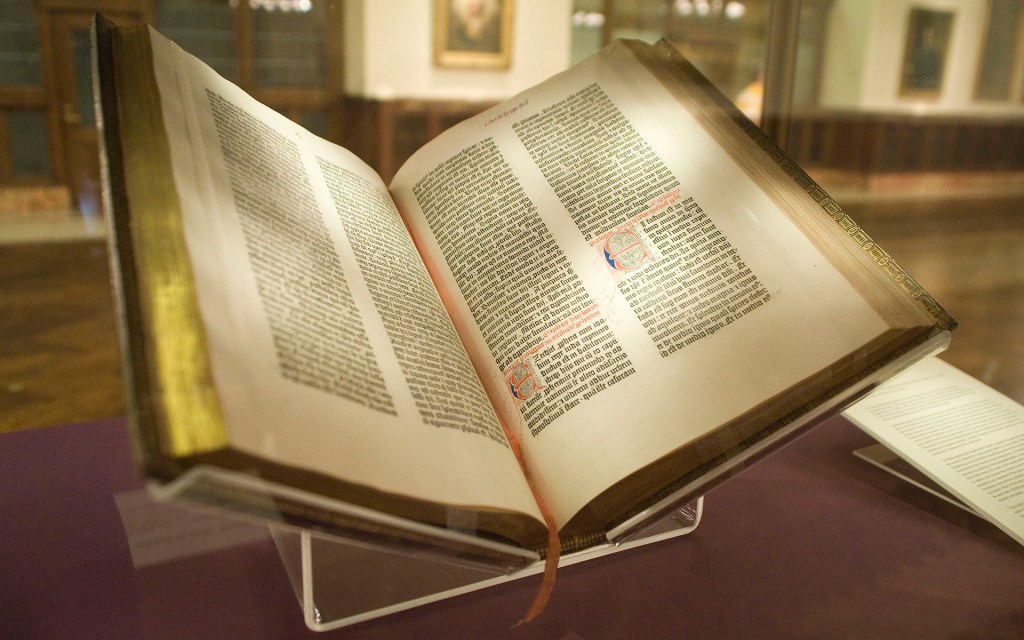
I wondered if a picture of (old) books from a library would do the trick. After all, if you post white papers and case studies on your business website, the documents serve as a “secret salesperson” to continue promoting your message, even when you’re not around.
I added this image to my Medium Writing Service description, and added a textual reference to a library in the descriptive text, and resubmitted it to the IS.
While I was at it, I added a textual reference to a town crier to the descriptive text for my Short Writing Service, and resubmitted that to the IS.
Because repurposing is good, I added those same images and text descriptions to the Short and Medium writing service descriptions on the Bredemarket website. I went ahead and added the images and text to the appropriate entries on the Bredemarket “Services” page on Facebook. (As I am writing this post, I realize that I probably ought to update some of the other services at some point. I’m putting that on the “to do” list.)
And now I waited to see if the new, improved (WITH EXTRA WORDS!) description of my Medium Writing Service would be approved by the IS.
You won’t believe what happened next!
And…the new submission was rejected.
Project category chosen doesn’t match the description or images
Because the IS doesn’t have a “white paper” category, I listed my Medium Writing Service under the “case study” category. However, my guess is that it doesn’t matter whether I use “case study” or “white paper” as my product category.
So, how do I illustrate a case study if I can’t show a literal case study?
Do I need to explicitly talk about case studies more frequently in my textual description?
At this point, I’m just going to sleep on it some more. Although if you have any suggestions, feel free to add them to the comments on this post.
And the exercise wasn’t a complete failure. Even though the Medium Writing Service remains unapproved, my Short Writing Service is now listed on the IS website, and I’ve made improvements to my Bredemarket web page and my Facebook page. Multiple wins for me; I get a cookie.