There’s a Reason Why “Tech” is a Four-Letter Word

By Tomia, original image en:User:Polylerus – Own work (Vector drawing based on Image:Profanity.JPG), Public Domain, https://commons.wikimedia.org/w/index.php?curid=3332425

We often use the phrase “four-letter word” to refer to cuss words that shouldn’t be said in polite company. Occasionally, we have our own words that we personally consider to be four-letter words. (Such as “BIPA.”)

There are some times when we resign ourselves to the fact that “tech” can be a four-letter word also. But there’s actually a good reason for the problems we have with today’s technology.

Tech can be dim

Just this week I was doing something on my smartphone and my screen got really dim all of a sudden, with no explanation.

So I went to my phone’s settings, and my brightness setting was down at the lowest level.

For no reason.

“Any sufficiently advanced technology is indistinguishable from magic.”

– Arthur C. Clarke, quoted here.

So I increased my screen’s brightness, and everything was back to normal. Or so I thought.

A little while later, my screen got dim again, so I went to the brightness setting…and was told that my brightness was very high. (Could have fooled me.)

I can’t remember what I did next (because when you are trying to fix something you can NEVER remember what you did next), but later my screen brightness was fine.

For no reason.

Was Arthur C. Clarke right? And if so, WHY was he right?

Perhaps it’s selective memory, but I don’t recall having this many technology problems when I was younger.

The shift to multi-purpose devices

Part of the reason for the increasing complexity of technology is that we make fewer and fewer single-purpose devices, and are manufacturing more and more multi-purpose devices.

One example of the shift: if I want to write a letter today, I can write it on my smartphone. (Assuming the screen is bright enough.) This same smartphone can perform my banking activities, play games, keep track of Bredemarket’s earnings…oh, and make phone calls.

Smartphones are an example of technologial convergence:

Technological convergence is a term that describes bringing previously unrelated technologies together, often in a single device. Smartphones might be the best possible example of such a convergence. Prior to the widespread adoption of smartphones, consumers generally relied on a collection of single-purpose devices. Some of these devices included telephones, wrist watches, digital cameras and global positioning system (GPS) navigators. Today, even low-end smartphones combine the functionality of all these separate devices, easily replacing them in a single device.

From a consumer perspective, technological convergence is often synonymous with innovation.

From https://www.techtarget.com/searchdatacenter/definition/technological-convergence

And the smartphone example certainly demonstrates innovation from the previous-generation single-purpose devices.

When I was a kid, if I wanted to write a letter, I had two choices:

  1. I could set a piece of paper on the table and write the letter with a writing implement such as a pen or pencil.
  2. I could roll a piece of paper into a typewriter and type the letter.

These were, for the most part, single purpose devices. Sure I could make a paper airplane out of the piece of paper, but I couldn’t use the typewriter to play a game or make a phone call.

Turning our attention to the typewriter, it certainly was a manufacturing marvel, and intricate precision was required to design the hammers that would hit the typewritter ribbon and leave their impressions on the piece of paper. And typewriters could break, and repairmen (back then they were mostly men) could fix them.

A smartphone is much more innovative than a smartphone. But it’s infinitely harder to figure out what is wrong with a smartphone.

The smartphone hardware alone is incredibly complex, with components from a multitude of manufacturers. Add the complexities of the operating system and all the different types of software that are loaded on a smartphone, and a single problem could result from a myriad of causes.

No wonder it seems like magic, even for the best of us.

Explaining technology

But this complexity has provided a number of jobs:

  • The helpful person at your cellular service provider who has acquired just enough information to recognize and fix an errant application.
  • The many people in call centers (the legitimate call centers, not the “we found a problem with your Windows computer” call scammers) who perform the same tasks at a distance.
By Earl Andrew at English Wikipedia – Own work, Public Domain, https://commons.wikimedia.org/w/index.php?curid=17793658
  • All the people who write instructions on how to use and fix all of our multi-purpose devices, from smartphones to computers to remote controls.

Oh, and the people that somehow have to succinctly explain to prospects why these multi-purpose devices are so great.

Because no one’s going to run into problems with technology unless they acquire the technology. And your firm has to get them to acquire your technology.

Crafting a technology marketing piece

So your firm’s marketer or writer has to craft some type of content that will make a prospect aware of your technology, and/or induce the prospect to consider purchasing the technology, and/or ideally convert the prospect into a paying customer.

Before your marketer or writer crafts the content, they have to answer some basic questions.

By Evan-Amos – Own work, Public Domain, https://commons.wikimedia.org/w/index.php?curid=11293857

Using a very simple single-purpose example of a hammer, here are the questions with explanations:

  • Why does the prospect need this technology? And why do you provide this technology? This rationale for why you are in business, and why your product exists, will help you make the sale. Does your prospect want to buy a hammer from a company that got tired of manufacturing plastic drink stirrers, or do they want to buy a hammer from a forester who wants to empower people to build useful items?
  • How does your firm provide this technology? If I want to insert a nail into a piece of wood, do I need to attach your device to an automobile or an aircraft carrier? No, the hammer will fit in your hand. (Assuming you have hands.)
  • What is the technology? Notice that the “why” and “how” questions come before the “what” question, because “why” and “how” are more critical. But you still have to explain what the technology is (with the caveat I mention below). Perhaps some of your prospects have no idea what a hammer is. Don’t assume they already know.
  • What is the goal of the technology? Does a hammer help you floss your teeth? No, it puts nails into wood.
  • What are the benefits of the technology? When I previously said that you should explain what the technology is, most prospects aren’t looking for detailed schematics. They primarily care about what the technology will do for them. For example, that hammer can keep their wooden structure from falling down. They don’t care about the exact composition of the metal in the hammer head.
  • Finally, who is the target audience for the technology? I don’t want to read through an entire marketing blurb and order a basic hammer, only to discover later that the product won’t help me keep two diamonds together but is really intended for wood. So don’t send an email to jewelers about your hammer. They have their own tools.
By Mauro Cateb – Own work, CC BY-SA 4.0, https://commons.wikimedia.org/w/index.php?curid=90944472

(UPDATE OCTOBER 23, 2023: “SIX QUESTIONS YOUR CONTENT CREATOR SHOULD ASK YOU IS SO 2022. DOWNLOAD THE NEWER “SEVEN QUESTIONS YOUR CONTENT CREATOR SHOULD ASK YOU” HERE.)

Once you answer these questions (more about the six questions in the Bredemarket e-book available here), your marketer or writer can craft your content.

Or, if you need help, Bredemarket (the technology content marketing expert) can craft your content, whether it’s a blog post, case study, white paper, or something else.

I’ve helped other technology firms explain their “hammers” to their target audiences, explaining the benefits, and answering the essential “why” questions about the hammers.

Can I help your technology firm communicate your message? Contact me.

Bredemarket logo

Which Words Should Your Marketers Use? My Four Suggestions.

I’ve talked about the words “why,” “how,” and “what” and their relation to writing, but I haven’t talked about the word “which.”

Not in relation to sandwiches, but in relation to words.

If you are a marketing executive, you know that the words you use in your marketing content can make or break your success. When your company asks employees or consultants to write marketing content for you, which words should they use?

Here are four suggestions for you and your writers to follow.

  1. Your writers should use the right words for your brand.
  2. Your writers should use the right words for your industry.
  3. Your writers should use words that get results.
  4. Your writers should be succinct.

Your writers should use the right words for your brand

Your company has a tone of voice, and your writers should know what it is. If you can’t tell them what it is, they will figure it out themselves.

Your company has a particular writing style—hopefully one that engages your prospects and customers. Regardless of your writer’s personal style, they must create copy that aligns with your own style. In effect, they put on a “mask” that aligns the words they create with the words that your company needs.

Your writers should use the right words for your industry

Similarly, your company provides products and services in one or more industries, and your copy must align with the terms those industries use, and the way industry participants express themselves.

For example, a writer who is writing content for the biometric industry will use different terms than a writer who is writing content for art collectors because of the differences in the two target audiences.

  • Biometric readers (the people, not the devices) care about matching accuracy measurements, such as those compiled by the U.S. National Institute of Standards and Technology (NIST) in its Face Recognition Vendor Test, or as measured in agency-managed benchmarks. (Mike French’s example.) They often respond to quantitative things, although more high-level concepts like “keeping citizens safe from repeat offenders” (a public safety-related benefit) also resonate.
  • Art collectors care about more qualitative things, such as not being scared of handing over their dream to a commissioned artist whose work will inspire affection. (Well, unless the collector is an art investor and not an art lover; investors use different terminology than lovers.)

So make sure your writers get the words right. Otherwise, it’s as if someone is speaking Italian to a bunch of French speakers. (Kaye Putnam’s example.) Your prospects will tune you out if you use words they don’t understand.

Your writers should use words that get results

There is one important exception to my suggestions above. If your company’s current words don’t result in action, quit using your current words and use better ones that support your awareness, consideration, conversion, or other goals.

If you start talking about your solution without addressing your prospect’s pain points or problems, they won’t know why they should care about your solution.

For example, let’s say that the message you want to give to your prospects is that your company makes wireless headphones.

So what?

The prospect doesn’t care about wireless headphones per se. The prospect cares about the troubles they face with tangled cords, and how your company offers a solution to their problem of tangled cords.

Features are important to you. Benefits are important to your prospects. Since the prospects are the ones with the money, listen to them and talk about benefits that change their lives, not how great your features are.

Your writers should be succinct

I have struggled with succinctness for decades. I could give you countless examples of my long-windedness, but…that wouldn’t be appropriate.

So how do I battle this personally? By creating a draft 0.5 before I create my draft 1. I figure out what I’m going to say, say it, and then sleep on the text—sometimes literally. When I take a fresh look at the text, I usually ruthlessly chop a bunch of it out and focus on the beef.

Now there are times in which detail is appropriate, but there are also times in which a succinct message gets better results.

Selecting your content marketer

If your company needs employees or consultants to write marketing content for you, make sure they create the right content.

If your company’s views on content creation parallel my own, maybe I can help you.

If you need a full-time employee on your staff to drive revenue as your personal Senior Product Marketing Manager or Senior Content Marketing Manager, take a look at my 29 years of technology (identity/biometric) and marketing experience on my LinkedIn profile. If you like what you see, contact me via LinkedIn or at jebredcal@gmail.com.

If you need a marketing consultant for a single project, then you can reach me via my Bredemarket consultancy.

Three Ways to Identify and Share Your Identity Firm’s Differentiators

(Part of the biometric product marketing expert series)

Are you an executive with a small or medium sized identity/biometrics firm?

If so, you want to share the story of your identity firm. But what are you going to say?

How will you figure out what makes your firm better than all the inferior identity firms that compete with you?

How will you get the word out about why your identity firm beats all the others?

Are you getting tired of my repeated questions?

Are you ready for the answers?

Your identity firm differs from all others

Over the last 29 years, I (John E. Bredehoft of Bredemarket) have worked for and with over a dozen identity firms, either as an employee or as a consultant.

You’d think that since I have worked for so many different identity firms, it’s an easy thing to start working with a new firm by simply slapping down the messaging that I’ve created for all the other identity firms.

Nothing could be further from the truth.

Designed by Freepik.

Every identity firm needs different messaging.

  • The messaging that I created in my various roles at IDEMIA and its corporate predecessors was dramatically different than the messaging I created as a Senior Product Marketing Manager at Incode Technologies, which was also very different from the messaging that I created for my previous Bredemarket clients.
  • IDEMIA benefits such as “servicing your needs anywhere in the world” and “applying our decades of identity experience to solve your problems” are not going to help with a U.S.-only firm that’s only a decade old.
  • Similarly, messaging for a company that develops its own facial recognition algorithms will necessarily differ from messaging for a company that chooses the best third-party facial recognition algorithms on the market.

So which messaging is right?

It depends on who is paying me.

How your differences affect your firm’s messaging

When creating messaging for your identity firm, one size does not fit all, for the reasons listed above.

The content of your messaging will differ, based upon your differentiators.

  • For example, if you were the U.S.-only firm established less than ten years ago, your messaging would emphasize the newness of your solution and approach, as opposed to the stodgy legacy companies that never updated their ideas.
  • And if your firm has certain types of end users, such as law enforcement users, your messaging would probably feature an abundance of U.S. flags.

In addition, the channels that you use for your messaging will differ.

Identity firms will not want to market on every single social media channel. They will only market on the channels where their most motivated buyers are present.

  • That may be your own website.
  • Or LinkedIn.
  • Or Facebook.
  • Or Twitter.
  • Or Instagram.
  • Or YouTube.
  • Or TikTok.
  • Or a private system only accessible to people with a Top Secret Clearance.
  • Or display advertisements located in airports.
From https://www.youtube.com/watch?v=H02iwWCrXew

It may be more than one of these channels, but it probably won’t be all of them.

But before you work on your content or channels, you need to know what to say, and how to communicate it.

How to know and communicate your differentiators

As we’ve noted, your firm is different than all others.

  • How do you know the differences?
  • How do you know what you want to talk about?
  • How do you know what you DON’T want to talk about?

Here are three methods to get you started on knowing and communicating your differentiators in your content.

Method One: The time-tested SWOT analysis

If you talk to a marketer for more than two seconds about positioning a company, the marketer will probably throw the acronym “SWOT” back at you. I’ve mentioned the SWOT acronym before.

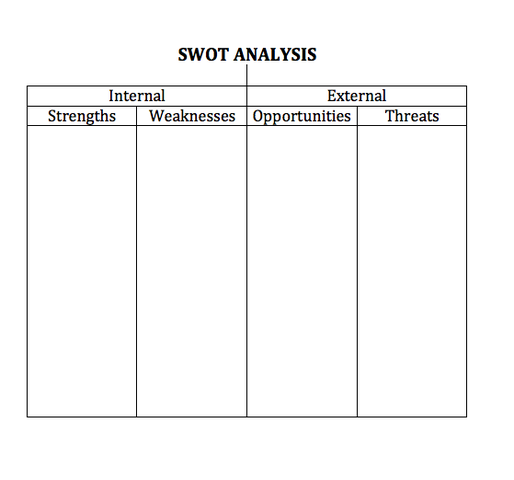
For those who don’t know the acronym, SWOT stands for

  • Strengths. These are internal attributes that benefit your firm. For example, your firm is winning a lot of business and growing in customer count and market share.
  • Weaknesses. These are also internal attributes, but in this case the attributes that detract from your firm. For example, you have very few customers.
  • Opportunities. These are external factors that enhance your firm. One example is a COVID or similar event that creates a surge in demand for contactless solutions.
  • Threats. The flip side is external factors that can harm your firm. One example is increasing privacy regulations that can slow or halt adoption of your product or service.

If you’re interested in more detail on the topic, there are a number of online sources that discuss SWOT analyses. Here’s TechTarget’s discussion of SWOT.

The common way to create the output from a SWOT analysis is to create four boxes and list each element (S, W, O, and T) within a box.

By Syassine – Own work, CC BY-SA 3.0, https://commons.wikimedia.org/w/index.php?curid=31368987

Once this is done, you’ll know that your messaging should emphasize the strengths and opportunities, and downplay or avoid the weaknesses and threats.

Or alternatively argue that the weaknesses and threats are really strengths and opportunities. (I’ve done this before.)

Method Two: Think before you create

Personally, I believe that a SWOT analysis is not enough. Before you use the SWOT findings to create content, there’s a little more work you have to do.

I recommend that before you create content, you should hold a kickoff of the content creation process and figure out what you want to do before you do it.

During that kickoff meeting, you should ask some questions to make sure you understand what needs to be done.

I’ve written about kickoffs and questions before, and I’m not going to repeat what I already said. If you want to know more:

Method Three: Send in the reinforcements

Now that you’ve locked down the messaging, it’s time to actually create the content that differentiates your identity firm from all the inferior identity firms in the market. While some companies can proceed right to content creation, others may run into one of two problems.

  • The identity firm doesn’t have any knowledgeable writers on staff. To create the content, you need people who understand the identity industry, and who know how to write. Some firms lack people with this knowledge and capability.
  • The identity firm has knowledgeable writers on staff, but they’re busy. Some companies have too many things to do at once, and any knowledgeable writers that are on staff may be unavailable due to other priorities.
Your current staff may have too much to do. By Backlit – Own work, CC BY-SA 3.0, https://commons.wikimedia.org/w/index.php?curid=12225421

This is where you supplement you identity firm’s existing staff with one or more knowledgeable writers who can work with you to create the content that leaves your inferior competitors in the dust.

What is next?

So do you need a knowledgeable biometric content marketing expert to create your content?

One who has been in the biometric industry for 29 years?

One who has been writing short and long form content for more than 29 years?

Are you getting tired of my repeated questions again?

Well then I’ll just tell you that Bredemarket is the answer to your identity/biometric content marketing needs.

Are you ready to take your identity firm to the next level with a compelling message that increases awareness, consideration, conversion, and long-term revenue? Let’s talk today!

Pilots, Co-Pilots, and Marketing and Writing Services

I’ve always been amused by this bumper sticker saying.

The phrase “God is my co-pilot,” taken from pilot Robert L. Scott Jr.’s World War II autobiography of the same name, superficially appears to depict a fervent religious devotion.

But look at it again.

Military pilots have a huge reputation for supersized egos. Not that I necessarily have a problem with egos, but this must be recognized. And the phrase above bears it out.

  • Scott is the pilot, in charge of things.
  • God is the co-pilot, subservient to Scott’s every command. Heck, since Scott runs the show, God might as well be a mere passenger.

But this is not only a religious issue.

Who controls artificial intelligence?

If you’re going to employ generative artificial intelligence (generative AI) to create your written work, you need to decide who will be the pilot, and who will be the co-pilot.

  • You could send the prompt off to your favorite generative AI tool and let it shape the words you will communicate to your customers. In this case, the tool is the pilot, and you’re just the co-pilot.
Designed by Freepik.

(The perceptive ones among you have already noted that I treat text and images differently. In the image above, I clearly took the co-pilot’s seat and let Freepik pilot the process. My raving egotism does not extend to my graphic capabilities.)

This concept of AI as a co-pilot rather than a pilot is not just my egotistical opinion.

When GitHub implemented its generative AI coding solution, it named the solution “GitHub Copilot.” The clear implication is that the human coder is still running the show, while GitHub Copilot is helping out its boss.

But enough about generative AI. Heaven knows I’ve been spouting off about that a lot lately. Let’s turn to another topic I spout off about a lot—how you should work with your content creator to generate your content marketing text.

Who should pilot a content marketing project?

Assume for the moment that your company has decided NOT to entrust its content marketing text to a generative AI tool, and instead has contracted with a human content marketing expert to create the text.

Again, there are two ways to approach the task.

  • The first approach is to yield all control to the expert. You sit back, relax, and tell your content marketing consultant to do whatever they want. They provide the text, and you pay the consultant with no questions asked. The content marketing consultant is the pilot here.
  • The second approach is to retain all control yourself. You tell the content marketing consultant exactly what you want, and exactly what words to say to describe your best-of-breed, game-changing, paradigm-shifting, outcome-optimizing solution. (That last sentence was painful to write, but I did it for you.) The content marketing consultant follows your exact commands and produces the copy with the exact words you want. You are the pilot here.

So which of these two methods is the best way to create content?

As far as I’m concerned, neither of them.

Which is why Bredemarket doesn’t work that way.

Can two people pilot a content marketing project?

Bredemarket’s preferred content creation process is a collaborative one, in which you and I both control the process. While in the end you are the de facto pilot since you control the purse-strings, Bredemarket emphasizes and follows this collaborative approach.

Throughout this collaborative and iterative package we both pilot the process, and we both contribute our unique strengths to produce the final written product.

Are you ready to collaborate?

If you have content marketing needs that Bredemarket can help you achieve, let me know and we’ll talk about how to pilot a content marketing project together.

My…Umm..Opportunity is YOUR Opportunity

A little over a year ago, Bredemarket announced two changes in my business scope and business hours. I stopped accepting work from clients who marketed systems to identify individuals, and I reduced my business hours to Saturday mornings only.

Generated at craiyon.com.

I had to change my business scope and business hours. On May 9, 2022, I started a full-time position with a company in the identity industry, which meant that I couldn’t consult on weekdays and couldn’t consult on identity projects.

But things change.

As of May 31, 2023, I will no longer be employed at my day job.

Which is my misfortune…um…opportunity.

Generated at craiyon.com.

Has Bredemarket changed its business scope and business hours a second time?

Yes.

As of June 1, 2023:

  • If you need a consultant for marketing or proposal work, and your company is involved in the identification of individuals, Bredemarket can accept the work.
  • If you need a consultant who can meet with you during normal business hours, Bredemarket can accept the work.

So what?

My…um…opportunity is your opportunity.

Now that I can expand my business scope and business hours again, you can take advantage of my extensive marketing expertise, including deep experience in the identity industry.

This means you can obtain quickly-generated and expert content with an agreed-upon focus.

This means you can get content that increases your revenue.

What kind of content?

Blog posts, case studies and testimonials, proposals and proposal text, white papers, and many other types of content.

How about e-books?

Yes I also write e-books.

These two e-books explain (a) how Bredemarket starts a project with you, and (b) how Bredemarket has helped other businesses over the years.

(UPDATE OCTOBER 22, 2023: “SIX QUESTIONS YOUR CONTENT CREATOR SHOULD ASK YOU IS SO 2022. DOWNLOAD THE NEWER “SEVEN QUESTIONS YOUR CONTENT CREATOR SHOULD ASK YOU” HERE.)

How can I find out more information about Bredemarket?

Contact me.

But wait…what if Bredemarket changes its business hours and business scope a THIRD time?

I very well could change Bredemarket’s business hours/scope again.

Maybe I’ll find a new full-time position in a couple of weeks, and I’ll again have to reduce hours and scope.

Which basically means that you have to ACT QUICKLY to ensure you can reserve my services.

(See “how to create a sense of urgency.”)

Generated at craiyon.com.

Marketing Ontario, California businesses through blog posts

I just added a page to the Bredemarket website entitled “Blog posts for your Ontario, California business.”

Now that’s Ontario California, not Ontario Canada.

Let me quote a little bit from the page I just created.

For example, let’s say that an Ontario, California content marketing expert wants to target businesses who need blog post writing services. This expert will then create a web page, and possibly a companion blog post, to attract those businesses.

From https://bredemarket.com/iew-ontario-blog/

You’re now reading the “companion blog post.”

Why did I write the companion blog post?

If I’m going to talk about blogging, I need a blog post to go with it, right?

The other purpose of this blog post is to direct you to the web page. I don’t want to repeat the exact same copy from the web page on the blog post, or the search engines will not like me. And you may not like me either.

If you’re an Ontario, California business who is looking for an effective method to promote your firm, and a description of how to move forward, go to the Bredemarket web page “Blog posts for your Ontario, California business.”

Why should I read the web page?

Needless to say, you only need to read the web page if you’re an Ontario, California business. Well, I guess Fontana businesses can read it also; just ignore the video with Mayor Leon and substitute a video with Mayor Warrent instead.

The web page addresses the following topics, among others:

  • Why do you want to use content marketing to promote your Ontario business? (The web page also addresses inbound marketing.)
  • Why do you want to use blog posts to promote your Ontario business?
  • How can an Ontario business create a blog post?
  • How can an Ontario business find a blog post writer?
  • What should you do next?

If you’re asking yourself these questions, go here to find the answers.

And what about social media?

Perhaps you’re reading this blog post because you learned about it on social media.

The web page includes a paragraph on promoting blog posts via social media, if that interests you.

Yes, that’s an old picture. Although some websites still reference Google+ today.

What Technologists Should Do Before Commissioning Thought Leadership Pieces

“Thought leadership” is the rage in all sorts of enterprises, including technology companies.

By CrisNYCa – Own work, CC BY-SA 4.0, https://commons.wikimedia.org/w/index.php?curid=94532194

But should you hop on the bandwagon? And if you do, how should you proceed?

Why technology thought leadership is important

Should you hop on the thought leadership bandwagon? I suggest that you should.

Why? Michael Brenner’s “The Smart CIO’s Guide to Thought Leadership in Tech” explains.

Tech is the fastest-changing industry in the world. New innovations, tools, and capabilities are continuously reshaping the way every company does business….

Companies of all types, then, turn to tech thought leadership to understand emerging trends and potential disruptions.

For CIOs and other tech thought leaders, this presents a huge opportunity. Establishing yourself as a tech thought leader gives you a wide audience and a platform for increasing your brand’s (and your own) visibility.

From https://marketinginsidergroup.com/content-marketing/thought-leadership-in-tech/

Benefits for your business and yourself? Sounds like a win-win to me. Be sure to read Brenner’s article for more of his thoughts.

Who should write the thought leadership piece?

Ready to be a thought leader? You need to get someone to write the thought leadership piece.

  • You could write it yourself.
  • You could have someone write it for you.
  • You could work with a writer and collaboratively create the piece.

How you work is up to you. Perhaps you have communication experience and know how to convey technical thoughts to non-technical audiences. Or perhaps you dread writing and would love to pass that task to someone else.

Now what?

Once you’ve decided who will write your thought leadership piece, you don’t want to just start typing. You need to prepare.

Whether you’re writing the first draft, or someone else is writing the first draft, you need to specify your needs for the piece.

And ask some questions before you start writing.

Click on the image below to find out what questions you need to ask.

How Bredemarket’s Six Questions Support Strategic Content Marketing

(UPDATE OCTOBER 23, 2023: “SIX QUESTIONS YOUR CONTENT CREATOR SHOULD ASK YOU IS SO 2022. DOWNLOAD THE NEWER “SEVEN QUESTIONS YOUR CONTENT CREATOR SHOULD ASK YOU” HERE.)

Just for fun, I’m going to challenge my assertion that there are six questions that your content creator must ask you before creating content.

I ought to know about these six questions. As a content marketing expert, I wrote the book on the topic.

To download this e-book, go to https://bredemarket.com/2022/12/18/six-questions-your-content-creator-should-ask-you-the-e-book-version/.

If you haven’t read the e-book, the six questions are:

  1. Why?
  2. How?
  3. What?
  4. Goal?
  5. Benefits?
  6. Target Audience?

The idea is that your content creator hosts a kickoff session, asks you the six questions, and only then starts to create the content in question—the blog post, case study, or whatever.

Are the six questions overkill?

But simplicity advocates may argue that those six questions are five questions too many.

Analysis paralysis may prevent you from moving forward at all, much less realizing your content creation goal. Perhaps you should be more efficient and just put pen to paper and, as the shoe people say, just do it.

I found a content marketing expert who agreed with this assertion, and wrote a post entitled “In marketing, move quickly.”

That content marketing expert was…well, it was me.

I ran across a local company (which I will not name) that issued a press release in December 2021. In part, the press release mentioned the local company’s new dedication to the marketing function.

From https://bredemarket.com/2022/03/23/in-marketing-move-quickly/

The company had hired an international marketing firm “to develop comprehensive marketing strategies….We expect their work to incorporate a website redesign, brand refresh, new strategic messaging and content, as well as focused video and digital campaigns.”

So, when I wrote the “In marketing, move quickly” post three months later, what had this international marketing firm accomplished in the interim?

The website has a full slew of data sheets on the company’s products, and I found a 2017 brochure that effectively served as a white paper. But that’s it; no other white papers, and no case studies describing happy customers’ experiences.

The company’s YouTube channel has two videos from 2021.

The company’s Facebook page hasn’t posted anything since 2017.

Neither of the company’s LinkedIn pages (yes, the company has two LinkedIn pages) has any posts.

From https://bredemarket.com/2022/03/23/in-marketing-move-quickly/

Now I have no visibility into this particular company, but I’ve been around the block to guess that the international marketing firm was probably still in the analysis stage, optimizing synergies according to “out of the box” criteria, to ensure bleeding-edge revenue maximization.

No, the six questions aren’t overkill

After reviewing what I wrote before in that blog post, I realize that my e-book lacks a very important point.

Don’t spend three months answering the six questions.

I shouldn’t HAVE to say this, but perhaps it’s safer to explicitly say it.

Now practices can very from consultation to consultation, but it’s very likely that a content creator and their client can breeze through those six questions in half an hour or less.

Or maybe the client can answer the questions on their own before the meeting.

If your content marketing expert schedules six one-hour meetings (or worse still, workshops) to address the six questions, run away!

(Is the content marketing expert billing by the hour?)

And the six questions create a content strategy

There’s something else that I failed to explicitly say in my e-book.

Not only do the answers to the six questions benefit that one piece of content, but they benefit everything else that your company does.

For example, let’s say that a content marketing expert is working with a gourmet ice cream shoppe (not a shop, but a shoppe), and the proprietor (Jane Cold) answers the “how” question as follows:

At Jane’s Gourmet Ice Cream Shoppe, we keep the internal dining temperature below 50 degrees Fahrenheit to ensure that our guests enjoy ice cream as it was meant to be enjoyed. We inform our guests of our temperature policy beforehand to ensure they bring proper attire.

By Edward S. Curtis – This file was derived from: Inupiat Family from Noatak, Alaska, 1929, Edward S. Curtis.jpg, Public Domain, https://commons.wikimedia.org/w/index.php?curid=24953870

Now let’s say that the piece of content in question is a social media post describing a new farkleberry ice cream flavor. (Thanks, Live Eat Learn.)

By Eric Hunt – Own work, CC BY-SA 4.0, https://commons.wikimedia.org/w/index.php?curid=85068643

While the content marketing expert will use the answer to the “how” question to create the content, the ramifications go far beyond the social media post itself.

  • Perhaps the new flavor could be branded “Frigid Farkleberry” to suggest how the ice cream should best be enjoyed.
  • Maybe in addition to branding, the “how” answer may even influence pricing. Perhaps prices incorporate the number “32,” as in a single-scoop price of $4.32. (Yes that price is high, but after all this is an ice cream shoppe.)

And what of future social media posts?

Let me clue you in on a little secret: once your content marketing expert has asked the six questions for the first piece of content, the kickoff is much quicker for subsequent pieces of content.

Chances are the basic “why” and “how” won’t change, although some of the later questions such as the target audience could change for each individual piece of content.

So without explicitly trying to do so, the six questions have created a de facto content marketing strategy. After creating five pieces of content, you’ve essentially defined your company’s mission, purpose, and differentiators, and may have defined as many as five separate vertical markets along the way.

Not a bad investment of thirty minutes of time.

(But a terrible investment of three months of time.)

An exercise for you

Normally this is the point where I’d tell you to contact me if you want to use Bredemarket’s content marketing expertise. But this time I’m going to do something different.

  • Why don’t you think of a piece of content you want to create?
  • Once you’ve decided on that, why don’t you ask yourself the six questions?
  • Once you have the answers, why don’t you see what type of overall content marketing strategy you can shape, solely based on those six responses?

4 Actions for IE Firms Needing Rapid Written Content

About a year ago, I wrote a two-part series of posts entitled “In marketing, move quickly.”

How can you move quickly?

If you’re an Inland Empire business that needs rapid written content creation, I’ll tell you how Bredemarket can help you create that content.

Why move quickly?

On the 99.9% chance that you didn’t read my two posts on this topic, here’s a brief TL;DR on what I (and others) said.

By Malene Thyssen – Own work, CC BY-SA 3.0, https://commons.wikimedia.org/w/index.php?curid=10119596
  • If you don’t move quickly, you may miss your opportunity.
  • The first post mentioned a company (whom I didn’t name) that hired an international marketing company in December 2021, but that hadn’t created any customer-facing content by March 2022.
  • The first post also mentioned a bank that put a customer-facing email test togehter in eight weeks.
  • Oh, and John DeLorean took eight years to get his car out, which didn’t help with his financing issues.
  • On the positive side, the second post described how one company moved quickly. Rather than waiting for a centralized content creator to distribute content, Intuit provided guidelines so that its employees could extend the reach of Intuit’s content through their own social media posts.
  • The second post also noted that quick generation of content is appreciated by customers, vendors, and partners.

How can you move quickly?

So let’s say you’re an Inland Empire business who needs to create between 400 and 600 words of content quickly, such as the text for a brochure, a blog post, or a LinkedIn or Facebook post.

How can you get it out quickly?

How can you avoid waiting eight weeks, or three months, or eight years for your customers to see your content?

Here are four actions you can take to get your content out.

  1. Specify your content needs.
  2. Ensure you are available.
  3. Ensure your content creator is available.
  4. Book your content creator.

I’ll describe these four actions below.

One: Specify your content needs

If you rush to create content without thinking through your needs, your content won’t be that effective. Take some time up front to plan what your content will be.

Ask yourself critical questions about your content.

(UPDATE OCTOBER 22, 2023: “SIX QUESTIONS YOUR CONTENT CREATOR SHOULD ASK YOU IS SO 2022. DOWNLOAD THE NEWER “SEVEN QUESTIONS YOUR CONTENT CREATOR SHOULD ASK YOU” HERE.)

Don’t know what to ask? I’ve written an e-book entitled “Six Questions Your Content Creator Should Ask You.”

The six questions (hint: you’ve already seen two of them in the first two parts of this post):

  1. Why?
  2. How?
  3. What?
  4. Goal?
  5. Benefits?
  6. Target Audience?

When Bredemarket meets with a customer, I ask more than these six questions, but they’re the most important ones.

If you can answer these questions, either on your own or with the help of your content creator, then you’ll have a roadmap that allows you to create the content together.

Two: Ensure you are available

Note the word “together” in the paragraph above.

After you meet with your content creator, your part of the task isn’t done. Or shouldn’t be.

When Bredemarket creates content for a customer, there are points within the process where the customer reviews the content and makes suggestions. Normally when I create between 400 and 600 words of content using the Bredemarket 400 Short Writing Service, there are two review cycles. Here’s how I explain them:

  • Bredemarket iteratively provides two review copies of the draft content within three days per review. (The number of review cycles and review time must agree with any due dates.) The draft content advances your goal, communicates your benefits, and speaks to your target audience in your preferred tone of voice. Relevant examples and key words/hashtags are included.
  • You return comments on each review copy within three days. For longer content, you may provide the draft formatted copy for the final review.

Why? (If you read my e-book, you know the “why” question is important.)

Maybe I have questions that popped up while I was drafting the content. Maybe something occurs to you after you see the draft content. Whatever the reason, these review cycles provide opportunities to improve the content as I develop it.

But to get your feedback, you have to be available. The standard process gives you three days to return your comments, although of course you can return them faster. But if you don’t return your comments for weeks or months…well, that kind of kills the idea of getting the content out quickly.

Of course, in some cases delays are unavoidable. One of my customers was dependent on a third party to complete his part of the review, but the third party was not delivering. In that case, there was nothing the customer could do, and that content was delayed.

One critical question: what if you need your content very quickly?

  • Now if you add up all the times in the Bredemarket 400 process, your total comes to fourteen days: one day for the review, three days for me to create the first draft, three days for your review, three days for my second draft, three days for your second review, and one day for the final copy.
  • If you need it in one week rather than two weeks, then we jointly need to figure out a faster cadence of reviews. I can adjust the schedule to meet your due dates.
  • But you have to be available for the reviews.
  • And as I note below, I have to be available for the creation.

So when you’re planning to have Bredemarket or another content creator generate something for you, remember that you’ll need to spend a little bit of time on reviews.

Three: Ensure your content creator is available

You know how I said that the Bredemarket 400 process gives you three days to review each content iteration? Well, at the same time it gives me three days to draft (and redraft) the content.

Can I, or the content creator you select, hold up our end of the process?

Right now I’m going to tell you something that has happened since I wrote those two “In marketing, move quickly” posts in March 2022. In May 2022, I accepted a full-time position with an identity company, and therefore no longer spend full time on Bredemarket activities.

Therefore, if you need to meet with me Monday to Friday between 8 am and 5 pm (Pacific), I can’t meet you. I have my day job to worry about.

I have regular office hours on Saturday mornings when I can meet with you, and I can arrange to be available on weekday evenings or early weekday mornings. And of course I can draft your content and incorporate your suggestions at those times also, outside of regular business hours.

But if you need a content creator that is available during regular (Inland Empire) business hours, then you’ll need to select someone else.

Just make sure that the content creator you select is available when you need them.

Four: Book your content creator

When you’re ready to move, move. If you don’t start the process of creating your critical content, by definition you’ll never finish it.

So take the next step and find someone who will create your content. There are a number of content creators who serve Inland Empire businesses.

But if you want to use the Ontario, California content marketing expert, contact me at Bredemarket and I’ll arrange a meeting. Be prepared for me to ask you a few questions.