(Pizza Stories) Is Your Firm Hungry for Awareness?

Leftover pizza is the best pizza. Preparation credit: Pizza N Such, Claremont, California. Can I earn free pizza as a powerful influencer? Probably not, but I’ll disclose on the 0.00001% chance that I do.

I wrote a post about pizza that concluded as follows:

Tal’s lead was hungry for ghostwriting services, and when they saw that Tal offered such a service, they contacted him.

What does this mean? I’ll go into that in a separate post.

From (Pizza Stories) The Worst Time to READ a Pizza Post on Social Media.

Now that it’s time to write the “separate post,” I really don’t want to get into the mechanics of how posts that attract prospects (hungry people, target audience) increase awareness and help you convert prospects for your products and services.

So forget that. I’m going to tell a story instead about two executives at a fictional company that has a real problem. The executives’ names are Jones and Smith.

The story

Jones was troubled. Sales weren’t increasing, prospects weren’t appearing, and if this malaise continued the company would have to conduct a second round of layoffs. Jones knew that “rightsizing” would be disastrous, so the company needed another solution.

So Jones videoconferenced Smith and asked, “How can we make 2024 better than 2023?”

Smith replied, “Increasing sales calls could help, and ads could help, but there’s another way to increase our awareness with our prospects. We could create content on our website and on our social channels that spreads knowledge of our products and services.”

Jones exclaimed, “That’s great! We could get generative AI to create content for us!”

“No, not that!” Smith replied. “Generative AI text sounds like a bot wrote it, and makes us sound boring, just like everyone else using generative AI text. Do we want to sound like that and put our prospects to sleep?”

By Ilya Repin – Tretyakov Gallery, Moscow, Public Domain, https://commons.wikimedia.org/w/index.php?curid=60387757

“So we need a human writer,” Jones realized, “one who can describe all of the features of our products.”

“Absolutely not,” Smith emphasized. “Customers don’t care about our features. They care about the benefits we can provide to them. If we just list a bunch of features, they’ll say, ‘So what?'”

By Mindaugas Danys from Vilnius, Lithuania, Lithuania – scream and shout, CC BY 2.0, https://commons.wikimedia.org/w/index.php?curid=44907034

“OK, we’ll go with benefits,” said Jones. “But why is content so important?”

Take blogging,” replied Smith. “The average company that blogs generates 55% more website visitors. B2B marketers that use blogs get 67% more leads than those who do not. Marketers who have prioritized blogging are 13x more likely to enjoy positive ROI. And 92% of companies who blog multiple times per day have acquired a customer from their blog.”

“Wow.” Jones was silent for a moment. “How do you know all of this stuff, Smith?”

“Because of the content that I’ve read online from a marketing and writing services company called Bredemarket. The company creates content to urge others to create content. Bredemarket eats its own wildebeest food.”


“Wildebeest?” Jones eyed Smith quizzically.

Black wildebeest. By derekkeats – Flickr: IMG_4955_facebook, CC BY-SA 2.0, https://commons.wikimedia.org/w/index.php?curid=14620744

“Never mind. The important thing is that Bredemarket’s marketing and writing services could help us increase awareness, and vault us over the companies that have blogs but don’t bother to post to them. In one industry, about one-third of the companies with blogs HAVEN’T SAID A SINGLE THING to their prospects and customers in the last two months. If we were in that industry, we could leapfrog over the silent companies.”

“That sounds great,” said Jones. “Let’s contact Bredemarket today.”

“Wonderful idea, Jones. By the way, I hear that Bredemarket excels at repurposing content also.”

The excited Jones asked Smith to contact Bredemarket, and then walked to a nearby venue and sang a song.

From https://www.youtube.com/watch?v=ifhcWeXIOZs

Explaining the Confusion of Wildebeest

I’ve been using the word “wildebeest” more often lately. In the Bredemarket blog, on Bredemarket’s LinkedIn pages, on my own LinkedIn page, and even in a job application cover letter.

For those who don’t know why I’m so hot on wildebeest, let me explain.

It all started with the dogs

When I started Bredemarket as a marketing and writing service firm, it stood to reason that I would have to market and write about Bredemarket itself.

There’s a common phrase for this practice: “eating your own dog food.”

Another John (a Mr. Carson) took “eating your own dog food” literally. From NBC. This picture from Madly Odd, https://madlyodd.com/johnny-carson-alpo-dog-food-ad/

It’s a VERY common phrase.

And that’s a problem, because people who eat their own dog food sound just like everybody else.

So I moved to iguanas

It’s important to differentiate yourself from the competition. Trust me on this.

So I stopped talking about eating my own dog food, and when I set my initial goals for 2021 in December 2020, one of my goals was “eat my own iguana food.”
But then I moved on

But for some reason the iguana emphasis left me cold, and I quietly pivoted back to mammals a little over a month later.

Black wildebeest. By derekkeats – Flickr: IMG_4955_facebook, CC BY-SA 2.0, https://commons.wikimedia.org/w/index.php?curid=14620744

Now I don’t always eat my own wildebeest food myself in this regard. I’ve previously noted that my Empoprise-NTN blog isn’t updated regularly…

From https://bredemarket.com/2021/01/25/three-ways-to-prove-to-your-customers-that-your-firm-is-an-ongoing-viable-concern/

(Which reminds me; time to update Empoprise-NTN again. If Buzztime even exists any more.)

The following month I made it official in “When wildebeests propose.”

You’ve heard the saying about eating your own dog food. That statement bored me, so I started talking about eating your own iguana food. Eventually I tired of iguanas and pivoted to wildebeests.

From https://bredemarket.com/2021/02/09/when-wildebeests-propose/

And for over 2 1/2 years I’ve continued to focus on the majestic wildebeest, both singly and in confusion (the correct term for a group of wildebeest). Let’s face it: how many other marketing and writing experts are talking about wildebeest? It’s my own little distinctive thingie.

The problem with wildebeest

But now I’m asking myself whether this is a GOOD distinction. After all, the common definition of “confusion” is NOT a positive one. Unless you’re a New Order fan.

From https://www.youtube.com/watch?v=c_L_-CKg6pw

So perhaps I’ll retire the wildebeest for something new that more closely reflects Bredemarket’s differentiators:

I help firms win by explaining why the firm serves its customers, focusing on customer needs, and highlighting benefits.

Yes, those are the same differentiators that I currently include in my personal LinkedIn profile. But after all, Bredemarket is a one-person operation.

sin, a one-man band in New York City. By slgckgc – https://www.flickr.com/photos/slgc/8037345945/, CC BY 2.0, https://commons.wikimedia.org/w/index.php?curid=47370848

If you have an idea of something that is better than a dog, an iguana, or a wildebeest, post it in the comments.

What is Your Tone of Voice?

We relate to firms as entities with personalities…and particular tones of voice. Could you imagine Procter & Gamble speaking in Apple’s tone of voice, or vice versa?

And one more thing…Charmin. Now in black.

(Thunderous applause and royal adoration with no indifference whatsoever.)

Designed by Freepik.

When you contract with a writer

Firms take care to speak in a particular tone of voice. Which means that the people writing their copy have to speak in that same tone of voice.

I have spent time thinking about Bredemarket’s own tone of voice, most recently when I delved into the “royalty” aspects of the Bredemarket family of archetypes. In that family “Sage” is most dominant, but there are also other elements.

Bredemarket’s top archetypes: sage, explorer, royalty, and entertainer.

In Bredemarket’s case, my sage/explorer/royalty/entertainer tone of voice is visible in Bredemarket’s writing. At least in Bredemarket’s SELF-promotional writing.

But MY tone of voice makes no difference to my clients, all of whom are focused on their OWN tones of voice. And Bredemarket has to adjust to EACH CLIENT’S tone of voice.

  • If I’m writing for a toilet paper manufacturer, I will NOT delve into details of how the product is used. Then again, maybe I will. Times have changed since Mr. Whipple.
  • If I’m writing for a cool consumer electronics firm, I definitely WILL delve into product use…if it’s cool.
  • If I’m writing for a technologist, I’m not going to throw a lot of music references into the technologist’s writing. I will emphasize the technologist’s expertise.
  • If I’m writing for a firm dedicated to advancement, I’m not going to throw ancient references into the firm’s writing. I will emphasize the newness of the firm’s approach, using the firm’s own key words.

My hope is that if you see two pieces of ghostwritten (work-for-hire) Bredemarket work for two different clients, you WON’T be able to tell that they were both written by me.

When your writer dons your mask

I’ve addressed the topic of adaptation before, where people don masks to portray characters that they are not.

By JamesHarrison – Own work, Public Domain, https://commons.wikimedia.org/w/index.php?curid=4873863

At the time I said the following:

So when Bredemarket or another content marketing expert starts to write something for you, should you fret and fuss over what your archetype is?

If you feel like it. But it’s not essential.

What is essential is that you have some concept of the tone of voice that you want to use in your communication.

From https://bredemarket.com/2022/10/30/donning-archetypes/

I then led into…well, something that is long outdated. But the gist of what I said at the time is that you need to determine what your firm’s tone of voice is, so that your writers can consistently write in that tone of voice.

Creating content with your tone of voice

So if Bredemarket works with you to create your content, how will I know your desired tone of voice? By one of two ways.

  1. You tell me.
  2. I ask you.
Bredemarket’s first seven questions, the October 30, 2023 version.

As we work through the seven questions that will shape your content, I ensure that I understand the tone of voice that you want to adopt in your content.

And with the review cycles interspersed through the content creation process, you can confirm that the tone is correct, and I can make adjustments as needed.

Unless you absolutely insist that I use a hackneyed phrase like “best of breed.” That requires a significant extra charge.

Do you want to drive content results in your own tone of voice with Bredemarket’s help?

Here’s how.

Brand Archetypes: I Am Royalty, But I Am Not Royalty

When I investigated Bredemarket’s archetypes back in 2021, the Kaye Putnam quiz that I took identified my primary archetype (sage) and three sub-archetypes (explorer, royalty, and entertainer).

Of my four top archetypes, the one that I haven’t really, um, explored is the “Royalty” brand archetype. This archetype was a surprise to me, and upon researching it further it fits me…and it doesn’t fit me.

I am Royalty

By United Kingdom Government – Illustrated magazine, 13 December 1952, p. 14. Copyright label: “CROWN COPYRIGHT RESERVED” (no other labels or attributions)., Public Domain, https://commons.wikimedia.org/w/index.php?curid=64590096

Using Kaye Putnam’s description of the Royalty brand archetype, I found some elements that spoke to me personally.

Whether you resonate with being a boss, aristocrat, king, queen, politician, or manager, your brand possesses the incredible power to evoke feelings of awe, admiration, and the promise of shared success in those who encounter it.

From https://www.kayeputnam.com/brand-archetype-royalty/

Let’s face it: I am the strong-willed person who self-brands as the temperamental writer, often moved to take charge of a situation, and frankly craving admiration and protesting indifference.

For example, for the last several weeks I’ve been tracking both impression and (more importantly) engagement statistics for my personal LinkedIn account and the Bredemarket website. What does engagement mean? In its most basic terms, it can be expressed as (in Sally Field’s words) “you like me.”

From https://www.youtube.com/watch?v=rl_NpdAy3WY

I am not Royalty

The “King” and the “Duke.” By Twain, Mark, 1835-1910 – Adventures of Huckleberry Finn.djvu, Public Domain, https://commons.wikimedia.org/w/index.php?curid=44881563

So those behaviors align with the Royalty archetype. But others do not.

Your brand exudes a sense of impeccable taste, inspiring others to aspire to your level of refinement.

From https://www.kayeputnam.com/brand-archetype-royalty/

I don’t think anyone would use the words “impeccable taste” and “level of refinement” to describe me. Even when I do wear a tie.

John E. Bredehoft at Bredemarket worldwide headquarters in Ontario, California, September 6, 2023.

So maybe I’m not elegant Royalty, just Royalty with an attitude.

Lorde, Reign O’er Me

Ever since I conceived the idea for this blog post, I wanted to work the Lorde song “Royals” into it if possible. But the song doesn’t really fit, since it’s really about established musical royalty who resist young upstarts like Lorde.

(Young but not young. Even a decade ago when the song was released, I was amused at the world-weariness expressed by a teenager. But I digress.)

And as Marc Bodnik notes, the song is contradictory:

The great irony of the lyrics is that “we’ll never be royals” but she keeps talking about becoming Queen and talks about “ruling.”…Will Lorde’s new rule be any better than the current regime? Who knows.

From https://www.huffpost.com/entry/what-does-the-song-royals_b_4310438

In an Abbott and Costello way, “Who” DID know.

The same lyricist who hoped to die before he got old (spoiler: he didn’t) subsequently wrote the lyric

Meet the new boss

Same as the old boss

From https://genius.com/The-who-wont-get-fooled-again-lyrics

Despite my employment background, I’m not a royal with revolutionary tendencies.

But I can don masks, which does matter.

To be continued…

Measuring Goals: What Cathy Camera Says

I am repurposing my recent e-book “Seven Questions Your Content Creator Should Ask You” as a post series on the Bredemarket Instagram account. I am doing this because series are cool and stuff. Whether or not my readers are anticipating each new post in the series is up for debate. Maybe all of them have read the e-book already. (Or maybe not.)

Monday’s Instagram post on the goal of your content

Anyway, on Monday I got to the fifth post in the Instagram series. Here’s what the post image looks like. (The Yogi Berra-themed image is timely with baseball’s World Series going on right now, even though the Yankees are nowhere near it.)

And here’s the text that accompanied the Instagram post:

The fourth of the seven questions your content creator should ask you is Goal?
It’s important that you set a goal.
Maybe awareness. Maybe consideration. Maybe conversion. Maybe something else.
As Yogi Berra reportedly said, “if you don’t know where you are going, you might end up someplace else.” And that “someplace else” might not be where you want to be.
#bredemarket7questions #contentmarketing #contentmarketingexpert #goal #goals

From https://www.instagram.com/p/CzB2biBr27o/

Cathy Camera’s LinkedIn comment

Well, as long as I had created the post series for Instagram, I figured I’d share the same series on two other Bredemarket social channels, one of which was the Bredemarket LinkedIn page.

When I posted the image and accompanying text there, Cathy Camera commented.

Who is Cathy Camera, you may ask? Well, Camera is “The Construction Copywriter.”

You need to get ahead of your competitors. So you need your clients to understand you’re delivering reliable, high-quality services.

Having someone like me, with knowledge of and experience working with your industry, will help you achieve your goals more quickly without stress.

From https://cathycamera.com.au/

If you guessed that Camera has thoughts about goals, you’re right. Here’s the comment she added to my LinkedIn post:

Yes, there should always be a goal and if people can be more specific about objectives, they’ll at least be able to measure their results.

From https://www.linkedin.com/posts/bredemarket_bredemarket7questions-contentmarketing-contentmarketingexpert-activity-7124787047231283200-G5Xn/

Cathy Camera highlighted something that I didn’t.

  • The goal you set isn’t only important when you have to create the content.
  • The goal you set is also important after you publish the content and you need to determine if the content did its job.

Being SMART in your goals

Note Camera’s comment about being “more specific about objectives.”

Ideally your goal for your content (or for anything) should be a SMART goal, where SMART stands for Specific, Measurable, Attainable, Relevant, and Time-Bound.

  • For example, a goal to enable Bredemarket to make US$10,000,000 (or A$10,000,000) from a single blog post is not an attainable goal.
  • But a goal to have blog post readers engage a certain number of times is certainly a relevant goal.

So it looks like my “set a goal” advice for your content could be a lot more…um…specific.

I’m not going to revise the e-book (again), but I did revise my form.

Seven Questions Your Content Creator Should Ask You: the e-book version

No, this is not déjà vu all over again.

If you’re familiar with Bredemarket’s “six questions your content creator should ask you”…I came up with a seventh question because I feared the six questions were not enough, and I wanted to provide you with better confidence that Bredemarket-authored content will achieve your goals.

To no one’s surprise, I’ll tell you WHY and HOW I added a seventh question.

If you want to skip to the meat, go to the WHAT section where you can download the new e-book.

Why?

Early Sunday morning I wrote something on LinkedIn and Facebook that dealt with three “e” words: entertainment, emotion, and engagement, and how the first and second words affect the third. The content was very long, and I don’t know if the content itself was engaging. But I figured that this wasn’t the end of the story:

I know THIS content won’t receive 250 engagements, and certainly won’t receive 25,000 impressions, but maybe I can repurpose the thoughts in some future content. (#Repurposing is good.)

From LinkedIn.

But what to repurpose?

Rather than delving into my content with over 25,000 impressions but less than 250 engagements, and rather than delving into the social media group I discussed, and rather than delving into the Four Tops and the Sons of the Pioneers (not as a single supergroup), I decided that I needed to delve into a single word: indifference, and how to prevent content indifference.

Because if your prospects are indifferent to your content, nothing else matters. And indifference saddens me.

By Mark Marathon – Own work, CC BY-SA 4.0, https://commons.wikimedia.org/w/index.php?curid=72257785

How?

Eventually I decided that I needed to revise an old piece of content from 2022.

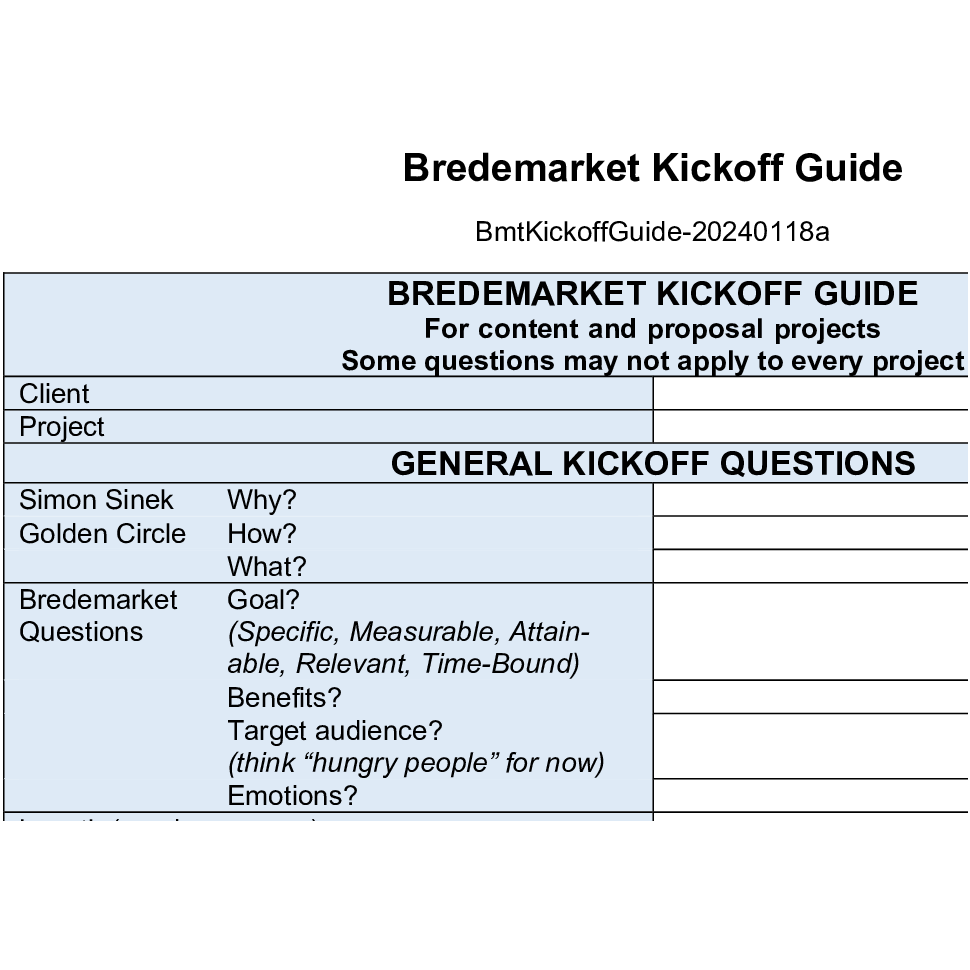
The first questions in the Bredemarket Kickoff Guide, BmtKickoffGuide-20231022a. No, you can’t have the guide; it’s proprietary.

I decided that I needed to update my process, as well as that e-book, and add a seventh question, “Emotions?”

What?

For those who have raced ahead to this section, Bredemarket has a new downloadable e-book (revised from an earlier version) entitled “Seven Questions Your Content Creator Should Ask You.” It includes a new page, “Emotions,” as well as minor revisions to the other pages. You can download it below.

Goal, Benefits, Target Audience, and Emotions

You’ll have to download the e-book to find the answers to the remaining four questions.

Copying the Competition Doesn’t Differentiate You (Trust Me)

Why does everyone think that “me too” is the stepping stone to success?

Let’s discuss:

“Me too” in music

Years ago I worked at my college’s 10 watt radio station, and therefore had access to a lot of records (yes, this was a long time ago).

And one of those records was so unmemorable that it was memorable.

The album, recorded in the early to mid 1960s, trumpeted the fact that the group that recorded the album was extremely versatile. You see, the record not only included surf songs, but also included car songs!

The only problem? The album was NOT by the Beach Boys.

By Capitol Records – Billboard, page 73, 11 September 1965, Public Domain, https://commons.wikimedia.org/w/index.php?curid=26923920

Instead, the album was from some otherwise unknown band that was trying to achieve success by doing what the competition did. (In this case, the Beach Boys.)

I can’t remember the name of the band, and I bet no one else can either.

“Me too” in computing and lawn care

Sadly, this tactic of Xeroxing (or Mitaing) the competition is not confined to popular music. Have you noticed that so many recipes for marketing success involve copying what your competitors do?

  • Semrush: “Analyze your competitors’ keywords that you are not ranking for to discover gaps in your SEO strategy.”
  • iSpionage: “If you can emulate your competitors but do things slightly better you have a good chance of being successful.”
  • Someone who shall remain nameless: “Look at this piece of collateral that one of our competitors did. We should do something just like that.”

And of course the tactic of slavishly copying competitors has been proven to work. For example, remember when Apple Computer adopted the slogan “Think The Same” as the company dressed in blue, ensured all its computers could run MS-DOS, and otherwise imitated everything that IBM did?

By Carlos Pérez Ruiz – originally posted to Flickr as Apple Macintosh 128Kb naked, CC BY-SA 2.0, https://commons.wikimedia.org/w/index.php?curid=10397868

OK, maybe not.

“But John,” you are saying. “That’s unfair. Not everyone can be Apple.”

My point exactly. Everyone can’t be Apple because they’re so busy trying to imitate someone else—either a competitor or some other really popular company.

Personally, I’m waiting for some company to claim to be “the Bredemarket of satellite television. (Which would simply mean that the company would have a lot of shows about wildebeests.) But I’ll probably have to wait a while for some company to be the Bredemarket of anything.

Black wildebeest. By derekkeats – Flickr: IMG_4955_facebook, CC BY-SA 2.0, https://commons.wikimedia.org/w/index.php?curid=14620744

(An aside: while talking with a friend, I compared the British phrase “eating your pudding” to the American phrase “eating your own dog food,” although I noted that “I like to say ‘eating your own wildebeest food‘ just to stand out.” Let’s see ChatGPT do THAT.)

“Me too” in identity verification

Now I’ll tread into more dangerous territory.

Here’s an example from the identity/biometric world. Since I self-identity (heh) as the identity content marketing expert, I’m supremely qualified to cite this example.

I spent a year embedded in the identity verification industry, and got to see the messaging from my own company and by the competition.

After a while, I realized that most of the firms in the industry were saying the same thing. Here are a few examples. See if you can spot the one word that EVERY company is using:

  • (Company I) “Reimagine trust.”
  • (Company J) “To protect against fraud and financial crime, businesses online need to know and trust that their customers are who they claim to be — and that these customers continue to be trustworthy.”
  • (Company M) “Trust is the core of any successful business relationship. As the digital revolution continues to push businesses and financial industries towards digital-first services, gaining digital trust with consumers will be of utmost importance for survival.”
  • (Company O) “Create trust at onboarding and beyond with a complete, AI-powered digital identity solution built to help you know your customers online.”
  • (Company P) “Trust that users are who they say they are, and gain their trust by humanizing the identity experience.”
  • (Company V) “Stop fraud. Build trust. Identity verification made simple.”

Yes, these companies, and many others, prominently feature the t-word in their messaging.

Don’t “me too” in identity verification

Now perhaps some of you would argue that trust is essential to identity verification in the same way that water is essential to an ocean, and that therefore EVERYBODY HAS to use the t-word in their communications.

Don’t tell that to Black Ink Tech, who uses the trademark “Truth Over Trust.”

And no, they didn’t violate any law by using an unapproved word. Instead, they got attention by standing out from the crowd.

Here’s another example that I can’t discuss fully, but I’ll say what I can.

I was talking to a Bredemarket biometric content prospect (not one of the ones listed above), and as is my practice, I started by asking the “why” question.

After all, if I was going to create content for this prospect, we had to ensure that the content stood out from their competitors.

Without revealing confidential information, I can say that I asked the firm why they were better than every other firm out there, and why all the other firms sucked. And the firm provided me with a compelling answer to that question. I can’t reveal that answer, but you can probably guess that the word “trust” was not involved.

A final thought

So let me ask you:

Why is YOUR firm better than every other firm out there, and why do all or YOUR competitors suck?

Your firm’s survival may depend upon communicating that answer.

Take care of yourself, and each other.

Jerry Springer. By Justin Hoch, CC BY 2.0, https://commons.wikimedia.org/w/index.php?curid=16673259

A Marketing Question, Not An Identification Question: Is Facial Coding Accurate?

While I don’t use all the marketing tools at my disposal, I am certainly curious about them. After all, such tools provide marketers with powerful insights on their prospects and customers.

I became especially curious about one marketing tool when re-examining a phrase I use often.

  • I use the phrase “biometric content marketing expert” in a non-traditional way. When I use it, I am attempting to say that I am a content marketing expert on the use of biometrics for identification. In other words, I can create multiple types of content that discusses fingerprint identification, facial recognition, and similar technologies.
  • But if you speak to a normal person, they will assume that a “biometric content marketing expert” is someone who uses biometrics (the broader term, not the narrower term) to support content marketing. This is something very different—something that is generally known as “facial coding,” a technique that purports to provide information to marketers.

What is facial coding?

By Peter Ziegler – Pixaby, CC BY-SA 4.0, https://commons.wikimedia.org/w/index.php?curid=63519842

Earlier this year, Reshu Rathi of Entropik wrote a blog post about facial coding. Rathi provided this definition.

We all know that our face conveys emotions through facial expressions; facial coding is the process of measuring those human emotions. With the help of computer vision, powered by AI and machine learning, emotions can be detected via webcam or mobile cam. The tech tracks every muscle movement on the face or all-action units (AU) based on the FACS (facial action coding system).

From https://www.entropik.io/blogs/facial-coding-what-why-and-how-to-use-facial-coding-in-marketing

The differences between facial coding and facial recognition

Unlike the topics in which I usually dwell, facial coding:

  • Does not identify individuals. Many people can share the same emotions, so detection of a particular emotion does not serve as individualization.
  • Does not provide permanent information. In the course of watching a movie or even a short advertisement, viewers often exhibit a wide range of emotions. Just because you exhibit a particular emotion at the beginning of an ad doesn’t mean you’ll exhibit the same emotion at the conclusion.
From https://www.youtube.com/watch?v=TnzFRV1LwIo

As Rathi describes the practice, it preserves privacy by allowing people to opt-in, and to record the emotions anonymously.

So, the user’s permission is required to access their camera and all this data is captured with consent. And no video is shared. Only the emotion data of the users are captured through their facial expressions and shared in real-time. The emotions on a person’s face are captured as binary units (0 and 1). Hence no PII (Personally Identifiable Information) related to race, ethnicity, gender, or age is captured at any point in time.

From https://www.entropik.io/blogs/facial-coding-what-why-and-how-to-use-facial-coding-in-marketing

Of course, some of this is a matter of implementation, or in the way that Entropik uses the facial coding technique.

  • But what if another firm chooses to gather more data, thus reducing the anonymity of the data collected? “I don’t only want to know how people react to the content. I want to know how black women in their 30s react to the content.”
  • And what if another firm (or a government agency, such as the Transportation Security Administration) chooses to gather the data without explicit consent, or with consent buried deep in the terms of service? In that case, people may not even realize that their facial expressions are being watched.
By Paweł Zdziarski – Own work, CC BY 2.5, https://commons.wikimedia.org/w/index.php?curid=1906323

Examining facial expressions is not the only way to decipher what is happening in a person’s mind as they view content. But it’s powerful.

Well, maybe.

Does everyone exhibit the same facial coding?

The underlying assumption behind emotion recognition is that you can identify emotions at a universal level. If content makes me happy, or if it makes a person halfway around the world happy, we will exhibit the same measurable facial characteristics.

Lisa Feldman Barrett disagrees.

Research has not revealed a consistent, physical fingerprint for even a single emotion. When scientists attach electrodes to a person’s face and measure muscle movement during an emotion, they find tremendous variety, not uniformity. They find the same variety with the body and brain. You can experience anger with or without a spike in blood pressure. You can experience fear with or without a change in the amygdala, the brain region tagged as the home of fear.

When scientists set aside the classical view and just look at the data, a radically different explanation for emotion comes to light. We find that emotions are not universal but vary from culture to culture. They are not triggered; you create them. They emerge as a combination of the physical properties of your body, a flexible brain that wires itself to whatever environment it develops in, and your culture and upbringing.

From https://www.theguardian.com/lifeandstyle/2017/mar/26/why-our-emotions-are-cultural-not-hardwired-at-birth

If Barrett is correct, then how reliable is facial coding, even within a particular region? After all, even Southern California does not have a single universal culture, but is made up of many cultures in which people react in many different ways. And if we preserve privacy by NOT collecting this cultural information, then we may not fully understand the codings that the cameras record.

Back to the familiar “biometric” world

And with that, I will retreat from the broader definition of biometrics to the narrower and more familiar one, as described here.

The term “Biometrics” has also been used to refer to the field of technology devoted to the identification of individuals using biological traits, such as those based on retinal or iris scanning, fingerprints, or face recognition. Neither the journal “Biometrics” nor the International Biometric Society is engaged in research, marketing, or reporting related to this technology. 

From https://www.biometricsociety.org/about/what-is-biometry

My self-description as a biometric content marketing expert applies to this narrower definition only.

Is Your Company Ignoring Your Prospects?

Are you locking your prospects out?

Designed by Freepik.

Ignoring your prospects is NOT a winning business strategy. But a lot of companies do it anyway by not communicating regularly with their prospects.

If you ignore your prospects, your prospects will ignore you.

Meetings and money, via a third party

Of my three Bredemarket meetings (so far) today, the second was the most promising.

A person at a large company needs consulting services from me. All we need to do is work out the mechanics. The large company relies on a third party to manage its indpendent contractor relationships, including onboarding, time cards, and payments for hourly work. I wanted to learn about the third party, but I ran into walls when seeking current information about the firm.

The third party’s website is static

The third party’s website talks about its services, some unique aspects about the business, the story of its founder (a fascinating story), its technology partners, and its call to action. It provides ALMOST everything…with the exception of CURRENT information.

Does your company website look like http://www.dolekemp96.org/main.htm?
  • No press releases from the third party.
  • No links to news articles that mention the third party.
  • Not even a blog.

Basically if you want CURRENT information about the company…

…you get crickets.

African field cricket, Gryllus bimaculatus. By Arpingstone – Own work, Public Domain, https://commons.wikimedia.org/w/index.php?curid=620363

Not literally, but you know what I mean.

Which makes me wonder—is the third party doing anything NOW? Or was all of the existing content set up when the company was founded a decade ago?

If text like this is on your home page, you have a problem. From https://serverfault.com/questions/65952/objective-speed-comparison-of-windows-7-vs-windows-xp, which acknowledges that this text is over 13 years old. Does your site have old text without such an acknowledgement?

Luckily for me, I knew where to find current information on the company. Since the company is a B2B provider, I assumed that the company has a LinkedIn page. And I was right. But…

The third party’s LinkedIn page is also static

As you probably know, company LinkedIn pages have several subpages. The “About” supage talks about the third party company’s services, and the “People” subpage links to the profiles of the company’s employees, including the founder. So I went to the “Posts” subpage for the third party…

…and found crickets.

From https://www.youtube.com/watch?v=oSW6IFt8OpQ

Not literally, but you know what I mean.

In nearly a decade of existence, the company has NEVER written a LinkedIn post to reach out to its prospects or customers.

Ignoring your prospects

As I’ve said before, companies that refuse to generate current content in the form of blog posts or social media posts make it appear that your company is no longer an ongoing, viable concern.

By Yintan at English Wikipedia, CC BY 4.0, https://commons.wikimedia.org/w/index.php?curid=63631702

And this is so easy to fix.

Pay attention to your prospects by providing current content.

If you ignore your prospects, your prospects will ignore you.

Are you ready to stop ignoring your prospects?

If you need help creating content for your blog, your social media platforms, or your website, Bredemarket can help you regain credibility with your prospects and customers.

Authorize Bredemarket, Ontario California’s content marketing expert, to help your firm produce words that return results.

Bredemarket logo

Four Restrictions on Bredemarket’s City of Ontario Business License, and Why You Should Care

Remember when I said that I spent Labor Day renewing my City of Ontario business license?

Well, the approved license arrived in the mail today.

City of Ontario business license for Bredemarket, October 01, 2023 through September 30, 2024.

The electronic mail, not the snail mail.

By Geierunited – Own work, CC BY-SA 3.0, https://commons.wikimedia.org/w/index.php?curid=95926

This coming year will be the fourth year of Bredemarket’s existence. I started in August 2020, but it took a few weeks for the city business license and other paperwork to complete.

Now while the City of Ontario (California, not Canada) business license renewal entitles me to conduct business in the city as Bredemarket (when coupled with the Fictitious Business Name statement I filed with San Bernardino County), it is not an official endorsement of my activity by the city, and is definitely NOT an endorsement of the call to action at the end of this post.

More importantly, the City of Ontario has imposed four significant restrictions on the way that Bredemarket conducts business. Do they affect how I do business with you? We’ll see.

First: I must post the business license in a conspicuous place

Done.

City of Ontario business license, posted in a conspicuous place in an undisclosed location. And no, I don’t wear my glasses all the time.

Although as we will see when we get to the third restriction, the whole meaning of “conspicuous place” is irrelevant to Bredemarket’s business.

Second: I can’t conduct just ANY business

The business license is issued “for consulting services, including marketing and writing services.” The license does NOT allow me to bake pies, perform auto maintenance, launch rockets into space, or perform heart surgery.

You won’t see the Bredemarket 33410 Aortic Valve Surgery Service any time soon. The city won’t let me offer it. (33410, by the way, is the medical code for Under Surgical Procedures on the Aortic Valve.)

Dang guvmint.

Third: No visitation from clients

Remember how the city requires that I post my license in a conspicuous place? Well, the city also prohibits me from having clients visit me at my work location. This makes sense, since residential neighborhoods aren’t really built to have a bunch of cars park outside a house where business is conducted.

No, Bredemarket clients cannot park their cars in front of my house. And no, this is not my house. (And they’re not your cars either.) Fair use. The Verge, “Multimillion-dollar Ferraris, Jaguars, Astons, and a fine cup of tea.” The cast of cars and characters from the first Goodwood press day in 1993. Lord Charles March is by the front door of the house with his light blue AC 16/80 designed by his grandfather.

This means that when I do have a person-to-person meeting (rather than a videoconference) to conduct business, the meeting has to be offsite. For example, a couple of years ago I met with an advisor at Brandon’s Diner in Upland. (And the lunch was tax deductible!)

Fourth: No signage permitted

Again, because my work location is in a residential neighborhood, I can’t put a huge neon sign in my front yard with the Bredemarket logo.

Bredemarket logo
Imagine this in my front yard.

And no, I can’t put a small neon sign in my front yard.

Or any neon sign.

I wonder if the city will let me put signage on my mailbox? Actually, the UPS Store probably won’t allow that either.

Bredemarket’s mailing address is 1030 N Mountain Ave #259, Ontario CA 91762-2114. If you read my previous post, you know that “MBE” stands for Mailboxes Etc.

So what?

The reason that these city restrictions don’t matter to you is because (since we still have the Internet) Bredemarket is perfectly capable of conducting its business online.

You don’t have to look for my business sign, or a parking place in front of the place where I conduct business. Why not? Because I can meet with you via Google Meet or another videoconferencing service, or we can talk on the phone, or even exchange emails with each other.

I’ve worked from home since March 2020—first for IDEMIA, then for Bredemarket, then for Incode Technologies, then for Bredemarket again. During that time I’ve been able to meet all of the needs of Bredemarket clients remotely, despite no public parking and no signage.

Well, almost all the needs. I haven’t been able to perform aortic valve surgery for my clients.

Dang guvmint.

The city does not endorse this call to action

Do you want to use the marketing and writing services of a government-licensed consulting firm?

More importantly, do you want to use the marketing and writing services of a consulting firm that ensures the right questions are asked at the beginning of the project, and that you have complete input during the writing and review cycles?

Authorize Bredemarket, Ontario California’s content marketing expert, to help your firm produce words that return results.