Dare to Incorporate Authentic Quotes in Press Releases

Initialism

I have been amused by press releases for many years.

You’re reading along in the press release and then you get to a quote from an executive with the company issuing the press release.

“MegaCorp’s new best-of-breed revolutionary platform will increase artificial intelligence synergies and optimize blockchain outcomes,” said Silas Phelps, Chief Executive Officer and Strategist at MegaCorp. “Did I mention pickleball?” he added.

Sometimes the executive has even read the quote before publication. Or maybe not. Because in most cases the quote was written by someone else.

Inner Stall

“Drains to Ocean” album cover. https://ontarioemperor.bandcamp.com/album/drains-to-ocean.

I was amused by this practice so much that when I wrote a press release for a side project of mine in 2017, I called out the practice.

The marketing flack who is pretending to speak for Ontario Emperor put some new words in his mouth for this release. “Yes, I am self-proclaiming this to be the greatest electronic album ever,” stated Ontario. “And in all honesty, the songs are more developed than the ones on my previous releases. Each of the twelve songs evokes a particular mood, although I will leave it to the listener to determine what these moods may be.”

Empoprises’ John E. Bredehoft also had some words put into his mouth. “Our experience with Bandcamp has been very fruitful,” Bredehoft supposedly said. “We look forward to expanding our relationship with Bandcamp in the future.”

As an aside, the Ontario Emperor electronic album “Drains to Ocean” is still available for purchase ($8 “or more”) at https://ontarioemperor.bandcamp.com/album/drains-to-ocean. Or you can save yourself some money and listen to one of the songs, “For a Meaningful Apocryphal Animation,” for FREE by scrolling to the bottom of Bredemarket’s “Information” page. (And to the bottom of this post.)

One more aside that may be of interest to a few of you: the drain pictured above is a few buildings west of IDEMIA’s LaPalma office in Anaheim Hills.

But years later, the whole thing became less of a joke.

Climbing

Madison Square Garden News Release 1974. Arnold wasn’t quoted. It wasn’t like he was an important government official or a wildly popular movie star or anything. – RMY Auctions, Public Domain, https://commons.wikimedia.org/w/index.php?curid=104969591.

Why?

Because one of Bredemarket’s clients required a draft press release, and I wrote the first draft, including quotes from “Executive X.”

Now I didn’t make these quotes up out of whole cloth, taking them from an internal client document.

But Executive X thought they were a little off, so the executive, myself, and a third person got together to hammer out a new quote that was more in line with something Executive X would say.

And I’m glad we did. Even though the vast majority of people who read the press release never knew Executive X, those who did know the executive would be pleased with the quote. Hopefully it sounded somewhat more authentic than the usual run-of-the-mill quotes found in press releases.

I stubbornly think that readers will reward authenticity someday. At least the good readers will.

But I failed in one respect. I didn’t create an apocryphal animation to go with the quote. But that’s a topic for another time.

Friction is Bad

Some time ago I read a story (which may or may not have been true) about an employer who called multiple job applicants to the office for a morning interview. As time passed and the employer didn’t interview anyone, some of the applicants got tired of waiting and left. At the end of the day, only one applicant remained. That applicant got the job.

  • The person who told the story thought that it demonstrated that perseverance pays off.
  • Most of the readers thought that it demonstrated that the employer was a jerk and that the work environment was probably toxic.

If this were to happen in real life, the employer would paradoxically lose out on the BEST candidates who had better things to do than sit around an office all day.

Why?

Because people avoid friction. If job applicants can obtain jobs without playing silly games, they will.

Friction is bad.

Waiting room in an airport.
Waiting room image by User:Mattes – Own work, Public Domain, https://commons.wikimedia.org/w/index.php?curid=1732601.

The evolution of fingerprint capture

When I started in the biometric industry 30 years ago, many police agencies were capturing fingerprints by putting ink on a person’s fingers and rolling/slapping the prints on a card.

That was messy and time-consuming, so companies like Digital Biometrics and Identix developed “livescan” devices, which did not require ANY ink and which let police agencies capture fingerprints by rolling/slapping the prints on a glass platen. This process could require a minute or two for the livescan operator to capture all fourteen images.

That’s a long time.

As I’ve previously noted, it was TOO long for some people in the federal government, who began asking in 2004 if technology could capture a complete set of fingerprints in 15 seconds.

20 years later, we can capture fingerprints (at least 8 of them) in a couple of seconds.

How?

By avoiding friction. Rather than forcing people to place their fingerprints on a card or a platen, “contactless” technology lets the “wave” (or “fly”) their fingers over a capture device, or hold their fingerprints in front of a smartphone camera.

Friction is bad.

The sound of silence

Despite what lyricists say, silence is NOT your old friend.

When a prospect wants to find out about your biometric solution, how does silence help you?

Let’s say that a prospect hears that MegaCorp offers a biometric solution, but MegaCorp’s blog and social media haven’t posted anything lately.

What are the chances that the prospect will search far and wide to find out about MegaCorp’s biometric solution?

Actually, the chances are better that the prospect won’t search at all, and will turn to the competitors who are NOT silent.

Blogging benefits: 55% more website visitors, 67% more leads, 13x more likely to enjoy positive ROI, 92% acquire customers.

Are you going to look for the information that is easily available, or the information that is hard to obtain?

Friction is bad.

Eating my own wildebeest food

I’m trying to reduce friction in Bredemarket’s own practices.

While I still use landing pages for some thing that require further explanation for some prospects, I’m trying to avoid them in some instances.

I’m working on a marketing campaign for a client, and my first “draft 0.5” of the campaign was loaded with friction.

  • The prospect had to open an email.
  • In the email, the prospect had to click on a landing page.
  • On the landing page, the prospect had to fill out a form to book a meeting.

Huge numbers of people drop out of the process at every step. So why not eliminate a step, and let the prospect book a meeting in a form embedded in the email?

Friction is bad.

And I’m applying this same principle to this post.

If your identity/biometric firm is desperate for content to convert prospects into paying customers, why don’t you schedule a free 30-minute meeting with Bredemarket to discuss your needs and what I can offer?

Incidentally, while I often repurpose blog content on Bredemarket’s social media channels, this post WON’T be one of them. I can’t embed a Calendly form into an Instagram or LinkedIn post.

And I can’t embed YouTube videos either.

From https://www.youtube.com/watch?v=nkUOACGtGfA.

Do You Know Your Identity/Biometric Competitors…And Yourself?

Do you need identity/biometric analysis from an informed analyst with 30 years of identity/biometric experience?

Do you need:

  • Competitor and competitor product analysis?
  • Industry analysis?
  • Use case analysis?
  • Analysis of your own company?

Book a free meeting with Bredemarket and discuss your needs. Click the image below to drive informed analysis with Bredemarket Identity Firm Services.

Drive informed analysis with Bredemarket Identity Firm Services

Bredemarket Under the Scope

You can plan all you want, but doing matters.

This week I originally planned to work on Monday, Tuesday, Thursday, and Friday and spend Wednesday at the B2B Marketing Expo at the Los Angeles Convention Center. I had figured out my Metrolink and Metro connections, signed up for a “speed networking” event, and even tied a planned blog post and LinkedIn post into my “CPA” marketing campaign.

‘Til Tuesday.

Now I worked Monday, Tuesday, Wednesday, and Thursday, and am taking most of Friday off.

Things move forward.

(Tunnel image CC BY-SA 3.0. I’m sorry.)

Important and not urgent, but how important?

Whether and how you delegate something depends upon its importance, especially if you recognize three levels of importance. Sometimes the very important and critically important items require a CPA, or Content-Proposal-Analysis marketing professional. (I know one.)

When importance is simple

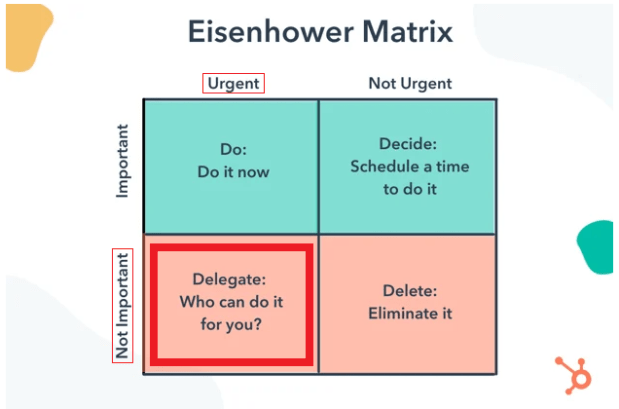
Last October I spent some time talking about the Eisenhower Matrix and its critical flaw, focusing upon the “important but not urgent” quadrant:

When you have a single level of importance, then decisions are pretty simple. For urgent things, do it yourself if it’s important, delegate it if it’s not.

When “importance” is more granular

But what if, instead of “Not Important” and “Important,” we had three levels of importance instead of just one? In other words, “Not Important,” “Important,” “Very Important,” and “Critically Important”?

A U.S. Navy plane flying over a Soviet ship in October 1962 is, um, classified as “Critically Important.” Oh, and it’s urgent. By USN – Dictionary of American Naval Aviation Squadrons Volume 2: The History of VP, VPB, VP(H) and VP(AM) Squadrons [4], Public Domain, https://commons.wikimedia.org/w/index.php?curid=7328539.

In that case, you not only consider whether to delegate something, but who should be delegated that thing. (Or, as you’ll see, WHAT should be delegated that thing.)

  • If the need is not important, delegate it, but it doesn’t really matter to whom or what you delegate it. ChatGPT or Bard is “good enough,” even if the result is awful.
  • If the need is important, delegate it to someone you trust to create very good content. Let them create the content, you approve it, and you’re done.
  • If the need is very important, then you may delegate some of the work, but you don’t want to delegate all of it. You need to be involved in the content creation process from the initial meeting, through the review of every draft, and of course for the final approval. The goal is stellar content.
  • If the need is critically important, then you probably don’t want to delegate the work and will want to do it yourself—unless you can find someone who is better than you in creating content.

As I noted in October, a more granular approach to importance increases the, um, importance of Bredemarket’s services.

  • In the simple Eisenhower Matrix model, Bredemarket handles the Not Important stuff while you handle the Important stuff.
  • In the “three levels of importance” model, Bredemarket handles the Very Important and Critically Important stuff. Because the merely Important stuff and the Not Important stuff doesn’t require my 30 years of technology, identity, and biometrics expertise.

Sometimes you need a CPA (but NOT a Certified Public Accountant)

But if your needs are critical, and you require the services of a CPA (Content-Proposal-Analysis marketing professional), then you need to learn what Bredemarket can do for you. Click on the image to learn more.

Bredemarket’s “CPA.”

Bredemarket’s “CPA”

Is your firm losing business and leaving important items unfinished?

I, John E. Bredehoft of Bredemarket, am a “CPA.” Not a Certified Public Accountant; a Content-Proposal-Analysis marketing professional:

  • Content such as blog posts, case studies, data sheets, white papers, and more.
  • Proposal submissions from identity/biometric and technology firms to governments and enterprises.
  • Analysis of markets, companies and competitors, products, and websites and social media.

I offer over 30 years of technology experience—30 in identity/biometrics, where I am the biometric product marketing expert.

I ask questions first (why, how, what, and more) and collaborate later to ensure I deliver the right content to you.

I provide pre-packaged services or bill you at an hourly rate.

Click here to find out more about Bredemarket’s “CPA” services, and schedule a free 30 minute content needs assessment with me.

Rethinking (some of) My Go-to-market Concepts

My current two categories for go-to-market collateral, “external” and “internal,” are not sufficient. I want to fix that, but I’m still thinking through things, such as what to call the third category. As of this moment, my best option is “intrinsic,” based upon my conversations with my good buddy Gemini.

My current two categories for go-to-market collateral

Based upon go-to-market efforts that stretch back a decade (even before I formally became a Product Marketing Manager), I have traditionally divided go-to-market output into two categories.

22 types of content Bredemarket can create.
  • External content for your hungry people (target audience), such as articles, blog posts, social media, case studies, white papers, and proposals. This content goes to CEOs, marketers, engineers, IT staff, and many others at the companies that buy from you.
  • Internal content for the people in the company who talk to your hungry people, such as battlecards, sales playbooks, and scripts for trade show demonstrations. This content goes to salespeople, marketers, product managers, customer success folks, and many other employees and contractors.
  • Some content can either be external or internal, depending upon the audience.

Simple and straightforward, right?

My emerging third category

But during a current go-to-market effort for a client, I realized that these two categories are insufficient, since both the client and I are creating content that will never been seen by either the external clients or the internal clients.

I’ll give you two heavily redacted and anonymized examples for a #fakefakefake machine.

AI-generated by Google Gemini.
  • Bob wrote a Word document that listed the pain points that MegaCorp’s client encounter when trying to put green round widgets on their end customers’ beanie caps.
  • Judy created a picture with stick figures that showed how clients can use the MegaCorp WidgetPlacer 2000 for their beanie cap production needs.

Bob and Judy (names from this song) are NEVER going to show that document or that picture to the customers, or even to the company’s own account managers.

So why create it?

Because they will be the initial guides as the go-to-market team creates all the other external and internal collateral for the effort.

These foundation documents are a critical part of the go-to-market effort. Without them, the subsequent go-to-market collateral will be a contradictory mishmash of stuff, and you’ll need to undertake a lot of effort to align all the content after the fact.

And the third category is…

…well, I don’t know what to call this third category yet.

  • “Internal internal content” seems a bit silly.
  • “Foundational content” seems a bit grandiose.
  • “Bob and Judy” content seems like an independent TV show.

Google Gemini, you’re my only hope.

Not THOSE Gemini. Metropolitan Museum of Art, New York, Public Domain, https://commons.wikimedia.org/w/index.php?curid=15044467.

My question:

If we call the first category “external” marketing content for customers, and we call the second category “internal” marketing content for employees, then what do we call the third category which is only for the people who create marketing content for customers and employees?

Gemini’s first batch of answers:

Internal Marketing Content for Marketing Teams

Marketing Team Communication

Marketing Team Resources

Internal Marketing Tools

Brevity is NOT a strength of generative AI. Even when I specifically instructed Gemini to provide single word responses, I got hyphenated words:

Intra-marketing (combining “intra” for within and “marketing”)

Meta-marketing (implying a higher-level perspective on marketing)

Team-marketing (emphasizing its focus on the marketing team)

The fatal flaw is that not all the people on a go-to-market team are marketers. (This is my fault because of the prompt I wrote.)

And if I lop off the last part of each compound phrase, two of my options are “team” (too generic) and “meta” (NO).

And “intra” is too close to “internal internal.” But perhaps it’s a start. So I asked Gemini for words similar to “intra-” and got this response:

The prefix “intra-” means “within,” “inside,” or “inner.” Here are 12 words that convey a similar meaning:

  1. Inward: Turning or moving toward the inside.
  2. Internal: Existing or occurring within something.
  3. Inner: Situated or located within.
  4. Intrinsic: Belonging to or inherent in the nature of something.
  5. Interior: The inside part of something.
  6. Intramural: Occurring within a school or institution.
  7. Intranet: A private computer network within an organization.
  8. Intravenous: Administered into a vein.
  9. Intracranial: Situated or occurring within the skull.
  10. Intracellular: Existing or occurring within a cell.
  11. Intralingual: Relating to or occurring within a language.
  12. Intrajugular: Situated or occurring within the jugular vein.

I kind of like “intrinsic,” but I’ll sleep on it.

In the meantime, what would YOU call the third category?

More on Go-to-Market Tiers

In my post “Seven Essential Product Marketing Strategy and Process Documents, the August 30, 2024 Iteration,” I alluded to the fact that not all go-to-market efforts are the same.

You can’t just slap a few things together in three days and say your go-to-market is complete. You need a plan on how you will go to market, including the different tiers of go-to-market efforts (you won’t spend four months planning materials for your 5.0.11 software release)…

Unless you’re in very unusual circumstances, your go-to-market efforts will encompass variable efforts.

Two tier

In its simplest form, you will have two tiers. For example, Holly Watson of Amazon Web Services distinguishes between “launches” and “releases.”

Release to me relates to the update of an existing product vs. a net-new addition to a solution offering. It’s common to have multiple releases a quarter vs. large launches 1-2x per year.

Three tier

You can get fancier.

Stepped pyramids in Teotihuacan, Mexico. By Juan Carlos Fonseca Mata – Own work, CC BY-SA 4.0, https://commons.wikimedia.org/w/index.php?curid=91032399.

My former product marketing team devised a three-tier system, in which the top tier encompassed a full-blown effort and the bottom tier just had some release notes, a bit of internal education, and maybe a blog post.

Defined tiers

But as I said on August 30, you need to define the tiers beforehand. Don’t just shoot from the lip and say you want a blog post, a press release, and a brochure…oh, and maybe a cool infographic! Yeah!

If Steve Jobs was on stage, it was a top tier go-to-market effort by definition. By matt buchanan – originally posted to Flickr as Apple iPad Event, CC BY 2.0, https://commons.wikimedia.org/w/index.php?curid=9110964.

Establish your tiers.

Establish the content for each tier.

Execute.

And repeat.