Ignoring your prospects is NOT a winning business strategy. But a lot of companies do it anyway by not communicating regularly with their prospects.
If you ignore your prospects, your prospects will ignore you.
Meetings and money, via a third party
Of my three Bredemarket meetings (so far) today, the second was the most promising.
A person at a large company needs consulting services from me. All we need to do is work out the mechanics. The large company relies on a third party to manage its indpendent contractor relationships, including onboarding, time cards, and payments for hourly work. I wanted to learn about the third party, but I ran into walls when seeking current information about the firm.
The third party’s website is static
The third party’s website talks about its services, some unique aspects about the business, the story of its founder (a fascinating story), its technology partners, and its call to action. It provides ALMOST everything…with the exception of CURRENT information.
Luckily for me, I knew where to find current information on the company. Since the company is a B2B provider, I assumed that the company has a LinkedIn page. And I was right. But…
The third party’s LinkedIn page is also static
As you probably know, company LinkedIn pages have several subpages. The “About” supage talks about the third party company’s services, and the “People” subpage links to the profiles of the company’s employees, including the founder. So I went to the “Posts” subpage for the third party…
Use other social media outlets: TikTok, X, YouTube, whatever.
Pay attention to your prospects by providing current content.
If you ignore your prospects, your prospects will ignore you.
Are you ready to stop ignoring your prospects?
If you need help creating content for your blog, your social media platforms, or your website, Bredemarket can help you regain credibility with your prospects and customers.
Authorize Bredemarket, Ontario California’s content marketing expert, to help your firm produce words that return results.
If your Inland Empire company doesn’t have an online presence, one quick way to create one is to create a business page on Facebook.
This post outlines the benefits of establishing an online presence via a Facebook business page. It also provides four examples of Facebook business pages. Finally, the post addresses the thorny question of creating content for your Facebook business page.
Why Faceboook may be the best online presence for your business
For the first time in years, I attended an Ontario IDEA Exchange meeting at AmPac Business Capital on Tuesday afternoon. There was a mixture of attendees: some who had established several businesses, some like me who had run one business for some time, and a few who were just starting out in business.
The ones who were starting out were still trying to figure out all the things you need to do to start a business: figuring out why the business exists in the first place, getting the appropriate business licenses (and in some cases professional licenses), printing business cards (or creating the online equivalent), setting up SOME kind of way to track prospects and customers…and establishing an online presence.
Now some businesses choose to establish their online presence by creating a website.
But even the simplest website can involve a lot of complexity—bredemarket.com currently has 57 pages, not counting tag pages and individual blog post pages.
For many small businesses, it may be much easier to create a Facebook business page then to create an entire website.
Facebook business pages are free. (Well, unless you run ads.)
Facebook business pages are easy to create.
Facebook business pages potentially reach billions of people, including your prospects and customers.
Creating a Facebook business page
So how do you create a Facebook business page?
There’s no need for me to document all of that in detail, since many have already done so.
Don’t worry if you don’t have all the optional items, such as a page cover picture. You can add them later. This will get you going.
Other guides to creating Facebook business pages are available from Buffer (with pictures), Hootsuite (with pictures). Sprout Social (with pictures), and a number of other sources.
But before you create YOUR Facebook business page, let me show you four varied examples of EXISTING Facebook business pages.
Four examples of Facebook business pages
Let’s take a look at some pages that already exist. Perhaps one or more of these will give you ideas for your own page.
The artist page (Paso Artis)
Paso Artis is a European business whose proprietor is a painter who sells her paintings.
The menu options at the bottom of the picture above (some of which cannot be seen) illustrate some of the elements you can include in a Facebook page. Here are just a few of the page elements that Paso Artis uses:
Posts. This is the equivalent of a blog on a website, and allows you to post text, images, videos, and other types of content.
About. This is where you provide contact and other basic information about your business.
Shop. Facebook allows you to include a shop, which Paso Artis uses to sell her paintings.
Photos. As you can imagine for an artist’s page, photos of the artwork are essential.
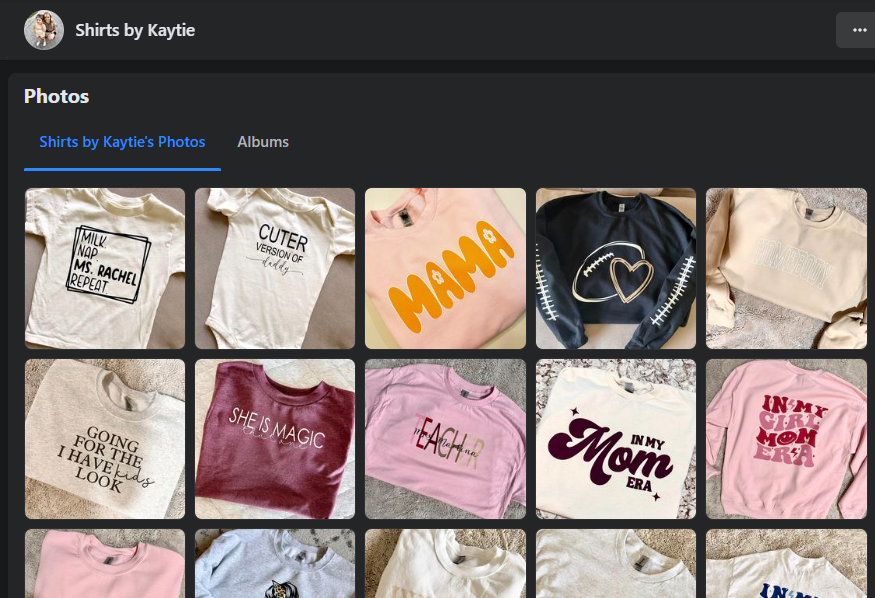
The shirtmaker page (Shirts by Kaytie)
(UPDATE 10/20/2023: Because Shirts by Kaytie is sadly no longer in business, I have removed the, um, live links to her Facebook page.)
Let’s leave Europe and go to Illinois where we find another artist, but her work is not displayed on paintings, but on shirts. Here is the Shirts by Kaytie Facebook page.
You’ll notice that Shirts by Kaytie has a different menu item order (and different menu items) than Paso Artis. For example, Shirts by Kaytie doesn’t have a Facebook “shop” element; you need to contact her directly to purchase items.
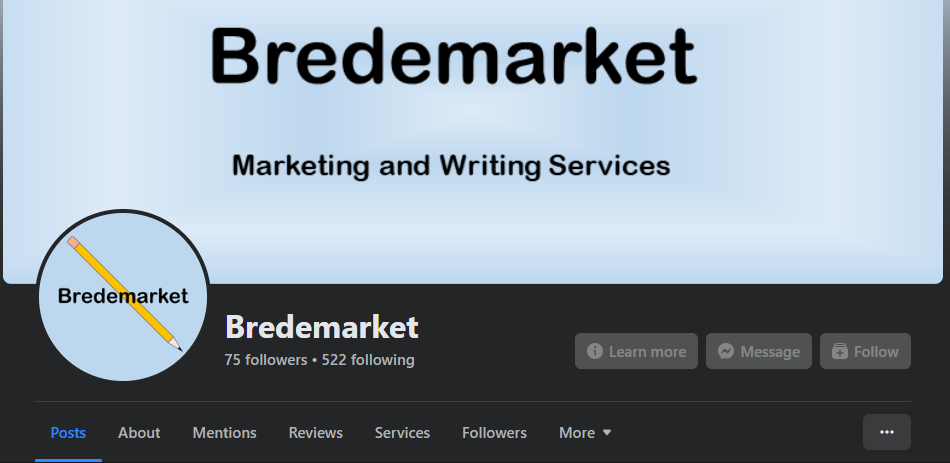
Enough of such exotic locations as Europe and Illinois. Let’s head to California’s Inland Empire and look at my favorite marketing/writing services Facebook page, the Bredemarket Facebook page.
First, Bredemarket (unlike Paso Artis and Shirts by Kaytie) provides services rather than tangible products. Therefore, I chose to include a “Services” element as part of my Facebook page.
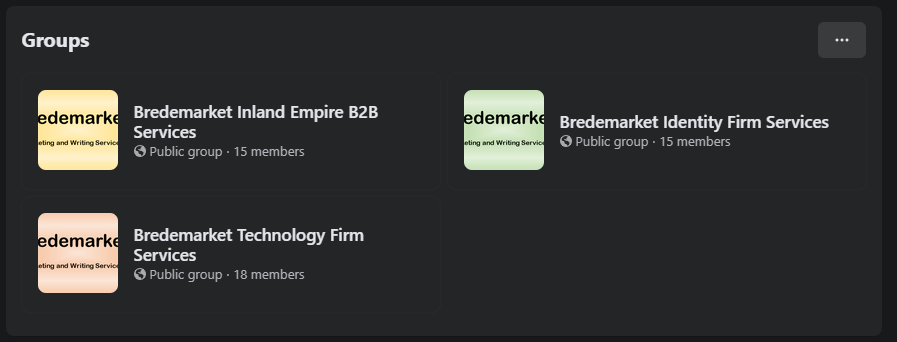
Second, Bredemarket has chosen to implement Facebook’s “groups” feature. In Bredemarket’s case, there are three separate groups that focus on various aspects of Bredemarket’s business. Inland Empire businesses can read the content in the Bredemarket Inland Empire B2B Services group and not get bogged down in out-of-area identity discussions about the change from FRVT to FRTE. (They’re missing out.)
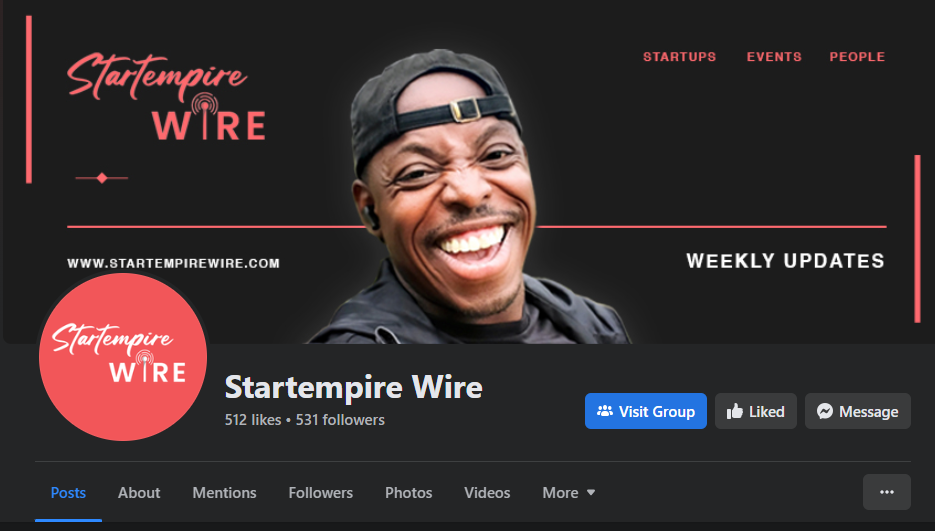
By the way, if you are an Inland Empire business—especially an Inland Empire startup technology business—and you have never heard of Startempire Wire, STOP READING MY POST and go follow Startempire Wire’s Facebook pageNOW. Startempire Wire is THE news source for Inland Empire startup tech information, and is a strong champion of the IE tech community.
So what does Startempire Wire’s Facebook page offer? Posts, photos, weekly videos, and the “Inland Empire Startup Scene” group. All of the content is jam-packed with information.
Facebook pages are essential to these firms’ strategies
Now in some cases the Facebook pages are only part of the online presence for these firms. Both Bredemarket and Startempire Wire have their own web pages, and both firms are also active on other online properties such as LinkedIn. (Bredemarket is almost everywhere, but not on Snapchat.) But Facebook is an essential part of the outreach for all four of these firms, allowing them to reach prospects and clients who are only on Facebook and nowhere else.
Perhaps a Facebook page is a perfect solution for YOUR firm’s online presence.
Let’s talk about content
But creating a Facebook page is not enough.
You need to populate it with content, such as images, videos…and posts.
Now I’m not saying that you HAVE to update your Facebook page daily, but it’s a good idea to add new content at least once a month.
But what if you aren’t a writer, or don’t have time to write? Do you have to resort to ChatGPT?
Heavens no. (I’ll say more about that later.)
Well, online content creation is where Bredemarket comes in. I help firms create blog posts, Facebook posts, LinkedIn articles, case studies, white papers, and other content (22 different types of content at last count).
Does your product (or company) need these 22 content types?
Let me help you populate your Facebook page (or other online content).
Authorize Bredemarket, Ontario California’s content marketing expert, to help your firm produce words that return results.
I can’t share work samples that I created for Bredemarket clients, because they are ghostwritten “works for hire” that are not publicly attributed to Bredemarket.
(For the same reason, I can’t share most work samples that I created for my previous employers.)
But I CAN share work samples that I created for…Bredemarket.
The video containing this image can be found on various Bredemarket properties.
Actually, you can search through the entire Bredemarket website and social media outlets and find them.
Or you can just watch the video below, which summarizes everything.
But what if I want to know how to work with Bredemarket?
Glad you asked.
After reading Mace’s LinkedIn post, I realized that I have a bunch of different online sources that explain how to work with Bredemarket, but they’re scattered all over the place. This post groups them all the “how to work with Bredemarket” content together, following an outline similar (yet slightly different) to Mace’s.
And no, it’s not a stand-alone PDF, but as you read the content below you’ll discover two stand-alone PDFs that address critical portions of the process.
Question 1: Why would I work with Bredemarket?
As you’ll see below, “why” is a very important question, even more important than “how.” Here are some reasons to work with Bredemarket.
You require the words to communicate the benefits of your identity/biometrics product/service. I offer 29 years of experience in the identity/biometrics industry and am a biometric content marketing expert and an identity content marketing expert. I have created multiple types of content (see below) to share critical points about identity/biometrics offerings.
You require the words to communicate the benefits of your technology product/service. I have also created multiple types of content to share critical points about technology offerings.
You require the words to communicate the benefits of a product/service you provide to California’s Inland Empire. I’ve lived in the Inland Empire for…well, for more than 29 years. I know the area—its past, its present, and its future.
You require one of the following types of content. Blogs, case studies / testimonials, data sheets, e-books, proposals, social media posts / Xs (or whatever tweets are called today), white papers, or anything. I’ve done these for others and can do it for you.
Question 2: Why WOULDN’T I work with Bredemarket?
This question is just as important as the prior one. If you need the following, you WON’T want to work with Bredemarket.
You require high quality graphics. Sorry, that’s not me.
I did not draw this myself. Originally created by Jleedev using Inkscape and GIMP. Redrawn as SVG by Ben Liblit using Inkscape. – Own work, Public Domain, link.
You are based outside of the United States. Foreign laws and exchange rates make my brain hurt, so I only pursue business domestically. But depending upon where you are, I may be able to recommend a content marketer for you.
Question 3: What are Bredemarket’s most popular packages? How much do they cost?
Here are the three most common packages that Bredemarket offers.
Note that these are the standard packages. If your needs are different, I can adapt them, or charge you an hourly rate if the need is not well defined. (But as you will see below, I try to work with you at the outset to define the project.)
If you follow the link above for your desired package and download the first brochure on each page, you’ll get a description of the appropriate service. The pricing is at the bottom of each brochure.
Each brochure also explains how I kick off a project, but the procedure is fairly common for each package.
Question 4: What are Bredemarket’s working practices?
But that’s not all that we address in the kickoff. There are some other lower-level questions that I ask you (such as the long and short form of your company name).
Once we have defined the project, I iteratively provide draft copy and you iteratively review it. The number and length of review cycles varies depending upon the content length and your needs. For example, I use up to two review cycles of up to three days each for short content.
Eventually I provide the final copy, you publish it and pay me, and both of us are happy.
Are you considering contracting with a marketing and writing service?
Would you like to know more about Bredemarket’s marketing and writing services to provide the right words for identity/biometrics, technology, and local B2B firms?
Would you like multiple options to learn about Bredemarket?
This post is ONLY intended for people who want to stay up-to-date with information from Bredemarket. If you have no such interest, you can skip reading this post and I’ll “give a couple of minutes back to you.”
The Bredemarket blog contains over 400 posts on marketing, writing, identity and biometrics, technology, and California’s Inland Empire. It also lets you know how you can use Bredemarket’s marketing and writing services for your company.
LinkedIn Bredemarket page
To subscribe to the LinkedIn page and see the latest content from Bredemarket, and special content from Bredemarket’s market-oriented LinkedIn pages:
I’ve found LinkedIn to be a valuable source of information, and much of the third-party information I find on LinkedIn is reshared on the Bredemarket LinkedIn page and its market-oriented “showcase” pages on identity, technology, and local business. (You can follow those three pages also.)
Bredemarket mailing list
To subscribe to the mailing list and receive special private content in advance of everyone else:
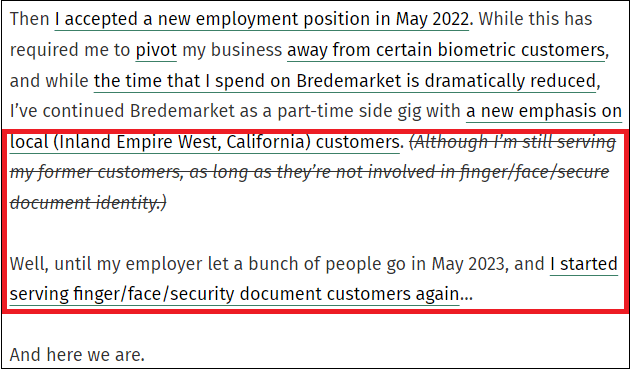
Basically, I had gone through great trouble to document that Bredemarket would NOT take identity work, so I had to reverse a lot of pages to say that Bredemarket WOULD take identity work.
I may have found a few additional pages after June 1, but eventually I reached the point where everything on the Bredemarket website was completely and totally updated, and I wouldn’t have to perform any other changes.
You can predict where this is going.
Who I…was
Today it occurred to me that some of the readers of the LinkedIn Bredemarket page may not know the person behind Bredemarket, so I took the opportunity to share Bredemarket’s “Who I Am” web page on the LinkedIn page.
So yes, this biometric content marketing expert/identity content marketing expert IS available for your content marketing needs. If you’re interested in receiving my help with your identity written content, contact me.
I know that I’m the guy who likes to say that it’s all semantics. After all, I’m the person who has referred to five-page long documents as “battlecards.”
But sometimes the semantics are critically important. Take the terms “factors” and “modalities.” On the surface they sound similar, but in practice there is an extremely important difference between factors of authentication and modalities of authentication. Let’s discuss.
What is a factor?
To answer the question “what is a factor,” let me steal from something I wrote back in 2021 called “The five authentication factors.”
Something You Know. Think “password.” And no, passwords aren’t dead. But the use of your mother’s maiden name as an authentication factor is hopefully decreasing.
Something You Have. I’ve spent much of the last ten years working with this factor, primarily in the form of driver’s licenses. (Yes, MorphoTrak proposed driver’s license systems. No, they eventually stopped doing so. But obviously IDEMIA North America, the former MorphoTrust, has implemented a number of driver’s license systems.) But there are other examples, such as hardware or software tokens.
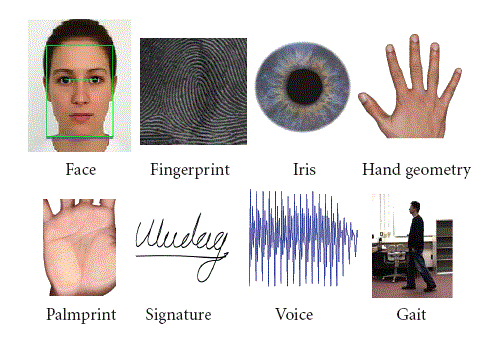
Something You Are. I’ve spent…a long time with this factor, since this is the factor that includes biometrics modalities (finger, face, iris, DNA, voice, vein, etc.). It also includes behavioral biometrics, provided that they are truly behavioral and relatively static.
Something You Do. The Cybersecurity Man chose to explain this in a non-behavioral fashion, such as using swiping patterns to unlock a device. This is different from something such as gait recognition, which supposedly remains constant and is thus classified as behavioral biometrics.
Somewhere You Are. This is an emerging factor, as smartphones become more and more prevalent and locations are therefore easier to capture. Even then, however, precision isn’t always as good as we want it to be. For example, when you and a few hundred of your closest friends have illegally entered the U.S. Capitol, you can’t use geolocation alone to determine who exactly is in Speaker Pelosi’s office.
(By the way, if you search the series of tubes for reading material on authentication factors, you’ll find a lot of references to only three authentication factors, including references from some very respectable sources. Those sources are only 60% right, since they leave off the final two factors I listed above. It’s five factors of authentication, folks. Maybe.)
The one striking thing about the five factors is that while they can all be used to authenticate (and verify) identities, they are inherently different from one another. The ridges of my fingerprint bear no relation to my 16 character password, nor do they bear any relation to my driver’s license. These differences are critical, as we shall see.
What is a modality?
In identity usage, a modality refers to different variations of the same factor. This is most commonly used with the “something you are” (biometric) factor, but it doesn’t have to be.
[M]any businesses and individuals (are adopting) biometric authentication as it been established as the most secure authentication method surpassing passwords and pins. There are many modalities of biometric authentication to pick from, but which method is the best?
After looking at fingerprints, faces, voices, and irises, Aware basically answered its “best” question by concluding “it depends.” Different modalities have their own strengths and weaknesses, depending upon the use case. (If you wear thick gloves as part of your daily work, forget about fingerprints.)
ID R&D goes a step further and argues that it’s best to use multimodal biometrics, in which the two biometrics are face and voice. (By an amazing coincidence, ID R&D offers face and voice solutions.)
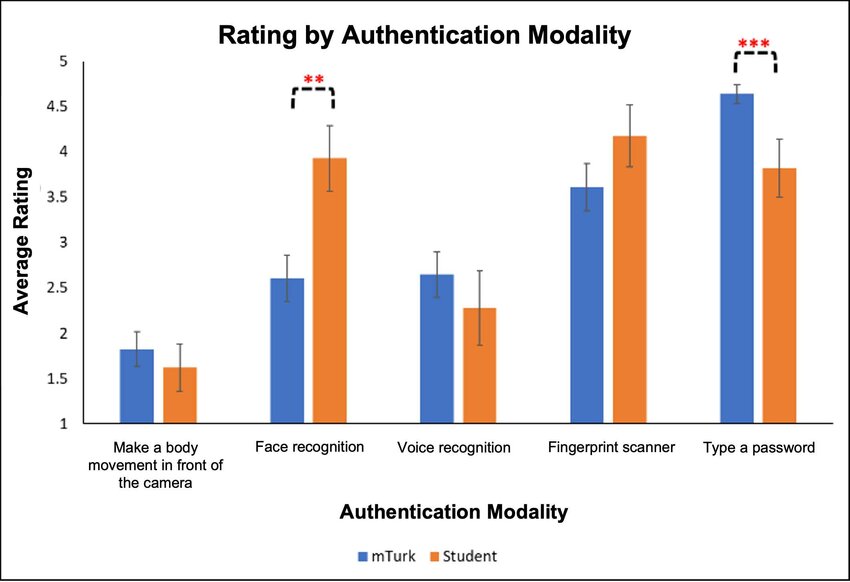
The three modalities in the middle—face, voice, and fingerprint—are all clearly biometric “something you are” modalities.
But the modality on the left, “Make a body movement in front of the camera,” is not a biometric modality (despite its reference to the body), but is an example of “something you do.”
Passwords, of course, are “something you know.”
In fact, each authentication factor has multiple modalities.
For example, a few of the modalities associated with “something you have” include driver’s licenses, passports, hardware tokens, and even smartphones.
Why multifactor is (usually) more robust than multimodal
Modalities within a single authentication factor are more closely related than modalities within multiple authentication factors. As I mentioned above when talking about factors, there is no relationship between my fingerprint, my password, and my driver’s license. However, there is SOME relationship between my driver’s license and my passport, since the two share some common information such as my legal name and my date of birth.
What does this mean?
If I’ve fraudulently created a fake driver’s license in your name, I already have some of the information that I need to create a fake passport in your name.
If I’ve fraudulently created a fake iris, there’s a chance that I might already have some of the information that I need to create a fake face.
However, if I’ve bought your Coinbase password on the dark web, that doesn’t necessarily mean that I was able to also buy your passport information on the dark web (although it is possible).
Can an identity content marketing expert help you navigate these issues?
As you can see, you need to be very careful when writing about modalities and factors.
You need a biometric content marketing expert who has worked with many of these modalities.
Actually, you need an identity content marketing expert who has worked with many of these factors.
So if you are with an identity company and need to write a blog post, LinkedIn article, white paper, or other piece of content that touches on multifactor and multimodal issues, why not engage with Bredemarket to help you out?
If you’re interested in receiving my help with your identity written content, contact me.
Stump the Experts at WWDC 2010 Stefan Haubold • CC BY-SA 3.0
One way for your firm to publicize its offerings is through company LinkedIn articles. My LinkedIn article, written by my company Bredemarket, discusses…well, company LinkedIn articles. It also discusses:
Why you should write LinkedIn articles.
Why companies should write LinkedIn articles under their own names.
How to create LinkedIn articles.
Finally, who can write your LinkedIn articles. (I have a suggestion.)
So you’ve decided that you are going to create some content for your business. But which content type should you create first? Audio? Blog post? Case study? Social media post? White paper? Video? Something else?
But coming up with a complex content creation matrix is silly, because selecting a content type isn’t that hard. (This post does have a content creation matrix, but it’s easy to understand and pretty straightforward.)
The first question
What is the first question you have to answer before deciding which content to create?
First, you need to look at your online presence and see which outlets you have, and which ones you don’t have.
Do you have a website?
Do you have a blog?
Do you have social media accounts? If so, which ones, and which types of content do they support? (Threads, for example, supports text, image, audio, and video content.)
If you don’t have a certain outlet, then that makes your decision a lot easier.
For example, if you have social media outlets but don’t have a blog, then don’t worry about creating blog posts (unless you have LinkedIn and want to create LinkedIn articles). You’re not going to create blog posts on Instagram or Threads or Twitter (unless you’re a blue check person).
Similarly, if you’re not on YouTube, TikTok, or Instagram, videos are less important. (Although a lot of services support video.)
Create content for your outlet(s)
So now that you know which content outlets you have, and which you don’t, you can create content that is supported by your outlets.
Here’s a handy-dandy table that suggests the content types you can create, depending upon your online presence. These are suggestions, not hard and fast rules.
Content Type
Website
Blog
Social Media With Audio
Social Media With Images
Social Media With Text
Social Media With Video
Audio
Yes
Blog
Yes
Case Study
Download
Social Media Post
Yes
Yes
Yes
Yes
Video
Yes
White Paper
Download
Some of these are fairly obvious (yes, if you have a blog you can create blog posts), but it helps to say them.
Don’t worry about the content outlets that you don’t have. If you don’t have a blog today, don’t worry about creating one just so you can write blogs. Go with what you have.
(And if you don’t have ANYTHING right now to promote your business, then the easiest thing to do is to create some type of social media account: Facebook, LinkedIn, whatever. They’re free, and it’s easy to create content for them.)
As I said above, these are suggestions, not hard and fast rules. For example, the table above says that case studies and white papers are best if you have a website from which prospects can download documents. But some social media services allow you to embed documents (such as case studies or white papers) into your social media posts.
Think about what you’ve got, and create for it.
Repurpose
And once you’ve created the content, don’t be afraid to distribute it on other channels, or even to repurpose it on other channels.
Have you uploaded a great video to YouTube? Embed the video in a blog post.
Did you write a great blog post? Repurpose it as a downloadable document. (That’s what I did.)
You may choose to only issue a specific piece of content using a single content type. But if you feel like repurposing the material for other content types, go for it.
Don’t be afraid to fail
Finally, don’t be afraid to create content, even if it’s not perfect. I’ve (re)committed myself to video, and spent yesterday creating multiple videos for multiple outlets. Two of the videos that I created ended up havingproblems…but I left them up anyway, and learned in the process.
I figure that the more content that I create, the better that I will get at it.
You will find that the same holds true for you.
Do you need help with textual content?
Now when you are ready to create content, do you need someone to help you create it?
But if you need help with the text for blog posts, case studies, white papers, and the like, I can help you. Especially if your text involves biometrics, identity, or technology. Contact me!

















 Bredemarket
