As I pivot Bredemarket’s writing services (due to my exit from some biometric writing) and return to a more regular blog posting schedule, I’ve discovered that Bredemarket isn’t the only Inland Empire West business that could use some additional text content.
There are local business websites with blogs that are nearly dormant. And that’s not good.
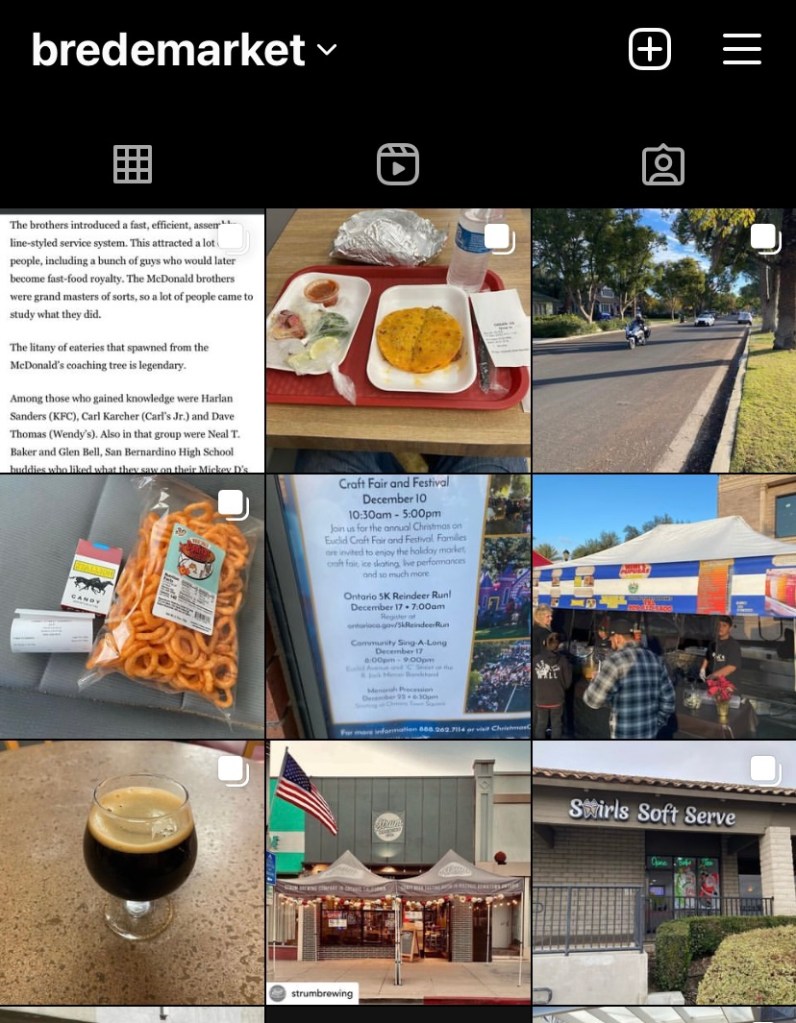
Sure, some of them have active image-based accounts on popular social services (Instagram, TikTok, etc.).
Content that answers a lot of questions about your business – six questions in particular. Actually more than that, but there are six questions that will get you started with your personal content creator. I know; I wrote the book on it.
The answers to those questions launch an iterativeprocess to create your blog content. Perhaps a one-time post, or better yet a blog post every month, attracting customers on a regular basis. Your own secret salesperson, as it were.
I offer the Bredemarket 400 Short Writing Service, a package that starts with a kickoff session and ends with between 400 and 600 words of blog or social content.
This gave me an opportunity to revisit the topic and add critical information on wildebeests, George (H.W.) Bush, and Yogi Berra.
But more importantly, it allows me to share my thoughts with a wider audience.
If you missed the October blog post, I state that there are six critical questions that your content creator must ask before creating content. These questions apply whether your content creator is a consultant, an employee at your company, or you.
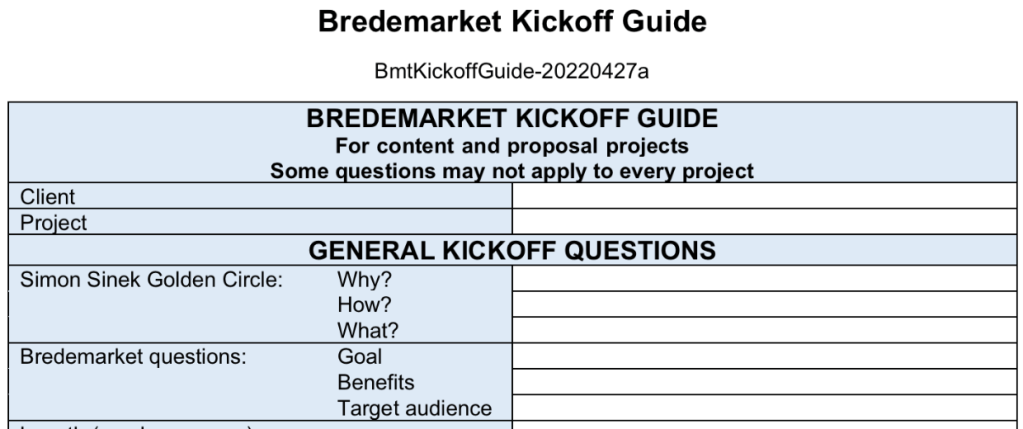
The e-book discusses each of these six questions:
Why?
How?
What?
Goal?
Benefits?
Target Audience?
And as I note in the e-book, that’s just the beginning of the content creation process.
Whether you intend to use Bredemarket as your content creator, use someone else as your content creator, or create your own content, the points in this e-book are helpful. They can be applied to content creation (case studies, white papers, blog posts) or proposal work, and apply whether you are writing for Inland Empire West businesses or businesses anywhere.
And if you read the e-book, you’ll discover why I’m NOT sharing it on the Bredemarket Identity Firm Services LinkedIn page and Facebook group.
You can download the e-book here. And you can be a content marketing expert also.
(UPDATE OCTOBER 22, 2023: “SIX QUESTIONS YOUR CONTENT CREATOR SHOULD ASK YOU IS SO 2022. DOWNLOAD THE NEWER “SEVEN QUESTIONS YOUR CONTENT CREATOR SHOULD ASK YOU” HERE.)
For those who are not familiar with the term, a “call to action,” abbreviated as CTA, is just what it sounds like: a summons to do something. So if you want to call it a STDS, feel free. (Although I wouldn’t.)
Of course, calls to action have been used long before the digital world appeared. For several decades, automobile dealer Cal Worthington (and his dog Spot) wanted people to come to his car dealerships, so in between the entertaining animals, the call to action “Go see Cal” was repeated in commercials like this one.
And things haven’t changed in the 21st century, except that most of us have retired the dog Spot. For example, some of my blog posts include the following call to action:
These three bullets, when used, are preceded by a statement such as “If I can work with you to create your written content, please contact me.” Or whatever makes sense for the particular blog post.
But not all of my posts include the three CTA bullets.
Posts for awareness don’t need CTAs
(UPDATE 7/24/2023: Upon further reflection, I should have said “Posts for awareness don’t ALWAYS need CTAs.” See my updated blog post, “Awareness Calls to Action.”)
Candy Street Market, 110 W Holt, Ontario, California
This post simply talked about a new candy store in Ontario, California, but never talked about Bredemarket’s content creation or proposal writing services.
So why did I write a post that doesn’t directly lead to business?
In short, the post let people know all of the business that I wouldn’t accept in the future.
Why post a call to action after announcing that?
And how would I word it? “If you are a biometric identity company that needs content marketing or proposal writing services, don’t call me”?
It comes down to goals
But you don’t need to detailed list of do’s and don’ts to determine which blog posts need CTAs.
It all boils down to one simple question:
What is the goal of the blog post?
As I stated in October, one of the six questions that you (or your content creator) should ask before starting work is about the goal for the piece of content.
Do you want people to keep you in mind if they need your product or service in the future? (“That guy knows Ontario, and he writes content; maybe he can help me.”)
Do you want people get more information on something (such as a service description)?
Do you want people to contact you personally if they want more information?
Do you want people to pull out their credit card immediately and buy something?
The answers to those questions will shape the final content, whether a CTA is needed, and the type of CTA.
This post DOES have a CTA
So let’s say you’re an Inland Empire business that needs a content marketing expert to write a blog post for you.
And let’s say that you have specific goals for this blog post.
And you’re targeting a particular audience for this blog post. (Maybe candy lovers.)
And you realize that buyers aren’t persuaded by a list of features you offer, but by a list of benefits for them. (Yes, benefits are important.)
Before Bredemarket writes a blog post for you, I’ll ask you about these items and others (see the list here), to make sure that my work is aligned with what you need.
So do you want to talk to me about that blog post that your business needs?
If you want a content marketing expert to write for your business, do you just say “Write this, and make it viral”?
Not THAT viral. (Too soon?) By Alexey Solodovnikov (Idea, Producer, CG, Editor), Valeria Arkhipova (Scientific Сonsultant) – Own work. Scientific consultants:Nikitin N.A., Doctor of Biological Sciences, Department of Virology, Faculty of Biology, Lomonosov Moscow State University.Borisevich S.S. Candidate of Chemical Sciences, Specialist in Molecular Modeling of Viral Surface Proteins, Senior Researcher, Laboratory of Chemical Physics, Ufa Institute of Chemistry RASArkhipova V.I., specialization in Fundamental and Applied chemistry, senior engineer, RNA Chemistry Laboratory, Institute of chemical biology and fundamental medicine SB RAS, CC BY-SA 4.0, https://commons.wikimedia.org/w/index.php?curid=104914011
Six words of instruction will not result in great content.
Even if you just say “Write this” and leave off the viral part, this will not work either.
You and your content creator have to have a shared understanding of what the content will be.
For example, as I indicated in a previous post, you and your content creator have to agree on the tone of voice to use in the content. The content creator could write something in a tone of voice that may not match your voice at all, which would mean that the content would sound horribly wrong to your audience.
Imagine a piece for financial executives written in the style of Crazy Eddie. Ouch.
And that’s just one thing that could go wrong when you and your content creator are not on the same…um, page.
Bredemarket’s content creation process includes six questions
When Bredemarket works with you to create content, I use a content creation process. I’ve revised my original content creation process severaltimes, and I’m sure I’ll revise it more as I work with more of you.
But as of today, Bredemarket’s kickoff meetings with clients begin with six high-level questions that set the scene for everything that follows.
Question One: Why?
As I noted in my Simon Sinek post, the “why?” question needs to be answered before any other question is asked.
Before you ask a content creator to write a case study about how your Magnificent Gizmo cures bad breath, you need to understand why you’re in the good breath business in the first place. Did you have an unpleasant childhood experience? Were you abandoned at the altar? WHY did you care enough to create the Magnificent Gizmo in the first place?
(As I write this post, I’m going to look at how each of these six questions can be answered for the post itself. After all, it’s fair to ask: Why does Bredemarket do what it does? Short answer: because I write. You can pry my keyboard out of my cold dead hands. For the longer answer, read the “Who I Am” page on the Bredemarket website.)
Question Two: How?
You also need to make sure your content creator can explain how you do what you do. Have you created your own set of algorithms that make breath good? Do you conduct extensive testing with billions of people, with their consent? How is your way of doing things superior to that of your competitors?
Once these are clear in your mind, you’re ready to talk about the “what.” As Sinek notes, many people start with the “what” and then proceed to the “how,” and may or may not even answer the “why.” But when you ask the “why” first and the “how” second, your “what” description is much better.
(Again, you may be asking what Bredemarket does. I craft the words to communicate with technical and non-technical audiences. For additional clarification, read “What I Do,” which also notes what I don’t do. Sorry, finger/face/ID document vendors.)
Question Four: Goal?
Once the Golden Circle is defined, we’re ready to dig a little deeper into the specific piece of content you want. We’re not ready to talk about page count and fonts, yet, though. There’s a few other things we need to settle.
What is the goal of the content? Simple awareness of the product or service you provide? Or are you ready for consideration? Or is it time for conversion? The goal affects the content dramatically.
(In the case of this post, the goal is primarily awareness, but if you’re ready for conversion to become a paying customer, I won’t turn you away.)
Question Five: Benefits?
I’ve written ad nauseum on the difference between benefits and features, so for this question five about benefits I’ll just briefly say that written content works best when it communicates how the solution will help (benefit) the customer. A list of features will not make a difference to a customer who has specific needs. Do you meet those needs? Maintain a customer focus.
(Bredemarket’s primary benefit is focused content that meets your needs. There are others, depending upon your industry and the content you require.)
Question Six: Target Audience?
This one is simple to understand.
If you’re a lollipop maker and you’re writing for kids who buy lollipops in convenience stores, you’ll write one way.
If you’re a lollipop maker and you’re writing to the convenience stores who could carry your lollipops, you’ll write another way.
Now sometimes content creators get fancy and create personas and all that (Jane Smith is a 54 year old single white owner of a convenience store in a rural area with an MBA and a love for Limp Bizkit), but the essential thing is that you understand who you want to read your content.
(This particular piece is targeted for business owners, executives, directors, and managers, especially in California’s Inland Empire, who have a need to create focused content that speaks to their customers. The target audience not only affects how I am writing this post, but also how I will distribute it.)
What if you use a different content creator?
I am forced to admit that not everyone chooses Bredemarket to create their content.
Maybe you create your content yourself.
Maybe you already have access to content creators.
Or maybe you have a limited budget and can only pay a penny a word to your content creator. Let’s face it, a five dollar blog post does sound attractive.
But that doesn’t mean that you can’t use these six questions. I did publish them, after all, and they’re based on questions that others have asked.
If you create your own content, ask yourself these six questions before you begin. They will focus your mind and make your final content better.
If you have someone else create your content, make sure that you provide the answers for your content creator. For example, if you seek a content creator on Upwork or Fiverr, put the answers to these questions in your request for quotes. Experienced writers will appreciate that you’re explaining the why, how, what, goal, benefits, and target audience at the very beginning, and you’ll get better quotes that way. If someone knows your target audience is crime scene examiners, then you’ll (hopefully) see some quotes that describe the writer’s experience in writing for crime scene examiners.
And if you provide the answers to those six questions and your content creator says, “That doesn’t matter. I write the same for everyone,” run away.
Bredemarket has always restricted its business to the United States. (Lately I’ve focused more on California’s Inland Empire West, but that’s another story.) So everyone in my target market is celebrating Labor Day today.
Theoretically.
It’s important to note that most other countries celebrate the contributions of labor on May 1, but for several reasons the United States chose a different day. The Massachusetts AFL-CIO page that explained this no longer exists, but I quoted from that page in a tymshft post a decade ago:
Despite the popularity of May Day and the appeal of an international holiday, the American Federation of Labor pushed to secure Labor Day as America’s primary celebration of its workers. This was due to the more radical tone that May Day had taken. Especially after the 1886 Haymarket riot, where several police officers and union members were killed in Chicago, May Day had become a day to protest the arrests of anarchists, socialists, and unionists, as well as an opportunity to push for better working conditions. Samuel Gompers and the AFL saw that the presence of more extreme elements of the Labor Movement would be detrimental to perception of the festival. To solve this, the AFL worked to elevate Labor Day over May Day, and also made an effort to bring a more moderate attitude to the Labor Day festivities. The AFL, whose city labor councils sponsored many of the Labor Day celebrations, banned radical speakers, red flags, internationalist slogans, and anything else that could shed an unfavorable light upon Labor Day or organized labor.
So for over a century, most Americans have chosen to celebrate Labor Day on the first Monday in September.
Well, some Americans.
I took a walk.
My employer for my day job is closed today (at least for its U.S. workers), so I kinda sorta took it a bit leisurely, waking up at…5:35 in the morning.
You see, this is the last week of my company’s wellness challenge, and because of the current heat wave in Southern California, I wanted to get my walking in while the temperatures were still in double digits (on the Fahrenheit scale; that’s something else that Americans do differently than the rest of the world).
I didn’t take any pictures of myself walking today, but here’s one that I took Saturday while I was walking inside (at the Ontario Mills indoor mall).
At Ontario Mills, Saturday, September 3, 2022. It was about 25 degrees cooler inside than it was outside.
Other people were working.
But while I took my early morning Labor Day walk, I ran across a lot of people…working.
There were the people at the Starbucks in downtown Ontario, busily supplying breakfast sandwiches and drinks to people.
There was the woman at a 7-Eleven in Ontario, letting me hydrate with a cold drink. (She may have been the owner, but owners deserve a day off too.)
Finally, I passed two men who have been working on and off on a residential wall, and today was apparently one of the “on” days. I hope they’re not working in the afternoon.
The truth is that, even in the midst of COVID, the entire workforce can’t shut down entirely. Some people have to work on days when many people don’t work. Remember that even in “blue law” states, preachers certainly work on Sundays.
Me too.
But still my morning walk was somewhat relaxing, because even though it was a weekday, I didn’t have to end the walk by 8:00 to start my day job. So while I got my steps in, I did so somewhat leisurely.
And after I write the post, there’s an email that I need to send.
So I guess I didn’t completely take the day off either.
But at least I’m not buliding a wall out of doors.
Oh, and I work on Saturday mornings also.
Of course, since I’m employed full-time, Bredemarket itself is a weekend job for me. My official office hours fall on Saturday mornings, for example.
While this is work, in a way it’s not work, because it’s a refreshing change from my normal work. (And since I enjoy my normal work, that isn’t so much work either. If you’re not working at something you enjoy, then you’re working.)
And if you don’t enjoy creating written content, let Bredemarket help you create it.
I’ll admit that the case studies that I’ve produced, either under the Bredemarket name or under other names, have been relatively short in the two-page range. This is why I usually recommmend the Bredemarket 400 Short Writing Service for clients who want my case study services.
But there’s no law that says that a case study has to be that short. If you want to create a 1,000 page case study, you’re certainly entitled to do so.
But what about a 17 page case study?
That’s the length of the case study that greenlining.org prepared on a program here in the City of Ontario.
Since 2007, a coalition of residents, community-based organizations and the City of Ontario have been working together under the Healthy Ontario Initiative (HOI) to improve health outcomes and quality-of-life. HOI came together to address community health and build safe and vibrant neighborhoods, against a backdrop of high levels of poverty and chronic disease burdens.
At 17 pages, the case study goes into a great deal of detail on a variety of initiatives, including Healthy Ontario and the Vista Verde Apartments near Holt and Grove. The apartment complex and other projects all fit within the goals of improving “health outcomes and quality-of-life.”
Remember the Which Wich in Eastvale that I wrote about in April?
Well, I actually saw it in person this morning.
Which Wich in Eastvale, California.
Based upon the limited hours, I am guessing that the original franchise owner hasn’t sold it yet.
Which Wich in Eastvale, California.
Some additional pictures from Eastvale, including a city informational kiosk and one very large Amazon distribution center.
Nice kiosk.Big building.
Reminder that if you’re an Eastvale business (or any business) of any type who can benefit from Bredemarket’s content marketing and/or proposal services:
But we don’t celebrate on the anniversary of that day. Instead we celebrate the anniversary of the day that the Continental Congress adopted the Declaration of Independence.
Which is why 4th and Euclid looks like this on Saturday morning.
4th and Euclid, July 2, 2022.
Come back Monday morning and it will look different, since 4th and Euclid is where Ontario’s Independence Day Parade begins.
When marketing your Inland Empire business to potential customers, you don’t start the conversation by talking about yourself. You start the conversation with a customer focus by talking about your potential customer’s needs.
And what better way to speak about your potential customer’s needs than by talking about other customers who have faced the same problem, and who solved the problem using a solution from your business?
A case study is one way to share another customer’s successes with your potential customers. Case studies can follow a format such as this:
The problem. Henry’s Horse Rentals couldn’t get any businesses because all of the people in Alta Loma who rented horses preferred dark green horses, and Henry’s horses were brown and black.
The solution (literally). Jane’s Green Widgets and Other Green Stuff offered an environmentally safe horse bath, Jane’s Dark Green Animal Bath, that turned the horses dark green, posed no health hazard to horses or people, gave the scent of a pine forest, and made the horses happy because they looked really cool.
The results. Once Henry’s Horse Rentals posted pictures of the newly-bathed horses on its TikTok account, renters formed lines around the stables, requiring Henry to increase his stable from three horses to seventeen. The fivefold increase in revenue allowed Henry to franchise his operations, bringing in more money and starting a worldwide dark green horse craze.
When potential customers read about the original customer’s success, they will want to do business with your company also.
But aren’t case studies only for large national firms?
National firms can certainly use case studies, and Bredemarket has written its share of case studies for large firms. But any company of any size can benefit from a case study. As long as you have a website or social media site to distribute electronic versions of your case study, or a way to hand out physical copies, a case study can start working for you.
Create the study, and at the end of the study encourage the reader to contact you for more information. (Or request the person’s contact information before letting the person download the case study, then subsequently follow up and see if you can help.)
Should you use case studies, or should you use testimonials instead?
Yes and yes.
You can distribute a two-page case study that describes your company’s benefits to potential customers.
Or you can distribute a one paragraph customer-authored testimonial that does the same thing.
Or you can do both. On a high level, there’s really no difference between the two, which is why I often speak of casetimonials as a catch-all for content written from the end customer point of view.
How can your company take advantage of the power of case studies?
Bredemarket can help Inland Empire firms create case studies, in the same way that I have worked with national firms.













 Bredemarket