Four Mini-Case Studies for One Inland Empire Business—My Own

I guess I can be persuasive. I just persuaded myself to do something.

On Saturday, I wrote the post “Six Benefits for Inland Empire Businesses from Case Studies.

Then I asked myself, why not write a case study for my own Inland Empire business, Bredemarket?

If I could demonstrate that Bredemarket benefited a firm via a case study, that could help Bredemarket get business from other firms. I said so myself:

A well-crafted case study can be the first step in convincing a potential customer to become a paying customer.

From https://bredemarket.com/2023/04/15/six-benefits-for-inland-empire-businesses-from-case-studies/

Achieving 400% of My Goal

But once I started writing the document, I decided that one case study wasn’t enough.

So I wrote four mini-case studies in the same document, briefly describing how I helped four Bredemarket clients create different types of content so that they could win more business.

  • I helped one client to quickly generate consistent proposals. One of the client’s salespeople even provided me with a testimonial. (You may have seen it before.)
  • I helped another client share persuasive case studies. The client kept on coming back to me for more case studies—a dozen in all—and other work.
  • I helped a third client position via blogs and a white paper.
  • Finally, I helped position a sole proprietor.

After the four mini-case studies, I briefly described how Bredemarket works with clients. (Sleep is involved.)

By Ilya Repin – Tretyakov Gallery, Moscow, Public Domain, https://commons.wikimedia.org/w/index.php?curid=60387757

I didn’t get into my six questions, since I already wrote an e-book on that topic, but I did provide an overview of the initial meeting, the content iteration process, and my work for hire policy (which explains why I didn’t name the four clients listed above).

So would you like to read my four mini-case studies?

Here is my latest e-book, “How Bredemarket Can Help You Win Business.”

And if I can help you win business, let me know. I have Saturday morning office hours.

Six Benefits for Inland Empire Businesses from Case Studies

Blog posts aren’t the only way that Inland Empire businesses can market themselves. Case studies are a somewhat different format, but case studies offer six benefits to Inland Empire businesses.

The six benefits

Here are six benefits that you can realize from case studies.

Case studies build credibility for Inland Empire businesses

You can claim that you do things from here to Rialto, but you’re claims may not be credible if you don’t have independent confirmation.

Independent confirmation adds credibility.

Which is why I like to quote this testimonial that Bredemarket received from a client.

“I just wanted to truly say thank you for putting these templates together. I worked on this…last week and it was extremely simple to use and I thought really provided a professional advantage and tool to give the customer….TRULY THANK YOU!”

Although the testimonial writer wasn’t from Inland Empire business, Bredemarket can provide the same services for local firms. And I hope you are just as happy with the result.

Case studies build trust for Inland Empire businesses

With credibility comes trust. When potential customers read your case studies and find out what you’ve done for others, they’re more inclined to trust that you can provide similar benefits to them.

Case studies increase awareness for Inland Empire businesses

Traditional sales funnels start with awareness, since people won’t buy a product or service unless they’ve actually heard of it.

By Steve simple – Own work, CC BY 3.0, https://commons.wikimedia.org/w/index.php?curid=7749648

Case studies offer a mechanism to tell a good story about how someone faced a problem, chose your solution, and achieved wonderful results. Regardless of the specifics of your case study outline, it probably includes a problem, a solution, and results somewhere in there.

And entertaining stories can be told again and again as you share your case studies on social media…and others share your case studies on social media.

Case studies highlight the expertise of Inland Empire businesses

As potential clients learn about you, they also learn about your expertise, or what you can do. For example, people who need proposal templates and who read the testimonial above learn that Bredemarket can create proposal templates. And when they read a case study about your product or service, they learn about your expertise in your particular area.

Case studies increase the online visibility of Inland Empire businesses

Credibility, trust, awareness, expertise.

So what?

The “so what” here is that in the same way that your friends can refer people to your business, your case studies can refer people also.

As your case studies highlight your credibility and trust, provide awareness, and demonstrate your expertise, your products and services (as documented in the case studies) become known to search engines, especially if you’re resharing via social media. And as the search engines record your case study content, you gain a “secret salesperson.” I wrote about this a couple of years ago, quoting Rhonda Salvestrini:

Content for your business is one of the best ways to drive organic traffic. It’s your secret salesperson because it’s out there working for you 24/7. And it’s evergreen, so not only is it working…day in and day out…it’s available years down the road.

Rhonda Salvestrini

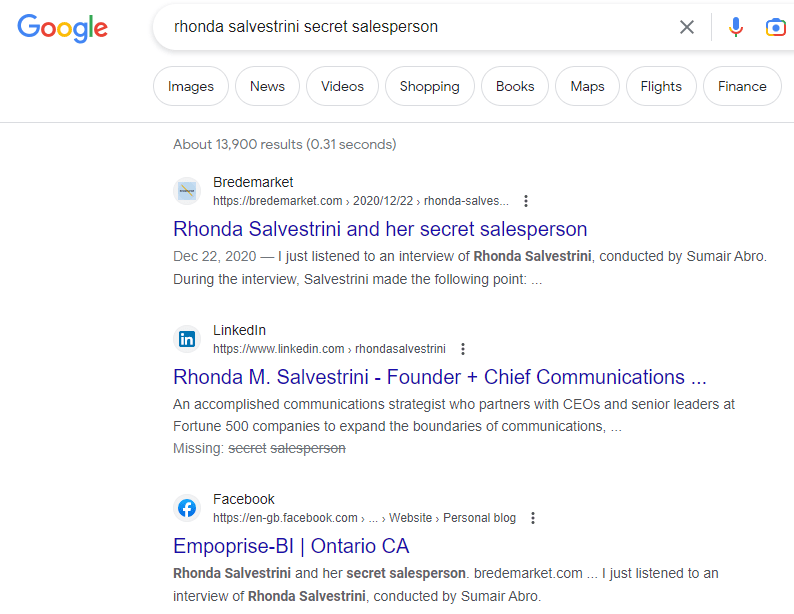
To prove the point that online content provides long-term benefits, I just conducted an incognito Google search for the words rhonda salvestrini secret salesperson.

  • Salvestrini’s own LinkedIn page was only the second result.
  • The first result was my 2020 blog post.
  • The third result wasn’t from Salvestrini either. It was a Facebook page for an old personal blog of mine that happened to reference those four words.
From https://www.google.com/search?q=rhonda+salvestrini+secret+salesperson

If you were searching for Salvestrini’s website and ended up at my blog post, I should clarify that I didn’t intentionally hijack Salvestrini’s traffic to draw it to my content. By happy accident, I just happened to use the magic words that drew searchers to my post. But if you’re interested in Salvestrini’s services, go to her website RhondaSalvestrini.com.

Now imagine the power if a potential customer is searching for their preferred terms and finds your case study.

And your secret salesperson isn’t secret any more. (Sorry Freddy.)

From https://www.youtube.com/watch?v=JwNVfFwAJdY

Case studies increase revenue for Inland Empire businesses

Credibility, trust, awareness, expertise, online visibility.

So what?

How about the bottom line? That’s important.

Bredemarket doesn’t do business in Sweden, but if it did, I’d want to get a lot of kroner. By Foto: Jonn Leffmann, CC BY 3.0, https://commons.wikimedia.org/w/index.php?curid=81842350

A well-crafted case study can be the first step in convincing a potential customer to become a paying customer.

So how do you create the case study?

Glad you asked. (Well, you sort of asked. Actually I asked. But you get the point.)

Well, you can just start writing, or get someone to start writing, and call the end result a case study.

But you need to create the right content.

And Bredemarket has a way to work with you to create the right content. To find out how to start a case study writing project or any writing project, click below.

Or just go straight to https://bredemarket.com/iehow/

4 Actions for IE Firms Needing Rapid Written Content

About a year ago, I wrote a two-part series of posts entitled “In marketing, move quickly.”

How can you move quickly?

If you’re an Inland Empire business that needs rapid written content creation, I’ll tell you how Bredemarket can help you create that content.

Why move quickly?

On the 99.9% chance that you didn’t read my two posts on this topic, here’s a brief TL;DR on what I (and others) said.

By Malene Thyssen – Own work, CC BY-SA 3.0, https://commons.wikimedia.org/w/index.php?curid=10119596
  • If you don’t move quickly, you may miss your opportunity.
  • The first post mentioned a company (whom I didn’t name) that hired an international marketing company in December 2021, but that hadn’t created any customer-facing content by March 2022.
  • The first post also mentioned a bank that put a customer-facing email test togehter in eight weeks.
  • Oh, and John DeLorean took eight years to get his car out, which didn’t help with his financing issues.
  • On the positive side, the second post described how one company moved quickly. Rather than waiting for a centralized content creator to distribute content, Intuit provided guidelines so that its employees could extend the reach of Intuit’s content through their own social media posts.
  • The second post also noted that quick generation of content is appreciated by customers, vendors, and partners.

How can you move quickly?

So let’s say you’re an Inland Empire business who needs to create between 400 and 600 words of content quickly, such as the text for a brochure, a blog post, or a LinkedIn or Facebook post.

How can you get it out quickly?

How can you avoid waiting eight weeks, or three months, or eight years for your customers to see your content?

Here are four actions you can take to get your content out.

  1. Specify your content needs.
  2. Ensure you are available.
  3. Ensure your content creator is available.
  4. Book your content creator.

I’ll describe these four actions below.

One: Specify your content needs

If you rush to create content without thinking through your needs, your content won’t be that effective. Take some time up front to plan what your content will be.

Ask yourself critical questions about your content.

(UPDATE OCTOBER 22, 2023: “SIX QUESTIONS YOUR CONTENT CREATOR SHOULD ASK YOU IS SO 2022. DOWNLOAD THE NEWER “SEVEN QUESTIONS YOUR CONTENT CREATOR SHOULD ASK YOU” HERE.)

Don’t know what to ask? I’ve written an e-book entitled “Six Questions Your Content Creator Should Ask You.”

The six questions (hint: you’ve already seen two of them in the first two parts of this post):

  1. Why?
  2. How?
  3. What?
  4. Goal?
  5. Benefits?
  6. Target Audience?

When Bredemarket meets with a customer, I ask more than these six questions, but they’re the most important ones.

If you can answer these questions, either on your own or with the help of your content creator, then you’ll have a roadmap that allows you to create the content together.

Two: Ensure you are available

Note the word “together” in the paragraph above.

After you meet with your content creator, your part of the task isn’t done. Or shouldn’t be.

When Bredemarket creates content for a customer, there are points within the process where the customer reviews the content and makes suggestions. Normally when I create between 400 and 600 words of content using the Bredemarket 400 Short Writing Service, there are two review cycles. Here’s how I explain them:

  • Bredemarket iteratively provides two review copies of the draft content within three days per review. (The number of review cycles and review time must agree with any due dates.) The draft content advances your goal, communicates your benefits, and speaks to your target audience in your preferred tone of voice. Relevant examples and key words/hashtags are included.
  • You return comments on each review copy within three days. For longer content, you may provide the draft formatted copy for the final review.

Why? (If you read my e-book, you know the “why” question is important.)

Maybe I have questions that popped up while I was drafting the content. Maybe something occurs to you after you see the draft content. Whatever the reason, these review cycles provide opportunities to improve the content as I develop it.

But to get your feedback, you have to be available. The standard process gives you three days to return your comments, although of course you can return them faster. But if you don’t return your comments for weeks or months…well, that kind of kills the idea of getting the content out quickly.

Of course, in some cases delays are unavoidable. One of my customers was dependent on a third party to complete his part of the review, but the third party was not delivering. In that case, there was nothing the customer could do, and that content was delayed.

One critical question: what if you need your content very quickly?

  • Now if you add up all the times in the Bredemarket 400 process, your total comes to fourteen days: one day for the review, three days for me to create the first draft, three days for your review, three days for my second draft, three days for your second review, and one day for the final copy.
  • If you need it in one week rather than two weeks, then we jointly need to figure out a faster cadence of reviews. I can adjust the schedule to meet your due dates.
  • But you have to be available for the reviews.
  • And as I note below, I have to be available for the creation.

So when you’re planning to have Bredemarket or another content creator generate something for you, remember that you’ll need to spend a little bit of time on reviews.

Three: Ensure your content creator is available

You know how I said that the Bredemarket 400 process gives you three days to review each content iteration? Well, at the same time it gives me three days to draft (and redraft) the content.

Can I, or the content creator you select, hold up our end of the process?

Right now I’m going to tell you something that has happened since I wrote those two “In marketing, move quickly” posts in March 2022. In May 2022, I accepted a full-time position with an identity company, and therefore no longer spend full time on Bredemarket activities.

Therefore, if you need to meet with me Monday to Friday between 8 am and 5 pm (Pacific), I can’t meet you. I have my day job to worry about.

I have regular office hours on Saturday mornings when I can meet with you, and I can arrange to be available on weekday evenings or early weekday mornings. And of course I can draft your content and incorporate your suggestions at those times also, outside of regular business hours.

But if you need a content creator that is available during regular (Inland Empire) business hours, then you’ll need to select someone else.

Just make sure that the content creator you select is available when you need them.

Four: Book your content creator

When you’re ready to move, move. If you don’t start the process of creating your critical content, by definition you’ll never finish it.

So take the next step and find someone who will create your content. There are a number of content creators who serve Inland Empire businesses.

But if you want to use the Ontario, California content marketing expert, contact me at Bredemarket and I’ll arrange a meeting. Be prepared for me to ask you a few questions.

What I Missed About QR Codes in 2021

A lot has happened with QR codes since I last wrote about them in October 2021. (For example, the Coinbase Super Bowl ad in 2022, and its demonstration of security risks.)

Now that I’m revisiting my October 2021 post on QR codes, I wish I could change one word to make myself look smarter.

See if you can guess which word I want to change.

I have since chosen to adopt QR codes for some of my Bredemarket work, especially in cases where an online reader may need additional information.

From https://bredemarket.com/2021/10/15/a-qr-code-is-not-a-way-of-life/

Did you find it?

Instead of writing “online,” I should have written “offline.”

I don’t know whether I just made a typo, or if I intentionally wrote “online,” but I shouldn’t have.

Why QR codes rarely make sense online

Because if you’re online, you don’t need a QR code, since you presumably have access to a clickable URL.

But if you’re offline—for example, if you’re watching a commercial on an old-fashioned TV screen—a QR code makes perfect sense. Well, as long as you explicitly identify where the QR code will lead you, something Coinbase failed to do in 2022. “Just click on the bouncing QR code and don’t worry where you’ll go!”

But there’s one more place where QR codes make sense. I didn’t explicitly refer to it in my 2021 post, but QR codes make sense when you’re looking at printed material, such as printed restaurant menus.

Or COVID questionnaires.

Which reminds me…

What I didn’t tell you about the Ontario Art Walk

…there’s one story about the Ontario Art Walk that I didn’t share in yesterday’s post.

After leaving Dragon Fruit Skincare, but before visiting the Chaffey Community Museum of Art, I visited one other location that I won’t identify. This location wanted you to answer a COVID questionnaire, which you accessed via a QR code.

I figured I’d do the right thing and answer the questionnaire, since I had nothing to worry about.

  • I was vaccinated.
  • I was boosted.
  • I hadn’t been around anyone with COVID.
  • I didn’t have a fever.

I entered the “right” response to every single question, except for the one that asked if I had a runny or stuffy nose. Since I had a stuffy nose, I indicated this.

But hey, it’s just a stuffy nose. What could go wrong?

When I finished the questionnaire, I was told that based on my answers, I was not allowed in the premises, and if I was already in the premises I should leave immediately.

Which I did.

And which is why I didn’t write about that particular location in yesterday’s post.

Bredemarket, pressing the flesh (sometimes six feet away)

But back to non-health related aspects of QR codes.

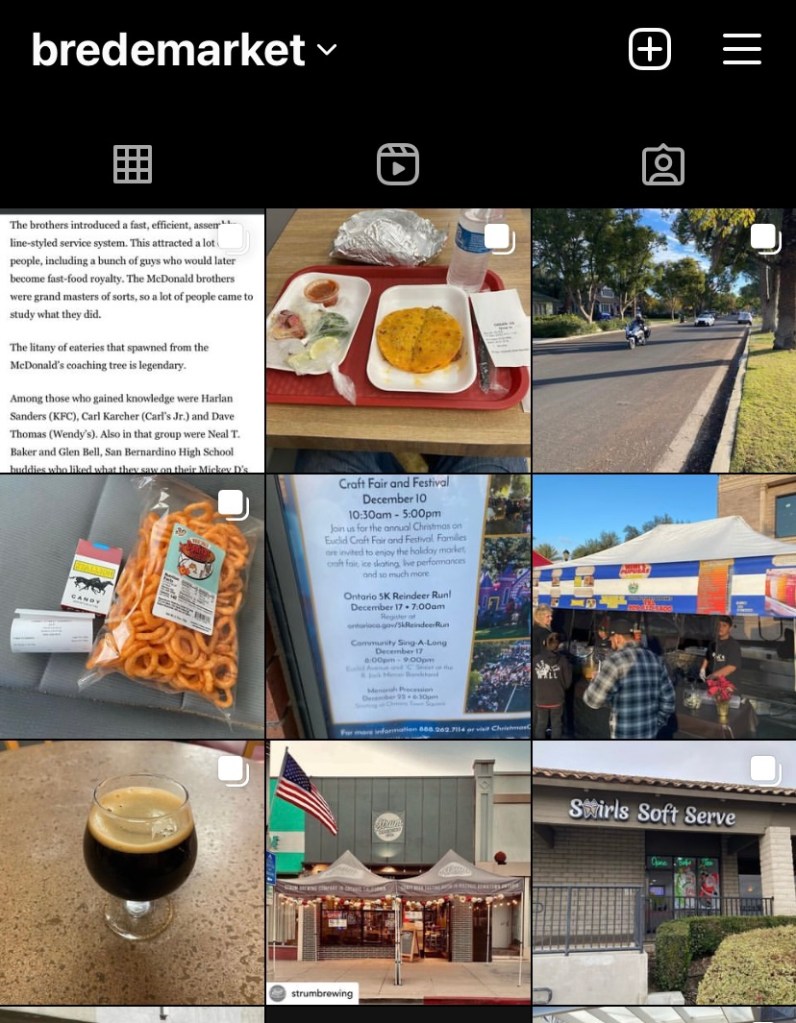
The Ontario Art Walk was actually the second in-person event that I had attended that week. As I noted on Instagram, I also went to a City of Ontario information session about a proposed bike lane.

Now that COVID has (mostly) receded, more of us are going to these in-person events. My target market (businesspeople in the United States) is mostly familiar with the century-old term “press the flesh.” While it usually applies to politicians attending in-person events, it can equally apply to non-political events.

Whenever I go out to these local events, I like to have some printed Bredemarket collateral handy in case I find a local businessperson looking for marketing services. After all, since I am the Ontario, California content marketing expert, I should let relevant people in Ontario know this.

In those cases, a QR code makes sense, since I can hand it to the person, the person can scan the QR code on their phone, and the person can immediately access whatever web page or other content I want to share with them.

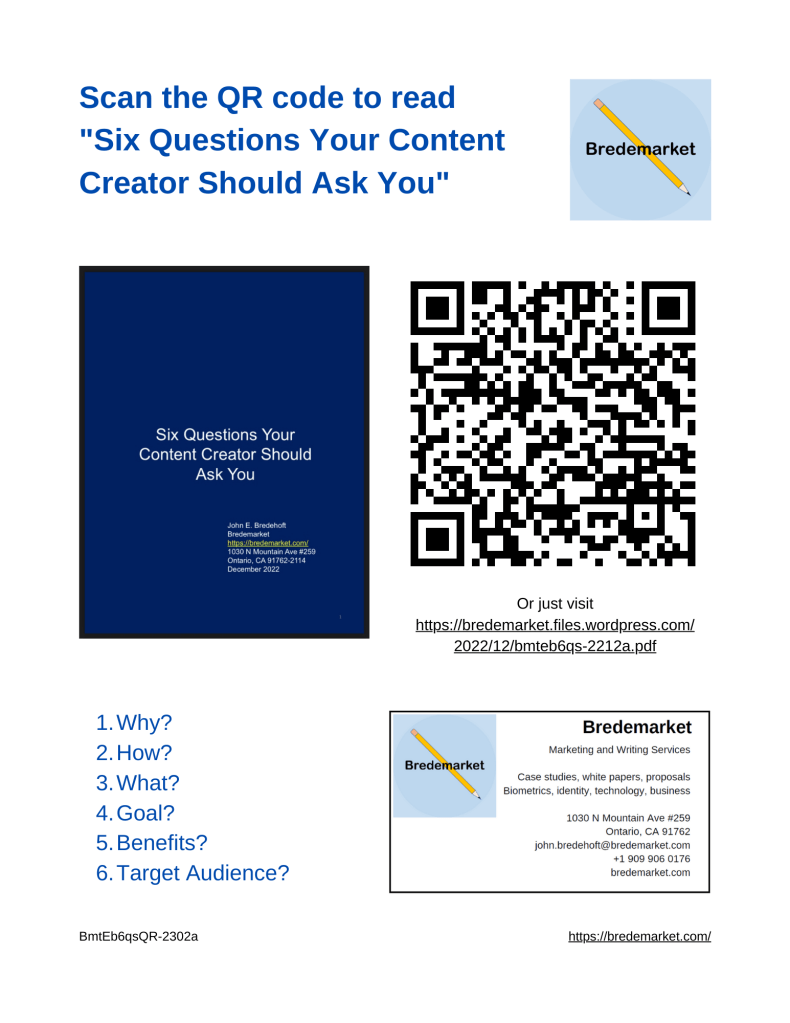
On Saturday, it occurred to me that if I ran across a possible customer during the Ontario Art Walk, I could use a QR code to share my e-book “Six Questions Your Content Creator Should Ask You.”

Unfortunately, this bright idea came to my mind at 5:30 pm for an event that started at 6. I dummied up a quick and dirty page with the cover and a QR code, but it was…dirty. Just as well I didn’t share that on Saturday.

But now that I have more time, I’ve created a better-looking printed handout so that I’m ready at the next in-person event I attend.

If we meet, ask me for it.

Making myself look less smart

Well, now that I’ve gone through all of this trouble explaining how QR codes are great for offline purposes, I’m going to share the aforementioned handout…online.

(UPDATE OCTOBER 22, 2023: “SIX QUESTIONS YOUR CONTENT CREATOR SHOULD ASK YOU IS SO 2022. DOWNLOAD THE NEWER “SEVEN QUESTIONS YOUR CONTENT CREATOR SHOULD ASK YOU” HERE.)

Which has probably prompted the following question from you.

“Why?”

Four reasons:

  1. It gave me the excuse to post the question “Why?” above, thus reiterating one of the major points of the e-book.
  2. Because I felt like sharing it.
  3. Just in case you don’t make “Event X” that I attend in the future, you can experience the joy of printing the flyer and scanning the QR code yourself. Just like you were there!
  4. To demonstrate that even when you provide a piece of content with a QR code, it’s also helpful to explicitly reveal the URL where you’ll head if you scan the code. (Look just below the QR code in the flyer above.) And if you receive the flyer in online form rather than printed form, that URL is clickable.

Ontario Art Walk, February 18, 2023

I finally made it to the quarterly Ontario Art Walk in downtown Ontario, California last night. I didn’t make it to all the studios, but here’s a sampling of what I did see.

Socal Trout Cartel

I’ve been following SCTC’s Instagram account for some time, and obviously knew of the interest in fishing and the clothing, but did not know that SCTC manufactured custom fishing rods. The technical specifics are way beyond my understanding (my only fishing experience was at Boy Scout camp, and I bought a cheap pole for that), but SCTC is more than happy to answer any questions you might have. https://www.socaltroutcartel.com/

I Am Threads

Co-located with Socal Trout Cartel, I Am Threads offers women’s clothing. See the website.

Lebec Makeup Atelier

So after looking at women’s clothing, I looked at women’s makeup. A few young women were busily applying makeup to celebrate a “prom night.” Hope they enjoyed it. https://lebeconline.wordpress.com/

Dirty Window Gallery / Rebecca Steen Art

This is another account that I have followed on Instagram for some time, and it was nice to finally meet Rebecca in person. My picture only captures a small part of her art; I should have taken more pictures.

Steen’s Etsy shop is here.

Geo.Metrics

I encountered my first DJ of the evening here. The atmosphere yesterday evening took me back to my college days. (OK, maybe Reed College was a little grungier.)

More information about Geo.Metrics is available at DOIA and on Instagram.

Paul Williams Gallery

Historical note: the gallery was not founded by Paul Williams. Well, I guess it sort of was. Paul Williams was an architect who designed a post office in Ontario in 1925, as David Allen notes. The post office moved to another location in 1941, but the building is still associated with Williams (as are others). The gallery that opened there in 2005 took Williams’ name, although it features art rather than architecture. Another Instagram account I’ve been following.

Dragon Fruit Skincare

I didn’t buy women’s clothes or women’s makeup, and I didn’t buy women’s skincare either (although their products are advertised as unisex). I did want to mention, however, that this was the second DJ of the evening, although this performance was lower key than the other two. https://www.dragonfruitskincare.com/

Chaffey Community Museum of Art

Crossing Euclid, I revisited the Chaffey Community Museum of Art, which featured rare evening hours in conjunction with the Ontario Art Walk. The current exhibits are from Chaffey Joint Union High School District students and faculty. https://www.chaffeymuseum.org/

Ontario Museum of History and Art

The third DJ (from JustUs Entertainment), a Black History-themed exhibit, and the tried-but-true exhibit devoted to the history of Ontario capped off my evening. https://www.ontariomuseum.org/

Sage Advice on the Benefits of Local Content Marketing Services

(This text was primarily created with ChatGPT. For the story behind the text, read my previous post.)

Inland Empire West business owners, gather around and listen closely, for I bring you a message of great importance. In this age of technology and information, the art of storytelling has become more vital than ever before.

By Mack Male – originally posted to Flickr as Ontario Convention Center, CC BY-SA 2.0, https://commons.wikimedia.org/w/index.php?curid=9512928

The way a tale is told can determine its success or failure, much like a business in the marketplace. A business must be able to captivate its audience, and draw them in with a story that is both compelling and relevant. This is where content marketing services come in.

By providing services that are tailored to the specific needs of a local community, businesses can reach their target audience more effectively. By understanding the unique culture and values of a region, businesses can craft stories that resonate with the people who live there.

Think of it like planting a seed in fertile soil. When the soil is rich and the conditions are right, the seed will take root and flourish. Similarly, when a business connects with its local audience through the power of storytelling, it will grow and prosper.

So heed my words. Invest in local content marketing services from Bredemarket, and watch as your business flourishes. The world is full of endless possibilities, and by harnessing the power of storytelling, you can tap into that potential and achieve great success.

The journey may be long, but the reward is great. Embrace the power of local content marketing services, and watch as your business blooms like a lotus in the sun.

If you are on the path seeking a talented marketer who has lived in the Inland Empire West for nearly 40 years to help you market your local business, consider Bredemarket.

Behind the Scenes: Harnessing the Power of ChatGPT for Bredemarket

On Wednesday I successfully logged into Bredemarket’s ChatGPT account.

If you’ve been following stories about how overloaded the free version of ChatGPT is these days, you can appreciate the magnitude of my accomplishment.

This allowed me to conduct some tests that I’ve wanted to perform for some time now. Since these tests related to creating content for my day job, I can’t share them with you here.

But after completing those tests, I took a few seconds to conduct a test for Bredemarket.

You’ll recall that Bredemarket identifies as a “sage” personality, and that Bredemarket has pivoted to providing services for local Inland Empire West businesses.

So here’s the prompt that I provided to ChatGPT:

Write in the style of a sage about providing local content marketing services.

OK, maybe ChatGPT took the “sage” persona a bit farther than I would. I’m imagining Tim Kazurinsky from his turn in “Gandhi and the Bandit.”

Here’s the original text that ChatGPT created, followed by my lightly edited version. The titles are my own.

A sage’s advice on local content marketing services, the ChatGPT version

Wise ones, gather around and listen closely, for I bring you a message of great importance. In this age of technology and information, the art of storytelling has become more vital than ever before.

The way a tale is told can determine its success or failure, much like a business in the marketplace. A business must be able to captivate its audience, and draw them in with a story that is both compelling and relevant. This is where local content marketing services come in.

By providing services that are tailored to the specific needs of a local community, businesses can reach their target audience more effectively. By understanding the unique culture and values of a region, businesses can craft stories that resonate with the people who live there.

Think of it like planting a seed in fertile soil. When the soil is rich and the conditions are right, the seed will take root and flourish. Similarly, when a business connects with its local audience through the power of storytelling, it will grow and prosper.

So heed my words, wise ones. Invest in local content marketing services, and watch as your business flourishes. The world is full of endless possibilities, and by harnessing the power of storytelling, you can tap into that potential and achieve great success.

The journey may be long, but the reward is great. Embrace the power of local content marketing services, and watch as your business blooms like a lotus in the sun.

Bredemarket’s advice on local content marketing services, the edited version

For the edited version, see this post.

But what if I’m caught?

If you’ve heard about ChatGPT, you’ve probably heard that it leads to the downfall of civilization since students will use it to complete school assignments, professionals will use it for proficiency examinations, and someone could even try to use it in court proceedings.

So what if someone detects that I didn’t write the post on local content marketing?

Writer.com has a tool called the AI Content Detector, and I ran it on two lightly edited ChatGPT samples, including my Bredemarket local content marketing post.

For the other sample, the AI Content Detector accurately estimated that only 6% of the text was written by a human.

What of Bredemarket’s post?

I have no idea why this sample appears to be 100% human-generated, even though the true estimate is closer to 6%.

But AI is constantly improving, so maybe if I test it again in a few days I’ll get caught.

I can use ChatGPT…but should I?

Of course, there’s the question of whether I should use ChatGPT for content creation.

In my writing, especially my writing for Bredemarket, I have a clearly identifiable tone of voice, casual yet technical. Anyone reading the ChatGPT-generated “sage” text who has read my other writing will detect a distinctly different style.

And does ChatGPT save time? In some instances it might save time in standard text generation, but I’ll probably have to perform extensive rewriting to avoid the AI detectors and to personalize the text for my specific needs. In the end, it probably won’t save me much time at all.

One potential way to use ChatGPT is to generate the text. and then pick out a phrase that I like and incorporate it into self-written text. Things like “captivate its audience” and “power of storytelling.”

Hey, it beats quoting snippets of text from Mel Brooks movies.

400 Words Are Worth Many Pictures

As I pivot Bredemarket’s writing services (due to my exit from some biometric writing) and return to a more regular blog posting schedule, I’ve discovered that Bredemarket isn’t the only Inland Empire West business that could use some additional text content.

There are local business websites with blogs that are nearly dormant. And that’s not good.

Sure, some of them have active image-based accounts on popular social services (Instagram, TikTok, etc.).

Not that there’s anything wrong with that. Bredemarket has an Instagram account of its own.

But their websites have blogs that are gathering dust.

Imagine if those blogs had a regular cadence of content, attracting content to YOUR website – not Mark Zuckerberg’s website or Bytedance’s website.

Content that not only describes what you do, but how you do it and why you do it.

Content that answers a lot of questions about your business – six questions in particular. Actually more than that, but there are six questions that will get you started with your personal content creator. I know; I wrote the book on it.

The answers to those questions launch an iterative process to create your blog content. Perhaps a one-time post, or better yet a blog post every month, attracting customers on a regular basis. Your own secret salesperson, as it were.

I offer the Bredemarket 400 Short Writing Service, a package that starts with a kickoff session and ends with between 400 and 600 words of blog or social content.

By Unknown author – postcard, Public Domain, https://commons.wikimedia.org/w/index.php?curid=7691878

Can you use Bredemarket to attract new customers?

If so, let’s talk.

Six Questions Your Content Creator Should Ask You: the e-book version

I love repurposing.

So I’ve repurposed my October 30 blog post into an e-book.

This gave me an opportunity to revisit the topic and add critical information on wildebeests, George (H.W.) Bush, and Yogi Berra.

But more importantly, it allows me to share my thoughts with a wider audience.

If you missed the October blog post, I state that there are six critical questions that your content creator must ask before creating content. These questions apply whether your content creator is a consultant, an employee at your company, or you.

The e-book discusses each of these six questions:

  1. Why?
  2. How?
  3. What?
  4. Goal?
  5. Benefits?
  6. Target Audience?

And as I note in the e-book, that’s just the beginning of the content creation process.

Whether you intend to use Bredemarket as your content creator, use someone else as your content creator, or create your own content, the points in this e-book are helpful. They can be applied to content creation (case studies, white papers, blog posts) or proposal work, and apply whether you are writing for Inland Empire West businesses or businesses anywhere.

And if you read the e-book, you’ll discover why I’m NOT sharing it on the Bredemarket Identity Firm Services LinkedIn page and Facebook group.

You can download the e-book here. And you can be a content marketing expert also.

(UPDATE OCTOBER 22, 2023: “SIX QUESTIONS YOUR CONTENT CREATOR SHOULD ASK YOU IS SO 2022. DOWNLOAD THE NEWER “SEVEN QUESTIONS YOUR CONTENT CREATOR SHOULD ASK YOU” HERE.)

Does Every Blog Post Need a Call to Action?

Does every blog post need a CTA?

No.

Let me explain.

What is a call to action?

No, not the Western Electric kind of call. By Jonathan Mauer – Own work, CC BY-SA 4.0, https://commons.wikimedia.org/w/index.php?curid=50534668

For those who are not familiar with the term, a “call to action,” abbreviated as CTA, is just what it sounds like: a summons to do something. So if you want to call it a STDS, feel free. (Although I wouldn’t.)

Of course, calls to action have been used long before the digital world appeared. For several decades, automobile dealer Cal Worthington (and his dog Spot) wanted people to come to his car dealerships, so in between the entertaining animals, the call to action “Go see Cal” was repeated in commercials like this one.

From https://www.youtube.com/watch?v=8hT2oP–NSU

And things haven’t changed in the 21st century, except that most of us have retired the dog Spot. For example, some of my blog posts include the following call to action:

These three bullets, when used, are preceded by a statement such as “If I can work with you to create your written content, please contact me.” Or whatever makes sense for the particular blog post.

But not all of my posts include the three CTA bullets.

Posts for awareness don’t need CTAs

(UPDATE 7/24/2023: Upon further reflection, I should have said “Posts for awareness don’t ALWAYS need CTAs.” See my updated blog post, “Awareness Calls to Action.”)

Take my post from last Saturday, “Candy Street Market is coming.”

Candy Street Market, 110 W Holt, Ontario, California

This post simply talked about a new candy store in Ontario, California, but never talked about Bredemarket’s content creation or proposal writing services.

So why did I write a post that doesn’t directly lead to business?

For the awareness.

The awareness of Bredemarket doesn’t equal the awareness of Kleenex. But I’m working on it. By kimubert – Flickr, CC BY 2.0, https://commons.wikimedia.org/w/index.php?curid=40263441

Ever since I exited some of my prior identity-related markets in the spring of 2022, I’ve pivoted my marketing activity and am concentrating more on serving local firms in California’s Inland Empire. This isn’t a new activity; I’ve targeted local businesses since September 2021. But since I am no longer serving my former clientele of companies that identify individuals using fingerprints, faces, and identity documents, the local business is obviously extremely important.

But the locals need to know that I’m here.

Hence I wrote about a local candy store to provide awareness to businesses that Bredemarket is out there.

If their curiosity is piqued, then perhaps they’ll subscribe to the blog or explore what I do to find out what Bredemarket can do for them.

And even if not, at least the readers know another place to get candy in downtown Ontario.

CTAs on some posts wouldn’t be prudent

And then there are posts in which a CTA plain doesn’t belong.

I already linked to one such post above: my April 22 post announcing my change in business scope.

In short, the post let people know all of the business that I wouldn’t accept in the future.

Why post a call to action after announcing that?

And how would I word it? “If you are a biometric identity company that needs content marketing or proposal writing services, don’t call me”?

It comes down to goals

But you don’t need to detailed list of do’s and don’ts to determine which blog posts need CTAs.

It all boils down to one simple question:

What is the goal of the blog post?

As I stated in October, one of the six questions that you (or your content creator) should ask before starting work is about the goal for the piece of content.

  • Do you want people to keep you in mind if they need your product or service in the future? (“That guy knows Ontario, and he writes content; maybe he can help me.”)
  • Do you want people get more information on something (such as a service description)?
  • Do you want people to contact you personally if they want more information?
  • Do you want people to pull out their credit card immediately and buy something?

The answers to those questions will shape the final content, whether a CTA is needed, and the type of CTA.

This post DOES have a CTA

So let’s say you’re an Inland Empire business that needs a content marketing expert to write a blog post for you.

And let’s say that you have specific goals for this blog post.

And you’re targeting a particular audience for this blog post. (Maybe candy lovers.)

And you realize that buyers aren’t persuaded by a list of features you offer, but by a list of benefits for them. (Yes, benefits are important.)

Before Bredemarket writes a blog post for you, I’ll ask you about these items and others (see the list here), to make sure that my work is aligned with what you need.

So do you want to talk to me about that blog post that your business needs?

Here’s the call to action. Talk to me.