Sadly the question “why would a robot fish?” was shared in a private Facebook group, so I cannot share the entire question with you. But I can share my response.
“Some humans don’t fish for food, but for relaxation. But if robots need downtime, it doesn’t have to be at a stream with a pole.”
After thinking, I composed the prompt for the Google Gemini picture that illustrates this post.
“Create a realistic picture of a robot by a stream in the woods, fishing. The eyes and other parts of the robot’s head indicate that its internal controls are in maintenance mode, or that the robot is ‘relaxing.’”
My own content creation process with Bredemarket includes a “sleep on it” step which lets my brain reset before taking a fresh look at the content.
The generative AI equivalent is to take the output from the initial prompt, start a new independent chat, and write a second prompt to re-evaluate the output of the first prompt.
You can bet that I paid attention to AKings’ latest post after I saw how it began:
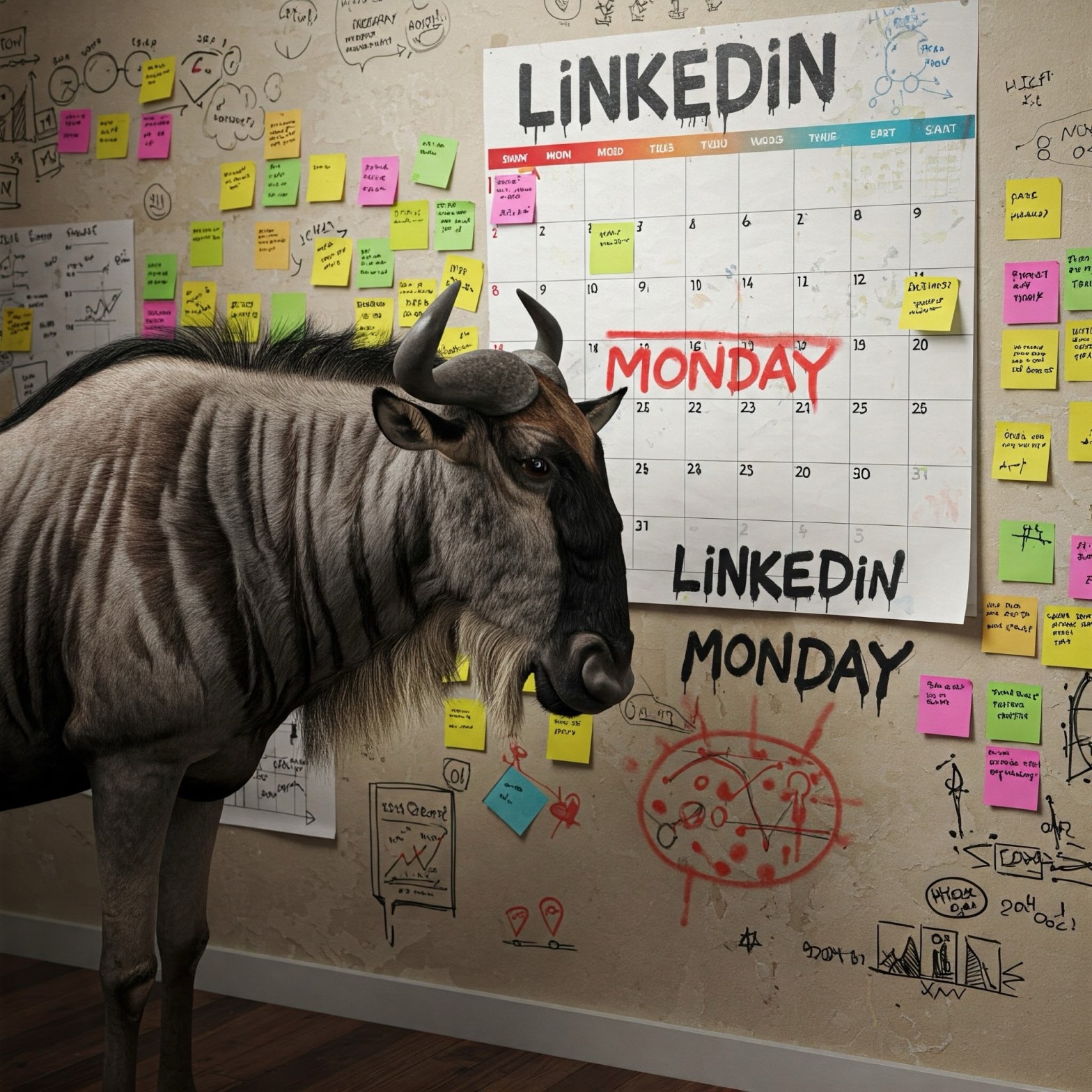
“Indiana. The Crossroads of America. A place where colossal semi-trucks roar in from the north, south, east, west, and every conceivable direction in between, like a great migration of diesel-belching wildebeests on their way to deliver vital supplies.”
Bredemarket’s self-promotional content is replete with wildebeests, iguanas, and wombats. Much of this was from an urge to differentiate from those who eat their own dog food. So Bredemarket ate its own iguana food, then its own wildebeest food.
But “wildebeest trucker” is a new one on me.
How do you differentiate your marketing content from that of your competitors?
Or do you eat their dog food?
But goin’ back to Indiana, AKings’ post is a literal tour of the state over a year, including an encounter with angry union members in Kokomo (not that Kokomo). Recommended reading.
I have worked with several companies’ content calendars over the years.
Two of Bredemarket’s clients are using Jira to manage their content calendars.
Another of Bredemarket’s clients doesn’t (as far as I know) have an official content calendar, but is tracking some content in a go-to-market Excel workbook.
If I remember correctly, MorphoTrak also used Excel for content management. MorphoTrak’s parent Morpho used a social media management platform, but I can’t remember which one.
At the time I was at Incode, the company used Asana to host its content calendar. (I have no idea how Incode has managed its content since May 2023.)
Bredemarket creates its own content (this is an example), and I also use Asana as my official content management platform.
Sharp-eyed people spotted how I worded that last sentence.
What did I just say?
If you read it again, you’ll see that I only discussed my OFFICIAL content management platform.
Some content, including this blog post/LinkedIn post/wherever else the text ends up, never gets logged in Asana. I just started writing it in iOS Notes and I will add various checkboxes up top as I share it on the blog and social channels.
Some other content, also not logged in Bredemarket’s Asana, is repeatable content that I store in Notes and repost periodically.
Something I post to my identity-related social channels (BIFS = Bredemarket Identity Firm Services).
And sometimes—a lot of the time, actually—I just go to a platform and WRITE stuff.
As a sole proprietor, I enjoy absolute control over Bredemarket’s messaging, and therefore the blog and social media approval process is very…streamlined. That isn’t the case elsewhere, where even a simple tweet requires approval. This makes it hard to live-tweet an event when the approver is unavailable…but there are workarounds. Perhaps I will reveal them one day.
What about process?
But if your corporate environment requires you to impose a strict content management structure, where all content is logged in the content calendar and all content requires approval, make sure that your content logging and approval process protects your company but DOESN’T silence it.
Because if your content approvals are too onerous, you will end up with no content at all.
Or you will end up with…perhaps I will reveal that one day.
Perhaps one of the biggest changes over the last several decades is that we no longer possess physical things.
Old and new music
When some of us were younger, we would always go to “the record store” to buy a CD or cassette or vinyl (the “record”) or maybe an 8 track. We would put the physical media on a playback device. And unless the media were damaged or stolen, you always had it. RCA wouldn’t come to your house and take your Elvis record.
Let me be your teddy wildebeest.
Then services from Napster 1.0 to Apple to Spotify started to provide music in digital form. And now your music COULD be taken away. When Neil Young got mad at Spotify, I couldn’t listen to Neil any more. (They subsequently kissed and made up.)
This is true of many other things: TV shows, movies, even computer software.
Which brings us to books.
Old and new books
You could once buy books at your local bookstore, or from an online bookstore called Amazon. But then Amazon developed the Kindle e-reader. And as The Verge points out, something on the Kindle today may not be there tomorrow.
“Amazon has occasionally removed books from its online store and remotely deleted them from Kindles or edited titles and re-uploaded new copies to its e-readers. In 2009, the company removed copies of George Orwell’s Nineteen Eighty-Four and Animal Farm, explaining the books had been mistakenly published. More recently, many of Roald Dahl’s books, including Charlie and the Chocolate Factory, were replaced with updated copies featuring modified language on various ebook platforms. It’s a reminder that you don’t actually own much of the digital content you consume, and without the ability to back up copies of ebooks, you could lose them entirely if they’re banned and removed.”
New and improved edition.
But there is a workaround. If your Kindle has a copy of Mein Kampf or a book about gay hotspots near the Gulf of Mexico and you don’t want to lose it, you can save it outside of the Amazon ecosystem.
“(The feature is) still accessible through Amazon’s website by accessing your “Content Library” while logged into your account. For purchased books you select the “More actions” menu, choose “Download & transfer via USB,” select a Kindle device you have registered, and a copy of the book will be downloaded to your computer.”
A nice feature…especially if you want to make sure you don’t lose your purchased content. And it’s really nice if you want to put your Amazon content on a non-Amazon e-reader. Because the Kindle only has a minuscule 72% share of the e-reader market, this is a gargantuan threat to Amazon’s ability to sell hardware.
You can see where this is going.
Ch-ch-ch-ch-changes
Amazon has made a change, according to The Verge:
“Starting February 26, 2025, the ‘Download & Transfer via USB’ option will no longer be available. You can still send Kindle books to your Wi-Fi enabled devices by selecting the ‘Deliver or Remove from Device’ option.”
February 25.
To clarify, you can still access your books on the Kindle app.
Just not outside of it.
How does this affect your content?
This serves as a reminder about technological change, walled gardens, and obsolescence.
Which ties in with one of Bredemarket’s favorite topics, repurposing.
Now Bredemarket doesn’t create videos for clients, but if you need your identity/biometric or technology text repurposed in another format, I can help.
Never mind that the resulting generative AI content was wordy, crappy, and possibly incorrect. For some people the fact that the content was THERE was good enough.
Then I noted that sometimes I will HAVE to get that content out without proper reflection. I outlined two measures to do this:
Don’t sleep on the content.
Let full-grown ideas spring out of your head.
But I still prefer to take my time brewing my content. I’ve spent way more than five minutes on this post alone, and I don’t even know how I’m going to end it yet. And I still haven’t selected the critically important image to accompany the post.
Am I a nut for doing things manually?
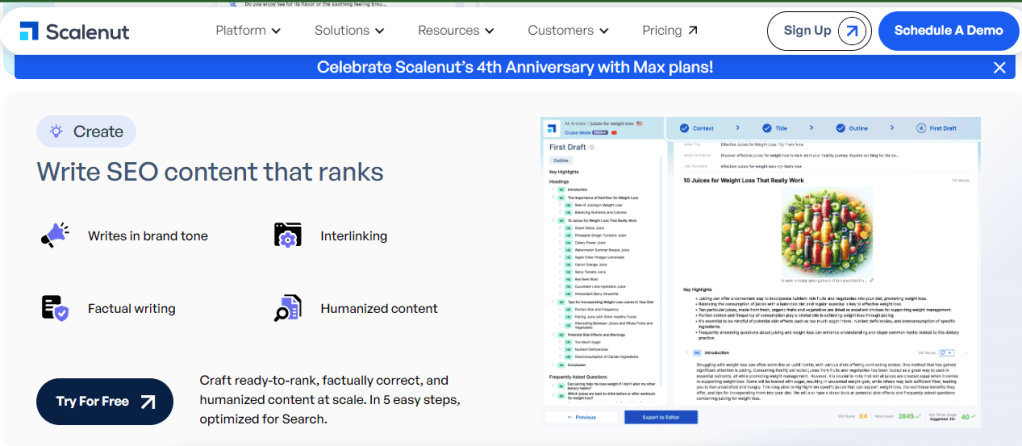
You’ve gone from idea to 2500+ word articles in 10 minutes.
And if Scalenut explains WHY its technology is so great, the description is hidden behind an array of features, benefits, and statistics.
Maybe it’s me, but Scalenut could improve its differentiation here, as outlined in my video.
Differentiation, by Bredemarket.
What Scalenut does…and doesn’t do
I should clarify that copyrighting is but one part of Scalenut’s arsenal.
Scalenut is a one-stop-shop AI-powered SEO writing tool that will see you through keyword selection, research, and content production. Plus, you get full access to their copywriting tool, which can create more specific short-form content like product descriptions.
You optimize SEO content by adding NLP keywords, which are the words that Google uses to decide what an article is about.
MacRae cautions that it’s not for “individuals whose writing is their brand,” and Scalenut’s price point means that it’s not for people who only need a few pieces a month.
But if you need a lot of content, and you’re not Stephen King or Dave Barry or John Bredehoft (not in terms of popularity, but of distinctness), then perhaps Scalenut may help you.
I can’t tell you why, though.
(And an apology for those who watch the video; like “The Long Run” album itself, it takes forever to get to the song.)
Now I’ve argued that there are benefits to a slower (i.e. greater than five minutes) content production process that results in more mature content.
But what if you need the content within five minutes? People aren’t going to wait for my dilly-dallying.
In fact, my LinkedIn post eight months ago was prompted by an encounter with an impatient content customer. I was waiting for some information before I wrote the content, and someone got tired of my waiting and just asked a generative AI engine to write something. (I think I was supposed to thank them for helping me, but I didn’t.)
This is not an isolated incident, and even with our lamentations that generative AI content blows monkey chunks, it’s still going to be “good enough” for some people.
So if I’m going to continue to make my living as a temperamental writer who is a “you can pry my keyboard out of my cold dead hands” type, I need to create my content VERY quickly.
And sometimes I’m going to have to take extreme measures to get that content out in five minutes.
Of course to do this, you need to approach the “draft 0.5” correctly with a focused message.
How do you jump straight to a polished piece? Meat Loaf and the Beastie Boys aren’t going to tell me. I need to go to the ancient Greeks.
Measure two: let full-grown ideas spring out of your head
Non-believers think that Christianity, Islam, and Judaism have some really weird practices. But frankly, they’re mild compared to ancient Greek mythology, which primarily consists of Zeus trying to be the Wilt Chamberlain of his time.
Take the story of Zeus lusting after Metis and succeeding in his pursuit, until an oracle (unrelated to Larry Ellison) prophesied that Zeus and Metis’ second offspring would overthrow Zeus. To prevent this, Zeus swallowed Metis.
Makes sense to me.
Then the story gets REALLY weird.
After a time, Zeus developed an unbearable headache, which made him scream out of pain so loudly it could be heard throughout the earth. The other gods came to see what the problem was. Hermes realized what needed to be done and directed Hephaestus to take a wedge and split open Zeus’s skull.
Yup, Athena, as a full-grown adult (wearing armor, no less), popped out of Zeus’ head.
Which was awfully convenient, since they didn’t have to go through potty training and learning the Greek language and all of that, because Athena was already mature.
So if I can conceive of my content as a full-grown piece of work from the outset, it will make it easier (and hopefully faster) to create it.
Results
I wasn’t able to write this particular blog post in five minutes, and I still had to go through some back-and-forth to tweak things such as headings. But I executed this content more quickly than normal.
This post talks about the Bredemarket 2800 Medium Writing Service, describes why your firm would elect that service over three of my other services, and explains how the Bredemarket 2800 Medium Writing Service works.
Four ways that Bredemarket provides written content
I know that the experts say that you’re NOT supposed to give your prospects a multitude of choices, and that you should keep your offerings simple. Sometimes REALLY simple.
But I’ve ignored the experts (again) and I’m giving Bredemarket’s prospects four options for content creation. I’ll briefly touch on three of them before describing the fourth one, the Bredemarket 2800 Medium Writing Service. Once I’m done, you’ll know when you want to elect Bredemarket 2800, and when you’ll want to elect one of the other three options:
Bredemarket 4000 (by the hour),
Bredemarket 4444 (by the month), or
Bredemarket 400 (by the small project).
One: by the hour (Bredemarket 4000 Long Writing Service)
Sometimes you don’t know the parameters of your project, or perhaps you may have multiple projects that require Bredemarket’s assistance. In those cases, Bredemarket bills by the hour using something I call the Bredemarket 4000 Long Writing Service.
Whether it’s proposal work or something else, I do the work (however much work there is) and bill you for the hours that I worked.
Two: by the month (Bredemarket 4444 Partner Retainer)
Perhaps you have ongoing needs and just need me to be available for a certain number of hours each month, yet you’re not ready to hire a full-time person to do the work. In that case, the Bredemarket 4444 Partner Retainer is the package that is best for you. With this level of commitment, I am embedded as part of your organization.
As I assert in the post “Three Levels of Engagement With Your Content Creator,” a retainer offers a happy middle ground between full-time employment and single project work. It gives you work flexibility, budget predictability, and consultant accessibility.
Three: by the small project (Bredemarket 400 Short Writing Service)
But what if you know the scope of your project, and it is a single simple project? If you only need between 400 and 600 words of text, then the ideal package for you is the Bredemarket 400 Short Writing Service.
If your project only requires 400 to 600 words (give or take), the Bredemarket 400 Short Writing Service is ideal for you.
But what if you need more words than that? A lot more?
Why would you need 3,000 words?
There are a few cases in which your firm may need roughly 3,000 words of text, rather than the roughtly 500 words of text described above.
Longer blog posts. Often blog posts are pretty short and fit well within a 400 to 600 word limit. But sometimes you need longer, more detailed blog posts that delve into a topic more deeply. If you need 3,000 words to tell your story, tell it.
Longer LinkedIn articles. In most cases, social media postings will not hit the 3,000 word mark. (For some social media platforms it’s near impossible to hit that limit anyway.) One notable exception is LinkedIn articles, which can enter into the same detail as a long blog post. If your audience is on LinkedIn, then place your content natively on LinkedIn (repurposing it to your blog for your non-LinkedIn prospects if you like).
Longer case studies. Case studies can vary in length. As it turns out, the case studies that Bredemarket has written for its clients are simple two-pagers (including graphics) and fit well within the Bredemarket 400 parameters. But perhaps your case study demands richer detail.
White papers. While one may debate about the semantics of what is a white paper vs. what is not a white paper, you may demand a document that requires around 3,000 words of detail.
The content type that you know about, but I don’t. You may require a particular piece of content that doesn’t fit into the nice neat categories above, but requires text of between 2,800 and 3,200 words.
In these cases, the Bredemarket 2800 Medium Writing Service provides the content you need.
But is Bredemarket 2800 the same as Bredemarket 400, with more words and a higher price?
No.
Longer content requires a slightly different process.
How the Bredemarket 2800 process differs from the Bredemarket 400 process
Admittedly there are some obvious similarities between Bredemarket 400 and Bredemarket 2800.
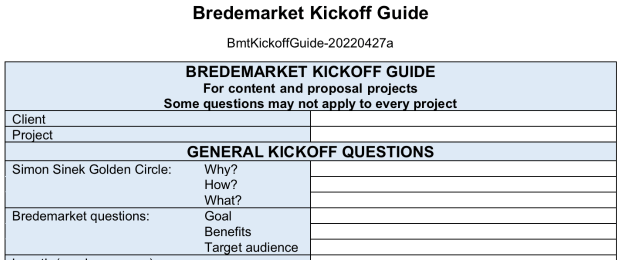
The kickoff is an important part of the content creation process, since the questions I ask during the kickoff (since expanded) ensure that I produce the right content at the end of the process.
The kickoff ensures that the final written content (a) answers the WHY/HOW/WHAT questions about you, (b) advances your GOAL, (c) communicates your BENEFITS, and (d) speaks to your TARGET AUDIENCE. It is both iterative and collaborative.
The beginning of the Bredemarket Kickoff Guide that I use. There are many, many more questions that I haven’t disclosed. Do you want to learn them? Buy the service.
The basic work during the kickoff is pretty much the same as for Bredemarket 400, although you and I will probably go in-depth on certain items, and there is a higher chance that the content specifications will be more detailed (for example, goals for each subsection of the content).
You and Bredemarket agree upon the topic, goal, benefits, and target audience (and, if necessary, outline, section sub-goals, relevant examples, and relevant key words/hashtags, and interim and final due dates).
For complex content requiring input and approval of multiple subject matter experts, you and Bredemarket agree on a preliminary list of tasks, assigned persons, and due dates.
For content that must be incorporated into your content management system, you and Bredemarket agree on the necessary format and other parameters. Otherwise, the final copy will be provided in Microsoft Word docx format, including (as appropriate) callout indicators, hyperlinks, key words, and/or hashtags.
For projects requiring multiple related pieces of content, you and Bredemarket agree upon the desired frequency of content.
The Bredemarket 2800 prework
Sometimes one or two additional things will happen before I start writing the first draft.
I may need to interview one of your customers or subject matter experts—for example, to obtain the facts necessary for a case study or white paper.
I may need to conduct additional research, as agreed upon by us during the kickoff.
The Bredemarket 2800 drafts
Once I’m ready, I start writing.
Between you and me, I create a draft 0.5, sleep on it (sometimes literally), and then create a much more succinct draft 1.0. See “Your writers (in this case me) should be succinct,” in my post “Which Words Should Your Marketers Use? My Four Suggestions.”
It shouldn’t surprise you to learn that it takes longer to write 3,000 words than it takes to write only 500 words. Therefore, I allow myself up to seven days (actual days, not working days) to produce the first draft. (Contrast this with Bredemarket 400, in which I commit to create a draft within three days.)
Then I hand the draft over to you for the first review.
After I receive your review comments, I work on the second draft (again, taking up to seven days) and hand it over for the second review.
Then (if necessary) I work on the third draft and hand it over for the third review. Unlike Bredemarket 400, which only includes two reviews, Bredemarket 2800 includes three reviews because of the higher complexity of the content.
At the end, I provide you with the final copy.
But what if you need your content much more quickly than the 1-2 months it may take to go through all three of the draft and review cycles?
Then we’ll mutually adjust the parameters (and the billing) accordingly.
However, remember that when I adjust my deliverable schedule, it also affects your deliverable schedule as described below.
The Bredemarket 2800 reviews
As decribed above, you will receive up to three review copies during the process.
Because this is a collaborative process, your participation is important to ensure that I create the proper content for your firm. So be prepared to spent the time necessary to ensure that the content is right.
I realize that you probably don’t have a lot of time to review consultant content. If you did have a lot of time, then you’d probably write the content yourself rather than asking a consultant to do it. For this reason, I give you seven days to review each draft, rather than the three days that I give to firms that elect the Bredemarket 400 Short Writing Service.
Of course, if you require a more rapid turnaround, then you’ll need to review the drafts much more quickly, in the same way that I’ll need to write the drafts much more quickly.
The Bredemarket 2800 end product
After the kickoffs, drafts, and reviews, I’ll provide the final copy in Microsoft Word docx format, unless we’ve agreed on some other format. This will give you the content you need to put in your blog, in an article on your LinkedIn page, or in whatever content you need.
In case you like to consume your information in video form, here’s a video about my Bredemarket 400 Short Writing Service, for text of between 400 and 600 words.
About the Bredemarket 400 Short Writing Service.
If you prefer to read your information rather than watch it, you can do that also.
It’s Saturday morning in California, and I’m a little bleary-eyed after a trip to Mexico City in connection with my day job. I was going to sleep in this morning, but I ended up reading a Forbes article that Mitch Wagner shared. Then I thought about it. Now I’m thinking about it some more.
Generated by Craiyon from the prompt “A powerful robot standing next to a weak robot, in which the two robots represent high quality generative AI vs. low quality generative AI”
Shrivastava obtained the quote in the article’s title from Melissa Shea of Fashion Mingle, who has used (and still uses) freelancers to write marketing copy and perform other tasks.
Why did Shea say what she said?
At $0 an hour, the chatbot can crank out more content much faster than freelancers and has replaced three content writers (Shea) would have otherwise hired through freelancing platform Upwork.
Shrivastava then goes on to say that this affects the Upwork, Fiverr, and related platforms in two significant ways:
People like Shea are less likely to go to Upwork and Fiverr to seek people for non-specialized tasks. After all, even the cheapest content creators from the most impoverished developing nations cost more than today’s free generative AI tools.
People seeking jobs on the platforms are trying to get an edge by using…you guessed it, AI.
In early April, business consultant Sean O’Dowd uploaded two job postings on Upwork and within 24 hours he received close to 300 applications from freelancers explaining why they should be hired. Of the 300 proposals, he suspects more than 200 were done by ChatGPT, he says.
Obviously O’Dowd isn’t going to pay for something he can get for free, and others who hire freelancers caution in advance that they won’t pay for work in which the freelancer uses AI.
(I assume in this instance “use” means “generate the majority of the content automatically.” Shrivastava mentions a graphic designer from Nigeria “who uses ChatGPT to help him ideate,” and I’ve used the same technique myself. For this post, I asked a generative AI tool to describe the benefits of case studies for Inland Empire businesses. I threw out everything that the tool wrote except for five short bullets. Which I then changed to six short bullets.)
What the Forbes article didn’t say
Rashi Shrivastava was examining the relationship between generative AI and freelancing TODAY. That in itself is a handful to analyze, but there’s an entirely different question to address.
I addressed this other question in a Bredemarket LinkedIn post earlier this morning providing my thoughts on Wagner’s share of Shrivastava’s article. Now I’m going to be lazy: not by using generative AI to write the following paragraphs, but to simply reprint what I already said on LinkedIn. (I guess I could use generative AI to rewrite the post using different words, but…well, we’ll get to that.)
There are so many things to unpack here, but I will confine myself to one (for now):
What happens when (not if) the better generative AI tools are no longer free? What happens if the better tools cost MORE than a beginning writer in a developing country? Or the worst (best?) case scenario: what happens if the highest quality tools cost more than an experienced writer in a developed country?
As time passes, we will see significant differences in these tools.
Some will crank out basic work with outdated data; these will be “good enough” and will be cheap and may even continue to be free.
Other tools will be constantly be retrained and provide proper attribution of training data. Because of significant investments in R&D, the better tools will provide higher quality work – maybe even better than Mitch Wagner’s work (or my own). Perhaps you may even need to “program” them – an order of magnitude more complex than proper prompt phrasing.
At that point, someone requiring high quality content may decide that it’s cheaper to let a human do it.
What generative AI says
So that was what I’ve written about a future in which the quality and cost of generative AI tools will vary dramatically. But what would generative AI write about its own future? Since the service is still free, I thought I should ask.
In the past I posed a question to generative AI asking if it was after my job. If I recall correctly, I posed the question to Google Bard, and it diplomatically answered that humans can never be replaced. (But what was the source of its information? Google executives who want to minimize the chances that Congress will clamp down on generative AI use?)
In this case, I’m turning to ChatGPT. My prompt was “What happens to the economics and usage of generative AI when the higher quality services are no longer free?” The remainder of this section is ChatGPT’s response.
If higher quality generative AI services are no longer free, it is likely that the economics and usage of such services will be affected in several ways:
Reduced usage: Some users may be deterred from using the service if it is no longer free. They may look for alternative solutions or reduce their usage of generative AI altogether.
Increased cost: Users who continue to use the service may have to pay for it. This could increase the cost of using generative AI, which may limit its adoption.
Competition: If one provider starts charging for generative AI services, it may create opportunities for other providers to offer similar services at a lower cost or with better features. This could increase competition in the market and ultimately benefit consumers.
Quality: If providers start charging for their services, they may have more resources to invest in improving the quality of their generative AI. This could lead to better results and more satisfied users.
In summary, the economics and usage of generative AI may be affected if higher quality services are no longer free. However, the impact will depend on the pricing strategies of providers and the behavior of users in response to the change.
Postscript: a little more about Mitch Wagner
Why did Mitch Wagner share the Forbes article in the first place?
Because generative AI affects him. Or maybe it doesn’t.
Read his LinkedIn biography (as of today; writers sometimes like to edit themselves) and judge for yourself if generative AI threatens someone with his broad experience.
I’m a marketing writer and tech journalist, with more than 25 years of experience telling stories about companies using technology to deliver business value.
I’m expert at interviewing, researching, writing and editing articles and newsletters for audiences at all levels of technology understanding on daily, weekly, and monthly deadlines. I’ve worked solo, led a small full-time team, and large teams of freelance contributors. I’m skilled in hosting podcasts, webinars, and video.
Previously, I worked at Oracle, part of a team of writers, editors, and designers telling stories about how the company and its customers are innovating and inspiring.
Prior to Oracle, I was an executive editor and writer at top tech journalism publications, covering the early days of the Internet, social media, and wireless communications.
I went through several titles, settling on “Tomorrow’s Generative AI Landscape Will Differ From Today’s.”
I then fed the following prompt to ChatGPT: “Rewrite the title “Tomorrow’s Generative AI Landscape Will Differ From Today’s” to optimize clicks”
ChatGPT returned this: “Revolutionary Changes in the Generative AI Landscape Coming Tomorrow – Don’t Miss Out!”
Unfortunately, ChatGPT had no way of knowing that BuzzFeed shut down this week. I was busy in Mexico City and missed the news, but luckily for me Mitch Wagner shared that news item also.
Earlier this week I was asked about one of the posts that I wrote in the Bredemarket blog. I had to confess that I hadn’t thought about the topic much recently.
After this conversation, I realized that the referenced post was written back in July.
Because I’ve written over 200 posts in the Bredemarket blog over the past year-plus, some of them kind of get merged together in my mind.
And in this particular case, my thoughts on the original topic have evolved since the summer.
So if you see a future post that revises and updates something I wrote about four months ago, now you know why.
I hope that the new post won’t be dramatically different from the old one.
















 Bredemarket