Forensic examiners, YOU’RE DOING IT WRONG based on this bold claim:
“Columbia engineers have built a new AI that shatters a long-held belief in forensics–that fingerprints from different fingers of the same person are unique. It turns out they are similar, only we’ve been comparing fingerprints the wrong way!” (From Newswise)
Couple that claim with the initial rejection of the paper by multiple forensic journals because “it is well known that every fingerprint is unique” (apparently the reviewer never read the NAS report), and you have the makings of a sexy story.
Or do you?
And what is the paper’s basis for the claim that fingerprints from the same person are NOT unique?
““The AI was not using ‘minutiae,’ which are the branchings and endpoints in fingerprint ridges – the patterns used in traditional fingerprint comparison,” said Guo, who began the study as a first-year student at Columbia Engineering in 2021. “Instead, it was using something else, related to the angles and curvatures of the swirls and loops in the center of the fingerprint.”” (From Newswise)
Perhaps there are similarities in the patterns of the fingers at the center of a print, but that doesn’t negate the uniqueness of the bifurcations and ridge ending locations throughout the print. Guo’s method uses less of the distal fingerprint than traditional minutiae analysis.
But maybe there are forensic applications for this alternate print comparison technique, at least as an investigative lead. (Let me repeat that again: “investigative lead.”) Courtroom use will be limited because there is no AI equivalent to explain to the court how the comparison was made, and if any other expert AI algorithm would yield the same results.
As I said, I shared the piece above to several places, including one frequented by forensic experts. One commenter in a private area offered the following observation, in part:
What was the validation process? Did they have a qualified latent print examiner confirm their data?
From a private source.
Before you dismiss the comment as reflecting a stick-in-the-mud forensic old fogey who does not recognize the great wisdom of our AI overlords, remember (as I noted above) that forensic experts are required to testify in court about things like this. If artificial intelligence is claimed to identify relationships between fingers from the same person, you’d better make really sure that this is true before someone is put to death.
I hate to repeat the phrase used by scientific study authors in search of more funding, but…
First example: A couple of years ago, when consulting for a large client, I worked on a proposal with one of the client’s partners, and one of the employees in the partner organization happened to be a former coworker from MorphoTrak.
Second example: This morning I’m meeting with Gene Volfe, a former coworker at Incode Technologies (we started at Incode on the same day). We’re working on a project together that requires Gene’s demand generation skills and my content skills…which we will be employing for the benefit of another former MorphoTrak coworker.
Third example: Speaking of Incode, two of my former coworkers are reuniting at a different company. As a sign that these two know each other well, one made a point of saying to the other, “Go Bills!”
And yes, Gene, I remember how you like Google Docs…
I see social posts in which the authors thank their followers for getting them to a certain follower count, and I receive Instagram messages promising me that for just a little money I can get tens of thousands of followers.
I definitely ignore the latter messages, and personally I ignore the former messages also.
Because follower counts don’t matter.
Just because Bredemarket has X followers doesn’t necessarily mean that Bredemarket will make lots of money. I could use viral tactics to attract countless followers that would never, ever purchase Bredemarket’s marketing and writing services.
In fact, I could live just fine with 25 followers…provided that they’re the RIGHT followers.
But while this is normally true, I’ve run into a couple of instances in which follower counts DO matter. Because you need a certain heft to get the large companies to pay attention to you.
So I started my own to fill the void, then waited for similarly interested WhatsApp users to find my channel via search.
But there was a catch.
Although it isn’t explicitly documented anywhere, it appears that using the WhatsApp channel search only returns channels that already have thousands of subscribers. When I searched for a WhatsApp channel for “identity,” WhatsApp returned nothing.
WhatsApp channel search for “identity.”
As a result, I found myself promoting my WhatsApp channel everywhere EXCEPT WhatsApp.
I also have a YouTube channel, and you CAN find that. But it also suffers from a lack of subscribers.
On Monday I received an onimous-sounding email from YouTube with the title “Your channel has lost access to advanced features.”
The opening paragraph read as follows:
To help keep our community safe, we limit some of our more powerful features to channels who have built and maintained a positive channel history or who have provided verification.
Ah, verification. I vaguely remember having to provide Alphabet with my ID a few months ago.
The message continued:
As of now, your channel doesn’t have sufficient channel history. It has lost access to advanced features. This may have happened because your channel did not follow our Community Guidelines.
While I initially panicked when I read that last sentence, I then un-panicked when I realized that this may NOT have happened because of a Community Guidelines violation. The more likely culprit was an insufficient channel history.
Your channel history data is used to determine whether your content and activity has consistently followed YouTube’s Community Guidelines.
Your channel history is a record of your:
Channel activity (like video uploads, live streams, and audience engagement.)
Personal data related to your Google Account.
When and how the account was created.
How often it’s used.
Your method of connecting to Google services.
Most active channels already have sufficient channel history to unlock advanced features without any further action required.
Frankly, my YouTube channel doesn’t have a ton of audience engagement. Now I could just start uploading a whole bunch of videos…but then I risk violating the Community Guidelines by getting a “spamming” accusation.
As it turns out, there’s only one “advanced feature” that I really miss: the ability to “Add external links to your video descriptions.” And I’m trying to tone down my use of external links because Alphabet (on YouTube) and Meta (on Instagram) discourage their use anyway.
But for now the previously-added external links to videos such as this one are now disabled.
Perhaps if I post long-form videos more frequently and get thousands of subscribers, I will get enough “audience engagement” to restore the advanced features.
But the question remains: how do I get thousands of people to subscribe to my WhatsApp channel and my YouTube channel?
Perhaps I can adapt a really cool TikTok challenge to WhatsApp and YouTube.
You can create the exciting Savage Challenge on TikTok and ask your audience to participate in it. In this challenge, people will have to learn and follow the choreography of Megan Thee Stallions’ highly loved song, “Savage.”
And if I go to the local car wash with a baseball bat and start knocking out car windows, I may end up in jail. And that usually does NOT increase the follower count. Because as Johnny Somali persumably found out in Japan, you can’t film videos when you’re in jail.
If you’re a 17x Certified Resume Writer with generic failing pitches, Bredemarket can’t fix your issues, but maybe someone else can.
The five reasons
Reason One: You don’t say WHY you exist
Let’s face it. 99% of the 17X Certified Resume Writer pitches read “You have an #OpenToWork banner, and I write resumes, so you should buy my services.”
This tells me NOTHING about you, or why you do what you do.
Was there a childhood experience that propelled you into the resume writing field?
Or did a simple tweak to your own resume propel you forward?
Or are you just doing this because it beats delivery driving?
Reason Two: You don’t say HOW you’ll make me a lot of money
Remember that I don’t care about your service. I care about how I’m going to get a company to hire me and pay me billions of dollars every year. (More or less.)
So, how will you do this? Do you have a process that results in stellar resumes? Or do you just type stuff at random and hope it comes out OK?
For example, here’s Bredemarket’s process. Did you see that my first two reasons in this particular post were “Why” and “How”? Now you know where I got those terms. And guess what comes next.
Reason Three: You don’t say WHAT you will emphasize in my resume…because you never read my profile
Be honest. When I see these pitches, I draw one of two conclusions:
You saw my #OpenToWork banner and immediately fired off a generic pitch without looking at my LinkedIn profile, in which case I have no reason to work with you.
You DID read my LinkedIn profile, but you’re such a poor communicator that you didn’t bother to say what you saw in my LinkedIn profile, in which case I have no reason to work with you.
Reason Four: You’re a “me too” resume writer
You may not realize this, but you are not the only 17X Certified Resume Writer out there. At the same time that you are sending your “You have an #OpenToWork banner, and I write resumes, so you should buy my services” pitch, other people are sending THEIR “You have an #OpenToWork banner, and I write resumes, so you should buy my services” pitch.
Your pitch doesn’t say why I should pick YOU. Or why you are great and why everyone else sucks. You all look the same to me.
As I said earlier: “If the 17x certified resume writers are unable to convey THEIR OWN unique value, why should I believe that they can convey MINE?”
Reason Five: You say nothing about product marketing, identity, biometrics, or technology
I end up shaking my head at the pitches that use the following introductory question to send me through their sequence:
I’m curious about which specific role you intend to apply for?
(I had to edit that pitch quote because the original version I received had a space between “for” and the question mark. I am in the United States. Punctuate accordingly.)
If you had actually read my profile (see reason 3 above), you’d know that I self-describe (at least this week, pending future edits) as a “Senior Product Marketing Manager experienced in identity and technology.” You’d also know that I talk about #identity, #biometrics, #facialrecognition, and #productmarketingmanager. You’d also know that my advertised top skills are Product Marketing, Content Marketing, Artificial Intelligence (AI), and Competitive Intelligence.
That’s a wealth of information right there, even without looking at my work history, my skills, or my posts.
Too bad you didn’t use it in your pitch.
Time to fix it
I’ll grant that an introductory pitch doesn’t have a lot of real estate, but you should be able to rework your pitch to accommodate all five gaps in your current marketing.
On behalf of a recruiter I am re-examining my consulting experience in the identity/biometric industry, and came to this realization:
If Bredemarket hasn’t consulted for you, it’s a guarantee that Bredemarket has applied its 29 years of identity/biometric experience consulting for your competitors.
Do you want your competitors to realize all the benefits?
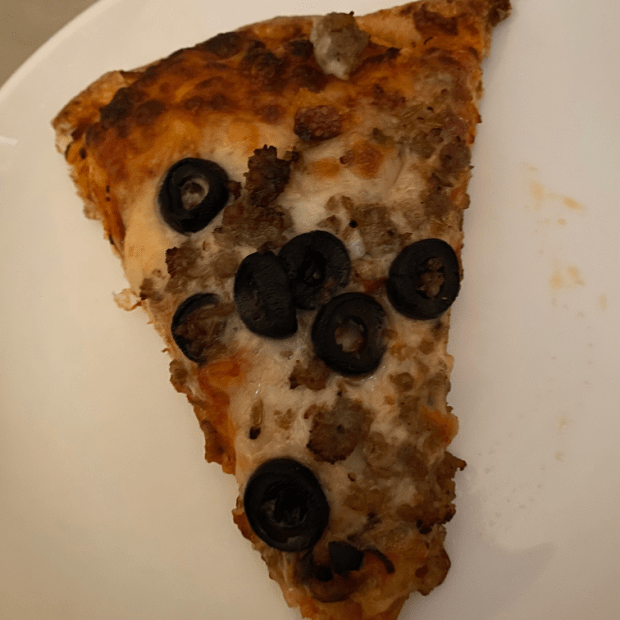
Leftover pizza is the best pizza. Preparation credit: Pizza N Such, Claremont, California. Can I earn free pizza as a powerful influencer? Probably not, but I’ll disclose on the 0.00001% chance that I do.
Now that it’s time to write the “separate post,” I really don’t want to get into the mechanics of how posts that attract prospects (hungry people, target audience) increase awareness and help you convert prospects for your products and services.
So forget that. I’m going to tell a story instead about two executives at a fictional company that has a real problem. The executives’ names are Jones and Smith.
The story
Jones was troubled. Sales weren’t increasing, prospects weren’t appearing, and if this malaise continued the company would have to conduct a second round of layoffs. Jones knew that “rightsizing” would be disastrous, so the company needed another solution.
So Jones videoconferenced Smith and asked, “How can we make 2024 better than 2023?”
Smith replied, “Increasing sales calls could help, and ads could help, but there’s another way to increase our awareness with our prospects. We could create content on our website and on our social channels that spreads knowledge of our products and services.”
Jones exclaimed, “That’s great! We could get generative AI to create content for us!”
“No, not that!” Smith replied. “Generative AI text sounds like a bot wrote it, and makes us sound boring, just like everyone else using generative AI text. Do we want to sound like that and put our prospects to sleep?”
“So we need a human writer,” Jones realized, “one who can describe all of the features of our products.”
“Absolutely not,” Smith emphasized. “Customers don’t care about our features. They care about the benefits we can provide to them. If we just list a bunch of features, they’ll say, ‘So what?'”
“OK, we’ll go with benefits,” said Jones. “But why is content so important?”
“Take blogging,” replied Smith. “The average company that blogs generates 55% more website visitors. B2B marketers that use blogs get 67% more leads than those who do not. Marketers who have prioritized blogging are 13x more likely to enjoy positive ROI. And 92% of companies who blog multiple times per day have acquired a customer from their blog.”
“Wow.” Jones was silent for a moment. “How do you know all of this stuff, Smith?”
“Because of the content that I’ve read online from a marketing and writing services company called Bredemarket. The company creates content to urge others to create content. Bredemarket eats its own wildebeest food.”
Have you ever seen those posts from self-appointed gurus?
Specifically, the ones that authoritatively state the BEST time to WRITE a post on Instagram, or LinkedIn, or TikTok, or whatever?
I religiously ignore those posts for a simple reason: My country has multiple time zones. So the best time in one time zone may be the worst time in another time zone.
However, I can tell you the WORST time to READ a post in the PACIFIC Time Zone…if the post concerns pizza.
And I’ll explain what all this means…eventually.
Ophir Tal on awareness
In addition to saying WHEN to post, the gurus also provide authoritative (and often contradictory) advice about WHAT to post.
For example, some gurus assert that you MUST prioritize bottom of funnel (conversion) content over top of funnel (awareness) content because it’s most important to get people to buy.
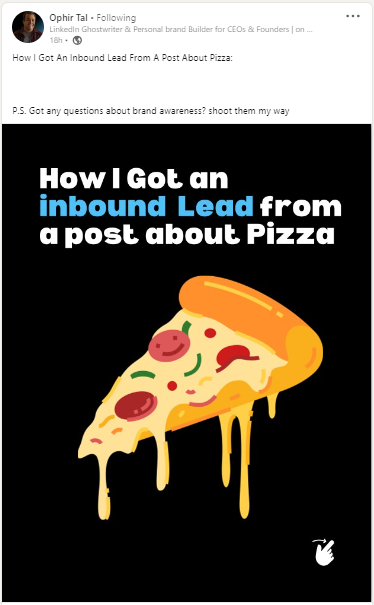
Ophir Tal disagrees, and has evidence to support his position.
This hook caught my attention. People want leads, and people like pizza, so I paid attention. But I also paid attention for a third reason that I’ll discuss later.
Tal then noted that the gurus would have recommended NOT posting this because he was “doing it wrong.” Specifically:
The post didn’t solve a problem for his potential clients. (Unless they regularly drop slices of pizza, I guess.)
It didn’t have a strong call to action.
It wasn’t targeted to his ideal clients. (Again, unless they regularly drop slices of pizza, or unless they love chicken wings.)
But despite doing everything wrong, that particular piece of content attracted the attention of someone “at a 6 figure ecom company.” After viewing the content, the reader looked at Tal’s profile and realized Tal could meet their need for ghostwriting services.
And now I’ll tell you the third reason why I paid attention to Tal’s post.
John Bredehoft on birthdays
As I noted above, I paid attention to Ophir Tal’s pizza post for two reasons:
People want leads.
People like pizza.
Now let’s jump back to a post I wrote all the way back in 2023, one that described why I’ve soured on the term “target audience.” (Or, in Tal’s words, “ideal clients.”) I started that post by wondering if the term “needy people” would be better than “target audience.” Yes, but not good enough.
I’ll grant that “needy people” has a negative connotation, like the person who is sad when people forget their birthday.
It turns out that these people had a VERY GOOD reason for forgetting my birthday. However, I cannot reveal this reason to you because the disclosure would force me to reveal someone’s personal identifiable information, or PII. (Mine.)
So after they remembered my birthday, one of them asked what I did for my birthday…and I told them that my wife, father-in-law, and brother-in-law went out to dinner.
For pizza.
And I also told them that there were leftovers, which my wife and I enjoyed a few days later.
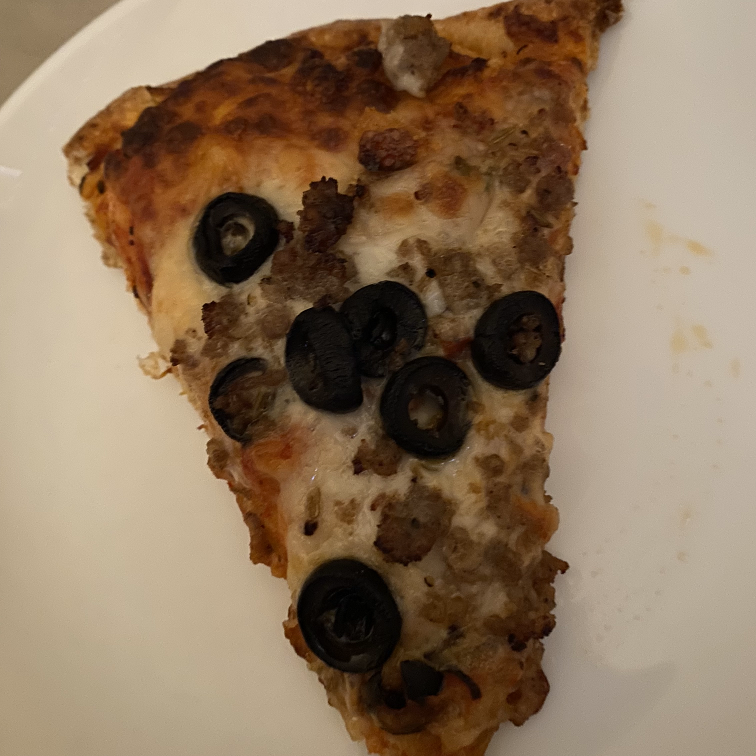
Leftover pizza is the best pizza. Preparation credit: Pizza N Such, Claremont, California. Can I earn free pizza as a powerful influencer? Probably not, but I’ll disclose on the 0.00001% chance that I do.
A nice story, and while I was reading Ophir Tal’s story on dropped pizza, I realized that I had missed an opportunity to tell my own story about leftover pizza.
Time to channel Steve Jobs…
Oh, and there’s one more thing
I forgot to mention one thing about the Ophir Tal story.
When I read the story, it was around 4:00 pm in California.
So when I read about Tal’s dropped pizza, and thought about my leftover pizza (which I had already eaten)…I was hungry.
As we close out 2023, I’ve been thinking about a lot of things.
Will 2024 be like 2021, in which the new year (2024) offers mimimal improvement over the preceding year (2023)? Reply hazy, try again later. (“And while tech layoffs slowed down in the summer and fall, it appears that cuts are ramping up yet again.”)
What new ways will we develop to better ghost people? Or will the old ways of ghosting continue to dominate the (lack of) conversation? (And if the person who ghosts is the ghoster, and the person who is ghosted is the ghostee…who is the ghost?)
Most importantly for this post, I’ve been thinking about the following: why are target audiences TARGETS, and why are they AUDIENCES? And is the term “target audience” the best description? (TL;DR: No.) If not, what’s a better description? (TL;DR: I don’t know.)
So let’s look at target audiences. And if you don’t mind, I’ve asked William Tell, Cheap Trick, Steve Dahl, Google Bard, Andrew Loog Oldham, and others to help me examine the topic, which will probably be Bredemarket’s last blog post of 2023.
But first I’ll explain where I’m coming from. Rather than diving into great detail, I’ll take a more, um, targeted approach and just quote a bit from the relevant information page.
There are roughly 8 billion people in the world. Most businesses don’t care about 7.99999 billion of these people; the businesses only care about 0.00001 billion (or fewer) people who will buy or recommend the business’ product or service.
Your content (or proposal) needs to resonate with these people. The others don’t matter.
Daily Copywriting’s use of the word “target” as a pejorative got me thinking about my fave phrase “target audience.”
Let’s start with the first word. At its worst, “target” implies something that you shoot, in a William Tell sort of way. If your weapon hits the target, you and your son don’t die. If your weapon misses low, you kill your son. Is that what we marketers do? Hopefully not.
Even at its best, “target” is just something that you get right. You’ve narrowed the 8 billion people to the few that really matter. So what?
Then we move to the second word of the fave phrase “target audience.” An audience is a group of people that sit in chairs while you perform your song and dance in front of them. (“These are the seven questions your content creator should ask you. Thank you for coming to my BRED talk.”)
Sometimes the audience just sits. Not good.
Sometimes the audience claps. A little better.
If you’re the Beatles or Cheap Trick, the audience screams. But still not enough.
Clapping or screaming is nice, but this doesn’t count as true engagement. I mean, in a way it would be nice if you scream with joy at this post, but it counts for nothing if you don’t actually buy Bredemarket’s marketing and writing services.
I’m forced to admit that there was one time where someone truly engaged his target audience—and that was during Steve Dahl’s “Disco Demolition Night.”
Dahl was not a disco fan, since he lost his WDAI radio job when his then-employer switched to a disco format. As a counter-reaction to disco, Dahl entertained baseball fans on Disco Demolition Night by destroying disco records between two games of a doubleheader. 7,000 fans stormed the field in delirious joy, wrecking the field, and the second game of the doubleheader was never played. This was NOT a good thing. But the White Sox survived, and even celebrated the 40th anniversary of the promotion. Dahl threw out the first pitch. Nothing exploded. But nothing was accomplished.
So if “target audience” isn’t the right term to use, what is?
I’ll grant that “needy people” has a negative connotation, like the person who is sad when people forget their birthday. (Not “ghosting” per se, but perhaps a little “boo.”) But “needy people” is certainly better than “target audience.”
“Needy” is stronger than “target.” Rather than just representing a demographic, it actually represents people who truly NEED things. Just because a company needs content for its website doesn’t necessarily mean that it needs Bredemarket. Many companies have their own people to create content.
And for the reasons stated by Daily Copyrighting, “people” is stronger than “audience.” You are not a faceless audience that claps (or screams) when Bredemarket does its song and dance. You are people who work in a certain way, which I why I talk to people before creating content for them.
This “needy people” phrase sounded good a few days ago, but now that I’ve thought about it some more I see some problems with this formulation also. In addition to the negative connotations of the phrase, the mere fact that someone is “needy” doesn’t necessary mean that they will buy Bredemarket’s services. Take my identification of “needy people” from a few days ago:
My mini-survey shows that of the 40+ identity firms with blogs, about one-third of them HAVEN’T SAID A SINGLE THING to their prospects and customers in the last two months.
Yes, these companies are damaging their future prospects and need Bredemarket. But none of these companies has approached Bredemarket, or any other marketing and writing consultant, or their in-house people.
Perhaps they don’t see the problem at all.
Perhaps they see the problem, but don’t want to spend money (even a few hundred dollars) to fix it.
Perhaps they see the problem but don’t consider it as critically important as the other problems they face. Rather than spending a few hundred dollars, some companies are saving millions of dollars by “rightsizing” by 10-20% and cutting marketing budgets. They’re just fine with spiderweb-covered blog pages.
Because “needy people” doesn’t capture my meaning, I’ll do the recommended thing and use this blog post to throw up another idea.
The problem with the term “hungry people”
My latest iteration of “target audience” is “hungry people.” I figure that unlike “needy people,” “hungry people” are more inspired to act on their needs. They don’t just clap or scream; they are motivated to search for something to eat.
Using my example of the non-blogging identity firms, perhaps some of those quiet firms are troubled by their lack of communication with their prospects and clients. Rather than doing nothing, these firms are ready to plug their communications gap. But will they plug it with healthy food, or with junk food?
Even without writers, companies can unleash a content creation boom with generative AI. By feeding the AI brand guidelines, target audience data, and product specifics, they can churn out blog posts, ad copy, product descriptions, and even social media snippets. This AI assistant generates captivating headlines, outlines engaging narratives, and drafts basic texts, all while maintaining brand voice and SEO optimization. AI handles the heavy lifting, freeing up resources for strategic planning and audience engagement, boosting content output from silence to symphony.
I know this may surprise you, but I didn’t write the paragraph above. Google Bard did. And perhaps some hungry companies will opt for the free route and let generative AI write their content rather than contracting or employing a content marketer. Silence to symphony for a $0 budget! I consider this bittersweet.
I let the melody shine, let it cleanse my mind, I feel free now. Even though the melody was from Andrew Loog Oldham, uncredited, resulting in a decades-long copyright dispute between the Verve and the Rolling Stones. From https://www.youtube.com/watch?v=1lyu1KKwC74.
So “hungry” doesn’t quite cut it, since I seek the people who are not only hungry, but who will pay for quality fare such as Bredemarket’s marketing and writing services.
To be continued
In this case, the blog post IS a temporary expression of thought. I’ve determined that “target audience” is an imperfect phrase and that I need to replace it with SOMETHING, but I haven’t figured out what that “something” is yet.
Until I get a better idea, I’ll use “hungry people” in my internal work, but I won’t change my customer-facing work (such as the e-book) until I come up with an effective alternative to “target audience.”
And one more thing
And unless I get a sudden brainstorm, this will probably be the last Bredemarket blog post for 2023, and I’m currently ruminating about the first question I asked in this post regarding prospects for 2024. While there were some positive things that happened this year, the negatives during the last seven months tended to outweigh the positives. A lot of other people are also experiencing this, so I’m sharing this song for those who are glad that 2023 is almost over, and who hope that 2024 isn’t more of the same.
Bredemarket spends a lot of its time on competitive analysis, either as part of client projects, or for my own personal edification. For example, right now I’m working on a client project and analyzing 20 of the client’s competitors in over 20 markets serving hundreds of customers.
But when I perform competitive analysis, I use entirely ethical and legal methods to obtain my competitive information. Nothing clandestine that will get me in trouble.
But sometimes the well of competitive information goes dry. Companies go silent and then come back, with no explanation of why its former communications were…um…incomplete.
Of course, I don’t know why a particular company suddenly decides that prospect/customer communication isn’t critically important.
But this got me thinking. How often DO companies go silent?
And I had an excellent way to conduct a mini-survey and find out.
Are the 40+ blogging identity firms still blogging?
Back in September, I identified over 40 identity firms that were blogging, some more frequently than others. Blogging provides quantifiable benefits, and these companies were obviously taking advantage of those benefits.
But that was back in September. How many of those companies were still actively blogging in mid-December? I wanted to find out, so I conducted a mini-survey of those identity blogs. Of the 40+ companies whose blogs and articles had identifiable posting dates:
21 had blogged at least once this month (December).
11 had last blogged in November.
3 had last blogged in October.
7 hadn’t blogged since the 3rd calendar quarter of 2023 (July – September).
4 hadn’t blogged since the 2nd calendar quarter (April – June).
1 hadn’t blogged since the 1st calendar quarter (January – March).
1 hadn’t blogged at all in 2023. Perhaps it forgot it had a blog, or a former employee never surrendered the password.
My mini-survey shows that of the 40+ identity firms with blogs, about one-third of them HAVEN’T SAID A SINGLE THING to their prospects and customers in the last two months.
To be fair, this is not a complete measure of corporate content marketing. While some of these companies hadn’t blogged on their own websites, they HAD communicated on Instagram (Mark Zuckerberg’s website), LinkedIn (Satya Nadella’s website), X (Elon Musk’s website), YouTube (Sundar Pichai’s website), and other websites controlled by other people. Great traffic for Zuck et al…not so great traffic for the companies.
More importantly, some of these companies communicate via email, which is a great way to find out what the company is doing…if the company has your email address.
If the company doesn’t have your email address, and if it isn’t blogging, then it’s going to be hard for prospects to find company information.
So why is your identity firm ignoring your customers?
Some identity companies with blogs and similar mechanisms are consciously making the choice to NOT communicate with their prospects and customers.
A couple of them have already been addressed by Bredemarket, such as “we don’t have the time.” (Bredemarket has the time.)
But I would like to dive into Full Funnel’s fourth reason: “we don’t have anything to say.” I encourage you to read Full Funnel’s response to that objection, because I agree with it. Your firm MUST have something to say if it wants to differentiate itself and remain viable. If you don’t have anything to say, prospects will go to your more talkative competitors.
When is your identity company going to start communicating with your prospects and customers?
If your identity company has fallen down on the blogging front, it’s best to restart the process as soon as possible. As I’ve said before, content marketing doesn’t yield immediate results. A particular piece of content may not result in a sale until six or twelve months later, or longer. Delaying the implementation simply delays the benefits I mentioned above.
So if your identity company is failing to reach your prospects and customers with content, why don’t you talk with Bredemarket now and develop a plan to reach them?
Yes, I know we’re right in the middle of the holidays, and some of you will put this off until next week, or probably the week after next.
For me, that’s just as well. That gives me more time to talk to your competitors and get their content process moving.
If you DON’T want your competitors to get in line ahead of you, click the image below and schedule a meeting. I’m available this week and most of next week.




















 Bredemarket