Bredemarket’s standard office hours are now from 8:00 am to 12:00 noon Pacific time on Saturdays. I have discontinued Monday-Friday weekday office hours. I am available by appointment outside of my office hours (please confirm first).
Identity/biometrics/technology marketing and writing services
Bredemarket’s standard office hours are now from 8:00 am to 12:00 noon Pacific time on Saturdays. I have discontinued Monday-Friday weekday office hours. I am available by appointment outside of my office hours (please confirm first).
Some people know what they will do, and what they will not do.
Other people say they will do anything.
Don’t trust the second group of people.
As you may know, Bredemarket has an online contact page that allows people to request information from me. The form on this page includes several checkboxes (recently edited) that allow the submitter to specify if they are interested in one of Bredemarket’s standard packages.
Occasionally I’ll get a submission from someone who checked ALL of the check boxes. In 100% of those cases, it turns out that the person is NOT interested in ANY of Bredemarket’s standard packages, but in something else. (In the most recent example, someone wanted to write a guest post on the Bredemarket blog that had NOTHING to do with marketing or writing services. No thanks.)
It reminds me about the time, many years ago, when I wrote an RFP. This was years before I actually began responding to RFPs, by the way. The consultant that our company brought in suggested that we create a Request for Proposal for a particular service that our company wanted. The main part of the created RFP was a check list to see if the respondent provided a particular feature that we wanted. The responses that we received fell into two categories:
Now I’ll grant that this filtering method doesn’t work for all proposals. Some RFPs truly demand mandatory compliance with every requirement. But in those cases, the RFPs usually require to say how they will perform each requirement. A simple “we do it” response is not sufficient.
The “check everything” rule also applies in one other instance: company offerings.
When a company states the products and services it will offer, the statement usually sets a boundary between what the company will do and what the company will not do.
Usually.
For example, this post from Reddit’s HireaWriter gives a clear picture of the writer’s strengths:
…I have a bachelor’s degree in screenwriting (writing for film, TV and radio), and I’m currently studying English Literature to further my skills. I’m about to be on summer holidays for a few months and I’m looking to collaborate on some writing projects.
I have freelance experience, writing YouTube scripts and some podcast work, I’m very capable of both fiction and non- fiction…
From https://www.reddit.com/r/HireaWriter/comments/u2ydhh/writer_looking_for_new_projects/
So if I need a YouTube script, I’ll consider this person. If I need an article for Foreign Affairs, maybe not.
But other company offerings are…less focused. You’ve probably seen the posts (I won’t link to them) from people who say that they write. When you ask what they write, they say that they write anything.
Now I guess that theoretically, I can write anything. (Heck, I wrote the Eastport Enquirer, which you can probably guess wasn’t high-minded business prose.) But I’m not going to make a living by writing 19th century fiction or French political positions. I’ll stick closer to content marketing and proposals if you don’t mind.
Behind the scenes, I have been spending the past month examining the services Bredemarket offers, and how my service offerings can best meet my goals for 2022 (including the super-secret goal that I am not publishing). As a result of this examination, I plan to make several changes to Bredemarket’s service offerings, one of which I am announcing today.
Effective immediately, Bredemarket is no longer offering editing services.

Some of you will recall that my “What I Do” page originally listed five writing service offerings:
I have reduced my writing offerings to three. As of today, I have discontinued the two editing services.
As I stated in my FAQ:
I prefer to concentrate on writing rather than editing. There are plenty of editors available.
From https://bredemarket.com/faq/
I anticipate that I will perform additional-fine tuning to Bredemarket’s service offerings. I will announce these as necessary.
If you have any questions…
When I established the Bredemarket Yelp account, I sadly had to inform two inquirers that my services (what I do) did not include resume writing services.
But I just discovered that if you are near Upland, California, you can obtain resume writing services for free.
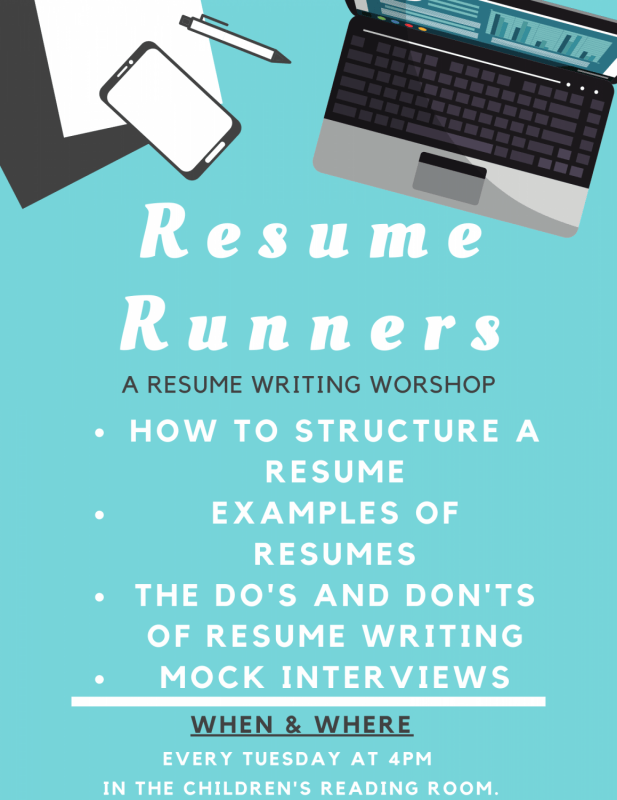
Today (March 29) and every Tuesday at 4:00 pm, the Upland Library hosts a resume writing workshop, “Resume Runners.” And unlike Bredemarket’s services, Upland Library services are free.
At the same time that Bredemarket helps other firms to market themselves, Bredemarket has to market ITSELF, including social media marketing. And for the past year I’ve subscribed to the following formula:
It sounded like a good formula at the time…but now I’m questioning the assumptions behind it. And I’m hoping that I can prove one of my assumptions wrong.
As I write this, Bredemarket has no clients in my hometown of Ontario, California, or in any of the nearby cities. In fact, my closest clients are located in Orange County, where I worked for 25 years.
It’s no secret that I’ve been working to rectify that gap and drum up more local business.
So this was an opportune time for me to encounter Jay Clouse’s September 2021 New Client Challenge. (It’s similar to a challenge Clouse ran in August 2020. Repurposing is good.) Clouse’s first question to all participants asked which market we would be targeting, and in my case the local small business market seemed an obvious choice.
And this dialogue played in my mind…
So when I market to local businesses, I’ll want to do that via relevant Facebook Groups. Obviously I won’t market the local services via LinkedIn or Twitter, because those services are not tailored to local service marketing.
Then I realized that I was wrong, for two reasons.
Specifically, some of you may recall that I only have two LinkedIn showcase pages, but I have three Facebook groups.
I explained the rationale for the lack of a third LinkedIn showcase page in a nice neat summary:
Using myself as an example, I have segmented my customers into markets: the identity (biometrics / secure documents) specific market (my primary market), the general technology market, and the general business market. I don’t even target the general business market on LinkedIn (I do on Facebook), but I’ve created showcase pages for the other two.
If you consider that “local business services” is a subset of “general business services,” some of you can see where this is going.
But it took a while for the thought to pound its way into my brain:
Why DON’T you target the (local) general business market on LinkedIn?
I could just create a new showcase page, a process that would only take a few minutes. I wouldn’t even have to create any new artwork, since I could simply repurpose the Facebook general business artwork and use it for a LinkedIn local business showcase page. (Repurposing is good.)
(As an aside, my approach to artwork for Bredemarket’s marketing segments was dictated by LinkedIn Stories. Which is now disappearing. Oh well.)
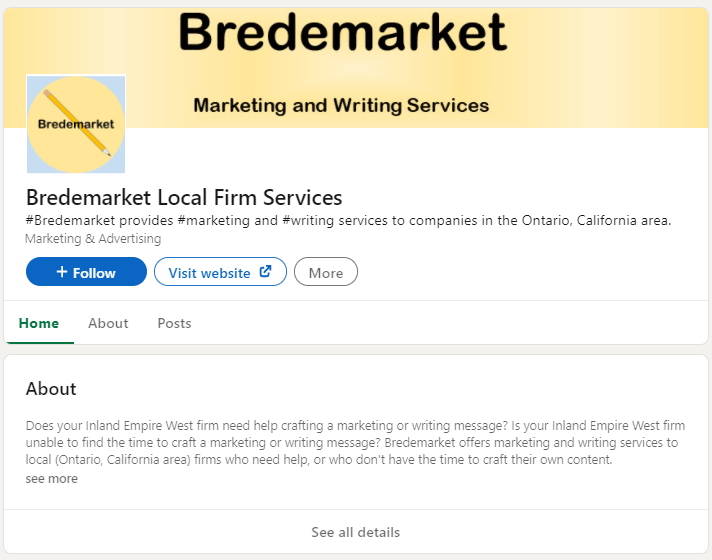
So anyway, LinkedIn is now the home of Bredemarket Local Firm Services.
Now I just have to populate the showcase page with content (and continue to do so), invite people to follow the new showcase page, and proceed on my plan for world domination, one loft at a time.
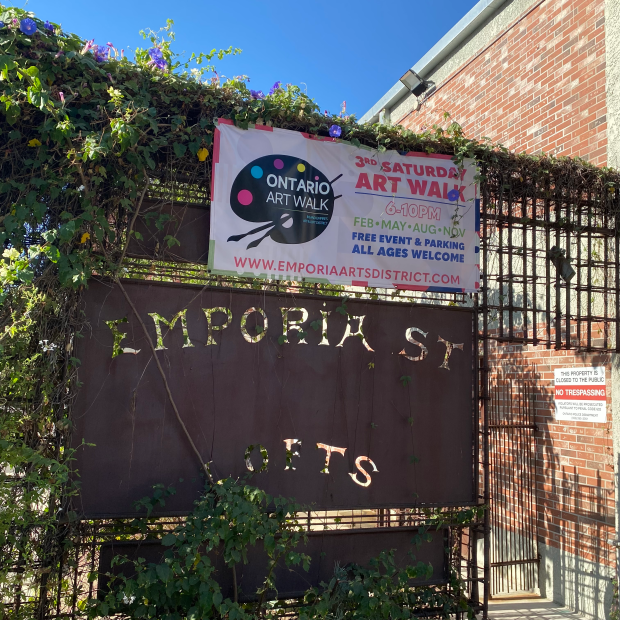
And if you’re a small business in the Ontario, California area, here’s some information on the services I can provide to you.
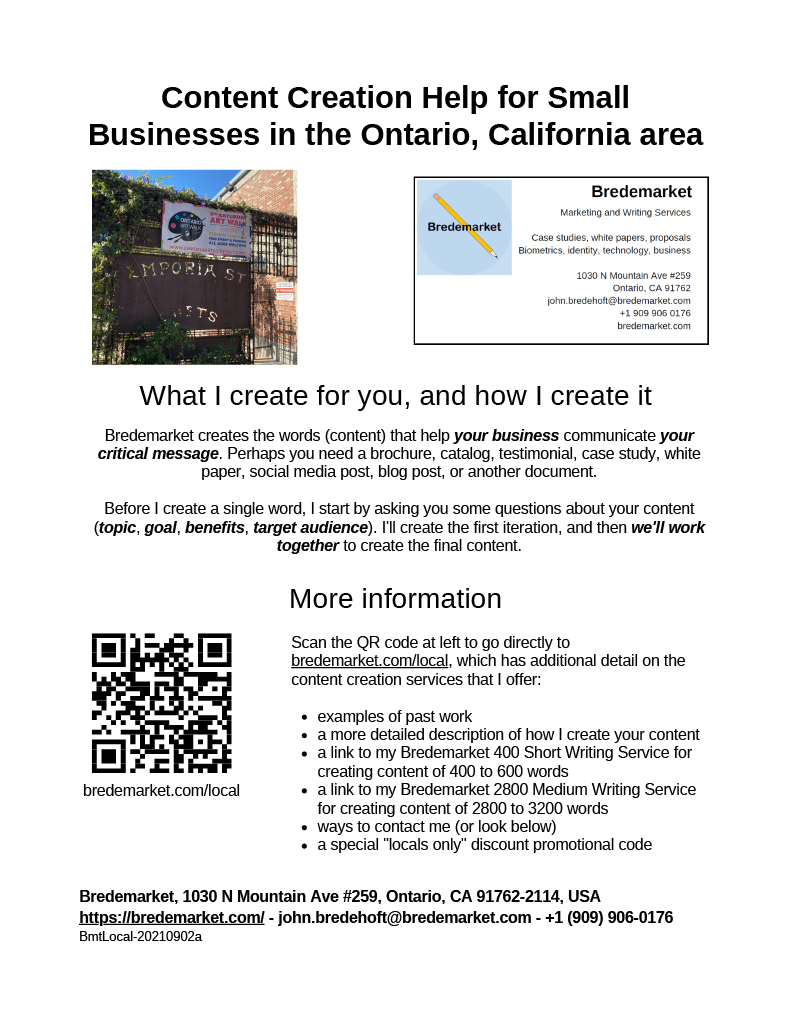
And if you want more detailed information, please visit https://bredemarket.com/local/. (Read to the end.)
And if you want even more detailed information, contact me.
I’d like to prove THIS assumption wrong:
(Still waiting for that $10,000 per hour client.)
Yes, this is post five in a series.
We”ll start with the end result, and then detail how it got here.

(Yes, I know an unboxing post is supposed to save the final result of the unboxing until the end, but I got excited. I’ll repeat this picture at the end to keep the story straight.)
As I detailed in the third post in the series, back on August 9 I was preparing to attend my first in-person event in a long time.
I’m going to an in-person event next week. For my younger readers (i.e. those who developed awareness after 2019), an “in-person event” is something where you are actually in the same room as the people that you are meeting, rather than looking at them in boxes on your computer screen

After registering for the event, I realized that I had never printed business cards for Bredemarket. So I designed one on Canva and ordered it that same day, August 9.
Canva filled the order and turned it over to a delivery service on August 10. I won’t name the delivery service, but it does business with the federal government and has an express business in addition to its ground business.
And the delivery service provides some good tracking of all the packages that it handles. I’d simply reproduce the tracking entries, but the most recent stops are first, which doesn’t lend itself to storytelling. So I’ll just reproduce selected stops on the way.
| Tuesday, August 10, 2021 | ||
| 8:30 PM | HENDERSON, NV | Left FedEx origin facility |
| 6:32 PM | HENDERSON, NV | Shipment exceptionBarcode label unreadable and replaced |
| 6:05 PM | HENDERSON, NV | Arrived at FedEx location |
| 3:06 PM | HENDERSON, NV | Picked up |
| 8:05 AM | Shipment information sent to FedEx |
That’s actually pretty nice, I thought at the time. The order was fulfilled within a few hundred miles of Bredemarket’s world headquarters in Ontario, California, and would certainly arrive in time for my in-person meeting.
| Wednesday, August 11, 2021 | ||
| 1:05 AM | BLOOMINGTON, CA | Arrived at FedEx location |
Very nice. Bloomington is within 20 miles of Ontario, so obviously I should expect my business cards to be delivered by the end of the week.
| Friday, August 13, 2021 | ||
| 11:55 PM | DEMING, NM | In transit |
| 10:52 AM | BLOOMINGTON, CA | Departed FedEx location |
Um, wait a minute. (Only now did I realize that this transit happened on Friday the 13th. Figures.)
I won’t reproduce the next few entries, but suffice it to say that as of 3:12 pm Central Time on Saturday, August 14, the package arrived at a location in Fort Worth, Texas.
By Tuesday, August 17, my package was still in Texas, and obviously wasn’t going to make it in time for my Wednesday night meeting. As I noted in the fourth post in the series, however, I had a workaround.

So that’s what I handed out on Wednesday, August 18. (Well, the first person only took a picture of the handout rather than taking the handout himself, because he prefers intangible things.)
At one point my expected delivery date was Thursday, August 19. That date came and went without business cards, but at least I got a podcast episode out of it.
Late that night, with my package still in Texas and no updated arrival date, I contacted Canva (even though it wasn’t Canva’s fault) because there wasn’t an efficient way to contact the delivery service. At the time I wondered if the package were truly lost and if I’d need Canva to replace it. I received an email from Canva that pretty much said to wait and see what happened.
Our records show that your print order…is currently in transit to your shipping address….
For a more detailed information about the delivery status, we highly suggest reaching out to the carrier since the order was already dispatched.
However, at the same time that I was filing things with Canva, I was also tweeting about it. And for those who don’t realize this, the social media people for many companies are proactive and really want to help.
Here to sort this out for you, John! Could you DM us your ticket ID (JTP-###…)? We’ll take a look! ^cv
The tweet actually contradicted the email (which said to contact the delivery service). But by the time Canva tweeted the request for my ticket ID, the delivery service had updated my status.
(And yes, I was checking Twitter before 5:00 am. Normally I don’t, but by this time I was really getting bugged about my wandering business cards.)
Later that day, my package finally left its Texas location. I had a momentary fear when it departed…a fear that people who live in Ontario, California will easily understand. Was my package headed back toward Ontario, California…or on its way to Ontario, Canada?
Thankfully, my package was in Deming, New Mexico on Friday evening, so at least it was headed in the right direction.
By Saturday, August 21, the package was back in Bloomington, California. But where would it go next?
Oh, and to top things off, in the middle of this I received a phishing attempt at one of my non-Bredemarket email addresses. Obviously this had nothing to do with my REAL shipment, but I still found it pretty funny.

Back to the question of where my package would go when it left Bloomington. Did my package have a lover in Deming, New Mexico that it wanted to visit for a third time?
| Sunday, August 22, 2021 | ||
| 8:51 AM | CHINO, CA | Delivery exceptionFuture delivery requested |
| 7:46 AM | CHINO, CA | At local FedEx facility |
| 5:35 AM | BLOOMINGTON, CA | Departed FedEx location |
Chino is even closer to Ontario than Bloomington. This was a positive move.
Let me explain the “future delivery requested” part. I was promised at one point that the package would be delivered on Sunday, August 22. Unfortunately, my business address (a UPS Store, competitor to the delivery service) is closed on Sunday.
Apparently the delivery service realized this too late, and told me that the package would be delivered Tuesday.
Then I was told that the package would be delivered Monday.
| Monday, August 23, 2021 | ||
| 1:24 PM | Ontario, CA | DeliveredSignature on file |
| 5:41 AM | CHINO, CA | On FedEx vehicle for delivery |
| 4:20 AM | CHINO, CA | At local FedEx facility |
I drove to my business address and proceeded with the unboxing.

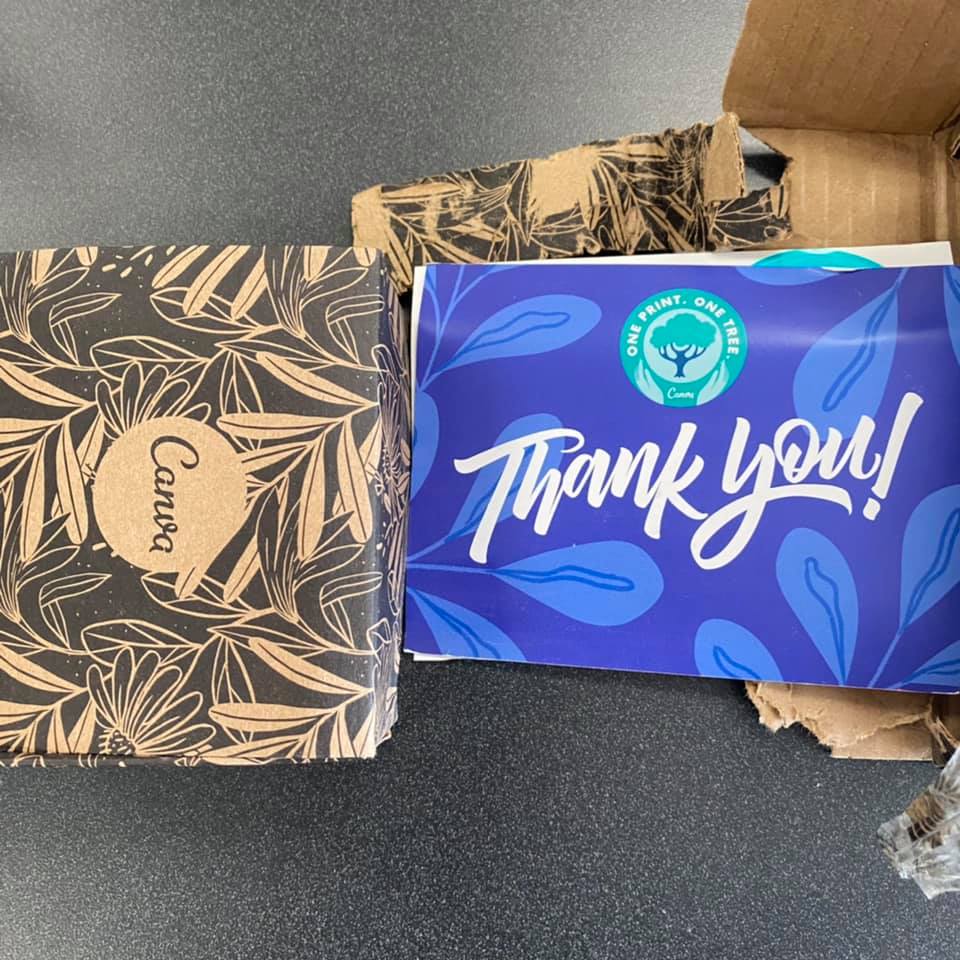
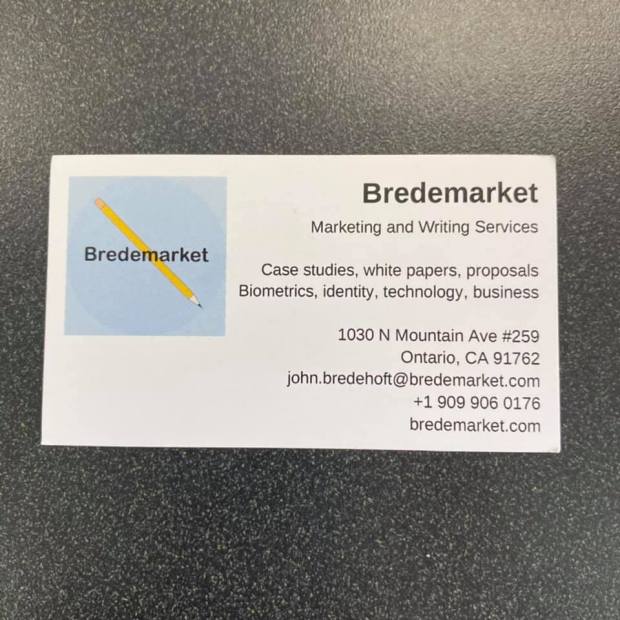
So that’s done. And since I’ve never really used business cards all that frequently, this order should last me a while.
When is my next in-person event?
So I just wrote a post that contained general tips for freelancers. But before launching into the meat of the post, I said the following:
I almost considered putting the Bredemarket Premium tag on this and making you pay to read it, but I’m not THAT much of a freelancing expert. (Yet.)
After I completed that post and shared it on Twitter, LinkedIn, and Facebook, I returned to my Bredemarket Premium idea. While my tips in the other post can help general freelancers, there are some things that I can share that are specific to BIOMETRIC freelancers.

So, here goes.
Subscribe to Bredemarket Premium to access this premium content.
I have marketed myself as the biometric content marketing expert and the biometric proposal writing expert.
Now I’m marketing myself as the freelancing expert.
“But John,” you may ask, “how can you do this? Yes, you are making money freelancing, but there are freelancers who are making a LOT more money than you are, who are working from exotic locales and are well known.”
Before I succumb to imposter syndrome, let me assert that I DO have some tips to offer based on my experience. Frankly, all of us do. Even if you’ve only been freelancing for a week, you’ve probably learned something that someone who has never freelanced would NOT know. So share it.
Before you read my tips, note an important point. I’ll caveat my tips by stating that MY experience may not necessarily apply to YOUR experience, and that sometimes it’s good to ignore the experts (or so-called experts). You need to do what is best for you.
How do I know that I have tips to offer?
Because someone whom I met via the Freelancers Union (see the link on the word “ignore” above) just asked me for advice, and by the time I was done answering her questions, I had written a LONG email.
So I figured that I’d share parts of the email (the portions that were NOT specific to her) with you.
I almost considered putting the Bredemarket Premium tag on this and making you pay to read it, but I’m not THAT much of a freelancing expert. (Yet.)

As I said, these are edited versions of my responses to the Freelancers Union contact, with some additions as I thought of other things. (I forgot to mention to my Freelancers Union contact that repurposing is important, and iteration is important.)
So, here goes.
For purposes of this discussion, I’m going to assume that the “single page” is a LinkedIn company page or a Facebook business page. (In many cases, it’s best to separate your freelancing page from your personal page. Again, some disagree with me.)
If you think that all of your multi-services are too much to list on one page, then you have the option of creating “showcase” pages to highlight specific aspects of what you do. For example, if you wanted to differentiate two different sets of services, you could create two separate showcase pages.
Using myself as an example, I have segmented my customers into markets: the identity (biometrics / secure documents) specific market (my primary market), the general technology market, and the general business market. I don’t even target the general business market on LinkedIn (I do on Facebook), but I’ve created showcase pages for the other two.
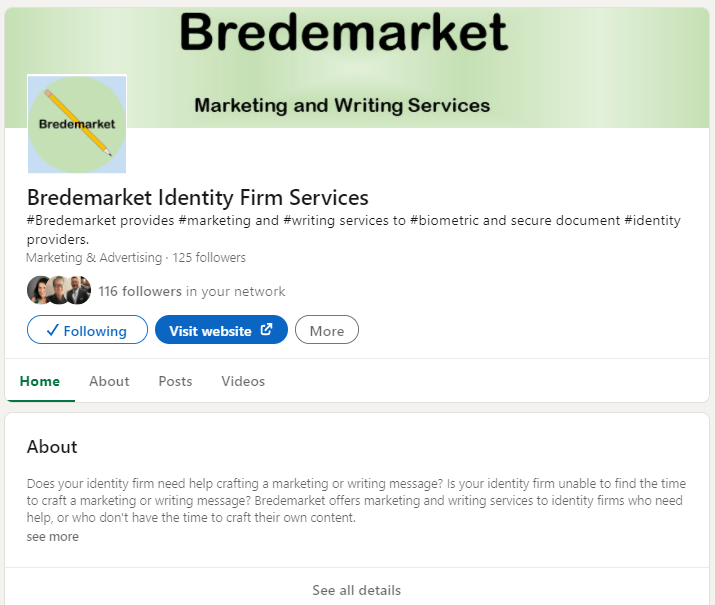
I have a similar structure on Facebook.
In addition, my website also has targeted pages. I won’t show examples here (EDIT: I didn’t share links in my original email to the contact, but I did share links in this new post), but I have a page that’s just targeted for general identity, multiple pages targeted for the biometric aspect of identity, one targeted for the content marketing aspect of biometrics, one for the proposal writing aspect of biometrics, etc. Therefore, if I’m talking to someone about biometric proposals, I can just send the link to the biometric proposal writing expert page.
I actually market on Twitter (@jebredcal), but I don’t go into that level of segmentation there. In fact, my Twitter account isn’t even solely devoted to my consulting. In that case, I don’t feel it worthwhile to create segmented Twitter accounts for my various submarkets, but it may be different for others.
However you slice and dice your market, dedicated pages for specific market segments allow for a more targeted experience. And the good thing is that it’s all free. (I actually pay for my website, but it could be free if I were fine with a mycompany.wordpress.com URL.)
TL;DR talk about your strengths.
In my case, I compensate for what I don’t do by emphasizing what I do.

For example, I do NOT create graphics (stick figures exhaust my capabilities), so my marketing materials emphasize my creation of text.
In addition, as I stated earlier, I emphasize the markets that I DO address – I talk a lot about biometrics/secure documents/identity, some about technology, and a little bit about general business.
And I don’t talk about graphics at all. (Whoops, I guess I just did.)
If I were you, I’d take a minute to think about the picture you want to use. How will this picture show that you are the best provider for your specific service in the entire universe? What should be in the background?

Look at it from the point of view of a potential customer – would I want to do business with this person?
Of course, different marketing efforts call for different pictures. I actually had a reason to use the 1980-1981 t-shirt picture that I posted toward the beginning of this post: I was talking about the fact that I have been writing since my college days. And at other times, I use a Users Conference picture in which I am talking about a smartphone app that I populated. It just depends on the context.

She asked one additional question about other reasonable ways to get her service out there. With one exception, I chose not to post my full response to that question here for two reasons:
So what’s the exception? In response to a specific comment that my contact made, I offered this response:
You never know when your existing network will yield opportunities.
I’m not going to print the rest of the paragraph from my email to my contact, but suffice it to say that the majority of Bredemarket’s business has been won as a result of people who knew me at IDEMIA, MorphoTrak, Motorola, or even Printrak.
In the end, you never know when those contacts you made months or years or decades ago may result in something new…not just in business, but in life.
P.S. One more thing: content calendars.
I guess this is the fourth post in a series. See posts one, two, and three.
I’ll quickly sum up all of those prior posts to say that I ordered some business cards.
Anyway, I have finally ordered some business cards, which should arrive before my in-person event next week.
I was able to follow the progress of my order via a handy dandy link to the shipper’s website. I won’t name the shipper, but it does a lot of federal business and offers a variety of services, including express services.
Initially the service said that my cards wouldn’t arrive until this week, but then the anticipated delivery date was revised to Tuesday, August 10.
So I watched as my package moved from Henderson, Nevada to Bloomington, California, less than 20 miles from Bredemarket’s world headquarters.
The package stayed in Bloomington for a few days before moving again.
To Deming, New Mexico.
My last report indicated that the package had arrived in Fort Worth, Texas, and would be delivered by Thursday, August 19.

The day AFTER my meeting.
I guess I should have ordered business cards a year ago. Oh well, better late than never.
But I have a workaround. I’ve created a handout that includes an image of my business card.

It won’t fit in a business card holder, but it’s better than nothing.
Incidentally, I haven’t bothered to upload the PDF of this particular data sheet to the Bredemarket website, since it’s really intended for in-person distribution. If you want to find out about the Bredemarket 400 and Bredemarket 2800 services, you can skip the QR codes and just use these links:
And there’s one service that I DON’T mention on this particular sheet (except for my reference to “other services”) because it’s not of primary interest to the market I’m addressing in my meeting this week. However, if your needs don’t fit into a standard package, Bredemarket can offer services at an hourly rate. This service (Bredemarket 4000 Long Writing Service) doesn’t have a PDF handout, but does have a web page.
Which I just updated with the details from my revision to my content creation process.
Again, better late than never.
As my regular readers know, I’ve recently spent some time refining my content creation process for Bredemarket’s clients. As part of this, I’ve made a point of emphasizing some key points that need to be established at the beginning of a client engagement with someone like you, including the following:
To use a simple example, if your goal is to have local law enforcement agencies request formal quotes from you, your benefits include your experience working as a certified latent fingerprint examiner, and your target audience is the forensic, records, and/or IT departments of local law enforcement agencies, then I have failed if Bredemarket’s generated content talks about general business topics with no reference to law enforcement or fingerprints.
However, I realize that there’s an implicit assumption that there is something that is at an even higher level than goals, benefits, or target audiences.
That “something” is your beliefs. (I speak in a business sense here, by the way, although your beliefs in general can impact how you do business.)
Because your beliefs underpin everything that you do.
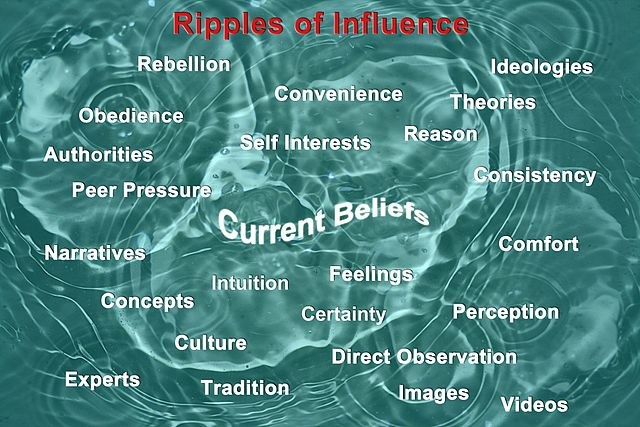
They are the (sometimes unspoken) foundation that effects the goals you set, the benefits you offer, the audiences you target, and even whether you will meet with a client at 6:00 in the morning local time. (There are pros and cons to taking 6am meetings; it’s not a one-size-fits-all decision. More about that later.)
The influence of beliefs on a business is obviously clearest when I as a consultant deal with other sole proprietors, because sole proprietors by definition have great control over how they do business.
Because of my background, many of the sole proprietors that I know are people who were formerly in the corporate world, but left it for some reason (sometimes by choice, sometimes not). Universally, these sole proprietors have seen things in the corporate world that they like, but have also seen corporate practices that they DO NOT like. Now that they’re in business for themselves, these sole proprietors have resolved that their business will never do these bad things.
I don’t want to single out any of the sole proprietors that I know, so I’m going to make up an example.
Beth Smith spent two years working for Pay By Touch, an early pioneer in digital identity that was in some respects ahead of its time. Even when founded in the early 2000s, the concept was solid: rather than having to drag out a credit card to make a payment, a grocery store shopper or other consumer could simply touch his or her finger against a fingerprint reader, securely allowing the consumer to pay by touch. Unfortunately, the leadership of the firm was not so good, and the company itself eventually went bankrupt.

Several years later, when digital identity became a hot topic, Beth Smith decided to re-enter the industry on her own. But she decided that a key belief of her business would be ethical behavior. No cocaine binges or unpaid bills would sully the reputation of Beth Smith Identity Services.
From this key belief, you can extrapolate how it would be reflected in Beth Smith’s goals, benefits, and target audience. For example, if you’re an illegal drug dealer, don’t even bother to ask Beth Smith Identity Services for a quote. She won’t talk to you.
Perhaps my made-up example is outrageous (then again, Pay By Touch’s founder John P. Rogers was pretty outrageous himself), but I’ve seen how similar beliefs (shaped by experience) have influenced other sole proprietors that I know.
But how do you discover a sole proprietor’s beliefs?
If I were interviewing you, I probably wouldn’t ask you what your key beliefs are. Perhaps I should (although that’s a rather personal question), but so far I haven’t needed to do so. If I already know you from past associations, I already know what your beliefs are. And if I don’t know you but just generally ask you about yourself and your business, your beliefs will probably come through in your conversation with me. If you spend a half hour talking with someone, you can learn all sorts of things. (But if you’re talking with me, my Calendly calendar doesn’t include 6am appointments.)
In terms of beliefs, a corporation is very different from a sole proprietor.
I know this from personal experience. The first multinational corporation that employed me was Motorola. This was before Motorola split into two entities, Motorola Solutions and Motorola Mobility.
During my period as a Motorola employee, the company had three leaders: Christopher Galvin, Edward Zander, and Greg Brown. While these leaders could set the direction for the company, they could not completely influence the beliefs of every member. It isn’t like all of the tens of thousands of Motorola employees immediately changed direction when Zander replaced Galvin, even though the two had distinctly different styles.
Galvin is a quiet, reserved, man who is perhaps contemplative and reflective to a fault. He believed in layers of management and many meetings that often kept Motorola from responding quickly to dynamic market circumstances. While not prone to take credit for successes, he always said the buck stopped with him when things didn’t go well. Zander, a freewheeling showman, is a boisterous, energetic, fast-moving Brooklyn native who often shoots from the hip or the lip.
I have never spoken with Galvin, Zander, or Brown, and I don’t think I’ve ever been in the same room with Galvin or Zander. Greg Brown advanced in Motorola’s hierarchy before becoming CEO, so I’m sure that I was in the same room with him at some point in my Motorola career.

So Galvin’s, Zander’s, and Brown’s influence on me and my beliefs was somewhat limited.
I was much more influenced by my direct supervisors, other directors and managers at Motorola’s Anaheim and Irvine offices, and selected people from Schaumburg, Plantation, Phoenix, Canada, and elsewhere who interacted with me on a daily basis.
The same holds true with my consulting business.
While I am technically delivering Bredemarket’s services to companies (including some large multinational companies), in reality I am delivering my services to Director Jim at Company X or Vice President Carol at Company Y. Director Jim and VP Carol have their own goals, perceived benefits, and target audiences…and their own beliefs.
When Bredemarket is delivering something to Director Jim, and is considering various options, there are times when I say to myself “Director Jim wouldn’t go for that.” Or if I’m delivering something to VP Carol, it will occur to me that she would really prefer a particular way of doing things.
Again, a consultant may not explicitly ask a corporate employee about their beliefs, but if the consultant regularly talks to the client, those beliefs will come out in the course of conversation.
This is the “physician heal thyself” portion of the post.
As you may have gathered from this post, I don’t always expect a sole proprietor or corporate employee to explicitly delineate their beliefs, perhaps because I can’t envision myself doing something like that. If I were talking to you as a potential client, it would feel brazen for me to declare, “This is what I believe.” Beliefs are personal, after all.
But even if I don’t explicitly state my beliefs, I need to make sure that they are reflected in Bredemarket’s goals, benefits, and target audiences.
How is my self-proclaimed status as a biometric content marketing expert and a biometric proposal writing expert influenced by my underlying beliefs?
For this post, I’ll dispense with my usual call to action to contact me if Bredemarket can help you. (Actually, I didn’t dispense with it, since I just wrote it.)
But I WILL ask you to think about something, whether you are a sole proprietor, a corporate employee, or a guy who used to be everyone’s best friend and is now having fun.

Think about your beliefs.



 Bredemarket