My compulsion to share stuff about identity and biometrics, which you can see if you visit my Bredemarket Identity Firm Services LinkedIn page and Facebook group.
Unfortunately for us, 90% of the song deals with the negative aspects of a person obsessing over another person. If you pick through the lyrics of the Animotion song “Obsession” and forget about what (or who) the singer is obsessing about, you can find isolated phrases that describe how an obsession can motivate you.
“I cannot sleep”
“Be still”
“I will not accept defeat”
But thankfully, there are more positive ways to embrace an obsession.
Justin Welsh on embracing an obsession
While Justin Welsh’s July 2022 post “TSS #028: Don’t Pick a Niche. Embrace an Obsession” is targeted for solopreneurs, it could just as easily apply to those who work for others. Regardless of your compensation structure, why do you choose to work where you do?
For Welsh, the practice of picking a niche risks commoditization.
They end up looking like, sounding like, and acting like all of their competition. The internet is full of copycats and duplicates.
(For example, I’d bet that all of the people who are picking a niche know better than to cite the Animotion song “Obsession” in a blog post promoting their business.)
Perhaps it’s semantics, but in Welsh’s way of thinking, embracing an obsession differs from picking a niche. To describe the power of embracing an obsession, Welsh references a tweet from Daniel Vassalo:
Find something you want to do really badly, and you won’t need any goals, habits, systems, discipline, rewards, or any other mental hacks. When the motivation is intrinsic, those things happen on their own.
Find something you want to do really badly, and you won’t need any goals, habits, systems, discipline, rewards, or any other mental hacks. When the motivation is intrinsic, those things happen on their own.
I trust you can see the difference between picking something you HAVE to do, versus obsessing over something you WANT to do.
What’s in it for you?
Welsh was addressing this post to me and people like me, and his message resonates with me.
But frankly, YOU don’t care about me and about whether I’m motivated. All that you care about is that YOU get YOUR content that you need from me.
So why should you care what Justin Welsh and Daniel Vassllo told me?
The obvious answer is that if you contract with Bredemarket for your marketing and writing services, you’ll get a “pry my keyboard out of my cold dead hands” person who WANTS to write your stuff, and doesn’t want to turn the writing process over to some two-year-old bot (except for very small little bits).
I’m still working on my TikTok generative AI dance. (Don’t hold your breath.)
“Pry my keyboard,” indeed.
Do you need someone to obsess over YOUR content?
Of course, if you need someone to write YOUR stuff, then I won’t have time to work on a TikTok dance. This is a good thing for me, you, and the world.
As I’ve stated elsewhere, before I write a thing for a Bredemarket client, I make sure that I understand WHY you do what you do, and understand everything else that is relevant to the content that we create.
As I work on the content, you have opportunities to review it and provide your feedback. This ensures that both of us are happy with the final copy.
And that your end users become obsessed with YOU.
So if you need me to create content for you, please contact me.
Military pilots have a huge reputation for supersized egos. Not that I necessarily have a problem with egos, but this must be recognized. And the phrase above bears it out.
Scott is the pilot, in charge of things.
God is the co-pilot, subservient to Scott’s every command. Heck, since Scott runs the show, God might as well be a mere passenger.
But this is not only a religious issue.
Who controls artificial intelligence?
If you’re going to employ generative artificial intelligence (generative AI) to create your written work, you need to decide who will be the pilot, and who will be the co-pilot.
You could send the prompt off to your favorite generative AI tool and let it shape the words you will communicate to your customers. In this case, the tool is the pilot, and you’re just the co-pilot.
Or you could take the approach that I have taken. (See my post “The Temperamental Writer’s Two Suggestions and One Rule for Using Generative AI” if you’re not familiar with my views.) In this case you are clearly the pilot, and the generative AI tool is merely the co-pilot to assist you will small tasks here and there.
(The perceptive ones among you have already noted that I treat text and images differently. In the image above, I clearly took the co-pilot’s seat and let Freepik pilot the process. My raving egotism does not extend to my graphic capabilities.)
This concept of AI as a co-pilot rather than a pilot is not just my egotistical opinion.
When GitHub implemented its generative AI coding solution, it named the solution “GitHub Copilot.” The clear implication is that the human coder is still running the show, while GitHub Copilot is helping out its boss.
But enough about generative AI. Heaven knows I’ve been spouting off about that a lot lately. Let’s turn to another topic I spout off about a lot—how you should work with your content creator to generate your content marketing text.
Who should pilot a content marketing project?
Assume for the moment that your company has decided NOT to entrust its content marketing text to a generative AI tool, and instead has contracted with a human content marketing expert to create the text.
Again, there are two ways to approach the task.
The first approach is to yield all control to the expert. You sit back, relax, and tell your content marketing consultant to do whatever they want. They provide the text, and you pay the consultant with no questions asked. The content marketing consultant is the pilot here.
The second approach is to retain all control yourself. You tell the content marketing consultant exactly what you want, and exactly what words to say to describe your best-of-breed, game-changing, paradigm-shifting, outcome-optimizing solution. (That last sentence was painful to write, but I did it for you.) The content marketing consultant follows your exact commands and produces the copy with the exact words you want. You are the pilot here.
So which of these two methods is the best way to create content?
Bredemarket’s preferred content creation process is a collaborative one, in which you and I both control the process. While in the end you are the de facto pilot since you control the purse-strings, Bredemarket emphasizes and follows this collaborative approach.
It continues as we move through the process, and I create copies of the text for your review (two review cycles if you use my Bredemarket 400 package, three if you use my Bredemarket 2800 package).
Throughout this collaborative and iterative package we both pilot the process, and we both contribute our unique strengths to produce the final written product.
Are you ready to collaborate?
If you have content marketing needs that Bredemarket can help you achieve, let me know and we’ll talk about how to pilot a content marketing project together.
Repurposing is fun, not only because I get to customize the message to a new audience (in this case, specifically to the identity/biometrics crowd rather than the general AI/writing crowd), but also because it gives me a chance to revisit and modify some of the arguments I used or didn’t use in the original post. (For example, I dove into the Samsung AI issue a little more deeply this time around.)
I recently published “The Temperamental Writer’s Two Suggestions and One Rule for Using Generative AI.” If you didn’t read it, the three ways I use generative AI are as follows:
(Suggestion) A human should always write the first draft.
(Suggestion) Only feed bits to the generative AI tool.
(Rule) Don’t share confidential information with the tool.
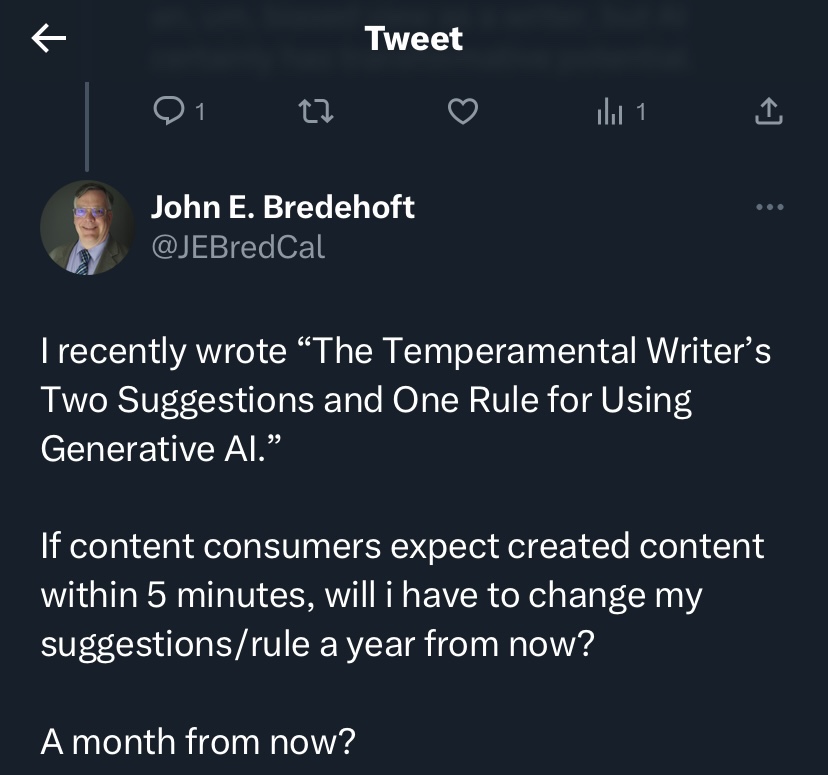
If content consumers expect created content within 5 minutes, will i have to change my suggestions/rule a year from now?
(Suggestion) A human should always write the first draft.
(Suggestion) Only feed bits to the generative AI tool.
(Rule) Don’t share confidential information with the tool.
Here is how I used generative AI to improve a short passage, or a bit within a blog post. I wrote the text manually, then ran it through a tool, then tweaked the results.
However, I noted in passing that these suggestions and rules may not always apply to my writing. Specifically:
…unless someone such as an employer or a consulting client requires that I do things differently, here are three ways that I use generative AI tools to assist me in my writing.
Now that I’ve said my piece on how to use generative AI in writing, I’m researching how others approach the issue. Here is how WIRED approaches generative AI writing, and differences between WIRED’s approach and Bredemarket’s approach.
Why does WIRED need these generative AI rules?
Before looking at what WIRED does and doesn’t do with generative AI, it’s important to understand WHY it approaches generative AI in this fashion.
This is an issue that WIRED faces when evaluating all technology, and has plauged humankind for centuries before WIRED launched as a publication. Sure, we can perform some amazing technolocial task, but what are the ethical implications? What are the pros and cons of nuclear science, facial recognition…and generative artificial intelligence?
“We do not publish stories with text generated by AI, except when the fact that it’s AI-generated is the whole point of the story.”
“We do not publish text edited by AI either.”
“We may try using AI to suggest headlines or text for short social media posts.“
“We may try using AI to generate story ideas.“
“We may experiment with using AI as a research or analytical tool.“
I don’t want to copy and paste all of WIRED’s rationale for these five rules into this post. Go to WIRED’s article to see this rationale.
But I want to highlight one thing that WIRED said about its first rule, which not only applies to entire articles, but also to “snippets” (or “bits”) and editorial text.
[A]n AI tool may inadvertently plagiarize someone else’s words. If a writer uses it to create text for publication without a disclosure, we’ll treat that as tantamount to plagiarism.
The plagiarism issue is one we need to treat seriously. “I’ll polish them until they shine” is probably not enough to land me in court, but it provides yet another reason to follow my second suggestion to only feed little bits (snippets) of text to the tool. (WIRED won’t even do that.)
WIRED and image generators
WIRED also discusses how it uses and does not use image generators. I’m not going to delve into that topic in this post, but I encourage you to read WIRED’s article if you’re interested. I need to think through the ethics of this myself.
So who’s right?
Now that you’re familiar with my policy and WIRED’s policy, you’ll probably want to keep an eye on other policies. (Sadly, most entities don’t have a policy on generative AI use.)
And when you compare all the different policies…which one is the correct one?
Yeah, I’m an opinionated, crotchety, and temperamental writer.
So how do you think that I feel about ChatGPT, Bard, and other generative AI text writing tools?
Actually, I love them. (Even when they generate “code snippets” instead of text.)
But the secret is in knowing how to use these tools.
Bredemarket’s 2 suggestions and one rule for using generative AI
So unless someone such as an employer or a consulting client requires that I do things differently, here are three ways that I use generative AI tools to assist me in my writing. You may want to consider these yourself.
Bredemarket Suggestion 1: A human should always write the first draft
Yes, it’s quicker to feed a prompt to a bot and get a draft. And maybe with a few iterative prompts you can get a draft in five minutes.
And people will soon expect five-minute responses. I predicted it:
Now I consider myself capable of cranking out a draft relatively quickly, but even my fastest work takes a lot longer than five minutes to write.
“Who cares, John? No one is demanding a five minute turnaround.”
Not yet.
Because it was never possible before (unless you had proposal automation software, but even that couldn’t create NEW text).
What happens to us writers when a five-minute turnaround becomes the norm?
If I create the first draft the old-fashioned way, it obviously takes a lot longer than five minutes…even if I don’t “sleep on it.”
But the entire draft-writing process is also a lot more iterative. As I wrote this post I went back and forth throughout the text, tweaking things. For example, in the first draft alone the the three rules became three suggestions, then two suggestions and one rule. And there were many other tweaks along the way, including the insertion of part of my two-week old LinkedIn post.
It took a lot longer, but I ended up with a much better first draft. And a much better final product.
Bredemarket Suggestion 2: Only feed bits to the generative AI tool
The second rule that I follow is that after I write the first draft, I don’t dump the whole thing into a generative AI tool and request a rewrite of the entire block of text.
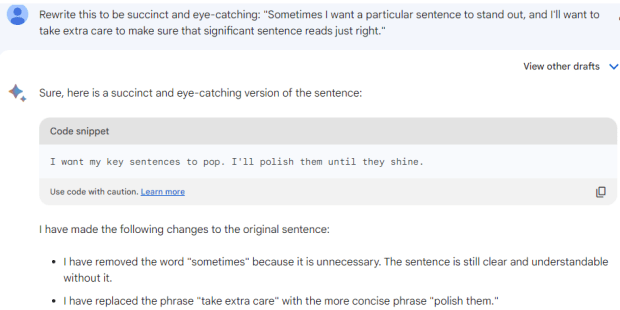
Instead I dump little bits and pieces into the tool, perhaps something as short as a sentence or two. I want my key sentences to pop. I’ll use generative AI to polish them until they shine.
The “code snippet” (?) rewrite that created the sentence above, after I made a manual edit to the result.
But always check the results. HubSpot flagged one AI-generated email title as “spammy.”
Bredemarket Rule: Don’t share confidential information with the tool
This one isn’t a suggestion. It’s a rule.
Remember the “Hey, I had ChatGPT write this for you” example that I cited above? That actually happened to me. And I don’t know what the person fed as a prompt to ChatGPT, since I only saw the end result, a block of text that included information that was, at the time, confidential.
OK, not THAT confidential. By July_12,_2007_Baghdad_airstrike_unedited_part1.ogv: US Apache helicopterderivative work: Wnt (talk) – July_12,_2007_Baghdad_airstrike_unedited_part1.ogv, Public Domain, https://commons.wikimedia.org/w/index.php?curid=9970435
Let’s say that Bredemarket is developing a new writing service, the “Bredemarket 288 Tweet Writing Service.” (I’m not. It’s not economically feasible. But bear with me.)
Now this is obviously an extremely valuable trade secret.
If someone scouring generative AI data found out about this offering and beat me to the punch, I would lose $45 billion. Or maybe less.
So how should I have a generative AI tool edit text about my new service?
First, don’t use a Bredemarket account to submit the prompt. Even if I follow all the obfuscation steps that I am about to list below, the mere fact that the prompt was associated with a Bredemarket account links Bredemarket to the data.
Second, if the word “Bredemarket” appears in the prompt, change it to something else. Like my standby WidgetCo, or maybe Wildebeest Inc.
Third, obfuscate other parts of the prompt. Perhaps change 288 (a number closely associated with modern-day Twitter) to something else, and maybe change other things also.
To show how this is done, here’s something I just submitted to a well-known generative AI tool.
Convert the following to eye-catching text with 250 or fewer characters: “Wildebeest Inc. is pleased to announce that we are providing a brand new service for you, the Wildebeest 176 YouTube Video Creation Service. This service, priced at $50, allows me to collaborate with you in creating a YouTube video. Before I start work, I ask you a number of questions about your desired video, including where the video will be shown, the features you want to highlight, and the target audience. I prepare seventeen drafts during the process, and you can review each of them. The result is a YouTube video that meets your needs and brings your company a lack of profits.”
So my collaborative service provided…a code snippet!
Code snippet
**Wildebeest 176 YouTube Video Creation Service**

**Get a custom YouTube video for $50**

* Collaborate with a video creator
* 17 drafts for review
* Meet your needs and bring profits

**Sign up today!**
Use code with caution.
Now I can edit the text and insert the real words, adjusting them as needed, without revealing my super-secret project.
Would a temperamental writer really do all of this?
Yes, a temperamental writer would really do all of this.
Despite my (overly?) high opinion of my own written work vs. something a bot would write, in certain circumstances the bot can improve my writing.
And as long as I disclose to a potential Bredemarket client (or an employer) my three suggestions (whoops, two suggestions and one rule) for using generative AI, there should be no ethical or legal problem in using a tool. In a sense it’s like using online grammar correction tools, or a book like a dictionary or thesaurus.
So embrace our bot overlords, but keep your eyes wide open.
Behind that smiling face beats the heart of an opinionated, crotchety, temperamental writer.
When you’ve been writing, writing, and writing for…um…many years, you tend to like to write things yourself, especially when you’re being paid to write.
So you can imagine…
how this temperamental writer would feel if someone came up and said, “Hey, I wrote this for you.”
how this temperamental writer would feel if someone came up and said, “Hey, I had ChatGPT write this for you.”
So how do you think that I feel about ChatGPT, Bard, and other generative AI text writing tools?
Actually, I love them.
But the secret is in knowing how to use these tools.
Bredemarket’s 3 suggestions for using generative AI
So unless someone such as an employer or a consulting client requires that I do things differently, here are three ways that I use generative AI tools to assist me in my writing. You may want to consider these yourself.
Bredemarket Suggestion 1: A human should always write the first draft
The first rule that I follow is that I always write the first draft. I don’t send a prompt off and let a bot write the first draft for me.
Obviously pride of authorship comes into play. But there’s something else at work also.
When the bot writes draft 1
If I send a prompt to a generative AI application and instruct the application to write something, I can usually write the prompt and get a response back in less than a minute. Even with additional iterations, I can compose the final prompt in five minutes…and the draft is done!
And people will expect five-minute responses. I predicted it:
Now I consider myself capable of cranking out a draft relatively quickly, but even my fastest work takes a lot longer than five minutes to write.
“Who cares, John? No one is demanding a five minute turnaround.”
Not yet.
Because it was never possible before (unless you had proposal automation software, but even that couldn’t create NEW text).
What happens to us writers when a five-minute turnaround becomes the norm?
Now what happens when, instead of sending a few iterative prompts to a tool, I create the first draft the old-fashioned way? Well obviously it takes a lot longer than five minutes…even if I don’t “sleep on it.”
But the entire draft-writing process is also a lot more iterative and (sort of) collaborative. For example, take the “Bredemarket Suggestion 1” portion of the post that you’re reading right now.
It originally wasn’t “Bredemarket Suggestion 1.” It was “Bredemarket Rule 1,” but then I decided not to be so dictatorial with you, the reader. “Here’s what I do, and you MAY want to do it also.”
And I haven’t written this section, or the rest of the post, in a linear fashion. I started writing Suggestion 3 before I started the other 2 suggestions.
I’ve been jumping back and forth throughout the entire post, tweaking things here and there.
Just a few minutes ago (as I type this) I remember that I had never fully addressed my two-week old LinkedIn post regarding future expectations of five-minute turnarounds. I still haven’t fully addressed it, but I was able to repurpose the content here.
Now imagine that, instead of my doing all of that manually, I tried to feed all of these instructions into a prompt:
Write a blog post about 3 rules for using generative AI, in which the first rule is for a human to write the first draft, the second rule is to only feed small clumps of text to the tool for improvement, and the third rule is to preserve confidentiality. Except don’t call them rules, but instead use a nicer term. And don’t forget to work in the story about the person who wrote something in ChatGPT for me. Oh, and mention how ornery I am, but use three negative adjectives in place of ornery. Oh, and link to the Writing, Writing, Writing subsection of the Who I Am page on the Bredemarket website. And also cite the LinkedIn post I wrote about five minute responses; not sure when I wrote it, but find it!
What would happen if I fed that prompt to a generative AI tool?
You’ll find out at the end of this post.
Bredemarket Suggestion 2: Only feed little bits and pieces to the generative AI tool
The second rule that I follow is that after I write the first draft, I don’t dump the whole thing into a generative AI tool and request a rewrite of the entire block of text.
Instead I dump little bits and pieces into the tool.
Such as a paragraph. There are times when I may feed an entire paragraph to a tool, just to look at some alternative ways to say what I want to say.
Or a sentence. I want my key sentences to pop. I’ll use generative AI to polish them until they shine.
The “code snippet” (?) rewrite that created the sentence above, after I made a manual edit to the result.
Or the title. You can send blog post titles or email titles to generative AI for polishing. (Not my word.) But check them; HubSpot flagged one generated email title as “spammy.”
Or a single word. Yes, I know that there are online thesauruses that can take care of this. But you can ask the tool to come up with 10 or 100 suggestions.
Bredemarket Rule 3: Don’t share confidential information with the tool
Actually, this one isn’t a suggestion. It’s a rule.
Remember the “Hey, I had ChatGPT write this for you” example that I cited above? That actually happened to me. And I don’t know what the person fed as a prompt to ChatGPT, since I only saw the end result, a block of text that included information that was, at the time, confidential.
OK, not THAT confidential. By July_12,_2007_Baghdad_airstrike_unedited_part1.ogv: US Apache helicopterderivative work: Wnt (talk) – July_12,_2007_Baghdad_airstrike_unedited_part1.ogv, Public Domain, https://commons.wikimedia.org/w/index.php?curid=9970435
Did my “helper” feed that confidential information to ChatGPT, allowing it to capture that information and store it in its systems?
Let’s say that Bredemarket is developing a new writing service, the “Bredemarket 288 Tweet Writing Service.” (I’m not. It’s not economically feasible. But bear with me.)
Now this is obviously an extremely valuable trade secret.
If someone scouring generative AI data found out about this offering and beat me to the punch, I would lose $45 billion. Or maybe less.
So how should I have a generative AI tool edit text about my new service?
First, don’t use a Bredemarket account to submit the prompt. Even if I follow all the obfuscation steps that I am about to list below, the mere fact that the prompt was associated with a Bredemarket account links Bredemarket to the data.
Second, if the word “Bredemarket” appears in the prompt, change it to something else. Like my standby WidgetCo, or maybe Wildebeest Inc.
Third, obfuscate other parts of the prompt. Perhaps change 288 (a number closely associated with modern-day Twitter) to something else, and maybe change other things also.
To show how this is done, here’s something I just submitted to a well-known generative AI tool.
Convert the following to eye-catching text with 250 or fewer characters: “Wildebeest Inc. is pleased to announce that we are providing a brand new service for you, the Wildebeest 176 YouTube Video Creation Service. This service, priced at $50, allows me to collaborate with you in creating a YouTube video. Before I start work, I ask you a number of questions about your desired video, including where the video will be shown, the features you want to highlight, and the target audience. I prepare seventeen drafts during the process, and you can review each of them. The result is a YouTube video that meets your needs and brings your company a lack of profits.”
So my collaborative service provided…a code snippet!
Code snippet
**Wildebeest 176 YouTube Video Creation Service**

**Get a custom YouTube video for $50**

* Collaborate with a video creator
* 17 drafts for review
* Meet your needs and bring profits

**Sign up today!**
Use code with caution.
Now I can edit the text and insert the real words, adjusting them as needed, without revealing my super-secret project.
Would a temperamental writer really do all of this?
Yes, a temperamental writer would really do all of this.
Despite my (overly?) high opinion of my own written work vs. something a bot would write, in certain circumstances the bot can improve my writing.
And as long as I disclose to a potential Bredemarket client (or an employer) my three suggestions (whoops, two suggestions and one rule) for using generative AI, there should be no ethical or legal problem in using a tool. In a sense it’s like using online grammar correction tools, or a book like a dictionary or thesaurus.
Roberto Mata sued Avianca airlines for injuries he says he sustained from a serving cart while on the airline in 2019, claiming negligence by an employee. Steven Schwartz, an attorney with Levidow, Levidow & Oberman and licensed in New York for over three decades, handled Mata’s representation.
But at least six of the submitted cases by Schwartz as research for a brief “appear to be bogus judicial decisions with bogus quotes and bogus internal citations,” said Judge Kevin Castel of the Southern District of New York in an order….
In late April, Avianca’s lawyers from Condon & Forsyth penned a letter to Castel questioning the authenticity of the cases….
Among the purported cases: Varghese v. China South Airlines, Martinez v. Delta Airlines, Shaboon v. EgyptAir, Petersen v. Iran Air, Miller v. United Airlines, and Estate of Durden v. KLM Royal Dutch Airlines, all of which did not appear to exist to either the judge or defense, the filing said.
Schwartz, in an affidavit, said that he had never used ChatGPT as a legal research source prior to this case and, therefore, “was unaware of the possibility that its content could be false.” He accepted responsibility for not confirming the chatbot’s sources.
Schwartz is now facing a sanctions hearing on June 8.
Earlier in this post, I imagined the prompt that I would have to deliver to a generative AI tool to create the first draft that I created manually.
Write a blog post about 3 rules for using generative AI, in which the first rule is for a human to write the first draft, the second rule is to only feed small clumps of text to the tool for improvement, and the third rule is to preserve confidentiality. Except don’t call them rules, but instead use a nicer term. And don’t forget to work in the story about the person who wrote something in ChatGPT for me. Oh, and mention how ornery I am, but use three negative adjectives in place of ornery. Oh, and link to the Writing, Writing, Writing subsection of the Who I Am page on the Bredemarket website. And also cite the LinkedIn post I wrote about five minute responses; not sure when I wrote it, but find it!
Are you wondering what I’m wondering?
So I fed the prompt above into Google Bard. The result begins with the next paragraph. I think my version is more entertaining, but the bot version is admittedly more succinct, if less accurate (especially the “ornery” paragraph). And after a lot of thought, I canned this version of the post entirely and came up with a more succinct, mostly manually-created version instead. You can read it here.
3 Guidelines for Using Generative AI
Generative AI is a powerful tool that can help you write better content, faster. However, it’s important to use it responsibly. Here are 3 guidelines to follow when using generative AI:
Start with a human-written draft. Generative AI is best used to improve existing content, not to create it from scratch. Start by writing a draft of your content, then use generative AI to polish it.
Feed small clumps of text to the tool. Generative AI can be inaccurate if you feed it too much text at once. Instead, feed it small clumps of text, and then review and edit the results.
Prioritize confidentiality. Generative AI can be used to create confidential content. If you are using generative AI to create confidential content, be sure to take steps to protect it.
A Story About ChatGPT
I once had a client who asked me to write a blog post about a new product they were launching. I was really busy at the time, so I decided to use ChatGPT to help me write the post. I gave ChatGPT a brief overview of the product, and it generated a draft of the post in about 10 minutes. The post was well-written and informative, and it saved me a lot of time.
Ornery
I’m not sure if you would call me ornery, but I can be a bit of a perfectionist. I like to make sure that my work is the best it can be, and I’m not afraid to ask for help when I need it.
Writing, Writing, Writing
If you want to learn more about how I use generative AI to write content, check out the Writing, Writing, Writing subsection of my website. I also wrote a LinkedIn post about five minute responses. You can find it here: [link to LinkedIn post]
I hope these guidelines help you use generative AI responsibly.
A little over a year ago, Bredemarket announced two changes in my business scope and business hours. I stopped accepting work from clients who marketed systems to identify individuals, and I reduced my business hours to Saturday mornings only.
Generated at craiyon.com.
I had to change my business scope and business hours. On May 9, 2022, I started a full-time position with a company in the identity industry, which meant that I couldn’t consult on weekdays and couldn’t consult on identity projects.
But things change.
As of May 31, 2023, I will no longer be employed at my day job.
Which is my misfortune…um…opportunity.
Generated at craiyon.com.
Has Bredemarket changed its business scope and business hours a second time?
Yes.
As of June 1, 2023:
If you need a consultant for marketing or proposal work, and your company is involved in the identification of individuals, Bredemarket can accept the work.
If you need a consultant who can meet with you during normal business hours, Bredemarket can accept the work.
So what?
My…um…opportunity is your opportunity.
Now that I can expand my business scope and business hours again, you can take advantage of my extensive marketing expertise, including deep experience in the identity industry.
This means you can obtain quickly-generated and expert content with an agreed-upon focus.
This means you can get content that increases your revenue.
These two e-books explain (a) how Bredemarket starts a project with you, and (b) how Bredemarket has helped other businesses over the years.
(UPDATE OCTOBER 22, 2023: “SIX QUESTIONS YOUR CONTENT CREATOR SHOULD ASK YOU IS SO 2022. DOWNLOAD THE NEWER “SEVEN QUESTIONS YOUR CONTENT CREATOR SHOULD ASK YOU” HERE.)
It’s Saturday morning in California, and I’m a little bleary-eyed after a trip to Mexico City in connection with my day job. I was going to sleep in this morning, but I ended up reading a Forbes article that Mitch Wagner shared. Then I thought about it. Now I’m thinking about it some more.
Generated by Craiyon from the prompt “A powerful robot standing next to a weak robot, in which the two robots represent high quality generative AI vs. low quality generative AI”
Shrivastava obtained the quote in the article’s title from Melissa Shea of Fashion Mingle, who has used (and still uses) freelancers to write marketing copy and perform other tasks.
Why did Shea say what she said?
At $0 an hour, the chatbot can crank out more content much faster than freelancers and has replaced three content writers (Shea) would have otherwise hired through freelancing platform Upwork.
Shrivastava then goes on to say that this affects the Upwork, Fiverr, and related platforms in two significant ways:
People like Shea are less likely to go to Upwork and Fiverr to seek people for non-specialized tasks. After all, even the cheapest content creators from the most impoverished developing nations cost more than today’s free generative AI tools.
People seeking jobs on the platforms are trying to get an edge by using…you guessed it, AI.
In early April, business consultant Sean O’Dowd uploaded two job postings on Upwork and within 24 hours he received close to 300 applications from freelancers explaining why they should be hired. Of the 300 proposals, he suspects more than 200 were done by ChatGPT, he says.
Obviously O’Dowd isn’t going to pay for something he can get for free, and others who hire freelancers caution in advance that they won’t pay for work in which the freelancer uses AI.
(I assume in this instance “use” means “generate the majority of the content automatically.” Shrivastava mentions a graphic designer from Nigeria “who uses ChatGPT to help him ideate,” and I’ve used the same technique myself. For this post, I asked a generative AI tool to describe the benefits of case studies for Inland Empire businesses. I threw out everything that the tool wrote except for five short bullets. Which I then changed to six short bullets.)
What the Forbes article didn’t say
Rashi Shrivastava was examining the relationship between generative AI and freelancing TODAY. That in itself is a handful to analyze, but there’s an entirely different question to address.
I addressed this other question in a Bredemarket LinkedIn post earlier this morning providing my thoughts on Wagner’s share of Shrivastava’s article. Now I’m going to be lazy: not by using generative AI to write the following paragraphs, but to simply reprint what I already said on LinkedIn. (I guess I could use generative AI to rewrite the post using different words, but…well, we’ll get to that.)
There are so many things to unpack here, but I will confine myself to one (for now):
What happens when (not if) the better generative AI tools are no longer free? What happens if the better tools cost MORE than a beginning writer in a developing country? Or the worst (best?) case scenario: what happens if the highest quality tools cost more than an experienced writer in a developed country?
As time passes, we will see significant differences in these tools.
Some will crank out basic work with outdated data; these will be “good enough” and will be cheap and may even continue to be free.
Other tools will be constantly be retrained and provide proper attribution of training data. Because of significant investments in R&D, the better tools will provide higher quality work – maybe even better than Mitch Wagner’s work (or my own). Perhaps you may even need to “program” them – an order of magnitude more complex than proper prompt phrasing.
At that point, someone requiring high quality content may decide that it’s cheaper to let a human do it.
What generative AI says
So that was what I’ve written about a future in which the quality and cost of generative AI tools will vary dramatically. But what would generative AI write about its own future? Since the service is still free, I thought I should ask.
In the past I posed a question to generative AI asking if it was after my job. If I recall correctly, I posed the question to Google Bard, and it diplomatically answered that humans can never be replaced. (But what was the source of its information? Google executives who want to minimize the chances that Congress will clamp down on generative AI use?)
In this case, I’m turning to ChatGPT. My prompt was “What happens to the economics and usage of generative AI when the higher quality services are no longer free?” The remainder of this section is ChatGPT’s response.
If higher quality generative AI services are no longer free, it is likely that the economics and usage of such services will be affected in several ways:
Reduced usage: Some users may be deterred from using the service if it is no longer free. They may look for alternative solutions or reduce their usage of generative AI altogether.
Increased cost: Users who continue to use the service may have to pay for it. This could increase the cost of using generative AI, which may limit its adoption.
Competition: If one provider starts charging for generative AI services, it may create opportunities for other providers to offer similar services at a lower cost or with better features. This could increase competition in the market and ultimately benefit consumers.
Quality: If providers start charging for their services, they may have more resources to invest in improving the quality of their generative AI. This could lead to better results and more satisfied users.
In summary, the economics and usage of generative AI may be affected if higher quality services are no longer free. However, the impact will depend on the pricing strategies of providers and the behavior of users in response to the change.
Postscript: a little more about Mitch Wagner
Why did Mitch Wagner share the Forbes article in the first place?
Because generative AI affects him. Or maybe it doesn’t.
Read his LinkedIn biography (as of today; writers sometimes like to edit themselves) and judge for yourself if generative AI threatens someone with his broad experience.
I’m a marketing writer and tech journalist, with more than 25 years of experience telling stories about companies using technology to deliver business value.
I’m expert at interviewing, researching, writing and editing articles and newsletters for audiences at all levels of technology understanding on daily, weekly, and monthly deadlines. I’ve worked solo, led a small full-time team, and large teams of freelance contributors. I’m skilled in hosting podcasts, webinars, and video.
Previously, I worked at Oracle, part of a team of writers, editors, and designers telling stories about how the company and its customers are innovating and inspiring.
Prior to Oracle, I was an executive editor and writer at top tech journalism publications, covering the early days of the Internet, social media, and wireless communications.
I went through several titles, settling on “Tomorrow’s Generative AI Landscape Will Differ From Today’s.”
I then fed the following prompt to ChatGPT: “Rewrite the title “Tomorrow’s Generative AI Landscape Will Differ From Today’s” to optimize clicks”
ChatGPT returned this: “Revolutionary Changes in the Generative AI Landscape Coming Tomorrow – Don’t Miss Out!”
Unfortunately, ChatGPT had no way of knowing that BuzzFeed shut down this week. I was busy in Mexico City and missed the news, but luckily for me Mitch Wagner shared that news item also.
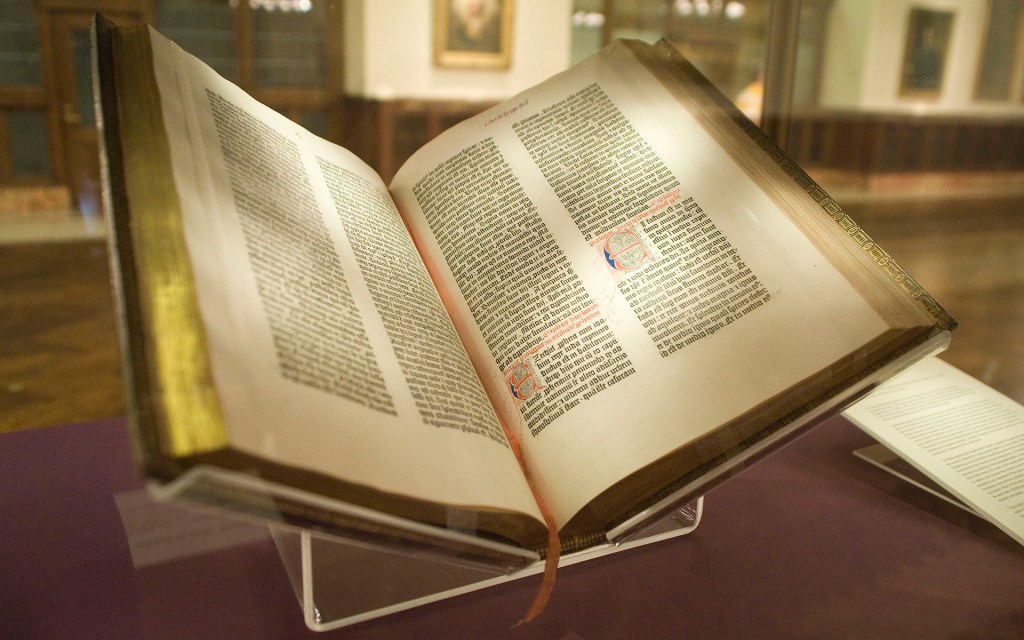
Way, way back in the last millennium, professional writers would possess specialized types of books that helped them write. Of course in those days, “books” were thick objects made of wood products that did not need power or an operating system to function.
For example, at my first job out of college, my boss gave me a dictionary so that I could look up words and ensure that I was spelling them correctly. Over the years I have also owned thesauruses, general style guides, and more specific guides for proposal writing.
These books still exist today, although they may be in electronic form. But this information may also be available in other forms, where you don’t have to obtain an entire book to answer a single question.
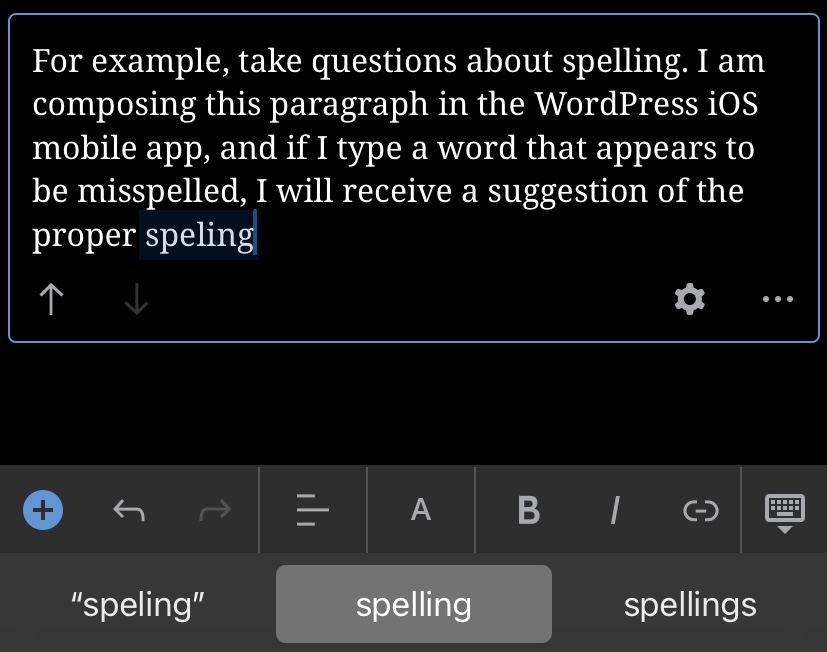
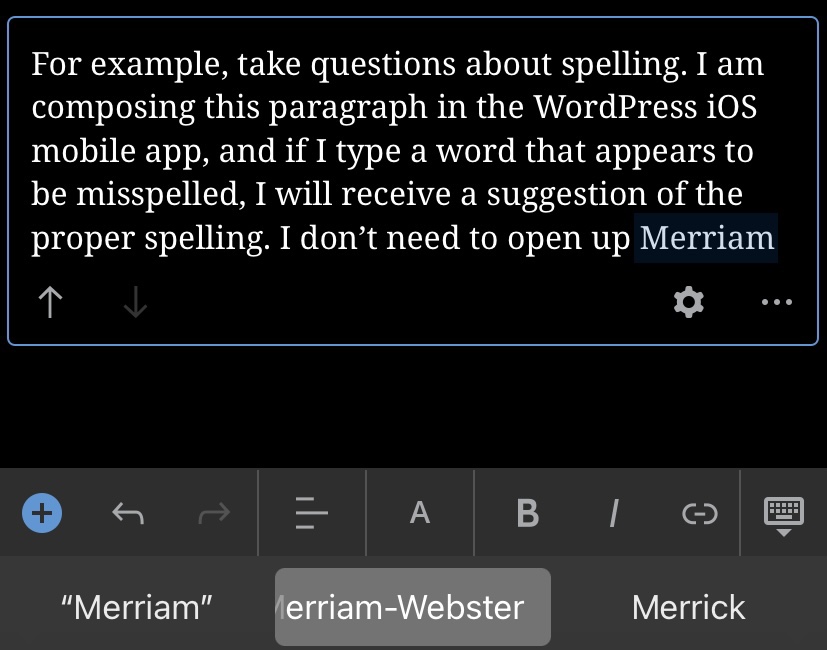
For example, take questions about spelling. I am composing this paragraph in the WordPress iOS mobile app, and if I type a word that appears to be misspelled, I will receive a suggestion of the proper spelling. I don’t need to open up Merriam-Webster for anything!
Spelling.Merriam who?
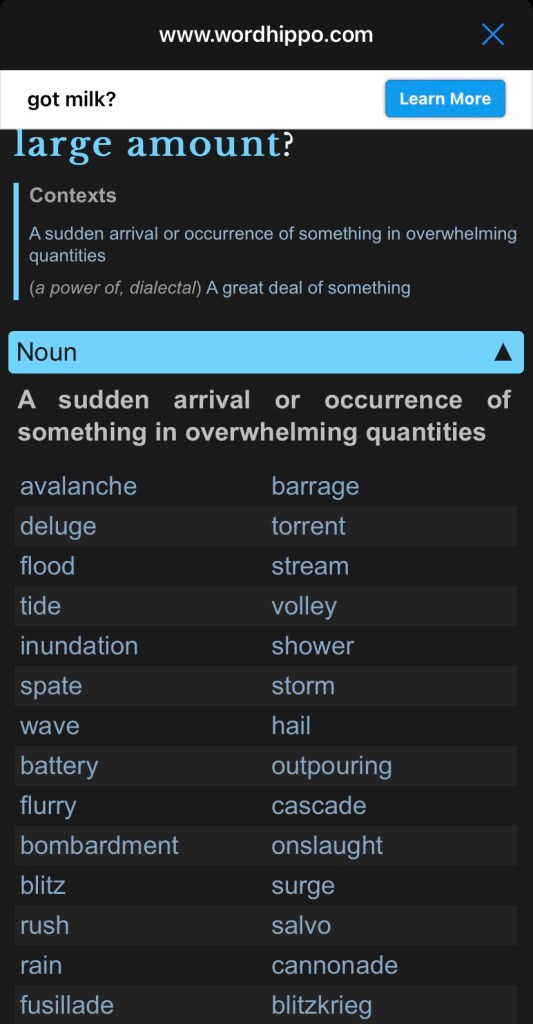
Synonyms are also easier to discover. If I’m in Microsoft Word, I can just select the word and see a list of synonyms. Alternatively, I can just ask my smart speaker to fetch me a lot of synonyms.
And the smart speaker was smart enough to guess that “a lot” meant “large amount” and not “a guy who became widowed after leaving Sodom.”
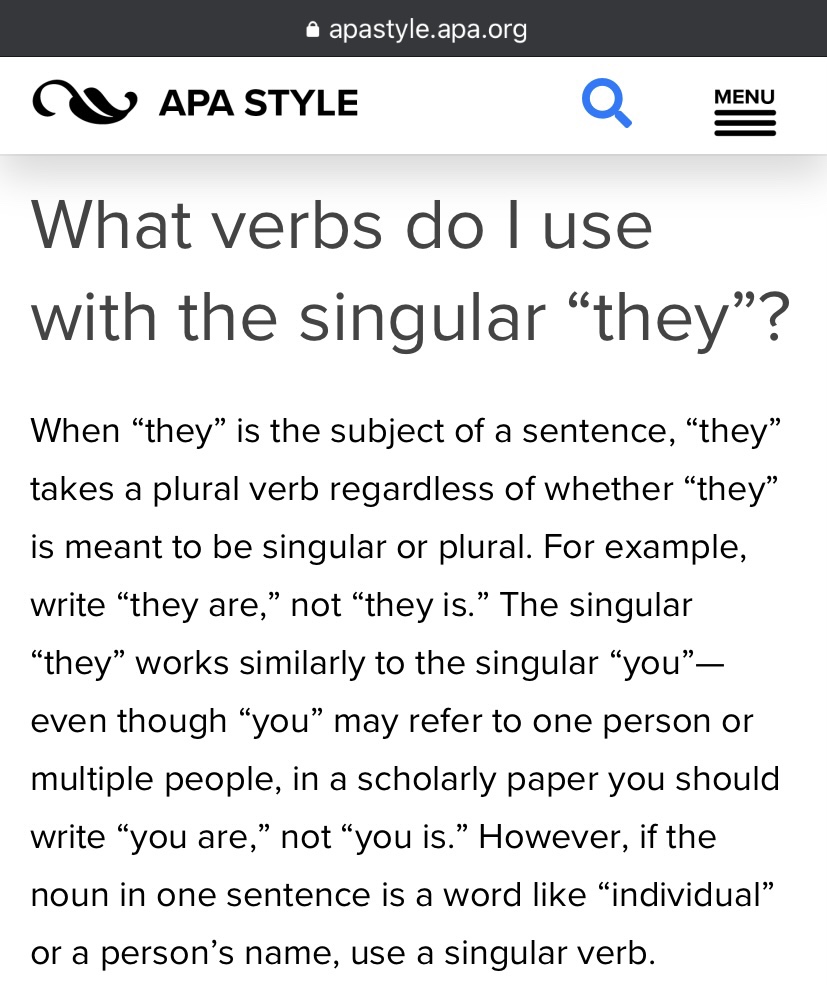
And there are other one-off questions. I recently shared an example of a source that answered a specific question that I had. I wanted to pose the classic identity question “who he says he is” but wanted to use the singular they to do so.
These are just a few examples. Many of the writing questions that required a book to answer in the last millennium are just a few keystrokes or voice commands away.
So you can get free answers to all of your writing questions in seconds!
Well, not really free.
If you look at the Word Hippo example above, four words appear at the very top that have nothing to do with “large amount.”
got milk? Learn More
My 1980s Merriam-Webster dictionary didn’t have advertisements.















 Bredemarket