In part because when I first tried to get a mobile driver’s license (mDL), I used my OLD physical driver’s license AFTER I had renewed my driver’s license online (but before I received the new physical license). Data mismatch. Rejected.
And in part because I kept on forgetting to perform the additional steps to confirm my identity.
And in part because I didn’t truly NEED the mDL—I haven’t flown anywhere since April 2023, and for some strange reason no vendor of age-controlled products has insisted on carding me.
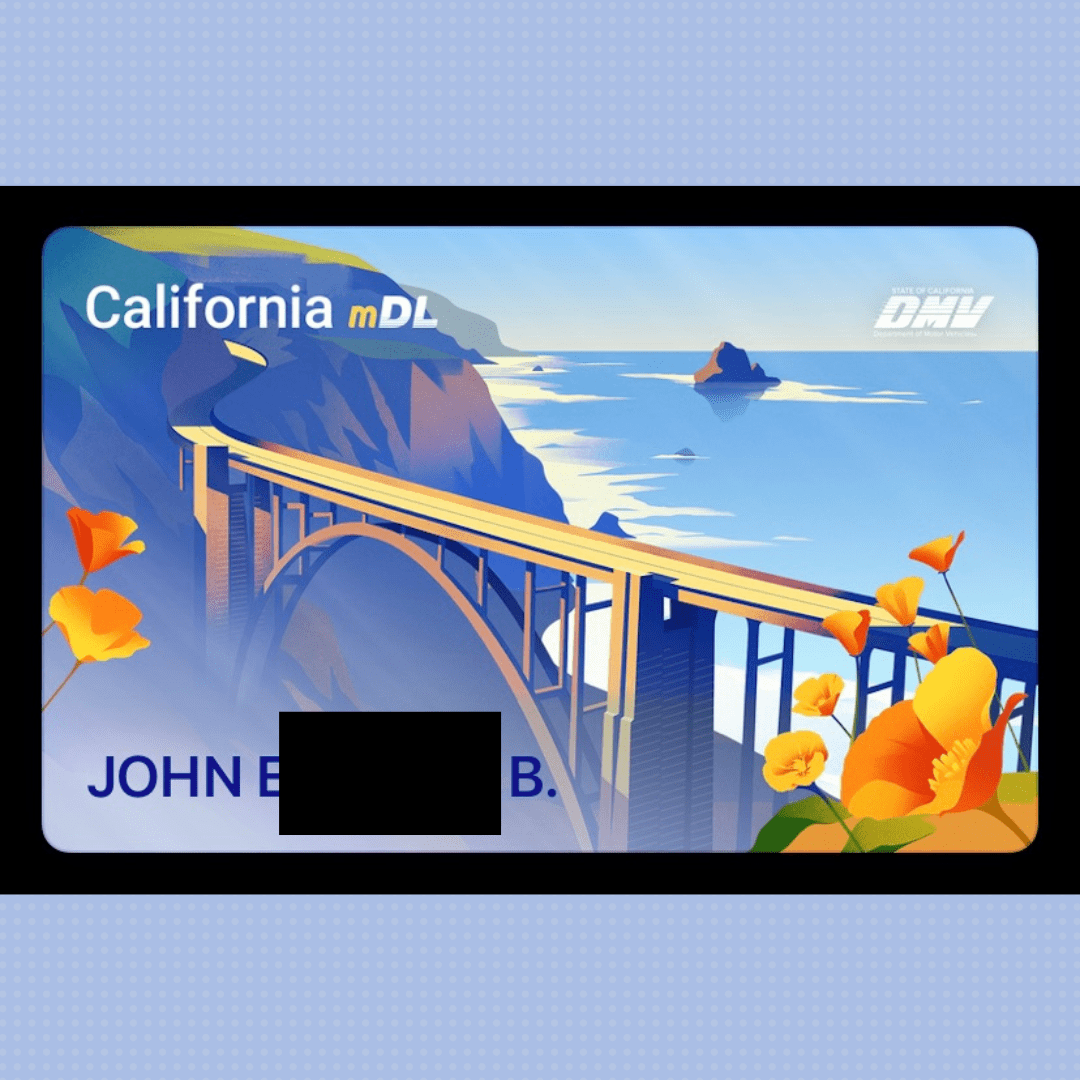
California mobile driver’s license (mDL).
But I now have a California mDL. After talking about mDLs for years as a former IDEMIA employee.
I’ve previously espoused the benefits of mDLs. For example, when a retailer DOES check my age before I buy a beer, the retailer doesn’t learn my address or my (claimed) height and weight. The retailer only needs to confirm that I am old enough to buy a beer.
Oddly enough, I had to block out certain information on my displayed mDL in the image above. Because MY privacy requirements obviously don’t conform to California’s privacy requirements.
In “On Attribute-Based Access Control,” I noted that NIST defined a subject as “a human user or NPE (Non-Person Entity), such as a device that issues access requests to perform operations on objects.” Again, there’s a need to determine that the NPE has the right attributes, and is not a fake, deep or shallow.
There’s clearly a need to identify non-person entities. If I work for IBM and have a computer issued by IBM, the internal network needs to know that this is my computer, and not the computer of a North Korean hacker.
But I was curious. Can the five (or six) factors identify non-person entities?
Let’s consider factor applicability, going from the easiest to the hardest.
The easy factors
Somewhere you are. Not only is this extremely applicable to non-person entities, but in truth this factor doesn’t identify persons, but non-person entities. Think about it: a standard geolocation application doesn’t identify where YOU are. It identities where YOUR SMARTPHONE is. Unless you have a chip implant, there is nothing on your body that can identify your location. So obviously “somewhere you are” applies to NPEs.
Something you have. Another no brainer. If a person has “something,” that something is by definition an NPE. So “something you have” applies to NPEs.
Something you do. NPEs can do things. My favorite example is Kraftwerk’s pocket calculator. You will recall that “by pressing down this special key it plays a little melody.” I actually had a Casio pocket calculator that did exactly that, playing a tune that is associated with Casio. Later, Brian Eno composed a startup sound for Windows 95. So “something you do” applies to NPEs. (Although I’m forced to admit that an illegal clone computer and operating system could reproduce the Eno sound.)
Something you know. This one is a conceptual challenge. What does an NPE “know”? For artificial intelligence creations such as Kwebbelkop AI, you can look at the training data used to create it and maintain it. For a German musician’s (or an Oregon college student’s) pocket calculator, you can look at the code used in the device, from the little melody itself to the action to take when the user enters a 1, a plus sign, and another 1. But is this knowledge? I lean toward saying yes—I can teach a bot my mother’s maiden name just as easily as I can teach myself my maiden name. But perhaps some would disagree.
Something you are. For simplicity’s sake, I’ll stick to physical objects here, ranging from pocket calculators to hand-made ceramic plates. The major reason that we like to use “something you are” as a factor is the promise of uniqueness. We believe that fingerprints are unique (well, most of us), and that irises are unique, and that DNA is unique except for identical twins. But is a pocket calculator truly unique, given that the same assembly line manufactures many pocket calculators? Perhaps ceramic plates exhibit uniqueness, perhaps not.
That’s all five factors, right?
Well, let’s look at the sixth one.
Somewhat you why
You know that I like the “why” question, and some time ago I tried to apply it to identity.
Why is a person using a credit card at a McDonald’s in Atlantic City? (Link) Or, was the credit card stolen, or was it being used legitimately?
Why is a person boarding a bus? (Link) Or, was the bus pass stolen, or was it being used legitimately?
Why is a person standing outside a corporate office with a laptop and monitor? (Link) Or, is there a legitimate reason for an ex-employee to gain access to the corporate office?
The first example is fundamental from an identity standpoint. It’s taken from real life, because I had never used any credit card in Atlantic City before. However, there was data that indicated that someone with my name (but not my REAL ID; they didn’t exist yet) flew to Atlantic City, so a reasonable person (or identity verification system) could conclude that I might want to eat while I was there.
But can you measure intent for an NPE?
Does Kwebbelkop AI have a reason to perform a particular activity?
Does my pocket calculator have a reason to tell me that 1 plus 1 equals 3?
Does my ceramic plate have a reason to stay intact when I drop it ten meters?
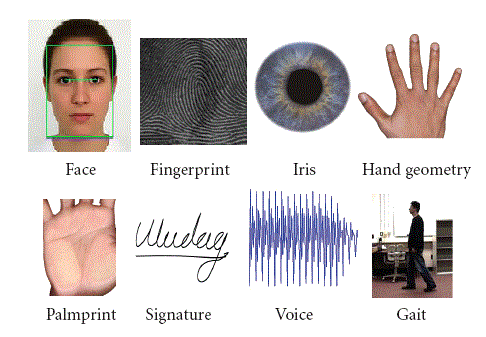
Something You Are. This is the factor that identifies people. It includes biometrics modalities (finger, face, iris, DNA, voice, vein, etc.). It also includes behavioral biometrics, provided that they are truly behavioral and relatively static.
Something You Have. While this is used to identify people, in truth this is the factor that identifies things. It includes driver’s licenses and hardware or software tokens.
Actually more than a decade, since my car’s picture was taken in Montclair, California a couple of decades ago doing something it shouldn’t have been doing. I ended up in traffic school for that one.
Now license plate recognition isn’t that reliable of an identifier, since within a minute I can remove a license plate from a vehicle and substitute another one in its place. However, it’s deemed to be reliable enough that it is used to identify who a car is.
Note my intentional use of the word “who” in the sentence above.
Because when my car made a left turn against a red light all those years ago, the police didn’t haul MY CAR into court.
Using then-current technology, it identified the car, looked up the registered owner, and hauled ME into court.
These days, it’s theoretically possible (where legally allowed) to identify the license plate of the car AND identify the face of the person driving the car.
But you still have this strange merger of who and what in which the non-human characteristics of an entity are used to identify the entity.
What you are.
But that’s nothing compared to what’s emerged over the past few years.
We Are The Robots
When the predecessors to today’s Internet were conceived in the 1960s, they were intended as a way for people to communicate with each other electronically.
And for decades the Internet continued to operate this way.
Until the Internet of Things (IoT) became more and more prominent.
Application programming interfaces (APIs) are the connective tissue behind digital modernization, helping applications and databases exchange data more effectively. The State of API Security in 2024 Report from Imperva, a Thales company, found that the majority of internet traffic (71%) in 2023 was API calls.
Couple this with the increasing use of chatbots and other artificial intelligence bots to generate content, and the result is that when you are communicating with someone on the Internet, there is often no “who.” There’s a “what.”
What you are.
Between the cars and the bots, there’s a lot going on.
What does this mean?
There are numerous legal and technical ramifications, but I want to concentrate on the higher meaning of all this. I’ve spent 29 years professionally devoted to the identification of who people are, but this focus on people is undergoing a seismic change.
The science fiction stories of the past, including TV shows such as Knight Rider and its car KITT, are becoming the present as we interact with automobiles, refrigerators, and other things. None of them have true sentience, but it doesn’t matter because they have the power to do things.
When marketing your facial recognition product (or any product), you need to pay attention to your positioning and messaging. This includes developing the answers to why, how, and what questions. But your positioning and your resulting messaging are deeply influenced by the characteristics of your product.
If facial recognition is your only modality
There are hundreds of facial recognition products on the market that are used for identity verification, authentication, crime solving (but ONLY as an investigative lead), and other purposes.
Some of these solutions ONLY use face as a biometric modality. Others use additional biometric modalities.
Similarly, a face-only company will argue that facial recognition is a very fast, very secure, and completely frictionless method of verification and authentication. When opponents bring up the demonstrated spoofs against faces, you will argue that your iBeta-conformant presentation attack detection methodology guards against such spoofing attempts.
Of course, if you initially only offer a face solution and then offer a second biometric, you’ll have to rewrite all your material. “You know how we said that face is great? Well, face and gait are even greater!”
It seems that many of the people that are waiting the long-delayed death of the password think that biometrics is the magic solution that will completely replace passwords.
For this reason, your company might have decided to use biometrics as your sole factor of identity verification and authentication.
Or perhaps your company took a different approach, and believes that multiple factors—perhaps all five factors—are required to truly verify and/or authenticate an individual. Use some combination of biometrics, secure documents such as driver’s licenses, geolocation, “something you do” such as a particular swiping pattern, and even (horrors!) knowledge-based authentication such as passwords or PINs.
This naturally shapes your positioning and messaging.
The single factor companies will argue that their approach is very fast, very secure, and completely frictionless. (Sound familiar?) No need to drag out your passport or your key fob, or to turn off your VPN to accurately indicate your location. Biometrics does it all!
The multiple factor companies will argue that ANY single factor can be spoofed, but that it is much, much harder to spoof multiple factors at once. (Sound familiar?)
So position yourself however you need to position yourself. Again, be prepared to change if your single factor solution adopts a second factor.
A final thought
Every company has its own way of approaching a problem, and your company is no different. As you prepare to market your products, survey your product, your customers, and your prospects and choose the correct positioning (and messaging) for your own circumstances.
And if you need help with biometric positioning and messaging, feel free to contact the biometric product marketing expert, John E. Bredehoft. (Full-time employment opportunities via LinkedIn, consulting opportunities via Bredemarket.)
In the meantime, take care of yourself, and each other.
Basically, I had gone through great trouble to document that Bredemarket would NOT take identity work, so I had to reverse a lot of pages to say that Bredemarket WOULD take identity work.
I may have found a few additional pages after June 1, but eventually I reached the point where everything on the Bredemarket website was completely and totally updated, and I wouldn’t have to perform any other changes.
You can predict where this is going.
Who I…was
Today it occurred to me that some of the readers of the LinkedIn Bredemarket page may not know the person behind Bredemarket, so I took the opportunity to share Bredemarket’s “Who I Am” web page on the LinkedIn page.
So yes, this biometric content marketing expert/identity content marketing expert IS available for your content marketing needs. If you’re interested in receiving my help with your identity written content, contact me.
As some of you know, I’m seeking full-time employment after my former employer let me go in late May. As part of my job search, I was recently invited to a second interview for a company in my industry. Before that interview, I made an important decision about how I was going to present myself.
If you’ve read any of Bredemarket’s content, there are times when it takes a light tone, in which wildebeests roam the earth while engaging in marketing activities such as elaborating the benefits of crossing the stream.
Some of that DOES NOT fly in the corporate world. (For most companies, anyway.) If you analyze a wide selection of corporate blogs, you won’t see the word “nothingburger.” But you do here.
So as I prepared for this important job interview, I made sure that I was ready to discuss the five factors of authentication, and my deep experience as an identity content marketing expert with many of those factors.
The five factors of authentication, of course, are:
For the purposes of this job interview, there isn’t! I confined myself to the five factors only during the discussion, using examples such as passwords, driver’s licenses, faces, actions, and smartphone geolocation information.
But in the end, my caution was of no avail. I DIDN’T make it to the next stage of interviews.
Maybe I SHOULD have mentioned “Somewhat you why” after all.
Depending upon whom you ask, there are either three or five factors of authentication.
Unless you ask me.
I say that there are six.
Let me explain.
First I’ll discuss what factors of authentication are, then I’ll talk about the three factor and five factor school, then I’ll briefly review my thoughts on the sixth factor—now that I know what I’ll call it.
For example, if Warren Buffett has a bank account, and I claim that I am Warren Buffett and am entitled to take money from that bank account, I must complete an authentication process to determine whether I am entitled to Warren Buffett’s money. (Spoiler alert: I’m not.)
An authentication factor is a special category of security credential that is used to verify the identity and authorization of a user attempting to gain access, send communications, or request data from a secured network, system or application….Each authentication factor represents a category of security controls of the same type.
When considering authentication factors, the whole group/category/type definition is important. For example, while a certain system may require both a 12-character password and a 4-digit personal identification number (PIN), these are pretty much the same type of authentication. It’s just that the password is longer than the PIN. From a security perspective, you don’t gain a lot by requiring both a password and a PIN. You would gain more by choosing a type of authentication that is substantially different from passwords and PIN.
How many factors of authentication are there?
So how do we define the factors of authentication? Different people have different definitions.
Factors include: (i) something you know (e.g. password/personal identification number (PIN)); (ii) something you have (e.g., cryptographic identification device, token); or (iii) something you are (e.g., biometric).
Note that NIST’s three factors are very different from one another. Knowing something (such as a password or a PIN) differs from having something (such as a driver’s license) or being something (a fingerprint or a face).
But some people believe that there are more than three factors of authentication.
Over the months, I struggled through some examples of the “why” factor.
Why is a person using a credit card at a McDonald’s in Atlantic City? (Link) Or, was the credit card stolen, or was it being used legitimately?
Why is a person boarding a bus? (Link) Or, was the bus pass stolen, or was it being used legitimately?
Why is a person standing outside a corporate office with a laptop and monitor? (Link) Or, is there a legitimate reason for an ex-employee to gain access to the corporate office?
As I refined my thinking, I came to the conclusion that “why” is a reasonable factor of authentication, and that this was separate from the other authentication factors (such as “something you do”).
And the sixth factor of authentication is called…
You’ll recall that I wanted to cast this sixth authentication factor into the “some xxx you xxx” format.
So, as of today, here is the official Bredemarket list of the six factors of authentication:
Something you know.
Something you have.
Something you are.
Something you do.
Somewhere you are.
(Drumroll…)
Somewhat you why.
Yes, the name of this factor stands out from the others like a sore thumb (probably a loop).
However, the performance of this factor stands out from the others. If we can develop algorithms that accurately measure the “why” reasonableness of something as a way to authenticate identity, then our authentication capabilities will become much more powerful.

Does your identity business provide biometric or non-biometric products and services that use finger, face, iris, DNA, voice, government documents, geolocation, or other factors or modalities?
Does your identity business need written content, such as blog posts (from the identity/biometric blog expert), case studies, data sheets, proposal text, social media posts, or white papers?
How can your identity business (with the help of an identity content marketing expert) create the right written content?
When keeping your websites updated, I advise you to do as I say, not as I do. Two of my websites were significantly out of date and needed hurried corrections.
I realized this morning that the “My Experience” page on my jebredcal website was roughly a year out of date, so I hurriedly added content to it. Now the page will turn up in searches for the acronym “ABM” (OK, maybe not on the first page of the search results).
After Castro identifies the various ways in which people prove identity online, and the drawbacks of these methods, here’s what Castro says about the problem that needs to be addressed:
…poor identity verification is one of the reasons that identity theft is such a growing problem as more services move online. The Federal Trade Commission received 1.4 million reports of identity theft last year, double the number in 2019, with one security research firm estimating $56 billion in losses.
Castro then goes on to state his ideal solution:
The best solution to this problem would be for the federal government to develop an interoperable framework for securely issuing and validating electronic IDs and then direct a federal agency to start issuing these electronic IDs upon request.
Castro then notes that the federal government has NOT done this:
But in the absence of federal action, a number of states have already begun this work on their own by creating digital driver’s licenses that provide a secure digital alternative to a physical identity document.
Why Americans oppose mandatory national physical and digital IDs
Castro’s proposal, while ideal from a technological standpoint, doesn’t fully account for the realities of American politics.
Many Americans (regardless of political leanings) are strongly opposed to ANY mandatory national ID system. For example, many Americans don’t want our Social Security Numbers to become mandatory national IDs (even though they are de facto national IDs today). And while the federal government does issue passports, it isn’t mandatory that people GET them.
And many Americans don’t want state driver’s licenses to become mandatory national IDs. I went into this whole issue in great detail in my prior post “How 6 CFR 37 (REAL IDs) exhibits…federalism,” which made the following points:
States are NOT mandated to issue REAL IDs. (And, no citizen is mandated to GET a REAL ID.)
The federal government CAN mandate which IDs are accepted for federal purposes.
Because the federal government can mandate the IDs to use when entering a federal facility or flying at a commercial airport, ALL of the states were eventually “persuaded” to issue REAL IDs. (Of course, it has take nearly two decades, so far, for that persuasion to work, and it won’t work until 2023, or later.)
So, considering all of the background regarding the difficulties in mandating a national PHYSICAL ID, imagine how things would erupt if the federal government mandated a national DIGITAL ID.
And this is why some states are moving ahead on their own with mobile driver’s licenses.
LA Wallet Louisiana Digital Driver’s License. lawallet.com.
However, there’s a teeny tiny catch: while the states can choose to mandate that their mDLs be accepted at the STATE level, states cannot mandate that their digital identities be used for FEDERAL purposes.
Here we go again.
Of course, federal government agencies are starting to look at the issues with a mobile version of a “REAL ID,” including the standard(s) to which any mobile ID used for federal purposes must adhere.
Improving Digital Identity Act of 2020, or 2021, or 2025…
While the government agencies are doing this work, another government agency (the U.S. Congress) is also working on this. Castro mentions Rep. Bill Foster’s H.R. 8215, introduced in the last Congress. I’m not sure why he bothered to introduce it in September 2020, when Congress wasn’t going to do anything with it. As you may have heard, we had an election at that time.
Regardless, the “Improving Digital Identity Act” proposes the creation of a task force at the federal level with federal, state participants, and local participants. It also mandates that NIST create a digital identity “framework,” with an interim version available 240 days after the Act is passed. Among other things, the ACT also mandates that NIST Special Publication 800-63 become “binding operational directives” for federal agencies.
(Does that mean that it will be illegal to mandate password changes every 90 days? Woo hoo!)
Should this Act actually pass at some point, its directives will need to be harmonized with what the Department of Homeland Security is already doing, and of course with what the states are already doing.
Oh, and remember my reference to the DHS’ work in this area? Among those who have submitted verbal and/or written comments, several (primarily from privacy organizations) have stated that the government should NOT be promoting ANY digital ID at all. The sentiments in this written comment, submitted anonymously, are all too common.
There are a lot of security and privacy concerns with accepting digital ID’s. First and foremost, drivers licenses contain a lot of sensitive information. If digital ID’s are accepted, then it could potentially leak that info to hackers if it is not secured properly. Plus, there is the added concern that using digital ID’s will lead to extra surveillance where unnecesary. Finally, digital ID will not allow individuals who are poorer to be abele to submit an ID because they might not have access to the same facilities. I am strongly against this rule and I do NOT think that digital ID should be an option.
I expect other privacy organizations to submit comments that may be better-written, but they echo the same sentiment.