Sometimes I think that half of the people writing on Substack are telling people how to write on Substack. So they can in turn tell people how to write on Substack.
But the people promoting Substack success are nothing compared to the ones promoting LinkedIn success.
Bredemarket currently manages four LinkedIn pages, and recently received a notification from LinkedIn that someone commented on one of Bredemarket’s LinkedIn posts, and why haven’t I engaged with the commenter?
“Are we ready for better identification systems? Let’s explore potential solutions. 🔑 #Innovation”
LinkedIn.
Frankly, that comment sounded…formulaic. And I had a hunch that the commenter had left similar comments on other posts.
I was right.
LinkedIn.
Obviously the well-meaning commenter had read some advice on How To Maximize Your LinkedIn Profile Reach With Text, An Emoji, And A Hashtag. And frankly, it doesn’t matter whether the comments were self-written or bot-written. Either way, they’re ineffective.
I was going to have Bredebot write a response to the comment for me, but in the end I didn’t bother.
Avoid rote steps to success. Be yourself.
And yes, I will probably post this to the same LinkedIn page, in case the commenter revisits.
On LinkedIn, the hashtag “#opentowork” isn’t the only magic phrase that attracts all sorts of people. I found this out Sunday morning when I reshared my September 26 “Graber Olives is in Foreclosure…But There’s a GoFundMe” post on Bredemarket’s Inland Empire LinkedIn page.
I should note this is Kelsey Graber’s GoFundMe. This is not my GoFundMe.
Anyway, I reshared the post on LinkedIn…and got all sorts of reposts…with additional commentary. The commentary was not addressed to the GoFundMe fundraiser…but to me. (The resharers probably never read my original post; they just saw the word “GoFundMe” and jumped.) I’ve redacted the redirects to WhatsApp…a common fraud scam tactic.
The scammers’ what
Foone Berkeley:
“Hi, I came across your campaign, really impressive work. It reminded me of an independent group I’ve seen quietly helping project owners connect with private contributors who genuinely want to make a difference.
I’m not part of their team, but I’ve seen them support a few people in my circle. If you’re open to exploring new sources of backing, you can reach them directly here:
📞 WhatsApp: [REDACTED]
They usually prefer to speak one-on-one with campaign owners to understand their goals and see if there’s a good fit.
Wishing you continued success, your work truly deserves attention.”
Alex Mary:
“Hello 🌸 I just read your campaign, and it truly touched me. I know how tough fundraising can be, but there are genuine people out there who want to help. A trusted charity once helped me raise over $38,000 after I’d almost given up. If you’d like, you can message them on WhatsApp 👉 [REDACTED] they might be able to guide you too. 💙”
Olivia Williams:
“If you’re looking to grow your campaign donations fast, I truly recommend reaching out to Crowd. She’s an expert in GoFundMe promotions and helped me raise over $180,000 a few months ago! he knows exactly how to attract real donors and get results. You can contact her directly here [REDACTED]”
The scammers’ how
Let’s look at the red flags common to all three:
The person is touched by the fundraising effort, but doesn’t say anything specific about them. (And doesn’t acknowledge that this is someone else’s fundraiser, not mine.)
The person resharing is not the person who can provide help. It’s always someone else: an independent group, a trusted charity, or a woman (or man?) named Crowd.
The person wants to get you off LinkedIn as soon as possible. Private email, SMS, or an encrypted service like WhatsApp or Telegram.
The scammers’ goals
So why are these people so willing to recommend helpers who can assist desperate GoFundMe fundraisers? GoFundMe itself has addressed this:
“If someone you don’t know is reaching out to offer something that sounds too good to be true, we always recommend validating the individual before sharing any personal information. Donors and donor networks shouldn’t expect anything from you in return for their generosity.”
Two common tactics include:
Guarantee reaching your fundraising goal in exchange for a service fee or percentage of funds raised
Make a donation if you provide personal information such as email address, phone number, or banking information
There are other tactics, but the goal is the same. Instead of helping you raise money, the “helper” wants to get money from you.
Now there are legitimate companies that assist charities in their fundraising efforts…but they can be contacted via methods other than WhatsApp.
Today’s honeypot
And now that I’ve written this warning, I’m going to conduct a little experiment.
I’m going to reshare THIS post on LinkedIn.
With quotes from the first and fourth paragraphs that include several mentions of the word “GoFundMe”…plus the additional honeypot word #opentowork. (I haven’t planted an opentowork honeypot in a while. Oh, and not that they’ll notice, but the words “fraud” and “scam” also appear.
Grok.
Let’s see what moths are attracted to the new flame.
And consider what YOU are doing to fight fraud.
Bredemarket specializes in helping anti-fraud firms market their products.
(Image sources: Gemini (still), GoFundMe, Grok (video). Only the GoFundMe is real.)
I just posted the latest edition of my LinkedIn newsletter, “The Wildebeest Speaks.” It examines the history of deepfakes / likenesses, including the Émile Cohl animated cartoon Fantasmagorie, my own deepfake / likeness creations, and the deepfake / likeness of Sam Altman committing a burglary, authorized by Altman himself. Unfortunately, some deepfakes are NOT authorized, and that’s a problem.
A client recently asked me to perform some research. After initially performing one aspect of the research manually, I performed the second part of the research automatically using Google Gemini. I informed the client of my use of AI for the second part of the research.
This particular use case is separate from using AI for CONTENT, something I’ve been discussing for years. However, since part of Bredemarket’s services include ANALYSIS, I felt it best to disclose when someone other than me performed the analysis.
This post describes the two parts of my research (manual and automated), what I disclosed to my client, and why I disclosed it.
Part One (Manual)
My client required assistance in identifying people with a particular skill set (which I cannot disclose). To fulfill this request, I went into LinkedIn, performed some searches, read some profiles, and selected people who may possess the skills my client required.
After spending some time collecting the research, I forwarded it to the client.
Google Gemini.
Part Two (Automated)
Several hours after sending the initial research to my client, I thought about taking a separate approach to my client’s need. Rather than identifying people with this skill set, I wanted to identify COMPANIES with this skill set.
But this time, I didn’t manually perform the research. I simply created a Google Gemini prompt asking for the companies with this skill set, their website URLs, their email addresses, and their phone numbers.
“Deloitte’s member firm in Australia will pay the government a partial refund for a $290,000 report that contained alleged AI-generated errors, including references to non-existent academic research papers and a fabricated quote from a federal court judgment.”
Now in this case the refund was due to hallucinations in the AI-generated document.
But what of the fact that at least one of Deloitte’s report writers was the Deloitte equivalent of Bredebot?
Personally, I think that disclosure in this instance is required also.
Inspired by the Constant Contact session I attended at the Small Business Expo, I wanted to conceptualize the Bredemarket online presence, and decided to adopt a “planet with rings” model.
Think of Bredemarket as a planet. Like Saturn, Uranus, Neptune, and Jupiter, the planet Bredemarket is surrounded by rings.
A variety of social platforms, including Bluesky, Instagram, Substack, and Threads.
Additional social platforms, including TikTok, WhatsApp, and YouTube.
While this conceptualization is really only useful to me, I thought a few of you may be interested in some of the “inner rings.”
And if you’re wondering why your favorite way cool platform is banished to the outer edges…well, that’s because it doesn’t make Bredemarket any money. I’ve got a business to run here, and TikTok doesn’t help me pay the bills…
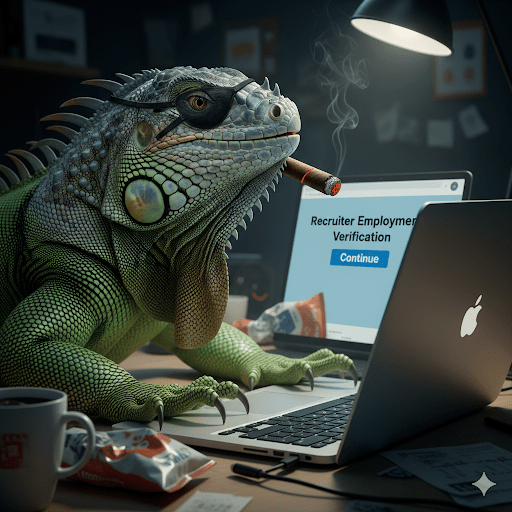
I’ve written about the fake recruiters who InMail you about a great position with their company. I shut up the fakes by requesting their corporate email address at their supposed employer. But what if LinkedIn could catch them BEFORE they ever sent that InMail to me?
“LinkedIn is looking to take on scammers who falsely present themselves as recruiters or company representatives in the app, with an expansion of its company verification option, while it’s also making workplace verification required when a member adds or updates a leadership or recruiter-related role.”
From HR Dive.
Of course, the proposed Know Your Recruiter system isn’t foolproof; nothing is. Scammers can avoid the LinkedIn verification step by simply NOT choosing a leadership or recruiter-related job title.
Imagen 4.
And as much as people like me wish that people would care about verified identities…many don’t.
If “Jones Jay” from Microsoft sends jobseekers an InMail about a wonderful position,
some will blindly respond without even looking at Jones Jay’s LinkedIn profile at all,
much less checking whether his identity and employer are verified.
But at least the attempt demonstrates that LinkedIn cares more about their real users than about the scammers who pay for Premium.
I’m conducting an experiment in which an AI bot, “Bredebot,” is writing on the Bredemarket blog and on LinkedIn with almost no restrictions.
Don’t do this at home. It’s not a good idea.
This post describes an example in which Bredebot misses a critically important point about Bredemarket’s target audience in the identity/biometric industry.
“The true competitive advantage isn’t the Al tools themselves but how you use them. Your unique processes for data capture, knowledge management, and building trust are the real ‘moat.’ Al becomes powerful when it’s integrated with your proprietary insights and context, making your approach impossible to replicate.”
Moat. I like that. Imagen 4 (via Bredebot.)
Mabry also advocates including a human in the loop: his firm, Fast + Light, always asks at least one human (preferably two) to review all AI-generated content.
In my Bredebot experiment, I rarely edit what Bredebot says. If you know me, it’s very obvious that Bredebot wrote this and I didn’t.
“Building Trust: In the identity and biometrics space, trust isn’t just a nice-to-have; it’s paramount. If customers don’t trust you with their most sensitive data, you simply don’t have a business. Your processes for privacy, security, transparency, and ethical AI usage are not just compliance requirements; they are fundamental differentiators. How you communicate these efforts, how you manage data breaches (heaven forbid!), and how you constantly reinforce your commitment to security are all part of this trust-building moat. This is where your wombat customers, usually burrowing away, will emerge to praise (or criticize) your efforts.”
While I certainly agree with the sentiment, and obviously don’t mind the reference to wombats, I would have made one change.
The t word
I would have modified Bredebot’s use of the T word. Just because Mabry used it doesn’t mean that Bredebot has to do the same.
“Now perhaps some of you would argue that trust is essential to identity verification in the same way that water is essential to an ocean, and that therefore EVERYBODY HAS to use the t-word in their communications.
I just published a new edition of Bredemarket’s LinkedIn newsletter this afternoon. Here’s how I started it:
“For years I maintained a negative stance on generative AI-authored text. But I recently tried relaxing it. By doing this I learned what AI authors are capable of…and what they clearly CANNOT do.”
Much of the article rehashes material I’ve shared before, but I did provide a little detail on the temperamental writer’s emotional hurt when Zoominfo turned to the bots:
“My first reaction was akin to a river in Egypt. I remain a temperamental writer, you know.”
Psst…check the book title.
But at least I closed the thing with a call to action.
“But if you are a marketing leader at an identity, biometric, or technology company, and you want an experienced human to help you with your content, proposals, and analysis, why don’t you schedule a free meeting with me to talk about your needs. Visit https://bredemarket.com/mark/ to find out more.”





 Bredemarket