Three Ways in Which My Identity/Biometric Experience Exhibits My “Bias”

Yeah, I’m still focused on that statement:

“I think too much knowledge is actually bad in tech: you’re biased.”

Why does this quote affect me so deeply? Because with my 30-plus years of identity/biometric experience, I obviously have too much knowledge of the industry, which is obviously bad. After all, all a biometric company needs is a salesperson, an engineer, an African data labeler, and someone to run the generative AI for everything else. The company doesn’t need someone who knows that Printrak isn’t spelled with a C.

Google Gemini.

In this post I will share three of the “biases” I have developed in my 30-plus years in identity and biometrics, and how to correct these biases by stripping away that 20th century experience and applying novel thinking.

And if that last paragraph made you throw up in your mouth…read to the end of the post.

But first, let’s briefly explore these three biases that I shamefully hold due to my status as a biometric product marketing expert:

  1. Independent algorithmic confirmation is valuable.
  2. Process is valuable.
  3. Artificial intelligence is merely a tool.
Biometric product marketing expert.

Bias 1: Independent Algorithmic Confirmation is Valuable

Biometric products need algorithms to encode and match the biometric samples, and ideally to detect presentation and injection attacks.

But how do prospects know that these algorithms work? How accurate are they? How fast are they? How secure are they?

My bias

My brain, embedded with over 30 years of bias, gravitates to the idea that vendors should submit their algorithms for independent testing and confirmation.

From a NIST facial recognition demographic bias text.

This could be an accuracy test such as the ones NIST and DHS administer, or confirmation of presentation attack detection capabilities (as BixeLab, iBeta, and other organizations perform), or confirmation of injection attack detection capabilities.

Novel thinking

But you’re smarter than that and refuse to support the testing-industrial complex. They have their explicit or implicit agendas and want to force the biometric vendors to do well on the tests. For example, the U.S. Federal Bureau of Investigation’s “Appendix F” fingerprint capture quality standard specifically EXCLUDES contactless solutions, forcing everyone down the same contact path.

But you and your novel thinking reject these unnecessary impediments. You’re not going to constrain yourself by the assertions of others. You are going to assert your own benefits. Develop and administer your own tests. Share with your prospects how wonderful you are without going through an intermediary. That will prove your superiority…right?

Bias 2: Process is Valuable

A biometric company has to perform a variety of tasks. Raise funding. Hire people. Develop, market, propose, sell, and implement products. Throw parties.

How will the company do all these things?

My bias

My brain, encumbered by my experience (including a decade at Motorola), persists in a belief that process is the answer. The process can be as simple as scribblings on a cocktail napkin, but you need some process if you want to cash out in a glorious exit—I mean, deliver superior products to your customers.

Perhaps you need a development processs that defines, among other things, how long a sprint should be. A capture and proposal process (Shipley or simpler) that defines, among other things, who has the authority to approve a $10 million proposal A go-to-market process that defines the deliverables for different tiers, and who is responsible, accountable, consulted, and informed. Or maybe just an onboarding process when starting a new project, dictating the questions you need to ask at the beginning.

Bredemarket’s seven questions. I ask, then I act.

Novel thinking

Sure all that process is fine…if you don’t want to do anything. Do you really want to force your people to wait two weeks for the latest product iteration? Impose a multinational bureauracy on your sales process? Go through an onerous checklist before marketing a product?

Google Gemini.

Just code it.

Just sell it.

Just write it.

Bias 3: Artificial Intelligence is Merely a Tool

The problem with experienced people is that they think that there is nothing new under the sun.

You talk about cloud computing, and they yawn, “Sounds like time sharing.” You talk about quantum computing, and they yawn, “Sounds like the Pentium.” You talk about blockchain, and they yawn, “Sounds like a notary public.”

My bias

As I sip my Pepperidge Farm, I can barely conceal my revulsion at those who think “we use AI” is a world-dominating marketing message. Artificial intelligence is not a way of life. It is a tool. A tool that in and of itself does not merit much of a mention.

Google Gemini.

How many automobile manufacturers proclaim “we use tires” as part of their marketing messaging? Tires are essential to an automobile’s performance, but since everyone has them, they’re not a differentiator and not worthy of mention.

In the same way, everyone has AI…so why talk about its mere presence? Talk about the benefits your implementation provides and how these benefits differentiate you from your competitors.

Novel thinking

Yep, the grandpas that declare “AI is only a tool” are missing the significance entirely. AI is not like a Pentium chip. It is a transformational technology that is already changing the way we create, sell, and market.

Therefore it is critically important to highlight your product’s AI use. AI isn’t a “so what” feature, but an indication of revolutionary transformative technology. You suppress mention of AI at your own peril.

How do I overcome my biases of experience?

OK, so I’ve identified the outmoded thinking that results from too much experience. But how do I overcome it?

I don’t.

Because if you haven’t already detected it, I believe that experience IS valuable, and that all three items above are essential and shouldn’t be jettisoned for the new, novel, and kewl.

  • Are you a identity/biometric marketing leader who needs to tell your prospects that your algorithms are validated by reputable independent bodies?
  • Or that you have a process (simple or not) that governs how your customers receive your products?
  • Or that your AI actually does unique things that your competitors don’t, providing true benefits to your customers?

Bredemarket can help with strategy, analysis, content, and/or proposals for your identity/biometric firm. Talk to me (for free).

By the way, here’s MY process (and my services and pricing).

Bredemareket: Services, Process, and Pricing.

Strategy for Marketing One or Multiple Products

Back when dinosaurs ruled the earth I was a technical writer at a software company. These were the days when software came with printed user guides, which I wrote.

I was NOT the de facto product marketer at this software company; the owner was. But during my tenure I observed how he marketed the evolving line of products through three distinct phases. I’m presenting these phase in the chronological order of the company, not the logical order.

Phase One: Multiple Related Products

When I joined Logic eXtension Resources (LXR), the company was transitioning from consulting work to becoming the leading software provider for users of the THEOS (formerly OASIS) operating system (Wikipedia). THEOS could be configured as a multi-user operating system that could run on (souped up) microcomputer hardware, and thus was an attractive alternative to minicomputers running UNIX.

And LXR provided the business applications: multiCALC for spreadsheets, multiWRITE for word processing, multiMAIL (which I recall nothing about), and multiPERT for project management.

Speaking of dinosaurs, this was when Lotus 1-2-3 was prominent in PC-DOS and MS-DOS circles. You may recall the key word associated with Lotus: integrated. (One prospect at a trade show asked if multiCALC was integrated—it wasn’t—but I doubt he even knew what the word meant.) But in the mind of the consumer, Lotus and the future Microsoft Office caused these seemingly disparate software packages to be regarded as a unified offering.

Google Gemini.

So the four products I mentioned were loosely related, inasmuch as all of them were business applications, and all ran on THEOS. “Hey, you know that spreadsheet you have? We have a word processor also!”

So we had customers using all four products, and I was eating my own wildebeest food and writing all my user manuals in multiWRITE.

Until I didn’t.

Phase Two: Multiple Unrelated Products

Behind the scenes, LXR shifted to the Macintosh computer for internal work, including my user manuals. We all admired the elegance of the Mac for developers and users alike.

At the same time, the owner decided to pursue his personal interest in education and launched a product that didn’t fit on THEOS and didn’t fit in the “multi” product line.

Enter LXR*TEST, an educational measurement/test generation software package for the Macintosh that created test banks of questions incorporating text and graphics. Questions from the test banks could then be incorporated into individual tests. And if you didn’t want to create your own test banks, third parties were creating test banks in LXR*TEST format.

So, how did the owner/product marketer market LXR*TEST along with all the “multi” products?

Google Gemini.

He didn’t.

The two product lines served two completely different target audiences. THEOS business prospects didn’t care a whit about test generation, and educators on Macs had no use for a THEOS word processor.

So LXR marketed separately to its target audiences, addressing their individual needs.

Phase Three: One Product

Eventually I left LXR and after a few years drifted into the wonderful world of biometrics.

I can’t remember exactly when LXR discontinued its THEOS products, but eventually it concentrated exclusively on LXR*TEST, bowing to the inevitable and releasing a Windows version to complement its Mac version.

Google Gemini.

Even after LXR was acquired, the parent company continued to offer LXR*TEST for years afterwards.

Of course this allowed LXR to devote its product marketing attention exclusively to the testing market.

Until LXR*TEST, and LXR itself, faded away.

Like several of my other employers that no longer exist in their initial form.

In Product Marketing, Strategy Precedes Tactics

I’ve decided to tweak Bredemarket’s public presentation by talking more about strategy. And although I’ve written some new strategy content recently, it’s a heck of a lot easier to repurpose some of the old content I’ve already written.

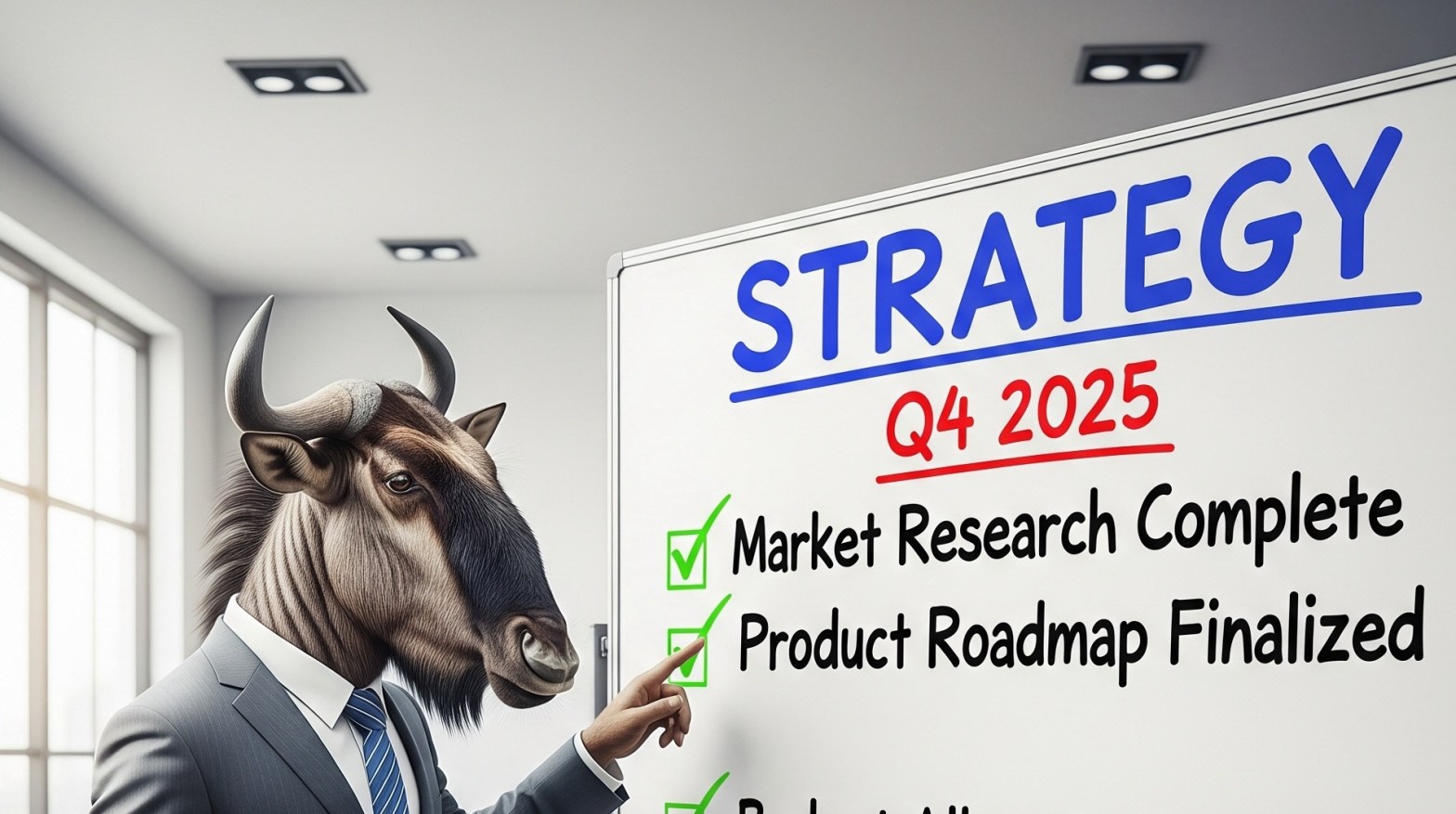
Such as my July 31, 2025 personal LinkedIn article (separate from Bredemarket’s “The Wildebeest Speaks”…which reminds me, I gotta write another one of those).

Job duties and SMART OKRs

The personal LinkedIn article was called “The Joy of Product Marketing Strategy, or SMART OKRs.”

Let me define the acronyms in the article title:

  • SMART: specific, measurable, attainable, relevant, and time-bound.
  • OKRs: Objectives and Key Results.

Putting it simply, the article talked about the myriad of things a product marketer was expected to do at one company.

Or at any company, frankly. Product marketing job descriptions are fairly interchangeable. Go-to-market. Sales enablement. Competitive analysis. Metrics. Cross-functional collaboration. If you think YOUR company’s product marketing is amazing and different…it isn’t.

The entire list of product marketing duties is a bunch of tactical moves. A brochure here, a battlecard there. It could devolve into a lot of meaningless busywork. (Says the guy who has now written over 2,000 blog posts.)

But WHY are you doing all this junk?

That’s where the strategy comes to play.

Why?

For example, why are you establishing and obtaining approval for this?

“a multi-tiered go-to-market process identifying the go-to-market tiers, the customer-facing and internal deliverables for each tier, as well as the responsible, accountable, consulted, and informed organizations for each deliverable”

Let me list three reasons:

  • To ensure your go-to-market efforts contain the correct deliverables for the tier. Running around like a headless chicken to guess what you need to produce is idiotic.
  • To make sure everybody knows what they have to do. You don’t want a go-to-market effort to tank because the VP of Product won’t approve the customer success internal deliverable.
  • And let’s not forget the biggest reason of all: to allow the product in your go-to-market revenue to get a ton of orders and make a ton of revenue.

Because that’s why you’re marketing products…I hope.

Ask before you act

A helpful tip: before I get into the minutiae (tip your servers, I’m here all week) of a project, I ask a lot of questions first. “Why?” is the first question, but there are more.

The seven questions I ask. One you’ve seen the movie, now read the book.

Speaking of asking, if you want to ask Bredemarket for help with your strategy and tactics for content, proposal, and analysis work, click on the Content for Tech Marketers image below and schedule a free meeting with me.

Understand, Adapt, or Create

When Bredemarket begins an engagement with a client, I usually have no idea what processes, templates, or practices the client already has. So I have to handle whatever is or is not there and either understand what is there, adapt it, or create what is needed.

Understand

In some cases clients already have a process.

For example, as I delved into the Sharepoint library for one of Bredemarket’s clients, I found a complete set of branding guidelines that covered logos, colors, and many other aspects of the company’s branding.

In that case, my job is to simply make sure that I align with the client’s branding, and that my content, proposals, and analysis work for the client aligns with the branding guidelines…or with whatever other process the client has.

Adapt

Sometimes the client has a process, but it needs to be adapted in some way.

Here’s an example I can publicly share: not from a Bredemarket client, but from my former employer Motorola (back when Motorola was one company). I was a product manager at the time, and products were developed via a “stage gate” process. At Motorola, of course, it was called M-Gates.

Our “Printrak” group (automated fingerprint identification systems, computer aided dispatch systems, and the like) was the odd group out in our part of Motorola (the part that would later become Motorola Solutions). Most of the people in that part of Motorola sold police radios that were manufactured in bulk. Therefore the stage gate process included a step for a limited production run of police radios before moving to full production.

That didn’t apply for the software we sold to government systems. For example, the entire production run for the Omnitrak 8.1 release was no more than a half dozen systems for customers in Switzerland, Oklahoma, and other places. A limited production run wouldn’t make sense.

So OUR stage gate process eliminated that step and went straight to full production.

Create

And then there are the clients who don’t have anything. In these cases, my invention hat goes on.

For one Bredemarket client, I was asked to develop several pieces of collateral, such as (ironically) one on process maturity, and several random pieces of content tied to a product release.

I decided to approach it more systematically by introducing a simple go-to-market process that defined the external and internal collateral required for a “high” tier product release and a “low” tier product release. Resisting my urge to define something thorough, I simplified the GTM process as much as possible, while still providing guidance on what a product release should contain.

The client rejected the idea: “we don’t need no steenking process.”

Not surprisingly, the process maturity content was never released either.

I’ve had better luck with other Bredemarket clients, defining go-to-market, proposal, and other processes for them as needed.

Be Prepared

Providing product marketing expertise is much more than writing about a product.

Before I write a word of text, I ensure that the content aligns with the client’s strategies…or my own strategies if the client doesn’t have any.

And of course I ask questions.

The Missing Piece to Solve Your Firm’s Product Marketing Puzzle

Technology marketing leaders know that product marketing is a puzzle that your firm can solve…with the proper resources.

Think of these four product marketing puzzle pieces:

  1. Product marketing strategy (not tactics), including why, how, what, and process.
  2. Product marketing environment, including the market and competitive intelligence, the customer feedback loop, and the company culture.
  3. Product marketing content, both internal and external, including positioning, personas, go-to-market, sales enablement, launches, pricing, packaging, and proposals.
  4. Product marketing performance, including metrics, objectives, and key results.

Does your firm have all four puzzle pieces? Or are one or more of the pieces lacking?

Imagen 4.

Can a technology product marketing expert with proven content, proposal, and analysis skills help your firm move forward?

Proven expertise from Printrak BIS, MorphoWay, and a recent launch for a Bredemarket client?

Recent Go-to-market.

If you are ready to move your firm’s product marketing forward with Bredemarket’s content-proposal-analysis services for technology firms, let’s discuss your needs and how Bredemarket can help you solve them. Book a free meeting at https://bredemarket.com/mark/.

Content for tech marketers.

Strategy is not Tactics

I’ve said that strategy is one of four essential elements of product marketing. But you have to know what strategy is…and what it is not.

To illustrate the difference between strategy and tactics, it helps to differentiate between abstract, long term goals and concrete, short term goals.

If your goal is to better the world, that’s a strategy.

If your goal is to excel in a particular industry, that’s a strategy.

Although strategies can change. Those who know of Nokia as a telecommunications company, and those who remember Nokia as a phone supplier, are not old enough to remember Nokia’s beginnings as a pulp mill in 1865.

If your goal is to secure business from a specific prospect, that’s a tactic. Or it should be.

Fleming Companies secured a 10-year contract in 2001 as the main supplier of groceries to Kmart, accounting for 20% of Fleming’s revenue. Kmart cancelled that contract when it declared bankruptcy a year later. Fleming filed a $1.4 billion claim in Kmart’s bankruptcy case…but only got $385 million. Fleming itself ended up in bankruptcy court in 2003.

But Fleming’s strategy was to excel at food wholesaling through acquisition and innovation.

It’s just that one tactical blunder upended that strategy.

Whether Bredemarket pivots from biometric content to resume writing (not likely), I am presently equipped to address both your strategic and tactical product marketing needs. If I can help you, talk to me at https://bredemarket.com/mark/.

Foresight

(Lorraine Motel CC BY-SA 3.0 Link)

You never know. Or maybe you do.

“Well, I don’t know what will happen now. We’ve got some difficult days ahead. But it doesn’t matter with me now. Because I’ve been to the mountaintop. And I don’t mind. Like anybody, I would like to live a long life. Longevity has its place. But I’m not concerned about that now. I just want to do God’s will. And He’s allowed me to go up to the mountain. And I’ve looked over. And I’ve seen the promised land. I may not get there with you. But I want you to know tonight, that we, as a people, will get to the promised land. And I’m happy, tonight. I’m not worried about anything. I’m not fearing any man. Mine eyes have seen the glory of the coming of the Lord.”

Southern.
Imagen 4. Link.

CxOs, Bredemarket Can Help Even If You DON’T Have Your Act Together

(Imagen 4)

I have positioned Bredemarket so I can fill the gaps in a Chief Marketing Officer’s existing content plan, or a Chief Revenue Officer’s proposal plan, or a Chief Strategy Officer’s existing analysis plan.

But what if you don’t have a plan?

Bredemarket can help you too.

This post describes how I can plug into your existing plan, or how I can help you create a plan if you don’t have one.

But first let’s dispense with the theory of how to properly do things, because it’s silly.

What theory says

If you read LinkedIn for any length of time, you will run across content marketers and copywriters and other Professional Content Experts.

These 17x certified PCEs are all too willing to tell you The Correct Way For Companies To Engage With Writing Contractors.

Because the way your company engages with contractors I s completely wrong.

Here is The Correct Way:

“When engaging with a contractor, you must provide the contractor with a detailed content brief that answers all 42 questions your contractor will ask or may ask. Failure to do this brands you as a failed substandard company.”

Imagen 4. Link.

Bull.

Bredemarket rarely receives any kind of brief from my clients. Sometimes we get a paragraph. Or sometimes we just get a couple of sentences:

“A local Utah paper ran an article about how our end customer used our solution to solve world hunger. Here’s the article; get additional information from the guy quoted in the article and write a blog post about it.”

These two sentences would drive a Professional Content Expert up a wall, because they don’t answer all 42 questions.

So what?

It’s a starting point. If I were given that, I could start.

So forget the theory of The Correct Way For Companies To Engage With Writing Contractors, and just start writing (but thinking first).

If you have a plan (or at least an idea)

Many of my clients have a content, proposal, or analysis plan—or at least an idea of what they need. There are many times when I simply plug in to a client’s existing plan. Here are some examples:

  • One client’s CMO needed a twice-a-month series of blog posts to promote one of their company’s services. The service featured multiple facets, so I had plenty to write about. So I plugged into the existing system and wrote.
  • Another client needed a series of case studies to grab the attention of their prospects. Again, the client’s product addressed multiple markets, and the variety of customer case studies gave me plenty to write about. So I plugged into the existing system and wrote.
  • Multiple clients have asked me to manage and/or write proposals for them. Two of the clients (one being SMA) had very well-defined capture management and proposal processes. The others didn’t—I was the de facto expert in the (virtual) room—but they knew which Request for Proposal (RFP) or Request for Information (RFI) required a response. So I plugged into the existing system and wrote.
  • Multiple clients (mainly in the identity/biometric realm) have asked me to perform analyses. Whether they had an established analysis process or not, they knew what they wanted. So I plugged into the existing system and wrote.

So I easily completed these one-off (or twelve-off) tasks, responding to my clients’ well-defined requests.

But others face the challenge of not knowing what they want.

If you don’t have a plan

Let’s say that my messages about being afraid of competitors stealing from you have resonated.

And you know you have a content black hole.

Imagen.

But how do you fill it?

Good question.

And perhaps you already know how you and I will figure out the answer.

The seven questions again

You may have seen me push my free ebook “Seven Questions Your Content Creator Should Ask You.”

I think I’ve pushed it a time or two.

The beautiful thing about the seven questions is that you can not only apply them to a particular piece of content such as a blog post, but to an entire content-proposal-analysis strategy.

And here I DO mean strategy, not tactics.

There are other methods to derive a strategy, but this is as good as any.

As a reminder, the seven questions are:

So if you book a free meeting with me to figure out a strategy, we can work through these questions to jointly understand your company, your products, and the material you need. I haven’t the slightest idea how our conversation will progress, but perhaps I may end up asking you questions like this:

  • WHY do your competitors suck?
  • HOW do your prospects make purchasing decisions?
  • WHAT do your salespeople need to close deals (conversion)?
  • What are your GOALS to move prospects through your funnel?

You get the idea. As we talk through things, perhaps you and I will get ideas about how Bredemarket can help you.

Or maybe not. Maybe it turns out you need a web designer, or a videographer, or a demand generation expert, or an accountant.

But if we determine that Bredemarket can help you, then we can create the plan and figure out how I can best execute on the plan. A competitor analysis? A series of blog posts? We will figure it out.

Then I’ll plug into the new existing system and write.

A call to action

Your content, proposals, and analyses will presumably incorporate a call to action.

It’s no surprise that this post also has one.

Visit my “content for tech marketers” page, read about what we can do together, and book a free 30 minute content needs assessment. You can book it at the top of the page or the bottom, whatever turns you on.

But let’s move. Your competitors are already moving.

Content for tech marketers.

Stealing the Sun

(Imagen 4)

I am going to publish a lengthy blog post on strategy development on Monday, and I’m trying to keep it a serious affair.

But as I worked on one part of the past, I found myself trying to work in song references.

But rather than break up the flow of the serious Monday post, I will instead work all the references into this Sunday post and be done with them.

Because the Monday post is serious and deals with important topics such as threats to corporate revenue.

Let’s say that my messages about being afraid of competitors stealing from you have resonated.

Whether they’ve been caught stealing or not.

And you know you have a content black hole.

Imagen.

Not a black hole sun.

But how do you fill it?

Good question.

I will answer it Monday.

Then we’ll all get rich.