Iris Recognition, Apple, and Worldcoin

(Part of the biometric product marketing expert series)

Iris recognition continues to make the news. Let’s review what iris recognition is and its benefits (and drawbacks), why Apple made the news last month, and why Worldcoin is making the news this month.

What is iris recognition?

There are a number of biometric modalities that can identify individuals by “who they are” (one of the five factors of authentication). A few examples include fingerprints, faces, voices, and DNA. All of these modalities purport to uniquely (or nearly uniquely) identify an individual.

One other way to identify individuals is via the irises in their eyes. I’m not a doctor, but presumably the Cleveland Clinic employs medical professionals who are qualified to define what the iris is.

The iris is the colored part of your eye. Muscles in your iris control your pupil — the small black opening that lets light into your eye.

From https://my.clevelandclinic.org/health/body/22502-iris
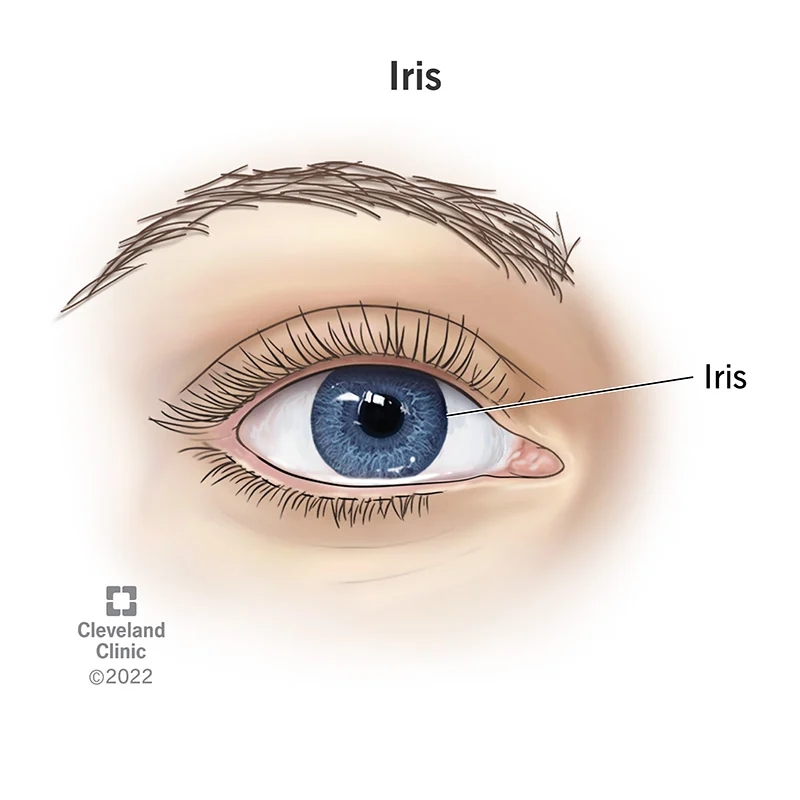
From Cleveland Clinic. (Link)

And here’s what else the Cleveland Clinic says about irises.

The color of your iris is like your fingerprint. It’s unique to you, and nobody else in the world has the exact same colored eye.

From https://my.clevelandclinic.org/health/body/22502-iris

John Daugman and irises

But why use irises rather than, say, fingerprints and faces? The best person to answer this is John Daugman. (At this point several of you are intoning, “John Daugman.” With reason. He’s the inventor of iris recognition.)

Here’s an excerpt from John Daugman’s 2004 paper on iris recognition:

(I)ris patterns become interesting as an alternative approach to reliable visual recognition of persons when imaging can be done at distances of less than a meter, and especially when there is a need to search very large databases without incurring any false matches despite a huge number of possibilities. Although small (11 mm) and sometimes problematic to image, the iris has the great mathematical advantage that its pattern variability among different persons is enormous.

Daugman, John, “How Iris Recognition Works.” IEEE TRANSACTIONS ON CIRCUITS AND SYSTEMS FOR VIDEO TECHNOLOGY, VOL. 14, NO. 1, JANUARY 2004. Quoted from page 21. (PDF)

Or in non-scientific speak, one benefit of iris recognition is that you know it is accurate, even when submitting a pair of irises in a one-to-many search against a huge database. How huge? We’ll discuss later.

Brandon Mayfield and fingerprints

Remember that Daugman’s paper was released roughly two months before Brandon Mayfield was misidentified in a fingerprint comparison. (Everyone now intone “Brandon Mayfield.”)

If you want to know the details of that episode, the Department of Justice Office of the Inspector General issued a 330 page report (PDF) on it. If you don’t have time to read 330 pages, here’s Al Jazeera’s shorter version of Brandon Mayfield’s story.

While some of the issues associated with Mayfield’s misidentification had nothing to do with forensic science (Al Jazeera spends some time discussing bias, and Itiel Dror also looked at bias post-Mayfield), this still shows that fingerprints are remarkably similar and that it takes care to properly identify people.

Police agencies, witnesses, and faces

And of course there are recent examples of facial misidentifications (both by police agencies and witnesses), again not necessarily forensic science related, and again showing the similarity of faces from two different people.

Iris “data richness” and independent testing

Why are irises more accurate than fingerprints and faces? Here’s what one vendor, Iris ID, claims about irises vs. other modalities:

At the root of iris recognition’s accuracy is the data-richness of the iris itself. The IrisAccess system captures over 240 degrees of freedom or unique characteristics in formulating its algorithmic template. Fingerprints, facial recognition and hand geometry have far less detailed input in template construction.

Iris ID, “How It Compares.” (Link)

Enough about claims. What about real results? The IREX 10 test, independently administered by the U.S. National Institute of Standards and Technology, measures the identification (one-to-many) accuracy of submitted algorithms. At the time I am writing this, the ten most accurate algorithms provide false negative identification rates (FNIR) between 0.0022 ± 0.0004 and 0.0037 ± 0.0005 when two eyes are used. (Single eye accuracy is lower.) By the time you see this, the top ten algorithms may have changed, because the vendors are always improving.

IREX10 two-eye accuracy, top ten algorithms as of July 28, 2023. (Link)

While the IREX10 one-to-many tests are conducted against databases of less than a million records, it is estimated that iris one-to-many accuracy remains high even with databases of a billion people—something we will return to later in this post.

Iris drawbacks

OK, so if irises are so accurate, why aren’t we dumping our fingerprint readers and face readers and just using irises?

In short, because of the high friction in capturing irises. You can use high-resolution cameras to capture fingerprints and faces from far away, but as of now iris capture usually requires you to get very close to the capture device.
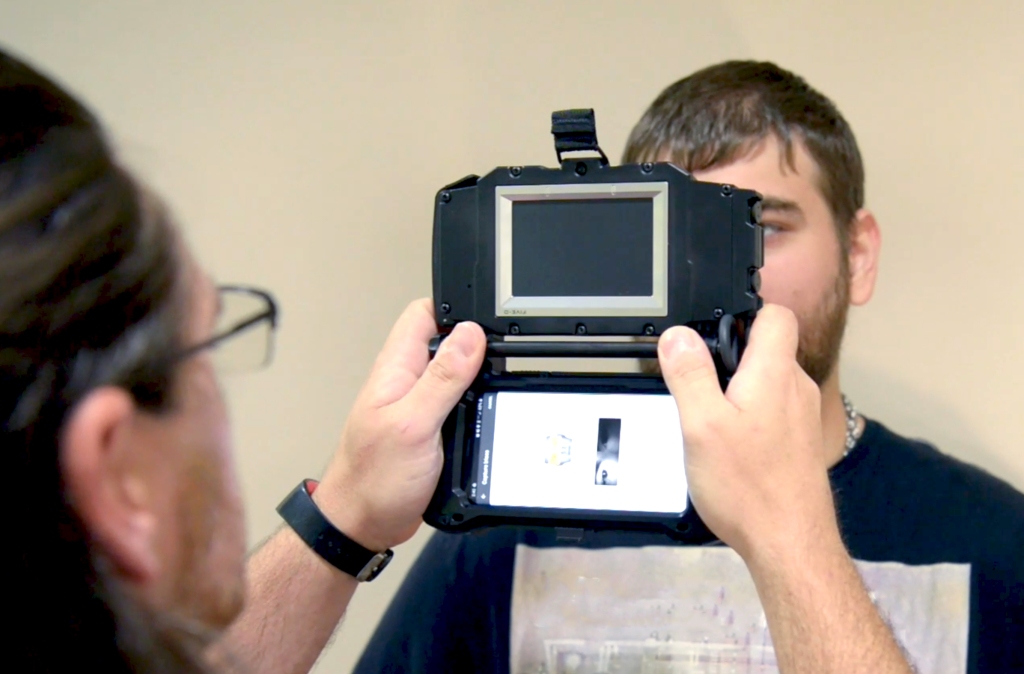
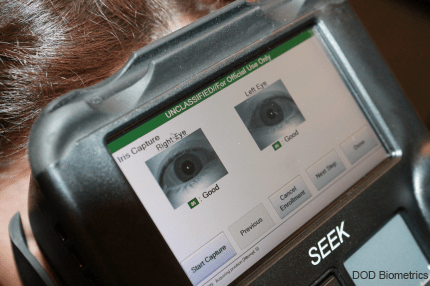
Iris image capture circa 2020 from the U.S. Federal Bureau of Investigation. (Link)

Which I guess is better than the old days when you had to put your eye right up against the capture device, but it’s still not as friendly (or intrusive) as face capture, which can be achieved as you’re walking down a passageway in an airport or sports stadium.

Irises and Apple Vision Pro

So how are irises being used today? You may or may not have hard last month’s hoopla about the Apple Vision Pro, which uses irises for one-to-one authetication.
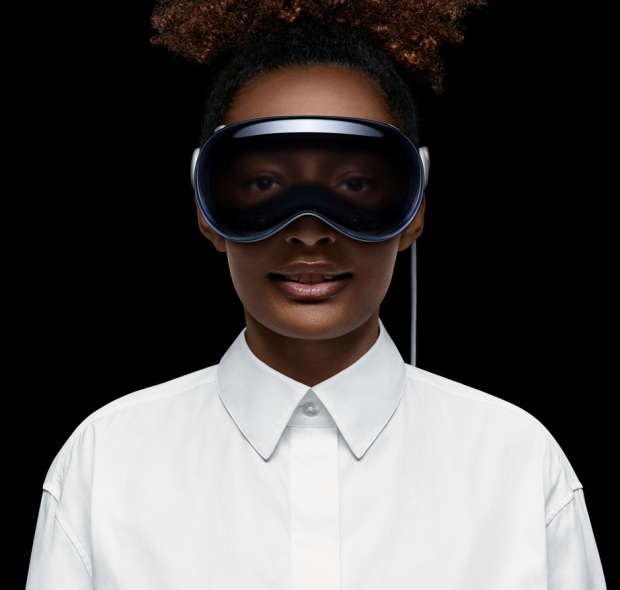
I’m not going to spend a ton of time delving into this, because I just discussed Apple Vision Pro in June. In fact, I’m just going to quote from what I already said.

And when all of us heard about Vision Pro, one of the things that Apple shared about it was its verification technique. Not Touch ID or Face ID, but Optic ID. (I like naming consistency.)

From https://bredemarket.com/2023/06/12/vision-pro-not-revolutionary-biometrics-event/
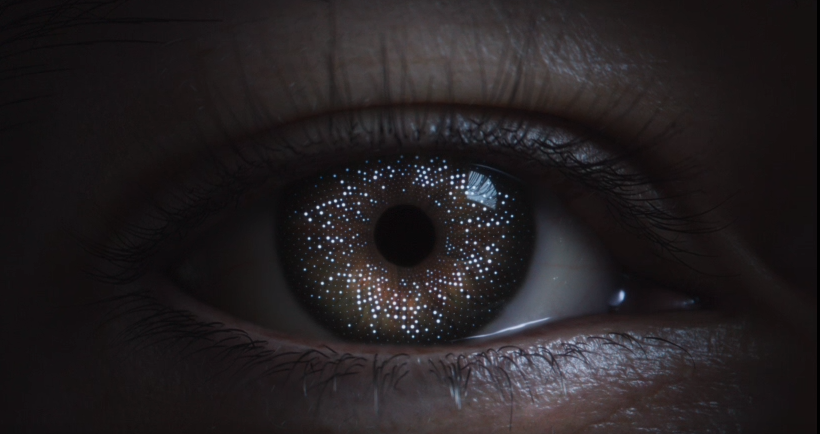
From Apple, https://www.apple.com/105/media/us/apple-vision-pro/2023/7e268c13-eb22-493d-a860-f0637bacb569/anim/drawer-privacy-optic-id/large.mp4

In short, as you wear the headset (which by definition is right on your head, not far away), the headset captures your iris images and uses them to authenticate you.

It’s a one-to-one comparison, not the one-to-many comparison that I discussed earlier in this post, but it is used to uniquely identify an individual.

But iris recognition doesn’t have to be used for identification.

Irises and Worldcoin

“But wait a minute, John,” you’re saying. “If you’re not using irises to determine if a person is who they say they are, then why would anyone use irises?”

Enter Worldcoin, which I mentioned in passing in my early July age estimation post.

Over the past several years, I’ve analyzed a variety of identity firms. Earlier this year I took a look at Worldcoin….Worldcoin’s World ID emphasizes privacy so much that it does not conclusively prove a person’s identity (it only proves a person’s uniqueness)…

From https://bredemarket.com/2023/07/03/age-estimation/

That’s the only thing that I’ve said about Worldcoin, at least publicly. (I looked at Worldcoin privately earlier in 2023, but that report is not publicly accessible and even I don’t have it any more.)

Worldcoin’s July 24 announcement

I guess it’s time for me to revisit Worldcoin, since the company made a super-big splashy announcement on Monday, July 24.

The Worldcoin Foundation today announced that Worldcoin, a project co-founded by Sam Altman, Alex Blania and Max Novendstern, is now live and in a production-grade state. 

The launch includes the release of the World ID SDK and plans to scale Orb operations to 35+ cities across 20+ countries around the world. In tandem, the Foundation’s subsidiary, World Assets Ltd., minted and released the Worldcoin token (WLD) to the millions of eligible people who participated in the beta; WLD is now transactable on the blockchain….

“In the age of AI, the need for proof of personhood is no longer a topic of serious debate; instead, the critical question is whether or not the proof of personhood solutions we have can be  privacy-first, decentralized and maximally inclusive,” said Worldcoin co-founder and Tools for Humanity CEO Alex Blania. “Through its unique technology, Worldcoin aims to provide anyone in the world, regardless of background, geography or income, access to the growing digital and global economy in a privacy preserving and decentralized way.”

From https://worldcoin.org/blog/announcements/worldcoin-project-launches

Worldcoin does NOT positively identify people…but it can still pay you

A very important note: Worldcoin’s purpose is not to determine identity (that a person is who they say they are). Worldcoin’s purpose is to determine uniqueness: namely, that a person (whoever they are) is unique among all the billions of people in the world. Once uniqueness is determined, the person can get money money money with an assurance that the same person won’t get money twice.
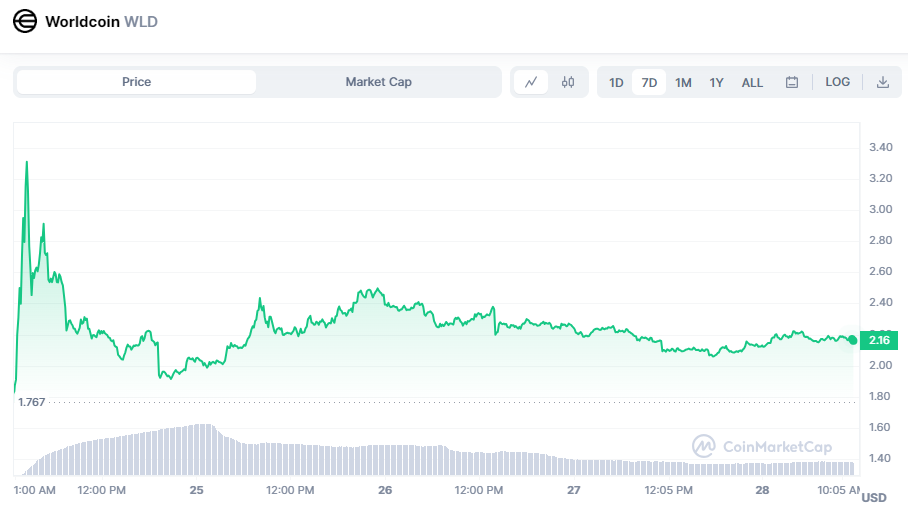
OK, so how are you going to determine the uniqueness of a person among all of the billions of people in the world?

Using the Orb to capture irises

As far as Worldcoin is concerned, irises are the best way to determine uniqueness, echoing what others have said.

Iris biometrics outperform other biometric modalities and already achieved false match rates beyond 1.2× ⁣10−141.2×10⁻¹⁴ (one false match in one trillion[9]) two decades ago[10]—even without recent advancements in AI. This is several orders of magnitude more accurate than the current state of the art in face recognition.

From https://worldcoin.org/blog/engineering/humanness-in-the-age-of-ai

So how is Worldcoin going to capture millions, and eventually billions, of iris pairs?

By using the Orb. (You may intone “the Orb” now.)

To complete your Worldcoin registration, you need to find an Orb that will capture your irises and verify your uniqueness.

Now you probably won’t find an Orb at your nearby 7 Eleven; as I write this, there are only a little over 100 listed locations in the entire world where Orbs are deployed. I happen to live within 50 miles of Santa Monica, where an Orb was recently deployed (by appointment only, unavailable on weekends, and you know how I feel about driving on Southern California freeways on a weekday).

But now that you can get crypto for enrolling at an Orb, people are getting more excited about the process, and there will be wider adoption.

Whether this will make a difference in the world or just be a fad remains to be seen.

Fill Your Company Gap With A Biometric Content Marketing Expert

Companies often have a lot of things they want to do, but don’t have the people to do them. It takes a long time to hire someone, and it even takes time to find a consultant that knows your industry and can do the work.

This affects identity/biometric companies just like it affects other companies. When an identity/biometric company needs a specific type of expertise and needs it NOW, it’s often hard to find the person they need.

If your company needs a biometric content marketing expert (or an identity content marketing expert) NOW, you’ve come to the right place—Bredemarket. Bredemarket has no identity learning curve, no content learning curve, and offers proven results.

Identity/biometric consulting in the 1990s

I remember when I first started working as an identity/biometric consultant, long before Bredemarket was a thing.

OK, not quite THAT long ago. I started working in biometrics in the 1990s—NOT the 1940s.

In 1994, the proposals department at Printrak International needed additional writers due to the manager’s maternity leave, and she was so valuable that Printrak needed to bring in TWO consultants to take her place.

At least initially, the other consultant and I couldn’t fill the manager’s shoes.

Designed by Freepik.
  • Both of us could write.
  • Both of us could spell “AFIS.”
  • Both of us could spell “RAID.” Not the bug spray, but the storage mechanism that stored all those “huge” fingerprint images.
  • But on that first night that I was cranking out proposal letters for something called a “Latent Station 2000,” I didn’t really know WHAT I was writing about.

As time went on, the other consultant and I learned much more—so much that the company brought both of us on as full-time employees.

After we were hired full-time, we spent a combined 45+ years at Printrak and its corporate successors in proposals, marketing, and product management positions, contributing to industry knowledge.

Which shows that learning how to spell “AFIS” can have long-term benefits.

Printrak’s problem

When Printrak needed biometric proposal writing experts quickly, it found two people who filled the bill. Sort of.

But neither of us knew biometrics before we started consuting at Printrak.

And I had never written a proposal before I started consulting at Printrak. (I had written an RFP. Sort of.)

But frankly, there weren’t a lot of identity/biometric consultants out in the field in the 1990s. There were the 20th century equivalents of Applied Forensic Services LLC, but at the time I don’t think there were any 20th century equivalents of Tandem Technical Writing LLC.

The 21st century solution

Unlike the 1990s, identity/biometric firms that need consulting help have many options. In addition to Applied Forensic Services and Tandem Technical Writing you have…me.

Mike and Laurel can tell you what they can do, and I heartily endorse both of them.

Let me share with you why I call myself a biometric content marketing expert who can help your identity/biometric company get marketing content out now:

  • No identity learning curve
  • No content learning curve
  • Proven results

No identity learning curve

I have worked with finger, face, iris, DNA, and other biometrics, as well as government-issued identity documents and geolocation. If you are interested, you can read my Bredemarket blog posts that mention the following topics:

No content learning curve

Because I’ve produced both external and internal content on identity/biometric topics, I offer the experience to produce your content in a number of formats.

  • External content: account-based marketing content, articles, blog posts (I am the identity/biometric blog expert), case studies, data sheets, partner comarketing content, presentations, proposals, sales literature sheets, scientific book chapters, smartphone application content (events), social media posts, web page content, and white papers.
  • Internal content: battlecards, competitive analyses, demonstration scripts (events), email internal newsletters, FAQs, multi-year plans, playbooks, project plans, proposal templates, quality improvement documents, requirements documents, strategic analyses, and website/social media analyses.

Proven results

Read about them here.

So how can you take advantage of my identity/biometric expertise?

If you need day-one help for an identity/biometric content marketing or proposal writing project, consider Bredemarket.

Why Apple Vision Pro Is a Technological Biometric Advance, but Not a Revolutionary Biometric Event

(Part of the biometric product marketing expert series)

(UPDATE JUNE 24: CORRECTED THE YEAR THAT COVID BEGAN.)

I haven’t said anything publicly about Apple Vision Pro, so it’s time for me to be “how do you do fellow kids” trendy and jump on the bandwagon.

Actually…

It ISN’T time for me to jump on the Apple Vision Pro bandwagon, because while Apple Vision Pro affects the biometric industry, it’s not a REVOLUTIONARY biometric event.

The four revolutionary biometric events in the 21st century

How do I define a “revolutionary biometric event”?

By Alberto Korda – Museo Che Guevara, Havana Cuba, Public Domain, https://commons.wikimedia.org/w/index.php?curid=6816940

I define it as something that completely transforms the biometric industry.

When I mention three of the four revolutionary biometric events in the 21st century, you will understand what I mean.

  • 9/11. After 9/11, orders of biometric devices skyrocketed, and biometrics were incorporated into identity documents such as passports and driver’s licenses. Who knows, maybe someday we’ll actually implement REAL ID in the United States. The latest extension of the REAL ID enforcement date moved it out to May 7, 2025. (Subject to change, of course.)
  • The Boston Marathon bombings, April 2013. After the bombings, the FBI was challenged in managing and analyzing countless hours of video evidence. Companies such as IDEMIA National Security Solutions, MorphoTrak, Motorola, Paravision, Rank One Computing, and many others have tirelessly worked to address this challenge, while ensuring that facial recognition results accurately identify perpetrators while protecting the privacy of others in the video feeds.
  • COVID-19, spring 2020 and beyond. COVID accelerated changes that were already taking place in the biometric industry. COVID prioritized mobile, remote, and contactless interactions and forced businesses to address issues that were not as critical previously, such as liveness detection.

These three are cataclysmic world events that had a profound impact on biometrics. The fourth one, which occurred after the Boston Marathon bombings but before COVID, was…an introduction of a product feature.

  • Touch ID, September 2013. When Apple introduced the iPhone 5s, it also introduced a new way to log in to the device. Rather than entering a passcode, iPhone 5S users could just use their finger to log in. The technical accomplishment was dwarfed by the legitimacy that this brought to using fingerprints for identification. Before 2013, attempts to implement fingerprint verification for benefits recipients were resisted because fingerprinting was something that criminals did. After September 2013, fingerprinting was something that the cool Apple kids did. The biometric industry changed overnight.

Of course, Apple followed Touch ID with Face ID, with adherents of the competing biometric modalities sparring over which was better. But Face ID wouldn’t have been accepted as widely if Touch ID hadn’t paved the way.

So why hasn’t iris verification taken off?

Iris verification has been around for decades (I remember Iridian before L-1; it’s now part of IDEMIA), but iris verification is nowhere near as popular in the general population as finger and face verification. There are two reasons for this:

  • Compared to other biometrics, irises are hard to capture. To capture a fingerprint, you can lay your finger on a capture device, or “slap” your four fingers on a capture device, or even “wave” your fingers across a capture device. Faces are even easier to capture; while older face capture systems required you to stand close to the camera, modern face devices can capture your face as you are walking by the camera, or even if you are some distance from the camera.
  • Compared to other biometrics, irises are expensive to capture. Many years ago, my then-employer developed a technological marvel, an iris capture device that could accurately capture irises for people of any height. Unfortunately, the technological marvel cost thousands upon thousands of dollars, and no customers were going to use it when they could acquire fingerprint and face capture devices that were much less costly.

So while people rushed to implement finger and face capture on phones and other devices, iris capture was reserved for narrow verticals that required iris accuracy.

With one exception. Samsung incorporated Princeton Identity technology into its Samsung Galaxy S8 in 2017. But the iris security was breached by a “dummy eye” just a month later, in the same way that gummy fingers and face masks have defeated other biometric technologies. (This is why liveness detection is so important.) While Samsung continues to sell iris verification today, it hadn’t been adopted by Apple and therefore wasn’t cool.

Until now.

About the Apple Vision Pro and Optic ID

The Apple Vision Pro is not the first headset that was ever created, but the iPhone wasn’t the first smartphone either. And coming late to the game doesn’t matter. Apple’s visibility among trendsetters ensures that when Apple releases something, people take notice.

And when all of us heard about Vision Pro, one of the things that Apple shared about it was its verification technique. Not Touch ID or Face ID, but Optic ID. (I like naming consistency.)

According to Apple, Optic ID works by analyzing a user’s iris through LED light exposure and then comparing it with an enrolled Optic ID stored on the device’s Secure Enclave….Optic ID will be used for everything from unlocking Vision Pro to using Apple Pay in your own headspace.

From The Verge, https://www.theverge.com/2023/6/5/23750147/apple-optic-id-vision-pro-iris-biometrics

So why did Apple incorporate Optic ID on this device and not the others?

There are multiple reasons, but one key reason is that the Vision Pro retails for US$3,499, which makes it easier for Apple to justify the cost of the iris components.

But the high price of the Vision Pro comes at…a price

However, that high price is also the reason why the Vision Pro is not going to revolutionize the biometric industry. CNET admitted that the Vision Pro is a niche item:

At $3,499, Apple’s Vision Pro costs more than three weeks worth of pay for the average American, according to Bureau of Labor Statistics data. It’s also significantly more expensive than rival devices like the upcoming $500 Meta Quest 3, $550 Sony PlayStation VR 2 and even the $1,000 Meta Quest Pro

From CNET, https://www.cnet.com/tech/computing/why-apple-vision-pros-3500-price-makes-more-sense-than-you-think/

Now CNET did go on to say the following:

With Vision Pro, Apple is trying to establish what it believes will be the next major evolution of the personal computer. That’s a bigger goal than selling millions of units on launch day, and a shift like that doesn’t happen overnight, no matter what the price is. The version of Vision Pro that Apple launches next year likely isn’t the one that most people will buy.

From CNET, https://www.cnet.com/tech/computing/why-apple-vision-pros-3500-price-makes-more-sense-than-you-think/

Certainly Vision Pro and Optic ID have the potential to revolutionize the computing industry…in the long term. And as that happens, the use of iris biometrics will become more popular with the general public…in the long term.

But not today. You’ll have to wait a little longer for the next biometric revolution. And hopefully it won’t be a catastrophic event like three of the previous revolutions.

How Can Your Identity Business Create the RIGHT Written Content?

Does your identity business provide biometric or non-biometric products and services that use finger, face, iris, DNA, voice, government documents, geolocation, or other factors or modalities?

Does your identity business need written content, such as blog posts (from the identity/biometric blog expert), case studies, data sheets, proposal text, social media posts, or white papers?

How can your identity business (with the help of an identity content marketing expert) create the right written content?

For the answer, click here.

The (possible) Afghan data treasure trove doesn’t just threaten the Taliban’s enemies

Recent events in Afghanistan have resulted in discussions among information technology and security professionals.

Taliban fighters in Kabul, Afghanistan, 17 August 2021. By VOA – https://www.youtube.com/watch?v=nAg7egiXClU, Public Domain, https://commons.wikimedia.org/w/index.php?curid=109043891

One August 17 article from the Intercept hit close to home for me:

THE TALIBAN HAVE seized U.S. military biometrics devices that could aid in the identification of Afghans who assisted coalition forces, current and former military officials have told The Intercept.

This post talks about the data the Taliban could POTENTIALLY get from captured biometric devices and other sources, and how that data could conceivably pose a threat to the Taliban’s enemies AND the Taliban itself.

What data could the Taliban get from biometric devices?

The specific device referenced by the Intercept article was HIIDE…and let’s just say that while I don’t know as much about that device as I should, I do know a little bit about it. (It was manufactured by a company that was subsequently acquired by Safran.)

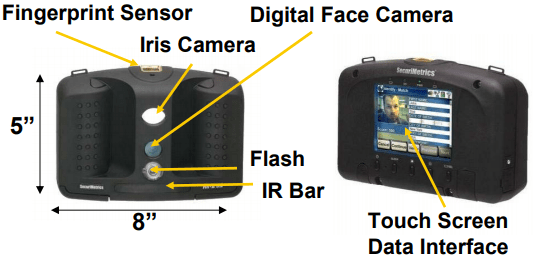
Another source implies that the Taliban may have acquired another device that the Intercept DIDN’T reference. The Taliban may not only have acquired live HIIDE devices, but also may have acquired devices from another company called SEEK.

(Yes, folks, these devices are called HIIDE and SEEK.)

At the time that this was revealed, I posted the following comment on LinkedIn:

Possession is not enough. Can the Taliban actually access the data? And how much data is on the devices themselves?

Someone interviewed by the Intercept speculated that even if the Taliban did not have the technological capability to hack the devices, it could turn to Pakistan’s Inter-Service Intelligence to do so. As we’ve learned over the years, Pakistan and the Taliban (and the Taliban’s allies such as al Qaeda) are NOT bitter enemies.

As I said, I don’t know enough about HIIDE and SEEK, so I’m not sure about some key things.

  • For example, I don’t know whether their on-board biometric data is limited to just biometric features (rather than images). While there’s the possibility that the devices stored biometric images, that has a drawback because of the large size of the images. Features derived from the images (which are necessary in matching anyway) take up much less storage space. And while biometric images are necessary in some cases (such as forensic latent fingerprint examination), there’s no need for images in devices that make a hit/no-hit decision without human intervention.
  • In addition, I don’t know what textual data is linked to the features (or images) on these devices. Obviously the more textual information that is available, such as a name, the more useful the data can be.
  • Also, the features stored on the devices may or may not be useful. There is no one standard for the specification of biometric features (each vendor has its own proprietary feature specification), and while it may be possible to convert fingerprint features from one vendor system to be used by another vendor’s system, I don’t know if this is possible for face and iris features.

Best-case scenario? Even if the Taliban or its friends can access the data on the devices, the data does not provide enough information for it to be used.

Worst-case scenario? The data DOES provide enough information so that EVERY PERSON whose data is stored on the device can be identified by a Taliban-equivalent device, which would presumably be called FIND (Find Infidels, Neutralize, Destroy).

I’ll return to that “every person” point later in this post.

But biometric data isn’t the only data that might have fallen into the Taliban’s hands.

What data could the Taliban get from non-biometric devices?

Now Politico has come out with its own article that asserts that the Taliban can potentially acquire a lot of other data. And Politico is not as pessimistic as the Intercept about the Taliban’s tech capabilities:

That gives today’s technologically adept Taliban tools to target Afghans who worked with the U.S. or the deposed Afghan government with unprecedented precision, increasing the danger for those who don’t get out on evacuation flights.

Before looking at the data the Taliban may have acquired, it’s useful to divide the data sources between data acquired from clients and data acquired from on-premise servers. HIIDE and SEEK, for example, are clients. (I’m only talking about on-premise servers because any data stored in a US government cloud can hopefully be secured so that the Taliban can’t get it. Hopefully.)

Unlike HIIDE and SEEK, which are mobile client devices, the Politico article focuses on data that is stored on on-premise Afghan government servers. It notes that American IT officials were more likely than Afghan IT officials to scrub their systems before the Taliban takeover, and one would hope that any data stored in US government cloud systems could also be secured before the Taliban could access it.

So what types of data would the Afghan government servers store?

Telecom companies store reams of records on who Afghan users have called and where they’ve been. Government databases include records of foreign-funded projects and associated personnel records.

More specifics are provided regarding telecom company data:

Take call logs. Telecommunications companies keep a record of nearly every phone call placed and to whom. U.S. State Department officials used the local cell networks to make calls to those who were working with the United States, including interpreters, drivers, cooks and more…

And mobile phone data is even more revealing:

Cell phones and mobile apps share data about users with third-party apps, such as location data, that the Taliban could easily get…

The geolocation issue has been known for years. Remember the brouhaha when military users of a particular fitness app effectively revealed the locations of secret U.S. military facilities?

Helmand province in Afghanistan. Photograph: Strava heatmap. Reproduced at https://www.theguardian.com/world/2018/jan/28/fitness-tracking-app-gives-away-location-of-secret-us-army-bases

In locations like Afghanistan, Djibouti and Syria, the users of Strava seem to be almost exclusively foreign military personnel, meaning that bases stand out brightly. In Helmand province, Afghanistan, for instance, the locations of forward operating bases can be clearly seen, glowing white against the black map.

Now perhaps enemy forces already knew about these locations, but it doesn’t help to broadcast them to everyone.

Back to Afghanistan and other data sources.

Afghan citizens’ ethnicity information can also be found in databases supporting the national ID system and voter registration.

This can be used by digital identity opponents to argue that digital identity, or any identity, is dangerous. I won’t dive into that issue right now.

Politico mentions other sources of data that the Taliban could conceivably access, including registration information (including identity documents) for non-governmental organization workers, tax records, and military commendation records.

So if you add up all of the data from all of the Afghan servers, and if the Taliban or its allies are able to achieve some level of technical expertise, then the data provides enough information so that EVERY PERSON whose data is stored on the servers can be identified by the Taliban.

Before we completely panic…

Of course it takes some effort to actually EMPLOY all of this data. In the ideal world, the Taliban would create a supercomputer system that aggregates the data and creates personal profiles that provide complete pictures of every person. But the world is not ideal, even in technologically advanced countries: remember that even after 9/11, it took years for the U.S. Departments of Justice, Homeland Security, and Defense to get their biometric systems to talk to each other.

Oh, and there’s one more thing.

Remember how I’ve mentioned a couple of times that the Taliban could conceivably get information on EVERY PERSON whose data is stored on these devices and servers?

One thing that’s been left unsaid by all of these commentaries is that this data trove not only reveals information about the enemies of the Taliban, but also reveals information about the Taliban itself.

  • The HIIDE and SEEK devices could include biometric templates of Taliban members (who would be considered “enemies” by these devices and may have been placed on “deny lists”).
  • The telecommunications records could reveal calls placed and received by Taliban members, including calls to Afghan government officials and NATO members that other Taliban members didn’t know about.
  • Mobile phone records could reveal the geolocations of Taliban members at any time, including locations that they didn’t want their fellow Taliban members to know about.
  • In general, the records could reveal Taliban members, including high-ranking Taliban members, who were secretly cooperating with the Taliban’s enemies.

With the knowledge that all of this data is now available, how many Taliban members will assist in decrypting this data? And how many will actively block this?

Oh, and even if all of the Taliban were completely loyal, any entity (such as the Pakistani Inter-Service Intelligence) that gets a hold of the data will NOT restrict its own data acquisition efforts to American, NATO, and former Afghan government intelligence. No, it will acquire information on the Taliban itself.

After all, this information could help the Pakistanis (or Chinese, or Russians, or whoever) put the, um, finger on Taliban members, should it prove useful to do so in the future.

Then again, Pakistan may want to ensure that its own digital data treasure trove is safe.