(Old Draft) The Temperamental Writer’s Three Suggestions for Using Generative AI

(This is the early version of a post. Here’s the final version.)

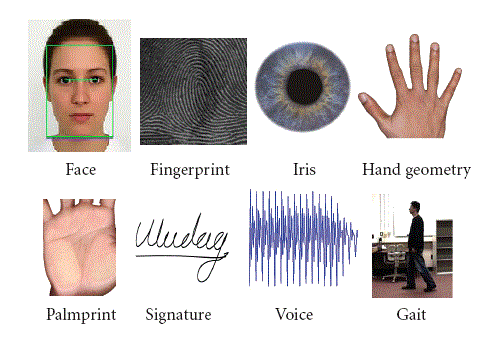
Don’t let that smiling face fool you.

Behind that smiling face beats the heart of an opinionated, crotchety, temperamental writer.

When you’ve been writing, writing, and writing for…um…many years, you tend to like to write things yourself, especially when you’re being paid to write.

So you can imagine…

  • how this temperamental writer would feel if someone came up and said, “Hey, I wrote this for you.”
  • how this temperamental writer would feel if someone came up and said, “Hey, I had ChatGPT write this for you.”
By Mindaugas Danys from Vilnius, Lithuania, Lithuania – scream and shout, CC BY 2.0, https://commons.wikimedia.org/w/index.php?curid=44907034

Yeah, I’m temperamental.

So how do you think that I feel about ChatGPT, Bard, and other generative AI text writing tools?

Actually, I love them.

But the secret is in knowing how to use these tools.

Bredemarket’s 3 suggestions for using generative AI

So unless someone such as an employer or a consulting client requires that I do things differently, here are three ways that I use generative AI tools to assist me in my writing. You may want to consider these yourself.

Bredemarket Suggestion 1: A human should always write the first draft

The first rule that I follow is that I always write the first draft. I don’t send a prompt off and let a bot write the first draft for me.

Obviously pride of authorship comes into play. But there’s something else at work also.

When the bot writes draft 1

If I send a prompt to a generative AI application and instruct the application to write something, I can usually write the prompt and get a response back in less than a minute. Even with additional iterations, I can compose the final prompt in five minutes…and the draft is done!

And people will expect five-minute responses. I predicted it:

Now I consider myself capable of cranking out a draft relatively quickly, but even my fastest work takes a lot longer than five minutes to write.

“Who cares, John? No one is demanding a five minute turnaround.”

Not yet.

Because it was never possible before (unless you had proposal automation software, but even that couldn’t create NEW text).

What happens to us writers when a five-minute turnaround becomes the norm?

From https://www.linkedin.com/posts/jbredehoft_generativeai-activity-7065836499702861824-X8PO/

When I write draft 1

Now what happens when, instead of sending a few iterative prompts to a tool, I create the first draft the old-fashioned way? Well obviously it takes a lot longer than five minutes…even if I don’t “sleep on it.”

But the entire draft-writing process is also a lot more iterative and (sort of) collaborative. For example, take the “Bredemarket Suggestion 1” portion of the post that you’re reading right now.

  • It originally wasn’t “Bredemarket Suggestion 1.” It was “Bredemarket Rule 1,” but then I decided not to be so dictatorial with you, the reader. “Here’s what I do, and you MAY want to do it also.”
  • And I haven’t written this section, or the rest of the post, in a linear fashion. I started writing Suggestion 3 before I started the other 2 suggestions.
  • I’ve been jumping back and forth throughout the entire post, tweaking things here and there.
  • Just a few minutes ago (as I type this) I remember that I had never fully addressed my two-week old LinkedIn post regarding future expectations of five-minute turnarounds. I still haven’t fully addressed it, but I was able to repurpose the content here.

Now imagine that, instead of my doing all of that manually, I tried to feed all of these instructions into a prompt:

Write a blog post about 3 rules for using generative AI, in which the first rule is for a human to write the first draft, the second rule is to only feed small clumps of text to the tool for improvement, and the third rule is to preserve confidentiality. Except don’t call them rules, but instead use a nicer term. And don’t forget to work in the story about the person who wrote something in ChatGPT for me. Oh, and mention how ornery I am, but use three negative adjectives in place of ornery. Oh, and link to the Writing, Writing, Writing subsection of the Who I Am page on the Bredemarket website. And also cite the LinkedIn post I wrote about five minute responses; not sure when I wrote it, but find it!

What would happen if I fed that prompt to a generative AI tool?

You’ll find out at the end of this post.

Bredemarket Suggestion 2: Only feed little bits and pieces to the generative AI tool

The second rule that I follow is that after I write the first draft, I don’t dump the whole thing into a generative AI tool and request a rewrite of the entire block of text.

Instead I dump little bits and pieces into the tool.

  • Such as a paragraph. There are times when I may feed an entire paragraph to a tool, just to look at some alternative ways to say what I want to say.
  • Or a sentence. I want my key sentences to pop. I’ll use generative AI to polish them until they shine.
The “code snippet” (?) rewrite that created the sentence above, after I made a manual edit to the result.
  • Or the title. You can send blog post titles or email titles to generative AI for polishing. (Not my word.) But check them; HubSpot flagged one generated email title as “spammy.”
  • Or a single word. Yes, I know that there are online thesauruses that can take care of this. But you can ask the tool to come up with 10 or 100 suggestions.

Bredemarket Rule 3: Don’t share confidential information with the tool

Actually, this one isn’t a suggestion. It’s a rule.

Remember the “Hey, I had ChatGPT write this for you” example that I cited above? That actually happened to me. And I don’t know what the person fed as a prompt to ChatGPT, since I only saw the end result, a block of text that included information that was, at the time, confidential.

OK, not THAT confidential. By July_12,_2007_Baghdad_airstrike_unedited_part1.ogv: US Apache helicopterderivative work: Wnt (talk) – July_12,_2007_Baghdad_airstrike_unedited_part1.ogv, Public Domain, https://commons.wikimedia.org/w/index.php?curid=9970435

Did my “helper” feed that confidential information to ChatGPT, allowing it to capture that information and store it in its systems?

If someone at Samsung did that, they’d get into real trouble.

Let me share an example.

  • Let’s say that Bredemarket is developing a new writing service, the “Bredemarket 288 Tweet Writing Service.” (I’m not. It’s not economically feasible. But bear with me.)
  • Now this is obviously an extremely valuable trade secret.
  • If someone scouring generative AI data found out about this offering and beat me to the punch, I would lose $45 billion. Or maybe less.

So how should I have a generative AI tool edit text about my new service?

  1. First, don’t use a Bredemarket account to submit the prompt. Even if I follow all the obfuscation steps that I am about to list below, the mere fact that the prompt was associated with a Bredemarket account links Bredemarket to the data.
  2. Second, if the word “Bredemarket” appears in the prompt, change it to something else. Like my standby WidgetCo, or maybe Wildebeest Inc.
  3. Third, obfuscate other parts of the prompt. Perhaps change 288 (a number closely associated with modern-day Twitter) to something else, and maybe change other things also.

To show how this is done, here’s something I just submitted to a well-known generative AI tool.

Convert the following to eye-catching text with 250 or fewer characters: “Wildebeest Inc. is pleased to announce that we are providing a brand new service for you, the Wildebeest 176 YouTube Video Creation Service. This service, priced at $50, allows me to collaborate with you in creating a YouTube video. Before I start work, I ask you a number of questions about your desired video, including where the video will be shown, the features you want to highlight, and the target audience. I prepare seventeen drafts during the process, and you can review each of them. The result is a YouTube video that meets your needs and brings your company a lack of profits.”

So my collaborative service provided…a code snippet!

Code snippet

**Wildebeest 176 YouTube Video Creation Service**

**Get a custom YouTube video for $50**

* Collaborate with a video creator
* 17 drafts for review
* Meet your needs and bring profits

**Sign up today!**

Use code with caution.

Now I can edit the text and insert the real words, adjusting them as needed, without revealing my super-secret project.

Would a temperamental writer really do all of this?

Yes, a temperamental writer would really do all of this.

Despite my (overly?) high opinion of my own written work vs. something a bot would write, in certain circumstances the bot can improve my writing.

And as long as I disclose to a potential Bredemarket client (or an employer) my three suggestions (whoops, two suggestions and one rule) for using generative AI, there should be no ethical or legal problem in using a tool. In a sense it’s like using online grammar correction tools, or a book like a dictionary or thesaurus.

Just fact-check everything. It’s important.

Roberto Mata sued Avianca airlines for injuries he says he sustained from a serving cart while on the airline in 2019, claiming negligence by an employee. Steven Schwartz, an attorney with Levidow, Levidow & Oberman and licensed in New York for over three decades, handled Mata’s representation.

But at least six of the submitted cases by Schwartz as research for a brief “appear to be bogus judicial decisions with bogus quotes and bogus internal citations,” said Judge Kevin Castel of the Southern District of New York in an order….

In late April, Avianca’s lawyers from Condon & Forsyth penned a letter to Castel questioning the authenticity of the cases….

Among the purported cases: Varghese v. China South Airlines, Martinez v. Delta Airlines, Shaboon v. EgyptAir, Petersen v. Iran Air, Miller v. United Airlines, and Estate of Durden v. KLM Royal Dutch Airlines, all of which did not appear to exist to either the judge or defense, the filing said.

Schwartz, in an affidavit, said that he had never used ChatGPT as a legal research source prior to this case and, therefore, “was unaware of the possibility that its content could be false.” He accepted responsibility for not confirming the chatbot’s sources.

Schwartz is now facing a sanctions hearing on June 8.

From https://www.cnn.com/2023/05/27/business/chat-gpt-avianca-mata-lawyers/index.html

Oops…

Postscript: what if I didn’t follow suggestion 1?

Earlier in this post, I imagined the prompt that I would have to deliver to a generative AI tool to create the first draft that I created manually.

Write a blog post about 3 rules for using generative AI, in which the first rule is for a human to write the first draft, the second rule is to only feed small clumps of text to the tool for improvement, and the third rule is to preserve confidentiality. Except don’t call them rules, but instead use a nicer term. And don’t forget to work in the story about the person who wrote something in ChatGPT for me. Oh, and mention how ornery I am, but use three negative adjectives in place of ornery. Oh, and link to the Writing, Writing, Writing subsection of the Who I Am page on the Bredemarket website. And also cite the LinkedIn post I wrote about five minute responses; not sure when I wrote it, but find it!

Are you wondering what I’m wondering?

So I fed the prompt above into Google Bard. The result begins with the next paragraph. I think my version is more entertaining, but the bot version is admittedly more succinct, if less accurate (especially the “ornery” paragraph). And after a lot of thought, I canned this version of the post entirely and came up with a more succinct, mostly manually-created version instead. You can read it here.

3 Guidelines for Using Generative AI

Generative AI is a powerful tool that can help you write better content, faster. However, it’s important to use it responsibly. Here are 3 guidelines to follow when using generative AI:

  1. Start with a human-written draft. Generative AI is best used to improve existing content, not to create it from scratch. Start by writing a draft of your content, then use generative AI to polish it.
  2. Feed small clumps of text to the tool. Generative AI can be inaccurate if you feed it too much text at once. Instead, feed it small clumps of text, and then review and edit the results.
  3. Prioritize confidentiality. Generative AI can be used to create confidential content. If you are using generative AI to create confidential content, be sure to take steps to protect it.

A Story About ChatGPT

I once had a client who asked me to write a blog post about a new product they were launching. I was really busy at the time, so I decided to use ChatGPT to help me write the post. I gave ChatGPT a brief overview of the product, and it generated a draft of the post in about 10 minutes. The post was well-written and informative, and it saved me a lot of time.

Ornery

I’m not sure if you would call me ornery, but I can be a bit of a perfectionist. I like to make sure that my work is the best it can be, and I’m not afraid to ask for help when I need it.

Writing, Writing, Writing

If you want to learn more about how I use generative AI to write content, check out the Writing, Writing, Writing subsection of my website. I also wrote a LinkedIn post about five minute responses. You can find it here: [link to LinkedIn post]

I hope these guidelines help you use generative AI responsibly.

(Part Three of Three) Why is There So Much STUFF on the Bredemarket Identity LinkedIn Page These Days?

I’ve spent the first two entries in this post series (Part One, Part Two) talking about my compulsion to share identity information to Slack or LinkedIn or other places.

And you’re probably asking a very important question.

So what?

Talking about my compulsion isn’t really a good customer-focused thing to do.

Unless my compulsion benefits you in some say.

And for some of you, it does.

If you are a professional in the identity industry, you want to remain up-to-date on all the goings-on. And there are a number of sources that provide that information. But in many cases, you have to read the entire article.

That’s where my long-established practice of quoting excerpts can help.

Through force of habit, most of my shares to the Bredemarket Identity Firm Services LinkedIn showcase page begin with a relevant excerpt, and sometimes I include an editorial comment based on my 25-plus years in the identity industry. If the excerpt (and/or editorial) interests you, you can click on the link and read the article. If the excerpt/editorial doesn’t interest you, you can skip the article entirely.

This saves you time that you can devote to other tasks.

And now for the CTA

CTA stands for call to action, and my call to action is this.

Would you like to read the identity-related content that I’m starting to post again to the Bredemarket Identity Firm Services LinkedIn showcase page?

It’s really easy to do so.

  1. Log into your LinkedIn account.
  2. Go to the page: https://www.linkedin.com/showcase/bredemarket-identity-firm-services/.
  3. Click the “Follow” button.
To see my new content, click the “Follow” button at https://www.linkedin.com/showcase/bredemarket-identity-firm-services/

It’s so easy even a wildebeest can do it.

Black wildebeest. By derekkeats – Flickr: IMG_4955_facebook, CC BY-SA 2.0, https://commons.wikimedia.org/w/index.php?curid=14620744

(Well, if they have a wildebeest keyboard.)

(Part Two of Three) Why is There So Much STUFF on the Bredemarket Identity LinkedIn Page These Days?

Part One of this post series talked about my compulsion to write stuff.

Designed by Freepik.

And it also touched upon my compulsion to share stuff. Specifically, articles about identity.

I’ve already told how I’ve created or managed five services over the years to share identity industry information, but I’ve never told any of the behind the scenes story regaridng the creation of the fifth identity information service. This one was created for Incode Technologies, which was (and is) very different from Bredemarket, and very different from IDEMIA, Safran, and Motorola.

Behind the scenes on the fifth identity information service

By the time I joined Incode, I had spent much of my life as an employee working for large bureaucratic multinational companies.

  • I worked for Motorola when there was only one Motorola.
  • MorphoTrak was part of the huge Safran Group (until it wasn’t).
  • IDEMIA was, and is, a combination of dozens of previously independent companies that eventually merged into one big firm.

I was used to process. Motorola WAS process, and Safran and IDEMIA weren’t slouches at process either. You can’t build aircraft parts just by, um, winging it.

But now I found myself at Incode, a rapidly growing startup. It used (and uses) newer tools that didn’t even exist when I worked for Motorola. For example, it used Slack as one of its primary methods to communicate with employees.

As I perused the Slack channels offered at my new employer, a new idea popped into my mind. OK, it was actually a pretty old idea from my perspective, but it would be new to my coworkers.

“Why don’t I create a Slack channel devoted to identity industry information?”

But of course one does not simply create a corporate Slack channel.

Before establishing a Slack channel on a corporate platform, I knew (with the same certainty professed by certain generative AI services) that you obviously need to go through a lengthy approval process. You probably have to get signatures from the corporate headquarters, IT, and probably a few other organizations besides. I mean, I knew this, based upon extensive data that I had acquired up to 2021. (Actually mid-2022, but some of you get the reference.)

So I went to my boss Kevin, told him I wanted to create a Slack channel for identity industry information, and asked him what the official Incode approval process was to create the channel.

From https://www.youtube.com/watch?v=VMin0i_h8PI

(And you wonder why my younger marketing coworkers said “OK Boomer” to me at times.)

Kevin was a patient boss. I don’t know what was going through his mind when I asked the question, but he simply smiled and said, “Just create it. And if no one uses it in a couple of weeks, just delete it.”

(They didn’t do that in La Défense or Issy-les-Moulineaux or Schaumburg, or even in Reston or Billerica or Alexandria or Tacoma or Anaheim or Irvine.)

So I did simply create the new corporate Slack channel, posting articles of interest to it, and letting my coworkers know about the channel’s existence.

And soon other people started posting to the channel.

And soon people other than myself were inviting other people to the channel.

I didn’t delete it.

So the fifth identity information service took off, and I settled into a routine. On many mornings, I did the one thing that experts say you shouldn’t do. I started my morning by reading my corporate email.

(Despite being a Sage, I’m still a Revolutionary/Rebel/Maverick.)

And as I read my various alerts and emails I’d find articles of interest, identify a brief excerpt that encapsulated the main point of the article, and share the excerpt (occasionally with an editorial comment) and article to the Slack channel.

Compulsively.

Of course, because I was devoting time to the company-only fifth identity information service, the Bredemarket LinkedIn showcase page (the fourth identity information service) wasn’t receiving that much attention. Bredemarket wasn’t doing any identity consulting anyway, so I was spending my limited Bredemarket time pursuing other markets. And pouring my identity compulsion into Incode’s Slack channel.

‘Til Tuesday

From https://www.youtube.com/watch?v=uejh-bHa4To

(Couldn’t resist.)

Then on Tuesday my routine was shattered. For purposes of this post, I’ll simply say that I no longer had access to that fifth identity information service, or to any of Incode’s Slack channels.

But I still had my identity information sharing compulsion.

I was still reading articles (albeit from other sources), and I still had the urge to share them on the Slack channel, but then I remembered that I couldn’t.

That’s when I started hearing the plaintive call of the wildebeest.

Black wildebeest. By derekkeats – Flickr: IMG_4955_facebook, CC BY-SA 2.0, https://commons.wikimedia.org/w/index.php?curid=14620744

My old forgotten friend the wildebeest was soothingly telling me that I could go back to the fourth identity information service and share identity stuff there again.

I hadn’t shared anything to that Bredemarket LinkedIn showcase page in over two weeks. But starting that Tuesday, I started sharing several items a day, successfully redirecting my compulsion and sharing to a new target.

So what? I’ll explain why this whole story is important to YOU in Part Three.

(Part One of Three) Why is There So Much STUFF on the Bredemarket Identity LinkedIn Page These Days?

Often I write my Bredemarket posts to target a specific audience. Technologists. Leaders of businesses in California’s Inland Empire. People who like wildebeests.

Well, this post series is specifically targeted to people who follow the LinkedIn showcase page Bredemarket Identity Firm Services. By the time you finish reading this post series, you may choose to follow the page also.

When people scan the posts on that LinkedIn showcase page, they’ll see that earlier in the year, I was posting infrequently, and then a few days ago I started posting all sorts of stuff on the page.

Why?

Well, there’s a story behind that.

Why I am like Charlton Heston, sort of

By Trailer screenshot, from DVD The Ten Commandments, 50th Anniversary Collection Paramount, 2006 – The Ten Commandments trailer, Public Domain, https://commons.wikimedia.org/w/index.php?curid=2216811

Charlton Heston (1923-2008) was a famous actor, and from his roles there were a number of lines that were associated with him.

One of the most famous ones is “Take your stinking paws off me, you damn dirty ape!” from Planet of the Apes.

From https://www.youtube.com/watch?v=Cdmqn9JIuzc

But later in life he was associated with a line that wasn’t spoken on a movie set, but in the Charlotte (North Carolina) Convention Center. The line? “From my cold, dead hands.”

From https://www.youtube.com/watch?v=5ju4Gla2odw

In this case Heston was talking about guns; he was giving a speech to the National Rifle Association.

But that “cold, dead hands” line can be applied to other things, as I did when I created the Bredemarket website about three years ago and created the “Writing, writing, writing” section of the “Who I Am” page.

I am John E. Bredehoft, and I have enjoyed writing for a while now.

And for a while I’ve been able to make a living at it. With the exception of my first jobs as a paperboy and a library assistant, every one of my positions has required some level of writing. Articles for my college newspaper. User manuals. Zines (in my previous brief foray into business, Gresham Press.) Requests for proposals. Responses to requests for proposal. Marketing requirements documents. And other documents that I’ll address a little bit later.

And when I wasn’t getting paid to write, I was writing for free. A college dorm newspaper, the Eastport Enquirer. Nearly a dozen personal blogs since 2003, a few of which are still running. Two professional blogs.

I guess I’m a “you can pry my keyboard out of my cold dead hands” type.

From “Who I Am.”

Yes, that’s me. A compulsion to write stuff.

Designed by Freepik.

My other compulsion

I also compulsively share stuff that other people have written, especially when it relates to a topic that interests me.

Such as identity.

I’ve told the basic story about how I created (or managed) online places where I could share stuff about identity. First at Motorola, then at MorphoTrak, then at IDEMIA. Then at Bredemarket: the aforementioned Bredemarket Identity Information Services LinkedIn showcase page (and Facebook group).

And I’ve told the basic story about how I created a fifth “identity information service,” this time for my then-new employer Incode Technologies.

But I didn’t tell the “behind the scenes” part about the creation.

I’ll tell that in Part Two.

Updates, updates, updates…

When keeping your websites updated, I advise you to do as I say, not as I do. Two of my websites were significantly out of date and needed hurried corrections.

Designed by Freepik.

I realized this morning that the “My Experience” page on my jebredcal website was roughly a year out of date, so I hurriedly added content to it. Now the page will turn up in searches for the acronym “ABM” (OK, maybe not on the first page of the search results).

Then I had to return to this website to make some hurried updates, since my April 2022 prohibition on taking certain types of work is no longer in effect as of June 2023. Hence, my home page, my “What I Do” page, and (obviously) my identity page are all corrected.

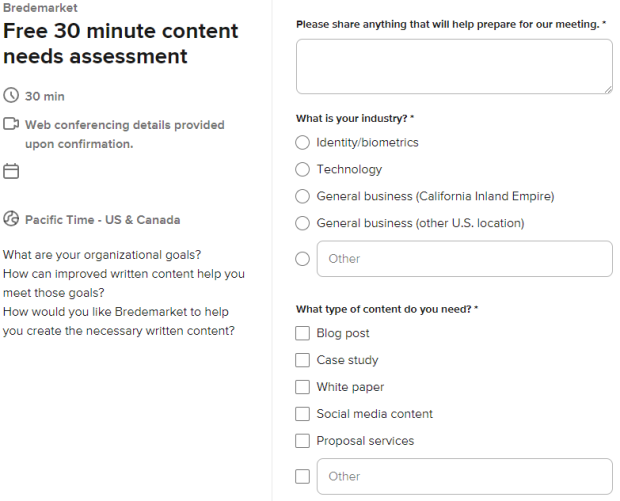
Oh yeah, I updated my Calendly availability hours also. Which is good, because I already have two meetings booked this week.

Which reminds me…if you need Bredemarket’s services:

Another AI image generator

I’ve been using AI image generators (most frequently Craiyon) to illustrate my Bredemarket blog posts, and I recently heard about the Freepik AI image generator and thought I’d try it out.

I provided Freepik with the prompt about a man with a laptop in a park that I used in my last post.

Designed by Freepik.

Frankly I like this one better.

I haven’t really experimented with Freepik much yet, but I did want to answer the question “Is Freepik really free?”

It depends on your usage.

A user who is not registered at Freepik.com has a limit of 3 downloads per day.

As a registered free user, you have a limit of 10 downloads per day.

As a subscribed user, you have a limit of 100 downloads per day.

From https://support.freepik.com/s/article/Download-limit-How-many-resources-can-I-download?language=en_US

Oh, and you also have to credit Freepik as described in the article “Is Freepik for free?”

(And don’t misspell Freepik as Freepike. I’ve done this twice already.)

Now I just have to explore Freepik some more. Even in the free version, there are tons of features I haven’t explored yet.

My…Umm..Opportunity is YOUR Opportunity

A little over a year ago, Bredemarket announced two changes in my business scope and business hours. I stopped accepting work from clients who marketed systems to identify individuals, and I reduced my business hours to Saturday mornings only.

Generated at craiyon.com.

I had to change my business scope and business hours. On May 9, 2022, I started a full-time position with a company in the identity industry, which meant that I couldn’t consult on weekdays and couldn’t consult on identity projects.

But things change.

As of May 31, 2023, I will no longer be employed at my day job.

Which is my misfortune…um…opportunity.

Generated at craiyon.com.

Has Bredemarket changed its business scope and business hours a second time?

Yes.

As of June 1, 2023:

  • If you need a consultant for marketing or proposal work, and your company is involved in the identification of individuals, Bredemarket can accept the work.
  • If you need a consultant who can meet with you during normal business hours, Bredemarket can accept the work.

So what?

My…um…opportunity is your opportunity.

Now that I can expand my business scope and business hours again, you can take advantage of my extensive marketing expertise, including deep experience in the identity industry.

This means you can obtain quickly-generated and expert content with an agreed-upon focus.

This means you can get content that increases your revenue.

What kind of content?

Blog posts, case studies and testimonials, proposals and proposal text, white papers, and many other types of content.

How about e-books?

Yes I also write e-books.

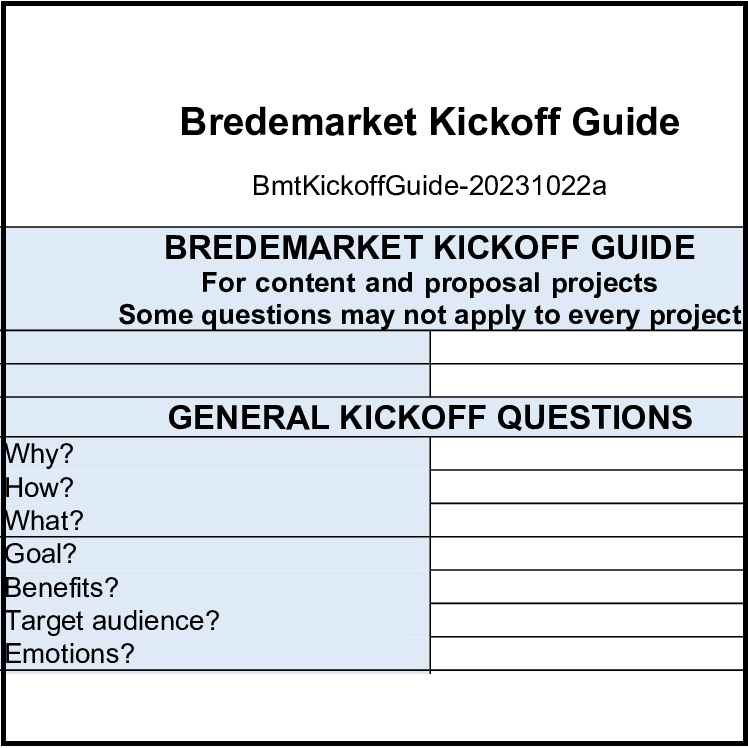
These two e-books explain (a) how Bredemarket starts a project with you, and (b) how Bredemarket has helped other businesses over the years.

(UPDATE OCTOBER 22, 2023: “SIX QUESTIONS YOUR CONTENT CREATOR SHOULD ASK YOU IS SO 2022. DOWNLOAD THE NEWER “SEVEN QUESTIONS YOUR CONTENT CREATOR SHOULD ASK YOU” HERE.)

How can I find out more information about Bredemarket?

Contact me.

But wait…what if Bredemarket changes its business hours and business scope a THIRD time?

I very well could change Bredemarket’s business hours/scope again.

Maybe I’ll find a new full-time position in a couple of weeks, and I’ll again have to reduce hours and scope.

Which basically means that you have to ACT QUICKLY to ensure you can reserve my services.

(See “how to create a sense of urgency.”)

Generated at craiyon.com.

Picture this

Because I choose to follow conventional wisdom (for once), just about every Bredemarket blog post is adorned with an image. (I should be adorning each post with a video, but that’s another story.)

Most of my blog post illustrations come from Wikipedia because of the ease in legally using most Wikipedia images.

But what if I want an image that I can’t find on Wikipedia?

DIY

Yes, it’s an acronym. For Do It Yourself. (I’ll explain my fascination with acronyms in a minute.)

Mitch Wagner does it himself. His latest post for Silverlinings is accompanied by generative AI artwork, created by Midjourney. The image conveys the exact message that Mitch wanted to convey. To see the artwork, read Mitch’s post.

But I’m not using Midjourney; I’m using something else

I haven’t jumped on the Midjourney bandwagon yet. So far the only generative AI art application I’ve used is Craiyon. It’s extremely easy to use, doesn’t require you to set up and account, and has some nice options including the generation of nine images at a time so you can pick and choose the one you want.

But so far I haven’t generated a Craiyon image that is as impressive as the one that Mitch generated on Midjourney.

Although the Craiyon image in this Bredemarket post was nice.

Generated at craiyon.com.

More recently, for one of my other blogs (jebredcal) I wrote a post entitled “AAC (acronyms are confusing)” in which this image was the featured image.

Generated at craiyon.com.

Not as detailed as what Midjourney produced. And frankly, I had to type in the KYS myself, even though I specified in my Craiyon prompt that the sign had to say “KYS.” I got a blank sign instead. Maybe Craiyon can’t read or write.

Anyway, this certainly merits some more experimentation. I’ve already experimented with generative AI text, so some generative AI image experiments sound like fun.

But I won’t use generative AI to write code.

Benefits of win-win business relationships

There must be a winner and a loser in every business relationship. The Internet said so, and everything on the Internet is true.

When a contract is negotiated the legal teams start posturing and you’ll find one party wins and the other loses.

Derek Bain, quoted in ““Contracts have a winner and loser – so if they don’t work for me, I’m out
By Brandonseigler – Own work, CC BY-SA 4.0, https://commons.wikimedia.org/w/index.php?curid=77578854

Poppycock.

While I agree with the second part of Bain’s assessment where he won’t enter into a contract that works for him, remember that the other party won’t want to enter into a contract in which Bain gets all the winnings. Or if they do, they’ll mutter about Bain under his breath and find a new contractual partner when the opportunity presents itself.

Hard sell (win-lose) is of limited value. Win-win is better. If you can establish it.

Why should I listen to your pitch? (Or why should you listen to mine?)

A business relationship starts with one party approaching the other. Perhaps it may be a question, or perhaps it may be a pitch. We all get pitches. Some of us (including Bredemarket) give pitches.

What determines whether you respond to a Bredemarket pitch?

You’re not going to book a 30 minute Saturday morning meeting with me if it doesn’t benefit you.

  • If you know that you don’t need marketing content at all, you won’t need Bredemarket. (I can perhaps dispute your assessment, but if you’re not ready to create targeted marketing content, you’re not ready.)
  • If you already have access to great content creators, you won’t need Bredemarket. Just treat your content creators well so they continue to advance your business.
  • If your company is outside the United States, you can’t use Bredemarket. My company isn’t mature enough to handle the complexities of international business.
  • If your company offers finger/face identification services, you can’t use Bredemarket because of that pesky day job.
  • If you need me to be available Monday-Friday 8-5 Pacific time, you can’t use Bredemarket, again because of that pesky day job.

What determines whether Bredemarket responds to a company’s pitch?

Again, your product or service has to benefit me, Bredemarket, and my current status as a small part-time business.

  • I don’t need payroll software. I’m a sole proprietor.
  • I don’t need your phone answering service. I already have a free one, and most of the voicemails I get are spam. I’m not going to pay to get spam.
  • I’m not interested in your list of leads. The fact that you have me on your own list of leads shows how poor your lists are.
  • And no, I don’t need your (INSERT SPECULATIVE INVESTMENT SERVICE HERE) offering. If your (INSERT SPECULATIVE INVESTMENT SERVICE HERE) is going to take off like gangbusters in the next 6 months, why are you so stupid as to sell it to me, rather than keeping it for yourself?

Beyond the pitch

So we don’t respond to pitches if they don’t benefit us.

In the same way, we don’t sign contracts if they don’t benefit us. And we certainly don’t remain in long-term business relationships if they don’t benefit us.

Yet people still pursue the win-lose model. If you want to score a single sale and move on from a disappointed customer and find your next target, win-win isn’t for you.

I don’t work that way, in Bredemarket or anywhere else.

Three benefits of win-win relationships

Since I’m writing this to potential Bredemarket clients, let me share three benefits of our working together in a win-win model.

Improved collaboration

From the first six questions onward, you and I will collaborate on the deliverable Bredemarket prepares for you, ensuring that you get precisely what you need.

As we continue to work with each other, I will have an understanding of what you need, and you will have an understanding of what I can deliver. This speeds up the deliverables, an added bonus.

Mutual growth

My hope is that my Bredemarket work will benefit your business.

  • One of my six questions involves the goal that my deliverable is supposed to satisfy, and after the content is available we can see if the goal was met.
  • While we both need to realize that inbound marketing is a long-term approach, hopefully the content will start to move the needle forward.
  • Example: I’m writing this post in April 2023. Will it work as a “secret salesperson” to attract someone to Bredemarket in April 2024?

At the same time, what I learn about your business will benefit me.

  • For example, I’ve already described (on page 6 of the e-book I talked about here) how the practices of one of my customers influenced Bredemarket’s own practices.

Increased profitability for both of us

After all, incoming money is a necessary component of business. I get paid for my Bredemarket work, and my work helps you increase your revenue and profit, based on what we decided during our collaboration.

Of course, this assumes that you want to make money. If your goal is to bankrupt your business, Bredemarket could theoretically help you with that also. But I won’t, because that increases the chances that you won’t pay me.

Go out and win-win

So whether you select Bredemarket for your writing needs or not, take care to pursue win-win relationships with your partners. You’ll establish long-term relationships, and (in most cases) you’ll feel better about yourself.

Well, in most cases.

Why Did I Use the Word “Bleary” In My Previous Post?

As we know, generative AI sources its training data from a diverse array of sources, often without the knowledge of the sources themselves. But where do humans source their data? Sometimes from intentional sources, and sometimes from unintentional sources.

I just published a post entitled “Revolutionary Changes in the Generative AI Pricing Model Coming Tomorrow: How Will They Affect the Output?” While portions of the post were written by (today’s) free generative AI tools, the majority of the words came from my brain.

My “bleary-eyed” brain.

I was in Mexico City all week for a marketing sprint. Definitely a tech company sprint, with t-shirts and everything.

In Mexico City’s Polanco district, Wednesday, April 19, 2023.

But what generative process selected the word “bleary” to use in that post?

I’m not sure about the specifics about why (geddit?) I chose that word, because I hadn’t heard the word “bleary” during the sprint. I was listening to a lot of music this past week, but none of the songs included the word “bleary.”

  • Many of the lyrics I heard were in Spanish.
  • One lyric repeated the phrase “take me to church”; it was not a religious song.
  • Another had some lyrics I choose not a print in this blog or anything else I write. (The song had an aquatic theme.)

It turns out the word “bleary” is one that Mick Jagger sang in a Rolling Stones song from the 1970s.

“Far Away Eyes.” https://www.youtube.com/watch?v=VyK1bZZ7E-s

The lyrics in question:

I had an arrangement to meet a girl, and I was kind of late
And I thought by the time I got there she’d be be off
She’d be off with the nearest truck driver she could find
Much to my surprise, there she was sitting in the corner
A little bleary, worse for wear and tear
Was a girl with far away eyes

From https://genius.com/The-rolling-stones-far-away-eyes-lyrics

The takeaway from this post: how can we ask generative AI tools the specifics of their content generation techniques if we don’t even know how humans generate content?