Bredemarket is NOT Candy Street Market

In late 2022 I wrote a Bredemarket blog post entitled “Candy Street Market is coming.” It covered a business on Holt Boulevard in Ontario, California.

I referred to this post a couple of other times, making clear that Bredemarket was NOT Candy Street Market.

Well, at least I thought I did.

Until Bredemarket recently received an email from a janitorial company that included the following:

Hello Candy Street Market,

We’ll be around your area this week.

Happy to drop by and give you a simple cleaning quote should you need it. Does that work?

I didn’t respond.

If the janitorial company stops by Candy Street Market anyway, they’re in for a rude surprise.

Candy Street Market closed a long time ago.

CHECK YOUR MAILING LISTS.

Injection Attack Detection, CEN/TS 18099:2025, and iProov

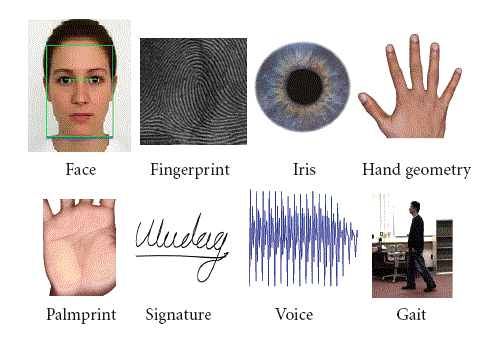
Most identity and biometric marketing leaders know that their products should detect attacks, including injection attacks. But do the products detect attacks? And do prospects know that the products detect attacks? (iProov prospects know. Or should know.)

I’ve mentioned injection attack detection a couple of times on the Bredemarket blog, noting its difference from presentation attack detection. While the latter affects what is shown to the biometric reader, the former bypasses the biometric reader entirely.

But I haven’t mentioned how vendors can secure independent confirmation of their injection attack defenses.

European Committee for Standardization (CEN)

Here’s part of what ID Tech Wire said a year ago.

“A new European technical standard, CEN/TS 18099:2025, has been published to address the growing concern of biometric data injection attacks. The standard provides a framework for evaluating the effectiveness of identity verification (IDV) vendors in detecting and mitigating these attacks, filling a critical gap left by existing regulations.”

Being a baseball hot dogs apple pie guy, I had never heard of CEN. Now I have.

“CEN, the European Committee for Standardization, is an association that brings together the National Standardization Bodies of 34 European countries.

“CEN provides a platform for the development of European Standards and other technical documents in relation to various kinds of products, materials, services and processes.”

And before you say that them furriner Europeans couldn’t possibly understand the nuances of good ol’ Murican injection attacks, look at all the countries that follow biometric interchange guidance from the American National Standards Institute (ANSI) and the National Institute of Standards and Technology (NIST).

So CEN is good.

But let’s get to THIS standard.

More on CEN/TS 18099:2025

The Biometric Data Injection Attack Detection standard can be found at multiple locations, including the aforementioned ANSI. From the current 2025 version:

“This document provides an overview of: 

– Definitions of biometric data injection attacks; 

– Use cases for injection attacks with biometric data on essential hardware components of biometric systems used for enrollment and verification; 

– Tools for injection attacks on systems using one or more biometric modalities. 

This document provides guidance for: 

– Injection Attack Instrument Detection System (defined in 3.12); 

– adequate risk mitigation for injection attack tools; 

– Creation of a test plan for the evaluation of an injection attack detection system (defined in 3.9).”

Like (most) good standards, you have to buy it. Current Murican price is $99.

You can see how this parallels the existing standard for presentation attack detection testing.

Which brings us to iProov…and Ingenium

iProov is a company in the United Kingdom. This post does not address whether the United Kingdom is part of Europe; I assigned that thankless task to Bredebot. But iProov does pay attention to European stands, according to this statement:

“[iProov] announced that its Dynamic Liveness technology is the first and only solution to successfully achieve an Ingenium Level 4 evaluation and the CEN/TS 18099 High technical specification for Injection Attack Detection, following an independent evaluation by the ISO/IEC 17025-accredited, Ingenium Biometric Laboratories. Ingenium Level 4 builds on the requirements outlined in CEN/TS 18099, providing an increased level of assurance with an extended period of active testing and inclusion of complex, highly-weighted attack types.”

Ingenium’s injection attack detection testing is arranged in five levels/tiers. The first two correspond to the “substantial” and “high” evaluation levels in CEN/TS 18099:2025. The final three levels exceed the standard.

Level 4:

“Level 4: A 40-day FTE evaluation that further exceeds the CEN TS 18099:2025 standard. Level 4 maintains a high attack weighting while specifically targeting the IAI detection capabilities of your system. Although not a formal PAD (Presentation Attack Detection) assessment, this level offers valuable insights into your system’s PAD subsystem resilience.”

Because while they are technically different, injection attack detection and presentation attack detection are intertwined. 

Does your product detect attacks?

And if you adopt a customer focus, the customer doesn’t really care about the TYPE of attack. The customer ONLY cares about the attack itself, and whether or not the vendor detected and prevented it.

Identity/biometric marketing leaders, does your product offer independent confirmation of its attack detection capabilities? If not, do you publicize your own self-assertion of detection?

Because if you DON’T explicitly address attack detection, your prospects are forced to assume that you can’t detect attacks at all. And your prospects will avoid you as dangerous and gravitate to vendors who DO assert attack detection in some way.

And you will lose money.

Regardless of whether you are in the United States, United Kingdom, or the European continent…losing money is not good.

So don’t lose money. Tell your prospects about your attack detection. Or have Bredemarket help you tell them. Talk to me.

Biometric product marketing expert. This is NOT in the United Kingdom.

Postscript: Non iProov injection attack detection here.

Navigating the Shifting Shores: Why Your Marketing Strategy Needs a Geopolitical GPS

(John’s note: minor edits because Google Gemini hallucinated. Bredebot never went to college, and neither Bredebot nor I had a “Professor Thompson.” And I, not Bredebot, is working on a future post.)

“Britain is an island.” That’s what John’s college professor drilled into him. A seemingly obvious statement, yet it set the stage for a lifetime of understanding that geography, history, and identity are never as simple as they first appear. Decades later, as a tech marketer specializing in identity and biometrics, I find myself thinking about another, more nuanced statement: “The United Kingdom is part of Europe.”

Now, before you reach for your Brexit bingo cards, let’s be clear: this isn’t a political debate. This is about marketing strategy in a world that’s constantly redrawing its lines – both literally and figuratively. For us CMOs in the tech space, especially those of us dealing with something as sensitive and regulated as identity and biometrics, understanding these shifting perspectives is absolutely crucial.

The “Island” Mentality: Pros and Cons

First, let’s unpack the “Britain is an island” idea from a marketing perspective. This often translates into a simplified view of market segmentation. It’s easy to look at a national border and say, “Okay, that’s one market, with its own unique characteristics.”

The Pros:

  • Clearer Targeting (Initially): An “island” approach can make initial market entry seem straightforward. You focus on national regulations, local cultural nuances, and specific industry bodies within those defined borders. For a new biometric solution, this might mean tailoring your messaging to the UK’s specific data protection laws or the country’s unique adoption rates for certain technologies.
  • Localized Messaging: It allows for highly focused campaigns. If you’re selling a FinTech biometric solution, you can speak directly to the concerns of UK financial institutions, their compliance officers, and their customer base. This can lead to more impactful, relevant communication.
  • Reduced Complexity (Perceived): On the surface, it feels less overwhelming. You’re not immediately juggling dozens of different regulatory frameworks or cultural sensitivities across an entire continent. It’s like having one very focused wildebeest as your marketing consultant, telling you exactly how to herd the local w… I mean, customers.

The Cons:

  • Missed Opportunities: The biggest pitfall. By seeing markets as isolated islands, you miss the currents connecting them. Innovation doesn’t respect borders, and neither do customer expectations. A great biometric user experience in Germany will likely influence expectations in the UK, regardless of their political relationship.
  • Scalability Headaches: If your product has global potential, an “island” strategy quickly becomes a game of whack-a-mole. You’re constantly re-inventing the wheel for each new market, rather than building scalable frameworks. This can be incredibly inefficient for product development, marketing assets, and sales enablement.
  • Tunnel Vision: You risk becoming insular, failing to see broader trends, competitive threats, or emerging technologies that might be gaining traction elsewhere but haven’t “landed” on your island yet.

“Part of Europe”: Embracing Interconnectedness

Now, let’s consider the second statement: “The United Kingdom is part of Europe.” This isn’t just about geography; it’s about acknowledging a shared history, economic ties, cultural exchange, and, crucially for us, a deeply intertwined regulatory and technical landscape.

The Pros:

  • Holistic Market Understanding: This perspective encourages you to see the bigger picture. Even with Brexit, the UK and Europe share a massive amount of technical infrastructure, business practices, and, perhaps most importantly, consumer expectations around privacy and security. You understand that a customer in London isn’t entirely disconnected from a customer in Berlin.
  • Strategic Standardization: For identity and biometrics, this is massive. European standards often set global benchmarks. By understanding and anticipating these, even if the UK creates its own versions, you can build products and marketing strategies that are inherently more robust and future-proof. It allows you to leverage common themes in privacy (like GDPR’s global influence) and security protocols.
  • Scalable Frameworks: Thinking continentally (or even globally) from the outset allows you to build marketing campaigns, product features, and compliance strategies that are designed for wider adoption. You develop core messaging that can be localized, rather than starting from scratch every time.
  • Anticipating Trends: You’re better positioned to spot emerging trends. What’s happening with digital identity wallets in the EU? How are different European nations approaching facial recognition in public spaces? These insights are vital, as they often foreshadow discussions and developments in the UK.

The Cons:

  • Increased Complexity (Initially): Acknowledging interconnectedness means dealing with a more complex landscape of regulations, cultural nuances, and competitive dynamics. It requires more upfront research and a more sophisticated marketing intelligence function.
  • Messaging Challenges: Crafting a message that resonates across diverse European markets while still feeling authentic in the UK can be a delicate balancing act. It requires skilled localization teams and a deep understanding of regional sensitivities.
  • Resource Intensive: Building a genuinely pan-European or globally aware marketing strategy demands more resources – more budget for research, more diverse teams, and more sophisticated tech stacks for campaign management and personalization.

Finding Your True North

So, where does this leave us, the CMOs steering tech companies through these waters? It leaves us with a mandate to be strategic cartographers. We can’t afford to be just “island” thinkers anymore. The digital world is far too interconnected.

For identity and biometrics, the “part of Europe” mentality offers a significant strategic advantage. It compels us to think about shared standards, interoperability, and universal customer needs. Even as the UK forges its own path, its technological and societal evolution remains deeply influenced by its continental neighbors.

This is why I’m particularly interested in how European biometric standards are influencing, or will influence, the UK. It’s not just about compliance; it’s about market expectations, product development, and ultimately, our ability to connect with customers on a global scale. In fact, that’s precisely what John is diving into for his own blog post – the applicability of European biometric standards in the UK. Stay tuned, because understanding these connections is how we truly future-proof our marketing strategies.

The Gettysburg Address: Why This Brief Call to Action Worked

(Explaining why the event was important. Using less than 300 words that could be delivered in less than two hours. Including a call of action to remember. We did.)

Fourscore and seven years ago our fathers brought forth on this continent, a new nation, conceived in Liberty, and dedicated to the proposition that all men are created equal.

Now we are engaged in a great civil war, testing whether that nation, or any nation so conceived and so dedicated, can long endure. We are met on a great battle-field of that war. We have come to dedicate a portion of that field, as a final resting place for those who here gave their lives that that nation might live. It is altogether fitting and proper that we should do this.

But, in a larger sense, we can not dedicate-we can not consecrate-we can not hallow-this ground. The brave men, living and dead, who struggled here, have consecrated it, far above our poor power to add or detract. The world will little note, nor long remember what we say here, but it can never forget what they did here. It is for us the living, rather, to be dedicated here to the unfinished work which they who fought here have thus far so nobly advanced. It is rather for us to be here dedicated to the great task remaining before us-that from these honored dead we take increased devotion to that cause for which they gave the last full measure of devotion-that we here highly resolve that these dead shall not have died in vain-that this nation, under God, shall have a new birth of freedom-and that government of the people, by the people, for the people shall not perish from the earth.

The Orb At The Gap

I missed this January story. Apparently World installed an iris-reading Orb inside a San Francisco Gap store…for better visibility.

“At Gap, we believe in originality, authenticity — what makes us human,” the plaque reads. “That’s why we’re partnering with World, to bridge the gap between humans and technology.”

However, it seems to be a visibility stunt. Gap doesn’t care whether its clothing is purchased by humans, and it would be delighted to sell individuals multiple pairs of jeans, even if they had previously purchased a pair.

Identity/Biometric Marketing Leaders: In Case You Missed It

If you’re an identity/biometric marketing leader who requires content, proposal, and analysis expertise from a biometric product marketing expert, make sure you read the following:

It will be worth your while.

Landscape. Biometric product marketing expert.

What is the Difference Between “Bredemarket Identity Firm Services” and “Bredemarket”?

I’m putting myself in the shoes of someone reading stuff on LinkedIn or Facebook.

  • At one point, the reader may encounter a reference to “Bredemarket.”
  • At another point, the reader may encounter a reference to “Bredemarket Identity Firm Services.”

Are “Bredemarket” and “Bredemarket Identity Firm Services” two separate entities?

No.

They overlap.

So if your specific interest is biometrics, or secure documents, or other identity factors, visit Bredemarket Identity Firm Services.

If your interests are more general (such as product marketing), visit Bredemarket.

Why Identity/Biometric Prospects of Marketing and Writing Firms Benefit from Specificity

Bredemarket markets to identity/biometric firms that market to their own prospects.

And this quote from Aja Frost at HubSpot is relevant to anyone who markets to anyone, and wants to attract attention from people using Google Gemini, ChatGPT, and other large language models to answer questions. You need to practice answer engine optimization (AEO).

“In the old world, you’d be publishing ‘The Ultimate Guide to Content Marketing.’ And in the AEO world, you are publishing ‘The Ultimate Guide to Content Marketing If You Work at a Logistics Company in New Jersey’ because answer engines surface highly relevant, contextualized, tailored information to every person who is using them.

HubSpot preaches something very similar to Never Search Alone: when you cast a wide net, there are too many holes.

Google Gemini.

This reminded me that I need to narrow my focus whenever possible and address the issues important to marketing leaders at identity and biometric firms.

What types of “highly relevant, contextualized, tailored information” do identity/biometric prospects need?

What types of customer-focused benefits resonate with them?

How can a biometric product marketing expert help identity/biometric firms?

Why don’t you ask me, and we can work together to create that highly relevant content?

Lee Densmer On Why You Need Content

Lee Densmer recently shared an email on “Your guide to understanding the costs of an effective content program.” Now Densmer is technically a competitor of Bredemarket (albeit a slightly more successful one), but you can always learn from the market.

A good chunk of her email was devoted to her statements on how much content should cost. It turns out that my rates are in the ballpark that she described.

Bredemarket’s services, process…and pricing.

But that’s not the most important part of the email. The key observation comes at the end.

“If you want to create high-quality blog posts, engaging videos, or targeted social media campaigns, you will need to pay for skilled writers, designers, videographers, and social media experts.

“No, it doesn’t come cheap. But remember that for every dollar spent on content marketing, you get 3 in return, and that content marketing brings 6x the ROI of other marketing tactics.”

I’ve seen similar statistics before.

If you want Densmer to work with you on your content, subscribe to her newsletter and interact with her.

But while Densmer is wonderful…she’s not the biometric product marketing expert.

You need to talk to Bredemarket about that.

A Dedicated Minority Can Influence Your Product

Because of something that happened during halftime at the 2026 Super Bowl, a lot of people are looking at something that happened during halftime at the 1992 Super Bowl.

You know, the story about how NO ONE watched the official 1992 halftime show and EVERYONE watched an unofficial one.

Except…that’s not what happened.

Marching bands at halftime

I was in my high school marching band, initially as a flute player, later as a drum major. I therefore performed in multiple football game halftime shows, entertaining the crowd with such classics as a Star Wars medley and a marching band arrangement of “Disco Duck.” (Cara and Jackie remember that one.)

And that was pretty much par for the course for football halftime shows. Not just at the high school level.

For example, let’s take a look at the Super Bowl. I will choose…Super Bowl XXVI.

It was a little fancier than my high school. Gloria Estefan sang during halftime. But the show also featured figure skaters Brian Boitano and Dorothy Hamill, the 1980 U.S. Olympic Hockey Team…and the University of Minnesota Marching Band. The theme was “Winter Magic.” Not sure how Miami-associated Estefan (who didn’t even appear until 10 minutes in) fit the theme.

Winter Magic.

Back in those days, the Winter Olympics were held on leap years, the same as the Summer Olympics. And therefore the Winter Olympics were just weeks away on CBS, the same network airing the Super Bowl. So this halftime show, in the middle of the Super Bowl, was guaranteed to get high viewership.

But not as high as expected.

The fourth network

Back when I was styling in my marching band uniform, the United States was dominated by three commercial television networks. A few years later a fourth network emerged, Fox.

Back in those days the name “Fox” was associated with innovation, and the fourth network definitely innovated with shows like the anti-Cosby “Married…with Children.” There was also a variety show, “The Tracey Ullman Show,” which spun off a cartoon show, The Samsons or something. And there was also comedy show with mostly black actors called “In Living Color.”

But the Big Three had one thing that Fox didn’t: NFL football. Those agreements were locked in place: the NFC on CBS, the AFC on NBC, and Monday Night Football on ABC. By 1985, Super Bowl telecasts began to rotate between these three networks, with CBS getting the 1992 slot.

Meanwhile, those rambunctious Fox folks were cooking up a surprise.

“During In Living Color’s first season, a marketing impresario named Jay Coleman approached Fox with an idea that would draw even bigger ratings and stick it to CBS, the NFL rights holder and Super Bowl carrier that Murdoch had in his sights: a special episode of In Living Color that would air opposite the Super Bowl intermission.”

An audacious idea, which they executed in a way to ensure that people could turn to Fox at halftime, then turn back to CBS for the second half of the game.

“[Jim] Carrey started by revealing a 26-minute countdown clock at the left bottom corner of the screen that would let viewers know when to switch back for the second half. “You won’t miss any of the senseless brutality!”

And they were off with a show that blew the marching band away in terms of creativity.

In Living Color.

But not in terms of ratings.

CBS won the time slot

The way the story is told today, you would think no one watched Estefan et al.

But statistics show that 79 million people watched the Super Bowl broadcast. 22 million watched In Living Color at halftime.

It’s uncertain how many people watched the Winter Magic portion of the CBS broadcast, but it’s quite possible that as many as 57 million stuck around.

Read that again.

57 million people.

Which is much more than 22 million people.

Of course, maybe all 57 million people didn’t stick around. Perhaps everyone not watching the Homeboy Shopping Network used the time for a bathroom break.

But it’s safe to say that more than 22 million people kept their TVs on CBS during halftime. Probably many, many more.

So on the surface the counter programming failed.

However, 22 million people is a lot of people to lose. In a more recent example, 2026 Turning Point counter programming drew no more than 5 million viewers. Although to be fair, it wasn’t even on TV, but on something called Ew Tube or something like that. And who would watch something on a computer or a phone?

But let’s go back to 1992. Maybe the NFL show won the ratings, but “The Shield” was shamed into revamping next year’s show.

They decided to can the marching band and ONLY go with a singer.

Michael Jackson.

What does this mean for B2B sales?

I will admit that the Super Bowl story is an…um…engaging story. (You see what I did there.)

Bryan Skankman. Hope they’re happy.

But in this case there truly is a lesson to be learned.

When battling against an established product, you don’t necessarily have to beat it. You just have to perform credibly.

But beware, because that may be enough for the established product to wake up and start innovating itself.