If you’re on a platform such as Facebook, you sometimes receive advertisements that are VERY specific. Such as, “This is the perfect drink holder for California white males over the age of 50!” It’s almost as if they know everything about you…because they do.
Unless you implement privacy restrictions and don’t allow platform advertisers to reference your personal information.
Of course, if the advertiser isn’t able to narrowcast directly to you, the advertiser will broadcast to everybody.
And Facebook will start showing you advertisements in Chinese.
Qiaobi.
And if you complain to Facebook and ask why you’re seeing Chinese ads, Facebook will simply reply, “We are prohibited from using your personal information. Since there are a billion Chinese, we take a guess that you’re Chinese and show you those ads.”
Which brings us to age and social media.
The Under 16s Are Blocklisted
Back when Marky Mark created The Facebook, he initially targeted college-age users. But as time went on, Facebook and its competitors started aiming for younger ages.
This makes sense. Advertisers want to target consumers who are suspectible to changing their minds and are not set in their ways. So while a super kewl soft drink manufacturer isn’t going to target me, it is going to target 18 year olds…and 16 year olds…and 14 year olds…and 12 year olds.
A recent DKC report stated that 42% of all household spending is influenced by 8- to 14-year-olds, and that this age group is DIRECTLY spending over $100 billion per year.
So you can bet that advertisers are clamoring to purchase ad time on Facebook, TikTok, and the other social media services to get a pipeline to the brains of these 8 to 14 year olds…whoops, 12 to 14 year olds, since most social media services require you to be at least 12 years old to have an account.
But what if access to that entire age group is cut off entirely?
We’re seeing all over the world that jurisdictions are enacting or trying to enact bans on the use of social media for people under 16 years of age. The latest country to propose such a move is Indonesia:
“Authorities in the country, which is Southeast Asia’s largest economy, said Friday they expect social media platforms to deactivate the accounts of under-16s from March 28, starting with YouTube, TikTok, Facebook, Instagram, Threads, X, Bigo Live and Roblox.”
In other words, all the popular sites that teens love.
And in certain jurisdictions, the companies will implement age verification and age estimation technology to ensure that kids don’t like about their ages to get in.
Assuming these prohibitions stand, this causes a huge problem for B2C marketers that target teens: how do you market to them when the direct pipelines to this age group are cut off?
I’m just thankful that Bredemarket and its clients sell to adults. You don’t really see 13 year olds buying biometric technology.
I debated whether or not I should publish this because it touches upon two controversial topics: U.S. politics, and my proposed sixth factor of authentication.
I eventually decided to share it on the Bredemarket blog but NOT link to it or quote it on my socials.
Well, I’m having the same debate with this post, which is ironic because I learned about the content via the socials. Not that I will identify the source, because it is from someone’s personal Facebook feed.
Just a random picture of Princess Diana. Public domain.
My earlier post analyzed my assumption that deepfakes are bad. It covered the end of National Science Foundation funding for deepfake research, apparently because deepfakes can be used as a form of First Amendment free speech.
Well, the same issue is appearing at the state level, according to the AP:
X Corp., the social media platform owned by Trump adviser Elon Musk, is challenging the constitutionality of a Minnesota ban on using deepfakes to influence elections and harm candidates, saying it violates First Amendment speech protections.
As I previously noted, this does NOT mean that X believes in a Constitutional right to financially defraud people.
But do I have a Constitutional right to dummy up a driver’s license for X identity verification?
Or do I have a Constitutional right to practice my freedom of religion by creating my own biometric-free voter identification card like John Wahl did?
Again, is it all about intent? Somewhat you why?
And if your firm provides facial recognition, how do you address such issues?
If you need help with your facial recognition product marketing, Bredemarket has an opening for a facial recognition client. I can offer
As I mentioned earlier, I don’t know if Login.gov is affected by the abrupt shutdown of GSA’s 18F. Was 18F still maintaining Login.gov code, or had the Login.gov folks established their own code maintenance, independent of the now-deprecated 18F?
Perhaps we will find out Monday.
But what if 18F were still responsible for Login.gov, which therefore is nearly impossible to update or maintain?
No, Mark Cuban, DOGE will not contract with the ex-18F workers. DOGE doesn’t need them. Look at what they’ve already done with verifying identities.
IDV via SMS
For example, at the private sector company X, you cannot get a paid X Premium subscription unless you have a confirmed phone number. Because everybody knows that confirming identities via an SMS text message is a foolproof method.
“According to information provided by Google, the decision to move away from SMS verification stems from numerous security vulnerabilities associated with text message codes. These include susceptibility to phishing attacks, where users might inadvertently share codes with malicious actors, and dependence on phone carriers’ security practices, which can vary widely in effectiveness.”
“X will provide a voluntary ID verification option for certain X features to increase the overall integrity and trust on our platform. We collect this data when X Premium subscribers optionally choose to apply for an ID verified badge by verifying their identity using a government-issued ID. Once confirmed, a verified label is added to the user’s profile for transparency and potentially unlocking additional benefits associated with specific X features in the future.”
But the public sector needs IDV
Identity verification isn’t mandatory on X because some people plain do not want it. Not because they’re crooks, but because they don’t want to hand their PII over to anyone if they don’t have to.
Of course, the Internal Revenue Service, the Social Security Administration, and many other government agencies HAVE to implement identity verification from Login.gov, ID.me, or some other provider.
Unlike my other Bredemarket blog posts, this one contains exactly zero images.
For a reason.
My most recent client uses Google Workspace, and I was in the client’s system performing some research for a piece of content I’m writing.
I was using Gemini for the research, and noticed that the implementation was labeled “Gemini Advanced.”
How advanced, I wondered. Bredemarket has a plain old regular version of Gemini with my Google Workspace, so I wondered if Gemini Advanced could do one particular thing that I can’t do.
So I entered one of my “draw a realistic picture” prompts, but did not specify that the entity in the picture had to be a wildebeest of iguana.
I entered my prompt…
…and received a picture that included…
…A PERSON.
(This is the part of the blog post where I should display the image, but the image belongs to my client so I can’t.)
In case you don’t know the history of why Google Gemini images of people are hard to get, it’s because of a brouhaha in 2024 that erupted when Google Gemini made some interesting choices when generating its images of people.
When prompted by CNN on Wednesday to generate an image of a pope, for example, Gemini produced an image of a man and a woman, neither of whom were White. Tech site The Verge also reported that the tool produced images of people of color in response a prompt to generate images of a “1943 German Soldier.”
I mean, when are we going to ever encounter a black Nazi?
Over the coming days, we’ll also start to roll out the generation of images of people, with an early access version for our Gemini Advanced, Business, and Enterprise users, starting in English….We don’t support the generation of photorealistic, identifiable individuals, depictions of minors or excessively gory, violent or sexual scenes.
Not sure whether Gemini Advanced users can generate images of black Popes, black Nazis, non-binary people, or (within the United States) the Gulf of Mexico.
Artificial intelligence is hard.
Incidentally, I have never tried to test guardrail-less Grok to see if it can generate images of black Nazis. And I don’t plan to.
Large Language Models (LLMs) are naturally influenced by their training data. Any biases present in the training data, whether intentional or unintentional, will naturally creep into the responses that the LLMs provide.
If I may take an extreme example (and prove Godwin’s Law in the process)…had Hitler developed an LLM in the late 1930s, you can imagine how it would answer selected questions about nationalities, races, or ethnic groups.
Of course that has nothing to do with the present day.
Red LLM, blue LLM?
But what IS newsworthy is that despite the presence of many technology leaders at President Donald Trump’s inauguration, I am unable to find any reference to a “red LLM.” Or, for that matter, a “blue LLM.”
Take the red LLM or the blue LLM.
Perhaps the terminology isn’t in vogue, but when you look at algorithmic bias in general, has anyone examined political bias?
Grok and bias
One potential field for study is Grok. Of all the godfathers of AI, Elon Musk is known both for his political views and his personal control of the companies he runs.
“Specifically, Grok falsely claimed that Kamala Harris, the Democratic presidential nominee, had missed ballot deadlines in nine states—an assertion that was entirely untrue.”
Yes, it sounds bad—until you realize that as recently as January 2025 some Google AI tools (but not others) were claiming that you had to tip Disney World cast members if you want to exit rides. Does Alphabet have a grudge against Disney? No, the tools were treating a popular satirical article as fact.
What data does Grok use?
“Grok is trained on tweets—a medium not known for its accuracy—and its content is generated in real-time.”
Regardless of how you feel about bias within X—and just because you feel about something doesn’t necessarily mean it’s true—the use of such a limited data set raises concerns.
But data isn’t the only issue. One common accusation about Grok is that it lacks the guardrails that other AI services have.
No guardrails.
A little secret: there are several reasons why Bredemarket includes wildebeest pictures, but one of them is that my version of Google Gemini does not presently generate images of people because of past image generation controversies.
“grok 2.0 image generation is better than llama’s and has no dumb guardrails”
Whether a particular guardrail is good or bad depends upon your personal, um, bias.
After all, guardrails are created by someone, and guardrails that prevent portrayal of a Black President, a man with a U.S. (or Confederate) flag wearing a red cap, or an independent Ukraine or Israel would be loved by some, unloved by others.
In essence, the complaints about Grok aren’t that they’re biased, but that they’re unfettered. People would be happy if Musk functioned as a fetterman (no, not him) and exerted more control over the content from Grok.
But Musk guardrailing Grok output is, of course, a double-edged sword. For example, what if Grok prohibited portrayal of the current U.S. President in an unfavorable light? (Or, if Musk breaks with Trump in the future, in a favorable light?)
The identity/biometric company never formally learned how its references to renamed companies and non-existent companies were repelling those very companies…and the prospects who knew the website information was inaccurate.
It could have learned…if it had met with me. But it chose not to do so.
NOTE TO SELF: INSERT STRONG FEAR UNCERTAINTY AND DOUBT PARAGRAPH HERE. TAKE OUT THESE TWO SENTENCES BEFORE POSTING THE FINAL VERSION!!!
(By the way…while the identity/biometric company never received this information formally, it did receive it informally…because such information is presumably critically important to the company.)
How many other companies are in the same situation, with:
My mini-survey shows that of the 40+ identity firms with blogs, about one-third of them HAVEN’T SAID A SINGLE THING to their prospects and customers in the last two months.
Is there a 29-year veteran of the identity industry, an identity content marketing expert who can help the companies fix these gaps?
My belief that everything on the Internet is true has been irrevocably shattered, all because of what an entertainment executive ordered in his spare time. But the Casey Bloys / “Kelly Shepherd” story is just a tiny bit of what is going on with synthetic identities. And X isn’t the only platform plagued by them, as my LinkedIn experience attests.
By the way, this blog post contains pictures of a lot of people. Casey Bloys is real. Some of the others, not so much.
Casey Bloys is the Chairman and CEO of HBO and Max Content. Bloys had to start a recent 2024 schedule presentation with an apology, according to Variety. After explaining how passionate he is about his programming, he went back in time a couple of years to a period that we all remember.
So when you think of that mindset, and then think of 2020 and 2021, I’m home, working from home and spending an unhealthy amount of scrolling through Twitter. And I come up with a very, very dumb idea to vent my frustration.
So why did Bloys have to apologize on Thursday? Because of an article that Rolling Stone published on Wednesday. The article led off with this juicy showbiz tidbit about Bloys’ idea for responding to a critic.
“Maybe a Twitter user should tweet that that’s a pretty blithe response to what soldiers legitimately go through on [the] battlefield,” he texted. “Do you have a secret handle? Couldn’t we say especially given that it’s D-Day to dismiss a soldier’s experience like that seems pretty disrespectful … this must be answered!”
(A note to my younger readers: Twitter used to be a popular social media service that no longer exists. It was replaced by X.)
Eventually Bloys found someone to create the “secret handle.” Sully Temori is now alleging wrongful termination by HBO (which is why we’re learning about these juicy tidbits, via court filings). But in 2021 he was an executive assistant who wanted to get ahead by pleasing his bosses.
Ms. Shepherd seems like a nice woman. A mom, a Texan, a herbalist and aromatherapist, and a vegan. (The cows love that last part.)
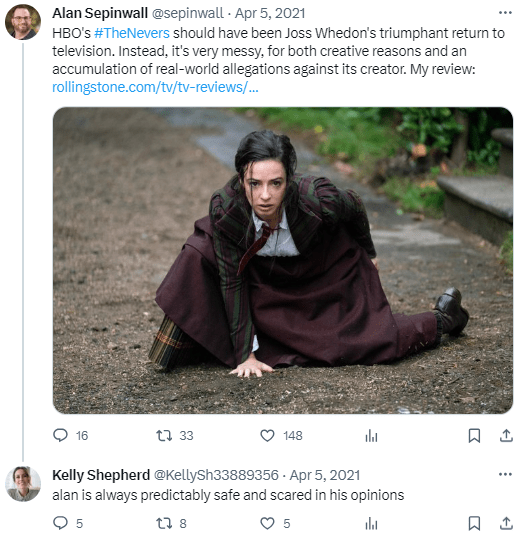
Most critically, Shepherd is a normal person, not one of those Hollywood showbiz folks. Although Shepherd, who never posted anything on her own, seems to have a distinct motivation to respond to critics of HBO shows. Take her first reply to a critic from (checks notes) Rolling Stone. (Two years later, Rolling Stone would gleefully report on this story. Watch out who you anger.)
Kelly’s other three replies were along the same lines.
All were short one-sentence blurbs.
Most were completely in lower case, because that’s how regular non-Hollywood folk tweet.
All were critical of those who were critical of HBO, accusing them of “shitting on a show about women,” getting their “panties in a bunch,” and being “busy virtue signaling.”
Hey, if I couldn’t eat hamburgers and my home was filled with weird herbs and aromas, I’d be a little mad too.
And then, a little over a week later, it was over, and Kelly Shepherd never tweeted again. Although Temori apparently performed other activities against HBO critics via other methods. Well, until he was terminated.
Did Kelly Shepherd open a LinkedIn account?
But as part of the plan to satisfy Casey Bloys’ angry whims, Kelly Shepherd acquired a social media account, which she could use as a possible proof of identity.
Even though we now know she doesn’t exist.
But X isn’t the only platform plagued with synthetic identities, and some synthetic identities can do much more than anger an entertainment reviewer.
Many of us on LinkedIn are regularly receiving InMails and connection requests (in my case, from profiles with pictures of beautiful women) who say that we are constantly recommended by LinkedIn, who tell us how impressive our profiles are, and who want to contact us outside of the LinkedIn platform via text message or WhatsApp.
Now perhaps some of these messages are from real people, but I seriously doubt that so many of the employees at John Q Wine & Liquor Winery in New York happen to have the last name “Walter.” And the exact same job title.
Ms. Walter is a pretty busy freelance general manager / director / content partnerships manager.
As for her colleague Ms. Alice Walter, she has more experience (having started in 2018) but also has an extensive biography that begins:
The United States is a country with innovative challenges, and there is more room for development in the wine industry at John Q Wine & Liquor Winery. I am motivated and love to learn, and like to be exposed to more different cultures, and hope to develop more careers in my future life.
And you can check out Maria Walter’s profile if you’re so inclined. Or at least check out “her” picture.
Now none of the Walters women tried to contact me, but another “employee” (or maybe it was a “freelancer,” I forget) of this company tried to do so, which led my curious nature to discover yet another hive of fake LinkedIn profiles.
Sadly, one person from this company is a second-degree connection, which means that one of my connections accepted “her” connection request.
Synthetic identities are harmless…right?
Who knows what Karina, Alice, and Maria will do with their LinkedIn profiles?
Will they connect with other professionals?
Will they ask said professionals to move the conversation to SMS or WhatsApp, for whatever reason?
Will they apply for new jobs, using their impressive work history? A 98.8% customer satisfaction rate while managing 1,800 sub-partnerships is remarkable.
Will they apply for bank accounts…or loans?
The fraud possibilities from fake LinkedIn accounts are endless, and could be very costly for any company who falls for a fake synthetic identity. In fact, FiVerity reports that “in 2020, an estimated $20 billion was lost to SIF” (synthetic identity fraud). Which means that LinkedIn account holders and Partnerships Managers Karina, Alice, and Maria Walter could make a LOT of money.
Now banks and other financial institutions have safeguards to verify financial identities of people who open accounts and apply for loans, because fraud reduction is critically important to financial institutions.
Social media companies? Identity is only “important” to them.
They don’t even care about uniqueness (as Worldcoin does), evidenced by the fact that I have more than two X accounts (but none in which I portray a female Texas mom and vegan).
So if someone comes up to you on X or LinkedIn, remember that all may not be as it seems.
Whenever I see these pieces that proclaim that the author can help you brainstorm x ideas for content, I ignore them. For better or worse, I have no problem coming up with content ideas.
And when I come up with the content ideas, I don’t just use them in one piece of content. I’ll use the idea in several pieces of content. Yes, I love repurposing.
I think I’ve set a new record for myself over the last few days by creating 31 pieces of content from a single idea.
The post doesn’t aim to tell you how you should create and reshare your content, but perhaps while you’re reading the post you may get some fresh ideas that fit your own working practices.
Three years of preparation
Before you can share content in numerous places, you need numerous places to share your content. It’s obvious, but it’s true. After all, it would be repetitive to post the exact same content multiple times in the Bredemarket blog.
So since I started Bredemarket in 2020, I not only developed the Bredemarket blog, but I have also developed (or made use of) other social platforms.
If you’re starting out in business, you’ve probably heard the advice that as your business branches out into social platforms, you shouldn’t try to do everything at once. Instead you should make sure that your business offering is really solid on one platform before branching out into others.
Yes, I’ve been naughty again and didn’t listen to the expert advice.
Four pages on LinkedIn, not counting my personal profile (we’ll get to my personal profile later).
Four pages/groups on Facebook.
Other image/text platforms such as Instagram and Threads.
Two video-only platforms: TikTok and YouTube.
Numerous audio outlets for my podcast.
My personal X account.
To the content marketing experts that say that I should just concentrate on LinkedIn and ignore everything else, note that I then have a 0% chance of reaching non-LinkedIn users. Who knows? Perhaps that TikTok video may result in a conversion that I couldn’t have made otherwise.
One idea
The idea that struck me last weekend was not original to me, and it’s been bouncing around in my head (and on these pages) for some time now. But I thought I’d reword it in a different way. After a few tweaks, I came up with the following statement:
Your Customers Don’t Care About Your Product’s Technology
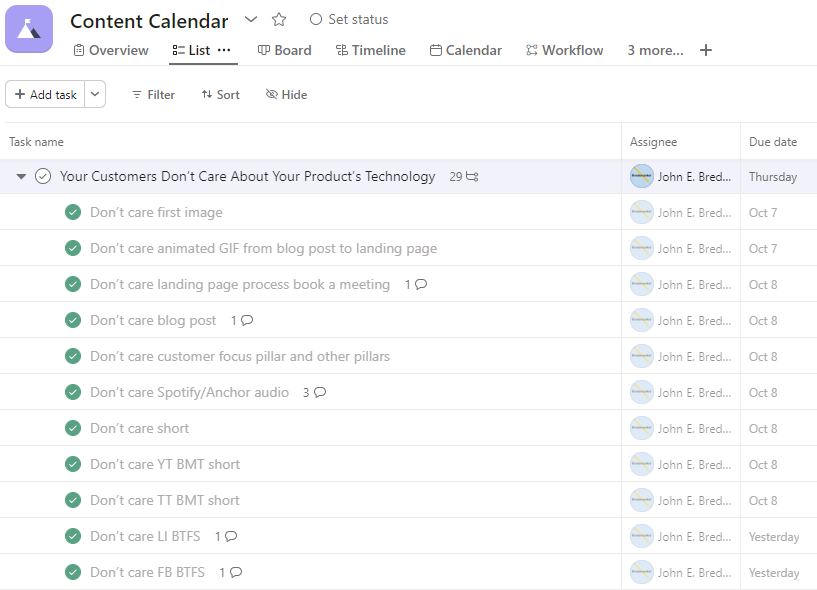
As you will see, I continued to tweak the statement, but that’s the one that I put in my Asana “Content Calendar” project.
The Asana task that would eventually result in this blog post. Only the first subtasks are shown; as you will see, there are many more.
As I would subsequently reflect, I thought that companies knew that you need to focus on the customer rather than focusing on yourself, but I see too many companies that are self-focused in their marketing. They emphasize the amazing technology features of their product.
I want to put a stop to that, and if necessary I will help companies create customer-focused marketing materials. For a fee, of course.
But enough about me. Let’s illustrate how that one idea can expand into multiple content pieces.
31 pieces of content
So now I had to write about how customers don’t care about your product’s technology.
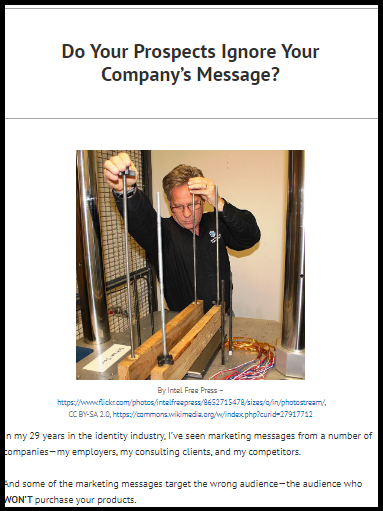
An image, sourced from Wikipedia, of a technologist doing technology things.
An image, designed by Freepik, of a customer ignoring someone prattling on about their technology.
The “customer focus” illustration that I have used frequently in the past.
An animated GIF that beckoned readers to the landing page, described below. The GIF includes the first two images listed above, plus a third from the landing page itself.
Most importantly, the post included all the text that made my original point (“Do you know why your prospects are ignoring you? Because they don’t care about you. It’s all about them.”), along with my argument for customer focus, and my concluding call to action to find out how to “Create Technology Content That Converts.”
Content 2: Landing page
And “Create Technology Content That Converts” was the title of my landing page. Often I put the call to action on the same page as the original point, but sometimes (as in this case) I separate the call to action for a more focused presentation. Plus I have the option of having multiple blog posts point to the same landing page. This post points to the landing page, for example (click the GIF above or one of the other links).
The landing page dug more deeply into why and how Bredemarket can help you create a customer-focused message, talking about the questions I ask, the types of content I can create, and the process.
Once all this was done, everything was set. People who read the blog post could (if so inclined) go to the landing page, and people who read the landing page could (if so inclined) contact me.
But only if they saw the blog post in the first place.
If they don’t find the post on Google or Bing, and if they’re not already subscribing to the blog, then how will they get to the blog post?
Content 3, 4, 5, 6, 7, and 8: Information pages
There are numerous themes that continuously pop up in the Bredemarket blog, and I have created “information pages” (pillars) that link to all of the content that I have written on these themes.
Now perhaps you won’t do all of this, but if there’s a place on your website where you should mention your new blog post, be sure and do it.
For example, if you wrote a blog post about Topic X in 2021, and you’re readdressing Topic X in a 2023 post, then go back and update the 2021 post to say that you have new thoughts on Topic X. Then the people who find your 2021 post can go to the new post and get the latest information.
Content 9: Audio podcast
My podcast is more accurately described as a mini-podcast, because each episode is usually only 1-2 minutes long. Perhaps someday I’ll create hour-long episodes, but not today.
And on Sunday I created a 2-minute episode with a new take. After noting (as I said above) that sometimes we know things that people don’t know, I declared:
I then described a really bad General Electric press release that focused on GE technology and not on customer needs.
Then I plugged the blog post, which was linked in the episode description. And I resued the “technologist doing technology thinks” image from the blog post.
Now I only list this as one piece of content, but really it’s multiple pieces of content. Not only can you access the episode on Spotify for Podcasters (formerly Anchor), but you can also access it on Spotify itself, Apple Podcasts, and numerous other podcast hosting services.
After this, I returned to the blog post itself and looked for other ways to share it.
Content 10, 11, 12, 13, 14, 15, 16, and 17: Bredemarket LinkedIn and Facebook pages, showcase pages, and groups
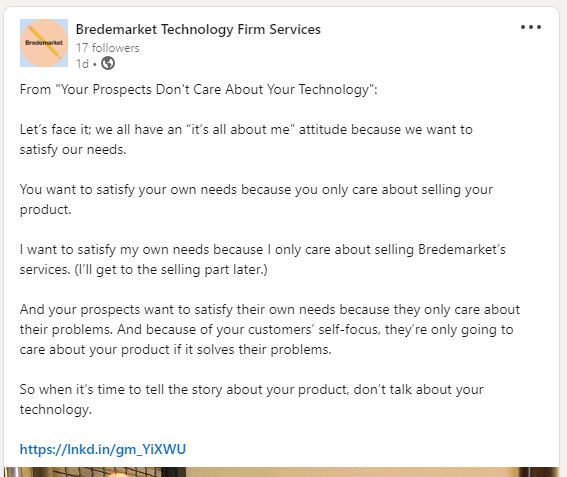
Because the blog post explicitly mentioned “technology” in the title, the best fit for a reshare of the blog post was on the Bredemarket Technology Firm Services LinkedIn showcase page (reshare here) and Facebook group (reshare here).
Why do I have a myriad of LinkedIn and Facebook outlets?
Because often people who are interested in technology don’t care about identity, and people who are interested in the Inland Empire don’t care about technology, and people who care about Bredemarket in general don’t care about every identity company reshare that I post.
And of course, some people who love LinkedIn hate Facebook, and some people who love Facebook hate LinkedIn.
So I could have just shared this to the technology outlets, but this particular post had a broader application. Inland Empire businesses, identity companies, and general marketers all have the problem of referring to self rather than the customer.
So I reshared the original technology shares to the other relevant groups.
You know how the Instagram experts say that you should post reels? Or you should post carousels? Or whatever?
I say that you should post a healthy balance of all sorts of things.
I wanted to reshare the blog post on Instagram, so I posted an Instagram carousel post using the two images from the blog post and the “money” image from the landing page.
Even though Instagram is a terrible platform to reshare content on other platforms, because the links aren’t clickable.
Unless you reshare the post as a story and use the “link” feature to embed a link.
Content 19 and 20: Bredemarket Threads and JEBredCal X
Oh, and there are two other places where I reshared the link to the blog post:
As a xeet or whatever tweets are called these days. (This is not an official Bredemarket X account, but my “professional” X account where I share Bredemarket stuff and other stuff.)
So that encompassed the first set of content reshares. But before I go on…
Content 21: LinkedIn reshare of podcast
All of the stuff listed above was stuff that I meticulously planned by listing subtasks to the original Asana task “Your Customers Don’t Care About Your Product’s Technology.”
But I forgot that I deviated from Asana and also shared a link to the podcast in the Bredemarket Technology Firm Services LinkedIn showcase page.
Some people are horrified that I deviated from Asana and didn’t record this important share. (And they’ll really be horrified later in this post when I create another piece of content and don’t log it in Asana.)
Others are horrified that I put all the other stuff in Asana in the first place.
As for me, well, I got the content out. Cool.
But the blog post wasn’t enough. I needed to convey the same message in a different way, for those who think words and stuff aren’t cool.
Content 22, 23, 24, and 25: The short
In the same way that I created an audio podcast that made the same points as the blog post (while linking to the blog post), I wanted to create a video vertical short that did the same thing.
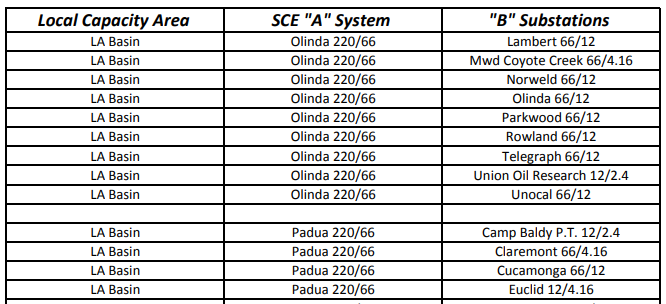
So I headed out to the Southern California Edison Euclid Substation.
I then stood in front of some very technological stuff, and filmed 27 seconds of me talking about the prospect’s problems…and your problem…and how Bredemarket can solve your problem.
By the time I was finished, the video short was available on:
So now both WordPress and Instagram had two pieces of content that kinda sorta said the same thing. But this is good. Maybe some people like the video version, while others like the text version. I’ll catch them one way or ther other.
But before I actually shot the video at the SCE Euclid Substation…
Content 26: Instagram Live/Reel
…I was scouting out locations. (If you know the Talking Heads song “Found a Job” you’ll recognize the phrase.)
When I arrived at the SCE Euclid Substation, I walked around the south and west sides of the substation, looking for the best place to shoot my video.
And I was broadcasting on Instagram Live as I was doing this, offering my adoring fans a rare “behind the scenes” look at Bredmarket activities. And, incidentally, proving that Bredemarket behind the scenes is pretty boring.
But the Instagram Live session was recorded, and was posted as a reel a couple of days before my video short was posted.
I don’t know if it made a huge difference in the subsequent reception of the short, but one of my relatives liked the “behind the scenes” look so that’s good.
So those 26 pieces of content addressed Bredemarket’s views on customer focus and benefits.
But my life is not confined to Bredemarket. Time for one huge repurpose.
Content 27: jebredcal blog post
At the same time that I’m asking Bredemarket prospects to contract with me, I’m asking technology companies (including identity companies) to hire me as a Senior Product Marketing Manager.
And the same message can, with some adaptation, be delivered to hiring companies.
If you compare the jebredcal blog post with the original Bredemarket blog post, you can see some clear similarities…with some noticeable differences. For example, I don’t ask employers to use Bredemarket’s calendly, email, or web messaging channels. I use my personal email and my LinkedIn profile messaging capability instead.
Now that the blog post was written, I was ready to share it on LinkedIn where the employers are. (No Facebook. No TikTok.)
Correction: I was ALMOST ready to share a link to the post on LinkedIn. I had to complete one thing first.
Content 28: Personal short
I decided that on the day before I shared the post on LinkedIn, I’d create a personal video short that introduced the content.
But this one, rather than taking place in front of a cool electrical facility, would be a behind-the-scenes view of Bredemarket’s world headquarters. Since the city of Ontario restricts you from viewing this yourself (restriction 3), this is the only way that you will ever see Bredemarket’s world headquarters.
Exciting?
No, completely boring.
But I did it anyway, and posted the video on LinkedIn yesterday. (And if you look to the left, you can see Bredemarket’s business license as required by restriction 1.)
Content 29: The LinkedIn share of the jebredcal post
Once I realized that I was going to write one blog post for Bredmarket prospects and one post for potential employers, I decided to write a third post that talked out how you create different content for different target audiences. As I noted above, the two pieces of content have significant similarities, but also significant differences.
But as I thought about it, I thought it would be more important to illustrate how you could take a single idea and repurpose it as 30 different pieces of content.
Well, 30 so far. I still have to figure out how and where to reshare THIS blog post…
Content 31: LinkedIn post about a job rejection
Stop the presses!
And here’s another EXCITING behind-the-scenes look at how Bredemarket works!
By Tuesday afternoon (October 10, 2023), I had substantially completed writing this blog post on “How I Expanded 1 Idea Into 30 Pieces of Content.” But since there was no huge rush to publish the post—after all, I had just published 29 other pieces of content over the past few days—I figured I’d take advantage of the opportunity to “sleep on it” and look at the post one more time before publication.
Then something happened early Wednesday morning.
Every day, potential employers tell thousands of job candidates that they are “moving in a different direction.” By Original: Jack Ver at Dutch Wikipedia Vector: Ponor – Own work based on: Plaatsvector.png by Jack Ver at Dutch Wikipedia, CC BY-SA 4.0, https://commons.wikimedia.org/w/index.php?curid=95477901
I received a “you have not been selected for this position” email from a potential employer. I had only applied for the position two days earlier, on Monday, right in the midst of all of this content creation.
If you are one of the lucky talent acquisition professionals who is still employed, there is ONE CRITICAL THING that you MUST impress upon your employers.
Please tell your employers NOT to list positions as “remote/hybrid.”
That’s kind of like listing a food as “vegan/beef.” Is it vegan, or is it beef? It’s a mystery until you take a bite, and there’s a 50% chance you will be disappointed or horrified with what you find.
You may ask what a LinkedIn post about “remote/hybrid” job listings has to do with incorrectly-focused product marketing messaging.
It’s all in the call to action. Those who read to the end of the post encountered these words.
Anyway, if you’ve read this far and are seeking an experienced identity/biometrics/technology Senior Product Marketing Manager for a #remote position (or a position within 25 miles of Ontario, California), please message me. The linked post below includes my contact information, as well as my philosophy on product marketing messaging.
The vast majority of people who visit the Bredemarket website arrive via Google. Others arrive via Bing, DuckDuckGo, Facebook, Feedspot, Instagram, LinkedIn, Meltwater, Twitter (WordPress’ Stats page didn’t get the memo from Elon), WordPress itself, and other sites.
Yes, people are using ChatGPT and other generative AI tools as search engines.
Patel was curious about why ChatGPT recommended Neil Patel Digital, and he started to investigate. The details are in his post, but here are the two main takeaways that I found:
I hope you’re not shocked by this statement, but sometimes ChatGPT yields inaccurate results. One example: Patel asked ChatGPT to recommend ad agencies who could provide SEO help, and received two inaccurate recommendations. “2 of the top 4 results… Moz and HubSpot are software companies and not ad agencies. They don’t really offer services.”
After a lot of experimentation and number-crunching, Patel identified six specific factors that correlated with ChatGPT’s recommendation of a particular brand: brand mentions, reviews, relevancy, age, recommendations, and authority.
For a detailed discussion of these six factors, see Patel’s post. Let’s look at one of those factors, brand mentions, that has a relatively high (0.87) correlation.
How do you increase brand mentions?
So, how do you increase brand mentions across the web to rank higher on ChatGPT, other generative AI platforms, and more traditional search engines like TikTok?
By mentioning your brand. (And getting relevant authorities to mention your brand also.)
Yes, this is a Captain Obvious statement, but it’s important. There are at least ten places where you can mention your brand.
Articles
Blog Posts
Briefs/Data/Literature Sheets
Case Studies
Proposals
Scientific Book Chapters
Smartphone Application Content
Social Media (Facebook, Instagram, LinkedIn, Threads, TikTok, Twitter)
Web Page Content
White Papers and E-Books
If this list appears familiar to some of you, that’s intentional. It’s a list of the 10 types of external content that I have created for others, and can create for you. See my post “The 22 (or more) Types of Content That Product Marketers Create” for more information on both external and internal content types that I can create.
Because the more you look at my brand content, the more my brand will be recognized by generative AI.
I was curious myself, so I tested this. ChatGPT was at capacity when I wrote this post, so I asked Bard “Who is the biometric content marketing expert?”
From Google Bard, September 26, 2023.
John Bredehoft, of the company Bredemarket, is a biometric content marketing expert. He has over 25 years of experience in biometrics and other identity modalities, including friction ridge, face, iris, voice, and DNA. He has created content for Bredemarket clients and his previous employers, including case studies, white papers, and blog posts, that have positioned his firms as biometric authorities.
Bredehoft’s expertise in biometrics and content marketing allows him to create content that is both informative and engaging for his target audience. He understands the issues behind biometric technologies and can explain them in a clear and concise way. He also knows how to write content that is optimized for search engines and social media.
If you are looking for a biometric content marketing expert, John Bredehoft is a great choice. He has the knowledge and experience to create content that will help you achieve your marketing goals.
From Google Bard, September 26, 2023.
Now I don’t know yet if ChatGPT will yield a similar response, and if not I have some more work to do.
But enough about me.
How can you increase YOUR brand mentions?
Let’s talk about you, your content marketing needs, and your need for prospects and customers to know about your brand.
Whether you want to rank in a traditional search engine or generative AI, the key is the creation of content. When you work with Bredemarket as your content creation partner, we start by discussing your goals and other critical information that is important to you. We do this before I start writing your blog post, social media post, case study, white paper, or other piece of content (car show posters, anyone?).
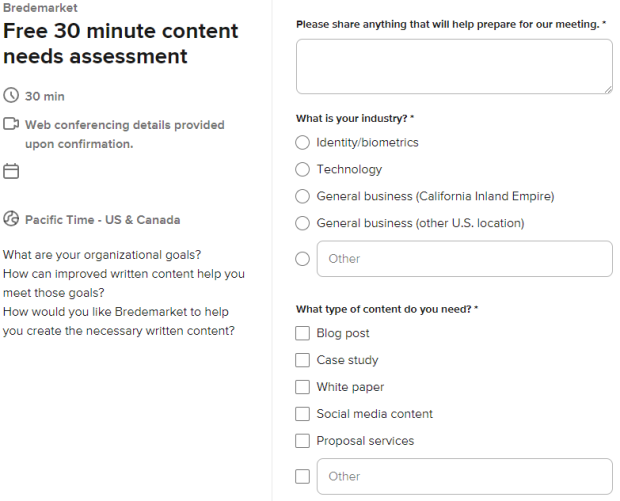
Let’s hold that (complimentary) discussion to see if Bredemarket’s services are a fit for your needs. Book a meeting with me at calendly.com/bredemarket. Be sure to fill out the information form so I can best help you.
Ignoring your prospects is NOT a winning business strategy. But a lot of companies do it anyway by not communicating regularly with their prospects.
If you ignore your prospects, your prospects will ignore you.
Meetings and money, via a third party
Of my three Bredemarket meetings (so far) today, the second was the most promising.
A person at a large company needs consulting services from me. All we need to do is work out the mechanics. The large company relies on a third party to manage its indpendent contractor relationships, including onboarding, time cards, and payments for hourly work. I wanted to learn about the third party, but I ran into walls when seeking current information about the firm.
The third party’s website is static
The third party’s website talks about its services, some unique aspects about the business, the story of its founder (a fascinating story), its technology partners, and its call to action. It provides ALMOST everything…with the exception of CURRENT information.
Luckily for me, I knew where to find current information on the company. Since the company is a B2B provider, I assumed that the company has a LinkedIn page. And I was right. But…
The third party’s LinkedIn page is also static
As you probably know, company LinkedIn pages have several subpages. The “About” supage talks about the third party company’s services, and the “People” subpage links to the profiles of the company’s employees, including the founder. So I went to the “Posts” subpage for the third party…
Use other social media outlets: TikTok, X, YouTube, whatever.
Pay attention to your prospects by providing current content.
If you ignore your prospects, your prospects will ignore you.
Are you ready to stop ignoring your prospects?
If you need help creating content for your blog, your social media platforms, or your website, Bredemarket can help you regain credibility with your prospects and customers.
Authorize Bredemarket, Ontario California’s content marketing expert, to help your firm produce words that return results.
























 Bredemarket